Overview
Matching premise strength is a critical skill within the parallel reasoning question type on the LSAT's logical reasoning section. This concept requires test-takers to evaluate not just the logical structure of an argument, but also the degree of support that premises provide to their conclusions. When the LSAT asks you to identify a parallel argument, you must ensure that the answer choice mirrors both the logical form AND the strength of reasoning present in the original stimulus.
Understanding premise strength is essential because the LSAT frequently includes trap answers that match the logical structure but fail to replicate the degree of certainty, probability, or support expressed in the original argument. For instance, if the stimulus presents a strong causal claim based on definitive evidence, the correct parallel must also present a strong causal claim with similarly definitive support—not a weak suggestion based on mere possibility. This distinction separates high scorers from average performers, as recognizing these nuances requires sophisticated analytical skills.
Within the broader landscape of Logical Reasoning, matching premise strength connects directly to argument evaluation, conditional reasoning, and causal reasoning. It demands that students move beyond surface-level pattern recognition to assess the qualitative nature of logical relationships. This skill also reinforces understanding of how evidence types (statistical, anecdotal, expert testimony, etc.) create different levels of argumentative force. Mastering this topic will enhance performance not only on parallel reasoning questions but also on strengthen/weaken questions, assumption questions, and flaw questions where premise strength plays a crucial role.
Learning Objectives
- [ ] Identify how matching premise strength appears in LSAT questions
- [ ] Explain the reasoning pattern behind matching premise strength
- [ ] Apply matching premise strength to solve LSAT-style problems accurately
- [ ] Distinguish between arguments with strong versus weak premise support
- [ ] Evaluate whether answer choices maintain the same degree of certainty as the stimulus
- [ ] Recognize common traps where logical structure matches but premise strength differs
- [ ] Analyze the relationship between evidence type and argumentative force in parallel reasoning contexts
Prerequisites
- Basic argument structure: Understanding premises, conclusions, and how they connect is fundamental to evaluating whether parallel arguments maintain equivalent support levels.
- Conditional reasoning fundamentals: Recognizing sufficient and necessary conditions helps identify when premise strength involves certainty versus probability.
- Causal reasoning basics: Distinguishing between strong causal claims and weak correlations is essential for matching the force of causal arguments.
- Argument forms: Familiarity with common logical patterns (modus ponens, modus tollens, analogical reasoning) provides the foundation for recognizing when structure is preserved but strength varies.
Why This Topic Matters
In real-world contexts, matching premise strength reflects the critical thinking skills lawyers must employ daily. Legal arguments require precise calibration of evidentiary support—distinguishing between proof beyond reasonable doubt, preponderance of evidence, and mere speculation. Attorneys must recognize when opposing counsel presents structurally similar arguments with fundamentally different levels of support, and they must construct parallel cases that maintain equivalent argumentative force.
On the LSAT, parallel reasoning questions appear in approximately 2-3 questions per Logical Reasoning section, making them a consistent presence on every exam. Among these, lsat matching premise strength considerations affect the majority of parallel reasoning questions, as the test-makers deliberately craft wrong answers that match structure but not strength. This topic also indirectly impacts performance on approximately 15-20% of all Logical Reasoning questions, as premise strength evaluation appears in strengthen/weaken questions, necessary assumption questions, and method of reasoning questions.
Common manifestations include: arguments moving from statistical evidence to probabilistic conclusions (where parallel answers must maintain similar statistical strength), arguments using definitive language ("must," "certainly," "proves") that require equally definitive parallels, arguments based on analogies where the strength of similarity must match, and arguments presenting multiple premises where the cumulative support level must be equivalent. The LSAT also frequently tests whether students can distinguish between arguments that establish possibility versus probability versus certainty—a distinction that hinges entirely on premise strength rather than logical form.
Core Concepts
Understanding Premise Strength
Premise strength refers to the degree of support that premises provide to a conclusion. This concept encompasses both the quality of evidence presented and the force of the logical connection between premises and conclusion. In parallel reasoning questions, matching this strength means ensuring that if the original argument's premises strongly support its conclusion, the parallel argument's premises must provide equally strong support—not merely similar logical structure.
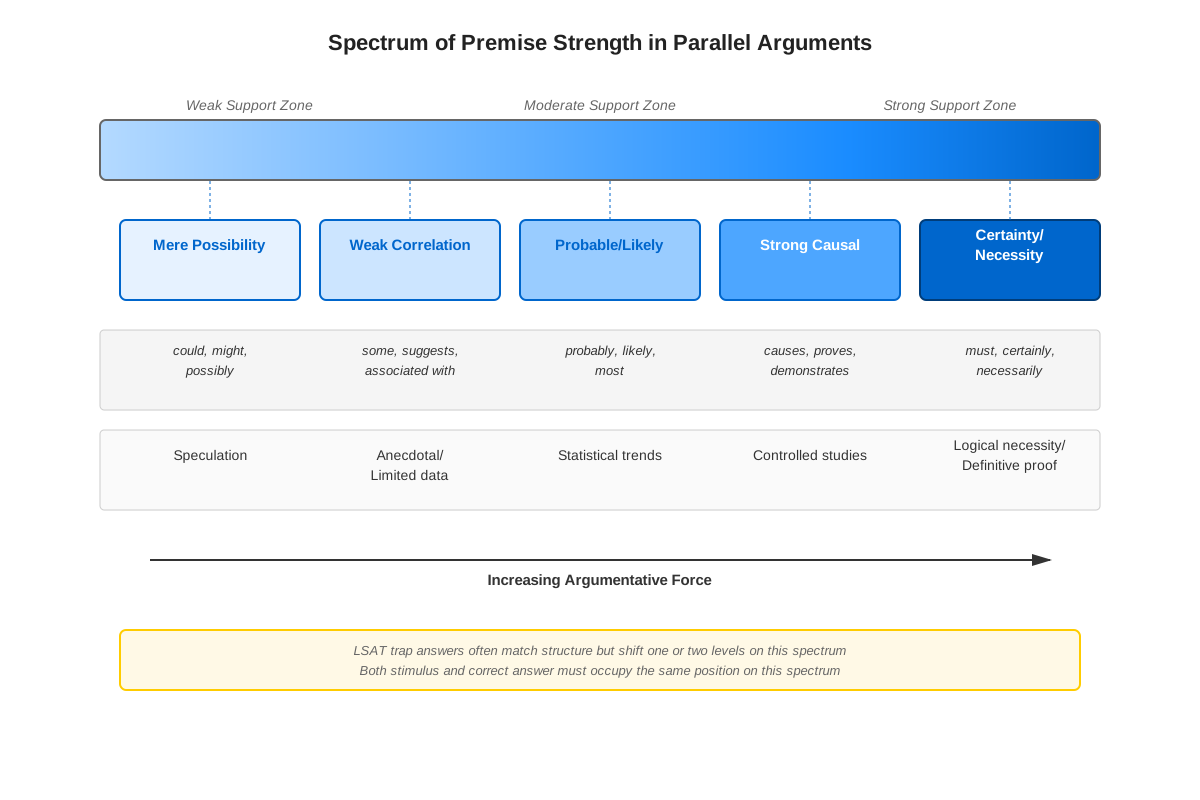
Premise strength exists on a spectrum from weak to strong. Weak premises might suggest possibility ("could be," "might," "it's conceivable that"), moderate premises indicate probability ("likely," "probably," "tends to"), and strong premises assert certainty ("must," "definitely," "proves conclusively"). The LSAT tests whether students recognize these gradations and can match them precisely.
Types of Premise Strength
Different evidence types create different strength levels. Statistical evidence with large sample sizes and rigorous methodology provides stronger support than anecdotal evidence. Expert testimony from recognized authorities carries more weight than lay opinions. Direct causal evidence (controlled experiments demonstrating mechanism) supports conclusions more strongly than correlational evidence (observed associations without established causation).
Consider these strength categories:
| Strength Level | Indicators | Example Language |
|---|---|---|
| Certainty | Definitive proof, logical necessity | "must be," "proves," "establishes conclusively" |
| High Probability | Strong statistical evidence, expert consensus | "almost certainly," "very likely," "strongly indicates" |
| Moderate Probability | Reasonable evidence, typical patterns | "probably," "suggests," "tends to show" |
| Possibility | Weak evidence, mere consistency | "could be," "might," "is consistent with" |
| Speculation | No real evidence, pure conjecture | "perhaps," "conceivably," "one might imagine" |
Matching Strength in Parallel Arguments
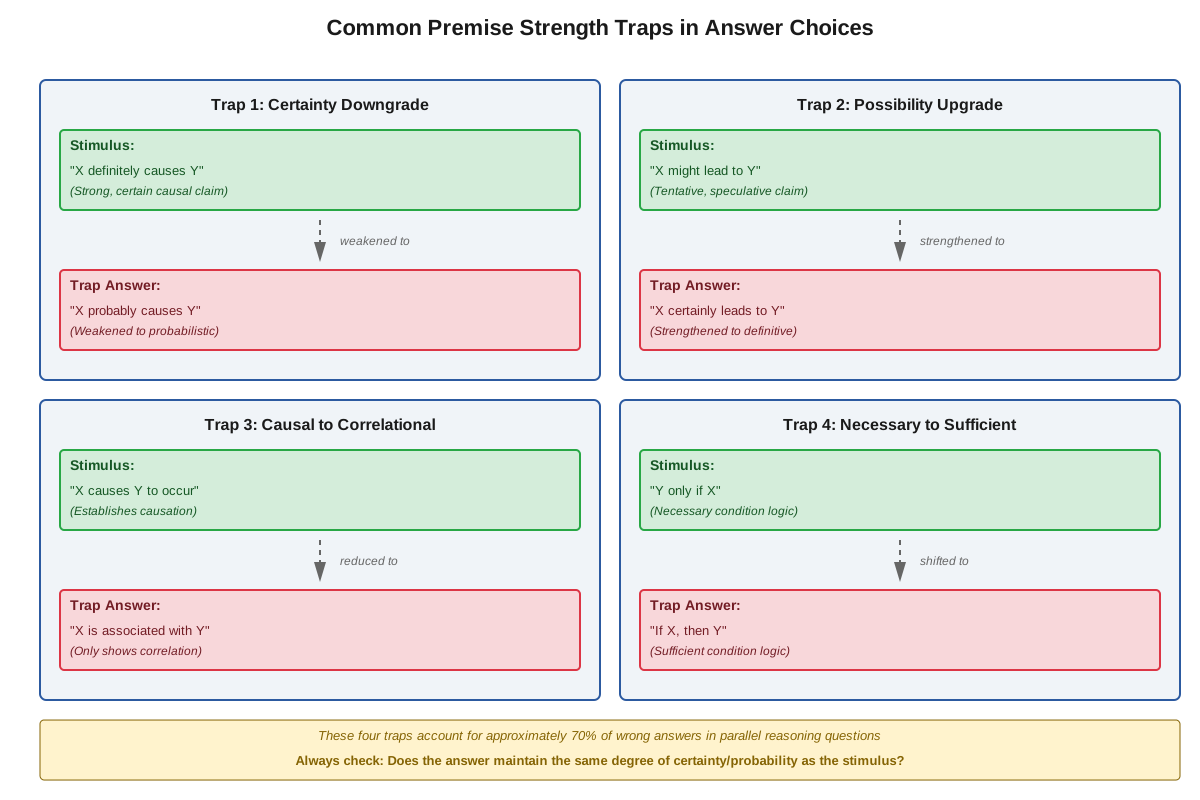
When the LSAT asks for a parallel argument, the correct answer must replicate three elements: (1) logical structure, (2) premise strength, and (3) conclusion strength. Many trap answers match elements 1 and 3 while failing on element 2. For example:
Stimulus: "Every observed swan has been white. Therefore, all swans are white."
- Structure: Universal generalization from observed sample
- Premise strength: Complete uniformity in observations (strong inductive support)
- Conclusion strength: Universal claim
Trap Answer: "Some observed ravens have been black. Therefore, all ravens are black."
- Structure: Universal generalization from observed sample ✓
- Premise strength: Partial observation only (weak inductive support) ✗
- Conclusion strength: Universal claim ✓
The trap fails because "some" creates weaker premise support than "every," even though the logical form (generalization from sample to population) remains identical.
Quantitative vs. Qualitative Strength
Premise strength can be quantitative (based on numbers, frequencies, or proportions) or qualitative (based on the nature of evidence or reasoning). Quantitative strength involves how much evidence exists: "90% of cases" provides stronger support than "a few cases." Qualitative strength involves evidence type: direct observation provides stronger support than hearsay, regardless of quantity.
Parallel reasoning questions require matching both dimensions. If the stimulus uses strong quantitative evidence ("the vast majority") and high-quality evidence (controlled studies), the parallel must do likewise—not substitute weak quantitative evidence ("several instances") or low-quality evidence (anecdotal reports).
Conditional Strength and Modality
Arguments involving conditional statements carry different strengths based on their modality—whether they express necessity, sufficiency, or mere correlation. "If A, then B must occur" expresses stronger support than "If A, then B might occur." When matching parallel reasoning, the modal strength must align.
Similarly, the strength of conditional premises themselves varies. "Whenever A occurs, B always follows" provides stronger support for causal claims than "When A occurs, B sometimes follows." The LSAT tests whether students recognize that parallel arguments must maintain equivalent conditional strength, not just equivalent conditional structure.
Cumulative Premise Strength
Some arguments derive their strength from multiple premises working together. The cumulative effect of several moderate premises might create strong overall support. When matching such arguments, the parallel must present a similar number of premises with similar individual and cumulative strength.
For example, an argument presenting three independent lines of evidence, each moderately supporting the conclusion, requires a parallel with three comparably strong independent lines—not one very strong line or five weak lines. The distribution of support matters as much as the total amount.
Concept Relationships
The concepts within matching premise strength form an interconnected system. Understanding premise strength types (statistical, expert, causal) enables recognition of quantitative versus qualitative strength, which together determine whether premises provide certainty, probability, or mere possibility. This strength assessment then guides evaluation of whether parallel arguments truly match the original's support level.
Conditional strength and modality connects to premise strength through the degree of necessity expressed in conditional relationships. Strong conditionals ("must") create stronger premise support than weak conditionals ("might"), affecting overall argument strength. This relationship flows into cumulative premise strength, where multiple conditional or non-conditional premises combine to create the total support level.
The topic connects to prerequisite knowledge as follows: Basic argument structure → provides framework for identifying premises and conclusions → enables premise strength evaluation → which combines with logical form recognition → to achieve complete parallel reasoning matching. Understanding causal reasoning enhances ability to assess whether causal premises provide strong or weak support, while conditional reasoning knowledge enables evaluation of modal strength in conditional arguments.
Within the broader Logical Reasoning curriculum, matching premise strength supports performance on strengthen/weaken questions (by clarifying what makes evidence strong or weak), assumption questions (by revealing gaps between premise strength and conclusion strength), and flaw questions (by exposing when conclusions overreach premise support).
High-Yield Facts
- ⭐ Parallel reasoning questions require matching both logical structure AND premise strength; structure alone is insufficient
- ⭐ The LSAT frequently includes trap answers that match structure but use weaker or stronger premises than the stimulus
- ⭐ Quantifiers like "all," "most," "some," and "few" directly affect premise strength and must match in parallel arguments
- ⭐ Modal terms ("must," "probably," "might," "could") indicate different strength levels and must be replicated in correct parallels
- ⭐ Statistical evidence strength depends on sample size, methodology, and representativeness—all factors that must align in parallel arguments
- Arguments moving from "every observed case" to universal conclusions require parallels with equally comprehensive observations, not partial samples
- Causal arguments based on controlled experiments provide stronger support than those based on mere correlation; parallels must match this distinction
- Expert testimony strength varies with expert qualifications; parallels must use comparably credible sources
- Multiple weak premises do not equal one strong premise; the number and individual strength of premises must match
- Conditional arguments expressing necessity ("if A, then B must occur") require parallels with equal modal force, not weaker conditionals
- Analogical arguments derive strength from similarity degree; parallels must present comparably strong analogies
- Temporal or frequency indicators ("always," "usually," "sometimes," "rarely") affect premise strength and must be matched precisely
Quick check — test yourself on Matching premise strength so far.
Try Flashcards →Common Misconceptions
Misconception: If two arguments have the same logical structure, they are parallel regardless of premise strength.
Correction: True parallel reasoning requires matching both structure and strength. An argument concluding "X must be true" based on definitive evidence is not parallel to one concluding "X must be true" based on weak speculation, even if both use the same logical form. The LSAT specifically tests this distinction.
Misconception: Stronger premises in an answer choice make it a better parallel than the stimulus.
Correction: The parallel must match the stimulus's premise strength, not exceed it. If the stimulus uses moderate evidence to reach a probable conclusion, an answer using definitive evidence to reach a certain conclusion fails to parallel the original, even if it seems like a "better" argument. Matching means equivalence, not improvement.
Misconception: Only the conclusion's strength matters for parallel reasoning; premise strength is secondary.
Correction: Premise strength and conclusion strength must both match the stimulus. A conclusion's appropriateness depends on premise strength—a certain conclusion requires strong premises, while a probable conclusion fits moderate premises. Mismatched premise-conclusion strength ratios break the parallel.
Misconception: Qualitative differences in evidence type don't matter as long as the quantity of evidence matches.
Correction: Both qualitative and quantitative aspects of premise strength must align. An argument based on three controlled experiments is not parallel to one based on three anecdotal reports, even though both cite three pieces of evidence. Evidence quality affects support strength independently of quantity.
Misconception: In arguments with multiple premises, only the total cumulative strength needs to match, not individual premise strengths.
Correction: The distribution of strength across premises matters. An argument with three moderately strong premises is not parallel to one with one very strong premise and two weak premises, even if the cumulative support seems similar. The pattern of support must match.
Worked Examples
Example 1: Matching Statistical Strength
Stimulus: "In a comprehensive study of 10,000 patients, 95% of those who took medication X recovered from disease Y within one week. Therefore, medication X is highly effective at treating disease Y."
Analysis:
- Logical structure: Statistical evidence → evaluative conclusion about effectiveness
- Premise strength: Very strong (large sample, high percentage, specific timeframe)
- Conclusion strength: Strong claim ("highly effective")
- Evidence type: Quantitative, statistical, large-scale study
Answer Choice A: "In a small survey of 50 people, 60% of those who used product Z reported satisfaction. Therefore, product Z is highly effective."
- Structure matches ✓
- Premise strength: Weak (small sample, moderate percentage, subjective measure) ✗
- Fails to match: Sample size dramatically smaller (50 vs. 10,000), percentage much lower (60% vs. 95%), and "reported satisfaction" is weaker evidence than objective recovery
Answer Choice B: "In a comprehensive analysis of 12,000 vehicles, 94% of those equipped with safety feature W avoided accidents in crash scenarios. Therefore, safety feature W is highly effective at preventing accidents."
- Structure matches ✓
- Premise strength: Very strong (large sample, high percentage, specific outcome) ✓
- Conclusion strength: Strong claim matches ✓
- Evidence type: Quantitative, statistical, large-scale study ✓
Correct Answer: B maintains equivalent premise strength through comparable sample size, percentage, and evidence quality.
Example 2: Matching Modal and Conditional Strength
Stimulus: "Whenever the temperature drops below freezing, the lake's surface must freeze. The temperature dropped below freezing last night. Therefore, the lake's surface must have frozen."
Analysis:
- Logical structure: Universal conditional (sufficient condition) + condition satisfied → necessary consequence
- Premise strength: Absolute ("whenever," "must") indicating certainty, not probability
- Conclusion strength: Certain ("must have")
- Modal force: Necessity throughout
Answer Choice A: "When it rains heavily, the river usually floods. It rained heavily yesterday. Therefore, the river probably flooded."
- Structure matches (conditional + condition satisfied → consequence) ✓
- Premise strength: Probabilistic ("usually") not absolute ✗
- Conclusion strength: Probable ("probably") not certain ✗
- Fails to match: Modal force is weaker throughout; "usually" and "probably" don't parallel "must" and "whenever"
Answer Choice B: "Whenever the alarm sounds, the building must be evacuated. The alarm sounded this morning. Therefore, the building must have been evacuated."
- Structure matches ✓
- Premise strength: Absolute ("whenever," "must") ✓
- Conclusion strength: Certain ("must have") ✓
- Modal force: Necessity throughout ✓
Correct Answer: B preserves the absolute, certain nature of the conditional relationship and conclusion, matching the stimulus's strong modal force rather than weakening it to probability.
Exam Strategy
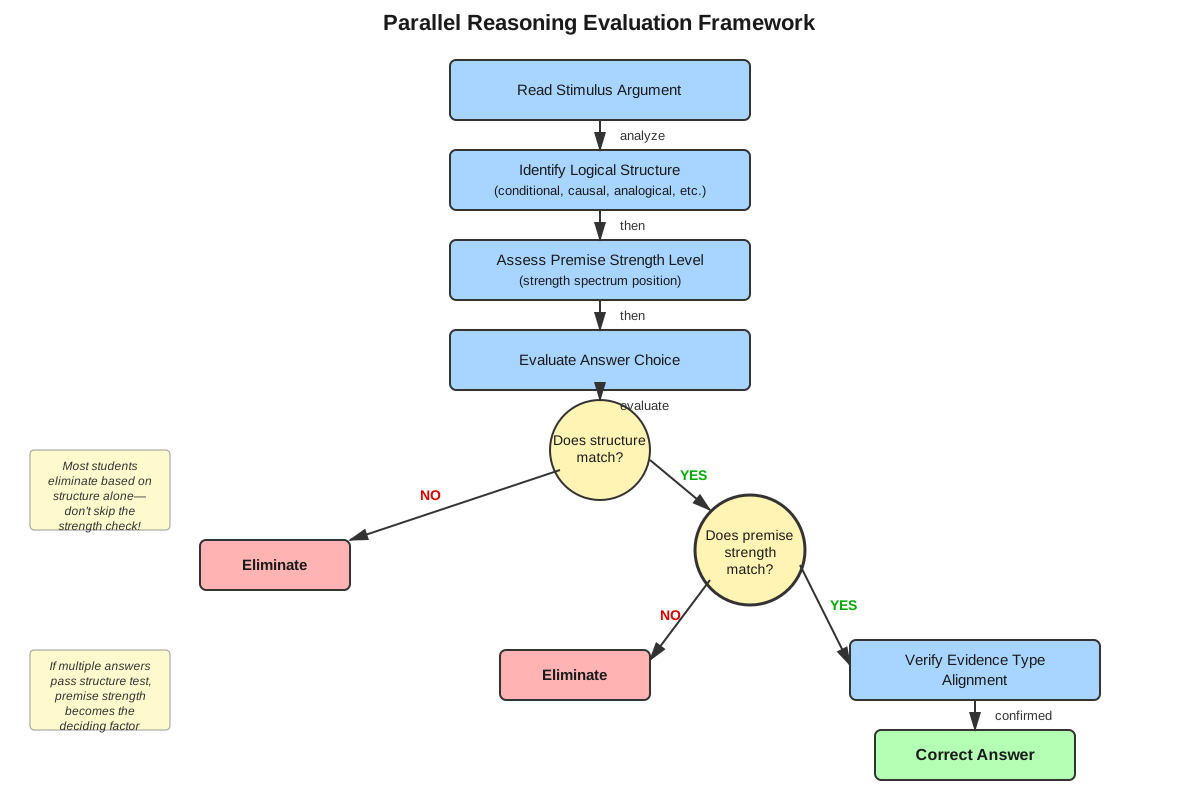
When approaching parallel reasoning questions involving premise strength, follow this systematic process:
Step 1: Analyze the stimulus's premise strength before examining answer choices. Identify specific strength indicators: quantifiers (all, most, some), modal terms (must, probably, might), evidence type (statistical, anecdotal, expert), and sample characteristics (size, quality, representativeness). Note these explicitly.
Step 2: Create a strength profile. Mentally categorize the stimulus as using certainty-level, high-probability, moderate-probability, or possibility-level premises. This profile becomes your matching template.
Step 3: Eliminate answers with mismatched strength immediately. Don't waste time fully analyzing an answer choice's logical structure if its premise strength clearly differs from the stimulus. A quick scan for strength indicators enables rapid elimination.
Exam Tip: Trigger words for strong premises include "all," "every," "always," "must," "proves," "establishes," "definitely," and "certainly." Trigger words for weak premises include "some," "might," "could," "possibly," "suggests," and "is consistent with." Mismatches in these terms between stimulus and answer choice signal incorrect parallels.
Step 4: Watch for the "stronger premise trap." The LSAT frequently includes answers that improve upon the stimulus's argument by using stronger premises or better evidence. Remember: you're matching, not improving. An answer with better reasoning is wrong if it doesn't match the original's strength level.
Step 5: Verify both individual and cumulative strength. For arguments with multiple premises, ensure each premise's strength matches and that the combined support level aligns. Don't accept answers where one very strong premise replaces several moderate ones.
Time allocation: Spend 15-20 seconds analyzing the stimulus's premise strength before examining answers. This upfront investment saves time by enabling rapid elimination. Parallel reasoning questions typically warrant 90-120 seconds total; premise strength analysis should constitute about 20% of that time.
Process of elimination: Eliminate answers with mismatched quantifiers first (fastest elimination), then mismatched modal terms, then mismatched evidence types. This sequence moves from most obvious to most subtle strength differences, maximizing efficiency.
Memory Techniques
MATCH acronym for parallel reasoning premise strength:
- Modal terms must align (must/probably/might)
- Amount of evidence must be equivalent (sample sizes, number of premises)
- Type of evidence must be similar (statistical/expert/anecdotal)
- Certainty level must match (definite/probable/possible)
- How strong each premise is individually must correspond
Strength Spectrum Visualization: Picture a horizontal line with five points labeled "Speculation—Possibility—Probability—High Probability—Certainty." When analyzing the stimulus, place a mental marker on this line. The correct parallel must place its marker at the same position.
The "Goldilocks Principle": Just as Goldilocks needed porridge that was "just right" (not too hot, not too cold), parallel reasoning needs premise strength that's "just right"—not too strong, not too weak, but matching exactly. This reminds you that both stronger and weaker premises create incorrect parallels.
Quantifier Hierarchy Mnemonic: "All Mammals Sometimes Nibble Food" represents the strength hierarchy: All (strongest) → Most → Some → Nearly none → Few (weakest). Parallel arguments must use quantifiers at the same hierarchy level.
Summary
Matching premise strength is a sophisticated skill that separates high LSAT scorers from average performers on parallel reasoning questions. This concept requires evaluating not just whether arguments share logical structure, but whether their premises provide equivalent degrees of support to their conclusions. Premise strength encompasses quantitative factors (sample size, frequency, proportion), qualitative factors (evidence type, source credibility), and modal factors (certainty versus probability versus possibility). The LSAT systematically tests whether students can distinguish between arguments that match structure but differ in strength, often through trap answers that use weaker quantifiers, less definitive modal terms, or lower-quality evidence than the stimulus. Success requires analyzing the stimulus's strength profile before examining answers, recognizing strength indicators like quantifiers and modal terms, and eliminating mismatches systematically. This skill connects to broader Logical Reasoning competencies including argument evaluation, evidence assessment, and conditional reasoning, while directly impacting performance on 2-3 questions per section and indirectly enhancing performance on strengthen/weaken and assumption questions.
Key Takeaways
- Parallel reasoning requires matching both logical structure AND premise strength; structure alone is insufficient for correct answers
- Premise strength exists on a spectrum from speculation to certainty, determined by quantifiers, modal terms, evidence type, and sample characteristics
- The LSAT's most common trap answers match structure but use weaker or stronger premises than the stimulus
- Quantifiers (all/most/some) and modal terms (must/probably/might) are high-yield indicators of premise strength that must align between stimulus and correct answer
- Both individual premise strength and cumulative support level must match in parallel arguments with multiple premises
- Stronger premises don't make better parallels—matching means equivalence, not improvement
- Systematic analysis of the stimulus's strength profile before examining answers enables rapid, accurate elimination of mismatched choices
Related Topics
Parallel Reasoning - Matching Logical Structure: While this guide focuses on premise strength, parallel reasoning also requires matching the formal logical structure of arguments. Mastering premise strength enables you to distinguish between answers that match structure but not strength versus those that match both.
Strengthen and Weaken Questions: Understanding premise strength directly enhances performance on strengthen/weaken questions, where you must identify what makes evidence more or less supportive of conclusions. The strength evaluation skills developed here transfer directly to assessing answer choices in these question types.
Necessary Assumption Questions: These questions often hinge on gaps between premise strength and conclusion strength. Recognizing when conclusions overreach premise support—a skill developed through matching premise strength—is essential for identifying necessary assumptions.
Flaw Questions: Many logical flaws involve mismatches between premise strength and conclusion strength (overgeneralization, hasty generalization, weak analogy). The analytical framework for evaluating premise strength applies directly to identifying these flaws.
Conditional Reasoning - Advanced Applications: Modal strength in conditional statements (must versus might) represents an advanced application of premise strength concepts. Mastering this topic provides foundation for more sophisticated conditional reasoning analysis.
Practice CTA
Now that you understand the principles of matching premise strength, it's time to apply these concepts to actual LSAT questions. The practice questions and flashcards will challenge you to identify strength indicators, distinguish between matched and mismatched parallels, and develop the rapid analysis skills necessary for test-day success. Remember: recognizing premise strength is a learnable skill that improves dramatically with deliberate practice. Each practice question you analyze strengthens your ability to spot strength mismatches quickly and confidently. Approach the practice materials systematically, using the MATCH acronym and strength spectrum visualization techniques you've learned. Your investment in mastering this high-yield topic will pay dividends across multiple Logical Reasoning question types!
Sign up free to keep reading
Create a free AnvayaPrep account to finish this LSAT guide on Matching premise strength — plus flashcards and practice questions.