Overview
Matching quantifier structure is a critical skill within the parallel reasoning section of LSAT logical reasoning questions. This concept requires test-takers to identify and match the logical structure of arguments, with particular attention to the quantifiers used—words like "all," "some," "most," "none," and "few" that specify the scope and extent of claims. When the LSAT asks you to find an argument that parallels another, you must ensure that not only the logical form matches, but also that the quantifier relationships remain consistent between the original argument and the correct answer choice.
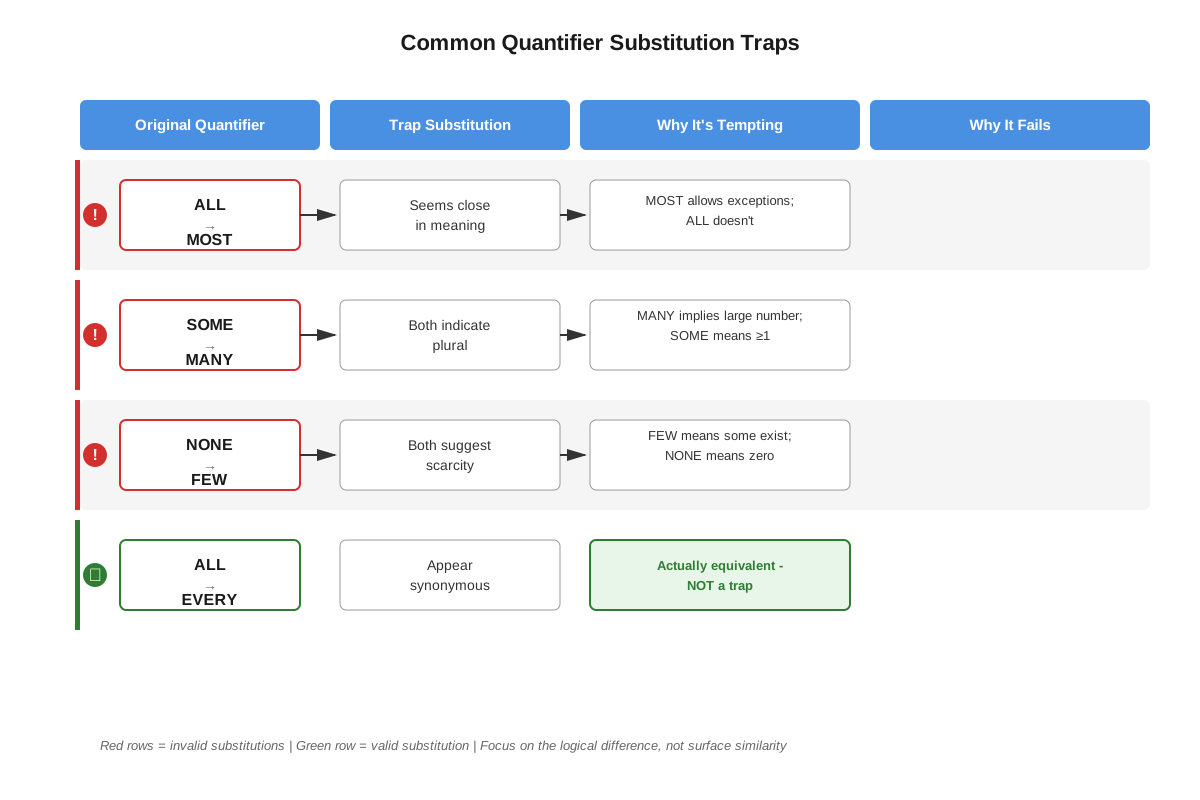
Understanding lsat matching quantifier structure is essential because parallel reasoning questions appear regularly on every LSAT administration, typically comprising 2-4 questions per test. These questions test your ability to abstract the logical skeleton of an argument from its content, focusing on the formal relationships between premises and conclusions. A common trap in these questions involves answer choices that discuss similar subject matter but employ different quantifier structures—for example, an original argument using "all" being matched with an answer choice using "most." Such subtle shifts fundamentally alter the logical validity of an argument, making what appears superficially similar actually logically distinct.
The relationship between matching quantifier structure and broader logical reasoning concepts is foundational. This skill builds upon understanding basic logical operators, conditional reasoning, and argument structure analysis. It connects directly to formal logic principles while also requiring the practical ability to recognize patterns quickly under timed conditions. Mastery of quantifier matching enhances performance not only on parallel reasoning questions but also strengthens skills needed for sufficient/necessary condition questions, strengthen/weaken questions, and logical flaw identification—making this a high-leverage topic for overall LSAT success.
Learning Objectives
- [ ] Identify how matching quantifier structure appears in LSAT questions
- [ ] Explain the reasoning pattern behind matching quantifier structure
- [ ] Apply matching quantifier structure to solve LSAT-style problems accurately
- [ ] Distinguish between different types of quantifiers and their logical implications
- [ ] Recognize when quantifier mismatches invalidate parallel reasoning answer choices
- [ ] Construct abstract representations of arguments that preserve quantifier relationships
- [ ] Evaluate multiple answer choices efficiently by comparing quantifier structures first
Prerequisites
- Basic logical operators and connectives: Understanding "and," "or," "if-then," and "not" is essential because quantifiers work in conjunction with these operators to create complete logical statements.
- Argument structure identification: Recognizing premises, conclusions, and intermediate steps allows students to map where quantifiers function within an argument's logical flow.
- Conditional reasoning fundamentals: Many quantified statements can be expressed as conditional relationships, and understanding this connection helps in recognizing structural parallels.
- Categorical logic basics: Familiarity with how categories relate (subset, overlap, exclusion) provides the foundation for understanding what quantifiers actually express about group relationships.
Why This Topic Matters
In real-world contexts, quantifier precision determines the validity of arguments in legal reasoning, policy analysis, scientific claims, and everyday decision-making. Attorneys must distinguish between "all defendants" and "some defendants" when applying legal precedents. Policymakers must understand whether a regulation affects "most" or "all" businesses in a sector. The ability to recognize and preserve quantifier structure ensures logical rigor in professional reasoning.
On the LSAT specifically, parallel reasoning questions appear with high frequency—typically 2-4 questions per test, representing approximately 8-16% of the Logical Reasoning section. These questions carry the same weight as any other Logical Reasoning question, making them significant contributors to your overall score. According to LSAC data, parallel reasoning questions have moderate difficulty ratings, with approximately 55-65% of test-takers answering them correctly, meaning they offer excellent opportunities for prepared students to gain competitive advantages.
Matching quantifier structure appears in LSAT questions in several distinct ways. Most commonly, it appears in explicit parallel reasoning questions that ask "Which one of the following exhibits a pattern of reasoning most similar to that in the argument above?" Additionally, this skill applies to parallel flaw questions, where you must match both the logical structure and the type of error. Less obviously, quantifier matching appears in principle questions where you must apply a general rule (often quantified) to specific situations, and in method of reasoning questions where you must identify the argumentative technique employed.
Core Concepts
Understanding Quantifiers in Logical Arguments
Quantifiers are linguistic elements that specify the quantity or scope of a claim about a category or group. In formal logic and LSAT arguments, quantifiers determine how many members of a set possess a particular property or stand in a particular relationship. The primary quantifiers encountered on the LSAT include:
- Universal affirmative ("all," "every," "any"): Indicates that a property applies to 100% of the category
- Universal negative ("no," "none"): Indicates that a property applies to 0% of the category
- Particular affirmative ("some," "at least one"): Indicates that a property applies to at least one member, possibly more
- Majority quantifiers ("most," "majority"): Indicates that a property applies to more than 50% of the category
- Minority quantifiers ("few," "several"): Indicates that a property applies to a small but non-zero portion
The logical strength of these quantifiers varies significantly. "All" makes the strongest positive claim, "most" makes a weaker but still substantial claim, and "some" makes the weakest positive claim. Understanding these gradations is crucial because substituting one quantifier for another changes the logical force of an argument and can transform a valid argument into an invalid one.
Quantifier Structure in Argument Patterns
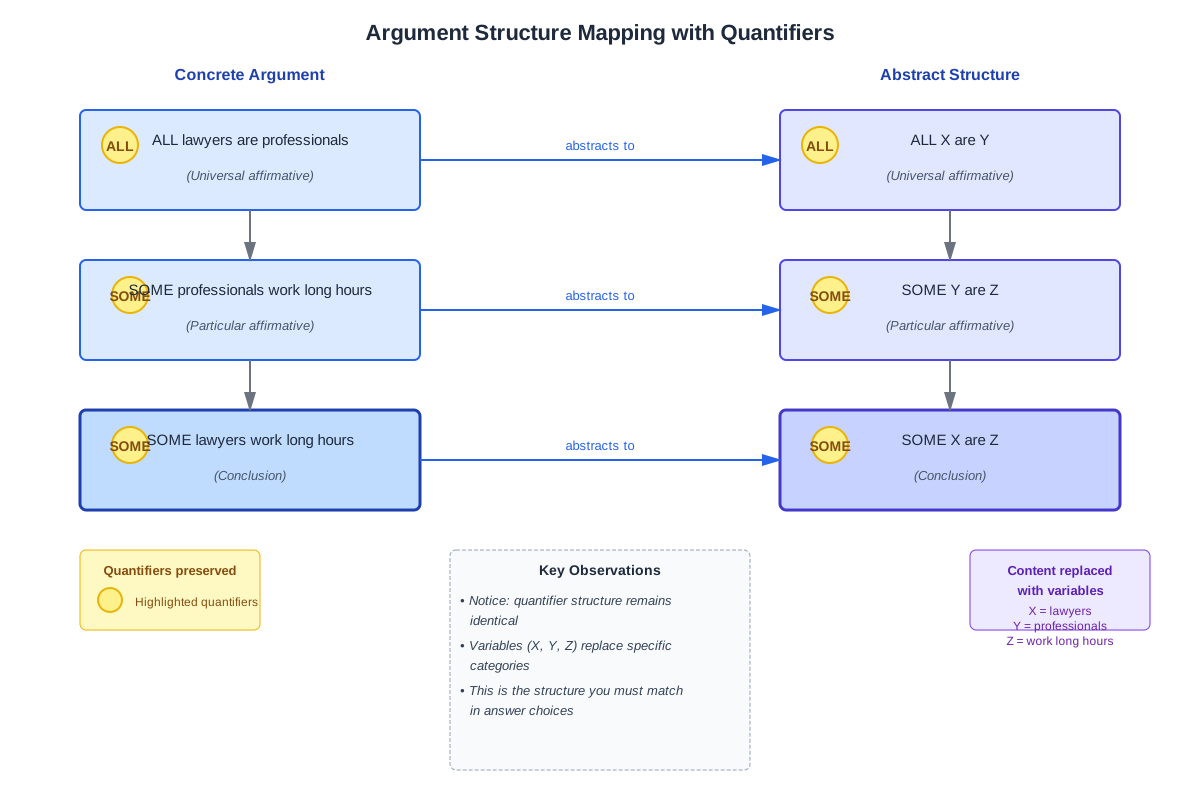
When analyzing arguments for parallel reasoning, the quantifier structure refers to the specific pattern of quantifiers used across premises and conclusion. Consider this basic structure:
Pattern A:
- Premise 1: All X are Y
- Premise 2: All Y are Z
- Conclusion: All X are Z
This represents a valid categorical syllogism. For an argument to parallel this structure, it must use "all" (or equivalent universal quantifiers) in the same positions. An argument using "most" or "some" would not match, even if the subject matter seemed similar.
Pattern B:
- Premise 1: Most X are Y
- Premise 2: Most Y are Z
- Conclusion: Most X are Z
This represents an invalid inference (the fallacy of composition with majority quantifiers), but if the original argument exhibits this pattern, the parallel answer must replicate this exact quantifier structure, including the flaw.
Quantifier Scope and Nested Structures
Complex arguments often feature nested quantifier structures where multiple quantifiers interact within a single statement. For example: "All members of some committees have voting rights" contains both "all" and "some" in a hierarchical relationship. When matching such structures, you must preserve not only which quantifiers appear but also their relative scope and ordering.
Consider the difference between:
- "Some of all the students passed" (ambiguous/unusual)
- "All of some students' exams were graded" (clearer nested structure)
The LSAT tests your ability to recognize when these complex structures are genuinely parallel versus when they merely appear similar on surface reading.
Quantifier Equivalences and Transformations
Certain quantified statements are logically equivalent despite using different words:
| Original Statement | Logical Equivalent |
|---|---|
| All X are Y | No X are non-Y |
| No X are Y | All X are non-Y |
| Some X are Y | Not all X are non-Y |
| Not all X are Y | Some X are non-Y |
When matching quantifier structure, recognizing these equivalences allows you to identify parallels even when surface vocabulary differs. However, the LSAT typically uses consistent vocabulary in correct parallel reasoning answers to reduce ambiguity.
Quantifiers in Conditional Statements
Many quantified statements can be expressed as conditional relationships:
- "All dogs are mammals" = "If something is a dog, then it is a mammal"
- "No reptiles are mammals" = "If something is a reptile, then it is not a mammal"
When matching quantifier structure in arguments containing conditionals, you must ensure that:
- The quantifier type matches (universal, particular, etc.)
- The conditional direction matches (sufficient vs. necessary)
- Any negations appear in parallel positions
The Matching Process: A Systematic Approach
To successfully match quantifier structure, follow this systematic process:
- Abstract the original argument: Strip away content and identify the pure logical form, noting each quantifier
- Create a template: Write out the structure using variables (X, Y, Z) and quantifiers
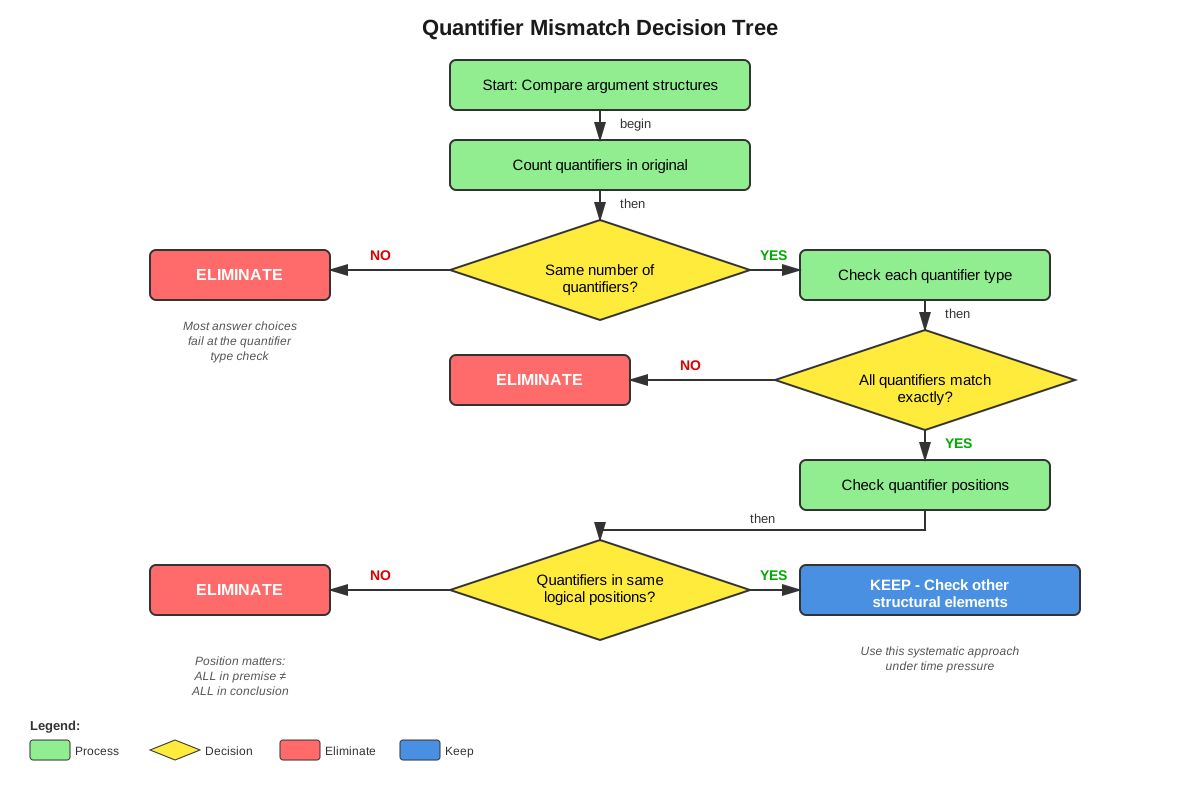
- Scan answer choices for quantifier patterns: Quickly eliminate choices with mismatched quantifiers
- Verify complete structural parallel: Ensure the remaining candidates match not just quantifiers but also logical connectives and argument flow
- Confirm with content substitution: Mentally substitute the original content into your chosen answer to verify the parallel holds
This process prioritizes efficiency by using quantifier matching as an early filter, eliminating wrong answers before investing time in detailed analysis.
Concept Relationships
The concepts within matching quantifier structure form an interconnected system. Understanding basic quantifiers serves as the foundation, leading directly to recognizing quantifier structure in arguments. This recognition enables pattern abstraction, which is the skill of mentally representing an argument's logical skeleton. Pattern abstraction, in turn, allows for efficient comparison between the original argument and answer choices.
Quantifier equivalences connect laterally to basic quantifier understanding, providing alternative expressions of the same logical relationships. These equivalences feed into nested structure analysis, which represents a more complex application requiring simultaneous tracking of multiple quantifier relationships.
The connection to prerequisite topics is direct: conditional reasoning provides the framework for understanding how universal quantifiers create if-then relationships, while argument structure identification determines where quantifiers function within the logical flow. Together, these prerequisites enable the higher-order skill of matching complete quantifier structures across different content domains.
Looking forward, mastery of matching quantifier structure enables progression to parallel flaw questions (where you must match both structure and error type), formal logic games (where quantifier rules govern deductions), and complex strengthen/weaken questions (where quantifier precision determines whether evidence is relevant).
Relationship Map:
Basic Quantifiers → Quantifier Structure Recognition → Pattern Abstraction → Efficient Answer Elimination
↓
Quantifier Equivalences → Nested Structure Analysis
↓
Integration with Conditional Reasoning → Application to Parallel Reasoning Questions → Extension to Parallel Flaw and Formal Logic
High-Yield Facts
⭐ Universal quantifiers ("all," "every," "each") create the strongest claims and must be matched exactly in parallel reasoning questions—substituting "most" or "some" invalidates the parallel.
⭐ "Some" in formal logic means "at least one, possibly all"—it is the weakest positive quantifier and cannot be matched with "most" or "all."
⭐ "Most" means "more than half" and represents a middle-strength quantifier that creates different logical implications than either "all" or "some."
⭐ Quantifier order matters: "All X are some Y" differs structurally from "Some X are all Y" even though both contain the same quantifiers.
⭐ Negative quantifiers ("no," "none") must be matched with negative quantifiers—replacing "no" with "not all" changes the logical structure.
- Parallel reasoning questions require matching both quantifier type and quantifier position within the argument structure.
- An argument with two universal premises and a universal conclusion must be matched with an answer containing the same quantifier pattern, regardless of content.
- Quantifier mismatches are among the most common wrong answer traps in parallel reasoning questions.
- "Few" and "several" are vague quantifiers that the LSAT uses less frequently than "all," "some," "most," and "no."
- When an original argument contains a quantifier flaw (like concluding "all" from "most"), the correct parallel answer must replicate that exact flaw with matching quantifiers.
- Compound quantified statements ("All X are either Y or Z") require matching both the quantifier and the logical connective structure.
- Implicit quantifiers (where "all" or "some" is understood but not stated) still count as part of the quantifier structure.
Quick check — test yourself on Matching quantifier structure so far.
Try Flashcards →Common Misconceptions
Misconception: If two arguments discuss similar topics, they must have parallel quantifier structures.
Correction: Content similarity is irrelevant to structural parallelism. An argument about "all dogs" and an argument about "some cats" have different quantifier structures despite both involving animals. Focus exclusively on the logical form, not the subject matter.
Misconception: "Most" and "all" are close enough to be considered matching quantifiers.
Correction: "Most" and "all" create fundamentally different logical relationships. "Most X are Y" allows for some X that are not Y, while "All X are Y" permits no exceptions. This difference can transform a valid argument into an invalid one, so these quantifiers never match in parallel reasoning.
Misconception: The conclusion's quantifier is most important, so matching it is sufficient.
Correction: Complete structural parallelism requires matching quantifiers in all premises and the conclusion. An argument with "all" premises and an "all" conclusion differs from an argument with "some" premises and an "all" conclusion, even though both conclusions use "all."
Misconception: Negative statements ("not all") match with universal negatives ("no").
Correction: "Not all X are Y" means "some X are not Y" (a particular negative), while "No X are Y" means "all X are not Y" (a universal negative). These represent different quantifier strengths and do not match structurally.
Misconception: If the logical validity matches (both valid or both invalid), the quantifier structure must match.
Correction: Multiple different quantifier structures can produce valid or invalid arguments. Two invalid arguments might fail for entirely different reasons with different quantifier patterns. Validity matching is necessary but not sufficient for structural parallelism.
Misconception: Quantifier matching only matters in parallel reasoning questions.
Correction: While most explicit in parallel reasoning questions, quantifier precision matters throughout logical reasoning. Strengthen/weaken questions often turn on quantifier scope, and flaw questions frequently involve quantifier shifts. Developing quantifier awareness improves performance across question types.
Worked Examples
Example 1: Basic Quantifier Matching
Original Argument:
"All professional athletes train daily. Everyone who trains daily develops discipline. Therefore, all professional athletes develop discipline."
Analysis:
Let's abstract the structure:
- Premise 1: All A are B (All professional athletes are daily trainers)
- Premise 2: All B are C (All daily trainers are discipline developers)
- Conclusion: All A are C (All professional athletes are discipline developers)
This is a valid categorical syllogism with universal quantifiers throughout.
Answer Choice Analysis:
(A) "Most students study regularly. Everyone who studies regularly improves their grades. Therefore, most students improve their grades."
- Structure: Most A are B; All B are C; Therefore, Most A are C
- Quantifier mismatch: Uses "most" in premise 1 and conclusion instead of "all"
- Eliminate
(B) "All musicians practice their instruments. Some people who practice instruments perform publicly. Therefore, some musicians perform publicly."
- Structure: All A are B; Some B are C; Therefore, Some A are C
- Quantifier mismatch: Uses "some" in premise 2 and conclusion instead of "all"
- Eliminate
(C) "All lawyers pass the bar exam. Everyone who passes the bar exam understands legal principles. Therefore, all lawyers understand legal principles."
- Structure: All A are B; All B are C; Therefore, All A are C
- Perfect quantifier match: Universal quantifiers in both premises and conclusion
- Keep as strong candidate
(D) "All teachers have degrees. No one without a degree can teach effectively. Therefore, all teachers can teach effectively."
- Structure: All A are B; No non-B are C; Therefore, All A are C
- Quantifier mismatch: Premise 2 uses a negative universal instead of a positive universal
- Eliminate
Correct Answer: (C)
The quantifier structure perfectly parallels the original: universal quantifiers in the same positions, creating the same valid syllogistic form. The content differs entirely (lawyers vs. athletes), but the logical skeleton matches exactly.
Example 2: Complex Quantifier Structure with a Flaw
Original Argument:
"Most experienced teachers use interactive methods. Most teachers who use interactive methods receive high student evaluations. Therefore, most experienced teachers receive high student evaluations."
Analysis:
- Premise 1: Most A are B
- Premise 2: Most B are C
- Conclusion: Most A are C
This argument commits the quantifier composition fallacy. Even if most A are B and most B are C, it's possible that the A's that are B are the B's that aren't C, meaning potentially few or no A's are C. For a parallel answer, we need to match this exact flawed structure with "most" quantifiers.
Answer Choice Analysis:
(A) "All dedicated employees arrive early. All employees who arrive early are productive. Therefore, all dedicated employees are productive."
- Structure: All A are B; All B are C; Therefore, All A are C
- Quantifier mismatch: Uses "all" instead of "most"
- Different validity: This is actually a valid argument, while the original is invalid
- Eliminate
(B) "Most novels are fiction. Most fiction books are bestsellers. Therefore, most novels are bestsellers."
- Structure: Most A are B; Most B are C; Therefore, Most A are C
- Perfect quantifier match: "Most" in both premises and conclusion
- Same flaw: Commits the identical quantifier composition fallacy
- Strong candidate
(C) "Some athletes are professionals. Most professionals earn high salaries. Therefore, some athletes earn high salaries."
- Structure: Some A are B; Most B are C; Therefore, Some A are C
- Quantifier mismatch: Uses "some" in premise 1 and conclusion instead of "most"
- Eliminate
(D) "Most scientists conduct research. Some researchers publish papers. Therefore, most scientists publish papers."
- Structure: Most A are B; Some B are C; Therefore, Most A are C
- Quantifier mismatch: Uses "some" in premise 2 instead of "most"
- Different flaw structure: The error pattern differs from the original
- Eliminate
Correct Answer: (B)
This answer perfectly replicates the quantifier structure of the original, including the flaw. Both arguments use "most" in both premises and the conclusion, and both commit the same logical error of assuming that overlapping majorities guarantee a majority in the final relationship.
Exam Strategy
When approaching parallel reasoning questions involving quantifier structure, implement this strategic framework:
Step 1: Immediate Quantifier Inventory (15-20 seconds)
Before reading answer choices, identify and note every quantifier in the original argument. Create a mental or written template: "All...most...some...therefore all." This template becomes your filter for rapid elimination.
Step 2: Scan Answer Choices for Quantifier Patterns (10 seconds per choice)
Read only for quantifiers initially, ignoring content. Eliminate any choice with a mismatched quantifier pattern before investing time in detailed analysis. This typically eliminates 3-4 of the 5 choices immediately.
Step 3: Verify Complete Structural Match (20-30 seconds)
For remaining candidates, verify that logical connectives ("and," "or," "if-then"), negations, and argument flow match the original. Ensure that quantifiers appear in parallel positions (e.g., if the original has "all" in the first premise, the answer must too).
Step 4: Content Substitution Check (10 seconds)
As a final verification, mentally substitute the original argument's content into your chosen answer's structure. If the substitution produces the original argument, you've found the correct parallel.
Trigger Words and Phrases:
- "Pattern of reasoning most similar" → Focus on structural matching, including quantifiers
- "Parallel reasoning" → Quantifier structure must match exactly
- "Flawed reasoning similar to" → Match both quantifier structure and the type of error
- "Most closely conforms to" → Look for identical logical form
Process of Elimination Tips:
- Eliminate first based on quantifier mismatches (fastest filter)
- Eliminate second based on different numbers of premises or different argument complexity
- Eliminate third based on mismatched logical connectives
- Verify the remaining choice by checking all structural elements
Time Allocation:
Parallel reasoning questions should take 1:15-1:30 minutes. Spend:
- 20 seconds: Understanding the original argument's structure
- 40 seconds: Scanning and eliminating based on quantifier mismatches
- 20 seconds: Verifying the correct answer's complete structural match
- 10 seconds: Final confirmation
Exam Tip: If you find yourself reading answer choices for content rather than structure, you're working inefficiently. Train yourself to see through content to the underlying logical skeleton, especially the quantifier pattern.
Memory Techniques
QUANTIFIER STRENGTH SPECTRUM (QSS) Mnemonic:
Remember quantifier strength from strongest to weakest: "Always Never Most Some"
- All (Always) = Strongest positive (100%)
- No/None (Never) = Strongest negative (0%)
- Most = Middle strength (>50%)
- Some = Weakest positive (≥1)
The MATCH Protocol for Parallel Reasoning:
- Map the original structure
- Abstract to variables and quantifiers
- Test each answer's quantifier pattern
- Confirm complete structural parallel
- Highlight the matching answer
Visualization Strategy:
Picture quantifiers as containers of different sizes:
- "All" = A completely full container (100%)
- "Most" = A more-than-half-full container (51-99%)
- "Some" = A container with at least one drop (1-100%)
- "No" = A completely empty container (0%)
When matching structures, visualize whether the containers in the answer choices match the fullness levels of the original argument's containers.
The "Skeleton Key" Technique:
When reading an argument, mentally strip away all content words and replace them with X, Y, Z while preserving quantifiers and connectives. Write this skeleton in the margin:
"All X → Y, Most Y → Z, ∴ Most X → Z"
This skeleton becomes your key for unlocking the correct answer—only one choice will fit this key exactly.
Summary
Matching quantifier structure is a high-yield LSAT skill that requires recognizing and replicating the precise pattern of quantifiers used in logical arguments. The core quantifiers—"all," "no," "most," and "some"—each create different logical relationships and cannot be substituted for one another in parallel reasoning questions. Success depends on abstracting arguments to their logical skeletons, focusing on quantifier patterns rather than content, and systematically eliminating answer choices that deviate from the original quantifier structure. This skill appears most explicitly in parallel reasoning questions but enhances performance across logical reasoning question types by developing precision in logical analysis. The key to mastery is training yourself to see through surface content to the underlying quantifier relationships, using these patterns as efficient filters for answer elimination, and verifying that complete structural parallelism exists before selecting an answer. Students who master quantifier matching gain significant advantages on 8-16% of logical reasoning questions while simultaneously strengthening their overall logical analysis capabilities.
Key Takeaways
- Quantifier precision is non-negotiable: "All," "most," and "some" are not interchangeable—each creates distinct logical relationships that must be matched exactly in parallel reasoning questions.
- Structure trumps content: Two arguments can discuss completely different topics yet be structurally parallel if their quantifier patterns match; conversely, similar content with different quantifiers means no parallel exists.
- Quantifier matching is your fastest elimination tool: Scanning for quantifier patterns before analyzing other structural elements allows you to eliminate 60-80% of wrong answers within seconds.
- Position matters as much as type: The quantifier in the first premise must match the first premise of the answer, the second premise must match the second, and so on—order and position are part of the structure.
- Parallel flaw questions require matching both structure and error: When the original argument contains a quantifier-based flaw, the correct answer must replicate that exact flaw with matching quantifiers.
- Develop quantifier awareness across all question types: While most explicit in parallel reasoning, quantifier precision affects strengthen/weaken questions, assumption questions, and flaw identification throughout logical reasoning.
- Practice abstraction until it becomes automatic: The ability to instantly convert "All professional athletes train daily" into "All A are B" is the foundation of efficient parallel reasoning performance.
Related Topics
Parallel Flaw Questions: Building directly on matching quantifier structure, these questions require identifying arguments that share both the same logical structure and the same type of reasoning error. Mastering quantifier matching is prerequisite to efficiently handling parallel flaw questions.
Formal Logic and Conditional Reasoning: Many quantified statements can be expressed as conditional relationships, and understanding the connection between universal quantifiers and sufficient/necessary conditions deepens logical analysis skills applicable across question types.
Categorical Syllogisms: The classical forms of categorical reasoning (All A are B, All B are C, therefore All A are C) represent the most common quantifier structures tested in parallel reasoning questions, making formal study of syllogistic forms valuable.
Strengthen and Weaken Questions with Quantifier Shifts: Many strengthen/weaken questions turn on subtle quantifier changes—understanding how shifting from "some" to "most" or "most" to "all" affects argument strength applies quantifier matching skills in new contexts.
Logical Equivalence and Contraposition: Understanding how quantified statements can be transformed while preserving logical meaning (e.g., "All A are B" ≡ "No A are non-B") enhances the ability to recognize structural parallels even when surface vocabulary differs.
Practice CTA
Now that you've mastered the core concepts of matching quantifier structure, it's time to cement your understanding through active practice. Attempt the practice questions designed specifically for this topic, focusing on applying the systematic approach outlined in the exam strategy section. As you work through problems, consciously practice the abstraction technique—converting arguments to their quantifier skeletons before analyzing answer choices. Use the flashcards to drill quantifier definitions and equivalences until recognition becomes automatic. Remember that matching quantifier structure is a skill that improves dramatically with deliberate practice. Each question you analyze strengthens your pattern recognition abilities and increases your speed on test day. You're building a competitive advantage on a high-frequency question type—invest the practice time now to reap scoring benefits on exam day.
Sign up free to keep reading
Create a free AnvayaPrep account to finish this LSAT guide on Matching quantifier structure — plus flashcards and practice questions.