Overview
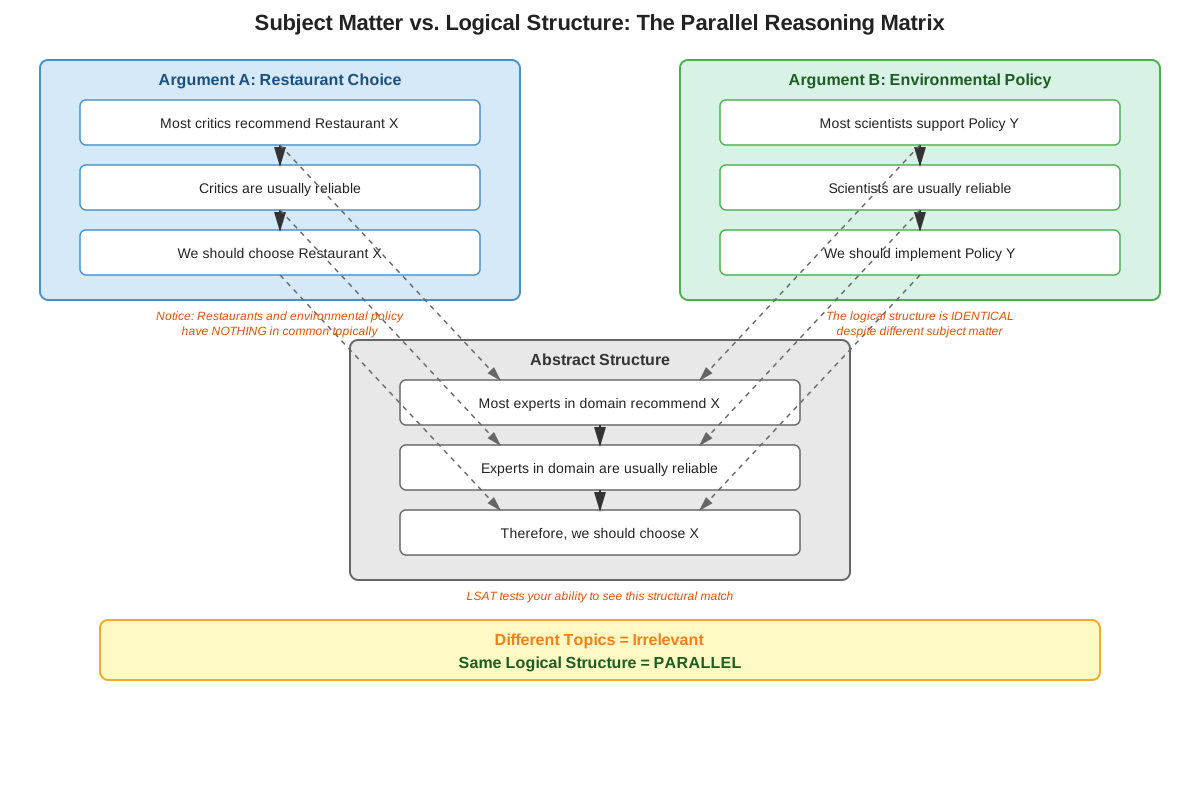
Matching subject matter irrelevance is a critical principle in LSAT Logical Reasoning that students must master to excel on parallel reasoning questions. This concept addresses a common trap: the mistaken belief that two arguments are parallel only if they discuss similar topics or content. In reality, the LSAT tests the ability to recognize structural similarities in reasoning patterns regardless of whether the arguments discuss economics, biology, ethics, or any other subject matter. An argument about restaurant choices can be structurally identical to an argument about political policy, even though their content differs entirely.
Understanding this principle transforms how students approach parallel reasoning questions, which typically ask test-takers to identify an answer choice that exhibits the "same pattern of reasoning" or "most closely parallels the reasoning" in the stimulus. Many students waste valuable time searching for answer choices that discuss similar topics, falling into a deliberate trap set by test makers. The LSAT rewards those who can abstract the logical structure from its content wrapper, recognizing that valid reasoning patterns transcend their subject matter.
This topic sits at the intersection of several fundamental Logical Reasoning skills: argument structure analysis, formal logic application, and pattern recognition. Mastering matching subject matter irrelevance enables students to work more efficiently, eliminate wrong answers quickly, and confidently select correct answers based on structural analysis rather than superficial content similarities. This skill proves essential not only for parallel reasoning questions but also strengthens performance on parallel flaw questions and helps develop the analytical mindset necessary for success across all Logical Reasoning question types.
Learning Objectives
- [ ] Identify how Matching subject matter irrelevance appears in LSAT questions
- [ ] Explain the reasoning pattern behind Matching subject matter irrelevance
- [ ] Apply Matching subject matter irrelevance to solve LSAT-style problems accurately
- [ ] Distinguish between structural parallelism and superficial content similarity in arguments
- [ ] Abstract logical structures from concrete examples across diverse subject matters
- [ ] Evaluate answer choices systematically by mapping structural elements rather than topical content
- [ ] Recognize common distractor patterns that exploit subject matter confusion
Prerequisites
- Basic argument structure: Understanding premises, conclusions, and how they connect is essential because parallel reasoning requires mapping these components across different arguments
- Conditional logic fundamentals: Recognizing if-then relationships and their contrapositives helps identify structural patterns that transcend content
- Formal logic notation: Familiarity with symbolic representation allows students to strip away content and focus purely on logical form
- Argument types and patterns: Knowledge of common reasoning patterns (causal, analogical, conditional) provides the framework for recognizing parallelism
Why This Topic Matters
In real-world contexts, the ability to recognize parallel reasoning structures regardless of subject matter proves invaluable for legal analysis, policy evaluation, and critical thinking. Lawyers must frequently identify when precedents from one area of law apply to cases in entirely different domains based on structural similarities in reasoning. This skill enables professionals to transfer insights across disciplines and recognize when arguments that appear different on the surface share fundamental logical flaws or strengths.
On the LSAT, parallel reasoning questions appear with significant frequency, typically comprising 2-4 questions per test across both Logical Reasoning sections. These questions carry substantial weight because they test multiple competencies simultaneously: argument analysis, pattern recognition, and the ability to work efficiently under time pressure. Lsat matching subject matter irrelevance specifically appears in every parallel reasoning question, as test makers consistently include wrong answer choices that match the stimulus's topic but fail to match its logical structure.
This topic manifests in several question formats: "Which one of the following exhibits the same pattern of reasoning as the argument above?" and "The reasoning in which one of the following is most similar to that in the argument above?" Additionally, parallel flaw questions ("The flawed reasoning in which one of the following most closely resembles the flawed reasoning above?") rely heavily on this same principle. Wrong answer choices frequently feature the same subject matter as the stimulus but employ different reasoning structures, deliberately exploiting students who haven't mastered matching subject matter irrelevance. Understanding this principle can save 30-60 seconds per question by immediately eliminating content-matching distractors.
Core Concepts
The Fundamental Principle of Structural Parallelism
Parallel reasoning on the LSAT requires identifying arguments that share identical logical structures, regardless of their content. The core insight of matching subject matter irrelevance is that the topic, domain, or specific examples used in an argument have no bearing on its logical form. An argument structured as "All A are B; X is an A; therefore, X is B" maintains this structure whether discussing animals, automobiles, or abstract concepts.
Consider this structure: "If the policy succeeds, costs will decrease. Costs decreased. Therefore, the policy succeeded." This commits the formal fallacy of affirming the consequent. A parallel argument might state: "If the plant receives water, it will grow. The plant grew. Therefore, it received water." Despite discussing entirely different subjects (policy versus botany), both arguments share the identical flawed structure: If P then Q; Q; therefore P.
The LSAT constructs parallel reasoning questions by first presenting a stimulus argument with a specific logical structure, then offering five answer choices. Typically, one or two answer choices will discuss similar subject matter to the stimulus but employ different reasoning patterns. These are sophisticated distractors designed to trap students who focus on content rather than structure. The correct answer will match the logical form precisely while usually discussing completely different subject matter.
Abstracting Logical Structure from Content
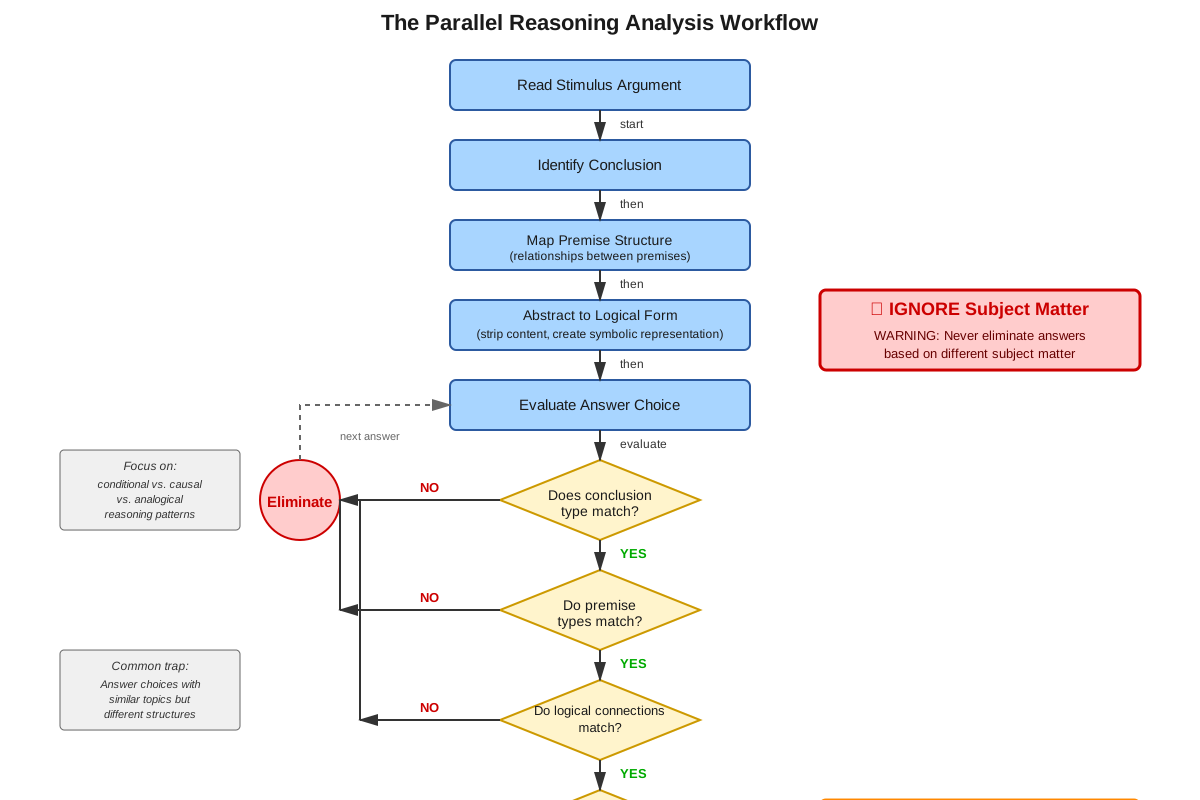
To apply matching subject matter irrelevance effectively, students must develop the skill of abstraction—mentally stripping away the specific content to reveal the underlying logical skeleton. This process involves several steps:
- Identify the conclusion: Determine what the argument is trying to prove
- Map the premises: List each piece of evidence or reasoning offered in support
- Recognize the logical connectors: Note how premises relate to the conclusion (causal, conditional, analogical, etc.)
- Translate to abstract form: Replace specific terms with variables or generic placeholders
- Match the pattern: Find the answer choice that maps identically to this abstract structure
For example, if a stimulus argues: "Most successful entrepreneurs take calculated risks. Jenna takes calculated risks. Therefore, Jenna will probably be a successful entrepreneur," the abstract structure is: "Most X are Y; Z is Y; therefore, Z is probably X." This represents a flawed pattern (affirming the consequent with a probabilistic conclusion). The correct parallel answer will match this exact structure, regardless of whether it discusses athletes, students, investments, or any other topic.
Common Structural Patterns in Parallel Reasoning
The LSAT employs recurring logical structures in parallel reasoning questions. Recognizing these patterns accelerates analysis:
| Structure Type | Abstract Form | Example |
|---|---|---|
| Categorical Syllogism | All A are B; All B are C; Therefore, all A are C | All dogs are mammals; All mammals are animals; Therefore, all dogs are animals |
| Conditional Chain | If A then B; If B then C; Therefore, if A then C | If it rains, streets are wet; If streets are wet, driving is dangerous; Therefore, if it rains, driving is dangerous |
| Sufficient-Necessary Confusion | If A then B; B; Therefore, A | If studying, then passing; Passed; Therefore, studied |
| Analogical Reasoning | X has properties 1, 2, 3; Y has properties 1, 2; Therefore, Y probably has property 3 | This restaurant has good food, service, ambiance; That restaurant has good food, service; Therefore, it probably has good ambiance |
| Causal Reasoning | A and B correlate; No other explanation; Therefore, A causes B | Sales increased when ads ran; No other changes occurred; Therefore, ads caused increased sales |
The Role of Variables and Placeholders
Professional LSAT instructors teach students to use variables or generic placeholders when analyzing parallel reasoning questions. This technique enforces matching subject matter irrelevance by making content differences visually obvious while highlighting structural similarities. When reading the stimulus, students might mentally translate: "All effective teachers inspire curiosity" becomes "All X have property Y," and "Professor Smith inspires curiosity" becomes "Z has property Y."
This translation process serves multiple purposes. First, it prevents the brain from becoming anchored to specific content, reducing the temptation to select answer choices based on topic similarity. Second, it creates a clear template for evaluation—each answer choice can be quickly tested against the abstract structure. Third, it reveals the logical relationships more clearly, making flaws or valid patterns easier to identify.
Content-Based Distractors
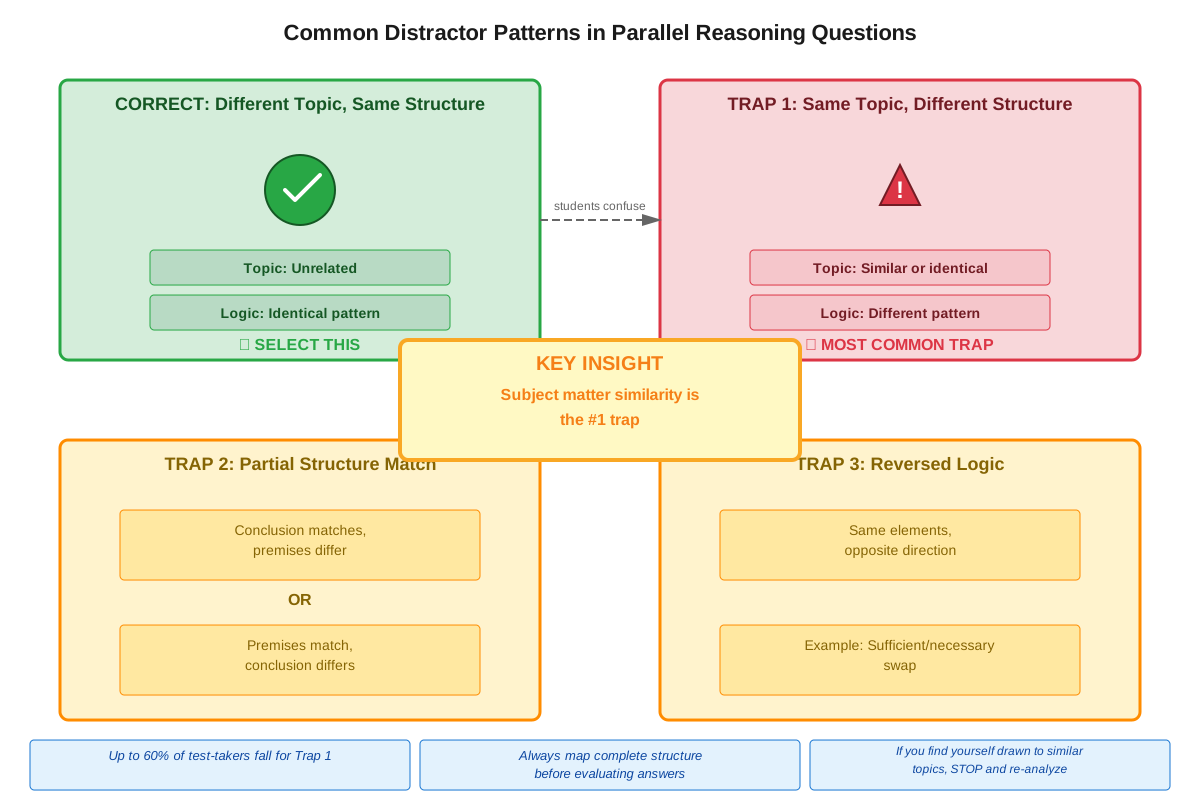
Test makers deliberately construct wrong answer choices that exploit students' natural tendency to focus on familiar content. These content-based distractors typically fall into several categories:
- Same topic, different structure: Discusses the same subject as the stimulus but employs a different reasoning pattern
- Similar vocabulary: Uses related terms or concepts but arranges them in a non-parallel structure
- Thematic connection: Addresses a related theme or field without matching the logical form
- Partial overlap: Matches one element of the structure (e.g., the conclusion type) but fails to match the complete pattern
For instance, if the stimulus discusses restaurant quality using conditional reasoning, a distractor might discuss restaurant quality using causal reasoning. Students who haven't internalized matching subject matter irrelevance will be drawn to this answer because it "feels" similar, despite the structural mismatch.
Structural Elements That Must Match
For two arguments to be truly parallel, specific structural elements must correspond exactly:
- Number of premises: The same quantity of supporting statements
- Type of premises: Categorical, conditional, causal, etc., must match
- Logical relationships: How premises connect to each other and to the conclusion
- Quantifiers: "All," "some," "most," "none" must correspond
- Modality: Certainty levels ("must," "probably," "might") must align
- Conclusion type: Descriptive, prescriptive, predictive, etc., must match
- Argument direction: Whether reasoning moves from general to specific or vice versa
These elements constitute the true structure of an argument and remain constant regardless of subject matter. A student who checks each element systematically will reliably identify parallel reasoning, while one who focuses on content will struggle with consistency.
Concept Relationships
The principle of matching subject matter irrelevance serves as the foundation for all parallel reasoning analysis. This concept directly enables structural abstraction, which is the cognitive process of mentally separating form from content. Structural abstraction, in turn, allows students to create logical templates that can be applied across diverse subject matters.
The relationship flows as follows: Understanding matching subject matter irrelevance → Developing abstraction skills → Creating mental templates → Efficiently evaluating answer choices → Avoiding content-based distractors → Selecting correct answers confidently.
This topic connects to prerequisite knowledge of argument structure by building upon the ability to identify premises and conclusions, then extending that skill to recognize when different arguments share identical structural relationships between these components. It relates to formal logic by applying the same principle that makes symbolic logic useful: variables can represent any content while preserving logical relationships.
The concept also connects forward to parallel flaw questions, where students must recognize not just parallel reasoning but specifically parallel flawed reasoning. The same principle applies—the flaw's structure matters, not its subject matter. Additionally, this skill enhances performance on method of reasoning questions, where recognizing argumentative techniques requires seeing past content to identify structural approaches.
Within the topic itself, the core principle (matching subject matter irrelevance) → enables the technique (abstraction) → which reveals patterns (common structures) → which helps avoid traps (content-based distractors) → leading to systematic evaluation (checking structural elements) → resulting in accurate answers.
High-Yield Facts
⭐ Parallel reasoning questions test logical structure, not subject matter similarity—the correct answer will almost always discuss a different topic than the stimulus.
⭐ Content-matching answer choices are typically wrong—if an answer choice discusses the same subject as the stimulus, it is likely a distractor unless it also perfectly matches the structure.
⭐ All structural elements must match exactly—number of premises, types of logical relationships, quantifiers, and conclusion type must correspond precisely.
⭐ Abstract the stimulus before evaluating answer choices—translate the argument into variables or generic terms to create a clear template for comparison.
⭐ The correct answer will feel "different" in content but "identical" in form—this contrast is intentional and helps confirm the right choice.
- Parallel reasoning questions appear 2-4 times per LSAT, making this a high-frequency question type worth mastering.
- Wrong answer choices often match 80-90% of the structure but fail on one critical element—careful systematic checking prevents these near-miss errors.
- The same principle applies to parallel flaw questions, where the flaw's structure (not its topic) must match.
- Time spent abstracting the stimulus (15-20 seconds) saves time evaluating answer choices (reducing from 60+ seconds to 30-40 seconds).
- Quantifiers ("all," "most," "some") are particularly important structural elements that must match exactly—a shift from "all" to "most" breaks parallelism.
- Conditional logic structures (if-then relationships) are among the most common patterns in parallel reasoning questions.
- The LSAT rarely uses the same subject matter in both stimulus and correct answer—when this occurs, it's usually in easier questions or as a confidence check.
Quick check — test yourself on Matching subject matter irrelevance so far.
Try Flashcards →Common Misconceptions
Misconception: Parallel reasoning means the arguments should discuss similar topics or related fields.
Correction: Parallel reasoning requires identical logical structure regardless of subject matter. An argument about cooking can be perfectly parallel to an argument about economics if they share the same reasoning pattern. The LSAT specifically tests the ability to recognize structural similarity across different content domains.
Misconception: If an answer choice uses similar vocabulary or terminology to the stimulus, it's more likely to be correct.
Correction: Similar vocabulary is often a red flag indicating a content-based distractor. Test makers deliberately use related terms to attract students who focus on content rather than structure. The correct answer typically uses completely different terminology while maintaining identical logical form.
Misconception: Matching some structural elements (like having the same number of premises) is sufficient for parallelism.
Correction: All structural elements must match exactly. An argument might have the same number of premises but arrange them in a different logical relationship, use different quantifiers, or reach a different type of conclusion. Partial structural overlap is insufficient—complete structural identity is required.
Misconception: Parallel reasoning questions are primarily about finding arguments with the same conclusion.
Correction: While the conclusion type must match, the reasoning process that leads to the conclusion is equally important. Two arguments might reach similar-sounding conclusions through entirely different logical pathways. The complete structure—premises, their relationships, and how they support the conclusion—must be parallel.
Misconception: Abstract or complex subject matter in an answer choice makes it less likely to be correct.
Correction: The complexity or abstractness of the subject matter is irrelevant to parallelism. Test makers sometimes use unfamiliar or complex topics in correct answers precisely because students mistakenly avoid them. Focus on structure, not content familiarity or complexity.
Misconception: If the stimulus contains a flaw, the correct answer must contain the same type of flaw with the same name (e.g., "ad hominem" or "false dichotomy").
Correction: While parallel flaw questions do require matching flawed structures, the flaw doesn't need to have the same traditional name or involve the same content area. The logical structure of the flaw must match, but this can manifest in completely different contexts with different conventional labels.
Worked Examples
Example 1: Basic Parallel Reasoning
Stimulus: "All professional athletes train regularly. Marcus trains regularly. Therefore, Marcus is probably a professional athlete."
Analysis: First, abstract the structure. This argument follows the pattern: "All X are Y; Z is Y; therefore, Z is probably X." This represents flawed reasoning (affirming the consequent) with a probabilistic conclusion. The argument incorrectly assumes that because Marcus has a characteristic common to all professional athletes, he must be a professional athlete—ignoring that many non-professional athletes also train regularly.
Answer Choice A: "All successful restaurants serve quality food. The new bistro serves quality food. Therefore, the new bistro is probably a successful restaurant."
Evaluation: Abstract this structure: "All X are Y; Z is Y; therefore, Z is probably X." This matches exactly. The number of premises (two), the type of premises (one universal categorical statement, one particular categorical statement), the logical relationship (affirming the consequent), and the conclusion type (probabilistic prediction) all correspond precisely. The subject matter is completely different (athletes versus restaurants), but the structure is identical. This is the correct answer.
Answer Choice B: "Most professional athletes train regularly. Marcus is a professional athlete. Therefore, Marcus probably trains regularly."
Evaluation: Abstract this structure: "Most X are Y; Z is X; therefore, Z is probably Y." This is valid reasoning (applying a characteristic of a group to a member of that group) and follows a different pattern than the stimulus. Despite discussing the same topic (professional athletes and training), this is structurally different and therefore incorrect. This exemplifies a content-based distractor.
Key Takeaway: The correct answer (A) discusses a completely different topic but matches the structure perfectly, while the wrong answer (B) discusses the same topic but has a different structure. This demonstrates the principle of matching subject matter irrelevance.
Example 2: Complex Conditional Reasoning
Stimulus: "If the company implements the new policy, employee satisfaction will increase. If employee satisfaction increases, productivity will improve. The company implemented the new policy. Therefore, productivity will improve."
Analysis: This argument contains a conditional chain with an affirmation of the sufficient condition. The structure is: "If A then B; If B then C; A; therefore, C." This is valid reasoning (modus ponens applied to a conditional chain). The argument has three premises: two conditional statements and one categorical statement affirming the first sufficient condition.
Answer Choice A: "If students study consistently, they understand the material better. If students understand the material better, they perform well on exams. These students studied consistently. Therefore, they will perform well on exams."
Evaluation: Abstract the structure: "If A then B; If B then C; A; therefore, C." This matches perfectly. The argument establishes a conditional chain (studying → understanding → performance), affirms the initial sufficient condition (students studied), and validly concludes the final necessary condition (good performance). The subject matter (education) differs entirely from the stimulus (business policy), but the logical structure is identical. The number of premises (three), their types (two conditionals, one categorical), and the reasoning pattern (valid conditional chain with modus ponens) all match. This is correct.
Answer Choice B: "If the company implements the new policy, employee satisfaction will increase. Employee satisfaction increased. Therefore, the company implemented the new policy."
Evaluation: Abstract the structure: "If A then B; B; therefore, A." This is affirming the consequent, a logical fallacy. While this answer choice discusses the exact same subject matter as the stimulus (company policy and employee satisfaction), it commits a different logical error and has only two premises instead of three. The structural mismatch makes this incorrect despite the content similarity. This is a classic content-based distractor.
Key Takeaway: The correct answer maintains the valid conditional chain structure across different subject matter, while the distractor uses the same content but commits a different logical error with fewer premises. This reinforces that structure, not content, determines parallelism.
Exam Strategy
When approaching parallel reasoning questions on the LSAT, implement this systematic process:
Step 1: Identify the question type (15-20 seconds). Look for trigger phrases: "exhibits the same pattern of reasoning," "most closely parallels the reasoning," or "reasoning most similar to." Recognize immediately that content is irrelevant and structure is everything.
Step 2: Abstract the stimulus (20-30 seconds). Read the stimulus carefully and create a structural template:
- Identify and count the premises
- Determine the type of each premise (categorical, conditional, causal, etc.)
- Note all quantifiers ("all," "most," "some," "none")
- Identify the conclusion and its type (certain, probable, prescriptive, etc.)
- Recognize the logical relationship (valid/invalid, and what pattern)
Step 3: Create a mental or written template (10 seconds). If time permits, jot down a quick abstract version: "If A→B; If B→C; A; ∴C" or "All X are Y; Z is Y; ∴Z is prob. X."
Step 4: Evaluate answer choices systematically (10-15 seconds each). For each answer choice:
- Immediately eliminate any choice that matches the stimulus's subject matter unless you've confirmed structural match
- Check the number of premises first (quickest elimination criterion)
- Verify the conclusion type matches
- Confirm the logical relationships correspond
- Ensure quantifiers align
Step 5: Confirm the correct answer (5-10 seconds). Before selecting, verify that every structural element matches. If two answers seem close, identify the specific structural difference that eliminates one.
Exam Tip: If you find yourself drawn to an answer choice because it discusses the same topic as the stimulus, this is a red flag. Pause and verify the structure carefully—you may be falling for a content-based distractor.
Trigger words and phrases to watch for:
- "Same pattern of reasoning" = focus exclusively on structure
- "Most closely parallels" = look for identical logical form
- "Reasoning most similar" = abstract the argument structure
- "Flawed reasoning" (in parallel flaw questions) = the flaw's structure must match, not its content
Process-of-elimination tips:
- Eliminate answer choices with different numbers of premises immediately
- Eliminate choices where quantifiers don't match ("all" vs. "most" is a structural difference)
- Eliminate choices where the conclusion type differs (certain vs. probable, descriptive vs. prescriptive)
- Be suspicious of answer choices that match the stimulus's topic—verify structure extra carefully
- Look for the answer that feels most "different" in content but "identical" in form
Time allocation advice: Parallel reasoning questions typically require 90-120 seconds. Allocate approximately 30-40 seconds to abstracting the stimulus and 50-70 seconds to evaluating answer choices. If you've properly abstracted the structure, answer choice evaluation should be relatively quick. If you find yourself spending more than 20 seconds on a single answer choice, you may not have adequately abstracted the stimulus—consider returning to create a clearer template.
Memory Techniques
SCREAM Acronym for structural elements that must match:
- Structure of premises (categorical, conditional, causal)
- Conclusion type (certain, probable, prescriptive)
- Relationships between premises
- Elements count (number of premises)
- Argument direction (general to specific or vice versa)
- Modifiers and quantifiers (all, most, some, none)
Visualization Strategy: Imagine the stimulus argument as a building's architectural blueprint. The correct answer is the same blueprint applied to different materials—the structure (blueprint) is identical, but the materials (content) differ. Wrong answers are different blueprints, even if they use similar materials.
The "Content Trap" Reminder: Create a mental image of a trap with the stimulus's subject matter as bait. When you see an answer choice discussing the same topic, visualize yourself stepping around the trap. This reinforces the instinct to be extra cautious with content-matching answers.
The Variable Translation Technique: Practice immediately translating arguments into variables as you read. Train yourself to automatically think "All X are Y" when you read "All doctors are professionals." This mental habit makes abstraction automatic rather than effortful.
The "Different Topic = Good Sign" Heuristic: Remember the counterintuitive principle that the correct answer usually discusses a completely different topic. When you find yourself thinking "this answer is about something totally different," that's often a positive indicator, not a reason to eliminate it.
Summary
Matching subject matter irrelevance is the foundational principle for success on LSAT parallel reasoning questions, establishing that logical structure—not content or topic—determines whether two arguments are parallel. Students must develop the skill of abstracting arguments into their logical skeletons, stripping away specific subject matter to reveal underlying patterns of reasoning. The LSAT deliberately constructs wrong answer choices that match the stimulus's content but employ different logical structures, exploiting the natural human tendency to focus on familiar topics. Conversely, correct answers typically discuss entirely different subject matters while maintaining perfect structural correspondence in premises, logical relationships, quantifiers, and conclusion types. Mastering this principle requires systematic analysis: abstracting the stimulus into a structural template, then evaluating each answer choice against that template while actively resisting the temptation to favor content-matching options. This skill proves essential not only for parallel reasoning questions but also for parallel flaw questions and strengthens overall logical analysis capabilities across the Logical Reasoning section.
Key Takeaways
- Parallel reasoning depends entirely on logical structure, not subject matter—the correct answer will almost always discuss a different topic than the stimulus while maintaining identical logical form.
- Content-matching answer choices are sophisticated distractors—if an answer discusses the same subject as the stimulus, approach with heightened skepticism and verify structure meticulously.
- Abstraction is the key skill—translate arguments into variables or generic terms before evaluating answer choices to prevent content bias from influencing analysis.
- All structural elements must match exactly—premises count, logical relationships, quantifiers, conclusion type, and argument direction must correspond precisely for true parallelism.
- Systematic evaluation saves time and improves accuracy—check elements in order (premise count, conclusion type, quantifiers, relationships) to eliminate wrong answers efficiently.
- The principle applies across question types—parallel reasoning, parallel flaw, and even some method of reasoning questions all reward the ability to see structure independent of content.
- Practice makes abstraction automatic—with repetition, the skill of mentally translating content into structure becomes rapid and effortless, dramatically improving speed and accuracy.
Related Topics
Parallel Flaw Questions: These questions require identifying arguments with identical flawed reasoning structures. Mastering matching subject matter irrelevance is essential because the same principle applies—the flaw's structure matters, not its content or the specific fallacy name. Success on parallel reasoning questions directly enables success on parallel flaw questions.
Method of Reasoning Questions: These questions ask how an argument proceeds or what technique it employs. Understanding that reasoning methods are structural rather than content-based helps identify argumentative techniques across diverse subject matters.
Formal Logic and Conditional Reasoning: Deeper study of formal logic strengthens the ability to recognize structural patterns. Conditional logic, in particular, appears frequently in parallel reasoning questions and benefits from the same abstraction skills.
Argument Structure and Diagramming: Advanced techniques for visually representing argument structures complement the abstraction skills developed through matching subject matter irrelevance, providing additional tools for complex parallel reasoning questions.
Sufficient and Necessary Conditions: Understanding these logical relationships enhances the ability to recognize when conditional structures match across different content areas, a common pattern in parallel reasoning questions.
Practice CTA
Now that you understand the principle of matching subject matter irrelevance and how to apply it systematically to parallel reasoning questions, it's time to reinforce these concepts through active practice. Attempt the practice questions designed for this topic, focusing on abstracting each stimulus before evaluating answer choices. Use the flashcards to drill the key structural patterns and common distractors until recognizing them becomes automatic. Remember: every parallel reasoning question you practice strengthens your ability to see logical structure independent of content—a skill that will serve you throughout the LSAT and beyond. The difference between students who struggle with these questions and those who excel comes down to consistent application of the principles you've just learned. You now have the knowledge; practice transforms that knowledge into reliable performance under test conditions.
Sign up free to keep reading
Create a free AnvayaPrep account to finish this LSAT guide on Matching subject matter irrelevance — plus flashcards and practice questions.