Overview
Overmatching content is a critical trap concept in LSAT Logical Reasoning, particularly within Parallel Reasoning questions. This phenomenon occurs when test-takers incorrectly select an answer choice that matches superficial elements of the stimulus—such as specific subject matter, vocabulary, or concrete examples—while failing to match the underlying logical structure. Understanding overmatching content is essential because the LSAT deliberately designs wrong answer choices to exploit this common error pattern, making it one of the most frequently encountered traps on the exam.
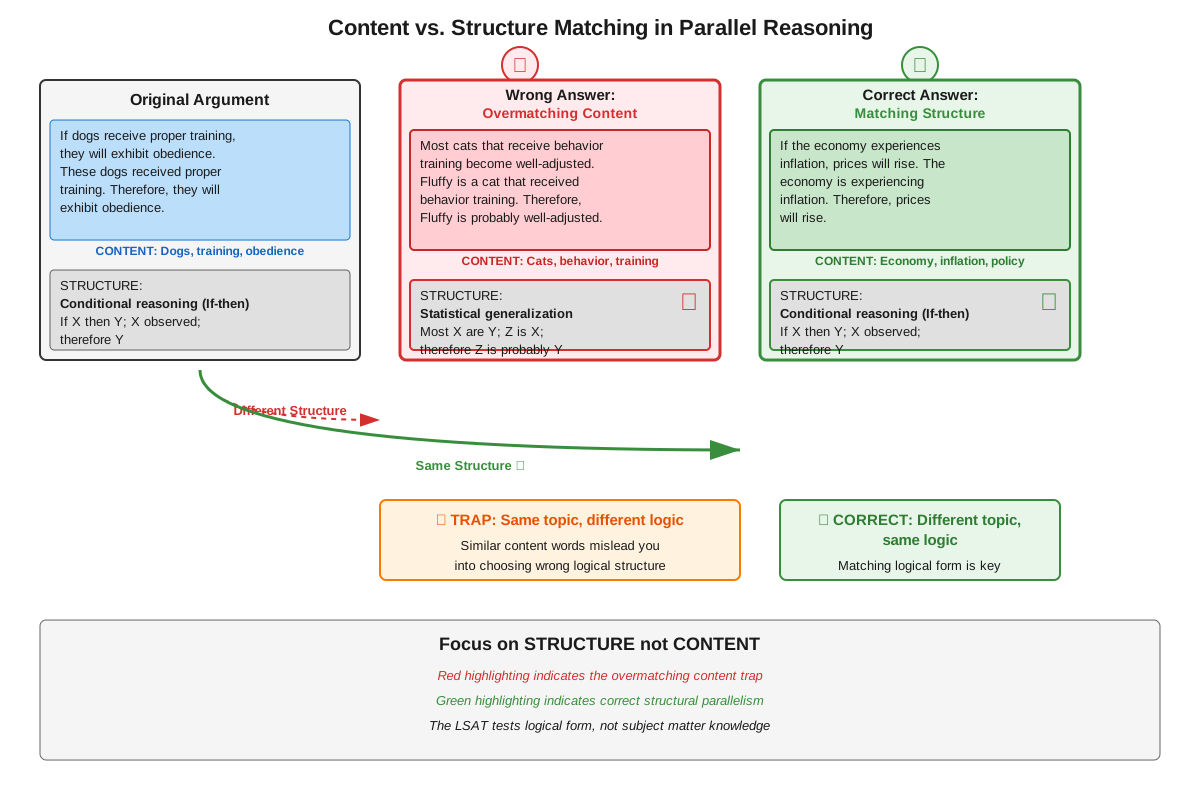
In Parallel Reasoning questions, the LSAT asks test-takers to identify an argument that exhibits the same pattern of reasoning as the stimulus argument. The correct answer must mirror the logical structure, not the content. However, test-makers craft attractive wrong answers that discuss similar topics or use parallel vocabulary to the original argument. For instance, if the stimulus discusses dogs and training, a wrong answer might also discuss pets and behavior modification, creating a false sense of similarity. Students who focus on content rather than structure consistently fall for these traps, significantly lowering their scores on what should be straightforward pattern-matching questions.
Mastering the identification and avoidance of overmatching content directly improves performance across multiple question types in Logical Reasoning. While most prominent in Parallel Reasoning and Parallel Flaw questions, this skill also enhances performance on Method of Reasoning questions, where understanding argument structure independent of content is paramount. Additionally, recognizing when content similarity is irrelevant strengthens overall logical analysis skills, helping students focus on what truly matters: the relationships between premises and conclusions, the types of evidence used, and the logical moves an argument makes.
Learning Objectives
- [ ] Identify how Overmatching content appears in LSAT questions
- [ ] Explain the reasoning pattern behind Overmatching content
- [ ] Apply Overmatching content to solve LSAT-style problems accurately
- [ ] Distinguish between structural parallelism and content similarity in answer choices
- [ ] Develop systematic approaches to abstract argument structures before evaluating answer choices
- [ ] Recognize the specific linguistic cues that signal content-based traps in Parallel Reasoning questions
Prerequisites
- Basic argument structure identification: Understanding premises, conclusions, and how they connect is essential because parallel reasoning requires matching these structural elements across different arguments.
- Conditional reasoning fundamentals: Recognizing sufficient and necessary conditions matters because many parallel reasoning questions involve matching conditional structures regardless of content.
- Argument types and patterns: Familiarity with common reasoning patterns (causal, analogical, conditional, etc.) provides the framework for identifying what needs to be matched structurally.
- Formal logic basics: Understanding logical operators and relationships enables abstraction of arguments from their specific content to their underlying form.
Why This Topic Matters
Overmatching content represents one of the most predictable and exploitable patterns in LSAT question design. Test-makers consistently use content similarity as a distractor because it appeals to the natural human tendency to recognize familiar topics and vocabulary. This makes it a high-frequency trap that appears in virtually every LSAT administration, affecting multiple questions per test.
Exam statistics reveal that Parallel Reasoning questions appear 2-4 times per Logical Reasoning section, meaning students encounter 4-8 such questions per complete LSAT. Research on test-taker performance indicates that overmatching content traps are responsible for approximately 60-70% of errors on these questions among students scoring below 160. Even high-scoring students occasionally fall for sophisticated content matches when under time pressure. Given that each question represents roughly one point on the scaled score, mastering this concept can directly translate to 3-5 additional points—a significant improvement that can determine admission outcomes.
In practical terms, this topic appears whenever the LSAT presents Parallel Reasoning questions (asking "Which one of the following exhibits a pattern of reasoning most similar to that in the argument above?") and Parallel Flaw questions (asking for arguments with similar flawed reasoning). The trap manifests when answer choices discuss the same subject matter, use similar terminology, or present analogous concrete scenarios while employing fundamentally different logical structures. For example, a stimulus about economic policy might be paired with wrong answers also discussing economics but using different reasoning patterns, while the correct answer discusses an entirely different topic (like biology) but mirrors the logical structure perfectly.
Core Concepts
What Is Overmatching Content?
Overmatching content (also called lsat overmatching content or content matching) refers to the error of selecting an answer choice based on superficial similarity in subject matter, vocabulary, or examples rather than on structural logical parallelism. This represents a fundamental misunderstanding of what parallel reasoning questions test: the form of an argument, not its content.
The LSAT operates on the principle that logical validity depends entirely on structure, not subject matter. An argument's reasoning pattern can be abstracted from its specific content and applied to any domain. For instance, the structure "All X are Y; Z is an X; therefore Z is Y" remains valid whether discussing animals, economics, or abstract concepts. Overmatching content occurs when test-takers lose sight of this principle and allow content to influence their selection.
The Anatomy of Content vs. Structure
Understanding the distinction between content and structure is fundamental to avoiding overmatching traps:
| Element | Content | Structure |
|---|---|---|
| Definition | The specific subject matter, examples, and vocabulary used | The logical relationships between premises and conclusions |
| Example | "Dogs," "training," "obedience" | "If X, then Y; X occurred; therefore Y" |
| Relevance to Parallel Reasoning | Irrelevant—can be completely different | Essential—must match exactly |
| How LSAT Uses It | As a distractor in wrong answers | As the basis for correct answers |
| Abstraction Level | Concrete and specific | Abstract and generalizable |
Content elements include:
- Specific nouns (dogs, economics, politicians, molecules)
- Particular verbs (running, investing, legislating, bonding)
- Domain-specific terminology
- Concrete scenarios and examples
- Numerical specifics or quantities
Structural elements include:
- Logical operators (if/then, all, some, none, most)
- Premise-conclusion relationships
- Types of reasoning (causal, analogical, conditional, categorical)
- Logical moves (generalization, application of principle, elimination of alternatives)
- Quantifier scope and relationships
How Overmatching Content Traps Work
The LSAT exploits overmatching content through deliberate answer choice construction. Test-makers understand cognitive biases that make content similarity psychologically compelling:
- Recognition bias: Familiar topics feel correct because they're easier to process
- Surface-level processing: Under time pressure, students default to quick pattern matching
- Confirmation bias: Once students notice content similarity, they seek confirming evidence rather than structural analysis
The typical trap construction follows this pattern:
- The stimulus presents an argument about Topic A using Structure X
- Wrong answer choices include arguments about Topic A (or closely related topics) using Structure Y, Z, or W
- The correct answer presents an argument about Topic B (completely different) using Structure X
Abstracting Arguments to Avoid Content Traps
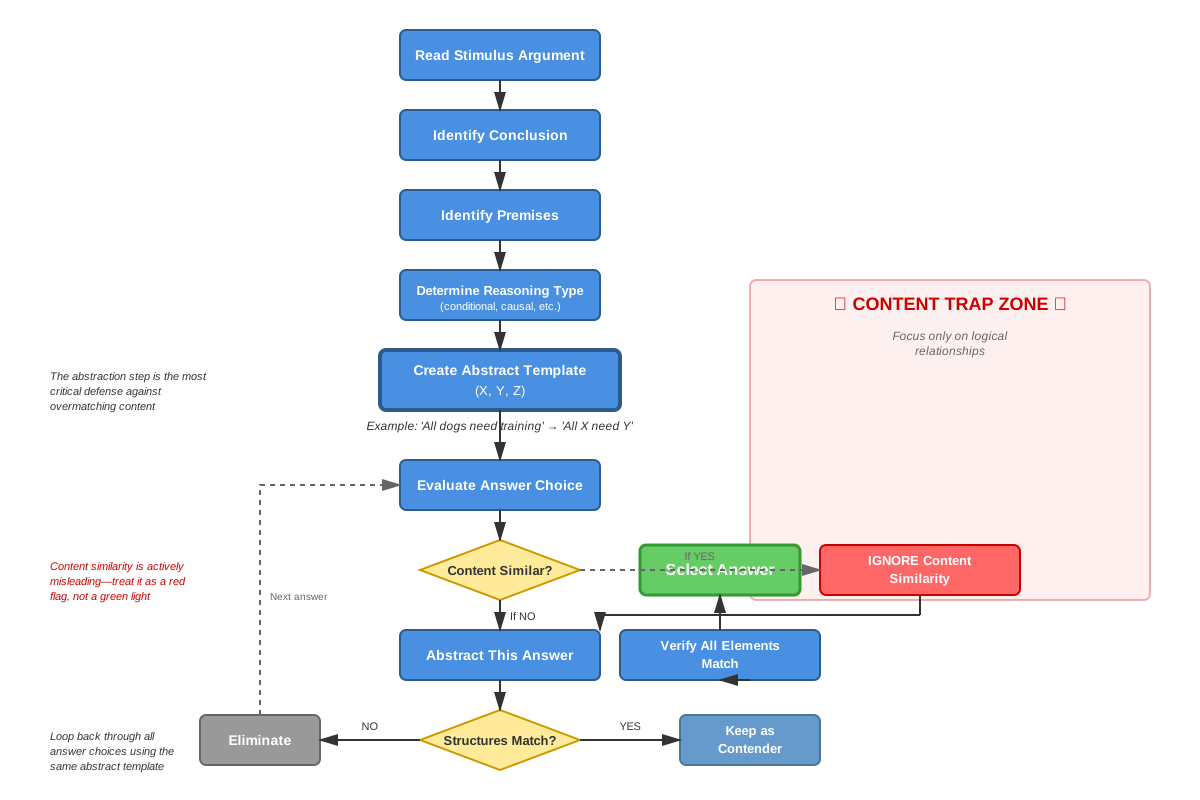
The most effective defense against overmatching content is argument abstraction—the process of representing an argument's structure using variables or generic terms before evaluating answer choices.
The abstraction process:
- Identify the conclusion: What is the argument trying to prove?
- Identify the premises: What evidence supports the conclusion?
- Map the logical relationships: How do premises connect to the conclusion?
- Replace specific content with variables: Substitute generic terms (X, Y, Z) or categories (Group A, Property B)
- Note structural features: Identify reasoning type, quantifiers, and logical operators
Example abstraction:
- Original: "All professional athletes train daily. Maria trains daily. Therefore, Maria is a professional athlete."
- Abstracted: "All members of Group X have Property Y. Individual Z has Property Y. Therefore, Individual Z is a member of Group X."
- Structural note: Invalid reasoning—affirming the consequent fallacy
Content Similarity as a Deliberate Distractor
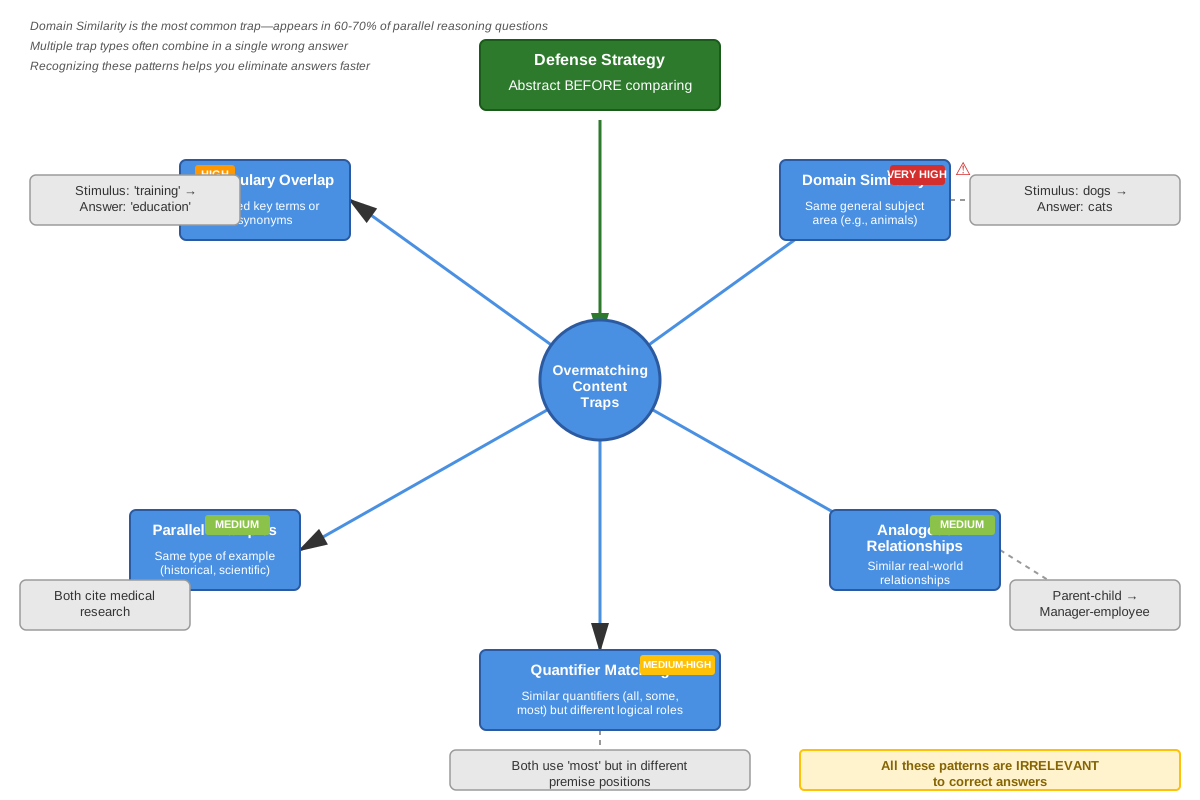
The LSAT uses several sophisticated techniques to make content-matching answers attractive:
Vocabulary echoing: Wrong answers repeat distinctive words from the stimulus, creating false familiarity. If the stimulus mentions "pharmaceutical companies" and "drug pricing," a wrong answer might also discuss "medication costs" and "healthcare corporations."
Domain consistency: Wrong answers stay within the same general field (all business examples, all scientific examples) while the correct answer ventures into different territory.
Analogous scenarios: Wrong answers present situations that feel parallel at the content level (if the stimulus discusses teacher-student relationships, wrong answers might discuss parent-child or mentor-mentee relationships) without matching logical structure.
Thematic resonance: Wrong answers maintain similar themes, tones, or implications (if the stimulus criticizes a policy, wrong answers also criticize policies) regardless of reasoning pattern.
Recognizing Structural Parallelism
True structural parallelism requires matching multiple dimensions simultaneously:
Reasoning type match: The fundamental pattern must be identical:
- Causal reasoning must match causal reasoning
- Analogical reasoning must match analogical reasoning
- Conditional reasoning must match conditional reasoning
- Categorical syllogisms must match categorical syllogisms
Quantifier match: The scope of claims must correspond:
- "All" must match "all" (or equivalent universal quantifiers)
- "Some" must match "some" (or equivalent existential quantifiers)
- "Most" must match "most"
- Specific numbers or proportions should correspond
Logical move match: The specific inferential steps must parallel:
- If the stimulus applies a general principle to a specific case, the answer must do likewise
- If the stimulus eliminates alternatives to reach a conclusion, the answer must use elimination
- If the stimulus draws an analogy between two situations, the answer must reason analogically
Validity/invalidity match: For Parallel Flaw questions specifically, the type of logical error must be identical, not just the presence of an error.
Concept Relationships
The concept of overmatching content sits at the intersection of several fundamental logical reasoning skills. Understanding these relationships clarifies both why this trap is so effective and how to systematically avoid it.
Overmatching content → derives from → Parallel Reasoning fundamentals: The entire concept exists because Parallel Reasoning questions test structural matching. Without understanding what parallel reasoning requires (identical logical structure), students cannot recognize when they're being distracted by content.
Argument abstraction → prevents → Overmatching content: The skill of abstracting arguments into structural templates directly counteracts the tendency to match content. By forcing attention to structure before content, abstraction makes content-based traps less psychologically compelling.
Formal logic knowledge → enables → Argument abstraction: Understanding logical operators, quantifiers, and valid/invalid argument forms provides the vocabulary and framework for abstracting arguments effectively.
Overmatching content awareness → improves → Method of Reasoning performance: Recognizing that content is irrelevant to logical structure enhances performance on Method of Reasoning questions, which also require identifying argument structure independent of subject matter.
Time pressure → increases susceptibility to → Overmatching content: The cognitive shortcuts students take under time constraints make content matching more likely, which is why the LSAT consistently includes these traps—they're especially effective in timed conditions.
Practice with abstraction → builds → Resistance to content traps: Repeated exposure to the abstraction process creates mental habits that automatically focus on structure, reducing vulnerability to content-based distractors even under pressure.
High-Yield Facts
⭐ Overmatching content is the most common error pattern in Parallel Reasoning questions, accounting for the majority of wrong answer selections among test-takers scoring below 160.
⭐ The correct answer in Parallel Reasoning questions frequently discusses a completely different topic from the stimulus, while wrong answers often share subject matter with the stimulus.
⭐ Content similarity is irrelevant to logical parallelism—arguments about entirely different subjects can have identical logical structures.
⭐ Abstracting the stimulus argument before reading answer choices dramatically reduces susceptibility to overmatching content traps.
⭐ Vocabulary repetition between stimulus and answer choice is often a red flag indicating a content-matching trap rather than structural parallelism.
- Parallel Reasoning questions appear 4-8 times per complete LSAT (both Logical Reasoning sections combined).
- The LSAT deliberately constructs wrong answers to match content while varying structure, making this a designed trap rather than an accidental pattern.
- Arguments can be abstracted using variables (X, Y, Z) or generic categories (Group A, Property B) to reveal underlying structure.
- Structural elements that must match include reasoning type, quantifier scope, logical operators, and the specific inferential moves from premises to conclusion.
- For Parallel Flaw questions, both the structure and the specific type of logical error must match, not merely the presence of flawed reasoning.
- Time pressure increases overmatching errors because content recognition is cognitively faster than structural analysis.
- Even sophisticated test-takers occasionally fall for content-matching traps when answers combine content similarity with partial structural similarity.
- The correct answer must match the stimulus on every structural dimension—reasoning type, quantifiers, logical moves, and validity/invalidity.
Common Misconceptions
Misconception: If an answer choice discusses the same topic as the stimulus, it's more likely to be correct because it shows the test-makers are maintaining consistency.
Correction: The opposite is true. Answer choices that share subject matter with the stimulus are more likely to be wrong answers designed to trap students who focus on content rather than structure. The LSAT deliberately uses content similarity as a distractor.
Misconception: Parallel Reasoning questions require finding arguments that reach similar conclusions or make similar points.
Correction: The conclusion's content is irrelevant. What matters is the logical relationship between premises and conclusion. An argument concluding "therefore, the policy will fail" can parallel an argument concluding "therefore, the species will thrive" if both use the same reasoning structure to reach their respective conclusions.
Misconception: If an answer choice uses some of the same logical keywords (like "if," "all," or "therefore") as the stimulus, it demonstrates structural parallelism.
Correction: The mere presence of logical keywords is insufficient. The keywords must be used in the same structural relationships. An answer using "if...then" in a different configuration than the stimulus does not match structurally, even though both contain conditional language.
Misconception: Overmatching content only affects weaker students; strong logical reasoners don't fall for these traps.
Correction: While more common among students scoring below 160, content-matching traps can affect test-takers at all levels, especially under time pressure or when wrong answers combine content similarity with partial structural similarity. Even high scorers must actively guard against this error pattern.
Misconception: The best strategy is to read all answer choices carefully and compare them to the stimulus to find the closest match.
Correction: This approach invites overmatching errors. The superior strategy is to abstract the stimulus argument's structure before reading answer choices, then evaluate each choice against that abstract structure rather than against the stimulus's specific content.
Misconception: If two answer choices both seem to match the structure, the one with more similar content should be selected as a tiebreaker.
Correction: Content should never serve as a tiebreaker. If two answers appear structurally parallel, one of them contains a structural difference that requires identification. Using content as a deciding factor abandons the fundamental principle that structure, not content, determines parallelism.
Quick check — test yourself on Overmatching content so far.
Try Flashcards →Worked Examples
Example 1: Basic Overmatching Content Trap
Stimulus: "All successful entrepreneurs take calculated risks. Jennifer takes calculated risks. Therefore, Jennifer is a successful entrepreneur."
Question: Which one of the following exhibits a pattern of reasoning most similar to that in the argument above?
Answer Choices:
(A) All successful entrepreneurs work long hours. Jennifer works long hours. Therefore, Jennifer will become wealthy.
(B) All roses are flowers. This plant is a flower. Therefore, this plant is a rose.
(C) All successful entrepreneurs innovate constantly. Jennifer innovates constantly. Therefore, Jennifer demonstrates the key trait of entrepreneurship.
(D) Most successful entrepreneurs studied business. Jennifer studied business. Therefore, Jennifer is probably a successful entrepreneur.
(E) All successful entrepreneurs face setbacks. Jennifer is a successful entrepreneur. Therefore, Jennifer faces setbacks.
Step 1: Abstract the stimulus structure
Before examining answer choices, identify the logical structure:
- Premise 1: All members of Group X have Property Y
- Premise 2: Individual Z has Property Y
- Conclusion: Individual Z is a member of Group X
Structural note: This is invalid reasoning—the fallacy of affirming the consequent. Having Property Y doesn't guarantee membership in Group X because non-members might also have Property Y.
Step 2: Identify content elements to ignore
Content to ignore: entrepreneurs, risks, Jennifer, success. These are specific nouns that could be replaced with any other nouns without changing the logical structure.
Step 3: Evaluate each answer choice structurally
(A) Content analysis: Discusses entrepreneurs, Jennifer, work hours—high content similarity to stimulus.
Structural analysis:
- All X have Y
- Z has Y
- Therefore, Z will have [different property W]
Verdict: Wrong structure. The conclusion introduces a new element (wealth) not present in the premises. This is a content-matching trap.
(B) Content analysis: Discusses roses and flowers—completely different topic from stimulus.
Structural analysis:
- All X are Y
- Z is Y
- Therefore, Z is X
Verdict: Perfect structural match! Same invalid reasoning pattern (affirming the consequent). The content difference is irrelevant.
(C) Content analysis: Discusses entrepreneurs and Jennifer again—high content similarity.
Structural analysis:
- All X have Y
- Z has Y
- Therefore, Z demonstrates [characteristic related to Y]
Verdict: Wrong structure. The conclusion is about demonstrating a trait, not about group membership. Another content trap.
(D) Content analysis: Discusses entrepreneurs and Jennifer—content similarity.
Structural analysis:
- Most X have Y (not "all")
- Z has Y
- Therefore, Z is probably X
Verdict: Wrong structure. Uses "most" instead of "all," changing the quantifier scope. The probabilistic conclusion also differs from the categorical conclusion in the stimulus.
(E) Content analysis: Discusses entrepreneurs and Jennifer—content similarity.
Structural analysis:
- All X have Y
- Z is X
- Therefore, Z has Y
Verdict: Wrong structure. The premises and conclusion are in different order—this is valid reasoning (applying a universal claim to a specific instance), while the stimulus was invalid.
Correct Answer: (B)
Key lesson: Choices (A), (C), (D), and (E) all match content (discussing entrepreneurs and Jennifer), making them psychologically attractive. However, only (B), which discusses an entirely different topic, matches the logical structure. This exemplifies how overmatching content traps work.
Example 2: Sophisticated Content Trap with Partial Structural Similarity
Stimulus: "Every time the central bank raises interest rates, inflation decreases within six months. The central bank raised interest rates last month. Therefore, inflation will decrease within the next five months."
Question: The pattern of reasoning in which one of the following is most similar to that in the argument above?
Answer Choices:
(A) Every time the government increases spending, economic growth accelerates. The government increased spending last quarter. Therefore, economic growth will accelerate soon.
(B) Whenever it rains heavily, the river floods. It rained heavily yesterday. Therefore, the river will flood today.
(C) Every time a company launches a new product, its stock price rises temporarily. TechCorp launched a new product last week. Therefore, TechCorp's stock price has risen temporarily.
(D) Whenever the temperature drops below freezing, the lake ices over. The temperature dropped below freezing last night. Therefore, the lake has iced over.
(E) Every time the team practices on Saturdays, they win their next game. The team practiced last Saturday. Therefore, they will win their next game.
Step 1: Abstract the stimulus structure
- Premise 1: Every time Event X occurs, Result Y follows within timeframe T
- Premise 2: Event X occurred at specific time T1
- Conclusion: Result Y will occur within timeframe T (measured from T1)
Structural notes:
- This is valid conditional reasoning (modus ponens)
- The temporal element is crucial—the conclusion specifies when the result will occur
- The conclusion is predictive (future-oriented)
Step 2: Evaluate answer choices
(A) Content analysis: Discusses economics and government policy—similar domain to stimulus (economics/monetary policy).
Structural analysis:
- Every time X, then Y
- X occurred
- Therefore, Y will occur "soon" (vague timeframe)
Verdict: Close but imperfect match. The conclusion uses "soon" rather than specifying a timeframe as precisely as the stimulus does. This is a sophisticated content trap—it matches the economic domain and has similar structure, but the temporal specificity differs slightly.
(B) Content analysis: Discusses weather and natural phenomena—different domain from stimulus.
Structural analysis:
- Whenever X, then Y
- X occurred yesterday
- Therefore, Y will occur today (specific timeframe)
Verdict: Perfect structural match! The temporal specificity matches—just as the stimulus specifies "within the next five months," this specifies "today." The content difference is irrelevant.
(C) Content analysis: Discusses business and markets—similar economic domain to stimulus.
Structural analysis:
- Every time X, then Y temporarily
- X occurred last week
- Therefore, Y has occurred (past tense, not future prediction)
Verdict: Wrong structure. The conclusion is about what has already happened, not a future prediction. The stimulus concludes about what will happen.
(D) Content analysis: Discusses weather and natural phenomena—different domain.
Structural analysis:
- Whenever X, then Y
- X occurred last night
- Therefore, Y has occurred (past/present, not future)
Verdict: Wrong structure. Like (C), this concludes about what has happened, not what will happen.
(E) Content analysis: Discusses sports—different domain from stimulus.
Structural analysis:
- Every time X, then Y
- X occurred last Saturday
- Therefore, Y will occur (future prediction with specific reference to "next game")
Verdict: Very close structural match with appropriate future orientation and temporal specificity.
Step 3: Distinguish between (B) and (E)
Both (B) and (E) have strong structural similarity. The key is examining temporal precision:
- Stimulus: "within the next five months" (specific timeframe from the triggering event)
- (B): "today" (specific timeframe from yesterday's rain)
- (E): "their next game" (specific event but not a precise timeframe)
(B) more precisely matches the temporal specificity of the stimulus because "today" following "yesterday" parallels "within the next five months" following "last month."
Correct Answer: (B)
Key lesson: This example shows how sophisticated content traps work. Choice (A) matches the economic domain and has similar structure, making it attractive. However, (B), despite discussing a completely different topic, more precisely matches the logical structure including the temporal specificity. This demonstrates why content must be completely ignored in favor of structural analysis.
Exam Strategy
Pre-Reading Strategy: Abstract First
Before reading any answer choices in Parallel Reasoning questions, invest 30-45 seconds abstracting the stimulus argument:
- Identify and bracket the conclusion (often signaled by "therefore," "thus," "so," "consequently")
- Identify and number the premises (evidence supporting the conclusion)
- Write a brief structural notation using variables or generic terms
- Note the reasoning type (conditional, causal, analogical, categorical, etc.)
- Identify any logical flaws (for Parallel Flaw questions)
This upfront investment prevents overmatching content errors and actually saves time by making answer choice evaluation faster and more accurate.
Trigger Words and Phrases
Question stem triggers that indicate overmatching content is likely:
- "Most similar pattern of reasoning"
- "Reasoning most closely parallels"
- "Most closely conforms to which principle"
- "Flawed reasoning most similar"
Answer choice red flags suggesting content-matching traps:
- Repetition of distinctive nouns from the stimulus
- Same domain or field as the stimulus
- Similar vocabulary or terminology
- Analogous scenarios (if stimulus discusses teachers/students, answer discusses doctors/patients)
Answer choice green flags suggesting potential correct answers:
- Completely different subject matter
- Different domain or field
- Generic or abstract language
- Unfamiliar vocabulary (indicating different content)
Process of Elimination Strategy
First pass—eliminate structural mismatches:
- Check reasoning type: Eliminate answers using different reasoning patterns (causal vs. conditional, analogical vs. categorical)
- Check quantifiers: Eliminate answers with different quantifier scope (all vs. most, some vs. none)
- Check validity: For Parallel Flaw questions, eliminate valid arguments or arguments with different flaw types
Second pass—verify remaining choices:
- Map each element: Ensure every premise and the conclusion in the answer corresponds to the stimulus structure
- Check logical moves: Verify the inferential steps match exactly
- Confirm temporal elements: If the stimulus includes temporal reasoning, ensure timing relationships match
Final verification:
- Re-read the correct answer choice alongside your structural abstraction
- Confirm every structural element matches
- Verify no content similarity influenced your selection
Time Allocation
Parallel Reasoning questions typically require more time than average Logical Reasoning questions:
- Average LR question: 1:20-1:30
- Parallel Reasoning question: 1:45-2:00
Time breakdown:
- Abstracting stimulus: 30-45 seconds
- First pass elimination: 30-45 seconds
- Detailed evaluation of remaining choices: 30-45 seconds
- Final verification: 15 seconds
Time-saving tip: Strong abstraction skills reduce time needed for answer evaluation. Students who skip abstraction often spend 2:30-3:00 on these questions through trial-and-error comparison.
When You're Stuck
If you've eliminated some choices but are stuck between two answers:
- Return to your abstraction: Don't compare answer choices to the stimulus; compare them to your structural notation
- Look for subtle quantifier differences: "All" vs. "most," "some" vs. "many," "none" vs. "few"
- Check conclusion strength: Does the conclusion claim certainty, probability, or possibility? Must match exactly.
- Examine logical moves: If the stimulus applies a principle to a case, the answer must do likewise (not derive a principle from cases)
- Ignore content completely: If you're noticing content similarity, you're being trapped
Never use content as a tiebreaker. If structural analysis doesn't distinguish between choices, you've missed a structural difference.
Memory Techniques
The SCRAP Mnemonic
Use SCRAP to remember what to analyze in Parallel Reasoning questions:
- Structure (not content)
- Conclusion type and strength
- Reasoning pattern (causal, conditional, analogical, etc.)
- Abstraction before evaluation
- Premise relationships
Visualization: The Skeleton Technique
Imagine the stimulus argument as a skeleton (structure) wearing clothes (content). Your job is to find another skeleton with the same bone structure, regardless of what clothes it's wearing. The LSAT shows you skeletons in different outfits—some wearing similar clothes (content traps), one wearing different clothes but having the same bone structure (correct answer).
The "X, Y, Z" Habit
Develop the automatic habit of replacing specific nouns with variables:
- First category/group mentioned → X
- Second category/group or property → Y
- Individual or specific instance → Z
Practice this substitution until it becomes automatic when reading Parallel Reasoning stimuli.
The Content Alarm
Train yourself to feel a mental "alarm" when you notice content similarity between stimulus and answer choice. Think: "Content match = probably wrong." This counter-intuitive association helps overcome the natural tendency to prefer familiar content.
Acronym for Reasoning Types: CACA
Remember common reasoning types with CACA:
- Conditional (if/then reasoning)
- Analogical (comparing two situations)
- Causal (X causes Y)
- Application (applying general principle to specific case)
Identify which type the stimulus uses, then find the same type in answer choices.
Summary
Overmatching content represents one of the most predictable and exploitable traps in LSAT Logical Reasoning, particularly in Parallel Reasoning questions. This error occurs when test-takers select answer choices based on superficial similarity in subject matter, vocabulary, or examples rather than on the underlying logical structure that actually determines parallelism. The LSAT deliberately constructs wrong answers that match content while varying structure, making this a designed trap that affects test-takers at all skill levels, especially under time pressure. The key to avoiding overmatching content lies in systematic argument abstraction—representing the stimulus's logical structure using variables or generic terms before evaluating answer choices. This forces attention to what matters (reasoning type, quantifier scope, logical moves, premise-conclusion relationships) and away from what doesn't (specific nouns, domain, vocabulary). Correct answers frequently discuss completely different topics from the stimulus, while wrong answers often share subject matter, making content similarity a red flag rather than a positive indicator. Mastering this concept requires developing the mental discipline to ignore content entirely and focus exclusively on structure, a skill that improves with deliberate practice and conscious application of abstraction techniques.
Key Takeaways
- Overmatching content is the most common error in Parallel Reasoning questions—selecting answers based on subject matter similarity rather than structural parallelism
- Content is completely irrelevant to logical parallelism—arguments about entirely different topics can have identical structures
- Abstract the stimulus argument before reading answer choices using variables (X, Y, Z) or generic categories to reveal structure independent of content
- Content similarity between stimulus and answer choice is a red flag—the LSAT deliberately uses matching content as a distractor in wrong answers
- Correct answers must match on every structural dimension: reasoning type, quantifiers, logical moves, premise-conclusion relationships, and validity/invalidity
- Invest time in upfront abstraction (30-45 seconds) to save time and improve accuracy during answer choice evaluation
- Develop the counter-intuitive habit of viewing content similarity as suspicious rather than reassuring—train yourself to prefer answers with different content but matching structure
Related Topics
Parallel Flaw Questions: A specialized application of parallel reasoning where both the structure and the specific type of logical error must match. Mastering overmatching content is essential for Parallel Flaw questions because content-matching traps are even more sophisticated when combined with partial flaw similarity.
Method of Reasoning Questions: These questions ask how an argument proceeds or what role a statement plays. Avoiding overmatching content improves performance here because method questions also require identifying argument structure independent of content.
Formal Logic and Conditional Reasoning: Understanding formal logical structures provides the framework for abstracting arguments effectively. Strong formal logic skills make structural analysis faster and more accurate.
Argument Structure Mapping: The broader skill of identifying premises, conclusions, and their relationships. This foundational skill enables effective abstraction and is prerequisite to avoiding overmatching content.
Sufficient and Necessary Conditions: Many Parallel Reasoning questions involve conditional structures. Understanding sufficient/necessary relationships enables precise structural matching regardless of content.
Practice CTA
Now that you understand how overmatching content traps work and how to avoid them through systematic abstraction, it's time to apply these skills to actual LSAT questions. The practice questions and flashcards for this topic will challenge you to distinguish between content similarity and structural parallelism under realistic conditions. Focus on implementing the abstraction process before evaluating answer choices—this upfront investment will feel slow initially but will dramatically improve your accuracy and speed with practice. Remember: every time you successfully ignore content to select a structurally parallel answer, you're building the mental habits that lead to consistent high performance on test day. Your ability to recognize and avoid these traps will directly translate to points on your LSAT score.
Sign up free to keep reading
Create a free AnvayaPrep account to finish this LSAT guide on Overmatching content — plus flashcards and practice questions.