Overview
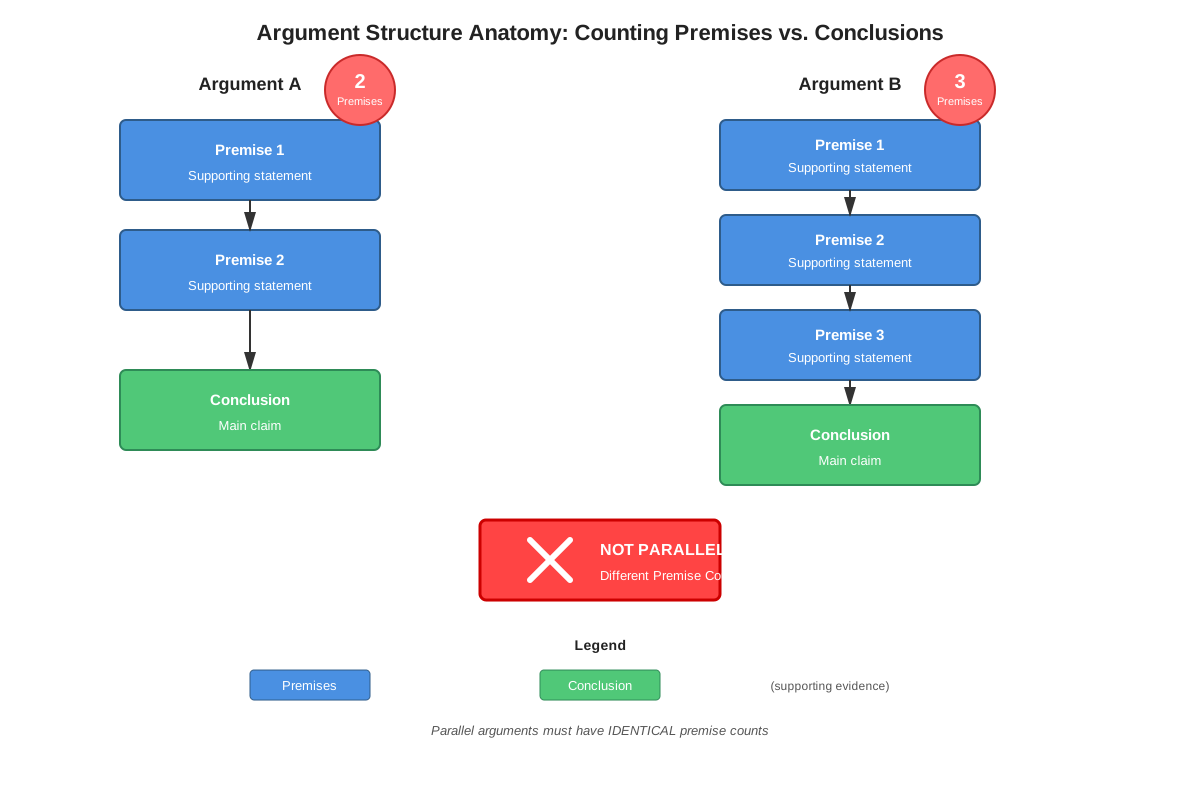
Premise count in parallel questions represents a critical structural element in LSAT Logical Reasoning that tests a student's ability to recognize and match the formal architecture of arguments. When the LSAT asks test-takers to identify an argument that parallels the reasoning in a stimulus, one of the most reliable and efficient screening mechanisms involves counting the number of premises in both the original argument and each answer choice. This technique serves as a powerful elimination tool because parallel arguments must maintain structural identity—if the stimulus contains two premises leading to a conclusion, the correct answer must also contain exactly two premises leading to a conclusion.
Understanding premise count becomes essential because parallel reasoning questions appear with notable frequency on the LSAT, typically 2-3 times per test section. These questions demand that students move beyond content analysis to focus on the formal structure of argumentation. The ability to quickly and accurately count premises allows test-takers to eliminate wrong answers in seconds rather than minutes, creating significant time savings that can be allocated to more challenging questions. This skill transforms what many students perceive as time-consuming questions into manageable, systematic exercises in pattern recognition.
Within the broader landscape of Logical Reasoning, premise counting connects directly to fundamental skills in argument analysis, including identifying conclusions, recognizing support structures, and understanding the relationship between evidence and claims. Mastery of this topic strengthens overall performance across multiple question types, including Strengthen, Weaken, and Assumption questions, all of which require precise identification of an argument's component parts. The discipline of counting premises reinforces the analytical rigor necessary for LSAT success while providing a concrete, actionable strategy for one of the exam's most distinctive question types.
Learning Objectives
- [ ] Identify how premise count in parallel questions appears in LSAT questions
- [ ] Explain the reasoning pattern behind premise count in parallel questions
- [ ] Apply premise count in parallel questions to solve LSAT-style problems accurately
- [ ] Distinguish between premises, sub-conclusions, and main conclusions within complex argument structures
- [ ] Evaluate answer choices systematically using premise count as a primary elimination criterion
- [ ] Recognize when premise count alone is sufficient versus when additional structural analysis is required
Prerequisites
- Basic argument structure identification: Understanding the distinction between premises (supporting statements) and conclusions (claims being supported) is fundamental to counting premises accurately.
- Conclusion indicator recognition: Familiarity with words like "therefore," "thus," "consequently," and "so" enables quick identification of where premises end and conclusions begin.
- Premise indicator recognition: Knowledge of terms like "because," "since," "given that," and "for" helps identify the boundaries between individual premises.
- Conditional reasoning basics: Some parallel questions involve conditional statements, requiring recognition of sufficient and necessary conditions within premise structures.
Why This Topic Matters
In legal practice and critical thinking more broadly, the ability to recognize structural parallels between arguments enables practitioners to apply precedent, identify analogous reasoning, and evaluate the strength of comparative claims. Lawyers regularly argue that one case should be decided like another because the reasoning structure is parallel, making this skill directly relevant to legal education and practice.
On the LSAT specifically, parallel reasoning questions appear in approximately 10-15% of Logical Reasoning sections, making them a high-frequency question type that significantly impacts overall scores. These questions typically appear as "Parallel Reasoning" or "Parallel Flaw" questions, with stem language such as "Which one of the following exhibits a pattern of reasoning most similar to that in the argument above?" or "The flawed reasoning in which one of the following is most similar to that in the argument above?"
Premise count in parallel questions appears most commonly in three contexts: (1) straightforward parallel reasoning questions where structural matching is the primary task, (2) parallel flaw questions where both the structure and the type of error must match, and (3) complex arguments with multiple layers where distinguishing premises from sub-conclusions becomes critical. Test-makers deliberately construct wrong answers with incorrect premise counts, knowing that students who fail to count systematically will waste time analyzing structurally incompatible options. According to LSAT preparation data, students who master premise counting improve their accuracy on parallel questions by 25-40% while reducing time spent per question by 30-60 seconds.
Core Concepts
Understanding Premises in Logical Arguments
A premise is a statement offered as evidence or support for a conclusion. In LSAT arguments, premises provide the factual basis, assumptions, or reasons that the arguer uses to justify their main claim. Identifying premises requires recognizing statements that answer the question "Why should I believe the conclusion?" Each distinct piece of evidence or separate reason constitutes a separate premise, even if multiple premises work together to support a single conclusion.
The critical distinction for lsat premise count in parallel questions involves recognizing that premises must be counted individually, not grouped by topic or theme. For example, consider: "All dogs are mammals. All mammals are warm-blooded. Therefore, all dogs are warm-blooded." This argument contains two premises (the first two statements) and one conclusion, regardless of the fact that both premises relate to classification. Students must develop the discipline to count each supporting statement separately.
The Structural Identity Principle
Parallel reasoning questions test structural identity—the requirement that two arguments share the same formal architecture regardless of their content. This principle means that if an original argument has the structure "Premise 1 + Premise 2 → Conclusion," the correct parallel must also follow "Premise 1 + Premise 2 → Conclusion," even though the specific content will differ entirely. The number of premises represents the most basic and easily verifiable aspect of structural identity.
The structural identity principle extends beyond mere counting to include the relationships between premises. Two premises might work independently (each providing separate support for the conclusion) or dependently (working together as a chain where one premise supports another, which then supports the conclusion). However, premise counting serves as the essential first filter: if the counts don't match, structural identity is impossible, and the answer choice can be eliminated immediately.
Distinguishing Premises from Conclusions
Accurate premise counting depends on reliably distinguishing premises from conclusions. The conclusion is the main claim the argument seeks to establish—the statement that requires support. Premises are the statements providing that support. Several strategies facilitate this distinction:
- Indicator word method: Look for conclusion indicators (therefore, thus, hence, consequently, so, it follows that) and premise indicators (because, since, for, given that, as, inasmuch as)
- Question method: Ask "What is the author trying to prove?" (conclusion) and "What reasons does the author give?" (premises)
- Dependency test: Premises can stand alone as factual claims; conclusions depend on premises for their justification
- Removal test: If removing a statement would leave the argument without support, it was a premise; if removal would leave the argument without a main point, it was the conclusion
Sub-Conclusions and Complex Structures
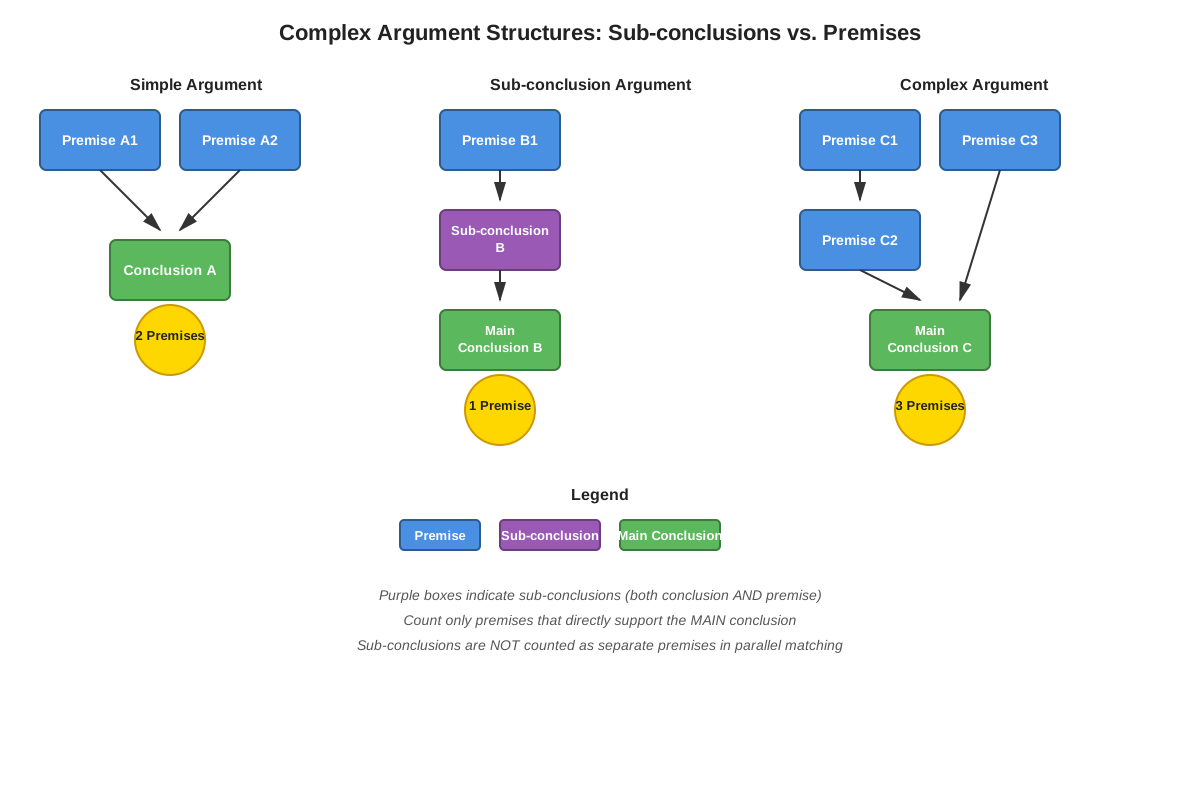
Some arguments contain sub-conclusions (also called intermediate conclusions)—statements that function as both a conclusion (supported by some premises) and a premise (supporting the main conclusion). For premise counting purposes, the critical question is whether to count sub-conclusions as premises when they support the main conclusion.
The LSAT convention treats sub-conclusions as premises when counting support for the main conclusion. Consider: "All birds have feathers. Penguins are birds. Therefore, penguins have feathers. Animals with feathers require specialized care. Therefore, penguins require specialized care." This argument has a sub-conclusion ("penguins have feathers") that serves as a premise for the main conclusion ("penguins require specialized care"). For parallel matching, this structure requires an answer with the same two-tier architecture: initial premises → sub-conclusion → additional premise → main conclusion.
Counting Methodology
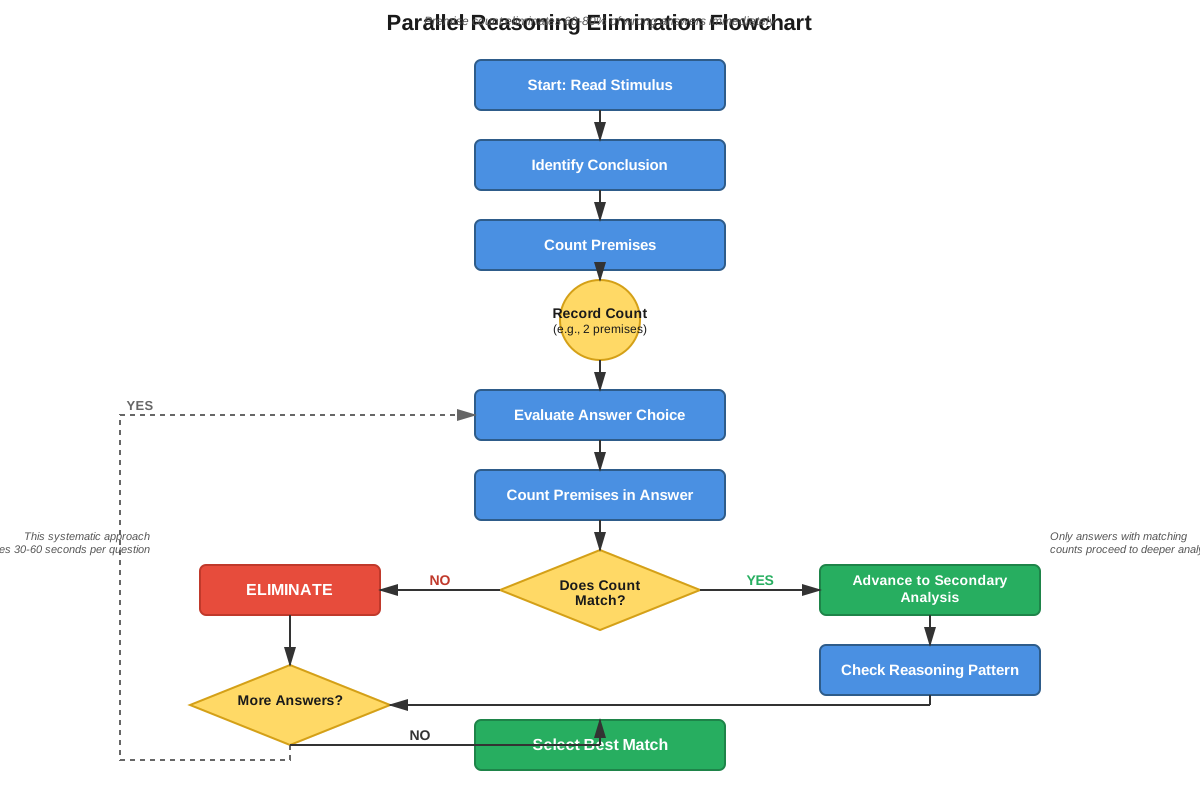
A systematic approach to premise count in parallel questions involves these steps:
- Identify the conclusion first: Locate the main claim using indicator words or logical structure
- Mark all remaining statements: Everything that isn't the conclusion is potentially a premise
- Count distinct supporting statements: Each separate piece of evidence counts as one premise
- Note the structure: Record whether premises work independently or in a chain
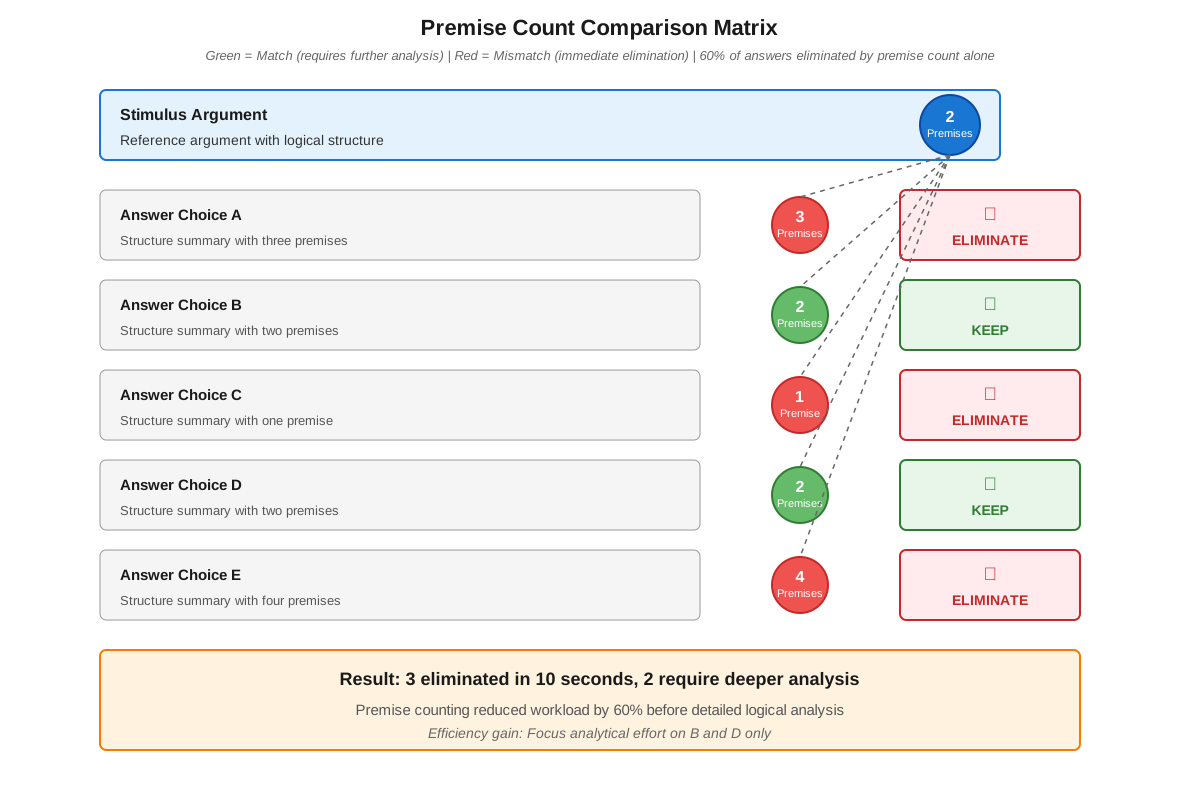
- Apply to answer choices: Eliminate any choice with a different premise count
- Verify remaining choices: For choices with matching counts, check deeper structural elements
Common Premise Count Patterns
LSAT arguments typically follow several standard patterns:
| Pattern | Structure | Example Framework |
|---|---|---|
| Single Premise | P → C | "All A are B. Therefore, this A is B." |
| Two Independent Premises | P1 + P2 → C | "All A are B. All C are B. Therefore, all A are C." |
| Premise Chain | P1 → P2 → C | "All A are B. All B are C. Therefore, all A are C." |
| Three Premises | P1 + P2 + P3 → C | Multiple pieces of evidence converging on one conclusion |
| Sub-Conclusion Structure | P1 + P2 → SC + P3 → C | Layered reasoning with intermediate steps |
Recognizing these patterns accelerates both counting and structural matching. The most common pattern on the LSAT involves two premises supporting a conclusion, making this the baseline expectation that students should verify or adjust based on the specific stimulus.
Background Information vs. Premises
A frequent complication involves distinguishing premises from background information or context. Background information sets the stage for an argument but doesn't directly support the conclusion. For example: "In recent years, coffee consumption has increased. Studies show caffeine improves alertness. Therefore, the increase in coffee consumption will lead to improved workplace productivity." The first sentence provides context but doesn't directly support the conclusion; only the second sentence (about caffeine and alertness) functions as a premise. For parallel purposes, this is a one-premise argument, and the correct answer should also contain contextual information plus one premise.
The distinction matters because test-makers often include background statements to inflate the apparent complexity of arguments and create wrong answers with inflated premise counts. Students must ask of each statement: "Does this directly support the conclusion, or does it merely provide context?"
Concept Relationships
The skill of counting premises in parallel questions builds directly on argument structure identification, which provides the foundational ability to distinguish premises from conclusions. This foundational skill → enables → premise counting, which serves as the first-level filter in parallel reasoning questions. Premise counting → combines with → structural pattern recognition to create a complete parallel reasoning strategy.
Within the topic itself, distinguishing premises from conclusions → enables → accurate premise counting → which facilitates → rapid elimination of structurally incompatible answers → leading to → efficient identification of correct parallel arguments. The ability to recognize sub-conclusions → refines → premise counting accuracy → preventing → false eliminations of correct answers with complex structures.
Premise counting connects to broader logical reasoning skills by reinforcing the analytical discipline required for assumption identification (which requires knowing what premises are present and what's missing), strengthen/weaken questions (which require understanding what would add to or undermine existing premises), and method of reasoning questions (which explicitly test understanding of argument structure). Mastery of premise counting → transfers to → improved performance across multiple question types → contributing to → overall Logical Reasoning score improvement.
The relationship to parallel reasoning more broadly positions premise counting as the first step in a multi-stage process: count premises → match basic structure → verify logical form → confirm reasoning pattern → select answer. Each stage depends on the previous one, making premise counting the gateway skill that determines efficiency for the entire question type.
Quick check — test yourself on Premise count in parallel questions so far.
Try Flashcards →High-Yield Facts
⭐ Parallel reasoning questions require structural identity, not content similarity—the correct answer will discuss completely different subject matter but follow the same logical architecture.
⭐ Premise count serves as the fastest and most reliable first-level elimination criterion—if the premise count doesn't match, the answer is definitively wrong regardless of other factors.
⭐ The most common LSAT argument structure involves two premises supporting one conclusion—this pattern appears in approximately 40% of parallel reasoning stimuli.
⭐ Sub-conclusions count as premises when they support the main conclusion—a statement can function as both a conclusion (of earlier premises) and a premise (for the final conclusion).
⭐ Background information and context do not count as premises—only statements that directly support the conclusion should be counted.
- Premise indicators (because, since, for, given that) signal the beginning of supporting statements and help establish premise boundaries.
- Conclusion indicators (therefore, thus, hence, consequently) mark the transition from premises to conclusion and help determine what not to count as a premise.
- Wrong answers in parallel questions often match content themes but fail to match structure—test-makers exploit the tendency to focus on subject matter rather than form.
- Compound sentences may contain multiple premises—"Dogs are mammals and mammals are warm-blooded" contains two distinct premises despite being one sentence.
- Questions asking for "parallel flaw" require matching both premise count and error type—the structural match must include the specific logical mistake.
- Independent premises each provide separate support for the conclusion, while dependent premises form a chain where one supports another—both types must be counted but the relationship matters for complete structural matching.
- Conditional statements (if-then structures) count as single premises even when they contain multiple clauses—"If it rains, then the ground will be wet" is one premise, not two.
- Quantifier patterns (all, some, none) must match in parallel reasoning—an argument using "all" in its premises should parallel to an answer using "all," not "some."
Common Misconceptions
Misconception: Parallel reasoning questions require matching the content or subject matter of the original argument.
Correction: Parallel reasoning tests structural identity only—the correct answer will almost always discuss completely different content while maintaining the same logical form. An argument about dogs and mammals might correctly parallel an argument about cars and vehicles, despite having no thematic connection.
Misconception: Longer statements always contain multiple premises that should be counted separately.
Correction: Sentence length doesn't determine premise count; logical function does. A single long sentence might contain one premise with elaboration, while a short sentence might contain multiple distinct claims. Count based on the number of distinct supporting ideas, not the number of words or sentences.
Misconception: Background information at the beginning of an argument counts as a premise.
Correction: Only statements that directly support the conclusion count as premises. Context-setting information, historical background, or scene-setting details don't provide logical support and shouldn't be counted. Ask: "Does removing this statement weaken the support for the conclusion?" If not, it's not a premise.
Misconception: If two answer choices have the same premise count as the stimulus, premise counting can't help further.
Correction: While premise counting alone won't distinguish between these answers, it has successfully eliminated three wrong answers, saving significant time. After using premise count as the first filter, students should then examine the logical relationships between premises and the type of reasoning employed.
Misconception: Sub-conclusions make premise counting impossible or unreliable.
Correction: Sub-conclusions follow consistent rules—they count as premises when supporting the main conclusion. The presence of a sub-conclusion creates a specific structural pattern (layered reasoning) that must be matched in the correct answer. Rather than making counting impossible, sub-conclusions create a more specific structural fingerprint.
Misconception: Parallel flaw questions don't require matching premise count, only matching the type of error.
Correction: Parallel flaw questions require both structural matching (including premise count) and error-type matching. The flaw must occur within the same structural framework. An argument with two premises committing a sampling error must parallel to an answer with two premises committing a sampling error, not an answer with three premises committing the same error.
Misconception: Conditional statements contain multiple premises because they have multiple parts (antecedent and consequent).
Correction: A conditional statement functions as a single premise regardless of its internal complexity. "If A, then B" is one premise, not two. However, if an argument contains multiple conditional statements ("If A, then B" and "If B, then C"), these count as separate premises.
Worked Examples
Example 1: Basic Two-Premise Parallel
Stimulus: "All professional athletes train regularly. Maria trains regularly. Therefore, Maria is a professional athlete."
Step 1 - Identify the conclusion: "Maria is a professional athlete" (signaled by "therefore")
Step 2 - Identify and count premises:
- Premise 1: "All professional athletes train regularly"
- Premise 2: "Maria trains regularly"
- Premise count: 2
Step 3 - Note the structure: This is a flawed argument (affirming the consequent) with two independent premises attempting to support the conclusion.
Step 4 - Evaluate answer choices:
(A) "All birds can fly. Penguins are birds. Therefore, penguins can fly."
- Premise count: 2 ✓
- Structure: Two premises, one conclusion ✓
- Reasoning pattern: Valid categorical syllogism ✗ (different from stimulus flaw)
(B) "Most doctors are wealthy. James is wealthy. Therefore, James is probably a doctor."
- Premise count: 2 ✓
- Structure: Two premises, one conclusion ✓
- Reasoning pattern: Affirming the consequent with probability language ✓
- This matches the structure and reasoning pattern
(C) "All roses are flowers. All flowers need water. Therefore, all roses need water."
- Premise count: 2 ✓
- Structure: Two premises, one conclusion ✓
- Reasoning pattern: Valid categorical syllogism ✗ (different from stimulus flaw)
Analysis: Premise counting eliminated no answers here (all had two premises), but it confirmed we were looking for a two-premise structure. The next step—analyzing the reasoning pattern—revealed that only (B) commits the same logical error (affirming the consequent) as the stimulus. This example demonstrates that premise counting is necessary but sometimes not sufficient; it serves as the first filter before deeper analysis.
Example 2: Complex Structure with Sub-Conclusion
Stimulus: "All mammals are warm-blooded. Whales are mammals. Therefore, whales are warm-blooded. All warm-blooded animals regulate their body temperature. Therefore, whales regulate their body temperature."
Step 1 - Identify the main conclusion: "Whales regulate their body temperature" (the final claim, supported by everything before it)
Step 2 - Identify the sub-conclusion: "Whales are warm-blooded" (this is supported by the first two statements and supports the main conclusion)
Step 3 - Count premises for the main conclusion:
- The sub-conclusion "whales are warm-blooded" functions as a premise for the main conclusion
- "All warm-blooded animals regulate their body temperature" is a premise for the main conclusion
- Premise count for main conclusion: 2
- Structure note: This is a layered argument with a sub-conclusion
Step 4 - Evaluate answer choices:
(A) "All plants need sunlight. Cacti are plants. Therefore, cacti need sunlight."
- Premise count: 2 ✓
- Structure: Two premises, one conclusion—but NO sub-conclusion ✗
- Eliminated: Missing the layered structure
(B) "All metals conduct electricity. Copper is a metal. Therefore, copper conducts electricity. Copper is used in wiring. Therefore, wiring conducts electricity."
- Premise count for main conclusion: 2 ✓
- Structure: Sub-conclusion ("copper conducts electricity") + additional premise → main conclusion ✓
- Reasoning pattern: Valid categorical reasoning in both layers ✓
- This matches both premise count and layered structure
(C) "All birds have feathers. All animals with feathers can fly. All flying animals migrate. Therefore, all birds migrate."
- Premise count: 3 ✗
- Structure: Three premises leading directly to conclusion, no sub-conclusion ✗
- Eliminated: Wrong premise count and structure
Analysis: This example shows how sub-conclusions affect counting. The stimulus has a 2-2-1 structure (two premises → sub-conclusion, which plus one more premise → main conclusion). Only answer (B) replicates this layered architecture. Premise counting here required recognizing that the sub-conclusion functions as a premise for the main conclusion, making the effective premise count "2" while noting the special layered structure.
Exam Strategy
When approaching premise count in parallel questions on the LSAT, implement this systematic process:
Phase 1 - Stimulus Analysis (30-45 seconds):
- Read the question stem first to confirm it's asking for parallel reasoning
- Identify the conclusion using indicator words or logical structure
- Count premises by marking each distinct supporting statement
- Note any special structural features (sub-conclusions, conditional chains, independent vs. dependent premises)
- Write down the premise count (e.g., "2P → C") on your scratch paper
Phase 2 - Answer Choice Screening (10-15 seconds per choice):
- Identify the conclusion in each answer choice
- Count premises quickly
- Eliminate immediately if premise count doesn't match
- Mark choices with matching counts for deeper analysis
Phase 3 - Structural Verification (20-30 seconds):
- For remaining choices with correct premise counts, verify the relationship between premises
- Check whether the reasoning pattern matches (valid/invalid, type of reasoning)
- Confirm that special structural features (like sub-conclusions) are present if they appeared in the stimulus
Exam Tip: If you can eliminate 3-4 answer choices based solely on premise count, you've saved 60-90 seconds that would have been spent analyzing structurally incompatible options. This time savings is one of the highest-yield strategies in Logical Reasoning.
Trigger words and phrases that signal parallel reasoning questions include:
- "Most similar pattern of reasoning"
- "Reasoning most closely parallels"
- "Exhibits a pattern of reasoning most similar"
- "Parallel flaw" or "flawed reasoning most similar"
- "Same reasoning structure"
Process-of-elimination tips specific to premise counting:
- Eliminate answer choices with different premise counts first—this is definitive and fast
- Watch for answers that add background information not present in the stimulus structure
- Be suspicious of answers that are significantly longer or shorter than the stimulus—length often correlates with structural differences
- If two answers have matching premise counts, look next at whether premises work independently or in a chain
Time allocation advice:
- Spend 30-45 seconds on stimulus analysis (including premise counting)
- Allocate 10-15 seconds per answer choice for initial screening
- Reserve 20-30 seconds for final verification of remaining choices
- Target total time: 90-120 seconds per parallel reasoning question
- If premise counting eliminates 3+ answers quickly, you can afford more time on final verification
Memory Techniques
Mnemonic for Premise Counting Process - "CICV":
- Conclusion first (identify what's being proven)
- Inventory premises (count each supporting statement)
- Count and compare (match to answer choices)
- Verify structure (check relationships for remaining choices)
Visualization Strategy: Picture the argument as a building where premises are foundation blocks and the conclusion is the roof. Count the foundation blocks—if the stimulus has two blocks supporting the roof, the correct answer must also have exactly two blocks, arranged in the same configuration (side-by-side for independent premises, stacked for dependent premises).
Acronym for What NOT to Count - "BBC":
- Background information (context-setting statements)
- Background facts (scene-setting details)
- Conclusion (the claim being supported, not the support itself)
Finger Counting Technique: Physically touch your fingers to your scratch paper as you identify each premise—this kinesthetic reinforcement helps prevent counting errors and creates a physical record you can reference when evaluating answer choices.
Pattern Recognition Shortcut: Memorize that approximately 40% of LSAT parallel reasoning questions use a two-premise structure. When you see a stimulus, your default hypothesis should be "two premises" unless evidence suggests otherwise. This creates a mental baseline that accelerates counting.
Summary
Premise count in parallel questions represents a foundational skill for efficiently solving one of the LSAT's most distinctive question types. By systematically counting the number of premises in the stimulus argument and matching that count in answer choices, test-takers can eliminate structurally incompatible options in seconds, creating significant time savings and improving accuracy. The core principle is structural identity—parallel arguments must maintain the same formal architecture regardless of content differences. Effective premise counting requires distinguishing premises from conclusions, recognizing that sub-conclusions function as premises when supporting main conclusions, and excluding background information from the count. The most common LSAT pattern involves two premises supporting one conclusion, though variations with single premises, three premises, or layered structures with sub-conclusions also appear regularly. Mastery of premise counting serves as the essential first filter in a multi-stage parallel reasoning strategy, enabling students to focus their analytical energy on structurally compatible answer choices rather than wasting time on options that can be eliminated immediately based on premise count alone.
Key Takeaways
- Premise count serves as the fastest and most reliable first-level elimination tool in parallel reasoning questions—if counts don't match, the answer is definitively wrong
- Structural identity, not content similarity, determines correct parallels—focus on the formal architecture of arguments rather than thematic connections
- Sub-conclusions count as premises when supporting the main conclusion—recognize layered argument structures and count accordingly
- Background information and context don't count as premises—only statements that directly support the conclusion should be included in the count
- The most common LSAT pattern uses two premises supporting one conclusion—make this your baseline expectation and adjust based on the specific stimulus
- Systematic counting saves 60-90 seconds per question—by eliminating structurally incompatible answers immediately, you create time for deeper analysis of remaining choices
- Premise counting integrates with broader argument analysis skills—mastery transfers to improved performance on assumption, strengthen, weaken, and method of reasoning questions
Related Topics
Parallel Flaw Questions: Building on premise counting, parallel flaw questions require matching both the structural architecture and the specific type of logical error. Mastering premise count provides the foundation for efficiently identifying arguments that commit the same mistake within the same structure.
Conditional Reasoning in Parallel Questions: Many parallel reasoning questions involve conditional statements (if-then structures) that must be matched in form. Understanding how conditionals function as single premises despite their complexity enables accurate counting in these specialized cases.
Method of Reasoning Questions: These questions explicitly test understanding of argument structure and reasoning patterns. The premise counting skills developed for parallel questions transfer directly to describing how arguments proceed from evidence to conclusion.
Argument Structure Mapping: Advanced parallel reasoning requires visualizing the relationships between premises and conclusions. Developing diagramming skills for complex arguments with multiple layers enhances both counting accuracy and structural matching.
Formal Logic and Categorical Reasoning: Many parallel reasoning questions involve categorical statements (all, some, none) and formal logical relationships. Understanding these patterns deepens the ability to recognize when structures truly match beyond mere premise count.
Practice CTA
Now that you've mastered the systematic approach to premise counting in parallel questions, it's time to apply these strategies to real LSAT questions. Work through the practice questions provided, focusing on implementing the CICV process (Conclusion, Inventory, Count, Verify) for each stimulus. Time yourself to ensure you're achieving the target of 90-120 seconds per question, and track how many answer choices you can eliminate based solely on premise count. Remember that every parallel reasoning question you encounter strengthens your structural analysis skills, creating compound benefits across all Logical Reasoning question types. Your ability to count premises accurately and efficiently will directly translate to points on test day—make this skill automatic through deliberate practice.
Sign up free to keep reading
Create a free AnvayaPrep account to finish this LSAT guide on Premise count in parallel questions — plus flashcards and practice questions.