Overview
Quantified parallel reasoning represents a sophisticated subset of parallel reasoning questions on the LSAT Logical Reasoning section. These questions require test-takers to identify arguments that share not only the same logical structure but also the same quantifier relationships—such as "all," "some," "most," "none," or "few." While standard parallel reasoning questions focus primarily on matching the overall argumentative form, quantified parallel reasoning demands precise attention to the scope and strength of claims made in both the original argument and the answer choices. This distinction makes these questions particularly challenging and high-yield for exam preparation.
Understanding quantified parallel reasoning is essential for LSAT success because these questions test multiple skills simultaneously: the ability to abstract logical structure from content, recognize quantifier relationships, and match patterns with precision. The LSAT frequently uses these questions to distinguish between high-scoring and mid-range test-takers, as they require both conceptual understanding and careful execution. Students who master this topic gain a significant advantage in the Logical Reasoning section, where even a few additional correct answers can dramatically improve overall scores.
Within the broader landscape of logical reasoning, quantified parallel reasoning builds upon foundational skills in argument analysis, formal logic, and pattern recognition. It connects directly to categorical reasoning, conditional logic, and the interpretation of quantified statements—all critical components of LSAT success. Mastering this topic strengthens overall logical reasoning abilities and provides transferable skills applicable to other question types, including Must Be True, Sufficient Assumption, and Flaw questions that involve quantified claims.
Learning Objectives
- [ ] Identify how quantified parallel reasoning appears in LSAT questions
- [ ] Explain the reasoning pattern behind quantified parallel reasoning
- [ ] Apply quantified parallel reasoning to solve LSAT-style problems accurately
- [ ] Distinguish between different types of quantifiers and their logical implications
- [ ] Recognize when quantifier mismatches eliminate answer choices
- [ ] Construct abstract representations of arguments that preserve quantifier relationships
- [ ] Evaluate answer choices systematically using quantifier analysis as a primary filter
Prerequisites
- Basic formal logic notation: Understanding symbols and representations for logical relationships is necessary to abstract argument structures efficiently
- Categorical reasoning: Familiarity with "all," "some," and "no" statements provides the foundation for recognizing quantifier patterns
- Standard parallel reasoning: Competence with matching argument structures without quantifier complexity establishes the baseline skill set
- Conditional logic fundamentals: Knowledge of sufficient and necessary conditions helps distinguish between different types of logical relationships
- Argument structure identification: The ability to separate premises from conclusions is essential for any parallel reasoning task
Why This Topic Matters
Quantified parallel reasoning questions appear with notable frequency on the LSAT, typically comprising 2-4 questions per test across both Logical Reasoning sections. These questions carry the same weight as any other Logical Reasoning question, but their complexity means they often serve as score differentiators. Test-takers who can efficiently and accurately solve these problems gain a measurable advantage, particularly when competing for scores in the 160+ range where every question matters significantly.
In real-world applications, the skills developed through quantified parallel reasoning practice extend far beyond standardized testing. Legal reasoning frequently requires attorneys to identify analogous cases, recognize parallel precedents, and apply established principles to new situations while maintaining precise logical relationships. The ability to abstract structure from content while preserving quantifier relationships is fundamental to legal analysis, statutory interpretation, and persuasive argumentation. Law students and practicing attorneys regularly employ these exact skills when distinguishing cases, crafting analogies, and evaluating the scope of legal rules.
On the LSAT, quantified parallel reasoning appears most commonly in questions that ask test-takers to identify which answer choice "most closely parallels the reasoning" in the stimulus. These questions may also appear as "parallel flaw" questions, where both the original argument and the correct answer contain the same logical error with matching quantifier relationships. The LSAT tests this concept through arguments involving categorical statements, statistical reasoning, and claims about groups and their members—all contexts where quantifier precision determines logical validity.
Core Concepts
Understanding Quantifiers in Logical Arguments
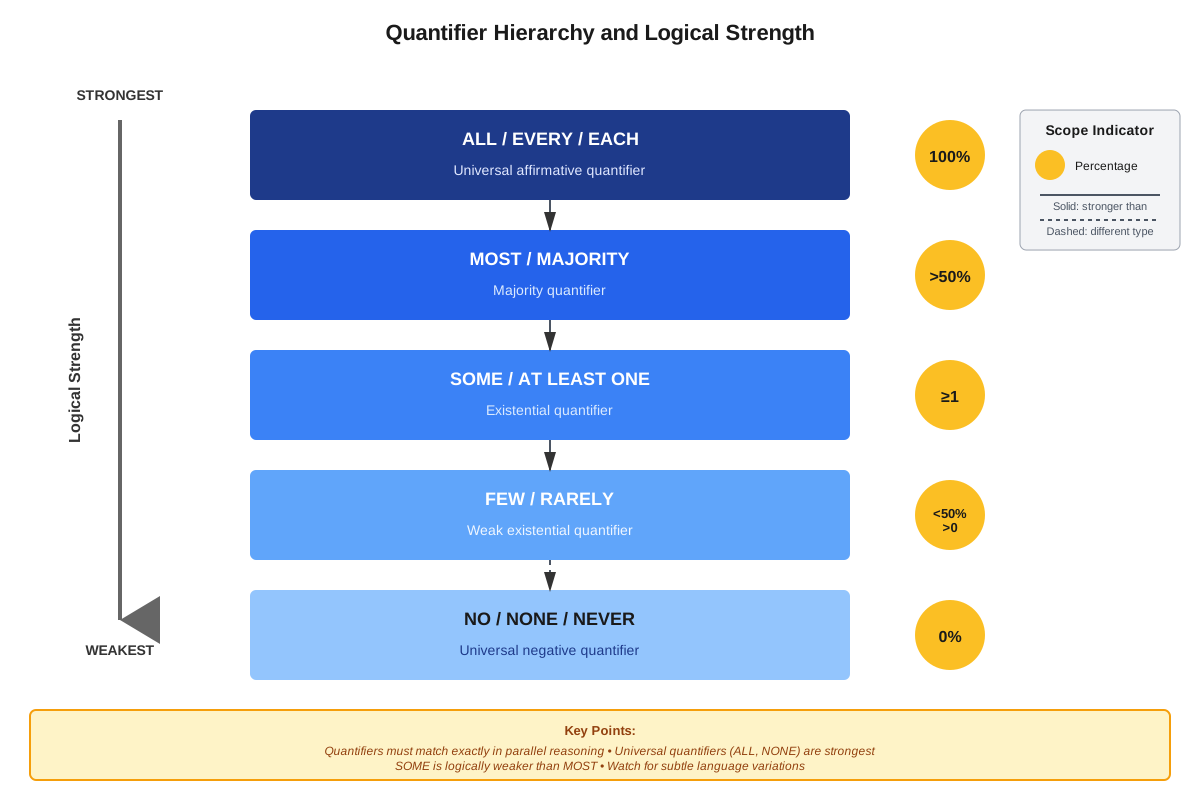
Quantifiers are linguistic elements that specify the scope or extent of a claim. In LSAT quantified parallel reasoning, the most common quantifiers include "all," "some," "most," "none," "few," and "many." Each quantifier carries specific logical implications that must be preserved when matching argument structures. The quantifier "all" indicates universal scope (100% of the category), "some" indicates at least one but possibly all, "most" indicates more than half, and "none" indicates zero instances. Understanding these precise meanings is crucial because substituting one quantifier for another changes the logical structure of an argument, even if the overall form appears similar.
The strength of a quantifier determines the strength of the conclusion it can support. Arguments moving from "all" premises to "all" conclusions follow different logical patterns than arguments moving from "some" premises to "some" conclusions. For instance, an argument structured as "All A are B; All B are C; Therefore, all A are C" follows a valid universal syllogistic form. This structure differs fundamentally from "Some A are B; Some B are C; Therefore, some A are C," which represents an invalid inference. Parallel reasoning questions exploit these distinctions by presenting answer choices that may match the content domain but fail to preserve quantifier relationships.
Structural Abstraction with Quantifier Preservation
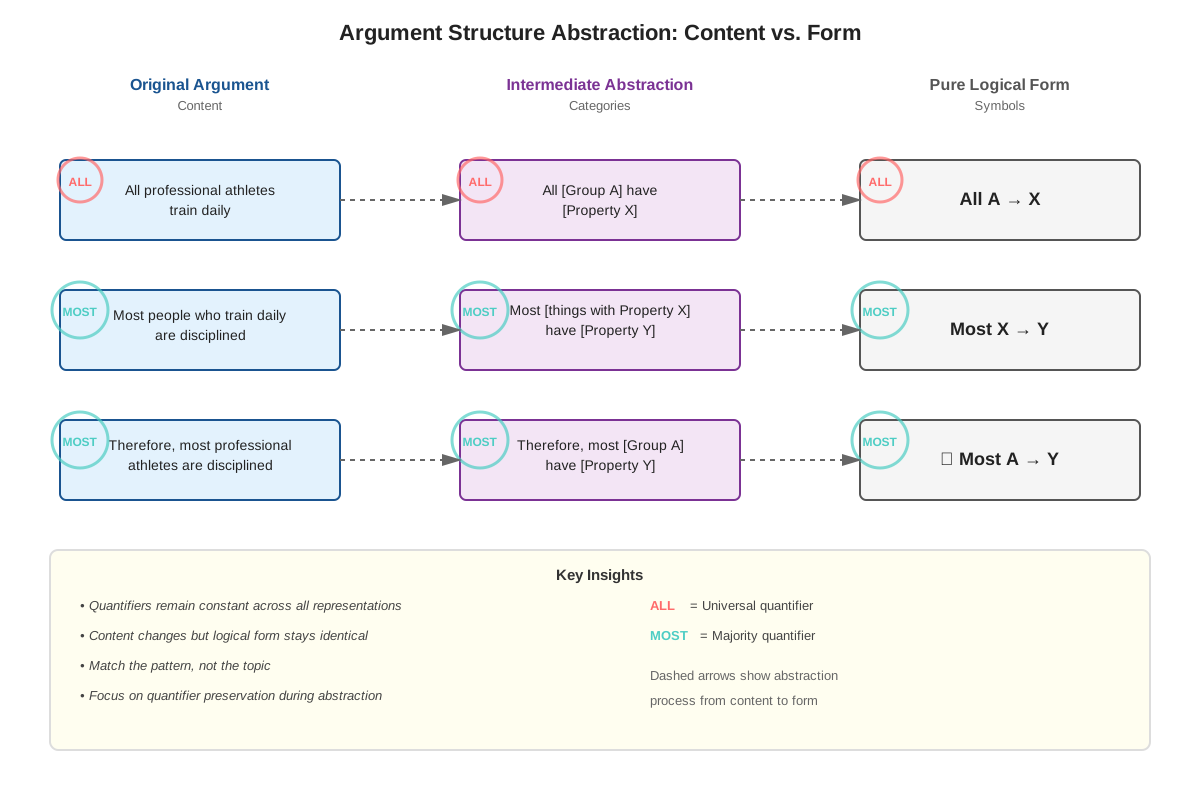
The core skill in quantified parallel reasoning involves creating an abstract representation of an argument that captures both its logical form and its quantifier relationships. This process requires stripping away specific content while maintaining the skeleton of the reasoning. Consider the argument: "All lawyers are professionals. Most professionals work long hours. Therefore, most lawyers work long hours." The abstract structure is: "All X are Y. Most Y are Z. Therefore, most X are Z."
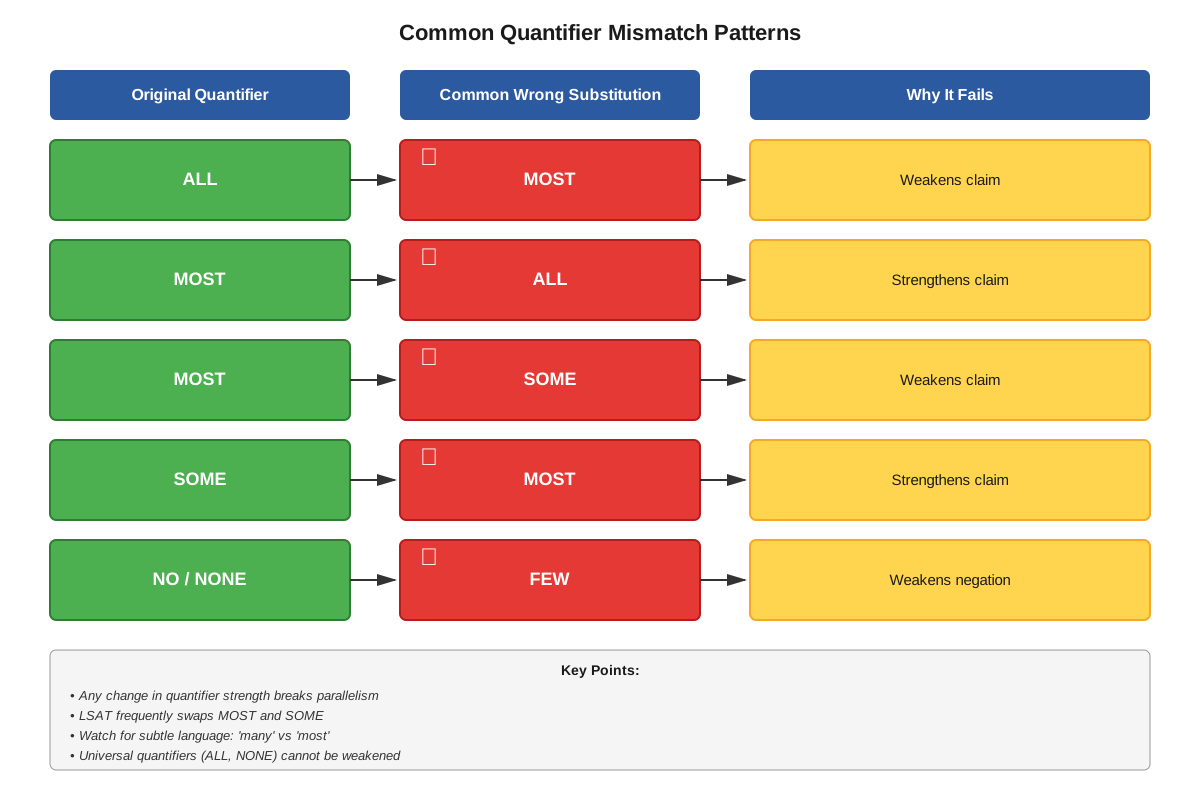
This abstraction process must preserve three elements simultaneously: (1) the number of premises and their relationships, (2) the specific quantifiers used in each statement, and (3) the logical connection between premises and conclusion. A common error involves matching the general form while substituting quantifiers—for example, matching the above argument with "All X are Y. Some Y are Z. Therefore, some X are Z." While this maintains the two-premise structure and the categorical nature of the statements, the quantifier shift from "most" to "some" represents a structural mismatch that would make this an incorrect answer choice.
Quantifier Logic and Valid Inference Patterns
Certain quantifier combinations support valid inferences while others do not. Understanding these patterns is essential for both identifying the structure of the original argument and evaluating answer choices. Valid patterns include:
- Universal-to-Universal: All A are B + All B are C → All A are C (valid)
- Universal-to-Particular: All A are B + Some B are C → Some A are C (invalid—the "some B" might not overlap with A)
- Particular-to-Particular: Some A are B + Some B are C → Some A are C (invalid—no guaranteed overlap)
- Most-to-Most: Most A are B + Most B are C → Some A are C (valid—guaranteed overlap)
The LSAT frequently tests whether test-takers recognize these validity patterns. In parallel reasoning questions, the correct answer must match not only the quantifiers used but also whether the original argument's inference is valid or invalid. A valid argument in the stimulus must be matched with a valid argument in the answer choices, and an invalid argument must be matched with an invalid argument containing the same logical flaw.
Negative Quantifiers and Their Implications
Negative quantifiers such as "no," "none," and "not all" introduce additional complexity to parallel reasoning questions. The statement "No A are B" is logically equivalent to "All A are non-B," but this equivalence must be recognized and preserved in parallel structures. Similarly, "Not all A are B" is equivalent to "Some A are not B," representing a partial negative claim rather than a universal one.
Arguments involving negative quantifiers follow distinct patterns. For example: "No politicians are trustworthy. All senators are politicians. Therefore, no senators are trustworthy." This structure (No A are B; All C are A; Therefore, no C are B) represents a valid negative syllogism. The parallel structure must preserve both the negative quantifier and the valid inference pattern. An answer choice stating "Few A are B; All C are A; Therefore, few C are B" would fail to match because "few" (meaning "not many" or "a small number") differs logically from "no" (meaning "zero").
Quantifier Scope in Complex Arguments
More sophisticated LSAT arguments involve multiple quantified claims with overlapping terms, requiring careful tracking of scope throughout the reasoning chain. Consider: "Most scientists support the theory. All who support the theory accept the evidence. Anyone who accepts the evidence must acknowledge the conclusion. Therefore, most scientists must acknowledge the conclusion."
This argument chains together quantified statements: Most S are T → All T are E → All E are C → Therefore, most S are C. The reasoning preserves the "most" quantifier through a chain of universal statements, which is logically valid because universal statements preserve or reduce (but never increase) the scope of quantified claims. A parallel argument must maintain this same pattern: beginning with a "most" claim, following with universal statements, and concluding with a "most" claim about the relationship between the first and last terms.
Quantifier Mismatches as Elimination Criteria
In lsat quantified parallel reasoning questions, quantifier mismatches provide the fastest and most reliable method for eliminating incorrect answer choices. If the stimulus contains two premises with "all" and "most" quantifiers, any answer choice using "all" and "some," or "some" and "most," or any other combination can be immediately eliminated. This elimination strategy should be applied systematically:
| Stimulus Quantifiers | Must Match In Answer | Can Eliminate If Answer Has |
|---|---|---|
| All, Most | All, Most | All, Some / Some, Most / All, All |
| Some, Some | Some, Some | All, Some / Most, Some / Any other combination |
| No, All | No, All | Few, All / No, Most / Not all, All |
| Most, Most | Most, Most | All, Most / Some, Most / Any other combination |
This systematic approach transforms quantified parallel reasoning from a time-consuming analysis task into an efficient elimination process, allowing test-takers to identify correct answers quickly and confidently.
Concept Relationships
The concepts within quantified parallel reasoning form an interconnected hierarchy. At the foundation lies quantifier identification—recognizing and categorizing the scope indicators in an argument. This skill feeds directly into structural abstraction, where the specific quantifiers identified must be preserved in the abstract representation. Structural abstraction, in turn, enables pattern matching, the process of comparing the original argument's structure against answer choices.
Understanding valid inference patterns connects back to prerequisite knowledge of categorical and conditional reasoning. The validity or invalidity of quantified inferences determines whether a parallel argument must also be valid or flawed, linking quantified parallel reasoning to parallel flaw questions. Negative quantifiers represent a specialized application of quantifier logic, requiring additional attention to logical equivalences and conversions.
The relationship map flows as follows: Quantifier Identification → Structural Abstraction → Pattern Recognition → Validity Assessment → Answer Choice Evaluation. Each step depends on the previous one, and weakness in any single area compromises performance on the entire question type. Mastery requires integrating all these components into a fluid, efficient process.
These concepts also connect to broader LSAT skills. Quantified parallel reasoning reinforces formal logic notation, strengthens argument structure analysis, and develops the abstraction skills necessary for Sufficient Assumption and Principle questions. The quantifier logic learned here applies directly to Must Be True questions involving categorical statements and to Flaw questions that involve scope errors or quantifier shifts.
Quick check — test yourself on Quantified parallel reasoning so far.
Try Flashcards →High-Yield Facts
⭐ Quantifiers must match exactly between the stimulus and correct answer—"most" cannot be substituted for "some" or "all"
⭐ Valid arguments in the stimulus must be matched with valid arguments in answer choices; invalid arguments must be matched with invalid arguments
⭐ "Some" means "at least one, possibly all" in formal logic, not "some but not all" as in casual usage
⭐ "Most" means "more than half" and can support stronger inferences than "some" but weaker inferences than "all"
⭐ Two "most" statements about overlapping categories guarantee at least "some" overlap (if most A are B and most B are C, then some A must be C)
- "No" and "All...not" are logically equivalent and can be treated as matching quantifiers
- "Not all" is equivalent to "some...not" and represents a partial negative, not a universal negative
- Arguments with three or more premises require matching the number of premises and the quantifier of each premise in sequence
- Negative conclusions require negative premises in valid categorical syllogisms
- The order of quantified premises matters when the argument involves a chain of reasoning connecting multiple terms
Common Misconceptions
Misconception: "Most" and "some" are interchangeable in parallel reasoning because both indicate partial quantities.
Correction: "Most" (more than 50%) and "some" (at least one) represent distinct quantifier strengths with different logical implications. An argument concluding "most X are Y" cannot be paralleled by an argument concluding "some X are Y" because the quantifier strength differs, even if the overall structure appears similar.
Misconception: If the content domains are similar (both arguments discuss professions, or both discuss animals), the arguments are more likely to be parallel.
Correction: Content similarity is irrelevant to logical structure. Parallel reasoning requires matching abstract structure and quantifier relationships, not matching subject matter. In fact, the LSAT often uses similar content in incorrect answer choices as a distractor.
Misconception: An argument is parallel if it has the same number of premises and a conclusion, regardless of quantifier relationships.
Correction: Matching the number of statements is necessary but not sufficient. The quantifiers in each corresponding statement must also match. An argument with two "all" premises differs structurally from an argument with one "all" premise and one "most" premise, even if both have two premises total.
Misconception: "Few" and "some" are equivalent quantifiers because both indicate less than "all."
Correction: "Few" typically means "not many" or "a small number" and carries a negative connotation, while "some" means "at least one" without specifying whether the quantity is large or small. These quantifiers have different logical properties and cannot be treated as equivalent in parallel reasoning.
Misconception: If the original argument is flawed, any answer choice with a flaw will be correct.
Correction: In parallel flaw questions, the correct answer must contain the same type of flaw with the same quantifier relationships. Different flaws, even if both arguments are invalid, do not constitute parallel reasoning. The specific nature of the logical error must match, not merely the presence of an error.
Misconception: Complex arguments with multiple quantified statements are too difficult to abstract, so guessing is more time-efficient.
Correction: Complex quantified arguments follow the same abstraction principles as simpler ones. By systematically identifying each quantifier and its position in the argument structure, even complex arguments can be efficiently analyzed. Developing this skill through practice is more effective than guessing.
Worked Examples
Example 1: Valid Universal Syllogism
Stimulus: "All successful entrepreneurs are risk-takers. All risk-takers experience failure at some point. Therefore, all successful entrepreneurs experience failure at some point."
Analysis:
Step 1: Identify the quantifiers—"all" appears in both premises and the conclusion.
Step 2: Abstract the structure—All A are B; All B are C; Therefore, all A are C.
Step 3: Assess validity—This is a valid universal syllogism (Barbara form in classical logic).
Step 4: The correct answer must have two "all" premises leading to an "all" conclusion, and the inference must be valid.
Correct Answer: "All professional athletes are dedicated individuals. All dedicated individuals make personal sacrifices. Therefore, all professional athletes make personal sacrifices."
Why it's correct: This answer preserves the All-All-All quantifier pattern and maintains the valid syllogistic structure. The terms connect in the same way (A→B→C), and the inference is valid.
Incorrect Answer to Avoid: "All professional athletes are dedicated individuals. Most dedicated individuals make personal sacrifices. Therefore, most professional athletes make personal sacrifices."
Why it's incorrect: Despite maintaining the general form and having a valid inference, this answer changes the second premise from "all" to "most," creating a quantifier mismatch. The structure is All-Most-Most, not All-All-All.
Example 2: Invalid Particular Inference
Stimulus: "Some politicians are lawyers. Some lawyers are wealthy. Therefore, some politicians are wealthy."
Analysis:
Step 1: Identify quantifiers—"some" appears in both premises and the conclusion.
Step 2: Abstract the structure—Some A are B; Some B are C; Therefore, some A are C.
Step 3: Assess validity—This is INVALID. Two "some" statements do not guarantee overlap between the first and third terms. The "some lawyers" who are politicians might be entirely different from the "some lawyers" who are wealthy.
Step 4: The correct answer must have two "some" premises leading to a "some" conclusion, and the inference must be invalid in the same way.
Correct Answer: "Some students are athletes. Some athletes are scholarship recipients. Therefore, some students are scholarship recipients."
Why it's correct: This matches the Some-Some-Some pattern and replicates the same logical flaw—assuming overlap between the first and third categories based on their separate relationships to the middle category.
Incorrect Answer to Avoid: "Most students are athletes. Most athletes are scholarship recipients. Therefore, some students are scholarship recipients."
Why it's incorrect: While this answer might seem similar because it also involves students, athletes, and scholarships, it changes the quantifiers from "some" to "most." Additionally, the inference becomes VALID (two "most" statements do guarantee some overlap), which means it fails to parallel the invalid reasoning in the stimulus.
Learning Objective Connection: These examples demonstrate how to identify quantified parallel reasoning in LSAT questions (Objective 1), explain the reasoning patterns including validity assessment (Objective 2), and apply systematic analysis to solve problems accurately (Objective 3).
Exam Strategy
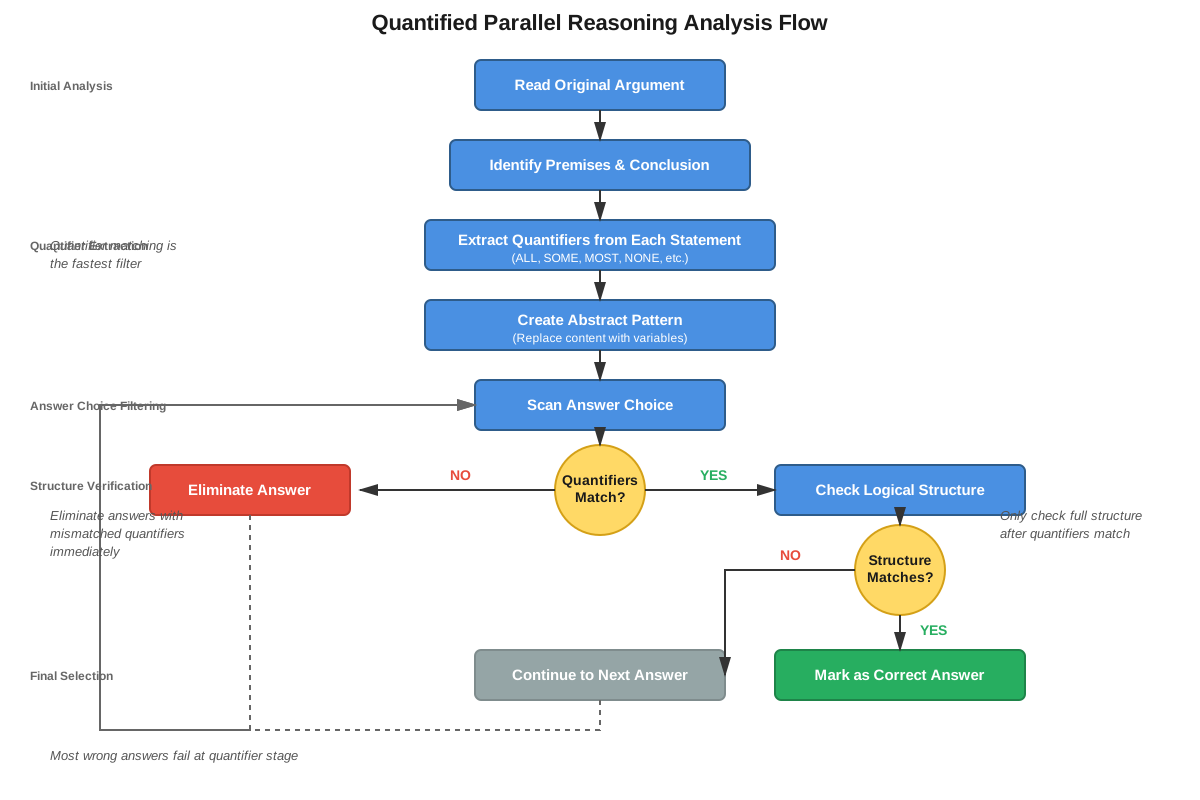
When approaching quantified parallel reasoning questions on the LSAT, implement a systematic four-step process:
Step 1: Identify and catalog all quantifiers in the stimulus before reading answer choices. Write down the sequence (e.g., "All-Most-Most" or "Some-No-Some") to create a quantifier template. This takes 10-15 seconds but saves significant time by providing a clear elimination criterion.
Step 2: Determine whether the argument is valid or invalid. If the conclusion follows logically from the premises, the correct answer must also be valid. If the reasoning contains a flaw, the correct answer must contain the same flaw. This assessment should take no more than 15-20 seconds for most arguments.
Step 3: Scan answer choices for quantifier matches before reading them in detail. Eliminate any choice that doesn't match your quantifier template. This rapid elimination often removes 3-4 answer choices immediately, leaving only 1-2 choices for detailed analysis.
Step 4: Verify the remaining choice(s) by confirming that the logical structure matches beyond just quantifiers—check that the number of premises matches, that terms connect in the same way, and that the conclusion follows (or fails to follow) in the same manner as the stimulus.
Exam Tip: Trigger words for quantified parallel reasoning questions include "most closely parallels the reasoning," "similar pattern of reasoning," "most similar in its logical structure," and "reasoning most similar to that in the argument above."
Time allocation: Spend no more than 90 seconds on quantified parallel reasoning questions. The systematic elimination approach should allow you to identify the correct answer within this timeframe. If you find yourself spending more than 2 minutes, mark the question and return to it if time permits.
Process of elimination tips specific to this topic:
- Eliminate immediately if the number of premises differs
- Eliminate immediately if any quantifier doesn't match
- Eliminate if the validity status differs (valid vs. invalid)
- Be suspicious of answer choices with similar content to the stimulus—these are often distractors
- Watch for answer choices that match most but not all quantifiers—these are designed to trap test-takers who don't check every statement
Memory Techniques
Mnemonic for common quantifier strengths (from strongest to weakest): "All Must Some Few None" (AMSFN)
- All = 100%
- Most = >50%
- Some = ≥1
- Few = small number
- None = 0%
Visualization strategy: Picture quantifiers as containers with different fill levels. "All" is completely full, "most" is more than half full, "some" has at least one drop, and "none" is empty. When matching arguments, visualize whether the containers in the answer choice match the fill levels in the stimulus.
Acronym for the systematic approach: QSVE
- Quantifiers: Identify and catalog
- Structure: Abstract the logical form
- Validity: Assess whether the inference is sound
- Eliminate: Remove mismatches systematically
Memory aid for "most" logic: "Two mosts make some" (If most A are B and most B are C, then some A must be C). Visualize two overlapping circles where more than half of each circle overlaps with the other—there must be some overlap between the outer edges.
Rhyme for negative quantifiers: "No means none, not all means some" (helps distinguish between universal negatives and partial negatives).
Summary
Quantified parallel reasoning represents a high-yield LSAT topic that tests the ability to match logical structures while preserving precise quantifier relationships. Success requires identifying quantifiers accurately, abstracting argument structure while maintaining quantifier information, and systematically eliminating answer choices that fail to match either the quantifier pattern or the validity status of the original argument. The most efficient approach involves cataloging quantifiers before reading answer choices, determining whether the reasoning is valid or flawed, and using quantifier mismatches as the primary elimination criterion. Understanding the logical implications of different quantifiers—particularly the distinctions between "all," "most," "some," and negative quantifiers—enables rapid and accurate answer selection. These questions appear regularly on the LSAT and serve as score differentiators, making mastery essential for achieving competitive scores. The skills developed through quantified parallel reasoning practice extend beyond this specific question type, strengthening overall logical reasoning abilities and supporting performance on related question types involving categorical statements, formal logic, and argument structure analysis.
Key Takeaways
- Quantifiers must match exactly between stimulus and correct answer—no substitutions allowed
- Valid arguments must be matched with valid arguments; invalid with invalid
- Systematic quantifier cataloging before reading answer choices saves time and improves accuracy
- "Most" means more than 50%, "some" means at least one, and these distinctions matter for logical validity
- Two "most" statements guarantee "some" overlap, but two "some" statements do not
- Negative quantifiers ("no," "none") differ logically from partial negatives ("not all," "few")
- Content similarity between stimulus and answer choice is irrelevant—focus on abstract structure
Related Topics
Parallel Flaw Questions: These questions combine quantified parallel reasoning with flaw identification, requiring test-takers to match both the logical structure and the specific error in reasoning. Mastering quantified parallel reasoning provides the foundation for efficiently solving parallel flaw questions.
Categorical Logic and Syllogisms: Understanding formal categorical logic deepens comprehension of why certain quantifier combinations produce valid inferences while others do not. This topic extends the quantifier logic introduced in parallel reasoning to more complex logical systems.
Sufficient Assumption Questions with Quantified Statements: These questions often require identifying the quantified premise that would make an argument valid. The quantifier logic learned in parallel reasoning directly applies to recognizing what quantifier strength is needed to bridge logical gaps.
Must Be True Questions Involving Quantifiers: These questions test whether test-takers can draw valid inferences from quantified premises. The validity patterns learned in parallel reasoning transfer directly to evaluating which conclusions must follow from given quantified statements.
Formal Logic Notation and Diagramming: Advanced formal logic techniques provide additional tools for representing and analyzing quantified arguments, building on the abstraction skills developed in parallel reasoning.
Practice CTA
Now that you've mastered the core concepts of quantified parallel reasoning, it's time to put your knowledge into action. Attempt the practice questions designed specifically for this topic, focusing on applying the systematic four-step approach outlined in the exam strategy section. Use the flashcards to reinforce your understanding of quantifier relationships and valid inference patterns. Remember that quantified parallel reasoning is a skill that improves dramatically with deliberate practice—each question you work through strengthens your pattern recognition abilities and increases your speed. Your investment in mastering this high-yield topic will pay dividends not only on parallel reasoning questions but across the entire Logical Reasoning section. You've built a strong foundation; now apply it with confidence!
Sign up free to keep reading
Create a free AnvayaPrep account to finish this LSAT guide on Quantified parallel reasoning — plus flashcards and practice questions.