Overview
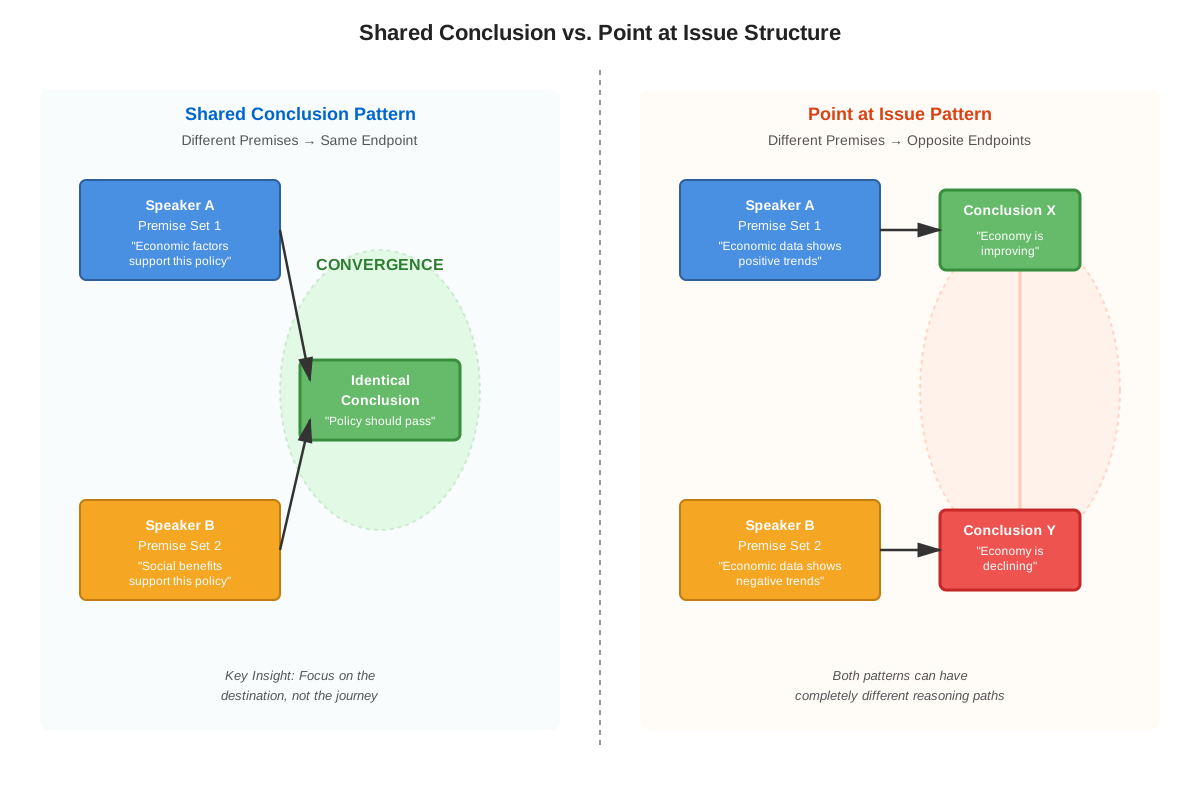
In LSAT Logical Reasoning, shared conclusion questions represent a unique and frequently tested question type that challenges test-takers to identify when two speakers arrive at the same endpoint despite potentially using different reasoning paths. Unlike point at issue and disagreement questions where test-takers must identify where speakers diverge, shared conclusion questions require recognizing convergence—the moment when two distinct arguments lead to identical or substantially similar conclusions. This concept sits at the intersection of argument analysis and comparative reasoning, demanding that students parse multiple argument structures simultaneously while maintaining focus on final claims rather than intermediate reasoning steps.
The ability to identify shared conclusions is essential for the LSAT because it tests multiple critical thinking skills simultaneously: argument structure recognition, conclusion identification, and comparative analysis. These questions typically present two speakers who may disagree on premises, evidence, or reasoning methodology but ultimately support the same final position. The LSAT uses this format to assess whether test-takers can distinguish between the journey (the reasoning process) and the destination (the conclusion), a skill fundamental to legal reasoning where attorneys may advocate for the same outcome using entirely different legal theories.
Within the broader Logical Reasoning framework, shared conclusion questions complement other argument analysis skills. While flaw questions test the ability to identify reasoning errors and assumption questions probe unstated premises, shared conclusion questions assess synthesis and comparison abilities. They connect directly to the point at issue and disagreement unit by presenting the inverse scenario: instead of finding where speakers diverge, students must recognize where they converge. Mastering this topic strengthens overall argument comprehension and prepares students for the nuanced comparative reasoning required throughout the LSAT and in legal practice.
Learning Objectives
- [ ] Identify how Shared conclusion appears in LSAT questions
- [ ] Explain the reasoning pattern behind Shared conclusion
- [ ] Apply Shared conclusion to solve LST-style problems accurately
- [ ] Distinguish between shared conclusions and similar-sounding but distinct conclusions
- [ ] Recognize when speakers use different premises to support identical conclusions
- [ ] Evaluate answer choices by comparing conclusion scope and specificity across multiple arguments
- [ ] Differentiate between shared conclusions and shared premises or intermediate steps
Prerequisites
- Basic argument structure identification: Understanding premises, conclusions, and argument components is essential because shared conclusion questions require isolating the conclusion from each speaker's argument before comparison.
- Conclusion indicator recognition: Familiarity with words like "therefore," "thus," "consequently," and "so" helps quickly locate each speaker's main claim.
- Comparative reasoning fundamentals: The ability to compare and contrast statements is necessary since these questions require determining whether two conclusions are functionally identical.
- Understanding of paraphrasing: Recognizing when two differently worded statements express the same idea is crucial because shared conclusions are rarely stated in identical language.
Why This Topic Matters
Shared conclusion questions appear regularly on the LSAT, typically comprising 2-4 questions per Logical Reasoning section. This frequency makes them a high-yield topic that can significantly impact overall scores. These questions test skills directly applicable to legal practice, where attorneys must recognize when different legal arguments support the same outcome, or when opposing counsel actually agrees on certain points despite appearing adversarial.
In real-world legal contexts, identifying shared conclusions enables attorneys to find common ground in negotiations, recognize when precedents support their position despite different reasoning, and understand when judges reach the same ruling through different legal doctrines. This skill proves invaluable in appellate practice, where multiple judges may concur in judgment while writing separate opinions with distinct reasoning.
On the LSAT, shared conclusion questions most commonly appear in these formats:
- Direct "shared conclusion" questions asking what both speakers would agree upon
- "Commitment" questions asking what a speaker's argument commits them to accepting
- "Agreement" questions explicitly asking for points of convergence
- Inference questions requiring synthesis of multiple viewpoints
The LSAC frequently uses shared conclusion questions to test sophisticated reasoning because they require students to move beyond surface-level reading. Test-takers must resist the temptation to select answer choices that merely represent shared premises or intermediate steps, focusing instead on the ultimate claim each argument supports.
Core Concepts
Definition of Shared Conclusion
A shared conclusion occurs when two or more speakers, through their respective arguments, arrive at the same final claim or position. The conclusion represents the ultimate point each speaker is trying to establish—the "so what" of their argument. Critically, speakers may share a conclusion while disagreeing entirely about premises, evidence, reasoning methodology, or intermediate steps. The shared element is exclusively the endpoint: the final assertion each argument supports.
For LSAT purposes, conclusions need not be worded identically to be "shared." Instead, they must be functionally equivalent—expressing the same claim with the same scope, specificity, and logical force. A shared conclusion might be stated as "The policy will fail" by one speaker and "The policy cannot succeed" by another; these are functionally identical despite different wording.
Distinguishing Conclusions from Premises
The most critical skill for shared conclusion questions is accurately identifying each speaker's conclusion. Many wrong answer choices exploit the common error of confusing premises with conclusions. A premise is a supporting statement—evidence or reasoning offered to support the conclusion. The conclusion is what the premises are meant to establish.
Consider this structure:
- Speaker A: "The law is unjust [premise] because it treats similar cases differently [premise]. Therefore, it should be repealed [conclusion]."
- Speaker B: "The law is ineffective [premise] and wastes resources [premise]. Therefore, it should be repealed [conclusion]."
Here, the speakers share a conclusion (the law should be repealed) but have entirely different premises. An incorrect answer choice might state "Both agree the law is unjust"—but only Speaker A makes this claim. The shared element is exclusively the conclusion.
Patterns of Shared Conclusions
lsat shared conclusion questions follow several recognizable patterns:
| Pattern Type | Description | Example Structure |
|---|---|---|
| Different Evidence, Same Claim | Speakers cite different facts supporting identical conclusions | A: "Sales data shows failure" → Product will fail B: "Customer reviews show failure" → Product will fail |
| Different Reasoning, Same Claim | Speakers use different logical approaches to reach the same endpoint | A: Uses cost-benefit analysis → Policy is unwise B: Uses ethical reasoning → Policy is unwise |
| Opposing Premises, Same Claim | Speakers disagree on facts but reach the same conclusion | A: "Because X is true" → Z should occur B: "Because X is false" → Z should occur |
| Different Scope in Premises, Same Scope in Conclusion | Speakers discuss different aspects but conclude identically | A: Discusses economic factors → Change needed B: Discusses social factors → Change needed |
Scope and Specificity Matching
For conclusions to be truly shared, they must match in both scope and specificity. Scope refers to the breadth of the claim (all, some, most, this particular instance), while specificity refers to the precision of what's being claimed.
Consider these conclusions:
- "Some environmental regulations are counterproductive"
- "All environmental regulations are counterproductive"
These are NOT shared conclusions despite similar wording because they differ in scope. The first makes a limited claim about some regulations; the second makes a universal claim about all regulations.
Similarly, these differ in specificity:
- "The proposed tax will harm the economy"
- "The proposed tax will cause a recession"
The second is more specific than the first. While a recession would harm the economy, harming the economy doesn't necessarily mean causing a recession. These conclusions are related but not shared.
The Role of Intermediate Conclusions
Complex arguments may contain intermediate conclusions—claims that serve as conclusions for some premises while functioning as premises for the ultimate conclusion. Shared conclusion questions test whether students can identify the final, main conclusion rather than being distracted by intermediate steps.
Example structure:
- Premise 1 + Premise 2 → Intermediate Conclusion → Main Conclusion
Two speakers might share an intermediate conclusion without sharing the main conclusion, or vice versa. The LSAT typically asks about the main conclusion, making it essential to trace each argument to its ultimate endpoint.
Negative vs. Positive Conclusions
Shared conclusions can be either positive (asserting something should happen or is true) or negative (asserting something should not happen or is false). The LSAT frequently tests whether students recognize that conclusions with the same logical force are shared even when expressed differently:
- "The plan should not be implemented" = "The plan should be rejected" = "We should refrain from implementing the plan"
All three express the same negative conclusion despite varied wording.
Concept Relationships
The concept of shared conclusion connects directly to fundamental argument analysis skills. Argument structure identification → enables → conclusion isolation → enables → shared conclusion recognition. Without first understanding how to parse individual arguments and locate their conclusions, students cannot compare conclusions across multiple speakers.
Shared conclusion questions exist in deliberate contrast to point at issue and disagreement questions. These two question types form complementary pairs: disagreement questions ask "Where do they differ?" while shared conclusion questions ask "Where do they agree?" Both require comparative analysis but focus on opposite ends of the agreement spectrum. Mastering one reinforces skills needed for the other.
Within the shared conclusion topic itself, concepts build hierarchically:
- Conclusion identification (foundational skill)
- Scope and specificity analysis (refinement skill)
- Functional equivalence recognition (synthesis skill)
- Comparative conclusion analysis (application skill)
The relationship to inference questions is also significant. Some inference questions ask what can be concluded from multiple speakers' statements, requiring synthesis similar to shared conclusion questions. However, inference questions may ask for new conclusions derived from combining information, while shared conclusion questions ask for conclusions already present in the arguments.
High-Yield Facts
⭐ Shared conclusions must match in both scope and specificity—similar-sounding conclusions with different scope are not shared.
⭐ Speakers can share a conclusion while disagreeing completely about premises, evidence, and reasoning methodology.
⭐ The conclusion is what the argument is trying to establish, not the evidence or reasoning used to establish it.
⭐ Functionally equivalent conclusions count as shared even when worded differently—focus on meaning, not phrasing.
⭐ Intermediate conclusions are not the same as main conclusions—always identify the ultimate claim each argument supports.
- Shared conclusion questions typically appear 2-4 times per Logical Reasoning section on the LSAT.
- Wrong answer choices frequently present shared premises rather than shared conclusions.
- Negative conclusions can be expressed in multiple ways while remaining functionally identical.
- The presence of disagreement on some points does not preclude agreement on the conclusion.
- Conclusion indicator words (therefore, thus, hence, so, consequently) help locate each speaker's main claim.
- Some shared conclusion questions ask what speakers are "committed to" rather than explicitly asking for shared conclusions.
- Paraphrasing is standard—the LSAT rarely presents shared conclusions in identical language.
- Speakers may use opposing evidence to support the same conclusion (e.g., "because X is high" vs. "because X is low" both supporting the same outcome).
Quick check — test yourself on Shared conclusion so far.
Try Flashcards →Common Misconceptions
Misconception: If two speakers disagree on any point, they cannot share a conclusion.
Correction: Speakers frequently share conclusions while disagreeing on premises, evidence, or reasoning. Disagreement on supporting elements does not preclude agreement on the final claim. The LSAT specifically tests this by presenting speakers who argue from different perspectives toward the same endpoint.
Misconception: Shared premises indicate shared conclusions.
Correction: Premises and conclusions are distinct argument components. Two speakers might accept the same facts (shared premises) but draw different conclusions from them, or they might disagree on facts but reach the same conclusion through different reasoning paths. Always identify the conclusion specifically—what the argument is trying to establish.
Misconception: Conclusions must be worded identically to be considered shared.
Correction: The LSAT tests functional equivalence, not identical phrasing. Conclusions like "The policy will fail," "The policy cannot succeed," and "The policy is doomed to failure" are functionally identical despite different wording. Focus on the logical content and scope of the claim, not the specific words used.
Misconception: If one speaker's conclusion is more specific than another's, they share a conclusion.
Correction: Shared conclusions must match in specificity and scope. If Speaker A concludes "Some regulations are harmful" and Speaker B concludes "All regulations are harmful," these are different conclusions. The second is broader in scope. Similarly, "The tax will harm the economy" and "The tax will cause a recession" differ in specificity—one is a subset of the other, but they're not identical claims.
Misconception: The first statement in each speaker's argument is always a premise, and the last statement is always the conclusion.
Correction: While conclusions often appear at the end of arguments, they can appear anywhere. Some arguments state the conclusion first, then provide supporting premises. Others embed the conclusion in the middle. Rely on conclusion indicators and logical structure, not position, to identify conclusions.
Misconception: Agreement on what should be done means agreement on why it should be done.
Correction: Shared conclusions concern the "what" (the final claim), not the "why" (the reasoning). Two speakers might agree that a policy should be implemented while completely disagreeing on the reasons for implementation. The LSAT tests whether students can separate the conclusion from the justification.
Worked Examples
Example 1: Different Evidence, Shared Conclusion
Passage:
Speaker A: The new highway project will devastate local businesses. Traffic studies show that bypass routes consistently reduce downtown commerce by 40-60%. Small retailers depend on pass-through traffic, and this highway will eliminate that traffic entirely. Therefore, the city council should reject the highway proposal.
Speaker B: The highway project's environmental impact assessment reveals unacceptable consequences. The proposed route crosses three protected wetlands and would destroy habitat for two endangered species. Given the city's commitment to environmental protection, the city council should reject the highway proposal.
Question: The speakers' arguments commit them to agreeing on which of the following?
Analysis:
Step 1: Identify Speaker A's conclusion
- Look for conclusion indicators: "Therefore" signals the conclusion
- Speaker A's conclusion: "The city council should reject the highway proposal"
- Speaker A's premises: Traffic studies, impact on businesses, elimination of pass-through traffic
Step 2: Identify Speaker B's conclusion
- Look for conclusion indicators: "Given" introduces the final reasoning
- Speaker B's conclusion: "The city council should reject the highway proposal"
- Speaker B's premises: Environmental impact assessment, wetlands, endangered species, city's environmental commitment
Step 3: Compare conclusions
- Both conclusions are identically worded: "The city council should reject the highway proposal"
- Scope matches: Both refer to the same specific proposal and the same specific action (rejection by city council)
- Specificity matches: Both make the same precise claim about what should happen
Step 4: Note the differences (to avoid trap answers)
- Speakers use completely different evidence (economic vs. environmental)
- Speakers have different concerns (business impact vs. environmental protection)
- Speakers likely disagree on which factor is most important
Correct Answer: The city council should reject the highway proposal.
Wrong Answer Examples:
- "The highway project will have negative consequences" (too vague—doesn't capture the specific recommendation to reject)
- "Traffic studies are important for infrastructure decisions" (only Speaker A discusses traffic studies—this is not shared)
- "Environmental protection should guide city policy" (only Speaker B's premise, not the conclusion)
Example 2: Opposing Premises, Shared Conclusion
Passage:
Speaker A: The recent increase in the minimum wage will boost the local economy. When workers earn more, they spend more on goods and services, creating a multiplier effect that benefits all businesses. Higher wages mean more consumer spending, which drives economic growth. Thus, the wage increase will strengthen our economic position.
Speaker B: The recent increase in the minimum wage will strengthen our economic position, though not for the reasons commonly cited. Higher wages will force businesses to invest in automation and efficiency improvements. This technological advancement will increase productivity and make our region more competitive nationally. The pressure to adapt will ultimately benefit the economy.
Question: Speaker A and Speaker B agree that which of the following is true?
Analysis:
Step 1: Identify Speaker A's conclusion
- Conclusion indicators: "Thus" signals the main conclusion
- Speaker A's conclusion: "The wage increase will strengthen our economic position"
- Note: "The recent increase in the minimum wage will boost the local economy" is an intermediate conclusion/restatement
- Speaker A's reasoning: Consumer spending → multiplier effect → economic growth
Step 2: Identify Speaker B's conclusion
- Conclusion indicators: The phrase "will strengthen our economic position" appears early, then is supported
- Speaker B's conclusion: "The wage increase will strengthen our economic position"
- Speaker B explicitly states this is true "though not for the reasons commonly cited"
- Speaker B's reasoning: Wage pressure → automation investment → productivity increase → competitiveness
Step 3: Compare conclusions
- Both use nearly identical language: "strengthen our economic position"
- Scope matches: Both refer to the same wage increase and the same economic outcome
- Specificity matches: Both make the same claim about the ultimate economic effect
Step 4: Recognize the key insight
- The speakers actually disagree on the mechanism (consumer spending vs. forced automation)
- They disagree on the intermediate steps
- Speaker B explicitly acknowledges disagreement on reasoning ("not for the reasons commonly cited")
- Yet they share the ultimate conclusion about the outcome
Correct Answer: The recent minimum wage increase will strengthen the economic position of the region.
Wrong Answer Examples:
- "Higher wages lead to increased consumer spending" (only Speaker A's premise)
- "Businesses will invest in automation due to wage increases" (only Speaker B's premise)
- "The minimum wage increase will have economic effects" (too vague—doesn't capture that both see it as strengthening, not just affecting)
- "Economic growth benefits all businesses" (only Speaker A mentions this)
Key Lesson: This example demonstrates that speakers can reach identical conclusions through contradictory reasoning paths. Speaker B essentially says "You're right about the conclusion but wrong about why." This is a sophisticated pattern the LSAT frequently tests.
Exam Strategy
Systematic Approach to Shared Conclusion Questions
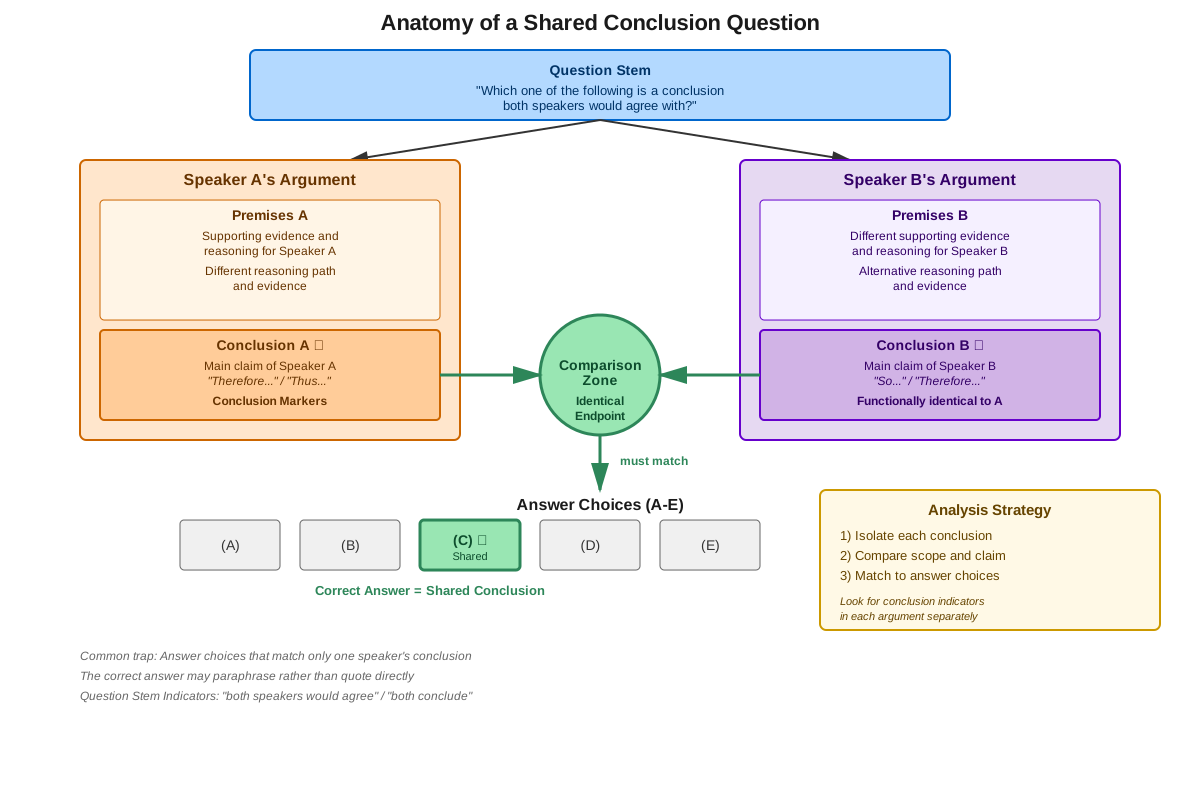
- Identify the question type immediately: Look for phrases like "both speakers agree," "committed to accepting," "shares the conclusion," or "would accept which of the following."
- Isolate each conclusion separately before comparing: Read Speaker A's argument completely and identify the conclusion. Then read Speaker B's argument and identify that conclusion. Only then compare them.
- Use conclusion indicators as guides: Words like "therefore," "thus," "hence," "so," "consequently," "it follows that," and "we can conclude" typically signal conclusions. However, don't rely solely on indicators—understand the logical structure.
- Apply the "so what?" test: Ask yourself, "What is this speaker ultimately trying to convince me of?" The answer is the conclusion.
- Check scope and specificity meticulously: When comparing conclusions, verify that they match in:
- Scope (all, some, most, this particular case)
- Specificity (general claim vs. precise claim)
- Logical force (positive assertion vs. negative assertion)
Trigger Words and Phrases
Question stem triggers for shared conclusion questions:
- "Both speakers agree that"
- "The speakers' arguments commit them to agreeing on"
- "Which one of the following is a claim that both speakers would accept?"
- "The dialogue provides the most support for the claim that the speakers agree that"
- "On the basis of their statements, the speakers are committed to disagreeing about whether" (inverse—asking for disagreement, not shared conclusion)
Conclusion indicators within passages:
- Therefore, thus, hence, so, consequently
- It follows that, we can conclude that
- This means that, this shows that
- For this reason, accordingly
- The point is that, what this establishes is
Process of Elimination Strategy
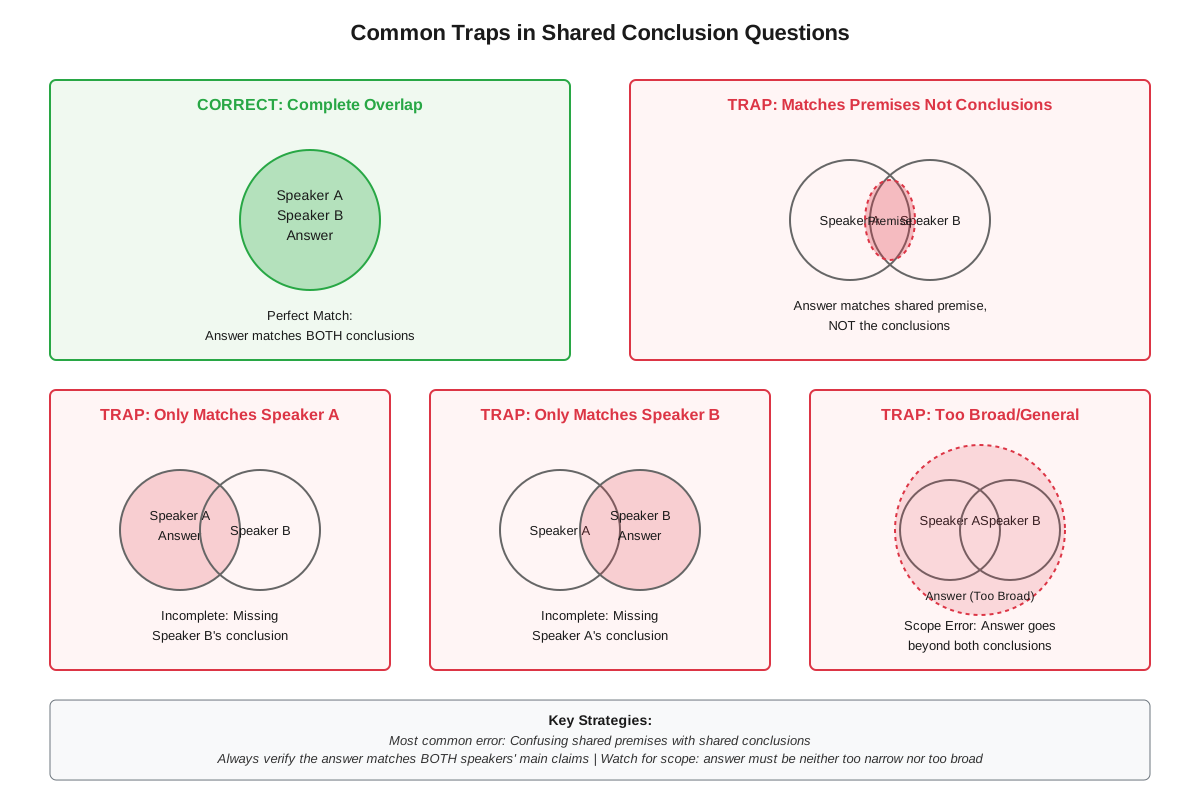
- Eliminate answer choices that represent only one speaker's view: If only Speaker A or only Speaker B would accept the statement, it cannot be a shared conclusion.
- Eliminate shared premises: Many wrong answers present facts or claims both speakers accept as premises but that neither argues as a conclusion.
- Eliminate intermediate conclusions: If both speakers pass through a similar intermediate step but reach different final conclusions, the intermediate step is not the answer.
- Eliminate scope mismatches: If an answer choice is broader or narrower than what both speakers actually conclude, eliminate it.
- Eliminate answers that are too vague: The correct answer should capture the specific conclusion both speakers reach, not a watered-down version that loses important details.
Time Allocation
Shared conclusion questions typically require 60-90 seconds:
- 20-30 seconds: Read and understand both arguments
- 15-20 seconds: Identify each conclusion
- 10-15 seconds: Compare conclusions
- 20-30 seconds: Evaluate answer choices
Exam Tip: If you find yourself spending more than 90 seconds, you may be overthinking. Return to the basics: What is each speaker's main point? Do those main points match?
Common Traps to Avoid
- The Premise Trap: Answer choice states something both speakers use as evidence, not what they conclude
- The Partial Agreement Trap: Answer choice states something one speaker concludes and the other merely accepts as a premise
- The Scope Shift Trap: Answer choice subtly changes the scope from what both speakers actually conclude
- The Intermediate Step Trap: Answer choice identifies a shared intermediate conclusion rather than the main conclusion
- The Implication Trap: Answer choice states something that might follow from both conclusions but that neither speaker actually concludes
Memory Techniques
The SCOPE Acronym
Use SCOPE to remember what must match for conclusions to be shared:
- Same ultimate claim
- Comparable specificity
- Overlapping meaning (functional equivalence)
- Precise scope match (all/some/most)
- Equivalent logical force (positive/negative)
The Journey vs. Destination Visualization
Visualize two hikers taking completely different trails up a mountain—one from the north, one from the south, through different terrain, at different speeds. Despite different journeys (premises and reasoning), they reach the same destination (conclusion). When you see two speakers arguing, picture them as these hikers: different paths, same endpoint.
The "Therefore Test"
To identify conclusions, mentally insert "therefore" before each sentence and ask whether it makes logical sense. The sentence that works best with "therefore" before it is likely the conclusion. For example:
- "Sales are declining" → Could be premise or conclusion
- "Therefore, sales are declining" → Makes sense if this is what's being established
- "Therefore, we should change our strategy" → This is what the declining sales are meant to support—this is the conclusion
The Paraphrase Practice
Create a mental habit of immediately paraphrasing each conclusion in your own words. This helps you focus on meaning rather than specific wording, making it easier to recognize when two differently worded conclusions are functionally identical.
Example:
- Original: "The policy should be rejected"
- Paraphrase: "Don't adopt this policy"
- Recognition: These mean the same thing
Summary
Shared conclusion questions test the ability to identify when two speakers, despite potentially different premises, evidence, or reasoning approaches, arrive at the same ultimate claim. Success requires distinguishing conclusions from premises, recognizing functional equivalence despite different wording, and matching both scope and specificity. The key insight is that speakers can disagree on everything except their final position—they can use opposing evidence, contradictory reasoning, and different values while still supporting identical conclusions. The LSAT tests this by presenting arguments that appear to disagree on the surface but actually converge on the ultimate claim. Students must resist the temptation to select answer choices representing shared premises or intermediate steps, focusing exclusively on the main conclusion each argument establishes. Mastery involves systematic conclusion identification, careful scope analysis, and recognition that the journey (reasoning) and destination (conclusion) are separate elements. This skill proves essential not only for shared conclusion questions specifically but for overall argument analysis throughout the Logical Reasoning section.
Key Takeaways
- Shared conclusions require identical scope and specificity—similar-sounding conclusions with different scope are not shared
- Speakers can share conclusions while disagreeing on everything else—different premises, evidence, and reasoning can support the same conclusion
- Conclusions and premises are distinct—what speakers use as support (premises) differs from what they're trying to establish (conclusions)
- Functional equivalence matters more than identical wording—focus on meaning and logical content, not specific phrasing
- Systematic conclusion identification is essential—isolate each speaker's conclusion separately before comparing
- Wrong answers typically present shared premises or intermediate steps—the correct answer must be what both speakers ultimately conclude
- Conclusion indicators help but aren't foolproof—understand logical structure, not just signal words
Related Topics
Point at Issue and Disagreement Questions: The complementary question type to shared conclusion questions. While shared conclusion questions ask where speakers agree, point at issue questions ask where they disagree. Mastering both provides complete coverage of comparative reasoning questions.
Argument Structure and Conclusion Identification: The foundational skill underlying shared conclusion questions. Deeper study of how to parse complex arguments and identify main conclusions versus intermediate conclusions strengthens performance on all argument-based questions.
Inference Questions with Multiple Speakers: Some inference questions require synthesizing information from multiple speakers to draw new conclusions. These questions build on shared conclusion skills by requiring not just recognition of existing shared conclusions but derivation of new conclusions from combined information.
Method of Reasoning Questions: Understanding how different reasoning approaches can support the same conclusion enhances appreciation of the shared conclusion concept. Method of reasoning questions focus on the "how" of arguments, while shared conclusion questions focus on the "what."
Parallel Reasoning Questions: These questions require identifying arguments with similar logical structures. The skill of recognizing when different surface content expresses the same logical relationship transfers directly to recognizing when different wording expresses the same conclusion.
Practice CTA
Now that you understand the concept of shared conclusions and how they appear on the LSAT, it's time to apply this knowledge. Work through the practice questions to test your ability to identify shared conclusions in various argument formats. Pay special attention to distinguishing conclusions from premises and recognizing functional equivalence despite different wording. The flashcards will help reinforce key concepts and common patterns. Remember: mastery comes from application. Each practice question you complete strengthens your pattern recognition and builds the confidence needed to tackle these questions quickly and accurately on test day. You've learned the framework—now make it automatic through deliberate practice.
Sign up free to keep reading
Create a free AnvayaPrep account to finish this LSAT guide on Shared conclusion — plus flashcards and practice questions.