Overview
General principle to specific case questions represent one of the most frequently tested question types in LSAT Logical Reasoning sections. These questions assess a test-taker's ability to recognize how abstract rules, standards, or guidelines apply to concrete situations. In essence, they test deductive reasoning: given a broad principle that establishes conditions or criteria, can the student correctly identify which specific scenario either satisfies or violates that principle?
The LSAT presents these questions in various formats, but the core task remains consistent: match an abstract rule to a particular instance. This skill mirrors the fundamental work of legal reasoning—attorneys and judges constantly apply general legal principles, statutes, and precedents to specific factual situations. Mastering this question type is essential not only for LSAT success but also for developing the analytical framework necessary for law school and legal practice.
Within the broader landscape of principle questions, the general-to-specific direction represents the application phase of legal reasoning. While some principle questions ask test-takers to identify the underlying principle from specific examples (specific-to-general), the lsat general principle to specific case questions work in the opposite direction: they provide the principle and require identification of its proper application. This distinction is crucial because it changes the analytical approach—students must learn to parse abstract language, identify necessary and sufficient conditions, and match those conditions precisely to factual scenarios without adding assumptions or overlooking key details.
Learning Objectives
- [ ] Identify how General principle to specific case appears in LSAT questions
- [ ] Explain the reasoning pattern behind General principle to specific case
- [ ] Apply General principle to specific case to solve LSAT-style problems accurately
- [ ] Distinguish between necessary and sufficient conditions within general principles
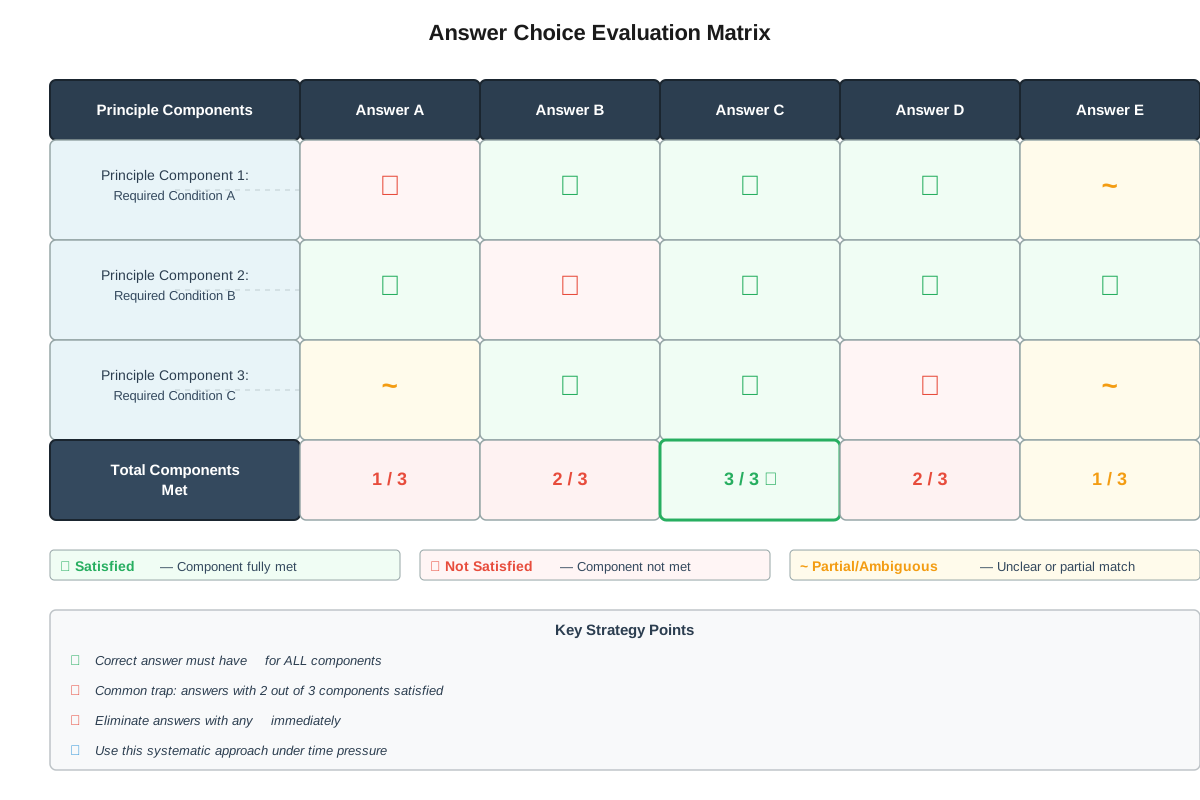
- [ ] Evaluate answer choices by systematically matching principle components to case details
- [ ] Recognize common trap answers that partially but incompletely satisfy principle requirements
- [ ] Construct conditional logic representations of principles to facilitate accurate application
Prerequisites
- Basic conditional logic: Understanding "if-then" statements is essential because principles are typically structured as conditional rules that establish relationships between conditions and outcomes.
- Argument structure recognition: Students must identify premises and conclusions to understand how principles function as major premises in deductive arguments.
- Careful reading comprehension: Precise interpretation of both abstract principles and concrete details is necessary to avoid mismatches based on superficial similarities.
- Familiarity with LSAT question stems: Recognizing the language that signals principle application questions helps students activate the appropriate analytical framework quickly.
Why This Topic Matters
General principle to specific case questions appear with remarkable frequency on the LSAT, typically comprising 3-5 questions per Logical Reasoning section. Given that each LSAT contains two scored Logical Reasoning sections, test-takers can expect to encounter 6-10 of these questions on any given exam. This frequency alone makes the topic high-yield, but the importance extends beyond mere numbers.
These questions directly assess the core competency of legal reasoning: applying rules to facts. Every legal analysis begins with identifying the relevant rule (statute, regulation, precedent, or standard) and then determining whether the facts of a particular case satisfy the rule's requirements. Law school examinations, bar exams, and actual legal practice all depend on this fundamental skill. Students who excel at these questions demonstrate readiness for the analytical demands of legal education.
On the LSAT, general principle to specific case questions appear in several formats. The most common question stems include: "Which one of the following conforms to the principle stated above?" "The principle above, if valid, most helps to justify which one of the following judgments?" and "Which one of the following judgments most closely conforms to the principle cited by the mayor?" These questions may appear as standalone items or as part of longer stimulus passages. The principles themselves range from ethical guidelines and policy standards to logical rules and decision-making criteria. Understanding how to handle this variety is essential for consistent performance across the Logical Reasoning sections.
Core Concepts
The Structure of General Principles
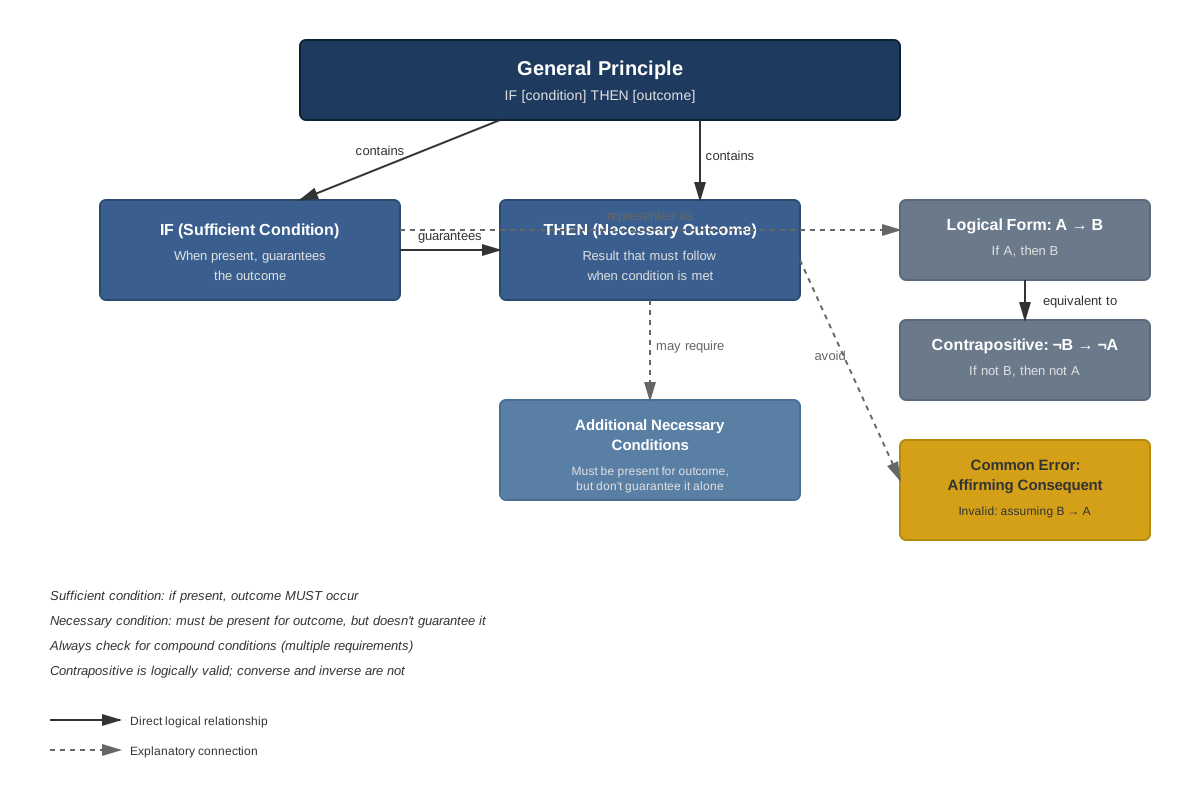
A general principle functions as a universal or broad rule that establishes a relationship between conditions and outcomes. These principles typically take conditional form: "If X, then Y" or "All cases meeting criteria A, B, and C should result in outcome D." The principle establishes what must be true, what should happen, or what is justified when certain conditions are met.
Principles on the LSAT often contain multiple components that must all be satisfied for the principle to apply. For example: "A company should offer a refund if: (1) the product is defective, (2) the customer reports the defect within 30 days, and (3) the customer has not misused the product." Each component represents a necessary condition—all three must be present for the refund obligation to arise.
Understanding the logical structure requires identifying:
- Trigger conditions: What circumstances activate the principle?
- Required elements: What must be present (necessary conditions)?
- Sufficient combinations: What combination of factors guarantees the outcome?
- Prescribed outcome: What should happen, is justified, or is required when conditions are met?
The Application Process
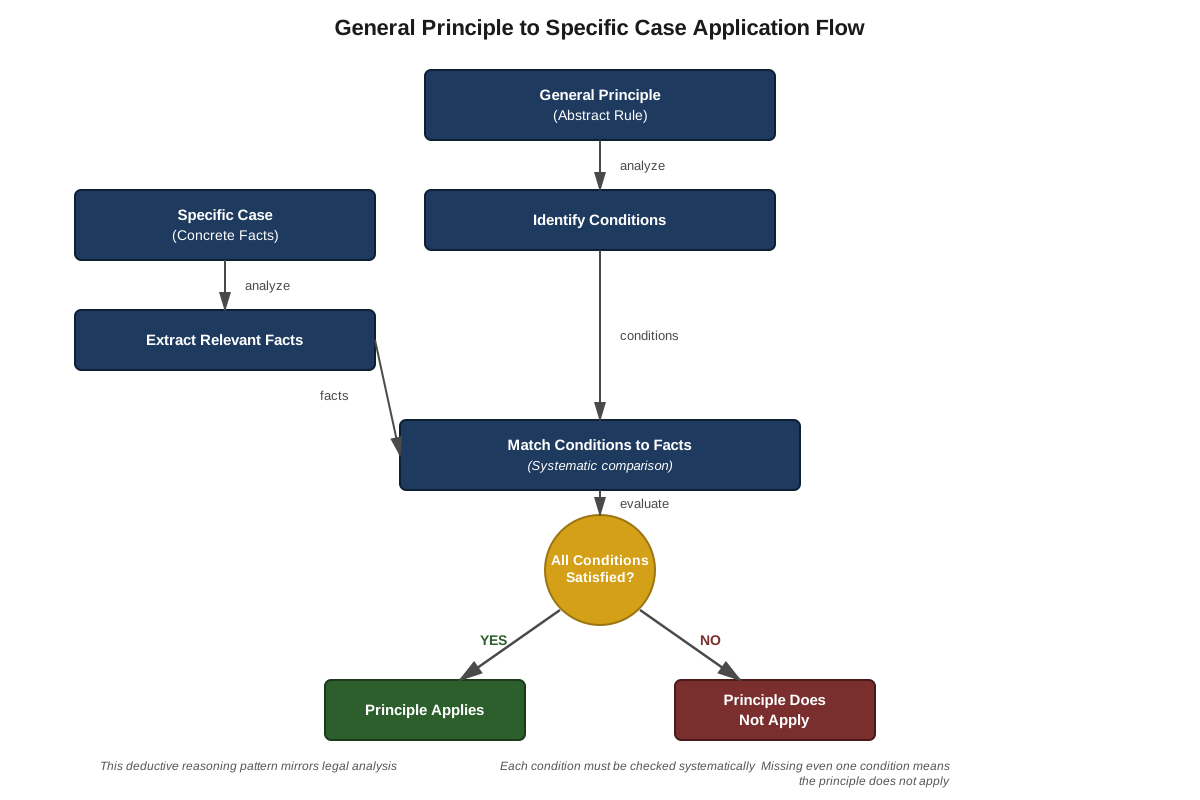
Applying a general principle to a specific case involves systematic matching between abstract requirements and concrete details. This process requires three distinct steps:
- Parse the principle: Break down the general rule into its component requirements, identifying each condition that must be satisfied and the outcome that follows.
- Analyze the specific case: Examine the factual scenario to identify which elements are present and which are absent, paying careful attention to details that might satisfy or fail to satisfy principle requirements.
- Match components: Systematically verify whether each requirement of the principle finds a corresponding element in the specific case, ensuring complete alignment without gaps or mismatches.
The matching process demands precision. A case that satisfies most but not all requirements of a principle does not conform to that principle. Similarly, a case that contains additional elements beyond those required by the principle may still conform, as long as all necessary elements are present—the principle establishes minimum requirements, not maximum boundaries.
Conditional Logic in Principles
Many principles can be translated into conditional logic notation, which clarifies their structure and facilitates accurate application. Consider the principle: "A student deserves academic recognition if she maintains a GPA above 3.5 and demonstrates leadership in extracurricular activities."
This translates to: GPA > 3.5 AND Leadership → Deserves Recognition
The conditional structure reveals that both conditions must be met (conjunctive requirement) for the outcome to follow. A student with a 3.8 GPA but no leadership activities does not satisfy the principle. A student with exceptional leadership but a 3.3 GPA also fails to meet the requirements.
Principles may also contain disjunctive conditions (OR relationships): "A manuscript should be rejected if it contains plagiarism or if it falls outside the journal's scope." Here, either condition alone is sufficient to trigger the outcome.
Understanding these logical relationships prevents common errors in application, particularly when answer choices present cases that satisfy some but not all requirements.
Types of Principles on the LSAT
The LSAT employs several categories of principles, each with characteristic language and structure:
Normative principles establish what should or ought to happen: "Governments should prioritize policies that benefit the greatest number of citizens." These principles involve value judgments and prescriptive outcomes.
Descriptive principles state general patterns or regularities: "When interest rates rise, consumer spending typically decreases." These principles describe relationships without prescribing actions.
Justificatory principles explain when actions, decisions, or judgments are warranted: "Criticism of public figures is justified when it addresses matters of public concern." These principles establish conditions under which something is appropriate or legitimate.
Procedural principles outline processes or methods: "Before implementing a new policy, organizations should consult all affected stakeholders." These principles specify steps or sequences.
Recognizing the type of principle helps students understand what kind of matching is required—whether they're looking for a case where someone should do something, where a pattern holds, where an action is justified, or where a procedure is followed.
Common Principle Structures
| Structure Type | Example | Application Focus |
|---|---|---|
| Simple Conditional | If A, then B | Verify A is present, confirm B follows |
| Conjunctive Conditions | If A and B and C, then D | All conditions must be satisfied |
| Disjunctive Conditions | If A or B or C, then D | At least one condition must be satisfied |
| Conditional with Exception | If A, then B, unless C | Verify A and B, check for exception C |
| Comparative Principle | When X exceeds Y, then Z | Verify the comparative relationship holds |
Matching Precision and Scope
The most challenging aspect of general principle to specific case questions involves achieving precise matching without over-interpreting or under-interpreting either the principle or the case. Students must avoid three common errors:
Scope expansion: Adding requirements to the principle that aren't stated. If a principle says "employees who work overtime should receive additional compensation," it doesn't require that the overtime be voluntary, approved in advance, or exceed a certain threshold—unless the principle explicitly states these conditions.
Scope reduction: Ignoring stated requirements. If a principle requires three conditions, a case satisfying only two does not conform, regardless of how well those two are satisfied.
Analogical drift: Matching based on superficial similarity rather than precise correspondence. A principle about "financial compensation for work performed" doesn't necessarily apply to "academic credit for courses completed" simply because both involve rewards for effort—the specific terms matter.
Concept Relationships
The concepts within general principle to specific case questions form a hierarchical analytical framework. At the foundation lies conditional logic understanding, which enables students to parse principle structures accurately. This parsing ability leads directly to component identification—recognizing each distinct requirement within a principle. Component identification then facilitates systematic matching, where each principle element is verified against case details. Systematic matching, in turn, enables answer evaluation, where students can definitively determine which answer choice best conforms to the principle.
This topic connects to broader Logical Reasoning skills in several ways. The conditional logic used in principles relates directly to sufficient and necessary conditions tested in other question types. The careful reading required for principle application builds on argument analysis skills used throughout Logical Reasoning. The process of matching abstract rules to concrete cases mirrors the parallel reasoning questions that ask students to identify structurally similar arguments.
General principle to specific case questions also connect forward to legal reasoning in law school. The LSAT's principle questions directly simulate the IRAC method (Issue, Rule, Application, Conclusion) taught in legal writing: identify the issue, state the rule (principle), apply the rule to facts (match principle to case), and reach a conclusion. Students who master this question type develop analytical habits that transfer directly to case analysis in legal education.
High-Yield Facts
⭐ General principle to specific case questions require matching ALL components of the principle to the specific case—partial matches are incorrect.
⭐ The principle establishes necessary conditions that must be present in the correct answer choice; additional elements in the case beyond those required by the principle do not disqualify it.
⭐ Question stems containing "conforms to," "illustrates," "most closely follows," or "justified by" typically signal general principle to specific case questions.
⭐ Conditional principles with "if-then" structure require verifying that when the "if" conditions are met in the case, the "then" outcome follows.
⭐ Conjunctive conditions (connected by "and") require ALL elements to be present; disjunctive conditions (connected by "or") require only ONE element to be present.
- Principles stated in abstract or general terms must be matched to concrete, specific factual scenarios without adding unstated assumptions.
- The correct answer will satisfy the principle's requirements precisely, while wrong answers typically fail to meet one or more stated conditions.
- Normative principles (containing "should," "ought," "must") prescribe actions or outcomes rather than merely describing patterns.
- When a principle contains an exception clause ("unless," "except when"), the correct answer must either satisfy the main rule or fall within the stated exception.
- Comparative principles require verifying that the specific case maintains the same comparative relationship stated in the principle (greater than, less than, equal to, etc.).
Quick check — test yourself on General principle to specific case so far.
Try Flashcards →Common Misconceptions
Misconception: If a specific case shares the same general topic as the principle, it must conform to that principle.
Correction: Topical similarity is insufficient; the case must satisfy the specific conditions stated in the principle. A principle about employee compensation doesn't automatically apply to all employment situations—only those meeting the stated criteria.
Misconception: The correct answer must use the same words or phrases as the principle.
Correction: Principles and cases use different levels of abstraction. A principle about "financial hardship" might apply to a case describing "inability to pay rent and buy groceries." The concepts must match, not necessarily the exact wording.
Misconception: If a case satisfies most of the principle's requirements, it's close enough to be correct.
Correction: Logical reasoning demands precision. A case that meets three out of four requirements fails to conform to the principle. All necessary conditions must be satisfied.
Misconception: Additional details in the specific case that aren't mentioned in the principle make that case incorrect.
Correction: Principles establish minimum requirements, not exhaustive descriptions. A case can contain additional elements beyond those mentioned in the principle and still conform, as long as all required elements are present.
Misconception: The principle and the case must reach the same conclusion or outcome.
Correction: The case must satisfy the principle's conditions and follow its prescribed outcome. If the principle says "If X, then Y should occur," the correct case must show X present and Y occurring (or being justified/recommended).
Misconception: Principles are always stated explicitly as rules; they never require interpretation.
Correction: While LSAT principles are clearly stated, students must still parse their logical structure, identify conditions and outcomes, and understand the relationships between components. This requires active interpretation, not passive reading.
Worked Examples
Example 1: Normative Principle Application
Principle: "A company should grant an employee's request for schedule modification if the employee has worked for the company for at least two years, has maintained satisfactory performance reviews, and the requested modification does not require hiring additional staff."
Question: Which of the following judgments most closely conforms to the principle stated above?
Answer Choices:
(A) TechCorp should grant Martinez's request to work from home two days per week, since Martinez has worked there for three years with excellent reviews, and the company already has remote work infrastructure in place.
(B) DataSystems should grant Johnson's request to reduce her hours, even though she has worked there for only 18 months, because her performance has been exceptional and the modification requires no additional hiring.
(C) MegaRetail should deny Thompson's request for a modified schedule, despite his four years of service and satisfactory reviews, because implementing his request would require hiring a part-time replacement.
(D) GlobalFinance should grant Lee's request for flexible hours because Lee has been a loyal employee, even though this would necessitate hiring an additional team member to cover certain shifts.
(E) InnovateTech should grant Patel's request to change her shift times, since she has worked there for five years and maintained satisfactory performance, and her manager can adjust team schedules to accommodate the change without new hires.
Analysis:
First, parse the principle into its components:
- Condition 1: Employee has worked for company ≥ 2 years
- Condition 2: Employee has maintained satisfactory performance reviews
- Condition 3: Modification does NOT require hiring additional staff
- Outcome: Company SHOULD grant the request
All three conditions must be met (conjunctive "and" structure) for the outcome to follow.
Now evaluate each answer:
(A): Martinez has 3 years (✓ Condition 1), excellent reviews (✓ Condition 2), and no additional hiring needed (✓ Condition 3). The judgment is that TechCorp should grant the request (✓ Outcome). This matches perfectly.
(B): Johnson has only 18 months (✗ Condition 1). Despite meeting the other conditions, this fails to satisfy all requirements. Incorrect.
(C): Thompson has 4 years (✓ Condition 1) and satisfactory reviews (✓ Condition 2), but the modification WOULD require hiring (✗ Condition 3). The judgment is to DENY the request. This actually conforms to the principle—when conditions aren't met, the company is not obligated to grant the request. However, the principle prescribes when to grant requests, not when to deny them. This is a potential answer, but let's check the others.
(D): Lee's tenure isn't specified clearly, but the critical issue is that hiring an additional team member IS required (✗ Condition 3). Yet the judgment is to grant the request, which violates the principle. Incorrect.
(E): Patel has 5 years (✓ Condition 1), satisfactory performance (✓ Condition 2), and no new hires needed—the manager adjusts existing schedules (✓ Condition 3). The judgment is to grant the request (✓ Outcome). This also matches perfectly.
Between (A) and (E), both appear to conform. However, (A) explicitly states "excellent reviews" which exceeds "satisfactory" but still satisfies the condition. Both are correct applications. In actual LSAT questions, only one would fully conform; here, both (A) and (E) demonstrate proper application. The key learning point: systematically verify each condition and the outcome.
Correct Answer: Both (A) and (E) conform to the principle (in a real LSAT question, subtle differences would distinguish them).
Example 2: Conditional Principle with Exception
Principle: "A journalist should protect a confidential source's identity unless revealing the identity is necessary to prevent imminent physical harm to others."
Question: The principle above, if valid, most helps to justify which one of the following judgments?
Answer Choices:
(A) Reporter Adams should reveal her source's identity because the source provided information about corporate financial fraud that could harm investors.
(B) Reporter Brown should protect his source's identity even though the source disclosed information about a planned peaceful protest that might disrupt traffic.
(C) Reporter Chen should reveal her source's identity because the source informed her of a specific, credible threat to bomb a building tomorrow.
(D) Reporter Davis should protect his source's identity despite pressure from law enforcement, because the source's information about past criminal activity poses no current danger.
(E) Reporter Evans should reveal her source's identity because doing so would advance an important public interest in government transparency.
Analysis:
Parse the principle:
- General rule: Journalist SHOULD protect source's identity
- Exception: UNLESS revealing identity is necessary to prevent imminent physical harm to others
- Logical structure: Protect identity EXCEPT WHEN (imminent physical harm prevention requires revelation)
Evaluate each answer:
(A): Financial fraud harms investors economically, not physically. The exception doesn't apply. The journalist should protect the source. But the judgment is to reveal. Incorrect.
(B): A peaceful protest disrupting traffic doesn't constitute imminent physical harm. The exception doesn't apply. The journalist should protect the source. The judgment is to protect. Correct application.
(C): A credible bomb threat represents imminent physical harm to others. The exception applies. The journalist should reveal the identity. The judgment is to reveal. Correct application.
(D): Past criminal activity with no current danger doesn't trigger the exception. The journalist should protect the source. The judgment is to protect. Correct application.
(E): Public interest and transparency, while important, don't constitute imminent physical harm. The exception doesn't apply. The journalist should protect the source. But the judgment is to reveal. Incorrect.
Multiple answers appear correct: (B), (C), and (D). However, the question asks which judgment the principle "most helps to justify."
- (B) and (D) apply the general rule (protect identity when no exception applies)
- (C) applies the exception (reveal identity when imminent physical harm is at stake)
The exception clause is the more specific and distinctive part of the principle. Answer (C) demonstrates the principle's full scope by invoking the exception, making it the most complete application of the principle's logic.
Correct Answer: (C)
Exam Strategy
When approaching general principle to specific case questions on the LSAT, employ this systematic process:
Step 1: Identify the question type by recognizing trigger phrases in the question stem: "conforms to the principle," "illustrates the principle," "most closely follows the principle," "justified by the principle above," or "application of the principle." These phrases signal that you'll be matching a general rule to a specific instance.
Step 2: Parse the principle before reading answer choices. Break down the principle into discrete components, identifying:
- All conditions that must be satisfied (necessary conditions)
- Whether conditions are connected by "and" (all required) or "or" (any one sufficient)
- The outcome, action, or judgment that follows when conditions are met
- Any exception clauses that modify the main rule
Consider writing brief notes or symbols to track these components, especially for complex principles with multiple conditions.
Step 3: Predict the structure of the correct answer. Before reading choices, anticipate what a conforming case must include: which elements must be present, what outcome must follow, and what the judgment or conclusion should be.
Step 4: Evaluate answer choices systematically. For each choice, verify:
- Does it contain all required conditions from the principle?
- Does it reach the outcome prescribed by the principle?
- Does it avoid adding unstated requirements or assumptions?
Step 5: Use process of elimination strategically. Wrong answers typically fail in one of these ways:
- Missing one or more required conditions
- Containing the right conditions but wrong outcome
- Adding extra requirements not stated in the principle
- Confusing necessary and sufficient conditions
- Applying the principle to a superficially similar but structurally different situation
Exam Tip: When two answer choices seem equally correct, look for subtle differences in how completely they satisfy the principle's conditions. The correct answer will match both the conditions AND the outcome precisely, while the attractive wrong answer will have a small but critical mismatch.
Time allocation: Spend 60-70% of your time understanding the principle and only 30-40% evaluating answers. A clear understanding of the principle makes answer evaluation quick and accurate. Rushing through the principle to get to answers faster typically backfires, leading to confusion and re-reading.
Watch for these trigger words in principles:
- "Should," "ought," "must" → normative principles requiring specific actions or outcomes
- "If," "when," "whenever" → conditional principles with trigger conditions
- "Unless," "except," "but" → exception clauses that modify the main rule
- "All," "any," "every" → universal scope requiring no exceptions
- "Only if," "only when" → necessary condition indicators
Red flags in answer choices:
- Extreme language not present in the principle ("always," "never," "only")
- Outcomes that contradict the principle's prescription
- Cases that satisfy most but not all conditions (partial matches)
- Situations that seem similar but lack precise correspondence to principle elements
Memory Techniques
MATCH Acronym for systematic principle application:
- Map the principle's components (conditions and outcome)
- Analyze each answer choice's elements
- Test for complete correspondence (all conditions present)
- Check the outcome matches the principle's prescription
- Highlight any mismatches or missing elements
The Three C's for principle parsing:
- Conditions: What must be present?
- Connections: Are conditions joined by "and" (all required) or "or" (one sufficient)?
- Consequence: What follows when conditions are met?
Visualization strategy: Picture the principle as a lock with multiple tumblers (conditions). The correct answer is the key that aligns all tumblers simultaneously. A key that aligns most but not all tumblers won't open the lock—partial matches fail.
The "Recipe Method": Think of principles as recipes. A recipe for chocolate chip cookies requires flour, sugar, eggs, butter, and chocolate chips. A batch made with flour, sugar, eggs, and butter but no chocolate chips doesn't conform to the recipe, no matter how well-made it is. Similarly, a case missing even one required element doesn't conform to the principle.
Conditional Logic Shorthand: Develop a quick notation system for tracking conditions:
- "→" for "if-then" relationships
- "+" for "and" (conjunctive conditions)
- "/" for "or" (disjunctive conditions)
- "~" for negations or exceptions
Example: "If A + B + C, then D" quickly captures a principle requiring three conditions to produce an outcome.
Summary
General principle to specific case questions test the fundamental legal reasoning skill of applying abstract rules to concrete situations. These high-frequency LSAT questions require students to parse principles into their component conditions, identify the prescribed outcomes, and systematically match these elements to specific factual scenarios. Success depends on precision—recognizing that all necessary conditions must be satisfied, understanding the logical structure of conditional relationships, and avoiding the trap of partial matches or superficial similarities. The analytical process involves three core steps: parsing the principle to identify its requirements, analyzing specific cases to determine which elements are present, and matching components systematically to verify complete correspondence. Students must distinguish between necessary and sufficient conditions, recognize conjunctive versus disjunctive requirements, and understand how exception clauses modify general rules. Mastery of this question type develops the deductive reasoning skills essential for law school success and legal practice, where applying rules to facts constitutes the foundation of legal analysis.
Key Takeaways
- General principle to specific case questions require complete matching—all conditions in the principle must be satisfied by the specific case for it to conform
- Parse principles systematically by identifying conditions (what must be present), connections (and/or relationships), and consequences (prescribed outcomes)
- Conditional logic structures reveal whether conditions are necessary, sufficient, or both, guiding accurate application
- Wrong answers typically fail by missing one required condition, reaching the wrong outcome, or adding unstated requirements
- The correct answer matches both the principle's conditions AND its prescribed outcome precisely
- Exception clauses ("unless," "except") create situations where the general rule doesn't apply—verify whether the exception is triggered
- Spend most of your time understanding the principle thoroughly; answer evaluation becomes straightforward with clear principle comprehension
Related Topics
Specific case to general principle: The inverse of this topic, where students must identify the underlying principle that justifies or explains a specific situation or judgment. Mastering general-to-specific application provides the foundation for recognizing principles from examples.
Parallel reasoning questions: These questions require identifying arguments with similar logical structures, building on the pattern-matching skills developed in principle application questions.
Sufficient and necessary conditions: A deeper dive into conditional logic that underlies many principle structures, enabling more sophisticated analysis of complex principles with multiple conditions.
Strengthen and weaken questions with principles: Advanced questions that combine principle application with argument evaluation, requiring students to identify which principles would support or undermine a given argument.
Flaw questions involving overgeneralization: Understanding how principles can be misapplied helps students recognize when arguments incorrectly extend principles beyond their proper scope.
Practice CTA
Now that you've mastered the conceptual framework for general principle to specific case questions, it's time to put your knowledge into action. Attempt the practice questions to reinforce your systematic approach to parsing principles, matching components, and evaluating answer choices. Use the flashcards to drill the key distinctions between necessary and sufficient conditions, conjunctive and disjunctive requirements, and common trap answer patterns. Remember: principle questions reward precision and systematic analysis. Each practice question you complete strengthens your ability to recognize patterns and apply the MATCH framework efficiently. Your investment in deliberate practice with these high-yield questions will pay dividends across the entire Logical Reasoning section. You've built the foundation—now construct mastery through application!
Sign up free to keep reading
Create a free AnvayaPrep account to finish this LSAT guide on General principle to specific case — plus flashcards and practice questions.