Overview
The overly broad principle is a critical concept in LSAT Logical Reasoning that tests a student's ability to evaluate whether a general rule or principle appropriately applies to a specific situation. This concept appears frequently in principle questions, which ask test-takers to identify, apply, or evaluate principles that justify or conform to the reasoning in an argument. An overly broad principle is one that extends beyond the scope of the argument it's meant to support, capturing situations or cases that the original reasoning does not address or intend to cover.
Understanding overly broad principles is essential for LSAT success because it requires precise analytical thinking—a core skill the exam measures. When evaluating answer choices in principle questions, students must distinguish between principles that accurately capture the reasoning in the stimulus and those that sweep too widely, inadvertently including scenarios the argument never contemplated. This skill directly translates to legal reasoning, where attorneys must apply rules and precedents with appropriate scope, neither too narrow to be useful nor too broad to be accurate.
Within the broader landscape of Logical Reasoning, the overly broad principle concept connects to several fundamental skills: identifying necessary versus sufficient conditions, recognizing scope limitations in arguments, and understanding the relationship between general rules and specific applications. Mastering this topic strengthens overall performance on assumption questions, strengthen/weaken questions, and flaw questions, as all these question types require careful attention to the boundaries and limitations of reasoning.
Learning Objectives
- [ ] Identify how overly broad principle appears in LSAT questions
- [ ] Explain the reasoning pattern behind overly broad principle
- [ ] Apply overly broad principle to solve LSAT-style problems accurately
- [ ] Distinguish between appropriately scoped principles and overly broad principles in answer choices
- [ ] Recognize the specific elements in a stimulus that constrain the scope of a valid principle
- [ ] Evaluate multiple principles to select the one with the most precise fit to the argument's reasoning
Prerequisites
- Basic argument structure: Understanding premises, conclusions, and how they connect is essential because principle questions require identifying what reasoning needs to be justified or evaluated
- Conditional reasoning: Familiarity with if-then statements helps recognize when principles create logical relationships that extend beyond the argument's scope
- Scope and degree: Recognizing the boundaries of what an argument addresses versus what it ignores is fundamental to identifying when a principle goes too far
- Question stem identification: Knowing how to recognize principle questions ensures proper application of overly broad principle analysis techniques
Why This Topic Matters
In legal practice, attorneys constantly work with principles, rules, and precedents, applying them to specific cases. The ability to recognize when a principle is too broad—and therefore might lead to unintended consequences or misapplications—is a fundamental lawyering skill. The LSAT tests this ability because it predicts success in legal reasoning, where precision in applying general rules to particular situations is paramount.
On the LSAT, principle questions appear in approximately 15-20% of Logical Reasoning questions, making them a high-frequency question type. The overly broad principle error appears most commonly in "principle-application" questions (where you must select a principle that justifies the reasoning) and "principle-conformity" questions (where you must identify a situation that conforms to a stated principle). Additionally, understanding overly broad principles helps with flaw questions, where "reasoning is too general" or "overgeneralizes" may be the correct answer.
This topic typically appears in several formats: answer choices that use absolute language ("all," "every," "never") when the stimulus uses qualified language ("some," "most," "often"); principles that address additional factors not mentioned in the stimulus; and principles that would justify conclusions beyond what the argument actually concludes. Recognizing these patterns is essential for eliminating wrong answers efficiently and selecting correct answers with confidence.
Core Concepts
What Is an Overly Broad Principle?
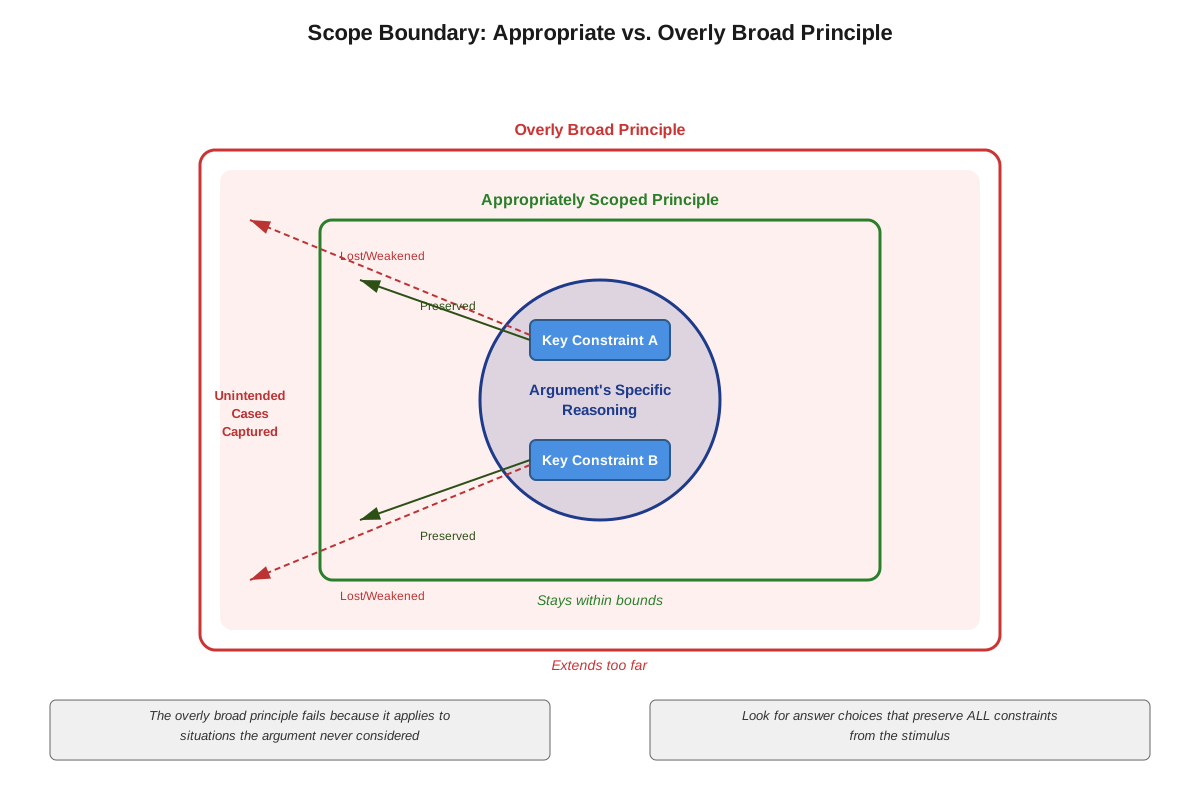
An overly broad principle is a general rule or statement that extends beyond the specific reasoning, facts, or scope of the argument it purports to describe or justify. While the principle may be consistent with the argument's reasoning, it also applies to situations, cases, or scenarios that the argument does not address or intend to cover. The principle "casts too wide a net," capturing more than it should.
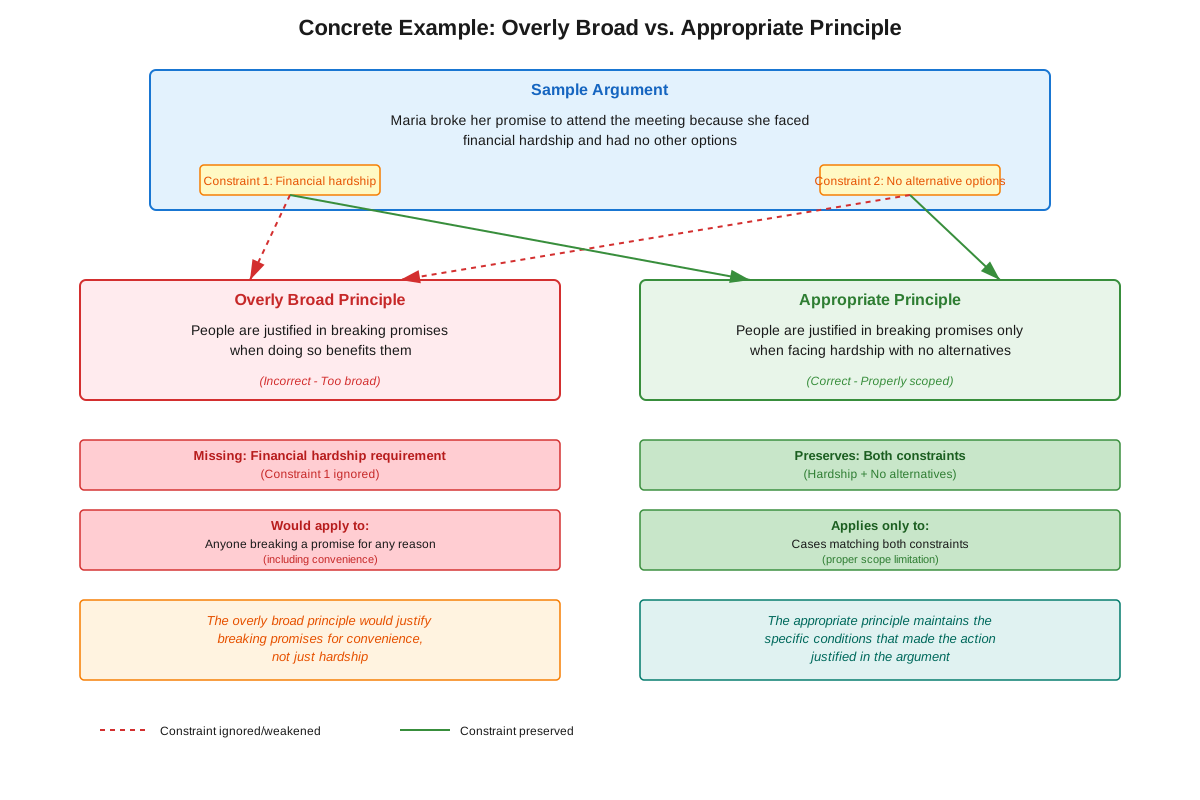
Consider this simple example: An argument concludes that "Sarah should apologize to Tom because she accidentally damaged his property." An overly broad principle would be: "Anyone who causes any harm to another person should apologize." This principle is too broad because it would require apologies for all harms (intentional, accidental, emotional, physical, etc.), whereas the argument specifically addresses accidental property damage. A more appropriately scoped principle would be: "People should apologize when they accidentally damage another person's property."
The Scope Problem
The fundamental issue with overly broad principles is scope mismatch. Every argument operates within certain boundaries—it addresses specific types of actions, particular circumstances, defined relationships, or limited contexts. A valid principle must respect these boundaries. When a principle extends beyond the argument's scope, it fails to accurately represent the reasoning.
Scope problems manifest in several ways:
- Subject scope: The principle applies to a broader category of people, entities, or things than the argument discusses
- Action scope: The principle covers more types of actions or behaviors than the argument addresses
- Circumstantial scope: The principle applies in more situations or contexts than the argument contemplates
- Degree scope: The principle uses absolute or extreme language when the argument uses moderate or qualified language
Identifying Scope Indicators in Stimuli
To avoid selecting overly broad principles, students must carefully identify the scope indicators in the stimulus—the specific elements that define the boundaries of the argument's reasoning:
- Qualifying language: Words like "some," "often," "typically," "in certain cases," "when," or "if" signal limited scope
- Specific conditions: Particular circumstances or requirements mentioned in the premises
- Defined categories: Specific types of people, actions, or situations the argument addresses
- Contextual limitations: Background information that constrains when or how the reasoning applies
The Relationship Between Principles and Sufficient Assumptions
Understanding overly broad principles requires recognizing the connection to sufficient assumptions. In principle-application questions, the correct answer often functions as a sufficient assumption—a principle that, if true, guarantees the conclusion follows from the premises. However, the LSAT rewards selecting the principle with the most precise fit, not just any principle that would be sufficient.
An overly broad principle might technically be sufficient (it would justify the conclusion), but it's incorrect because it also justifies far more than the argument requires. The test rewards precision and penalizes overreach.
Common Broadening Mechanisms
The LSAT uses several techniques to create overly broad principles in wrong answer choices:
| Broadening Technique | Example in Stimulus | Overly Broad Principle | Why It's Too Broad |
|---|---|---|---|
| Absolute language | "Most experts agree..." | "All experts must agree..." | Changes qualified claim to absolute |
| Category expansion | "Professional athletes should..." | "All athletes should..." | Expands from specific to general category |
| Condition removal | "When safety is at risk..." | "In all situations..." | Removes limiting condition |
| Factor addition | Argument mentions factor X | Principle requires factors X, Y, and Z | Adds elements not in original reasoning |
| Consequence expansion | "...should be criticized" | "...should be prohibited" | Extends to stronger consequence |
Distinguishing Overly Broad from Appropriately General
A crucial distinction exists between principles that are appropriately general (which is what principle questions require) and those that are overly broad. An appropriately general principle abstracts from the specific details while maintaining the essential scope and structure of the reasoning. An overly broad principle abstracts too much, losing essential limitations.
For example, if an argument states: "The city council should fund the new library because it will provide educational resources to underserved neighborhoods," an appropriately general principle might be: "Government bodies should fund projects that provide essential services to underserved communities." This maintains the key elements: government action, funding decisions, serving underserved populations, and providing essential services.
An overly broad version would be: "Governments should fund any project that benefits anyone." This loses the specificity about underserved populations and essential services, making it far too expansive.
Concept Relationships
The overly broad principle concept connects to multiple Logical Reasoning skills in a hierarchical and complementary way. At the foundation lies argument structure analysis—students must first identify premises and conclusions before evaluating whether a principle appropriately captures the reasoning. This leads directly to scope recognition, where students identify the boundaries and limitations of the argument's claims.
Scope recognition → enables → principle evaluation, where students assess whether a proposed principle respects those boundaries or extends beyond them. This evaluation process requires → conditional reasoning skills, as principles often take the form of conditional statements (if X, then Y), and students must verify that the conditions and consequences match the argument's scope.
The overly broad principle concept also connects laterally to necessary assumptions. While overly broad principles provide too much support (they're sufficient but excessive), necessary assumptions provide exactly what's needed. Understanding both extremes—too much and just enough—sharpens analytical precision.
Finally, this concept relates to flaw identification, particularly the "overgeneralization" flaw. When an argument itself commits this error, recognizing overly broad reasoning in the stimulus prepares students to identify overly broad principles in answer choices. The relationship map: Argument structure → Scope identification → Principle evaluation ↔ Conditional reasoning ↔ Necessary assumptions → Flaw recognition.
High-Yield Facts
⭐ An overly broad principle applies to more situations, cases, or circumstances than the argument's reasoning addresses or requires
⭐ Absolute language ("all," "every," "always," "never") in a principle often signals excessive breadth when the stimulus uses qualified language
⭐ The correct principle in principle-application questions must be sufficient to justify the conclusion but should not justify significantly more than what the argument concludes
⭐ Scope indicators in the stimulus (qualifying words, specific conditions, defined categories) constrain what principles can appropriately apply
⭐ An overly broad principle may be consistent with the argument but still incorrect because it extends beyond the argument's scope
- Removing conditions or qualifications from the stimulus when formulating a principle typically creates excessive breadth
- Expanding from a specific category mentioned in the stimulus to a broader category usually produces an overly broad principle
- Principles that introduce new factors or considerations not present in the stimulus often exceed appropriate scope
- The most common wrong answers in principle questions are overly broad principles, making this a high-value elimination strategy
- Context matters: what counts as "overly broad" depends entirely on the specific scope established by the stimulus
Quick check — test yourself on Overly broad principle so far.
Try Flashcards →Common Misconceptions
Misconception: Any principle that would justify the conclusion is correct → Correction: The correct principle must justify the conclusion without extending significantly beyond the argument's scope. Multiple principles might be sufficient, but only one will have the most precise fit to the reasoning presented.
Misconception: More general principles are always better because principle questions ask for general rules → Correction: Principles should be appropriately general—abstracting from specific details while maintaining essential scope limitations. Overgeneralization that loses important constraints is incorrect.
Misconception: If the stimulus uses an absolute term once, the principle can use absolute terms throughout → Correction: Each element of a principle must match the scope of the corresponding element in the stimulus. One absolute claim doesn't license unlimited absolute language elsewhere.
Misconception: Overly broad principles are always obviously wrong and easy to eliminate → Correction: The LSAT often creates subtly overly broad principles that seem reasonable at first glance. Careful comparison with the stimulus scope is essential for every answer choice.
Misconception: If a principle includes all the factors mentioned in the stimulus, it cannot be overly broad → Correction: A principle can include all relevant factors but still be overly broad if it applies those factors too widely, uses absolute language inappropriately, or removes important qualifying conditions.
Worked Examples
Example 1: Principle-Application Question
Stimulus: "The university should not implement the proposed parking fee increase. While the increase would generate revenue for campus improvements, it would create a significant financial burden for students who are already struggling with tuition costs and have no alternative transportation options."
Question: Which principle, if valid, most helps to justify the reasoning above?
Answer Choice A: "Universities should never implement policies that generate revenue if those policies create any financial burden for any students."
Answer Choice B: "Institutions should not implement revenue-generating policies when those policies would create significant financial hardship for people who lack reasonable alternatives and are already facing financial strain."
Analysis:
Step 1: Identify the conclusion and reasoning structure. The conclusion is that the university should NOT implement the fee increase. The reasoning is: (1) it would burden students, (2) these students are already struggling financially, and (3) they lack alternatives.
Step 2: Identify scope indicators. The argument specifies: "significant" burden (not any burden), students "already struggling" (not all students), and those with "no alternative" (a specific condition).
Step 3: Evaluate Answer Choice A. This principle uses "never" (absolute), "any financial burden" (removes "significant" qualifier), and "any students" (removes the "already struggling" and "no alternatives" conditions). This principle would prohibit universities from implementing countless policies that create even minor burdens for even one student. This is overly broad—it extends far beyond the specific reasoning about significant burdens on already-struggling students without alternatives.
Step 4: Evaluate Answer Choice B. This principle maintains the key scope elements: "significant financial hardship" (matches "significant burden"), "people who lack reasonable alternatives" (matches "no alternative transportation"), and "already facing financial strain" (matches "already struggling with tuition costs"). This principle is appropriately general—it abstracts from the specific parking fee context while maintaining the essential scope limitations.
Correct Answer: B. This principle justifies the reasoning without extending to situations the argument doesn't address.
Example 2: Identifying Overly Broad Principles
Stimulus: "The newspaper was justified in publishing the investigative report about the mayor's use of city funds, even though the mayor objected. The report concerned matters of significant public interest, and the newspaper verified all factual claims through multiple independent sources before publication."
Question: Which principle most closely conforms to the reasoning above?
Answer Choice A: "News organizations are always justified in publishing any information about public officials, regardless of the officials' objections."
Answer Choice B: "Publications are justified in releasing information that public officials want suppressed when that information involves matters of public concern and has been thoroughly verified."
Analysis:
Step 1: Identify the scope boundaries. The argument addresses: (1) information about a public official (the mayor), (2) matters of "significant public interest," (3) verified factual claims, and (4) publication despite objections.
Step 2: Evaluate Answer Choice A for scope. This principle uses "always" (absolute), "any information" (removes the "significant public interest" requirement), and "regardless of objections" (this part matches). However, it removes the verification requirement entirely and would justify publishing unverified, trivial, or even false information about public officials. This is dramatically overly broad.
Step 3: Evaluate Answer Choice B for scope. This principle maintains: "public officials" (matches), "want suppressed" (similar to "objected"), "matters of public concern" (matches "significant public interest"), and "thoroughly verified" (matches "verified through multiple independent sources"). The scope aligns with the argument's reasoning.
Correct Answer: B. Answer Choice A is overly broad because it eliminates essential conditions (public interest and verification) and uses absolute language.
Exam Strategy
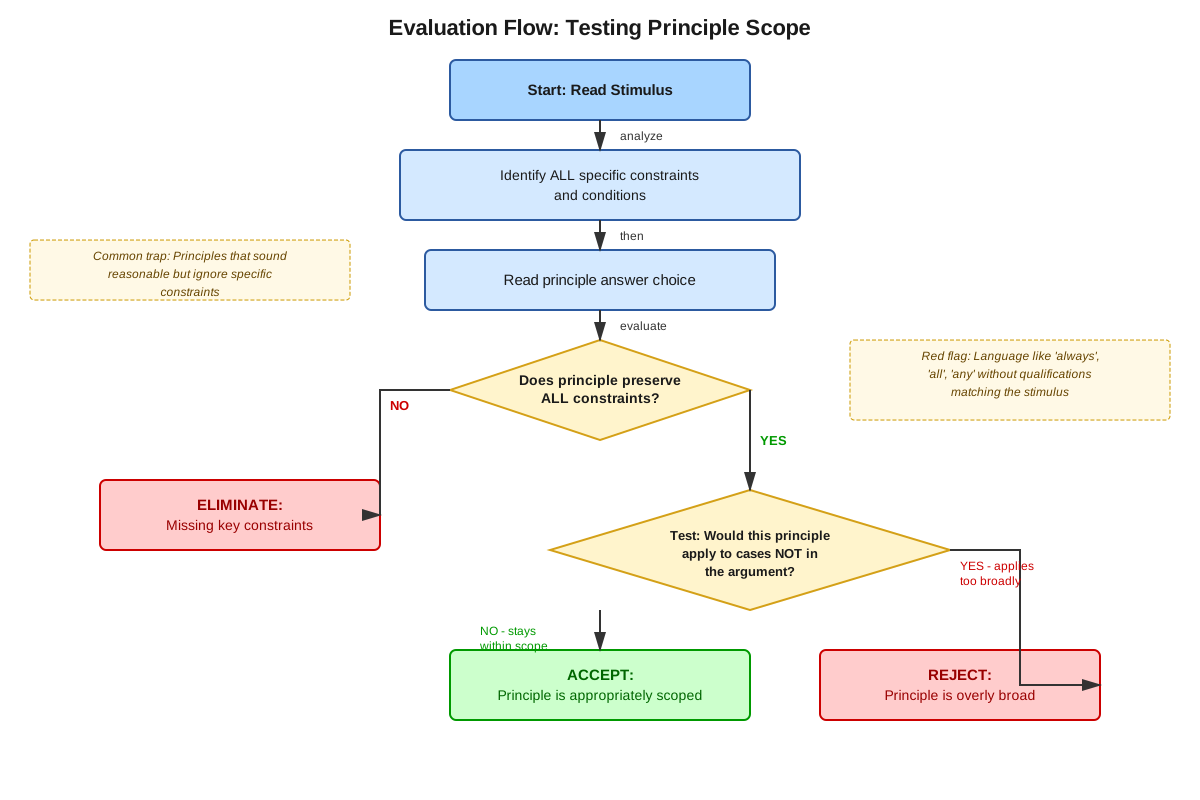
When approaching principle questions on the LSAT, implement this systematic process to avoid overly broad principles:
Step 1: Identify and underline scope indicators in the stimulus. Before looking at answer choices, mark qualifying language ("some," "most," "often"), specific conditions ("when," "if"), defined categories, and any contextual limitations. These indicators define the boundaries that correct principles must respect.
Step 2: Predict the scope of a correct principle. Based on the scope indicators, mentally formulate what elements a correct principle must include and what boundaries it must respect. This prediction serves as a filter for evaluating answer choices.
Step 3: Apply the "expansion test" to each answer choice. Ask: "Does this principle apply to situations beyond what the stimulus addresses?" If yes, the principle is likely overly broad. Specifically check whether the principle:
- Uses absolute language when the stimulus uses qualified language
- Applies to broader categories than the stimulus discusses
- Removes conditions or qualifications present in the stimulus
- Would justify conclusions beyond what the argument concludes
Step 4: Watch for trigger words indicating excessive breadth:
- Absolute quantifiers: "all," "every," "always," "never," "any," "none"
- Unqualified categorical statements when the stimulus includes qualifications
- Removal of conditional language ("when," "if," "provided that")
- Expansion words: "regardless," "without exception," "in all cases"
Exam Tip: The most common wrong answer pattern in principle questions is overly broad principles. When you've eliminated obviously wrong answers and face a choice between two remaining options, the more narrowly tailored principle is usually correct.
Time allocation advice: Spend 15-20 seconds carefully reading and annotating the stimulus for scope indicators. This upfront investment saves time by enabling faster, more accurate answer choice elimination. Principle questions typically warrant 1:30-1:45 minutes total.
Process of elimination strategy: Eliminate answer choices in this order:
- First pass: Eliminate choices with obvious scope violations (absolute language when stimulus is qualified, completely different subject matter)
- Second pass: Eliminate choices that remove essential conditions or qualifications from the stimulus
- Final selection: Between remaining choices, select the one with the most precise scope match
Memory Techniques
SCOPE Acronym for Checking Principles:
- Subject: Does the principle apply to the same category of people/things as the stimulus?
- Conditions: Does the principle maintain the conditions and qualifications in the stimulus?
- Outcome: Does the principle justify only the conclusion stated, not broader conclusions?
- Precision: Does the principle use language with appropriate specificity (not too absolute)?
- Exceptions: Does the principle respect limitations and exceptions implied by the stimulus?
Visualization Strategy: Picture the stimulus as a circle representing its scope. A correct principle should be a slightly larger circle that encompasses the stimulus reasoning but doesn't extend dramatically beyond it. An overly broad principle is a much larger circle that includes vast areas the stimulus never addresses.
The "Too Much" Test: When evaluating a principle, ask: "Would this principle require or justify actions/conclusions that seem too much compared to what the argument discusses?" If the principle feels like overkill, it's likely overly broad.
Mnemonic for Common Broadening Signals: "AARNE" - Absolute language, Added factors, Removed conditions, New categories, Expanded consequences. If an answer choice exhibits any AARNE characteristic, scrutinize it for excessive breadth.
Summary
The overly broad principle concept tests the ability to evaluate whether general rules appropriately match the scope of specific arguments. An overly broad principle extends beyond the boundaries established by the stimulus, applying to situations, categories, or circumstances the argument does not address. Success requires identifying scope indicators in the stimulus (qualifying language, specific conditions, defined categories), recognizing common broadening mechanisms in answer choices (absolute language, removed conditions, expanded categories), and selecting principles with precise scope alignment. This skill is fundamental to LSAT Logical Reasoning because it measures the precision in applying general rules to specific situations—a core competency for legal reasoning. The most effective strategy involves carefully annotating the stimulus for scope boundaries before evaluating answer choices, then systematically eliminating principles that extend beyond those boundaries. Understanding that the correct principle should be sufficient to justify the conclusion without being excessive is key to distinguishing appropriately general principles from overly broad ones.
Key Takeaways
- An overly broad principle applies to more situations than the argument's reasoning addresses, even if it's consistent with the argument
- Scope indicators in the stimulus (qualifying words, conditions, specific categories) define the boundaries that correct principles must respect
- Absolute language in principles ("all," "always," "never") often signals excessive breadth when the stimulus uses qualified language
- The correct principle should justify the conclusion without justifying significantly more than what the argument concludes
- Common broadening mechanisms include removing conditions, expanding categories, adding factors not in the stimulus, and using absolute language inappropriately
- Systematic scope comparison between stimulus and answer choices is the most reliable method for identifying overly broad principles
- Overly broad principles are the most common wrong answer type in principle questions, making this a high-value elimination skill
Related Topics
Necessary Assumptions: Understanding overly broad principles helps identify necessary assumptions, which provide exactly what's needed (not too much, not too little) to make an argument valid. Mastering overly broad principles develops the precision needed to recognize necessary assumptions.
Sufficient Assumptions: Overly broad principles are often sufficient to justify a conclusion but incorrect because they're excessive. Studying sufficient assumption questions reinforces understanding of what makes a principle appropriately scoped versus overly broad.
Flaw Questions - Overgeneralization: When arguments themselves commit the overgeneralization flaw, they employ overly broad reasoning. Recognizing this flaw in stimuli strengthens the ability to identify overly broad principles in answer choices.
Conditional Reasoning: Many principles take conditional form (if X, then Y). Advanced study of conditional logic helps evaluate whether the conditions and consequences in principles appropriately match the stimulus scope.
Parallel Reasoning: These questions require matching argument structures precisely, a skill that develops the same attention to scope and boundaries needed for avoiding overly broad principles.
Practice CTA
Now that you understand overly broad principles, it's time to cement your mastery through active practice. Attempt the practice questions associated with this topic, focusing on identifying scope indicators in stimuli and systematically evaluating whether principles respect those boundaries. Use the SCOPE acronym and the strategies outlined above. As you practice, you'll develop the intuition to quickly spot overly broad principles, dramatically improving your accuracy and speed on principle questions. Remember: precision in scope analysis is a learnable skill that improves with deliberate practice. Each practice question is an opportunity to refine your ability to think like the test-makers and select principles with laser-focused accuracy. You've got this!
Sign up free to keep reading
Create a free AnvayaPrep account to finish this LSAT guide on Overly broad principle — plus flashcards and practice questions.