Overview
Principle answer scope is one of the most critical skills tested in LSAT Logical Reasoning sections, appearing in approximately 15-20% of all Logical Reasoning questions. These questions require test-takers to identify or apply broad rules or generalizations that govern specific situations presented in stimulus passages. The challenge lies not merely in understanding the principle itself, but in recognizing when answer choices are too narrow, too broad, or simply misaligned with the scope of the argument presented.
Understanding LSAT principle answer scope means developing the ability to match the breadth and specificity of principles to the situations they're meant to govern. A principle that's too narrow fails to cover all relevant aspects of the stimulus, while one that's too broad introduces elements beyond what the argument supports. This precision in scope evaluation separates high-scoring test-takers from those who struggle with principle questions. The skill requires careful attention to conditional language, quantifiers, and the exact boundaries of what an argument establishes versus what it merely suggests.
Mastering principle answer scope connects directly to broader Logical Reasoning competencies including conditional reasoning, sufficient and necessary conditions, and argument structure analysis. This topic serves as a bridge between understanding individual arguments and recognizing the general rules that govern entire categories of reasoning. Success with principle questions often correlates strongly with overall LSAT performance, making this a high-yield area for focused study and practice.
Learning Objectives
- [ ] Identify how Principle answer scope appears in LSAT questions
- [ ] Explain the reasoning pattern behind Principle answer scope
- [ ] Apply Principle answer scope to solve LSAT-style problems accurately
- [ ] Distinguish between principles that are too narrow, too broad, and appropriately scoped
- [ ] Evaluate answer choices by mapping specific elements from the stimulus to general principle components
- [ ] Recognize common scope errors in distractor answer choices
- [ ] Apply scope analysis to both "identify the principle" and "apply the principle" question types
Prerequisites
- Basic argument structure: Understanding premises, conclusions, and how they connect is essential because principle questions require identifying what an argument establishes before determining what principle governs it
- Conditional reasoning fundamentals: Recognizing if-then relationships helps evaluate whether principles correctly capture the logical structure of arguments
- Quantifier recognition: Understanding terms like "all," "some," "most," and "none" is necessary because scope errors often involve inappropriate quantification
- Sufficient and necessary conditions: Distinguishing what's required versus what's enough matters when evaluating whether a principle correctly captures an argument's logic
Why This Topic Matters
In legal reasoning and judicial decision-making—the domains the LSAT is designed to assess—applying principles to specific cases represents a fundamental skill. Lawyers must constantly determine which legal principles govern particular situations, ensuring the scope of precedent matches the facts at hand. Overgeneralizing from a case creates bad law; undergeneralizing fails to provide adequate guidance. This same precision appears throughout legal education and practice.
On the LSAT, principle questions appear in both Logical Reasoning sections, typically comprising 3-5 questions per section. These questions manifest in several formats: identifying the principle underlying an argument, selecting a principle that justifies a conclusion, applying a stated principle to new situations, or finding situations that conform to a given principle. The logical reasoning section weights these questions heavily because they test multiple skills simultaneously—reading comprehension, abstract reasoning, and precise logical analysis.
Test-takers commonly encounter principle scope issues in questions that begin with stems like "Which one of the following principles, if valid, most helps to justify the reasoning above?" or "The reasoning in the argument most closely conforms to which one of the following principles?" The scope dimension becomes the primary differentiator among answer choices that might all seem superficially related to the stimulus. Understanding scope transforms these questions from confusing puzzles into systematic, solvable problems.
Core Concepts
Understanding Principle Scope
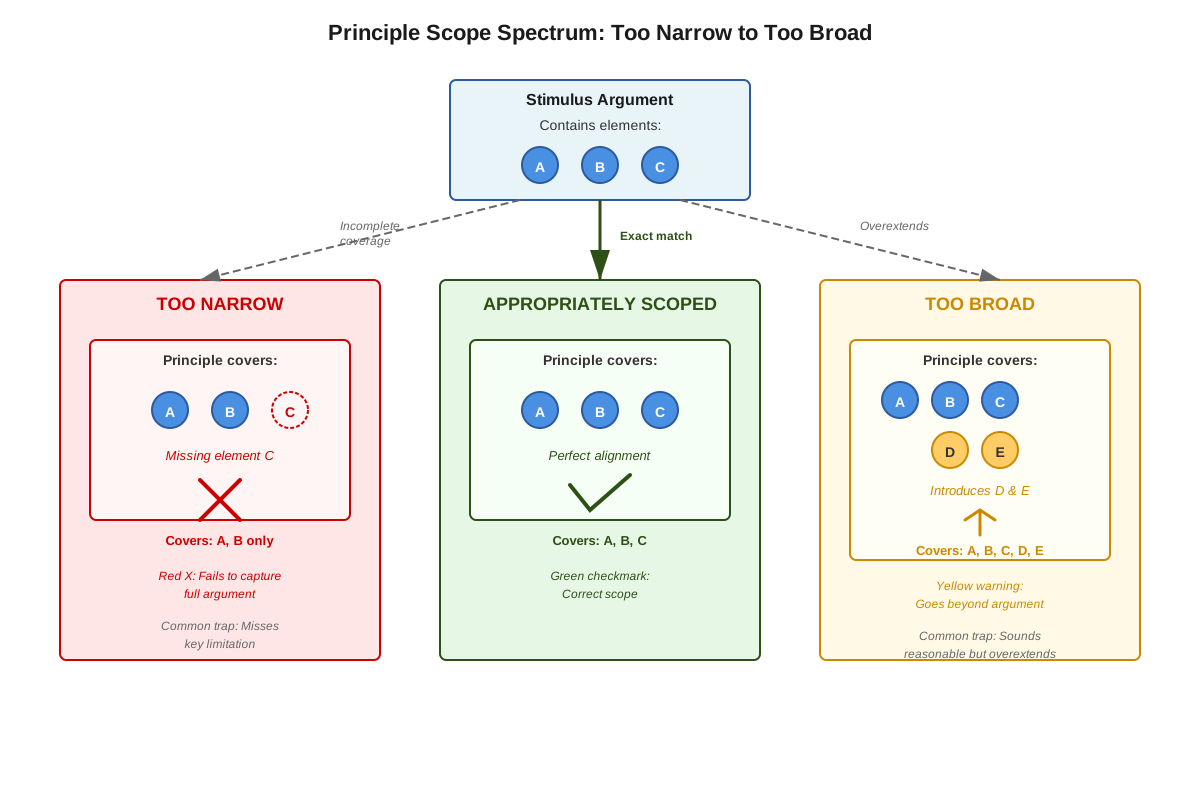
Principle answer scope refers to the breadth and specificity with which a general rule or principle applies to situations. A principle with appropriate scope covers exactly what the argument establishes—no more and no less. Think of scope as the "coverage area" of a principle: it must extend far enough to encompass all relevant elements of the stimulus while not reaching beyond what the argument supports.
The scope of a principle operates along multiple dimensions simultaneously. Categorical scope concerns which types of entities or situations the principle covers (people, actions, institutions, etc.). Conditional scope involves the circumstances under which the principle applies (always, sometimes, under specific conditions). Normative scope addresses whether the principle prescribes what must happen, what should happen, what may happen, or merely what does happen.
Scope That's Too Narrow
A principle is too narrow when it fails to capture all the essential elements present in the stimulus argument. This represents an undergeneralization—the principle covers only part of what needs to be explained or justified. For example, if an argument discusses both financial and ethical reasons for a decision, a principle mentioning only financial considerations would be too narrow, even if it correctly captures that aspect.
Narrow scope errors often manifest through:
- Omitting key conditions or qualifications present in the argument
- Restricting the principle to a subset of the relevant category
- Failing to account for all the factors the argument relies upon
- Using overly specific language where the argument supports broader application
Scope That's Too Broad
A principle is too broad when it extends beyond what the argument establishes, introducing elements, categories, or conditions not supported by the stimulus. This represents an overgeneralization—the principle makes claims about situations or factors the argument never addresses. If an argument discusses professional obligations of doctors, a principle about all healthcare workers would likely be too broad unless the argument explicitly supports that extension.
Broad scope errors typically appear through:
- Introducing new categories or entities not mentioned in the stimulus
- Removing necessary qualifications or conditions
- Making universal claims when the argument supports only particular instances
- Extending the principle to contexts the argument doesn't address
Scope That's Appropriately Matched
An appropriately scoped principle achieves precise alignment between the general rule and the specific situation. Every element in the principle corresponds to something in the stimulus, and every essential element from the stimulus appears in the principle. This doesn't mean the principle must use identical language—abstraction and generalization are expected—but the logical structure and scope must match.
Appropriate scope demonstrates:
- One-to-one correspondence between principle components and argument elements
- Correct level of abstraction (general enough to be a principle, specific enough to match the argument)
- Preservation of all relevant conditions and qualifications
- Accurate representation of the argument's logical structure
Mapping Stimulus to Principle
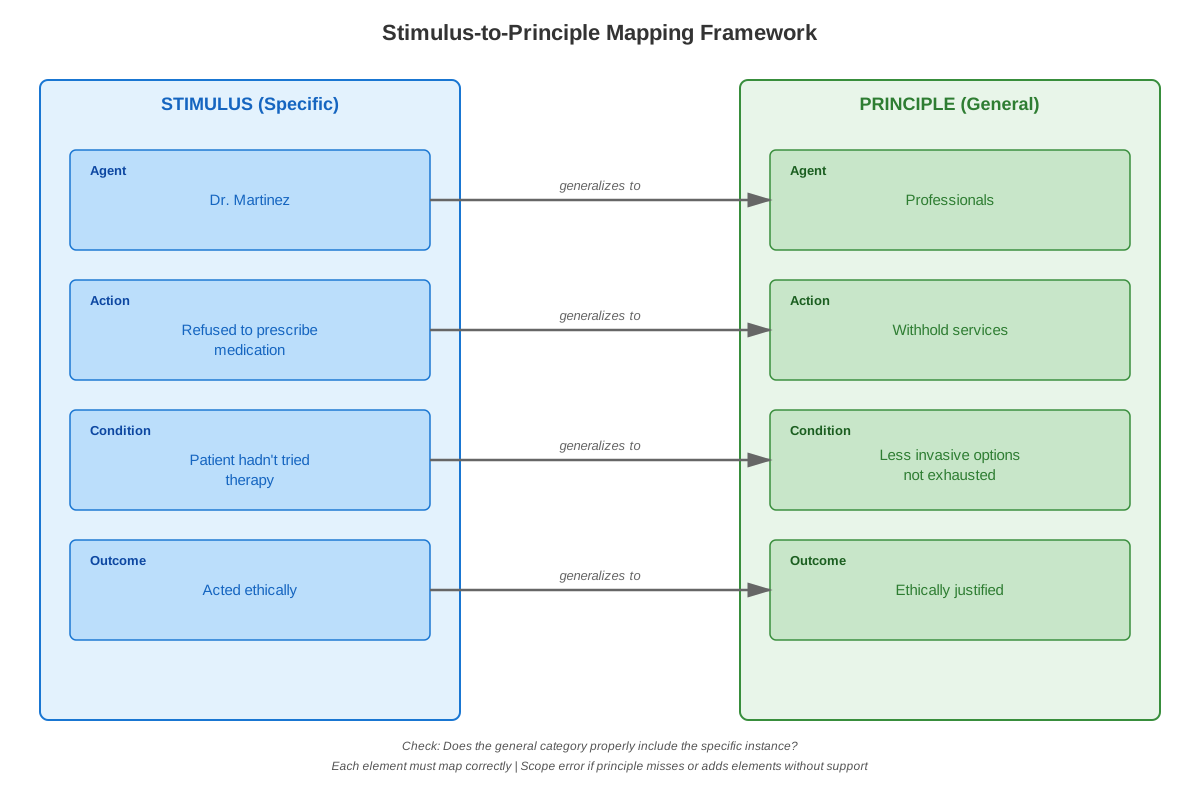
Effective scope evaluation requires systematic mapping between specific elements in the stimulus and general components in the principle. This process involves:
- Identify the argument's conclusion: What specific claim does the argument make?
- Catalog the premises: What specific reasons or evidence support that conclusion?
- Note all conditions and qualifications: What limitations or circumstances does the argument specify?
- Abstract to general categories: What broader categories do the specific elements represent?
- Check for completeness: Does the principle account for all essential elements?
- Check for excess: Does the principle introduce anything not supported by the argument?
Scope Indicators in Answer Choices
Certain linguistic markers signal scope issues in answer choices. Quantifiers like "all," "every," "any," "some," "most," and "none" directly determine how broadly a principle applies. Modal terms such as "must," "should," "may," "can," and "might" affect the strength and scope of the principle's requirements. Conditional markers including "if," "when," "whenever," "only if," and "unless" establish the circumstances under which the principle operates.
| Scope Indicator | Effect on Scope | Example |
|---|---|---|
| All/Every/Any | Maximally broad | "All professionals must..." |
| Some/Certain | Moderately narrow | "Some decisions require..." |
| Most | Broad but not universal | "Most actions should..." |
| Must/Required | Strong necessity | "One must always..." |
| Should/Ought | Moderate prescription | "One should generally..." |
| May/Can | Permissive, broader | "One may sometimes..." |
| Only if | Necessary condition | "...only if circumstances warrant" |
| If | Sufficient condition | "If X occurs, then..." |
Concept Relationships
The concepts within principle answer scope form an interconnected system. Understanding what constitutes appropriate scope requires first recognizing the two primary scope errors: too narrow and too broad. These three possibilities (too narrow, appropriate, too broad) exist on a continuum, with the correct answer occupying the precise middle ground.
The mapping process serves as the practical methodology for evaluating scope. By systematically comparing stimulus elements to principle components, test-takers can identify whether scope is appropriate or erroneous. This mapping connects directly to prerequisite knowledge of argument structure—one cannot map effectively without first identifying premises, conclusions, and conditions.
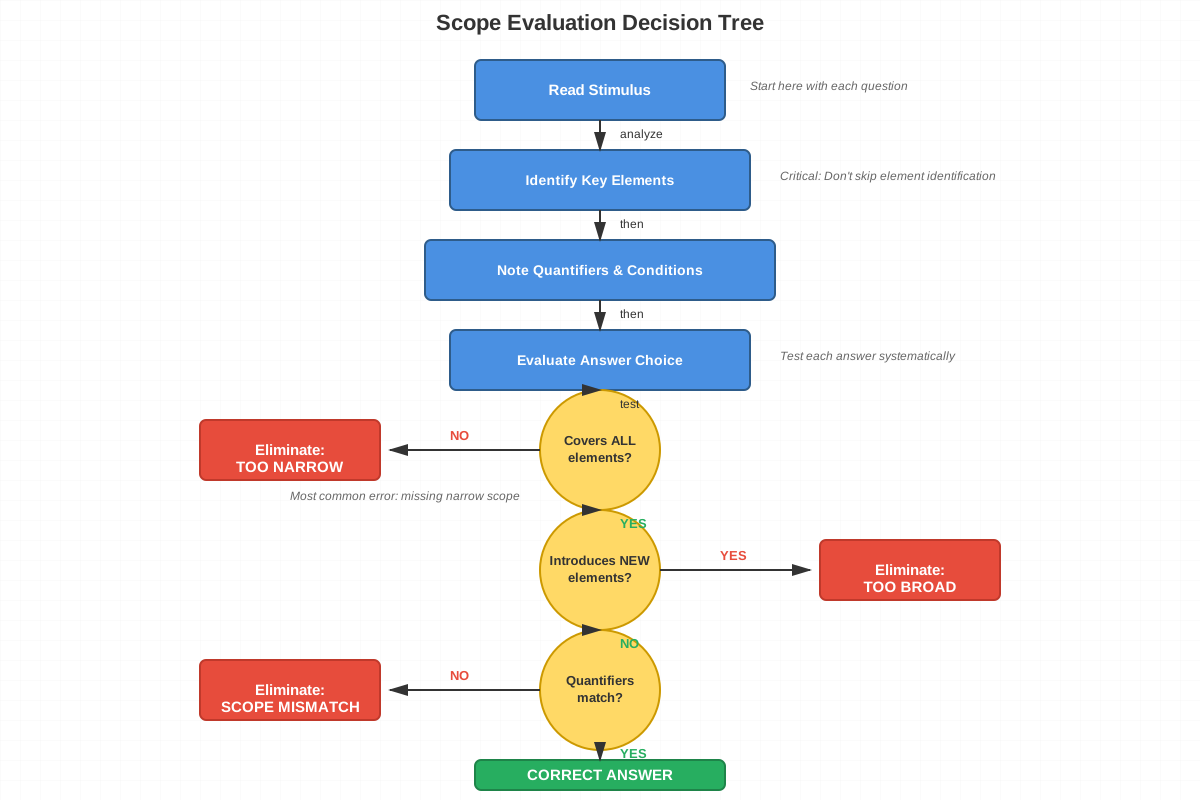
Scope indicators function as diagnostic tools within the mapping process. When evaluating an answer choice, attention to quantifiers, modals, and conditionals reveals potential scope problems before completing a full analysis. This creates an efficient workflow: Argument Analysis → Element Identification → Scope Indicator Check → Detailed Mapping → Scope Evaluation.
The relationship to broader Logical Reasoning skills operates hierarchically. Conditional reasoning provides the foundation for understanding how principles operate (as general if-then rules). Argument structure analysis enables identification of what needs to be captured in a principle. Scope evaluation then adds the precision layer, ensuring the principle matches the argument exactly. This skill subsequently supports performance on parallel reasoning questions, method of reasoning questions, and even some strengthen/weaken questions where principles serve as premises.
High-Yield Facts
- ⭐ Principle questions appear in 15-20% of Logical Reasoning questions, making scope evaluation a high-frequency skill
- ⭐ The correct answer to a principle question must account for every essential element in the stimulus without introducing unsupported elements
- ⭐ Scope errors are the most common reason test-takers eliminate correct answers or select attractive distractors
- ⭐ Quantifiers ("all," "some," "most") are the primary linguistic markers of scope and must be evaluated carefully
- ⭐ A principle can use different language than the stimulus as long as the logical scope remains equivalent
- Answer choices that introduce new categories or entities not mentioned in the stimulus are typically too broad
- Principles that omit key conditions or qualifications from the argument are typically too narrow
- The LSAT frequently includes one answer choice that's too narrow and one that's too broad, with the correct answer appropriately scoped between them
- Conditional language in principles ("if," "only if," "when") must match the conditional structure of the argument
- Normative terms ("should," "must," "ought") in principles must align with the prescriptive or descriptive nature of the argument
- Abstract language in principles is expected and correct—principles generalize from specific instances
- The most common distractor pattern is an answer that correctly captures part of the argument but omits essential elements (too narrow)
Common Misconceptions
Misconception: A principle must use similar or identical language to the stimulus to be correct.
Correction: Principles by definition abstract and generalize from specific instances. The correct answer will typically use more general language than the stimulus, as long as the logical scope and structure match. A stimulus about "physicians" might correctly correspond to a principle about "professionals" if the argument's logic applies at that level of generality.
Misconception: If an answer choice mentions something not explicitly stated in the stimulus, it must be wrong.
Correction: Principles often introduce general categories that encompass specific instances from the stimulus. The question is whether the generalization is supported, not whether it uses identical terms. However, introducing entirely new concepts or conditions not supported by the argument does create a scope error.
Misconception: The longest or most detailed answer choice is most likely to be correct because it's most complete.
Correction: Length correlates with neither correctness nor appropriate scope. Longer answers often introduce excessive detail that makes them too broad or too specific. The correct answer is the one with appropriate scope, regardless of length.
Misconception: Scope evaluation only matters for "identify the principle" questions, not "apply the principle" questions.
Correction: Scope operates in both directions. When applying a stated principle to situations, test-takers must evaluate whether each situation falls within the scope of the principle's conditions. Scope errors in application questions involve selecting situations that fall outside the principle's coverage or rejecting situations that fall within it.
Misconception: If an answer choice is true or reasonable, it's likely correct.
Correction: Principle questions test logical correspondence between argument and principle, not truth or reasonableness. An answer can state a perfectly sensible principle while having inappropriate scope for the specific argument presented. The question is always about match, not merit.
Misconception: Strong language like "must" or "all" makes an answer choice too extreme to be correct.
Correction: The appropriateness of strong language depends entirely on what the argument establishes. If the argument makes a universal claim or states an absolute requirement, the principle should reflect that strength. Conversely, if the argument is qualified or limited, strong language would be inappropriate. Match the scope to the argument, not to a preconceived notion about what sounds reasonable.
Quick check — test yourself on Principle answer scope so far.
Try Flashcards →Worked Examples
Example 1: Identifying the Principle
Stimulus: "The city council should not approve the new development project. While the project would create jobs and increase tax revenue, it would require destroying the historic courthouse, which has served as a symbol of the community's heritage for over a century. Economic benefits should not take precedence over preserving landmarks that embody a community's cultural identity."
Question: Which one of the following principles, if valid, most helps to justify the reasoning above?
Answer Choices:
A) Communities should never approve development projects that destroy historic buildings.
B) Economic considerations should be secondary to cultural preservation when a landmark embodies a community's identity.
C) Historic courthouses should be preserved regardless of economic benefits that might result from their destruction.
D) Development projects should be rejected if they harm any aspect of community heritage.
E) Cultural identity is more important than economic growth in all municipal decisions.
Analysis:
First, map the argument structure:
- Conclusion: The city council should not approve the project
- Premise 1: The project would create jobs and increase tax revenue (acknowledged benefit)
- Premise 2: The project would destroy the historic courthouse
- Premise 3: The courthouse symbolizes community heritage
- Principle stated: Economic benefits should not take precedence over preserving landmarks that embody cultural identity
Now evaluate each answer for scope:
Choice A - "Communities should never approve development projects that destroy historic buildings."
- Scope evaluation: TOO BROAD
- This extends to all historic buildings, but the argument specifically concerns landmarks that embody cultural identity. Not all historic buildings necessarily meet this criterion. The argument doesn't support such a universal prohibition.
Choice B - "Economic considerations should be secondary to cultural preservation when a landmark embodies a community's identity."
- Scope evaluation: APPROPRIATE
- Maps perfectly: "economic considerations" corresponds to jobs/tax revenue; "cultural preservation" corresponds to preserving the courthouse; "landmark embodies community's identity" matches the courthouse as a symbol of heritage. All elements present, no excess.
Choice C - "Historic courthouses should be preserved regardless of economic benefits."
- Scope evaluation: TOO NARROW
- Restricts to courthouses specifically, but the argument's logic would apply to any landmark embodying cultural identity. The building type isn't the essential factor—its symbolic significance is.
Choice D - "Development projects should be rejected if they harm any aspect of community heritage."
- Scope evaluation: TOO BROAD
- "Any aspect" is too expansive. The argument specifically concerns landmarks embodying cultural identity, not every possible heritage consideration.
Choice E - "Cultural identity is more important than economic growth in all municipal decisions."
- Scope evaluation: TOO BROAD
- "All municipal decisions" extends far beyond what the argument establishes. The argument concerns a specific type of situation (destroying landmarks), not every decision involving cultural and economic trade-offs.
Correct Answer: B
This example demonstrates how the correct answer maintains precise scope alignment while distractors err by being too narrow (C), too broad (A, D, E), or introducing unsupported elements.
Example 2: Applying the Principle
Stimulus: "A professional has an obligation to refuse a client's request if fulfilling that request would require the professional to act contrary to established ethical standards of their profession, even if the client would benefit from the service and even if refusing causes the professional financial loss."
Question: The principle above, if valid, most helps to justify which one of the following judgments?
Answer Choices:
A) An accountant should decline to prepare tax returns that exploit legal loopholes, even though doing so is technically permitted.
B) A lawyer should refuse to file a motion that misrepresents facts to the court, even though the client would gain an advantage and the lawyer would lose the client's business.
C) A doctor should not perform an unnecessary surgery, even if the patient requests it and the doctor would earn substantial fees.
D) An engineer should reject a project that seems unethical, even if professional standards don't explicitly prohibit it.
E) A therapist should refuse to treat a client whose values conflict with the therapist's personal beliefs, even if the client would benefit from treatment.
Analysis:
First, identify the principle's scope:
- Who: Professionals
- What action: Refuse client requests
- When: If fulfilling the request requires acting contrary to established ethical standards
- Even if: Client would benefit AND professional would suffer financial loss
Now evaluate which situation falls within this scope:
Choice A - Accountant declining to exploit legal loopholes
- Scope evaluation: OUTSIDE SCOPE
- "Legal loopholes" that are "technically permitted" don't constitute acting contrary to established ethical standards. The principle requires violation of ethical standards, not merely questionable practices.
Choice B - Lawyer refusing to misrepresent facts
- Scope evaluation: WITHIN SCOPE
- Misrepresenting facts to the court violates established legal ethics (✓)
- Client would gain advantage = client would benefit (✓)
- Lawyer would lose client's business = financial loss (✓)
- All conditions satisfied; scope matches perfectly
Choice C - Doctor not performing unnecessary surgery
- Scope evaluation: OUTSIDE SCOPE
- While performing unnecessary surgery might violate medical ethics, the principle requires that the client/patient would benefit. An unnecessary surgery by definition doesn't provide medical benefit. This fails the "even if the client would benefit" condition.
Choice D - Engineer rejecting project that "seems unethical"
- Scope evaluation: OUTSIDE SCOPE
- The principle requires acting contrary to "established ethical standards," not something that merely seems unethical. "Seems unethical" but isn't explicitly prohibited falls outside the principle's scope.
Choice E - Therapist refusing client due to value conflicts
- Scope evaluation: OUTSIDE SCOPE
- Personal beliefs of the professional aren't the same as established ethical standards of the profession. The principle concerns professional ethics, not personal values.
Correct Answer: B
This example shows how applying a principle requires checking whether all conditions fall within the principle's scope. Distractors often satisfy some but not all conditions, or involve situations that seem similar but fall outside the precise boundaries the principle establishes.
Exam Strategy
When approaching principle questions on the LSAT, implement a systematic process that prioritizes scope evaluation:
Step 1: Identify the question type. Principle questions typically use stems containing "principle," "generalization," "proposition," or "conforms to which one of the following." Distinguish between "identify the principle" (find the rule governing the argument) and "apply the principle" (find the situation the stated rule governs).
Step 2: Analyze the stimulus with scope in mind. For identify-the-principle questions, catalog every essential element: who/what is involved, what action or judgment occurs, under what conditions, and with what qualifications. For apply-the-principle questions, break down the stated principle into its component conditions and requirements.
Step 3: Predict scope boundaries before reading answers. Ask: What would be too narrow (what essential elements might be omitted)? What would be too broad (what might be inappropriately added or overgeneralized)? This prediction primes recognition of scope errors.
Step 4: Evaluate answers systematically. For each choice, perform element-by-element mapping. Check off each component from your stimulus analysis as you find its correspondence in the answer. Note any answer elements that lack stimulus support (potential too-broad error) and any stimulus elements missing from the answer (potential too-narrow error).
Exam Tip: The LSAT frequently includes one answer that's too narrow, one that's too broad, and one that's appropriately scoped. If you've eliminated answers for being too narrow or too broad, the remaining answer is likely correct even if it seems imperfect.
Trigger words for scope issues:
- Broadening words: "all," "every," "any," "always," "never," "regardless"
- Narrowing words: "only," "solely," "exclusively," "merely"
- Conditional markers: "if," "when," "whenever," "only if," "unless"
- Quantifiers: "some," "most," "many," "few"
Process of elimination strategy:
- First pass: Eliminate answers with obvious scope errors (introducing completely new concepts or omitting central elements)
- Second pass: Evaluate remaining answers for subtle scope issues (wrong quantifiers, missing qualifications)
- Final decision: Choose the answer with perfect element-to-element correspondence
Time allocation: Principle questions warrant slightly more time than average (90-120 seconds vs. 75-90 seconds) because scope evaluation requires careful analysis. However, if you find yourself re-reading answers multiple times, you likely haven't completed adequate stimulus analysis. Invest time upfront in mapping the argument structure.
Common trap patterns:
- Answers that sound reasonable or true but don't match the argument's scope
- Answers that use impressive or technical language to disguise scope errors
- Answers that correctly capture the conclusion but miss essential premises
- Answers that reverse or distort conditional relationships while maintaining superficial similarity
Memory Techniques
The SCOPE Acronym for Principle Evaluation:
- Specificity: Is the level of detail appropriate (not too specific, not too general)?
- Coverage: Does it cover all essential elements from the stimulus?
- Omissions: Are any critical components missing (too narrow)?
- Plus factors: Does it add unsupported elements (too broad)?
- Exact match: Do conditions and qualifications align precisely?
The Goldilocks Principle: Think of scope like Goldilocks and the three bears—one answer is too narrow (too small), one is too broad (too big), and one is just right. This mental model helps recognize that the LSAT typically includes scope errors in both directions, with the correct answer in the middle.
The Mapping Visualization: Imagine the stimulus as a puzzle with specific pieces (elements, conditions, qualifications). The correct principle is a frame that fits exactly around those pieces—no gaps (too narrow) and no excess space (too broad). Visualize checking whether each puzzle piece has a corresponding frame section.
The Quantifier Hierarchy: Remember the scope from broadest to narrowest:
- ALL/EVERY/ANY (universal)
- MOST (majority)
- MANY/SOME (plural but not majority)
- CERTAIN/SPECIFIC (limited subset)
- ONE/SINGLE (individual)
Match the quantifier level in the answer to what the argument establishes.
The "Plus-Minus" Check: When evaluating an answer, mark a "+" for each element it adds beyond the stimulus and a "−" for each element it omits from the stimulus. The correct answer should have no marks (or only marks that represent appropriate abstraction, not scope errors).
Summary
Principle answer scope represents a critical LSAT skill that tests the ability to match general rules to specific situations with precision. Success requires understanding that principles must be neither too narrow (omitting essential elements) nor too broad (introducing unsupported elements), but rather appropriately scoped to capture exactly what the argument establishes. The systematic approach involves analyzing the stimulus to identify all essential components, abstracting those components to general categories, and then evaluating answer choices through careful element-by-element mapping. Scope indicators—particularly quantifiers, modal terms, and conditional markers—serve as diagnostic tools for identifying potential scope errors. The most common trap patterns involve answers that seem reasonable or partially correct but fail to maintain precise scope alignment. Mastering this topic requires practice in recognizing the boundaries of what arguments establish and evaluating whether principles respect those boundaries. This skill connects fundamentally to broader logical reasoning competencies and appears frequently enough on the LSAT to significantly impact overall performance.
Key Takeaways
- Principle answer scope requires exact alignment between the breadth of a general rule and the specific situation it governs—neither too narrow nor too broad
- Systematic mapping of stimulus elements to principle components is the most reliable method for evaluating scope accuracy
- Quantifiers, modal terms, and conditional markers are the primary linguistic indicators of scope and must be evaluated carefully
- The LSAT typically includes scope errors in both directions (too narrow and too broad) among wrong answers, with the correct answer precisely scoped between them
- A principle can and should use more general language than the stimulus, but every essential element must be represented and no unsupported elements introduced
- Scope evaluation applies to both identifying principles that govern arguments and applying stated principles to new situations
- Common distractors include answers that correctly capture part of the argument but omit key elements (too narrow) or introduce new categories not supported by the argument (too broad)
Related Topics
Conditional Reasoning in Principles: Many principles take the form of conditional statements (if-then structures). Mastering conditional logic—including sufficient and necessary conditions, contrapositives, and conditional chains—enhances principle question performance by clarifying the logical structure that scope must match.
Parallel Reasoning Questions: These questions require identifying arguments with the same logical structure as a given argument, which involves scope matching at the structural level. Skills developed for principle scope transfer directly to recognizing when arguments operate at equivalent levels of generality.
Method of Reasoning Questions: Understanding how arguments work—including the role of principles as premises—supports both method of reasoning analysis and principle question performance. Recognizing when an argument appeals to a general principle helps identify what scope that principle must have.
Strengthen and Weaken Questions with Principles: Principles often serve as strengthening or weakening premises. Evaluating whether a principle has appropriate scope to affect an argument's conclusion represents an advanced application of scope analysis skills.
Practice CTA
Now that you've mastered the core concepts of principle answer scope, it's time to put your knowledge into practice. Work through the practice questions to apply your systematic approach to scope evaluation, and use the flashcards to reinforce key concepts and common trap patterns. Remember: principle questions reward careful, methodical analysis more than intuition. Each practice question is an opportunity to refine your mapping process and strengthen your ability to recognize scope errors. The investment you make in deliberate practice with this high-yield topic will pay dividends throughout both Logical Reasoning sections. You've built the foundation—now build the skill through application!
Sign up free to keep reading
Create a free AnvayaPrep account to finish this LSAT guide on Principle answer scope — plus flashcards and practice questions.