Overview
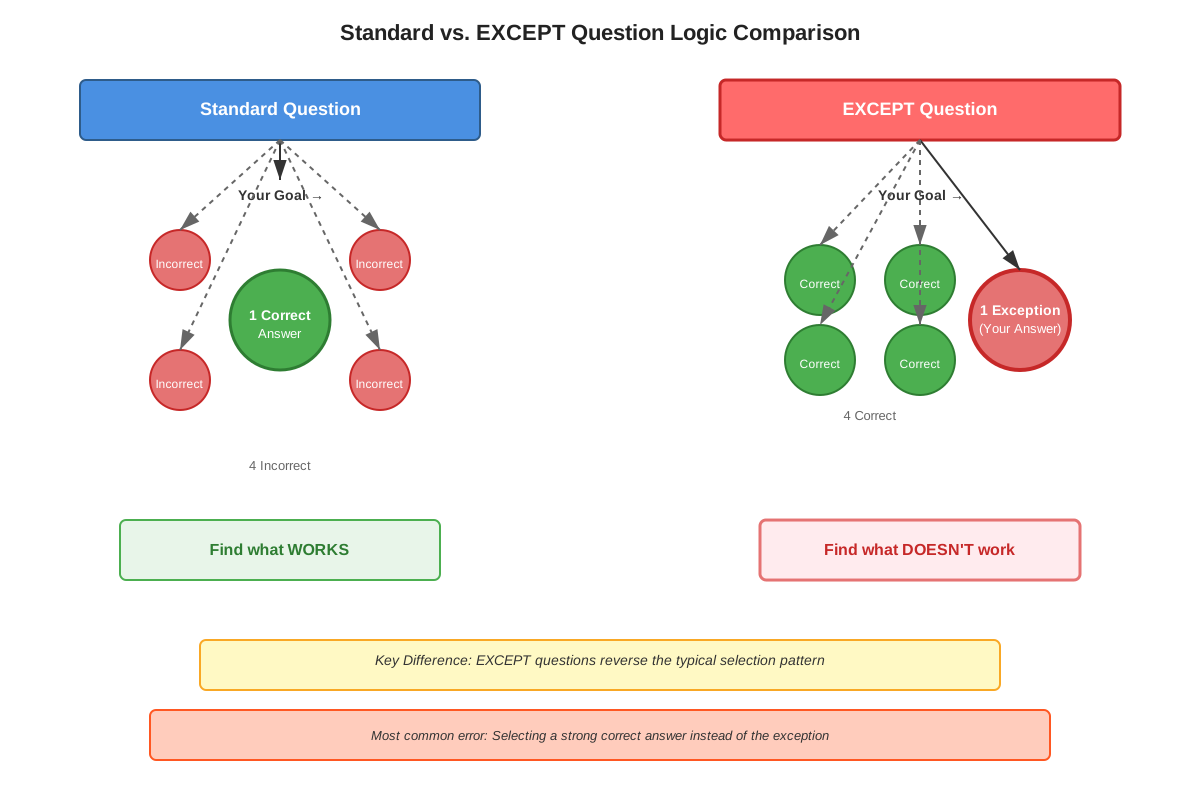
Except question stems represent a unique and frequently tested category within LSAT logical reasoning sections that requires students to reverse their typical approach to answer selection. Unlike standard question types where test-takers identify the one correct answer among four incorrect options, except questions ask students to identify the one answer choice that does NOT satisfy a particular criterion while the other four choices DO meet that criterion. This inverted logic makes except questions particularly challenging and prone to careless errors, even among well-prepared students.
Understanding LSAT except question stems is essential for achieving a competitive score because these questions appear regularly throughout both Logical Reasoning sections and occasionally in Reading Comprehension. The cognitive shift required—from seeking what works to identifying what doesn't—demands careful attention to the question stem and systematic evaluation of each answer choice. Students who fail to recognize except question stems often select a strong answer that supports the argument or follows logically from the passage, only to realize they've chosen exactly the opposite of what the question requested.
Within the broader framework of question stem recognition, except questions serve as a critical test of reading precision and adaptability. They connect to virtually every other question type in Logical Reasoning—including strengthen, weaken, assumption, inference, and flaw questions—because the "except" modifier can be applied to any of these categories. Mastering except question stems therefore enhances overall performance across the entire Logical Reasoning section while building the careful reading habits essential for LSAT success.
Learning Objectives
- [ ] Identify how except question stems appears in LSAT questions
- [ ] Explain the reasoning pattern behind except question stems
- [ ] Apply except question stems to solve LSAT-style problems accurately
- [ ] Distinguish between different types of except questions (strengthen EXCEPT, weaken EXCEPT, inference EXCEPT, etc.)
- [ ] Develop a systematic process for eliminating four correct answers to identify the one exception
- [ ] Recognize common trap answers in except questions that exploit the reversed logic
- [ ] Demonstrate improved accuracy on timed except questions through strategic annotation
Prerequisites
- Basic argument structure identification: Understanding premises, conclusions, and evidence is necessary because except questions require evaluating how each answer choice relates to the argument's components.
- Familiarity with standard question types: Knowledge of strengthen, weaken, assumption, inference, and other common question types is essential since except questions are typically these standard types with reversed logic.
- Conditional reasoning fundamentals: Understanding sufficient and necessary conditions helps evaluate answer choices systematically, particularly in inference EXCEPT questions.
- Reading comprehension skills: The ability to parse complex question stems accurately is critical for recognizing the "except" modifier and understanding what the question actually asks.
Why This Topic Matters
Except questions appear with remarkable consistency on the LSAT, typically showing up 3-5 times per test across the two Logical Reasoning sections. This frequency translates to approximately 6-10% of all Logical Reasoning questions, making them too significant to ignore or approach casually. More importantly, except questions have a higher-than-average error rate among test-takers because the reversed logic creates cognitive friction that leads to mistakes even when students understand the underlying concepts.
In real-world legal practice, attorneys must constantly evaluate multiple pieces of evidence or arguments to identify which elements don't support a particular conclusion or which facts are inconsistent with a theory. This skill—distinguishing what doesn't fit from what does—mirrors the analytical thinking required for except questions. Law schools value this ability because it reflects the kind of critical analysis essential for case preparation, contract review, and legal argumentation.
On the LSAT, except questions most commonly appear in the following formats: strengthen EXCEPT (asking which answer doesn't strengthen the argument), weaken EXCEPT (asking which answer doesn't weaken the argument), inference EXCEPT (asking which statement cannot be properly inferred), and assumption EXCEPT (asking which is not an assumption). Less frequently, they appear as flaw EXCEPT, principle EXCEPT, or parallel reasoning EXCEPT questions. The versatility of the except format means that mastering this question type provides benefits across the entire Logical Reasoning section.
Core Concepts
The Fundamental Logic of Except Questions
The core principle underlying all except question stems is logical inversion: instead of identifying one answer that satisfies a criterion among four that don't, students must identify one answer that fails to satisfy the criterion among four that do. This creates a 4-to-1 ratio where the correct answer is actually the "odd one out" or the exception to the pattern established by the other choices.
When approaching except questions, students must understand that they are essentially looking for four correct answers and one incorrect answer (relative to the question's criterion). For example, in a "strengthen EXCEPT" question, four answers will strengthen the argument to varying degrees, while one answer will either weaken the argument, be irrelevant, or have no effect. The answer that doesn't strengthen—regardless of whether it actively weakens or simply remains neutral—is the correct choice.
Recognizing Except Question Stems
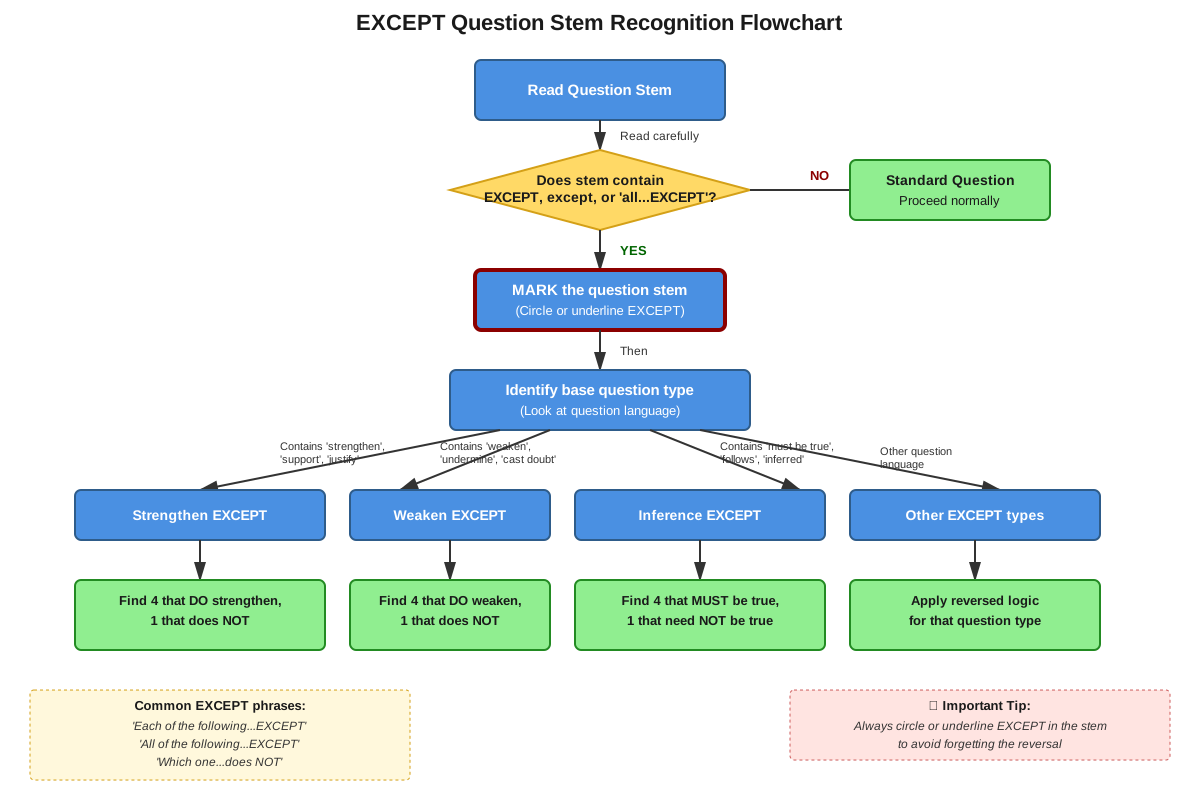
Question stem recognition for except questions requires attention to specific linguistic markers. The word "EXCEPT" typically appears in all capital letters to draw attention, though occasionally it may appear as "NOT" or in phrases like "with the exception of" or "all of the following...EXCEPT." Common formulations include:
- "Each of the following strengthens the argument EXCEPT:"
- "All of the following weaken the conclusion EXCEPT:"
- "Each of the following can be properly inferred EXCEPT:"
- "The argument depends on which of the following assumptions EXCEPT:"
- "All of the following are flaws in the reasoning EXCEPT:"
The placement of "EXCEPT" is crucial—it typically appears at the end of the question stem, which means students who read too quickly may process the entire question stem except for the final word, leading to a complete misunderstanding of what the question asks.
Types of Except Questions
| Question Type | What to Look For | What the Correct Answer Does |
|---|---|---|
| Strengthen EXCEPT | Four answers that support the conclusion | Doesn't strengthen (may weaken, or be neutral) |
| Weaken EXCEPT | Four answers that undermine the conclusion | Doesn't weaken (may strengthen, or be neutral) |
| Inference EXCEPT | Four statements that must be true based on the passage | Cannot be properly inferred or proven |
| Assumption EXCEPT | Four unstated premises the argument requires | Not necessary for the argument's logic |
| Flaw EXCEPT | Four logical errors present in the argument | Not a flaw in the reasoning |
The Systematic Evaluation Process
Successfully answering except questions requires a methodical approach to each answer choice. Rather than seeking the "right" answer in the traditional sense, students should evaluate each choice individually against the criterion specified in the question stem. A recommended process includes:
- Annotate the question stem: Circle or underline "EXCEPT" to maintain awareness of the reversed logic throughout the evaluation process
- Predict the pattern: Determine what four answers should do (strengthen, weaken, etc.) and what the exception might look like
- Evaluate each choice independently: Mark each answer with a symbol indicating whether it meets the criterion (✓) or doesn't (✗)
- Verify the 4-to-1 ratio: Confirm that exactly four answers meet the criterion and one doesn't
- Select the exception: Choose the answer marked as not meeting the criterion
This systematic approach prevents the common error of selecting a strong answer that does exactly what most of the answers should do, rather than identifying the one that doesn't.
The Role of Neutral Answers
A particularly important concept in except questions is the role of neutral or irrelevant answers. In a strengthen EXCEPT question, the correct answer doesn't necessarily weaken the argument—it might simply have no effect on the argument's strength. Similarly, in a weaken EXCEPT question, the correct answer might neither weaken nor strengthen the argument but instead be completely irrelevant to the conclusion.
This neutrality principle means students must resist the temptation to look for an answer that does the opposite of what the question stem suggests. While the correct answer in a strengthen EXCEPT question might weaken the argument, it's equally likely to be neutral. The key criterion is simply that it doesn't strengthen, regardless of what else it might do.
Concept Relationships
The concepts within except questions form a hierarchical relationship: question stem recognition serves as the foundation, enabling students to identify that they're dealing with an except question. This recognition triggers the logical inversion principle, which fundamentally changes the evaluation approach. The systematic evaluation process then provides the method for applying this inverted logic, while understanding neutral answers prevents common errors during evaluation.
Except questions connect directly to prerequisite knowledge of standard question types—a student cannot effectively answer a strengthen EXCEPT question without first understanding what it means to strengthen an argument. The relationship flows: standard question type mastery → recognition of except modifier → application of inverted logic → systematic evaluation → correct answer selection.
Within the broader context of Logical Reasoning, except questions relate to time management strategies (they typically require more time than standard questions), process of elimination techniques (which become even more critical when identifying four correct answers), and careful reading skills (essential for catching the "EXCEPT" modifier). These connections mean that improving performance on except questions often yields benefits across other question types as well.
High-Yield Facts
⭐ Except questions require identifying the ONE answer that does NOT meet the criterion while four others DO meet it
⭐ The word "EXCEPT" typically appears in all capitals at the end of the question stem
⭐ In strengthen EXCEPT questions, the correct answer either weakens the argument, has no effect, or is irrelevant—it simply doesn't strengthen
⭐ Except questions appear 3-5 times per LSAT, representing approximately 6-10% of Logical Reasoning questions
⭐ The correct answer in an except question doesn't necessarily do the opposite of what the question stem suggests—it might be neutral
- Except questions can be applied to virtually any standard question type (strengthen, weaken, inference, assumption, flaw, etc.)
- Annotating the question stem by circling "EXCEPT" significantly reduces careless errors
- Evaluating each answer choice independently with checkmarks prevents confusion about which answers meet the criterion
- Except questions typically require 15-30 seconds more than comparable standard questions due to the need to evaluate all five choices thoroughly
- The most common error on except questions is selecting a strong answer that does exactly what four of the answers should do, rather than identifying the exception
Quick check — test yourself on Except question stems so far.
Try Flashcards →Common Misconceptions
Misconception: The correct answer in a strengthen EXCEPT question must weaken the argument. → Correction: The correct answer simply needs to NOT strengthen the argument; it can weaken, be neutral, or be irrelevant. Any answer that doesn't strengthen qualifies as correct.
Misconception: Except questions are just regular questions asked backwards, so the approach doesn't need to change. → Correction: Except questions require a fundamentally different evaluation strategy where students must identify four answers that work rather than one, making systematic evaluation of all choices essential rather than optional.
Misconception: If an answer choice is irrelevant to the argument, it can't be correct in an except question. → Correction: Irrelevant answers are frequently correct in except questions because irrelevance means the answer doesn't strengthen, doesn't weaken, or cannot be inferred—making it the exception among four relevant answers.
Misconception: The "EXCEPT" modifier only appears at the end of question stems. → Correction: While "EXCEPT" most commonly appears at the end, it can also appear mid-stem in phrases like "all of the following, EXCEPT which one, would strengthen..." Careful reading of the entire question stem is essential.
Misconception: Except questions are rare enough that developing a specific strategy isn't worthwhile. → Correction: With 3-5 appearances per test and a higher-than-average error rate, except questions represent a high-yield opportunity for score improvement through strategic preparation.
Worked Examples
Example 1: Strengthen EXCEPT Question
Passage: "City Council Member: Our city should implement a bike-sharing program. Such programs have reduced traffic congestion in other cities, and our residents have expressed strong interest in alternative transportation options. Additionally, bike-sharing would promote public health by encouraging physical activity."
Question: Each of the following, if true, strengthens the council member's argument EXCEPT:
(A) Cities with bike-sharing programs have seen a 15% reduction in short car trips
(B) A recent survey showed 68% of city residents would use a bike-sharing program
(C) Bike-sharing programs in similar-sized cities have been financially self-sustaining
(D) The city has an extensive network of bike lanes already in place
(E) Bike-sharing programs are more popular in cities with mild climates than in cities with harsh winters
Analysis:
First, annotate the question stem by circling "EXCEPT"—this is a strengthen EXCEPT question, meaning four answers will strengthen the argument and one won't.
The argument concludes that the city should implement a bike-sharing program, supported by premises about traffic reduction, resident interest, and health benefits.
Evaluating each choice:
(A) ✓ Strengthens: Provides evidence that bike-sharing reduces car trips, supporting the traffic congestion claim
(B) ✓ Strengthens: Confirms the premise about resident interest with specific data
(C) ✓ Strengthens: Addresses a potential concern about cost, making implementation more feasible
(D) ✓ Strengthens: Shows the city has infrastructure to support bike-sharing, making success more likely
(E) ✗ Doesn't strengthen: This is about climate preferences but provides no information about whether this city has a mild or harsh climate, making it irrelevant to whether this specific city should implement the program
Answer: (E) is correct because it's the only choice that doesn't strengthen the argument. Notice that (E) doesn't weaken the argument either—it's simply irrelevant without information about this city's climate.
Example 2: Inference EXCEPT Question
Passage: "All members of the debate team are also members of the honor society. Some members of the honor society participate in the science fair. No one who participates in the science fair is on the basketball team."
Question: If the statements above are true, which of the following CANNOT be properly inferred?
(A) At least some debate team members do not play basketball
(B) Some honor society members do not play basketball
(C) No basketball players are on the debate team
(D) All debate team members are in the honor society
(E) Some debate team members participate in the science fair
Analysis:
This is an inference EXCEPT question, so four answers CAN be properly inferred while one CANNOT.
Setting up the logical relationships:
- All debate team → honor society
- Some honor society → science fair
- Science fair → NOT basketball
Evaluating each choice:
(A) ✓ Can be inferred: Some honor society members do science fair, and science fair participants don't play basketball, so at least some debate team members (who are all in honor society) don't play basketball
(B) ✓ Can be inferred: Some honor society members do science fair, and science fair participants don't play basketball
(C) ✓ Can be inferred: If any debate team member played basketball, they'd be in honor society and potentially do science fair, but science fair participants can't play basketball—so no debate team members play basketball
(D) ✓ Can be inferred: This directly restates the first premise
(E) ✗ Cannot be inferred: We know some honor society members do science fair, and all debate team members are in honor society, but we don't know if the honor society members who do science fair are specifically the ones who are also on the debate team. The overlap is possible but not provable.
Answer: (E) is correct because it's the only statement that cannot be definitively inferred from the passage. This demonstrates how inference EXCEPT questions test the boundary between what must be true and what might be true.
Exam Strategy
When approaching except questions on the LSAT, implement these strategic practices:
Pre-Reading Strategy: Before reading the passage, scan question stems to identify except questions. This mental preparation helps activate the appropriate evaluation mindset before engaging with the content.
Annotation is Non-Negotiable: Always circle, underline, or otherwise mark "EXCEPT" in the question stem. This physical action reinforces awareness and serves as a visual reminder throughout the evaluation process. Students who skip this step have significantly higher error rates.
Use Consistent Notation: Develop a personal system for marking answers—such as checkmarks for answers that meet the criterion and X's for those that don't. Consistency prevents confusion when reviewing choices.
Evaluate All Five Choices: Unlike standard questions where finding a strong answer might allow skipping remaining choices, except questions require evaluating all five answers to confirm the 4-to-1 pattern. If evaluation reveals three answers meeting the criterion and two not meeting it, re-evaluate because one assessment is incorrect.
Exam Tip: If time is running short, except questions are better candidates for educated guessing than standard questions because the 4-to-1 ratio means four answers are "correct" in some sense. Eliminating even one or two choices significantly improves odds.
Trigger Words to Watch For:
- "EXCEPT" (most common)
- "NOT"
- "with the exception of"
- "all of the following...EXCEPT"
- "each of the following...EXCEPT"
Time Allocation: Budget approximately 1:45-2:00 for except questions compared to 1:15-1:30 for standard questions. The additional time accounts for the need to evaluate all five choices systematically rather than stopping at a strong answer.
Process of Elimination Adaptation: In standard questions, aggressive elimination of wrong answers leads to the correct answer. In except questions, aggressive elimination of "right" answers (those meeting the criterion) leads to the correct answer. This mental shift is crucial.
Memory Techniques
The "4-to-1" Mnemonic: Remember that except questions are "FOUR-get about one"—four answers do what the question asks, and you need to forget about those to find the one exception.
The EXCEPT Acronym:
- Evaluate each answer independently
- X-out answers that meet the criterion
- Confirm the 4-to-1 pattern
- Eliminate the four that work
- Pick the exception
- Trust your systematic process
Visual Technique: Imagine except questions as "reverse target practice"—instead of aiming for the bullseye (one correct answer), you're identifying the one spot outside the target while four arrows hit the mark.
The "Opposite Day" Reminder: When you see "EXCEPT," mentally note "opposite day"—you're looking for what doesn't work rather than what does. This simple mental flag helps maintain the correct mindset.
Finger Counting Method: As you evaluate each answer choice, physically count on your fingers how many meet the criterion. When you reach four fingers up, the remaining choice must be the exception. This kinesthetic reinforcement prevents errors.
Summary
Except question stems represent a critical category within LSAT Logical Reasoning that requires students to reverse their standard approach by identifying the one answer that does NOT satisfy a criterion while four others do. These questions appear 3-5 times per test and can be applied to virtually any standard question type, including strengthen, weaken, inference, and assumption questions. The key to success lies in recognizing the "EXCEPT" modifier through careful reading, understanding that the correct answer simply doesn't meet the criterion (rather than necessarily doing the opposite), and implementing a systematic evaluation process that assesses all five answer choices. Students must annotate question stems, use consistent notation for tracking which answers meet the criterion, and resist the temptation to select strong answers that do exactly what four of the choices should do. The neutral answer principle—recognizing that correct answers might be irrelevant rather than oppositional—prevents common errors. With proper strategy and practice, except questions transform from a source of careless mistakes into an opportunity for confident, accurate performance.
Key Takeaways
- Except questions require identifying ONE answer that doesn't meet the criterion among FOUR that do—a 4-to-1 ratio that reverses standard question logic
- Always annotate "EXCEPT" in the question stem to maintain awareness of the inverted logic throughout evaluation
- The correct answer doesn't necessarily do the opposite of what the question stem suggests; it might simply be neutral or irrelevant
- Systematic evaluation of all five answer choices is essential, using consistent notation to track which answers meet the criterion
- Except questions appear frequently enough (3-5 per test) and have high enough error rates to warrant dedicated strategic preparation
- Budget additional time for except questions (1:45-2:00) compared to standard questions due to the need for comprehensive evaluation
- Understanding except questions enhances performance across all Logical Reasoning question types by building careful reading habits and systematic evaluation skills
Related Topics
Strengthen and Weaken Questions: Mastering standard strengthen and weaken questions provides the foundation for strengthen EXCEPT and weaken EXCEPT questions, as the same principles apply with inverted selection criteria.
Sufficient and Necessary Assumptions: Understanding assumption questions is essential for tackling assumption EXCEPT questions, which require identifying which unstated premise the argument doesn't depend on.
Formal Logic and Conditional Reasoning: These skills become particularly important in inference EXCEPT questions, where students must determine which statement cannot be proven from the given information.
Question Stem Recognition Strategies: Developing broader skills in identifying question types quickly and accurately enhances the ability to spot except questions and activate the appropriate evaluation strategy.
Time Management and Pacing: Since except questions require more time than standard questions, understanding overall section timing helps students allocate appropriate resources without compromising performance on other questions.
Practice CTA
Now that you understand the structure, strategy, and common pitfalls of except question stems, it's time to put this knowledge into practice. Attempt the practice questions designed specifically for this topic, paying careful attention to annotating question stems and systematically evaluating all answer choices. Use the flashcards to reinforce recognition of different except question formulations and to internalize the key strategic principles. Remember that except questions, while initially challenging, become highly predictable with practice—each question you complete builds the pattern recognition and systematic thinking that leads to consistent accuracy. Your investment in mastering this question type will pay dividends across the entire Logical Reasoning section!
Sign up free to keep reading
Create a free AnvayaPrep account to finish this LSAT guide on Except question stems — plus flashcards and practice questions.