Overview
Fill in the blank question stems represent a distinctive and strategically important question type within the LSAT's Logical Reasoning sections. Unlike most LSAT questions that present a complete argument followed by a question stem, fill-in-the-blank questions integrate the task directly into the argument itself, requiring test-takers to identify the missing piece that completes the logical structure. These questions typically appear 2-4 times per test and demand a unique skill set: the ability to recognize logical patterns, understand argumentative flow, and predict conclusions or premises based on contextual clues. Mastering this question type is essential because it tests pure logical reasoning ability without the additional layer of question stem interpretation that characterizes other Logical Reasoning questions.
The importance of question stem recognition cannot be overstated when approaching fill-in-the-blank questions. While traditional LSAT questions require students to first understand the argument and then determine what task the question stem demands, fill-in-the-blank questions reverse this process. The blank itself becomes the question, and recognizing where it appears in the argument's structure—whether as a conclusion, premise, intermediate step, or principle—determines the entire approach to solving the problem. This makes fill-in-the-blank questions both more straightforward in one sense (the task is always to complete the argument) and more challenging in another (the completion must fit perfectly within the logical framework).
Fill-in-the-blank questions connect intimately with virtually every other aspect of Logical Reasoning. They require understanding of argument structure, conditional reasoning, causal relationships, and logical indicators. Success with these questions demonstrates mastery of how arguments flow from premises to conclusions, how evidence supports claims, and how logical principles apply to specific situations. Students who excel at fill-in-the-blank questions typically show strong overall Logical Reasoning performance because these questions test the foundational skills underlying all argument analysis.
Learning Objectives
- [ ] Identify how fill in the blank question stems appears in LSAT questions
- [ ] Explain the reasoning pattern behind fill in the blank question stems
- [ ] Apply fill in the blank question stems to solve LSAT-style problems accurately
- [ ] Distinguish between blanks that require conclusions versus premises versus intermediate steps
- [ ] Evaluate answer choices based on logical necessity versus mere compatibility
- [ ] Predict the content and logical function of the blank before reviewing answer choices
- [ ] Recognize structural indicators that signal what type of completion is required
Prerequisites
- Basic argument structure: Understanding the distinction between premises and conclusions is fundamental because fill-in-the-blank questions require identifying which role the blank plays in the argument's logical architecture.
- Logical indicators and keywords: Familiarity with words like "therefore," "because," "since," and "thus" is essential because these indicators often appear immediately before or after the blank, signaling its logical function.
- Conditional reasoning fundamentals: Knowledge of if-then relationships helps because many fill-in-the-blank questions involve completing conditional chains or applying conditional principles.
- Argument evaluation skills: The ability to assess whether reasoning is valid or sound provides the foundation for determining whether a proposed completion strengthens, maintains, or weakens the argument's logical integrity.
Why This Topic Matters
Fill-in-the-blank questions matter significantly for LSAT success because they appear consistently across all administrations of the test and represent a high-yield opportunity for score improvement. These questions typically account for 4-8% of all Logical Reasoning questions, appearing 2-4 times per test across the two scored Logical Reasoning sections. Their predictable structure and systematic approach make them ideal candidates for mastery, offering reliable points that can elevate a score from good to excellent.
In real-world applications, the skills tested by fill-in-the-blank questions mirror essential legal reasoning abilities. Attorneys must constantly complete logical chains, inferring unstated premises in opposing arguments, predicting how judges will complete legal reasoning, and filling gaps in evidentiary chains. The ability to recognize what logically must follow from given premises, or what premise is necessary to reach a stated conclusion, represents core competencies in legal analysis and advocacy.
On the LSAT, fill-in-the-blank questions appear in several distinct formats. Most commonly, the blank appears at the end of the argument as the conclusion (approximately 60% of cases). Less frequently but still regularly, the blank appears mid-argument as a premise or intermediate step (approximately 30% of cases). Occasionally, the blank appears at the beginning as an initial premise or principle (approximately 10% of cases). Each position requires a slightly different analytical approach, but all demand the same fundamental skill: understanding how the blank functions within the argument's logical structure and selecting the completion that makes the argument logically coherent and complete.
Core Concepts
The Nature of Fill-in-the-Blank Questions
Fill in the blank question stems on the LSAT present arguments with a missing component, indicated by a blank line or the phrase "which one of the following most logically completes the argument?" These questions differ fundamentally from other Logical Reasoning question types because they don't ask test-takers to evaluate, strengthen, weaken, or identify assumptions in a complete argument. Instead, they require completing an incomplete argument in a way that maintains logical coherence and follows the established reasoning pattern.
The blank serves as a placeholder for a specific logical element that the argument requires. This element must satisfy multiple criteria simultaneously: it must be grammatically appropriate, logically necessary or strongly supported by the given information, consistent with the argument's scope and tone, and sufficient to complete the logical chain the argument establishes. Understanding these requirements separates successful test-takers from those who struggle with these questions.
Identifying Blank Position and Function
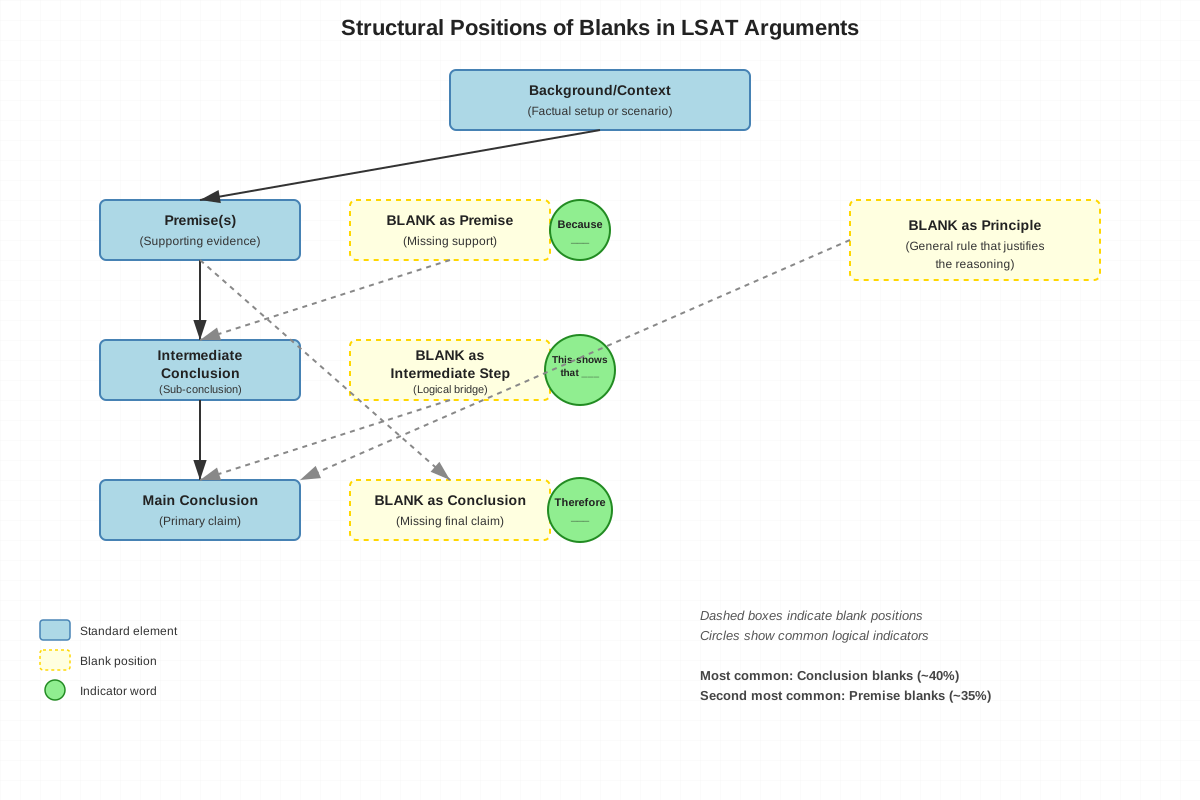
The position of the blank within the argument determines its logical function and, consequently, the approach needed to solve the question. When the blank appears at the end of the argument, it almost always represents the conclusion. The test-taker's task becomes predicting what conclusion the premises support. Key indicators include conclusion keywords immediately before the blank ("therefore," "thus," "consequently," "it follows that") or the absence of any statements following the blank.
When the blank appears in the middle of the argument, it typically serves as either a premise or an intermediate conclusion that bridges earlier premises to the final conclusion. These questions require careful attention to what comes before and after the blank. The content following the blank often provides crucial clues about what the blank must contain, as it needs to support or lead to those subsequent statements.
Blanks appearing at the beginning of the argument usually represent initial premises or general principles that the argument then applies to a specific situation. These are less common but require recognizing that the blank establishes the foundation upon which the rest of the argument builds.
The Logical Reasoning Pattern
Fill-in-the-blank questions test the ability to recognize and complete logical patterns. The most common pattern involves deductive reasoning, where the blank represents a conclusion that necessarily follows from the stated premises. For example, if the argument establishes that "All A are B" and "All B are C," the blank completing "therefore, all A are ___" must logically be "C."
Another frequent pattern involves principle application, where the argument states a general principle and applies it to a specific case, with the blank representing either the principle or the application. For instance, an argument might establish facts about a specific situation and then state "This illustrates the principle that ___," requiring the test-taker to identify the general principle the specific case exemplifies.
Causal reasoning patterns also appear regularly, where the argument establishes a causal relationship and the blank completes either the cause or the effect. These questions require careful attention to causal indicators like "because," "leads to," "results in," and "causes."
Prediction Strategy
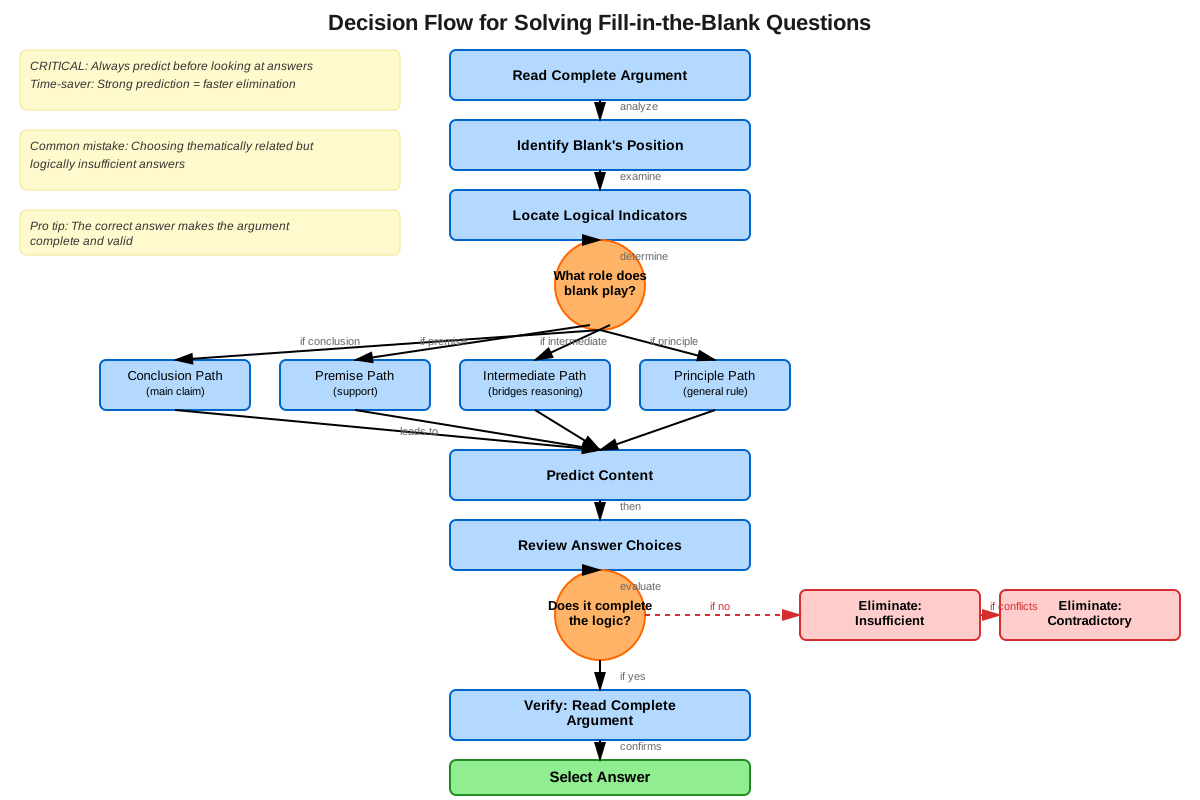
The most effective approach to fill-in-the-blank questions involves prediction before evaluation. Before examining the answer choices, successful test-takers formulate their own completion of the blank based on the argument's logical structure. This prediction need not match any answer choice word-for-word, but it should capture the essential logical content and function required.
The prediction process involves three steps:
- Identify the blank's logical function: Determine whether it serves as a conclusion, premise, intermediate step, or principle
- Analyze the logical relationship: Understand how the blank connects to the surrounding statements
- Formulate the logical content: Predict what information or claim must fill the blank to complete the logical chain
This prediction serves as a filter when evaluating answer choices, allowing test-takers to quickly eliminate options that don't match the predicted logical function or content.
Answer Choice Evaluation Criteria
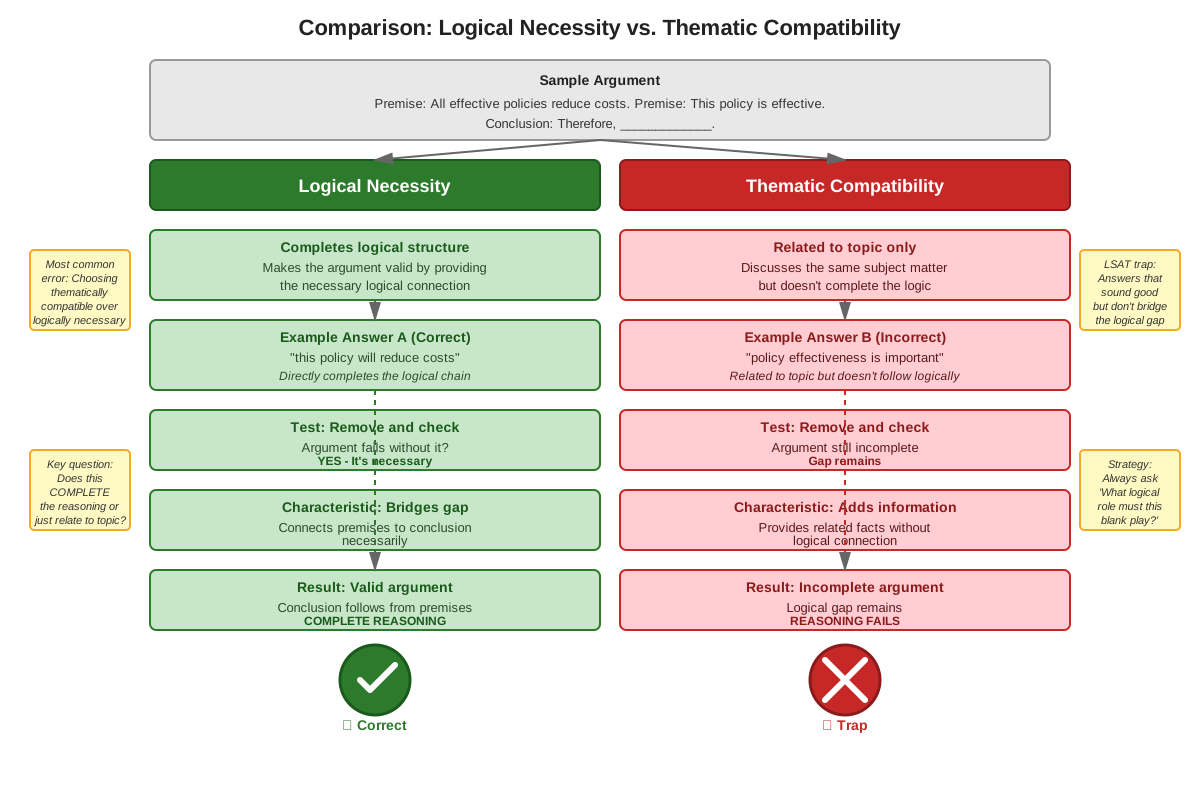
Not all answer choices that could grammatically or topically fit the blank are correct. The correct answer must satisfy logical necessity or strong logical support—it must be what the argument's logic demands or strongly suggests, not merely what could possibly work. This distinction separates correct answers from attractive distractors.
| Evaluation Criterion | Correct Answer | Incorrect Distractor |
|---|---|---|
| Logical necessity | Required by the argument's logic | Merely compatible with the argument |
| Scope | Matches the argument's scope precisely | Too broad or too narrow |
| Strength | Appropriate level of certainty | Too strong or too weak |
| Relevance | Directly addresses the logical gap | Tangentially related |
| Consistency | Aligns with all stated information | Contradicts or ignores some information |
Common Structural Patterns
Several structural patterns appear repeatedly in LSAT fill in the blank question stems. Recognizing these patterns accelerates the solving process:
Pattern 1: Conditional Chain Completion
The argument establishes a series of conditional relationships, and the blank completes the chain. Example structure: "If A, then B. If B, then C. Therefore, if A, then ___."
Pattern 2: Principle to Application
The argument states a general principle and describes a specific situation, with the blank providing the application of the principle to that situation.
Pattern 3: Evidence to Conclusion
The argument presents multiple pieces of evidence, and the blank states the conclusion this evidence supports.
Pattern 4: Contrast Completion
The argument establishes a contrast or comparison, and the blank completes the second half of the comparison.
Pattern 5: Explanation Completion
The argument describes a phenomenon and begins explaining it, with the blank completing the explanation.
Concept Relationships
The concepts within fill-in-the-blank questions form an interconnected system where each element depends on and reinforces the others. Question stem recognition serves as the foundation, enabling test-takers to immediately identify that they're dealing with a fill-in-the-blank question rather than another question type. This recognition → triggers the appropriate analytical approach → which involves identifying the blank's position and function → which determines the prediction strategy → which guides answer choice evaluation.
The relationship between blank position and logical function is deterministic: position → determines function → determines required content. A blank at the argument's end → functions as the conclusion → requires content that the premises support. A blank mid-argument → functions as a premise or intermediate step → requires content that supports subsequent statements or bridges earlier premises to later conclusions.
Fill-in-the-blank questions connect to prerequisite knowledge in essential ways. Understanding argument structure enables identifying whether the blank represents a premise or conclusion. Knowledge of logical indicators helps determine the blank's function based on surrounding keywords. Familiarity with conditional reasoning allows completing conditional chains accurately. These prerequisite concepts → provide the analytical tools → necessary for systematic blank completion.
The prediction-before-evaluation strategy connects directly to answer choice evaluation criteria. The prediction → establishes expectations for logical function and content → which serve as filters → eliminating answer choices that don't match → narrowing options to those that satisfy logical necessity. This systematic process prevents the common error of selecting answer choices that merely sound good or relate topically to the argument without completing its logical structure.
High-Yield Facts
⭐ Fill-in-the-blank questions appear 2-4 times per LSAT, representing approximately 4-8% of all Logical Reasoning questions.
⭐ The blank appears at the end of the argument (as the conclusion) in approximately 60% of fill-in-the-blank questions.
⭐ The correct answer must satisfy logical necessity or strong logical support, not merely compatibility with the argument.
⭐ Predicting the blank's content before reviewing answer choices significantly improves accuracy and speed.
⭐ The position of the blank within the argument determines its logical function (conclusion, premise, or intermediate step).
- Logical indicators immediately before or after the blank provide crucial clues about its function.
- Fill-in-the-blank questions test the same logical reasoning skills as assumption questions but in reverse.
- The correct answer will match the argument's scope—neither too broad nor too narrow.
- Incorrect answer choices often include information that's true or relevant but doesn't complete the specific logical chain.
- Fill-in-the-blank questions rarely require outside knowledge; all necessary information appears in the argument.
- The grammatical structure surrounding the blank constrains possible answer choices and provides additional clues.
- Conditional chain completion represents one of the most common fill-in-the-blank patterns.
- The correct answer maintains consistency with the argument's tone and level of certainty.
Quick check — test yourself on Fill in the blank question stems so far.
Try Flashcards →Common Misconceptions
Misconception: Any answer choice that relates to the argument's topic and fits grammatically is correct. → Correction: The correct answer must complete the argument's specific logical structure, not merely relate to its subject matter. Topical relevance is necessary but insufficient; logical necessity or strong logical support is required.
Misconception: Fill-in-the-blank questions are easier than other Logical Reasoning questions because they're more straightforward. → Correction: While fill-in-the-blank questions have a clearer task (complete the argument), they require the same rigorous logical analysis as other question types. The apparent simplicity can lead to carelessness and errors if test-takers don't systematically analyze the argument's logical structure.
Misconception: The blank always represents the argument's main conclusion. → Correction: While blanks frequently appear as conclusions (approximately 60% of the time), they can also represent premises, intermediate steps, or principles. Assuming the blank is always the conclusion leads to errors on the 40% of questions where it serves a different function.
Misconception: The correct answer should introduce new, interesting information that adds to the argument. → Correction: The correct answer typically follows predictably from the given information. LSAT arguments are self-contained logical structures; the correct completion should be what the argument's logic demands, which often feels obvious once identified rather than surprising or novel.
Misconception: If an answer choice could be true based on the argument, it's a viable option. → Correction: "Could be true" is an insufficient standard. The correct answer must be what the argument's logic requires or strongly supports. Many incorrect answer choices could be true but don't complete the specific logical chain the argument establishes.
Misconception: Longer, more detailed answer choices are more likely to be correct because they're more complete. → Correction: Answer choice length has no correlation with correctness. The correct answer is the one that precisely completes the logical structure, whether that requires many words or few. Some of the most elegant completions are concise.
Misconception: Fill-in-the-blank questions don't require identifying assumptions because the argument is incomplete. → Correction: Understanding what the argument assumes is often essential for predicting what the blank should contain. The blank frequently makes explicit what the argument otherwise assumes, or it represents a conclusion that depends on recognizing unstated assumptions in the given premises.
Worked Examples
Example 1: Conclusion Completion
Argument: "Studies have shown that regular exercise reduces stress levels in most people. Additionally, reduced stress levels correlate strongly with improved sleep quality. Therefore, people who exercise regularly ___."
Step 1 - Identify the blank's position and function: The blank appears at the end of the argument, immediately following the conclusion indicator "therefore." This signals that the blank represents the argument's conclusion.
Step 2 - Analyze the logical structure: The argument presents two premises:
- Premise 1: Regular exercise → reduced stress (in most people)
- Premise 2: Reduced stress → improved sleep quality
The conclusion should connect the first element (regular exercise) to the final element (sleep quality) through the intermediate element (stress).
Step 3 - Predict the blank's content: Following the logical chain, the conclusion should state that people who exercise regularly experience improved sleep quality. The prediction should maintain the qualified language ("most people") from the first premise.
Step 4 - Evaluate answer choices:
- (A) "are healthier than those who don't exercise" - Too broad; the argument only discusses stress and sleep, not overall health
- (B) "should reduce their stress through other means as well" - Contradicts the argument's logic; if exercise reduces stress, why would other means be necessary?
- (C) "typically experience better sleep quality" - CORRECT. This completes the logical chain from exercise → reduced stress → improved sleep, and "typically" appropriately qualifies the claim
- (D) "never experience sleep problems" - Too strong; the argument discusses correlation and "most people," not absolute guarantees
- (E) "reduce their stress levels to zero" - Too strong and not supported; the argument says exercise "reduces" stress, not eliminates it
Key Takeaway: This example demonstrates the importance of following the logical chain precisely and maintaining appropriate qualifiers. The correct answer (C) completes the argument by connecting the first and last elements through the intermediate relationship established in the premises.
Example 2: Mid-Argument Premise Completion
Argument: "The city council plans to reduce traffic congestion by expanding public transportation. However, this plan will only succeed if ___. Unfortunately, recent surveys show that most residents prefer driving their personal vehicles even when public transportation is available. Therefore, the city council's plan is unlikely to achieve its goal."
Step 1 - Identify the blank's position and function: The blank appears mid-argument, after "if" and before the final conclusion. The phrase "this plan will only succeed if" indicates the blank represents a necessary condition for the plan's success—essentially a premise that the argument will then show is not met.
Step 2 - Analyze the logical structure: The argument follows this pattern:
- Plan: Expand public transportation to reduce congestion
- Necessary condition for success: [blank]
- Evidence: Most residents prefer driving even when public transportation is available
- Conclusion: The plan will likely fail
The blank must state a condition that the subsequent evidence shows is not satisfied.
Step 3 - Predict the blank's content: The blank should state something like "residents actually use the expanded public transportation" or "people choose public transportation over personal vehicles." This would create a logical flow where the plan requires usage, but the evidence shows people won't use it, leading to the conclusion that the plan will fail.
Step 4 - Evaluate answer choices:
- (A) "the city has sufficient funding for the expansion" - Doesn't connect to the evidence about resident preferences
- (B) "traffic congestion is currently a serious problem" - Irrelevant to whether the solution will work
- (C) "residents actually use the expanded public transportation options" - CORRECT. This necessary condition directly connects to the evidence that residents prefer driving, creating a logical chain to the conclusion that the plan will fail
- (D) "other cities have successfully reduced congestion this way" - Doesn't connect to the specific evidence about this city's residents
- (E) "the expansion is completed within two years" - Timeline is irrelevant to the argument about resident behavior
Key Takeaway: This example illustrates how mid-argument blanks often represent necessary conditions or intermediate steps that the argument then shows are not satisfied. The correct answer must create a logical bridge between the plan and the evidence that follows.
Exam Strategy
When approaching fill-in-the-blank questions on the LSAT, implement a systematic four-step process that maximizes accuracy while maintaining efficient time management. First, read the entire argument carefully, paying special attention to what comes immediately before and after the blank. The surrounding context provides essential clues about the blank's logical function and required content. Don't rush to the answer choices; invest 15-20 seconds in thoroughly understanding the argument's structure.
Second, identify the blank's position and function before attempting to predict its content. Ask: Is this the conclusion, a premise, or an intermediate step? What logical role does this blank play in the argument's structure? Look for logical indicators like "therefore," "because," "since," "however," and "if...then" near the blank. These keywords signal the blank's function and its relationship to surrounding statements.
Third, formulate a prediction of what should fill the blank. This prediction should capture the logical content and function required, even if it doesn't match the exact wording of any answer choice. Think: "The blank needs to state that X leads to Y" or "The blank should provide a principle that explains why this situation matters." This prediction serves as your filter when evaluating answer choices.
Fourth, evaluate answer choices systematically against your prediction and the argument's logical requirements. Eliminate choices that don't match the blank's function, that are too broad or narrow in scope, that are too strong or weak in certainty, or that introduce irrelevant information. The correct answer should feel like the natural, logical completion of the argument.
Exam Tip: Trigger words to watch for include "therefore" (signals conclusion), "because/since" (signals premise), "if...then" (signals conditional relationship), "however/but" (signals contrast), and "thus/consequently" (signals conclusion). These indicators appear frequently near blanks and reveal the blank's logical function.
Time allocation for fill-in-the-blank questions should typically be 60-75 seconds per question, slightly less than the average 90 seconds for other Logical Reasoning questions. The clearer task structure allows for faster processing, but don't sacrifice accuracy for speed. If you find yourself spending more than 90 seconds, make your best prediction, eliminate clearly wrong answers, and select from the remaining options.
Process-of-elimination tips specific to fill-in-the-blank questions:
- Eliminate answer choices that change the argument's scope (too broad or too narrow)
- Eliminate choices that are too strong or too weak relative to the argument's language
- Eliminate choices that introduce new topics not connected to the argument's logical chain
- Eliminate choices that contradict information stated in the argument
- Eliminate choices that don't match the grammatical structure required by the blank's position
Memory Techniques
BLANK - A mnemonic for the systematic approach to fill-in-the-blank questions:
- Before answer choices, read completely
- Locate the blank's position and function
- Analyze the logical structure and relationships
- Note your prediction of required content
- Keep evaluating choices against logical necessity
The Position-Function Connection: Visualize the argument as a bridge. If the blank is at the end, it's the destination (conclusion). If it's in the middle, it's a support beam (premise or intermediate step). If it's at the beginning, it's the foundation (initial premise or principle). This spatial visualization helps remember how position determines function.
The Three C's of Correct Answers: The right answer must be:
- Consistent with all stated information
- Connected logically to surrounding statements
- Complete in fulfilling the argument's logical requirements
Conditional Chain Visualization: For arguments involving conditional reasoning, visualize a chain of links: A → B → C. The blank represents one link in this chain. Identify which links are given and which link is missing—that's what the blank must provide.
Summary
Fill-in-the-blank questions on the LSAT represent a distinctive question type that tests pure logical reasoning ability by requiring test-takers to complete incomplete arguments. These questions appear 2-4 times per test and demand systematic analysis of argument structure, identification of the blank's position and logical function, and selection of completions that satisfy logical necessity rather than mere compatibility. Success requires recognizing that the blank's position determines its function: end-position blanks typically serve as conclusions, mid-argument blanks serve as premises or intermediate steps, and beginning blanks establish foundational principles. The most effective strategy involves predicting the blank's content before evaluating answer choices, using that prediction as a filter to eliminate options that don't complete the argument's specific logical chain. The correct answer must match the argument's scope, maintain appropriate levels of certainty, and create a coherent logical structure from premises to conclusion. Mastering fill-in-the-blank questions demonstrates command of fundamental logical reasoning skills that underlie all LSAT Logical Reasoning questions.
Key Takeaways
- Fill-in-the-blank questions require completing arguments by identifying what the logical structure demands, not merely what could fit topically or grammatically
- The blank's position within the argument determines its logical function: conclusions appear at the end, premises or intermediate steps appear mid-argument, and foundational principles appear at the beginning
- Predicting the blank's content before reviewing answer choices significantly improves accuracy by providing a filter for evaluation
- The correct answer must satisfy logical necessity or strong logical support, maintaining consistency with the argument's scope, tone, and level of certainty
- Logical indicators (therefore, because, since, if...then, however) near the blank provide crucial clues about its function and required content
- Fill-in-the-blank questions test the same core logical reasoning skills as other question types but in a more direct format, making them high-yield opportunities for score improvement
- Systematic analysis following the BLANK approach (Before answer choices read, Locate position, Analyze structure, Note prediction, Keep evaluating) maximizes efficiency and accuracy
Related Topics
Assumption Questions: Fill-in-the-blank questions closely relate to assumption questions, as both require identifying missing logical elements. Mastering fill-in-the-blank questions builds skills for recognizing what arguments assume but don't state explicitly.
Argument Structure Analysis: Understanding how premises support conclusions and how intermediate steps bridge logical gaps is essential for both identifying argument components and completing fill-in-the-blank questions effectively.
Conditional Reasoning: Many fill-in-the-blank questions involve completing conditional chains or applying conditional principles, making strong conditional reasoning skills directly applicable to this question type.
Strengthen and Weaken Questions: The ability to identify what would complete an argument logically relates to understanding what would strengthen it, as both require recognizing what the argument needs to be more complete or compelling.
Main Point Questions: Recognizing conclusions in complete arguments (main point questions) develops the same skills needed to predict conclusions in incomplete arguments (fill-in-the-blank questions where the blank represents the conclusion).
Practice CTA
Now that you've mastered the concepts behind fill-in-the-blank question stems, it's time to put your knowledge into practice. Attempt the practice questions and review the flashcards to reinforce your understanding of blank position identification, logical function recognition, and systematic prediction strategies. Remember: fill-in-the-blank questions represent high-yield opportunities for score improvement because their systematic structure makes them highly learnable. Each practice question you complete strengthens your ability to recognize logical patterns and predict required completions. Consistent practice with these questions will not only improve your performance on fill-in-the-blank items but will also enhance your overall logical reasoning skills across all question types. You've built the foundation—now apply it with confidence!
Sign up free to keep reading
Create a free AnvayaPrep account to finish this LSAT guide on Fill in the blank question stems — plus flashcards and practice questions.