Overview
Flaw question stems represent one of the most frequently tested question types on the LSAT Logical Reasoning sections, appearing approximately 4-6 times per test. These questions ask test-takers to identify the specific error in reasoning that undermines an argument's logical validity. Unlike questions that ask whether an argument is strong or weak, flaw questions specifically require recognition of how and why the reasoning fails. Mastering lsat flaw question stems is essential because they test the fundamental skill of critical analysis—the ability to dissect arguments, recognize logical gaps, and articulate precisely what makes reasoning unsound.
The importance of question stem recognition cannot be overstated when approaching flaw questions. The question stem tells you exactly what task you must perform, and misidentifying the question type leads to applying the wrong strategy and selecting incorrect answers. Flaw questions have distinctive language patterns that signal you need to find a logical error rather than strengthen, weaken, or make an assumption. Recognizing these stems immediately allows you to shift into the appropriate analytical mindset: looking for gaps, overgeneralizations, causal errors, and other reasoning mistakes.
Within the broader landscape of logical reasoning, flaw questions occupy a central position. They connect directly to assumption questions (the flaw often lies in an unwarranted assumption), strengthen/weaken questions (understanding flaws helps you know what would fix or worsen an argument), and parallel reasoning questions (recognizing flawed patterns helps match argument structures). Essentially, flaw questions test your ability to perform the diagnostic work that underlies all critical reasoning: identifying exactly where and how an argument goes wrong.
Learning Objectives
- [ ] Identify how Flaw question stems appears in LSAT questions
- [ ] Explain the reasoning pattern behind Flaw question stems
- [ ] Apply Flaw question stems to solve LSAT-style problems accurately
- [ ] Distinguish flaw question stems from other question types with similar wording
- [ ] Categorize common flaw types based on question stem language
- [ ] Predict likely answer choice formats based on specific flaw question stem variations
- [ ] Evaluate answer choices efficiently by matching them to the argument's specific logical error
Prerequisites
- Basic argument structure: Understanding premises, conclusions, and how they relate is essential because flaw questions require identifying where the connection between premises and conclusion breaks down
- Common logical fallacies: Familiarity with standard reasoning errors (causal fallacies, sampling errors, equivocation, etc.) provides the vocabulary and conceptual framework for recognizing flaws
- Question stem identification fundamentals: Basic ability to distinguish question types ensures you can recognize when a question is asking about flaws versus other tasks like assumptions or inferences
- Conditional reasoning basics: Many flaws involve errors in conditional logic (confusing necessary and sufficient conditions, improper negations), so understanding conditional statements is crucial
Why This Topic Matters
Flaw questions are among the highest-yield question types for LSAT preparation. They typically constitute 15-20% of all Logical Reasoning questions, meaning you'll encounter approximately 8-10 flaw questions on a typical LSAT. This frequency alone makes them essential, but their importance extends beyond mere numbers. Flaw questions test the core analytical skill that the LSAT measures: the ability to evaluate arguments critically and identify logical weaknesses.
In real-world applications, the skill of identifying flawed reasoning is fundamental to legal practice. Attorneys must recognize weaknesses in opposing arguments, identify gaps in reasoning during case analysis, and construct sound arguments that avoid logical pitfalls. Law school classes, particularly in first-year courses, constantly require students to critique legal reasoning and identify where judicial opinions or legal arguments fail logically. The LSAT's emphasis on flaw questions directly reflects the importance of this skill in legal education and practice.
On the exam itself, flaw questions appear in predictable patterns. They commonly test specific error types: causal reasoning flaws, sampling and generalization errors, flawed analogies, circular reasoning, and conditional logic mistakes. The question stems follow recognizable formats, and answer choices typically describe the flaw in abstract terms that match the argument's structure. Understanding these patterns allows for efficient, accurate performance under time pressure. Additionally, mastering flaw questions creates a foundation for success on related question types—once you can identify what's wrong with an argument, you can more easily determine what assumptions it makes, what would strengthen or weaken it, and how its reasoning pattern compares to other arguments.
Core Concepts
Defining Flaw Questions
A flaw question asks you to identify the specific logical error that undermines an argument's reasoning. These questions present an argument with a clear gap or mistake in its logical structure, then ask you to describe that error. The correct answer will precisely characterize the reasoning mistake without adding new information or making claims about whether the conclusion is true or false. Flaw questions focus exclusively on the process of reasoning, not the truth of the conclusion.
The key distinction is that flaw questions assume the argument is flawed—your job is not to determine whether there's an error but rather to identify what the error is. This differs fundamentally from evaluation questions (which ask what would help determine if reasoning is sound) or strengthen/weaken questions (which ask what additional information would affect the argument).
Recognizing Flaw Question Stems
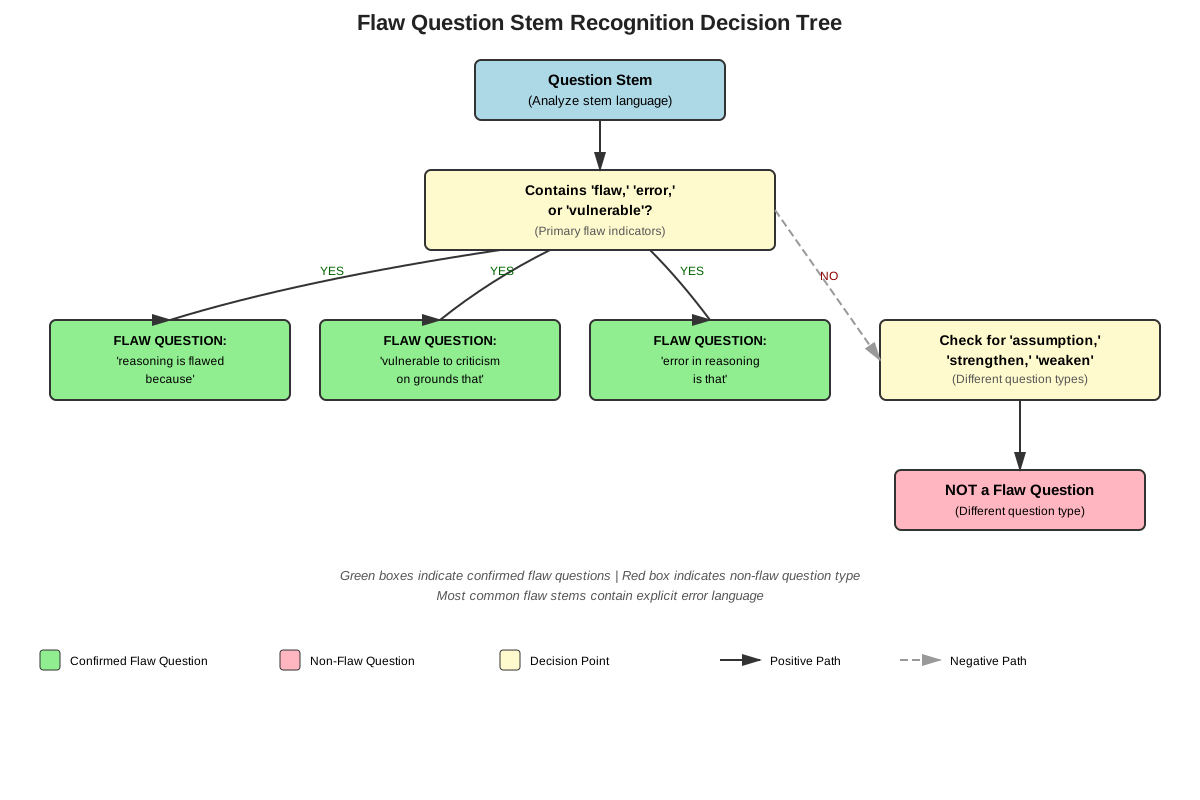
Lsat flaw question stems follow several standard formats, each with distinctive language patterns:
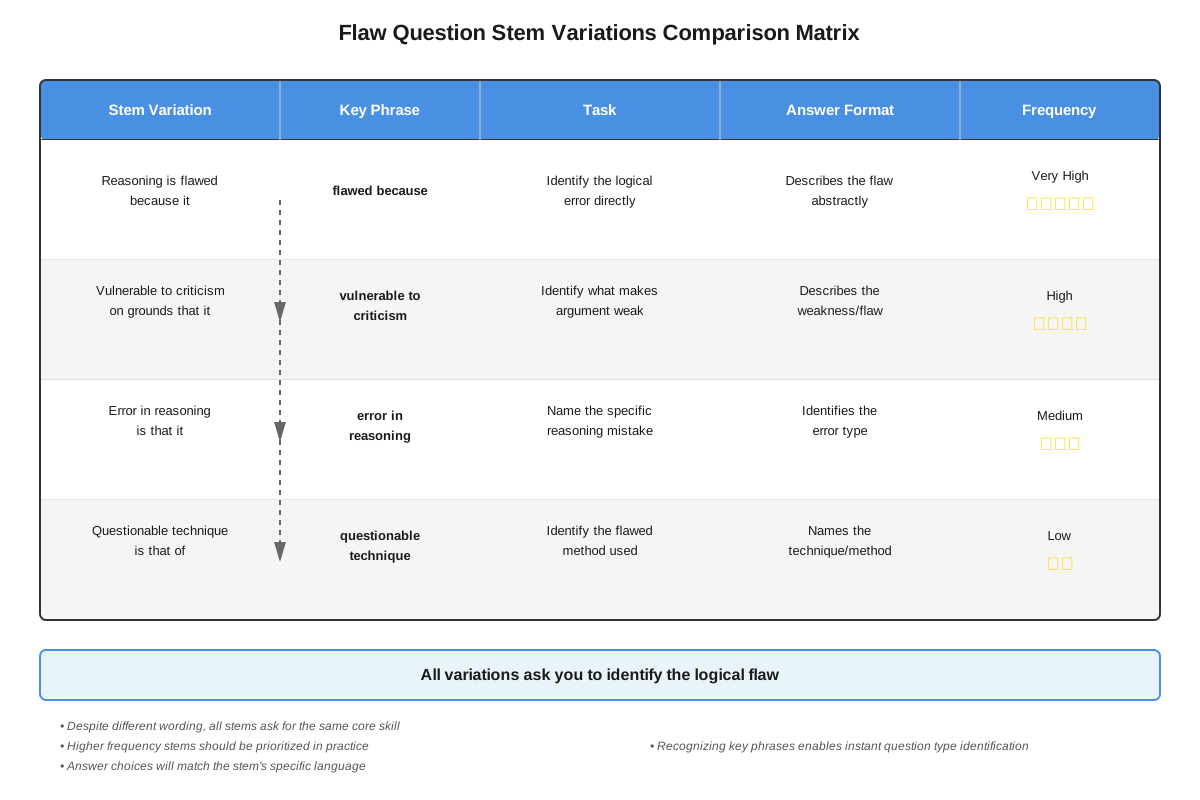
| Stem Type | Example Language | What It Signals |
|---|---|---|
| Direct flaw identification | "The reasoning is flawed in that it..." | Most common format; answer describes the error |
| Vulnerable to criticism | "The argument is vulnerable to criticism on the grounds that..." | Slightly formal phrasing; same task as direct identification |
| Questionable technique | "The argument employs which one of the following questionable techniques?" | Emphasizes the method of reasoning used |
| Error in reasoning | "The reasoning above is flawed because it..." | Straightforward identification of the mistake |
| Fails to consider | "The argument fails to consider the possibility that..." | Often signals overlooked alternatives or assumptions |
Common Flaw Question Stem Variations
Understanding subtle variations helps avoid confusion with similar question types:
"The reasoning in the argument is flawed because the argument..." - This is the most straightforward flaw stem. It directly asks you to identify what makes the reasoning unsound.
"The argument is most vulnerable to criticism on the grounds that it..." - This formal phrasing means exactly the same as direct flaw questions. The word "vulnerable" indicates a weakness exists; "grounds" refers to the reason or basis for criticism.
"A questionable technique used in the argument is that of..." - This variation emphasizes the method or approach the argument uses. The answer will describe a reasoning strategy that's logically problematic.
"Which one of the following most accurately describes a flaw in the argument's reasoning?" - The phrase "most accurately describes" indicates you're looking for the best characterization of the error, even if multiple answers might identify problems.
"The argument is flawed in that it takes for granted that..." - This specific variation combines flaw identification with assumption language. It's asking what unwarranted assumption creates the flaw.
The Anatomy of Flaw Question Answers
Answer choices in flaw questions follow predictable formats. They typically:
- Describe the error abstractly: Rather than referencing specific content from the argument, correct answers characterize the type of reasoning error in general terms
- Match the argument's structure: The answer must accurately reflect what actually happens in the argument, not describe a different flaw
- Use precise logical language: Terms like "presumes," "takes for granted," "confuses," "overlooks," "fails to establish," and "treats" signal specific reasoning errors
Distinguishing Flaws from Assumptions
A critical distinction exists between flaw questions and assumption questions, though they're closely related. An assumption is an unstated premise that must be true for the argument to work. A flaw is a reasoning error that makes the argument logically unsound. Often, the flaw is that the argument makes an unwarranted assumption, but not all flaws are assumption-based, and not all assumptions represent flaws.
For example, if an argument concludes that a medication is safe because no side effects were reported in a study, the assumption might be "the study would have detected side effects if they existed." The flaw might be "takes the absence of reported side effects as evidence that no side effects occurred" or "overlooks the possibility that side effects went unreported." The flaw describes the reasoning error; the assumption states what must be true for the reasoning to work.
The Role of Conclusion Indicators in Flaw Questions
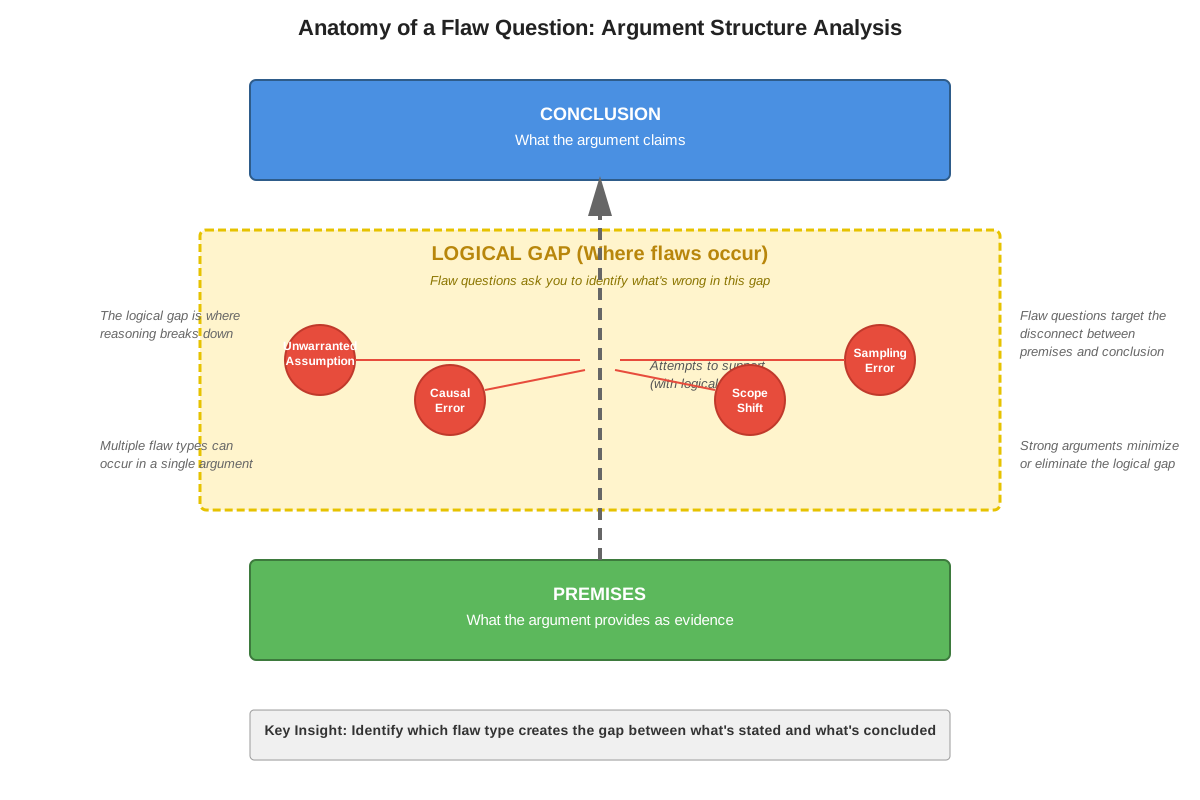
When approaching flaw questions, identifying the conclusion is paramount. The flaw always involves a gap between the premises and the conclusion—either the premises don't adequately support the conclusion, or the reasoning process connecting them is faulty. Look for conclusion indicators like "therefore," "thus," "consequently," "so," and "it follows that" to quickly locate what the argument is trying to prove. Once you've identified the conclusion, ask: "Do the premises actually establish this? What's missing? What's assumed? What alternative explanations exist?"
Common Flaw Categories
While flaw questions can test any reasoning error, certain categories appear repeatedly:
Causal Flaws: Assuming causation from correlation, reversing cause and effect, overlooking alternative causes, or failing to establish that correlation exists
Sampling/Generalization Flaws: Drawing broad conclusions from unrepresentative samples, overgeneralizing from limited evidence, or assuming a sample is representative without justification
Conditional Logic Flaws: Confusing necessary and sufficient conditions, making improper negations or reversals, or treating conditional statements as biconditional
Comparison/Analogy Flaws: Assuming two things are comparable without establishing relevant similarities, or overlooking important differences
Circular Reasoning: Using the conclusion as support for itself, often with different wording
Ad Hominem: Attacking the source of an argument rather than addressing the argument itself
Appeal to Authority/Popularity: Assuming something is true because an authority says so or many people believe it, without establishing the authority's expertise or relevance
Concept Relationships
The concepts within flaw question stems form an interconnected system. Question stem recognition serves as the entry point—correctly identifying that a question asks about flaws determines your entire approach. This recognition skill connects directly to understanding flaw categories, because certain stem variations often signal specific flaw types. For example, stems mentioning "takes for granted" frequently indicate assumption-based flaws, while "fails to consider" often signals overlooked alternatives or possibilities.
The relationship flows: Stem Recognition → Flaw Category Identification → Answer Choice Evaluation. Once you recognize the question type and identify what category of flaw likely exists, you can predict answer choice formats and eliminate options that describe different reasoning errors.
Flaw questions also connect extensively to prerequisite knowledge. Basic argument structure enables you to separate premises from conclusions, which is essential because flaws always involve the relationship between these elements. Common logical fallacies provide the vocabulary and conceptual framework that answer choices use—terms like "circular reasoning," "false dilemma," and "hasty generalization" appear regularly in correct answers.
The connection to assumption questions is particularly strong: many flaws involve unwarranted assumptions, so understanding what an argument assumes helps identify its flaws. Similarly, strengthen and weaken questions connect because understanding an argument's flaw reveals what information would fix it (strengthen) or make it worse (weaken).
Finally, conditional reasoning connects to a specific subset of flaw questions. Many arguments make errors in conditional logic, and recognizing these requires understanding how conditional statements work, what makes them valid, and what errors commonly occur (confusing necessity with sufficiency, improper negations, etc.).
Quick check — test yourself on Flaw question stems so far.
Try Flashcards →High-Yield Facts
⭐ Flaw question stems always assume the argument contains a logical error—your task is identifying what the error is, not whether one exists
⭐ The most common flaw question stem format is "The reasoning is flawed in that it..." or "The argument is vulnerable to criticism on the grounds that..."
⭐ Correct answers describe the flaw abstractly, using general logical terms rather than specific content from the argument
⭐ Approximately 15-20% of all Logical Reasoning questions are flaw questions, making them one of the highest-yield question types
⭐ Flaw questions test the same analytical skill as assumption questions but from a different angle—the flaw often involves making an unwarranted assumption
- The phrase "vulnerable to criticism" means exactly the same as "flawed" in question stems
- Flaw question answers frequently use verbs like "presumes," "assumes," "takes for granted," "overlooks," "fails to establish," "treats," and "confuses"
- Causal reasoning flaws and sampling/generalization flaws are the most frequently tested flaw categories
- The conclusion of the argument is always central to identifying the flaw—the error involves how premises relate to the conclusion
- Wrong answers in flaw questions often describe reasoning errors that don't actually occur in the argument, even if they describe real logical fallacies
Common Misconceptions
Misconception: Flaw questions ask whether an argument is flawed → Correction: Flaw questions assume the argument IS flawed and ask you to identify the specific error. You're not evaluating whether a flaw exists; you're diagnosing what the flaw is.
Misconception: The correct answer will use specific details from the argument → Correction: Correct answers describe the flaw in abstract, general terms that could apply to any argument with that reasoning pattern. They characterize the type of error, not the specific content.
Misconception: If an answer describes a real logical fallacy, it must be correct → Correction: The answer must describe a flaw that actually occurs in the specific argument presented. Many wrong answers accurately describe logical fallacies that simply don't appear in the argument.
Misconception: Flaw questions and assumption questions are the same → Correction: While related, they ask different things. Assumption questions ask what must be true for the argument to work; flaw questions ask what reasoning error undermines the argument. The flaw might involve an unwarranted assumption, but they're distinct question types requiring different approaches.
Misconception: The flaw is always in the conclusion → Correction: The flaw involves the relationship between premises and conclusion—how the reasoning connects them. The conclusion itself might be true; the error is in how the argument tries to establish it.
Misconception: Longer, more complex answer choices are more likely to be correct → Correction: Answer length doesn't correlate with correctness. Some correct answers are concise; some wrong answers are verbose. Focus on whether the answer accurately describes what happens in the argument.
Misconception: "Fails to consider" stems are asking about assumptions → Correction: While these stems do involve overlooked possibilities (which relates to assumptions), they're still flaw questions asking you to identify a reasoning error. The answer will describe what the argument failed to consider that creates a logical gap.
Worked Examples
Example 1: Causal Flaw
Argument: "Studies show that people who drink coffee regularly have lower rates of depression than those who don't drink coffee. Therefore, drinking coffee prevents depression."
Question Stem: "The reasoning in the argument is flawed in that the argument..."
Analysis:
- Identify the conclusion: "Drinking coffee prevents depression" (signaled by "therefore")
- Identify the premise: Coffee drinkers have lower depression rates than non-coffee drinkers
- Identify the gap: The argument moves from correlation (coffee drinking associated with lower depression) to causation (coffee prevents depression)
- Recognize the flaw type: This is a classic causal flaw—assuming causation from correlation without ruling out alternative explanations
Correct Answer: "treats a correlation between two phenomena as evidence that one causes the other"
Why this is correct: This answer abstractly describes exactly what happens—the argument observes a correlation (coffee drinking and lower depression rates occur together) and concludes causation (coffee causes the lower rates). The answer uses general terms ("two phenomena," "correlation," "causes") rather than specific content.
Wrong Answer Example: "assumes that anything that prevents depression is beneficial"
Why this is wrong: While this might be a questionable assumption, it's not the primary flaw in the reasoning. The argument doesn't actually make this assumption—it doesn't discuss whether preventing depression is beneficial. This answer describes a flaw that doesn't occur in the argument.
Example 2: Sampling Flaw
Argument: "A survey of 100 members of the Luxury Car Owners Club found that 87% support reducing public transportation funding. This shows that most citizens support reducing public transportation funding."
Question Stem: "The argument is most vulnerable to criticism on the grounds that it..."
Analysis:
- Identify the conclusion: "Most citizens support reducing public transportation funding"
- Identify the premise: 87% of Luxury Car Owners Club members support this in a survey
- Identify the gap: The argument generalizes from a specific group (luxury car owners) to all citizens
- Recognize the flaw type: This is a sampling/generalization flaw—the sample is clearly unrepresentative of the broader population
Correct Answer: "draws a conclusion about a large population based on evidence from an unrepresentative sample of that population"
Why this is correct: The answer precisely describes the reasoning error. Luxury car owners are not representative of all citizens (they're wealthier, have different transportation needs, etc.), yet the argument treats survey results from this group as evidence about citizens generally. The answer uses abstract language ("large population," "unrepresentative sample") that captures the structure of the error.
Wrong Answer Example: "relies on a survey that may have been poorly conducted"
Why this is wrong: The argument doesn't have a flaw in survey methodology—we have no reason to think the survey of club members was poorly conducted. The flaw is in generalizing from this specific group to all citizens, not in how the survey was administered.
Exam Strategy
Immediate Recognition Protocol
When you encounter a question stem, scan for these trigger phrases that signal flaw questions:
- "flawed in that"
- "vulnerable to criticism"
- "questionable technique"
- "reasoning error"
- "fails to consider"
- "overlooks the possibility"
Exam Tip: If you see any variation of "the argument is flawed" or "vulnerable to criticism," immediately shift into flaw-finding mode. Your task is diagnosing the error, not evaluating truth or adding information.
Four-Step Approach to Flaw Questions
- Identify the conclusion precisely: Underline or mentally note exactly what the argument is trying to prove. The flaw always involves how the premises relate to this conclusion.
- Articulate the gap in your own words: Before looking at answer choices, describe to yourself what's wrong with the reasoning. Use simple language: "This assumes X," "This ignores Y," "This confuses correlation with causation."
- Predict the answer category: Based on your gap analysis, predict what type of flaw you're looking for (causal, sampling, conditional logic, etc.). This helps you eliminate wrong answers quickly.
- Match abstractly: Find the answer choice that describes your identified gap in abstract, general terms. Don't expect the answer to use the same words as the argument—it will describe the reasoning pattern.
Process of Elimination Strategy
Wrong answers in flaw questions typically fall into these categories:
- Describes a flaw that doesn't occur: The answer accurately describes a logical fallacy, but that fallacy doesn't appear in this specific argument
- Too specific or too general: The answer either focuses on irrelevant details or describes something so broad it doesn't capture the specific error
- Describes the opposite error: The answer says the argument does X when it actually does the opposite
- Confuses premise and conclusion: The answer misidentifies what the argument is trying to prove versus what it uses as evidence
Time Management: Spend 30-45 seconds on the argument itself, identifying the conclusion and flaw. This upfront investment makes answer choice evaluation much faster—you'll eliminate wrong answers in seconds when you know exactly what you're looking for.
Red Flag Words in Answer Choices
Certain words in answer choices should trigger careful evaluation:
- "Presumes" or "takes for granted": Signals an assumption-based flaw
- "Confuses" or "treats": Indicates the argument equates or conflates distinct concepts
- "Overlooks" or "fails to consider": Points to ignored alternatives or possibilities
- "Establishes" or "demonstrates": Often appears in wrong answers claiming the argument proves something it doesn't actually address
Memory Techniques
The FLAW Acronym
Find the conclusion first
Locate the gap between premises and conclusion
Articulate the error in simple terms
Watch for abstract answer descriptions
Stem Recognition Mnemonic: "VFQ"
Vulnerable to criticism = Flawed = Questionable technique
All three phrases mean the same thing—you're identifying a reasoning error.
Visualization Strategy
Picture the argument as a bridge: premises on one side, conclusion on the other. The flaw is the missing plank, weak support, or structural defect that makes the bridge unsound. When you read the argument, visualize where the bridge is weakest—that's your flaw.
Common Flaw Categories: "CCSA"
Causal (correlation ≠ causation)
Conditional logic errors
Sampling/generalization problems
Analogy/comparison failures
These four categories cover the vast majority of flaw questions. When you identify the question type, quickly categorize which type of flaw you're likely dealing with.
Summary
Flaw question stems are among the most important and frequently tested question types in LSAT Logical Reasoning, appearing 8-10 times per test. These questions present arguments with logical errors and ask you to identify the specific reasoning mistake. Recognizing flaw question stems through trigger phrases like "flawed in that," "vulnerable to criticism," and "questionable technique" is essential for applying the correct strategy. The key approach involves identifying the conclusion, articulating the gap between premises and conclusion, and matching this gap to an answer choice that describes the error in abstract, general terms. Common flaw categories include causal reasoning errors, sampling and generalization problems, conditional logic mistakes, and flawed analogies. Success on flaw questions requires distinguishing them from related question types (particularly assumption questions), understanding that correct answers describe reasoning patterns rather than specific content, and recognizing that the flaw always involves how premises relate to the conclusion rather than whether the conclusion is true.
Key Takeaways
- Flaw question stems assume an error exists and ask you to identify it—you're diagnosing the specific reasoning mistake, not evaluating whether the argument is sound
- The most common stem formats include "flawed in that," "vulnerable to criticism," and "questionable technique," all of which signal the same task
- Correct answers describe the flaw abstractly using general logical terms, not specific content from the argument
- The conclusion is always central to identifying the flaw—the error involves how premises connect to what the argument tries to prove
- Causal flaws (assuming causation from correlation) and sampling flaws (generalizing from unrepresentative samples) are the most frequently tested categories
- Flaw questions connect closely to assumption questions—many flaws involve unwarranted assumptions, but the question types require different approaches
- Efficient performance requires identifying the conclusion and gap before evaluating answer choices, allowing rapid elimination of options that describe errors not present in the argument
Related Topics
Assumption Questions: These questions ask what unstated premise an argument requires. Mastering flaw questions provides direct preparation for assumption questions because many flaws involve unwarranted assumptions. Understanding what's wrong with an argument helps identify what it takes for granted.
Strengthen and Weaken Questions: Once you can identify an argument's flaw, you can more easily determine what information would fix the reasoning (strengthen) or make it worse (weaken). The flaw reveals the argument's vulnerability.
Parallel Reasoning and Parallel Flaw Questions: These questions require matching argument structures. Understanding common flaw patterns helps you recognize when two arguments make the same type of reasoning error, even with different content.
Formal Logic and Conditional Reasoning: Many flaw questions involve errors in conditional logic. Deepening your understanding of sufficient and necessary conditions, proper negations, and valid inferences enhances your ability to spot conditional reasoning flaws.
Argument Structure and Diagramming: Advanced techniques for mapping argument structure help visualize the relationship between premises and conclusions, making flaws more apparent and easier to articulate.
Practice CTA
Now that you understand how to recognize and approach flaw question stems, it's time to apply this knowledge. Work through the practice questions to test your ability to identify flaw stems, categorize reasoning errors, and select correct answers efficiently. Use the flashcards to reinforce recognition of common stem variations and flaw categories. Remember: flaw questions are highly learnable—the same patterns appear repeatedly, and with practice, you'll develop the pattern recognition that makes these questions fast and reliable scoring opportunities. Each practice question you complete strengthens your diagnostic skills and builds the confidence you need for test day success.
Sign up free to keep reading
Create a free AnvayaPrep account to finish this LSAT guide on Flaw question stems — plus flashcards and practice questions.