Overview
Method of reasoning question stems represent one of the most frequently tested question types in LSAT Logical Reasoning sections, appearing approximately 4-6 times per test. These questions ask test-takers to identify and describe the argumentative technique or logical structure an author uses to reach their conclusion. Unlike questions that ask whether an argument is valid or what would strengthen it, method of reasoning questions focus exclusively on how the argument proceeds—the structural blueprint of the reasoning itself.
Mastering LSAT method of reasoning question stems is essential because these questions test a fundamental skill that underlies all logical analysis: the ability to step back from content and recognize form. When facing these questions, students must abstract away from the specific subject matter (whether the passage discusses economics, biology, or law) and identify the underlying logical moves the author makes. This metacognitive skill—thinking about thinking—is precisely what law schools value and what the LSAT measures.
Within the broader landscape of logical reasoning, method of reasoning questions occupy a unique position. While other question types ask you to evaluate, strengthen, weaken, or find assumptions in arguments, method questions require you to describe the argumentative architecture itself. This skill connects directly to question stem recognition, as identifying these stems quickly and accurately allows test-takers to adopt the appropriate analytical mindset before even reading the stimulus. Understanding method of reasoning questions also builds foundational skills for parallel reasoning questions, flaw questions, and principle questions—all of which require recognizing argumentative structures.
Learning Objectives
- [ ] Identify how Method of reasoning question stems appears in LSAT questions
- [ ] Explain the reasoning pattern behind Method of reasoning question stems
- [ ] Apply Method of reasoning question stems to solve LSAT-style problems accurately
- [ ] Distinguish method of reasoning questions from other Logical Reasoning question types within 5 seconds of reading the stem
- [ ] Categorize method of reasoning questions into their common subtypes (descriptive vs. comparative)
- [ ] Predict common wrong answer patterns in method of reasoning questions before reviewing answer choices
Prerequisites
- Basic argument structure: Understanding premises, conclusions, and how they connect is essential because method questions require identifying these components before describing how they relate
- Conditional reasoning fundamentals: Many method of reasoning questions involve describing conditional relationships, contrapositive reasoning, or hypothetical scenarios
- Common argument patterns: Familiarity with analogies, generalizations, cause-and-effect reasoning, and counterexamples provides the vocabulary needed to describe argumentative methods
- Question stem recognition basics: The ability to quickly identify question types allows efficient allocation of time and appropriate analytical approaches
Why This Topic Matters
Method of reasoning questions test a lawyer's core competency: analyzing the structure and validity of arguments independent of personal beliefs about the content. In legal practice, attorneys must constantly evaluate how opposing counsel constructs arguments, identify logical moves in judicial opinions, and craft their own persuasive reasoning. The LSAT uses method questions to assess whether candidates can perform this structural analysis under time pressure.
On the LSAT, method of reasoning questions typically appear 4-6 times per test (approximately 15-20% of Logical Reasoning questions), making them one of the most common question types alongside assumption and strengthen/weaken questions. These questions appear in both Logical Reasoning sections and consistently span the difficulty spectrum from relatively straightforward to highly challenging. The LSAC (Law School Admission Council) considers these questions essential measures of analytical reasoning ability.
Method of reasoning questions commonly appear in several formats: single-argument analysis (describing how one person argues), dialogue analysis (describing how one speaker responds to another), and comparative method questions (identifying similarities or differences between two argumentative approaches). The stimuli often involve abstract reasoning, scientific methodology, philosophical arguments, or legal reasoning—contexts where the structure of argument matters more than domain-specific knowledge. Recognizing these patterns allows test-takers to anticipate what they're looking for before diving into complex answer choices.
Core Concepts
Defining Method of Reasoning Questions
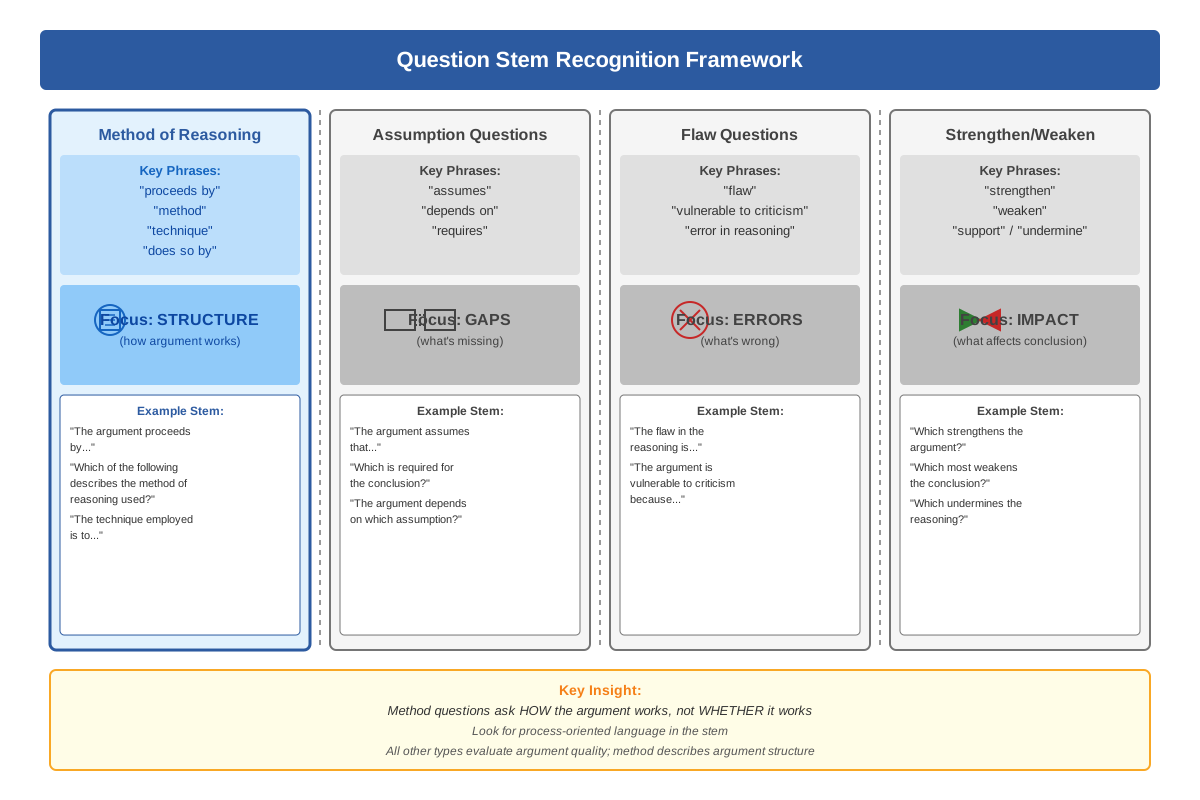
A method of reasoning question stem asks the test-taker to describe the argumentative technique, logical structure, or reasoning pattern used in the stimulus. These questions focus on the "how" rather than the "what" or "whether" of an argument. The question stem itself serves as the primary identifier, typically containing phrases like "proceeds by," "employs which technique," "uses which method," or "the argument does which of the following."
The fundamental task in these questions involves two steps: first, understanding the argument's content well enough to identify its structural components (premises, conclusion, intermediate steps); second, abstracting from that content to recognize the logical pattern or technique employed. This abstraction requires seeing past the specific subject matter to identify the underlying form.
Common Method of Reasoning Question Stem Formulations
Method of reasoning question stems appear in predictable patterns. Recognizing these formulations instantly signals the appropriate analytical approach:
Standard descriptive stems:
- "The argument proceeds by..."
- "Which one of the following describes the technique of reasoning used above?"
- "The argument employs which one of the following methods?"
- "The argument does which of the following?"
Dialogue/response stems:
- "Keisha responds to James by..."
- "The critic's response proceeds by..."
- "Maria counters David's argument by..."
Comparative stems:
- "The relationship of Alex's response to Chen's argument is most similar to..."
- "The two arguments employ which of the following similar techniques?"
Types of Argumentative Methods Tested
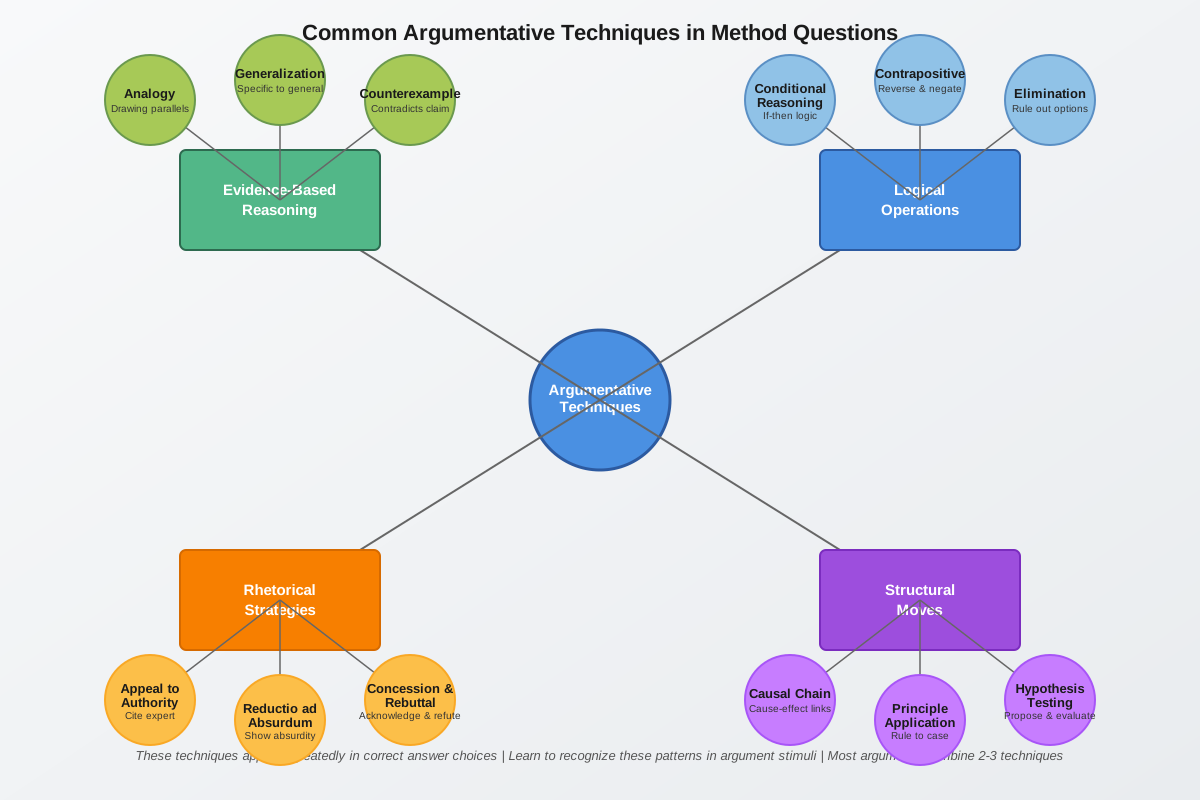
The LSAT tests recognition of specific argumentative techniques repeatedly. Understanding these common patterns allows efficient answer choice evaluation:
| Argumentative Method | Description | Example Structure |
|---|---|---|
| Analogy | Comparing two situations to suggest similar conclusions | "Just as X has property Y, so too does Z have property Y" |
| Counterexample | Providing a specific case that contradicts a general claim | "The claim says all A are B, but here's an A that isn't B" |
| Reductio ad absurdum | Showing a position leads to absurd/contradictory consequences | "If we accept X, then Y follows, but Y is clearly false" |
| Appeal to authority | Citing expert opinion as evidence | "Expert E claims X, therefore X is likely true" |
| Causal reasoning | Establishing or challenging cause-effect relationships | "X occurred before Y, and X is sufficient for Y" |
| Generalization | Moving from specific cases to general principles | "These five cases all show X, so X is generally true" |
| Elimination | Ruling out alternatives to support a conclusion | "It must be A because it cannot be B, C, or D" |
Descriptive vs. Comparative Method Questions
Method of reasoning questions divide into two major categories that require slightly different approaches:
Descriptive method questions ask you to characterize how a single argument proceeds or how one speaker responds to another. These questions require identifying the logical moves within one argumentative structure. The correct answer will accurately describe the relationship between premises and conclusion, the type of evidence used, or the logical technique employed.
Comparative method questions ask you to identify similarities or differences between two arguments or to find an argument that uses a similar method to the one in the stimulus. These questions require recognizing abstract argumentative patterns that can appear across different content domains. The correct answer will match the logical structure while potentially discussing completely different subject matter.
The Abstraction Requirement
The defining challenge of method of reasoning questions is abstraction—the ability to recognize logical form independent of content. An argument about tax policy and an argument about evolutionary biology might employ identical logical structures. Test-takers must learn to see past the surface content to identify the underlying pattern.
This abstraction operates at multiple levels:
- Content to structure: Recognizing that "All mammals are warm-blooded; whales are mammals; therefore whales are warm-blooded" has the same structure as "All lawyers passed the bar; Sarah is a lawyer; therefore Sarah passed the bar"
- Specific to general: Seeing that providing three examples of a phenomenon represents "supporting a generalization with specific instances"
- Implicit to explicit: Identifying unstated logical moves, such as when an argument assumes a causal relationship without explicitly stating it
Common Reasoning Patterns in Answer Choices
Method of reasoning answer choices use specific vocabulary to describe argumentative techniques. Familiarity with this vocabulary accelerates answer choice evaluation:
- "Establishes that one claim is compatible with another": Shows two claims can both be true simultaneously
- "Provides evidence that undermines a generalization": Offers a counterexample or contradictory data
- "Draws a conclusion by ruling out alternative explanations": Uses process of elimination
- "Supports a hypothesis by citing an authority": Appeals to expert testimony
- "Argues by analogy": Compares two situations to suggest similar conclusions
- "Demonstrates that accepting a claim leads to an absurdity": Uses reductio ad absurdum
- "Challenges a claim by questioning the representativeness of evidence": Attacks sampling or generalization
- "Infers a causal relationship from a correlation": Moves from co-occurrence to causation
Concept Relationships
Method of reasoning questions connect to virtually every other Logical Reasoning question type because they require understanding argument structure—the foundation of all logical analysis. The relationship flows as follows:
Argument Structure Recognition → Method of Reasoning Questions: Before describing how an argument proceeds, one must identify its components (premises, conclusion, assumptions). This foundational skill enables method analysis.
Method of Reasoning → Parallel Reasoning: Parallel reasoning questions are essentially comparative method questions that ask for an argument with identical structure. Mastering method questions builds the abstraction skills necessary for parallel reasoning.
Method of Reasoning ↔ Flaw Questions: These question types are closely related but inverse. Method questions ask "how does the argument proceed?" while flaw questions ask "what's wrong with how the argument proceeds?" Understanding common argumentative methods helps identify when those methods are misapplied.
Method of Reasoning → Principle Questions: Some principle questions ask which principle describes the reasoning used. These are essentially method questions framed in terms of general rules rather than specific techniques.
Question Stem Recognition → Method of Reasoning: Rapid identification of method question stems allows test-takers to adopt the appropriate mindset (structural analysis rather than content evaluation) before reading the stimulus.
Within method of reasoning questions themselves, the concepts connect hierarchically: Question Stem Recognition → Argument Structure Analysis → Pattern Identification → Abstraction to General Form → Answer Choice Matching. Each step depends on the previous one, making this a sequential rather than parallel process.
Quick check — test yourself on Method of reasoning question stems so far.
Try Flashcards →High-Yield Facts
⭐ Method of reasoning questions appear 4-6 times per LSAT, making them one of the most common question types in Logical Reasoning sections.
⭐ The question stem always asks "how" the argument proceeds, not whether it's valid or what would strengthen it—this distinction is crucial for question type identification.
⭐ Correct answers describe the logical structure, not the content, meaning they could theoretically apply to arguments about completely different topics with the same structure.
⭐ Common stem phrases include "proceeds by," "employs which technique," "responds by," and "does which of the following"—recognizing these triggers instant question type identification.
⭐ Dialogue-based method questions typically ask how the second speaker responds to the first, requiring identification of the relationship between two argumentative positions.
- Method questions test abstraction ability—seeing logical form independent of specific content—which is fundamental to legal reasoning.
- Wrong answers often describe what the argument discusses rather than how it argues, confusing content with structure.
- The most commonly tested argumentative methods include analogy, counterexample, elimination of alternatives, and reductio ad absurdum.
- Comparative method questions require matching abstract logical structures across different content domains.
- Answer choices use technical vocabulary like "compatible," "undermines," "establishes," and "demonstrates" that have precise logical meanings.
- Method questions rarely require outside knowledge; the answer is always fully supported by the stimulus structure.
- Reading the question stem first is particularly valuable for method questions because it focuses attention on structure rather than content evaluation.
Common Misconceptions
Misconception: Method of reasoning questions ask whether the argument is good or bad.
Correction: Method questions are purely descriptive, asking how the argument proceeds regardless of its validity. An argument can use a particular method (like analogy) whether that method is well-applied or poorly-applied. Evaluation comes in flaw questions, not method questions.
Misconception: The correct answer must use the same terminology or subject matter as the stimulus.
Correction: Correct answers describe abstract logical structure and often use completely different vocabulary or examples than the stimulus. An argument about biology might be correctly described using an answer choice that discusses "establishing compatibility between claims" without mentioning biology at all.
Misconception: If an answer choice describes something true about the argument, it must be correct.
Correction: Many wrong answers accurately describe some aspect of the argument's content without capturing its method. For example, an answer might correctly note that the argument "discusses economic policy" while failing to describe how the argument actually proceeds (perhaps by analogy or elimination).
Misconception: Method questions require identifying every logical step in the argument.
Correction: Method questions ask for the primary or most significant argumentative technique, not an exhaustive catalog of every logical move. The correct answer captures the main structural pattern, even if the argument contains other minor elements.
Misconception: Dialogue method questions ask what the second speaker believes about the topic.
Correction: Dialogue method questions ask how the second speaker responds to the first speaker's reasoning—the relationship between argumentative positions, not the content of beliefs. The second speaker might agree with the first speaker's conclusion while challenging their method, or vice versa.
Worked Examples
Example 1: Standard Descriptive Method Question
Stimulus:
"Some people claim that all great leaders possess charisma. However, this cannot be true. Historical records clearly show that several highly effective military commanders were described by contemporaries as reserved and uncharismatic, yet they achieved remarkable success in leading their troops."
Question Stem:
"The argument proceeds by"
Analysis:
First, identify the argument structure:
- Conclusion: The claim that all great leaders possess charisma cannot be true
- Premise: Historical records show several effective military commanders were uncharismatic yet successful
Second, identify the argumentative method:
The argument challenges a universal claim ("all great leaders possess charisma") by providing specific instances that contradict it (uncharismatic military commanders who were nonetheless great leaders). This is the classic structure of refutation by counterexample.
Correct Answer Pattern:
"Providing examples that are inconsistent with a generalization in order to challenge that generalization"
Why This Works:
This answer accurately describes the logical structure: the argument uses specific cases (examples) that contradict (are inconsistent with) a universal claim (generalization) to argue against it (challenge). The answer abstracts from the specific content (leadership, charisma, military commanders) to describe the logical form.
Common Wrong Answer Patterns:
- "Arguing that charisma is not important for leadership" (describes content/conclusion, not method)
- "Citing historical records as evidence" (too vague; doesn't capture the counterexample structure)
- "Questioning the definition of great leadership" (misidentifies the argumentative move)
Example 2: Dialogue Method Question
Stimulus:
"Marcus: The new traffic regulations will reduce accidents because they lower speed limits on dangerous roads.
Yuki: Your reasoning is flawed. Many cities that lowered speed limits saw no reduction in accidents, while some cities that kept speed limits constant experienced fewer accidents after improving road maintenance."
Question Stem:
"Yuki responds to Marcus by"
Analysis:
First, identify Marcus's argument structure:
- Conclusion: New regulations will reduce accidents
- Premise: They lower speed limits on dangerous roads
- Implicit assumption: Lowering speed limits causes accident reduction
Second, identify how Yuki responds:
Yuki doesn't directly attack Marcus's conclusion or premises. Instead, Yuki challenges the assumed causal relationship between speed limits and accidents by providing evidence that this relationship doesn't hold consistently (cities with lower limits but no accident reduction) and that an alternative factor (road maintenance) might be responsible.
Correct Answer Pattern:
"Challenging a causal claim by presenting evidence that the alleged cause does not reliably produce the effect and suggesting an alternative explanation"
Why This Works:
This answer captures multiple aspects of Yuki's method: (1) challenging causation, (2) using counterevidence (cities where the cause didn't produce the effect), and (3) proposing an alternative causal factor. It describes the relationship between the two arguments rather than just summarizing Yuki's position.
Common Wrong Answer Patterns:
- "Disagreeing with Marcus's conclusion" (describes what Yuki does, not how)
- "Providing evidence about traffic accidents" (too vague; doesn't capture the specific logical move)
- "Arguing that road maintenance is more important than speed limits" (overstates Yuki's claim; Yuki suggests an alternative, not a ranking)
Exam Strategy
Pre-Reading Strategy
Always read the question stem before the stimulus for method of reasoning questions. When you identify a method question stem, mentally prepare to:
- Focus on structure over content
- Identify the conclusion and main premises
- Notice the logical relationship between premises and conclusion
- Think about how you would describe the argument's technique in your own words
Trigger Word Recognition
Develop automatic recognition of method question stems. Key triggers include:
- "proceeds by"
- "technique of reasoning"
- "method of argument"
- "does which of the following"
- "responds by" (in dialogue)
- "employs which"
When you see these phrases, immediately shift to structural analysis mode.
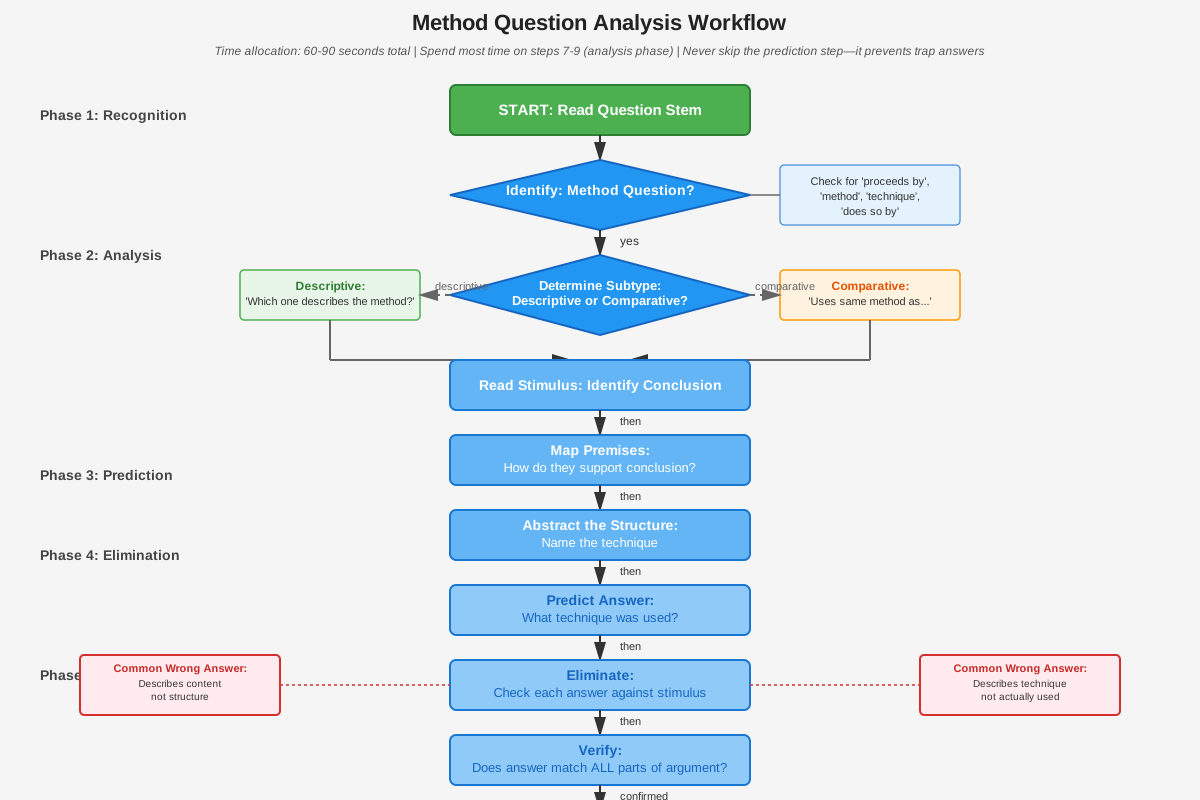
Stimulus Analysis Process
Follow this systematic approach:
- Identify the conclusion first: Method questions require knowing what the argument is trying to prove
- Map the premises: Note what evidence supports the conclusion
- Identify the logical connection: How do the premises relate to the conclusion? (Analogy? Elimination? Counterexample?)
- Abstract to general form: Mentally rephrase the method without content-specific terms
- Predict the answer: Before looking at choices, articulate the method in your own words
Answer Choice Evaluation
Use this elimination strategy:
First pass—eliminate answers that:
- Describe content rather than structure ("discusses economic policy")
- Describe conclusions rather than methods ("argues that X is false")
- Mention elements not present in the argument ("cites statistical evidence" when no statistics appear)
Second pass—compare remaining answers:
- Choose the answer that most completely captures the primary argumentative move
- Prefer specific descriptions over vague ones
- Verify that every element of the answer choice is supported by the stimulus
Time Management
Method of reasoning questions typically require 60-90 seconds for medium difficulty questions. Allocate time as follows:
- Question stem identification: 5 seconds
- Stimulus analysis: 30-40 seconds
- Answer choice evaluation: 25-45 seconds
If you find yourself spending more than 90 seconds, you're likely over-analyzing. Trust your structural analysis and move forward.
Common Trap Patterns
Be alert for these wrong answer patterns:
- Content description masquerading as method: "Argues that speed limits don't reduce accidents" (what) vs. "Challenges a causal claim with counterevidence" (how)
- Partial descriptions: Answers that capture one aspect of the method but miss the primary technique
- Overly specific answers: Answers that describe minor details rather than the main argumentative structure
- Reversed relationships: In dialogue questions, answers that describe what the first speaker does rather than how the second responds
Memory Techniques
The "PACE" Framework for Method Questions
Pattern recognition: Identify the question stem triggers
Abstract the structure: Remove content-specific details
Categorize the method: Match to common argumentative techniques
Evaluate systematically: Eliminate wrong answer patterns first
Common Methods Mnemonic: "CARE CAGE"
- Counterexample
- Analogy
- Reductio ad absurdum
- Elimination of alternatives
- Causal reasoning
- Authority appeal
- Generalization
- Establishing compatibility
Visualization Strategy
Picture arguments as building structures:
- Premises = foundation blocks
- Conclusion = roof
- Method = the architectural technique connecting them (bridge, arch, columns, etc.)
When analyzing method, visualize how the foundation supports the roof. Is it through parallel supports (analogy)? By removing competing structures (elimination)? By showing another structure collapsed (reductio)?
Dialogue Question Reminder: "R-R-R"
When the second speaker Responds, they might:
- Refute (provide counterevidence)
- Reframe (accept facts but reinterpret)
- Redirect (shift to different considerations)
Summary
Method of reasoning question stems ask test-takers to identify and describe the argumentative technique or logical structure used in an LSAT stimulus, focusing on how an argument proceeds rather than whether it's valid or what would strengthen it. These questions appear 4-6 times per test and require a crucial skill: abstracting from specific content to recognize underlying logical form. Success depends on systematic question stem recognition (identifying triggers like "proceeds by" or "responds by"), structural analysis (mapping conclusions, premises, and their relationships), and pattern matching (connecting the argument's structure to common argumentative techniques like analogy, counterexample, elimination, or reductio ad absurdum). The primary challenge is maintaining focus on structure rather than content—describing the logical architecture rather than the building materials. Mastering method questions builds foundational skills for parallel reasoning, flaw identification, and all logical analysis, making this topic essential for LSAT success.
Key Takeaways
- Method of reasoning questions ask "how does the argument proceed?" not "is the argument valid?" or "what's the conclusion?"—this distinction is fundamental to question type recognition
- Correct answers describe abstract logical structure that could apply to arguments about completely different topics; they focus on form, not content
- Common question stem triggers include "proceeds by," "technique of reasoning," "employs which method," and "responds by"—instant recognition enables appropriate analytical approach
- The most frequently tested argumentative methods are counterexample, analogy, elimination of alternatives, reductio ad absurdum, and causal reasoning
- Dialogue method questions require identifying the relationship between two argumentative positions, not just summarizing what the second speaker believes
- Systematic analysis involves: identify conclusion → map premises → recognize logical connection → abstract to general form → match to answer choices
- Wrong answers typically describe content rather than structure, mention elements not present in the argument, or capture minor details while missing the primary method
Related Topics
Parallel Reasoning Questions: These questions extend method of reasoning skills by asking test-takers to find arguments with identical logical structure across different content domains. Mastering method questions provides the abstraction skills necessary for parallel reasoning success.
Flaw Questions: Understanding common argumentative methods enables recognition of when those methods are misapplied. Flaw questions ask "what's wrong with how the argument proceeds?" making them the evaluative counterpart to descriptive method questions.
Argument Structure and Conclusion Identification: These foundational skills underlie all method analysis. Strengthening conclusion identification and premise mapping directly improves method question performance.
Formal Logic and Conditional Reasoning: Many method questions involve describing conditional reasoning patterns, contrapositive reasoning, or logical relationships that require formal logic understanding.
Principle Questions (Method Variant): Some principle questions ask which general rule describes the reasoning used, essentially combining method analysis with principle application.
Practice CTA
Now that you understand method of reasoning question stems, it's time to apply these concepts to actual LSAT questions. The practice questions and flashcards will help solidify your ability to recognize question stems instantly, abstract argumentative structures efficiently, and match those structures to correct answer choices under time pressure. Remember: method questions reward systematic analysis over intuition. Trust the process you've learned—identify the stem, map the structure, abstract the pattern, and evaluate methodically. Each practice question strengthens your pattern recognition and builds the confidence needed for test day success. You've got this!
Sign up free to keep reading
Create a free AnvayaPrep account to finish this LSAT guide on Method of reasoning question stems — plus flashcards and practice questions.