Overview
Must be true question stems represent one of the most fundamental and frequently tested question types in LSAT Logical Reasoning sections. These questions require test-takers to identify answer choices that are directly supported by, or logically follow from, the information presented in the stimulus. Unlike questions that ask for assumptions or strengthen arguments, must be true questions demand strict adherence to what can be proven from the given facts alone—no additional information, no speculation, and no creative interpretation beyond what the passage explicitly states or necessarily implies.
Understanding LSAT must be true question stems is essential because they test pure logical inference skills, the bedrock of legal reasoning. These questions assess whether students can distinguish between what must follow from given premises versus what merely could be true or is likely true. This distinction is critical in legal practice, where attorneys must identify what can be conclusively established from evidence versus what remains speculative. Must be true questions typically appear 3-5 times per Logical Reasoning section, making them high-yield material that directly impacts overall LSAT performance.
Within the broader framework of question stem recognition, must be true questions occupy a unique position. They form the foundation for understanding inference-based reasoning that extends to related question types like "most strongly supported" and "must be false" questions. Mastering these stems enables students to quickly categorize questions during timed conditions, activate the appropriate analytical framework, and avoid common traps designed to catch those who confuse logical necessity with mere possibility. The skills developed through must be true questions—careful reading, precise logical deduction, and rigorous proof standards—transfer directly to success across all Logical Reasoning question types.
Learning Objectives
- [ ] Identify how Must be true question stems appears in LSAT questions
- [ ] Explain the reasoning pattern behind Must be true question stems
- [ ] Apply Must be true question stems to solve LSAT-style problems accurately
- [ ] Distinguish must be true questions from closely related question types (e.g., most strongly supported, could be true)
- [ ] Recognize and avoid common trap answers in must be true questions
- [ ] Evaluate answer choices using the strict standard of logical necessity
- [ ] Combine multiple premises to derive valid inferences in complex stimuli
Prerequisites
- Basic formal logic concepts: Understanding conditional statements, contrapositives, and basic logical operators is essential for recognizing when conclusions necessarily follow from premises
- Argument structure identification: Recognizing premises, conclusions, and supporting evidence helps distinguish what information is given versus what must be inferred
- Reading comprehension fundamentals: The ability to parse complex sentences and identify key claims ensures accurate understanding of the stimulus before attempting inferences
- Familiarity with LSAT question format: Understanding how stimuli and answer choices are structured allows efficient navigation during timed conditions
Why This Topic Matters
Must be true questions represent approximately 15-20% of all Logical Reasoning questions on the LSAT, making them one of the most frequently tested question types. Each LSAT typically contains 6-10 must be true questions across both Logical Reasoning sections, meaning mastery of this question type can directly impact 3-5 points on the scaled score. For students targeting scores above 165, near-perfect accuracy on must be true questions is essential, as these questions are often considered more straightforward than assumption or flaw questions when approached with the correct methodology.
In legal practice, the reasoning skills tested by must be true questions directly parallel the analytical work attorneys perform daily. Lawyers must constantly determine what can be conclusively established from contracts, statutes, precedents, and evidence versus what remains uncertain or requires additional proof. The ability to draw only warranted inferences—neither overreaching beyond what the facts support nor failing to recognize what necessarily follows—is fundamental to legal analysis, brief writing, and oral advocacy.
On the LSAT, must be true questions appear in various contexts. They may follow factual passages describing situations, scientific findings, or statistical data. They commonly accompany arguments where the question asks what must be true if the argument's premises are accepted. Some stimuli present conditional chains or formal logic structures that require combining multiple statements. Others provide descriptive scenarios where careful attention to quantifiers (all, some, most, none) determines what can be conclusively inferred. The LSAT frequently tests whether students can recognize the difference between what the passage proves versus what it merely suggests or makes plausible.
Core Concepts
Defining Must Be True Questions
Must be true question stems are prompts that ask test-takers to identify answer choices that are logically guaranteed by the information in the stimulus. The correct answer to a must be true question cannot be false if the stimulus is true—it follows with logical necessity. These questions test deductive reasoning: the ability to recognize what conclusions are forced by the given premises, regardless of what might be true in the real world or what seems plausible.
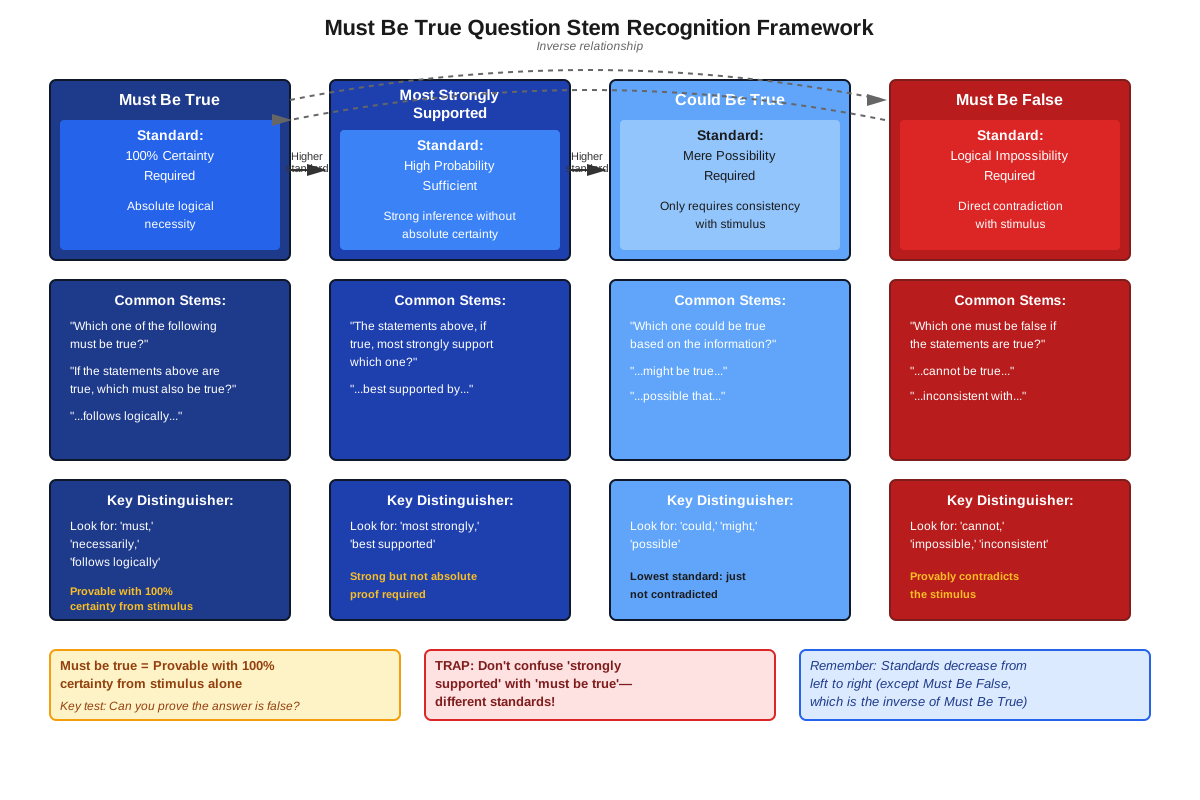
The standard of proof for must be true questions is absolute certainty within the logical framework established by the stimulus. If there exists even one possible scenario where the stimulus is true but the answer choice is false, that answer choice is incorrect. This distinguishes must be true questions from "most strongly supported" questions, which allow for high probability rather than certainty, and from "could be true" questions, which only require possibility rather than necessity.
Common Question Stem Formulations
Recognizing must be true questions requires familiarity with their characteristic language. The LSAT uses various phrasings, but all share the requirement of logical necessity:
Direct "must be true" language:
- "Which one of the following must be true?"
- "If the statements above are true, which one of the following must also be true?"
- "Which one of the following can be properly inferred from the passage?"
- "Which one of the following follows logically from the statements above?"
"Properly concluded" variations:
- "Which one of the following can be properly concluded from the information above?"
- "The statements above, if true, most strongly support which one of the following?"
- "Which one of the following conclusions is best supported by the information above?"
Conditional formulations:
- "If all the statements above are true, which one of the following must also be true?"
- "The information above provides the most support for which one of the following?"
Note that "most strongly supported" represents a slightly relaxed standard compared to pure "must be true," though the LSAT often treats them similarly in practice. The key distinction is that "most strongly supported" technically allows for very high probability rather than absolute certainty, though correct answers typically still follow with near-logical necessity.
The Logical Reasoning Pattern
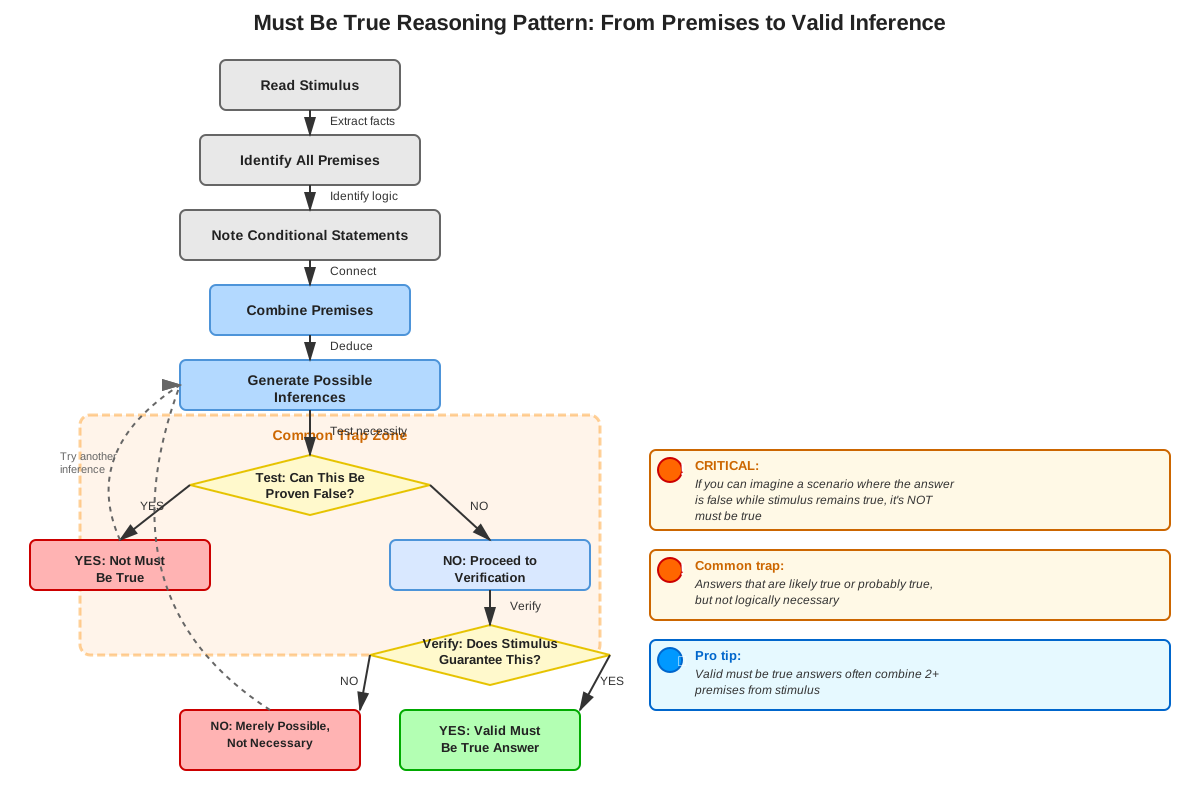
The reasoning pattern for must be true questions follows a strict deductive framework:
- Accept all stimulus information as true: Unlike strengthen/weaken questions where you evaluate arguments, must be true questions require treating every statement in the stimulus as an established fact
- Identify explicit statements and their logical relationships: Note conditional statements, quantified claims (all, some, most, none), and factual assertions
- Recognize valid inference patterns: Combine premises using formal logic rules (modus ponens, modus tollens, disjunctive syllogism, etc.)
- Apply the necessity test: The correct answer must be true in every possible scenario consistent with the stimulus
Types of Inferences Tested
Must be true questions test several categories of logical inference:
Conditional reasoning inferences:
When the stimulus contains conditional statements (if-then relationships), correct answers often result from:
- Applying modus ponens: If "If A then B" is true and "A" is true, then "B" must be true
- Applying modus tollens: If "If A then B" is true and "B" is false, then "A" must be false
- Chaining conditionals: If "If A then B" and "If B then C" are both true, then "If A then C" must be true
Quantifier-based inferences:
Statements using "all," "some," "most," or "none" generate specific valid inferences:
- From "All A are B" and "X is an A," we can infer "X is a B"
- From "No A are B" and "X is an A," we can infer "X is not a B"
- From "Some A are B," we can infer "At least one A is a B"
Combinatorial inferences:
Multiple premises combine to yield conclusions that neither premise alone supports:
- Premise 1: "All lawyers are college graduates"
- Premise 2: "Maria is a lawyer"
- Valid inference: "Maria is a college graduate"
Constraint-based inferences:
When the stimulus establishes limitations or requirements, correct answers identify what must occur given those constraints:
- If a stimulus states "The committee must include at least three members from Group A or at least two from Group B," and then states "The committee includes only one member from Group B," we can infer "The committee includes at least three members from Group A"
The Proof Standard: Necessity vs. Possibility
The critical distinction in must be true questions is between logical necessity and mere possibility:
| Concept | Definition | Example |
|---|---|---|
| Must be true | Cannot be false given the stimulus; true in all possible scenarios | If "All dogs are mammals" and "Fido is a dog," then "Fido is a mammal" must be true |
| Could be true | Might be true; consistent with the stimulus but not required | If "Some lawyers are wealthy," then "John, a lawyer, is wealthy" could be true |
| Likely true | Probably true based on the stimulus but not guaranteed | If "Most students passed," then "Sarah passed" is likely true but not certain |
| Must be false | Cannot be true given the stimulus; contradicts the information | If "No cats are reptiles" then "Felix the cat is a reptile" must be false |
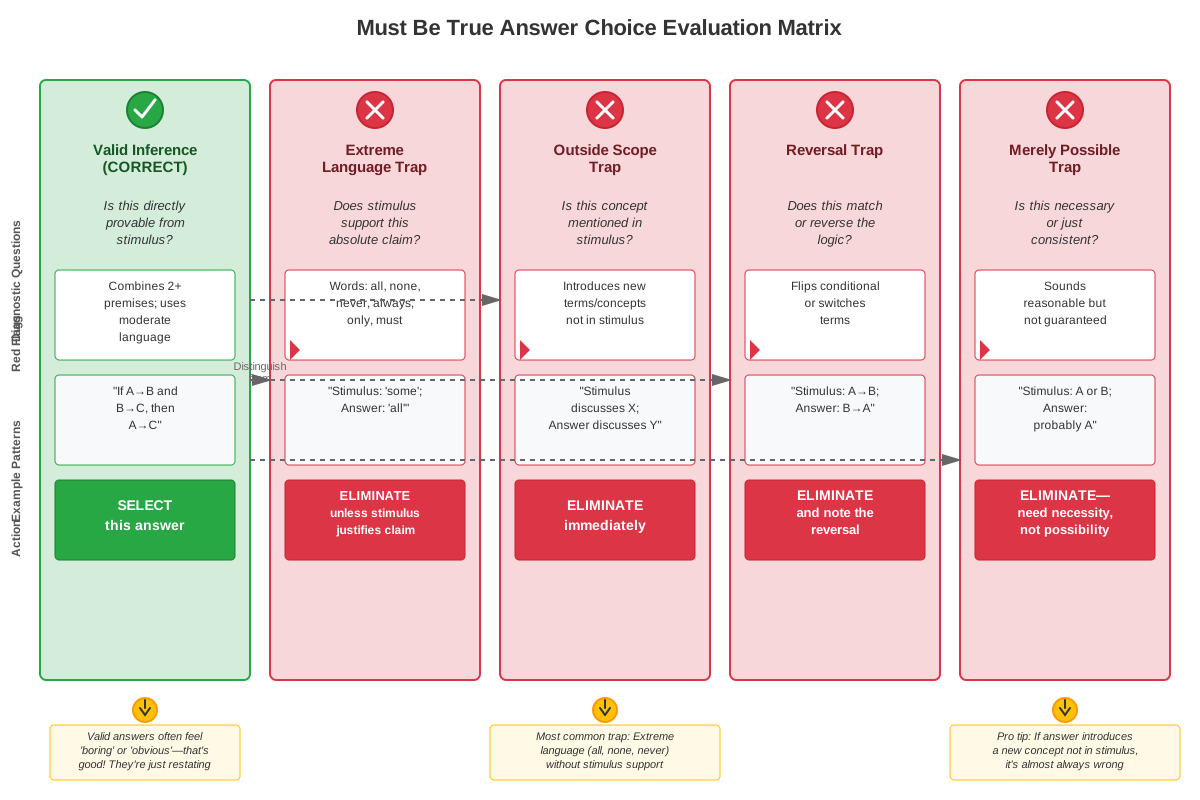
Wrong answers in must be true questions typically fall into the "could be true" or "likely true" categories—they're consistent with the stimulus and may even seem probable, but they're not logically required.
Common Stimulus Structures
Must be true questions appear with various stimulus types:
Factual descriptions: The stimulus presents a situation, study results, or set of circumstances without making an argument. The question asks what must follow from these facts.
Arguments with premises: The stimulus contains an argument, but the question ignores the conclusion and asks only what must be true based on the premises.
Formal logic puzzles: The stimulus presents conditional statements or rules, and the question tests whether you can correctly apply logical operations.
Comparative statements: The stimulus makes comparisons or establishes relationships between groups, quantities, or characteristics.
Concept Relationships
Must be true questions form the foundation of inference-based reasoning in LSAT Logical Reasoning. The core skill—determining what necessarily follows from given information—connects directly to formal logic principles, particularly conditional reasoning and quantifier logic. When students master the strict proof standard required for must be true questions (absolute necessity), they develop the analytical precision needed for related question types.
The relationship flows as follows: Question stem recognition → identifies the question as must be true → activates strict deductive reasoning mode → applies formal logic rules → evaluates answer choices against the necessity standard → eliminates answers that are merely possible or probable → selects the answer that cannot be false.
Must be true questions connect to "most strongly supported" questions through a relaxed proof standard—the latter allows high probability rather than certainty, but the analytical approach remains similar. They relate inversely to "could be true EXCEPT" questions, which ask for the one answer that must be false or cannot be true. Understanding must be true reasoning also supports "must be false" questions, which require identifying what contradicts the stimulus.
The skills developed through must be true questions transfer to assumption questions (identifying unstated premises that must be true for arguments to work) and inference questions in Reading Comprehension (determining what passage content proves). The logical precision required creates a foundation for all LSAT analytical reasoning.
High-Yield Facts
⭐ Must be true questions require absolute certainty—if an answer could be false in any scenario consistent with the stimulus, it's wrong
⭐ The correct answer is often a combination or restatement of explicit stimulus information rather than a distant inference
⭐ Common wrong answer types include: could be true but not must be true, reverses a conditional, confuses necessary and sufficient conditions, and goes beyond the scope
⭐ Conditional statements in the stimulus are high-yield—correct answers frequently result from applying modus ponens or modus tollens
⭐ Pay careful attention to quantifiers (all, some, most, none)—they determine what inferences are valid
- Must be true questions typically appear 6-10 times per LSAT across both Logical Reasoning sections
- "Properly inferred," "properly concluded," and "follows logically" are synonymous with "must be true"
- The stimulus in must be true questions is always treated as true—never question or evaluate the premises
- Extreme language in answer choices (always, never, only, all) is not automatically wrong in must be true questions if the stimulus supports it
- Combining two or more premises often yields the correct answer in complex must be true questions
- Contrapositive reasoning is frequently tested: if the stimulus says "If A then B," then "If not B then not A" must also be true
- Wrong answers often introduce new information not mentioned or implied by the stimulus
- The correct answer may seem obvious or simple—don't overthink by seeking complex inferences
- Time-efficient strategy: eliminate answers that could be false before seeking proof that remaining answers must be true
- Must be true questions reward careful, literal reading—avoid bringing in outside knowledge or assumptions
Quick check — test yourself on Must be true question stems so far.
Try Flashcards →Common Misconceptions
Misconception: Must be true questions ask for what is probably or likely true based on the stimulus.
Correction: Must be true questions require absolute logical necessity. An answer that is highly probable or very likely but not guaranteed is incorrect. The correct answer must be true in every possible scenario consistent with the stimulus, not just in most scenarios or the most likely scenario.
Misconception: The correct answer will always involve a complex inference combining multiple premises.
Correction: While some must be true questions require combining premises, many correct answers are direct restatements or simple applications of stimulus information. The LSAT frequently rewards careful reading over complex logical gymnastics. Don't overlook straightforward answers in search of sophisticated inferences.
Misconception: Extreme language (all, always, never, none, only) in answer choices indicates a wrong answer.
Correction: Unlike assumption or strengthen questions where extreme language often signals wrong answers, must be true questions can have correct answers with extreme language if the stimulus supports it. If the stimulus states "All members attended," then an answer saying "Every member attended" is perfectly valid.
Misconception: Must be true and most strongly supported questions are identical.
Correction: While similar, these question types have slightly different standards. "Must be true" requires absolute logical necessity, while "most strongly supported" technically allows for very high probability rather than certainty. In practice, the LSAT often treats them similarly, but when in doubt, "most strongly supported" permits a marginally more relaxed standard.
Misconception: If an answer choice is consistent with the stimulus and doesn't contradict anything, it must be correct.
Correction: Consistency is necessary but not sufficient. An answer can be consistent with the stimulus (could be true) without being required by it (must be true). The correct answer must be forced by the stimulus—it cannot be false if the stimulus is true.
Misconception: You should bring in real-world knowledge to evaluate answer choices.
Correction: Must be true questions operate within the closed logical system of the stimulus. Real-world knowledge is irrelevant and often misleading. Even if an answer choice contradicts reality but follows logically from the stimulus, it's correct. Conversely, even if an answer is true in the real world, it's wrong if the stimulus doesn't prove it.
Misconception: The correct answer will introduce new concepts or ideas beyond what the stimulus discusses.
Correction: Correct answers rarely introduce entirely new concepts. They typically recombine, restate, or directly apply stimulus information. Answers that bring in new topics or ideas not mentioned or clearly implied by the stimulus are usually wrong.
Worked Examples
Example 1: Conditional Reasoning Chain
Stimulus: All members of the debate team are honor students. Some honor students participate in the science fair. No one who participates in the science fair is on the basketball team.
Question: If the statements above are true, which one of the following must also be true?
Answer Choices:
(A) Some members of the debate team participate in the science fair.
(B) No members of the debate team are on the basketball team.
(C) Some honor students are not on the basketball team.
(D) All honor students are either on the debate team or participate in the science fair.
(E) No members of the debate team participate in the science fair.
Analysis:
Let's map the logical relationships:
- Premise 1: Debate team → Honor student
- Premise 2: Some honor students → Science fair
- Premise 3: Science fair → NOT basketball team
Evaluating each answer:
(A) "Some members of the debate team participate in the science fair."
- We know all debate team members are honor students, and some honor students do science fair
- But we don't know if the honor students who do science fair are the same ones on the debate team
- This COULD be true but doesn't MUST be true
- Eliminate
(B) "No members of the debate team are on the basketball team."
- We know debate team → honor student, but we have no information connecting honor students generally to basketball
- Some honor students do science fair, and science fair → NOT basketball, but we don't know if debate team members are among those doing science fair
- This could be true or false
- Eliminate
(C) "Some honor students are not on the basketball team."
- Premise 2 tells us some honor students participate in science fair
- Premise 3 tells us no one in science fair is on basketball team
- Therefore, those honor students who participate in science fair cannot be on the basketball team
- This means at least some honor students (those doing science fair) are definitely not on the basketball team
- This MUST be true
- Strong candidate
(D) "All honor students are either on the debate team or participate in the science fair."
- The stimulus tells us all debate team members are honor students, not that all honor students are on debate team
- This reverses the conditional and is not supported
- Eliminate
(E) "No members of the debate team participate in the science fair."
- Nothing in the stimulus prevents debate team members from also doing science fair
- This could be true but is not required
- Eliminate
Correct Answer: (C)
This question demonstrates combining premises to reach a valid inference. The key is recognizing that "some honor students" in premise 2 establishes the existence of at least one honor student who does science fair, and premise 3 guarantees that person is not on the basketball team.
Example 2: Quantifier-Based Inference
Stimulus: Most of the company's software engineers have advanced degrees. All employees with advanced degrees receive priority parking. Chen is a software engineer at the company who does not receive priority parking.
Question: Which one of the following can be properly concluded from the information above?
Answer Choices:
(A) Chen does not have an advanced degree.
(B) Most software engineers at the company receive priority parking.
(C) Some software engineers at the company do not have advanced degrees.
(D) Chen is not among the majority of the company's software engineers.
(E) Most employees with advanced degrees are software engineers.
Analysis:
Let's identify what we know:
- Premise 1: Most software engineers → advanced degree
- Premise 2: Advanced degree → priority parking (contrapositive: NOT priority parking → NOT advanced degree)
- Premise 3: Chen is a software engineer AND Chen does NOT have priority parking
Evaluating each answer:
(A) "Chen does not have an advanced degree."
- From premise 2's contrapositive: NOT priority parking → NOT advanced degree
- Chen does not have priority parking (premise 3)
- Therefore, Chen does not have an advanced degree
- This MUST be true
- Strong candidate
(B) "Most software engineers at the company receive priority parking."
- We know most software engineers have advanced degrees, and all with advanced degrees get priority parking
- But "most" doesn't tell us the exact percentage—it could be 51% or 99%
- We can't definitively conclude that most software engineers get priority parking without knowing the exact proportion
- Actually, wait—if most software engineers have advanced degrees, and all people with advanced degrees get priority parking, then most software engineers must get priority parking
- This appears to MUST be true as well
- Strong candidate
Let me reconsider (B) more carefully: If most (>50%) of software engineers have advanced degrees, and 100% of people with advanced degrees get priority parking, then >50% of software engineers get priority parking. This does follow necessarily.
However, let's continue evaluating:
(C) "Some software engineers at the company do not have advanced degrees."
- We know most software engineers have advanced degrees
- "Most" means more than half but not all
- Therefore, some (fewer than half) do not have advanced degrees
- This MUST be true
- Strong candidate
(D) "Chen is not among the majority of the company's software engineers."
- Chen is a software engineer without an advanced degree
- Most software engineers have advanced degrees
- Therefore Chen is in the minority of software engineers (those without advanced degrees)
- This MUST be true
- Strong candidate
(E) "Most employees with advanced degrees are software engineers."
- The stimulus tells us most software engineers have advanced degrees, not that most people with advanced degrees are software engineers
- This reverses the relationship
- Eliminate
Re-evaluation: We have multiple strong candidates. Let's apply the strictest logical standard:
(A) Uses valid contrapositive reasoning and must be true.
(B) Follows from combining "most" with "all" and must be true.
(C) Follows from the meaning of "most" (not all) and must be true.
(D) Restates that Chen is in the minority group and must be true.
In actual LSAT questions, only one answer is correct. The most direct and certain inference is (A) because it follows from a simple application of modus tollens/contrapositive reasoning with no quantifier complexity. The others, while seemingly valid, involve more complex reasoning about quantifiers that could introduce ambiguity.
Correct Answer: (A)
This example illustrates the importance of conditional reasoning and contrapositives in must be true questions. When you see a conditional statement, immediately consider its contrapositive as a source of valid inferences.
Exam Strategy
Immediate Recognition and Categorization
When you encounter a question stem, spend 2-3 seconds identifying whether it's a must be true question. Look for key phrases: "must be true," "properly inferred," "properly concluded," "follows logically," or "most strongly supported." Once identified, activate the strict deductive reasoning mode—you're looking for logical necessity, not plausibility.
Reading the Stimulus
Read must be true stimuli with extreme precision. Unlike argument-based questions where you evaluate reasoning quality, here you accept every statement as fact. Pay special attention to:
- Conditional indicators: if, when, whenever, only if, unless, until
- Quantifiers: all, some, most, many, few, none, no
- Temporal markers: before, after, always, never, sometimes
- Comparative language: more than, less than, at least, at most
Mark or mentally note these elements as you read—they're the building blocks of valid inferences.
The Prediction Strategy
Before looking at answer choices, pause and ask: "What must be true based on this information?" Sometimes you can predict the correct answer, especially with straightforward conditional reasoning or quantifier logic. Even if you can't predict the exact answer, identifying what types of inferences are possible helps you evaluate choices efficiently.
Evaluating Answer Choices
Use a two-pass approach:
First pass—Elimination: Quickly eliminate answers that:
- Introduce new concepts not mentioned or implied in the stimulus
- Could be false in any scenario consistent with the stimulus
- Reverse conditional relationships
- Misuse quantifiers (e.g., claiming "all" when stimulus says "some")
Second pass—Verification: For remaining answers, apply the necessity test: "If the stimulus is true, can this answer be false?" If yes, eliminate it. The correct answer cannot be false if the stimulus is true.
Common Trigger Words in Wrong Answers
Be alert for these red flags:
- Scope shifts: Answer discusses a different group or topic than the stimulus
- Degree mismatches: Stimulus says "some," answer says "most" or "all"
- Temporal confusion: Answer claims something about timing not established in stimulus
- Causal claims: Answer asserts causation when stimulus only shows correlation
Time Management
Must be true questions should typically take 1:00-1:30 minutes. They're often more straightforward than assumption or flaw questions, so don't overthink. If you find yourself spending more than 2 minutes, you're likely overcomplicating the inference. Return to the stimulus, identify the explicit logical relationships, and look for the answer that's a direct consequence.
The "Could Be False" Test
When stuck between two answers, apply this test: For each answer, try to construct a scenario where the stimulus is true but the answer is false. If you can construct such a scenario, the answer is wrong. The correct answer will resist all attempts to falsify it while keeping the stimulus true.
Memory Techniques
The MUST Acronym
Match the stimulus exactly—don't add information
Use formal logic rules strictly
Scrutinize quantifiers and conditionals
Test by trying to make the answer false
Visualization Strategy
Picture must be true questions as a locked box. The stimulus provides the contents of the box. The correct answer describes something that must be in the box given what you know. Wrong answers describe things that might be in the box, probably are in the box, or are in a different box entirely. You can only select what you can prove is definitely in the box.
The Necessity Mantra
Before selecting an answer, mentally state: "This must be true. It cannot be false. There is no scenario where the stimulus is true and this answer is false." If you can't confidently make this statement, the answer is wrong.
Conditional Chain Visualization
For stimuli with multiple conditional statements, draw a simple chain:
A → B → C → D
This visual representation makes it immediately clear that:
- A → D (must be true)
- NOT D → NOT A (must be true via contrapositive)
- B → A (NOT must be true—reverses the conditional)
Quantifier Hierarchy
Remember the strength hierarchy:
All (strongest) > Most > Many/Some > Few (weakest) > None (strongest negative)
Valid inferences move down or stay at the same level, never up. If the stimulus says "some," you cannot infer "most" or "all."
Summary
Must be true question stems are among the most fundamental and frequently tested question types in LSAT Logical Reasoning, appearing 6-10 times per test. These questions require identifying answer choices that follow with logical necessity from the stimulus—they cannot be false if the stimulus is true. Success requires recognizing characteristic question stem language ("must be true," "properly inferred," "follows logically"), accepting all stimulus information as fact, and applying strict deductive reasoning. The correct answer typically results from combining premises, applying conditional logic rules (modus ponens, modus tollens, contrapositive), or carefully interpreting quantifiers (all, some, most, none). Common wrong answers include statements that could be true but aren't required, reverse conditional relationships, introduce new information, or misuse quantifiers. The key distinction is between logical necessity (must be true) and mere possibility or probability (could be true, likely true). Mastering must be true questions develops the analytical precision required for all LSAT Logical Reasoning question types and mirrors the rigorous proof standards essential to legal reasoning.
Key Takeaways
- Must be true questions require absolute logical necessity—the correct answer cannot be false if the stimulus is true
- Recognize these questions through stems containing "must be true," "properly inferred," "properly concluded," or "follows logically"
- Accept all stimulus information as fact and apply strict deductive reasoning without adding assumptions or outside knowledge
- Pay careful attention to conditionals (if-then statements) and quantifiers (all, some, most, none)—they're the foundation of valid inferences
- The correct answer is often a direct combination or restatement of stimulus information rather than a distant, complex inference
- Wrong answers typically fall into "could be true" or "likely true" categories—consistent with the stimulus but not required by it
- Apply the falsification test: try to make the answer false while keeping the stimulus true; if you can, the answer is wrong
Related Topics
Most Strongly Supported Questions: These questions use a slightly relaxed standard compared to must be true, allowing for high probability rather than absolute certainty. Mastering must be true questions provides the foundation for these related stems.
Must Be False Questions: The inverse of must be true questions, these ask for answer choices that cannot be true given the stimulus. The same logical reasoning skills apply, but you're identifying contradictions rather than valid inferences.
Conditional Reasoning: A deeper dive into if-then logic, contrapositives, and conditional chains. This topic provides the formal logic foundation that makes must be true questions more systematic and efficient.
Quantifier Logic: Advanced study of how "all," "some," "most," and "none" generate valid and invalid inferences. This topic extends the quantifier concepts essential to must be true questions.
Inference Questions in Reading Comprehension: The skills developed through must be true questions transfer directly to inference questions in the Reading Comprehension section, where you must identify what passage content proves.
Practice CTA
Now that you understand the core concepts, recognition patterns, and strategic approaches for must be true question stems, it's time to apply this knowledge. Work through the practice questions to reinforce your ability to identify these stems, apply strict deductive reasoning, and distinguish logical necessity from mere possibility. Use the flashcards to internalize key concepts and common question stem formulations. Remember: must be true questions reward precision and careful reading—skills that improve dramatically with focused practice. Each question you work through strengthens your logical reasoning abilities and builds the confidence needed for test day success.
Sign up free to keep reading
Create a free AnvayaPrep account to finish this LSAT guide on Must be true question stems — plus flashcards and practice questions.