Overview
In LSAT Logical Reasoning, question stem recognition forms the critical first step in approaching any problem correctly. Among the most frequently tested question types are those that ask what "must be true" versus what is "most strongly supported" by the stimulus. While these stems may appear similar at first glance, they represent fundamentally different standards of proof and require distinct strategic approaches. Understanding the nuanced difference between these two question types can mean the difference between selecting a definitively correct answer and falling for an attractive but incorrect trap answer.
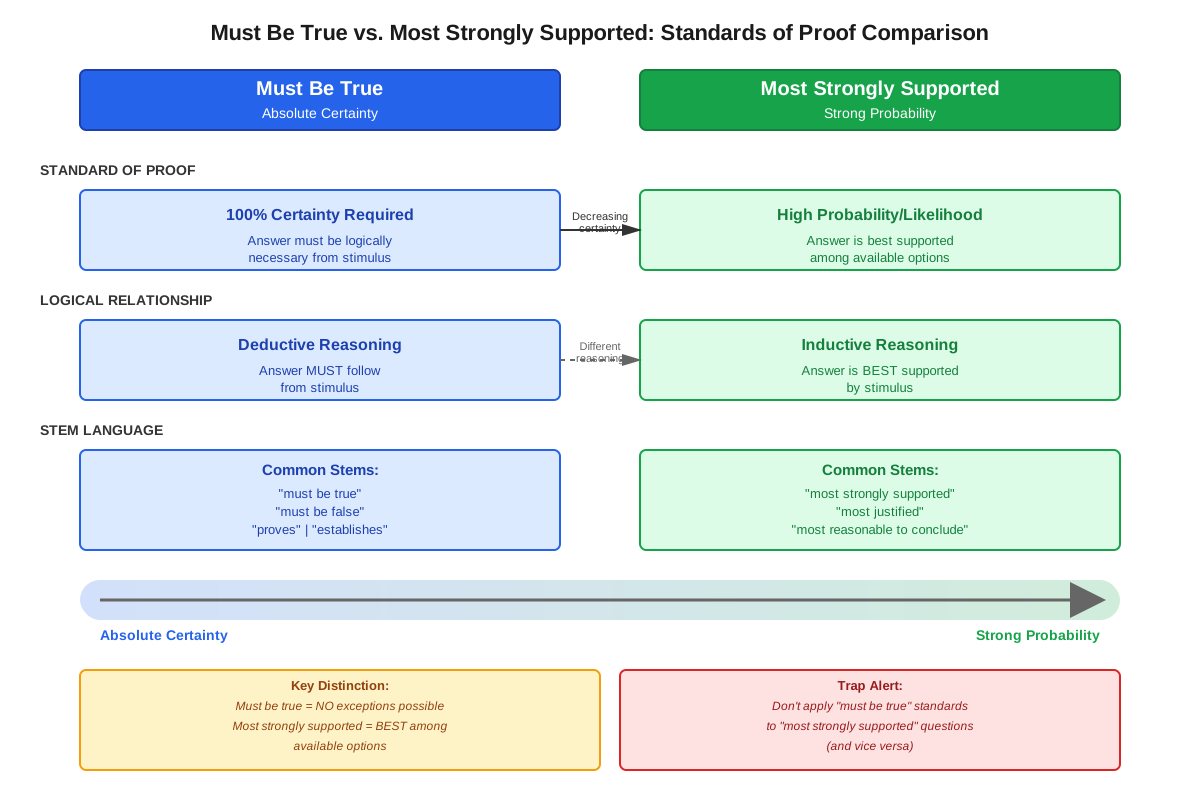
The distinction between must be true versus most strongly supported stems centers on the degree of certainty required. "Must be true" questions demand absolute logical necessity—the correct answer follows with 100% certainty from the information provided in the stimulus. In contrast, "most strongly supported" questions ask for the answer choice that is most likely or most reasonable given the stimulus, even if it doesn't follow with absolute certainty. This difference in evidentiary standards fundamentally changes how test-takers should evaluate answer choices and what kinds of logical inferences are acceptable.
Mastering this distinction is essential for LSAT success because these question types appear with high frequency throughout the Logical Reasoning sections, and misidentifying the question type leads to systematic errors. Both question types test core logical reasoning skills—the ability to draw valid inferences, recognize what follows from given premises, and distinguish between degrees of logical support. This topic connects directly to broader concepts in formal logic, inference-making, and critical reading, serving as a gateway to understanding how the LSAT tests reasoning precision across multiple question formats.
Learning Objectives
- [ ] Identify how must be true versus most strongly supported stems appears in LSAT questions
- [ ] Explain the reasoning pattern behind must be true versus most strongly supported stems
- [ ] Apply must be true versus most strongly supported stems to solve LSAT-style problems accurately
- [ ] Distinguish between absolute logical necessity and strong probabilistic support in answer choices
- [ ] Recognize common language variations that signal each question type
- [ ] Evaluate answer choices using the appropriate standard of proof for each stem type
- [ ] Identify trap answers that exploit confusion between these two standards
Prerequisites
- Basic formal logic concepts: Understanding conditional statements, necessary and sufficient conditions, and valid inference patterns is essential because "must be true" questions often test formal logical relationships.
- Stimulus analysis skills: The ability to identify premises, conclusions, and supporting evidence in argument passages is necessary because both question types require careful extraction of information from the stimulus.
- Understanding of inference types: Familiarity with deductive versus inductive reasoning helps distinguish between the absolute certainty of "must be true" and the probabilistic nature of "most strongly supported."
- Reading comprehension fundamentals: Strong reading skills are required to parse complex stimuli and recognize what information is explicitly stated versus what must be inferred.
Why This Topic Matters
The ability to distinguish between "must be true" and "most strongly supported" questions has profound practical implications beyond the LSAT. In legal reasoning, attorneys must constantly differentiate between what can be proven beyond reasonable doubt versus what is merely probable or likely. Judges evaluate evidence using different standards of proof depending on the type of case. This same precision in reasoning applies to scientific research, policy analysis, and any field requiring careful evaluation of evidence and claims.
On the LSAT specifically, these two question types combined account for approximately 15-20% of all Logical Reasoning questions, making them among the most frequently tested formats. "Must be true" questions typically appear 3-5 times per test, while "most strongly supported" questions appear 2-4 times per test. Both question types appear in various forms throughout the exam, sometimes embedded within more complex question formats or combined with other reasoning tasks.
These question types commonly appear in several contexts: following factual passages that present data or observations without explicit arguments; after descriptive passages about scientific findings, historical events, or social phenomena; and in passages presenting multiple perspectives or pieces of information that must be synthesized. The LSAT frequently tests whether students can maintain the appropriate standard of proof when moving from stimulus to answer choice, making this distinction a high-yield area for score improvement.
Core Concepts
The "Must Be True" Standard
Must be true questions require absolute logical necessity. The correct answer must follow with 100% certainty from the information provided in the stimulus—no exceptions, no qualifications, no additional assumptions needed. If there is any conceivable scenario, however unlikely, in which the stimulus could be true but the answer choice false, then that answer choice does not "must be true."
This standard aligns with deductive reasoning and formal logic. When an answer "must be true," it is logically entailed by the premises. Think of it as a mathematical proof: given the axioms (the stimulus), the theorem (the correct answer) follows necessarily. Common language variations that signal this question type include:
- "Which one of the following must be true?"
- "If the statements above are true, which one of the following must also be true?"
- "The statements above, if true, most strongly support which one of the following?"
- "Which one of the following can be properly inferred from the passage?"
- "Which one of the following follows logically from the statements above?"
The key characteristic is the demand for certainty. When evaluating answer choices for "must be true" questions, apply the negation test: if you can imagine any scenario where the stimulus is true but the answer choice is false, eliminate that choice immediately.
The "Most Strongly Supported" Standard
Most strongly supported questions operate under a different evidentiary standard. These questions ask which answer choice is most likely, most reasonable, or best supported by the stimulus—even if it doesn't follow with absolute certainty. The correct answer represents the strongest inference available, but it may involve some degree of probability, likelihood, or reasonable extrapolation beyond what is explicitly stated.
This standard aligns more closely with inductive reasoning and probabilistic inference. The stimulus provides evidence that makes one answer choice more likely or more reasonable than the alternatives, even if it doesn't guarantee that answer with 100% certainty. Common language variations include:
- "Which one of the following is most strongly supported by the information above?"
- "The statements above most strongly support which one of the following?"
- "The information above provides the most support for which one of the following?"
- "Which one of the following is most likely to be true based on the passage?"
The critical difference lies in the words "most strongly" or "most likely"—these signal that you're looking for the best available inference, not an absolutely certain one. The correct answer will have more support than the other choices, but it may still involve some inferential leap or reasonable assumption.
Comparative Analysis: Key Differences
| Aspect | Must Be True | Most Strongly Supported |
|---|---|---|
| Standard of Proof | Absolute certainty (100%) | Strongest available support (may be <100%) |
| Reasoning Type | Primarily deductive | Primarily inductive |
| Logical Relationship | Necessary entailment | Probabilistic support |
| Acceptable Inferences | Only what follows with certainty | Reasonable extrapolations allowed |
| Answer Evaluation | Binary (must be true or not) | Comparative (which is most supported) |
| Trap Answers | Likely but not certain | Somewhat supported but not most supported |
Identifying Question Type Through Language Cues
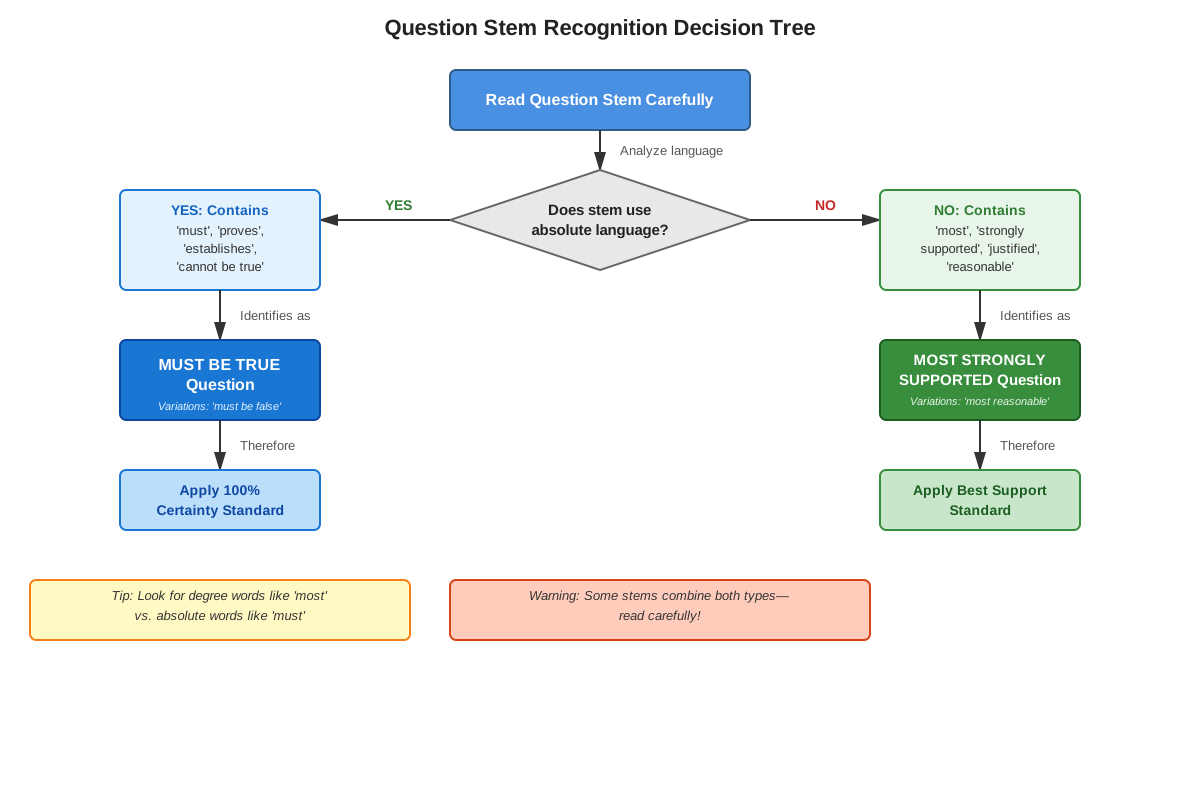
The LSAT uses specific linguistic markers to signal which standard applies. Recognizing these cues immediately upon reading the question stem allows for proper answer evaluation strategy.
For "must be true" questions, watch for:
- The word "must" (most obvious indicator)
- "Follows logically"
- "Can be properly inferred"
- "Properly concluded"
- "Necessarily true"
For "most strongly supported" questions, watch for:
- "Most strongly supported"
- "Most likely"
- "Most reasonable to conclude"
- "Best supported"
- "Provides the most support for"
Occasionally, the LSAT uses hybrid language that can create ambiguity. For example, "Which one of the following is most strongly supported by the statements above?" technically asks for the most strongly supported answer, but if one answer choice must be true while others are merely possible, the "must be true" answer is automatically the most strongly supported. Understanding this hierarchy helps navigate ambiguous stems.
The Role of Assumptions and Gaps
A crucial distinction between these question types involves how they treat logical gaps and unstated assumptions. In "must be true" questions, the correct answer cannot require any additional assumptions beyond what's explicitly stated in the stimulus. Every logical step must be airtight and fully supported by the given information.
In "most strongly supported" questions, reasonable assumptions are permissible if they're the kind of background knowledge or common-sense inferences that most people would accept. For example, if a stimulus discusses a study of "adults," a "most strongly supported" answer might reasonably assume these are human adults rather than adult insects, even though this isn't explicitly stated. A "must be true" answer would need to work regardless of what kind of adults are discussed.
Answer Choice Evaluation Strategies
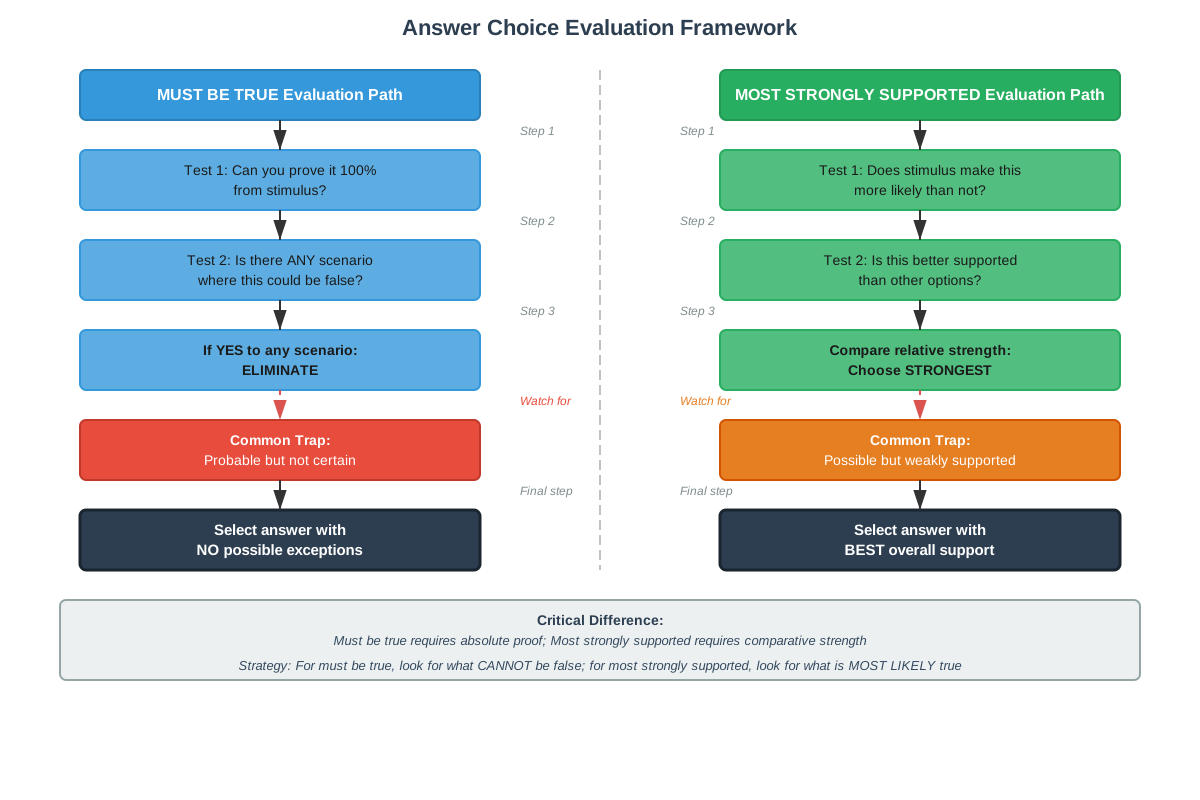
For "must be true" questions, use the certainty test: Can you imagine any scenario, however unlikely, where the stimulus is true but this answer choice is false? If yes, eliminate it. The correct answer will be impossible to deny given the stimulus. Look for answers that:
- Restate information directly from the stimulus
- Combine explicitly stated facts through valid logical operations
- Apply formal logical rules (contrapositive, disjunctive syllogism, etc.)
- Make only the most conservative inferences
For "most strongly supported" questions, use the comparative support test: Which answer choice receives the most evidential support from the stimulus, even if that support isn't absolute? The correct answer will:
- Have more textual support than competing choices
- Require fewer or more reasonable assumptions
- Align with the overall thrust or implication of the passage
- Be more probable or likely given the information provided
Concept Relationships
The distinction between "must be true" and "most strongly supported" stems connects directly to fundamental concepts in logic and epistemology. At the foundational level, this distinction reflects the difference between deductive validity (where conclusions follow necessarily from premises) and inductive strength (where conclusions are supported but not guaranteed by premises). Understanding formal logic provides the tools to recognize when something must be true, while understanding inductive reasoning helps evaluate degrees of support.
Within the broader category of question stem recognition, this distinction represents one of several critical differentiations test-takers must make. Other related distinctions include sufficient assumption versus necessary assumption questions, strengthen versus justify questions, and inference versus main point questions. Each pair requires recognizing subtle language differences that signal different logical tasks.
The relationship flows as follows: Stimulus Analysis → Question Stem Recognition (identifying must be true vs. most strongly supported) → Answer Choice Evaluation (applying appropriate standard) → Correct Answer Selection. Errors at the question stem recognition stage cascade through the entire problem-solving process, leading to systematic mistakes even when the stimulus is properly understood.
These question types also connect to conditional reasoning and formal logic because "must be true" questions frequently test whether students can correctly apply logical rules like modus ponens, modus tollens, or contrapositive formation. Meanwhile, "most strongly supported" questions often connect to causal reasoning and argument analysis because they may ask what causal relationship or explanatory hypothesis is best supported by presented data.
High-Yield Facts
⭐ "Must be true" requires 100% certainty; if any scenario exists where the stimulus is true but the answer is false, that answer is incorrect.
⭐ "Most strongly supported" asks for the best available inference, which may involve reasonable assumptions or probabilistic reasoning.
⭐ The word "must" in a question stem is the clearest indicator of the absolute certainty standard.
⭐ For "must be true" questions, the correct answer often closely paraphrases or combines information explicitly stated in the stimulus.
⭐ For "most strongly supported" questions, the correct answer may go slightly beyond what's explicitly stated, making reasonable inferences.
- "Follows logically," "properly inferred," and "properly concluded" all signal the "must be true" standard.
- "Most likely," "most reasonable," and "best supported" signal the "most strongly supported" standard.
- Trap answers for "must be true" questions are often statements that are likely or probable but not absolutely certain.
- Trap answers for "most strongly supported" questions are often statements that have some support but less than the correct answer.
- When a "must be true" answer exists among the choices for a "most strongly supported" question, it is automatically the correct answer because absolute certainty is the strongest possible support.
- Formal logical operations (contrapositive, disjunctive syllogism) frequently appear in "must be true" questions.
- "Most strongly supported" questions more commonly appear after descriptive or factual passages rather than explicit arguments.
- Both question types require careful attention to scope, degree, and qualification in answer choices.
- Extreme language (all, none, always, never) is more acceptable in "must be true" answers if the stimulus supports it, but often signals incorrect answers in "most strongly supported" questions.
- The correct answer to either question type will never contradict the stimulus or require information not provided or reasonably inferable.
Quick check — test yourself on Must be true versus most strongly supported stems so far.
Try Flashcards →Common Misconceptions
Misconception: "Must be true" and "most strongly supported" are essentially the same thing, just worded differently.
Correction: These represent fundamentally different standards of proof. "Must be true" requires absolute logical necessity with zero exceptions, while "most strongly supported" asks for the best available inference even if it's not 100% certain. Using the wrong standard leads to systematic errors in answer selection.
Misconception: For "most strongly supported" questions, the correct answer just needs to be possible or consistent with the stimulus.
Correction: The correct answer must be the MOST strongly supported among the choices, not merely possible. Multiple answer choices may be consistent with the stimulus, but only one receives the strongest evidential support. The task is comparative, not absolute.
Misconception: "Must be true" answers always restate information word-for-word from the stimulus.
Correction: While "must be true" answers often closely track the stimulus language, they may also combine multiple pieces of information through valid logical operations or express the same idea using different words. The key is logical necessity, not identical phrasing.
Misconception: If an answer choice requires any inference at all, it can't be a "must be true" answer.
Correction: "Must be true" answers can involve inference, but only inferences that follow with absolute certainty. Applying formal logical rules (like the contrapositive) or combining explicitly stated facts through valid reasoning both count as acceptable inferences for "must be true" questions.
Misconception: Extreme language (all, always, never, none) automatically makes an answer choice wrong.
Correction: Extreme language is only problematic if the stimulus doesn't support it. If the stimulus states "All members of the committee voted yes," then an answer saying "Every committee member voted yes" is perfectly acceptable. The issue isn't the extreme language itself but whether it's warranted by the stimulus.
Misconception: "Most strongly supported" questions allow you to bring in outside knowledge or common sense that isn't in the passage.
Correction: While "most strongly supported" questions permit reasonable background assumptions (like assuming "adults" means human adults unless context suggests otherwise), they don't allow importing substantive outside knowledge. The support must come from the stimulus itself, though the inferential leap may be slightly larger than in "must be true" questions.
Misconception: The longest or most detailed answer choice is usually correct for these question types.
Correction: Length and detail are irrelevant to correctness. The LSAT deliberately includes verbose wrong answers and concise correct answers (and vice versa) to test whether students are evaluating logical support rather than superficial features.
Worked Examples
Example 1: Must Be True Question
Stimulus: "Every member of the city council voted in favor of the new zoning ordinance. Council member Rodriguez voted in favor of every proposal that Council member Chen supported. Council member Chen supported the new zoning ordinance."
Question Stem: "If the statements above are true, which one of the following must also be true?"
Answer Choices:
(A) Council member Rodriguez supported every proposal that passed.
(B) Council member Chen voted in favor of the new zoning ordinance.
(C) Council member Rodriguez voted in favor of the new zoning ordinance.
(D) The new zoning ordinance was the only proposal all council members supported.
(E) Council member Rodriguez and Council member Chen voted the same way on every proposal.
Analysis:
First, recognize this is a "must be true" question requiring absolute certainty. Extract the facts:
- Every council member voted for the zoning ordinance
- Rodriguez voted for every proposal Chen supported
- Chen supported the zoning ordinance
Now evaluate each answer:
(A) We know Rodriguez voted for everything Chen supported, but we don't know if Chen supported everything that passed. This requires an additional assumption. Eliminate.
(B) We know Chen supported the ordinance, and we know every council member voted for it. Since Chen is a council member, Chen must have voted for it. This seems strong, but let's check the others.
(C) We know Rodriguez voted for everything Chen supported (fact 2), and Chen supported the ordinance (fact 3). By valid logical inference, Rodriguez must have voted for the ordinance. Additionally, fact 1 tells us every council member voted for it, and Rodriguez is a council member. This is doubly supported and must be true.
(D) The stimulus only discusses one proposal. We have no information about whether other proposals received unanimous support. Eliminate.
(E) We only know Rodriguez voted for everything Chen supported, not that they voted identically on everything. Chen might have supported things Rodriguez didn't, or they might have voted differently on proposals Chen didn't support. Eliminate.
Correct Answer: (C)
This answer must be true through two independent logical paths: (1) the conditional relationship between Rodriguez's votes and Chen's support, combined with Chen's support for the ordinance, and (2) the fact that every council member voted for it and Rodriguez is a council member. Note that (B) is also correct, making this a question with two valid answers—in actual LSAT questions, only one answer would be defensible, but this illustrates how "must be true" answers follow with certainty.
Example 2: Most Strongly Supported Question
Stimulus: "A recent study found that employees who work in offices with windows report higher job satisfaction than those who work in windowless offices. The study controlled for salary, job responsibilities, and commute time. Researchers noted that offices with windows also tend to have better air circulation and more varied lighting throughout the day."
Question Stem: "The information above most strongly supports which one of the following?"
Answer Choices:
(A) Windows are the primary cause of increased job satisfaction among office workers.
(B) Improving air circulation would increase job satisfaction as much as adding windows.
(C) Environmental factors beyond salary and job duties influence employee job satisfaction.
(D) All employees would prefer to work in offices with windows if given the choice.
(E) The presence of windows is the only difference between high and low satisfaction offices.
Analysis:
This is a "most strongly supported" question, so we're looking for the answer with the strongest evidential support, even if it's not 100% certain.
(A) The stimulus shows correlation but doesn't establish that windows are the "primary cause." The mention of air circulation and lighting suggests multiple factors might be involved. This goes too far. Eliminate.
(B) The study doesn't compare air circulation improvements to window additions, so we have no basis for this comparison. Eliminate.
(C) The study controlled for salary and job duties but still found differences in satisfaction. The differences correlated with windows (and associated factors like air circulation and lighting). This strongly suggests that environmental factors—beyond the controlled variables—do influence satisfaction. This is well-supported without overreaching.
(D) "All employees" is too extreme. The study found a general trend but doesn't support a universal claim about every single employee. Eliminate.
(E) The stimulus explicitly mentions that windowed offices also have better air circulation and varied lighting, so windows aren't the "only difference." This contradicts the stimulus. Eliminate.
Correct Answer: (C)
This answer is most strongly supported because it makes a reasonable, moderate inference from the data. The study controlled for certain factors but still found differences, and those differences correlated with environmental features. Answer (C) doesn't overreach by claiming causation or making extreme universal claims—it simply notes that environmental factors appear to matter, which is exactly what the study suggests. Notice that this answer doesn't "must be true" in the absolute sense (perhaps some confounding variable wasn't controlled for), but it's the most reasonable conclusion from the evidence provided.
Exam Strategy
When approaching these question types on the LSAT, implement a systematic three-step process:
Step 1: Identify the Question Type Immediately
Before reading answer choices, determine whether you're dealing with "must be true" or "most strongly supported." Circle or mentally note the key language in the stem. This determines your entire evaluation strategy. Spend 3-5 seconds on this identification—it's time well invested because it prevents the most common error (applying the wrong standard).
Step 2: Set Your Mental Standard
For "must be true": Adopt a skeptical mindset. Your job is to eliminate anything that isn't absolutely certain. Think "prove it to me with 100% certainty."
For "most strongly supported": Adopt a comparative mindset. Your job is to find the answer with the most evidential support, even if it's not perfect. Think "which answer is most reasonable given the evidence?"
Step 3: Apply the Appropriate Elimination Strategy
For "must be true" questions:
- Eliminate answers that are merely likely or probable
- Eliminate answers requiring additional assumptions
- Eliminate answers that could be false in any conceivable scenario where the stimulus is true
- Keep answers that restate, combine, or validly infer from stimulus facts
For "most strongly supported" questions:
- Eliminate answers that contradict the stimulus
- Eliminate answers with no textual support
- Eliminate answers that are less supported than competing choices
- Keep the answer with the strongest evidential backing, even if imperfect
Exam Tip: When stuck between two answers on a "must be true" question, try to construct a scenario where the stimulus is true but each answer choice is false. If you can construct such a scenario for one answer but not the other, eliminate the one you can construct a counterexample for.
Exam Tip: For "most strongly supported" questions, if one answer choice would be true in 80% of scenarios consistent with the stimulus while another would be true in 95% of such scenarios, choose the 95% answer—you're looking for the strongest support, not perfect support.
Trigger Words to Watch For:
In the stimulus itself, pay attention to:
- Quantifiers (all, some, most, many, few)
- Conditional indicators (if, then, only if, unless)
- Causal language (causes, leads to, results in)
- Degree modifiers (very, slightly, significantly)
These affect what can be validly inferred and with what degree of certainty.
Time Allocation:
Spend approximately 1:15-1:30 on these questions. Allocate:
- 20-30 seconds reading and analyzing the stimulus
- 5 seconds identifying question type
- 40-60 seconds evaluating answer choices
- 10 seconds confirming your selection
These questions should be slightly faster than assumption or flaw questions because they don't require identifying argument structure—just extracting and combining information.
Memory Techniques
The CERTAINTY Acronym for "Must Be True":
- Confirm every detail is supported
- Eliminate anything merely probable
- Requires zero assumptions
- Test with counterexamples
- Absolute necessity required
- Inference must be airtight
- No exceptions allowed
- Track back to stimulus facts
- Yield only to logical necessity
The SUPPORT Acronym for "Most Strongly Supported":
- Strongest among choices wins
- Use comparative evaluation
- Probable is acceptable
- Permit reasonable assumptions
- Outside knowledge (minimal) allowed
- Reasonable inference sufficient
- Textual backing required
Visualization Strategy: Picture "must be true" as a steel chain—every link must be perfectly forged with no weak points. Picture "most strongly supported" as a rope bridge—it needs to be the strongest available path across, but it doesn't need to be indestructible.
The 100% Rule: For "must be true," if you're not 100% certain, it's wrong. For "most strongly supported," if it's more than 50% likely and better than the alternatives, it might be right.
The Paraphrase Test: "Must be true" answers often closely paraphrase the stimulus. "Most strongly supported" answers often extend slightly beyond the stimulus. If you can find the answer almost word-for-word in the passage, lean toward it for "must be true" questions.
Summary
The distinction between "must be true" and "most strongly supported" question stems represents a fundamental difference in evidentiary standards that appears throughout LSAT Logical Reasoning sections. "Must be true" questions demand absolute logical necessity—the correct answer must follow with 100% certainty from the stimulus, with no exceptions and no additional assumptions required. These questions test deductive reasoning and formal logic skills, requiring test-takers to identify what is logically entailed by the given premises. In contrast, "most strongly supported" questions ask for the answer choice that receives the strongest evidential backing from the stimulus, even if that support falls short of absolute certainty. These questions permit reasonable inferences and minor assumptions, testing inductive reasoning and the ability to evaluate comparative degrees of support. Recognizing which standard applies—through careful attention to question stem language like "must," "follows logically," "most strongly supported," or "most likely"—is the critical first step in approaching these questions correctly. The most common error is applying the wrong standard: treating "must be true" questions too leniently by accepting merely probable answers, or treating "most strongly supported" questions too strictly by demanding absolute certainty. Mastering this distinction requires understanding both the logical principles underlying each question type and the strategic approaches for evaluating answer choices under each standard.
Key Takeaways
- "Must be true" requires 100% certainty with zero exceptions; "most strongly supported" requires the strongest available inference, even if less than 100% certain
- Question stem language is the definitive indicator: "must," "follows logically," and "properly inferred" signal absolute certainty; "most strongly supported," "most likely," and "best supported" signal comparative evaluation
- The most common error is applying the wrong standard—being too lenient on "must be true" or too strict on "most strongly supported"
- For "must be true" questions, eliminate any answer that could possibly be false even if the stimulus is true; for "most strongly supported," select the answer with the most textual backing
- "Must be true" answers often closely paraphrase or combine stimulus information; "most strongly supported" answers may extend slightly beyond what's explicitly stated
- Both question types appear frequently on the LSAT (combined 15-20% of Logical Reasoning questions), making this distinction high-yield for score improvement
- Understanding this distinction connects to broader logical concepts including deductive versus inductive reasoning, degrees of certainty, and standards of proof
Related Topics
Inference Questions (General): Both "must be true" and "most strongly supported" fall under the broader category of inference questions. Mastering the distinction covered in this guide provides the foundation for understanding the full spectrum of inference question types on the LSAT.
Conditional Reasoning: "Must be true" questions frequently test the ability to apply conditional logic rules correctly. Understanding sufficient and necessary conditions, contrapositives, and valid conditional inferences is essential for success on many "must be true" questions.
Assumption Questions: While assumption questions ask what must be assumed for an argument to work, they share with "must be true" questions the requirement for logical necessity. Understanding the certainty standard helps distinguish necessary from sufficient assumptions.
Strengthen and Weaken Questions: These question types involve evaluating degrees of support for conclusions, similar to "most strongly supported" questions. The comparative evaluation skills developed here transfer directly to strengthen/weaken questions.
Main Point and Role Questions: These require identifying what an argument is trying to establish and how different statements function, skills that build on the careful reading and inference-making required for "must be true" and "most strongly supported" questions.
Practice CTA
Now that you've mastered the distinction between "must be true" and "most strongly supported" question stems, it's time to put your knowledge into action. Work through the practice questions to reinforce your understanding and develop the pattern recognition skills that will serve you on test day. Pay special attention to identifying the question type before evaluating answer choices—this single habit will dramatically improve your accuracy. The flashcards will help you internalize the key distinctions and trigger words that signal each question type. Remember: understanding the concept is just the first step; achieving mastery requires deliberate practice applying these principles to actual LSAT-style problems. You've built the foundation—now build the skill through repetition and reflection on your reasoning process. Every practice question you complete with conscious attention to question type identification strengthens your ability to execute under timed conditions. You've got this!
Sign up free to keep reading
Create a free AnvayaPrep account to finish this LSAT guide on Must be true versus most strongly supported stems — plus flashcards and practice questions.