Overview
Necessary assumption question stems represent one of the most frequently tested and strategically important question types in LSAT Logical Reasoning sections. These questions ask test-takers to identify an unstated premise that must be true for an argument's conclusion to logically follow from its evidence. Unlike sufficient assumption questions that provide more than enough support, necessary assumptions identify the minimum required conditions—the logical "bridges" without which an argument completely collapses.
Mastering necessary assumption questions is essential for LSAT success because they appear in approximately 4-6 questions per test, making them one of the most common question types alongside strengthen/weaken questions. These questions test a fundamental skill that underlies nearly all logical reasoning: the ability to identify gaps between evidence and conclusions. When an LSAT argument moves from premises to conclusion, it almost always relies on unstated assumptions. Recognizing these gaps and understanding what must be true to bridge them is critical not only for necessary assumption questions but also for strengthen, weaken, flaw, and evaluation questions.
The ability to recognize necessary assumption question stems through precise question stem recognition creates a strategic advantage. Different question types require different approaches, and misidentifying a necessary assumption question as a sufficient assumption or strengthen question leads to systematic errors. Necessary assumption questions demand a specific technique: the "negation test," where the correct answer, when negated, destroys the argument. This unique characteristic distinguishes necessary assumptions from all other question types and makes accurate stem recognition the first critical step toward consistent performance.
Learning Objectives
- [ ] Identify how necessary assumption question stems appear in LSAT questions
- [ ] Explain the reasoning pattern behind necessary assumption question stems
- [ ] Apply necessary assumption question stems to solve LSAT-style problems accurately
- [ ] Distinguish necessary assumption stems from sufficient assumption and strengthen question stems
- [ ] Execute the negation test to verify necessary assumptions
- [ ] Recognize common language variations used in necessary assumption question stems
- [ ] Identify the logical gaps that necessary assumptions must bridge
Prerequisites
- Basic argument structure: Understanding premises, conclusions, and how to identify them is essential because necessary assumptions bridge the gap between these components
- Conditional reasoning fundamentals: Recognizing if-then relationships helps identify what must be true for conclusions to follow
- Distinction between necessary and sufficient conditions: This logical foundation is critical for understanding why necessary assumptions differ from sufficient assumptions
- Question stem identification skills: Basic ability to read and categorize question types enables accurate recognition of necessary assumption stems
Why This Topic Matters
Necessary assumption questions test a lawyer's fundamental skill: identifying what must be true for an argument to hold together. In legal practice, attorneys must recognize unstated premises in opposing counsel's arguments, identify gaps in reasoning, and understand what assumptions underlie judicial opinions. This same analytical skill translates directly to law school case analysis and Socratic method discussions.
On the LSAT, necessary assumption questions typically appear 4-6 times per test across both Logical Reasoning sections, representing approximately 15-20% of all Logical Reasoning questions. This frequency makes them second only to strengthen/weaken questions in importance. Each question is worth the same number of points, but necessary assumption questions often appear in the middle-to-difficult range, making them high-value targets for score improvement.
These questions appear in several predictable patterns: causal arguments that assume no alternative causes, arguments from analogy that assume relevant similarities, statistical arguments that assume representative samples, and prescriptive arguments that assume feasibility. The LSAT frequently tests whether students can identify assumptions about scope (that terms mean the same thing throughout), about causation (that correlation implies causation), and about the absence of alternative explanations. Recognizing these patterns through accurate question stem identification allows test-takers to anticipate the type of logical gap they need to find.
Core Concepts
Defining Necessary Assumptions
A necessary assumption is an unstated premise that must be true for an argument's conclusion to logically follow from its stated evidence. If a necessary assumption is false, the argument completely falls apart—the conclusion can no longer be validly drawn from the premises. This "must be true for the argument to work" characteristic distinguishes necessary assumptions from other logical elements.
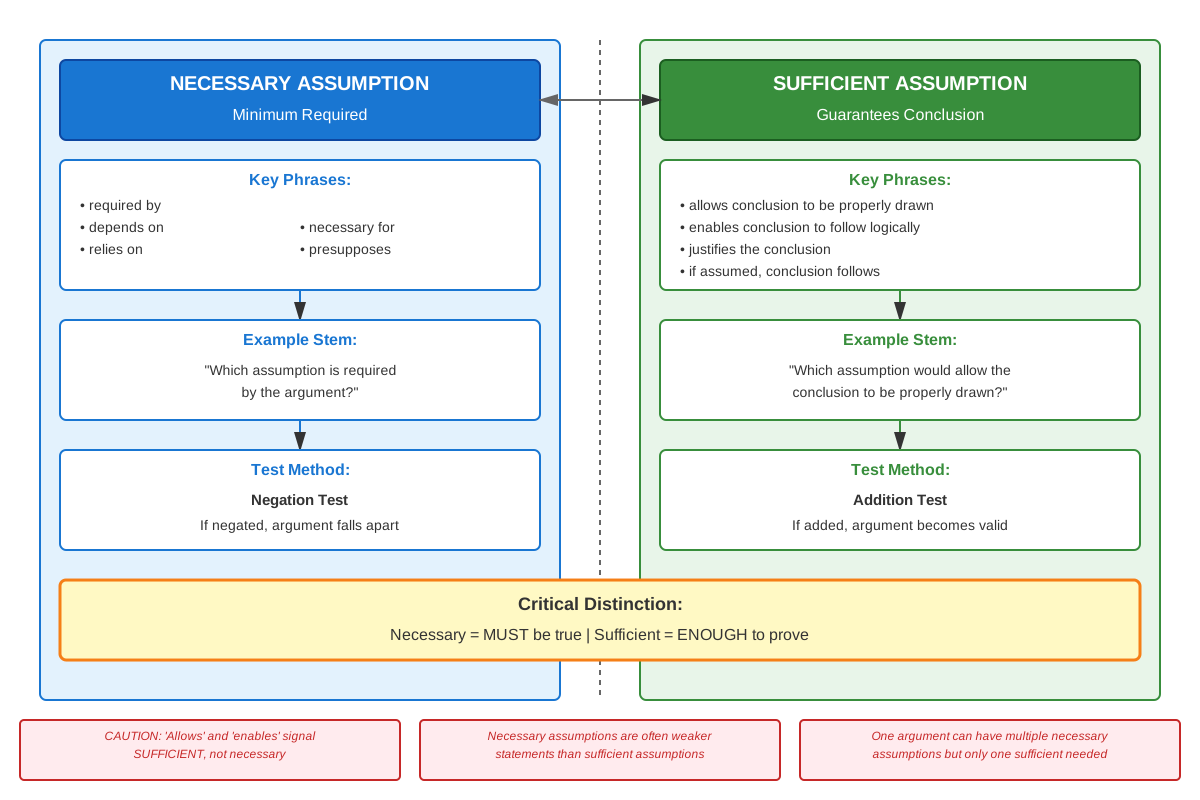
The key distinction lies in understanding necessity versus sufficiency. A necessary condition is required but may not be enough on its own. For example, having oxygen is necessary for fire, but oxygen alone doesn't guarantee fire. In contrast, a sufficient condition guarantees an outcome but isn't required—pouring gasoline and lighting a match is sufficient to start a fire, but fire can start other ways. Necessary assumptions identify what must be present, not what would definitely prove the conclusion.
Recognizing Necessary Assumption Question Stems
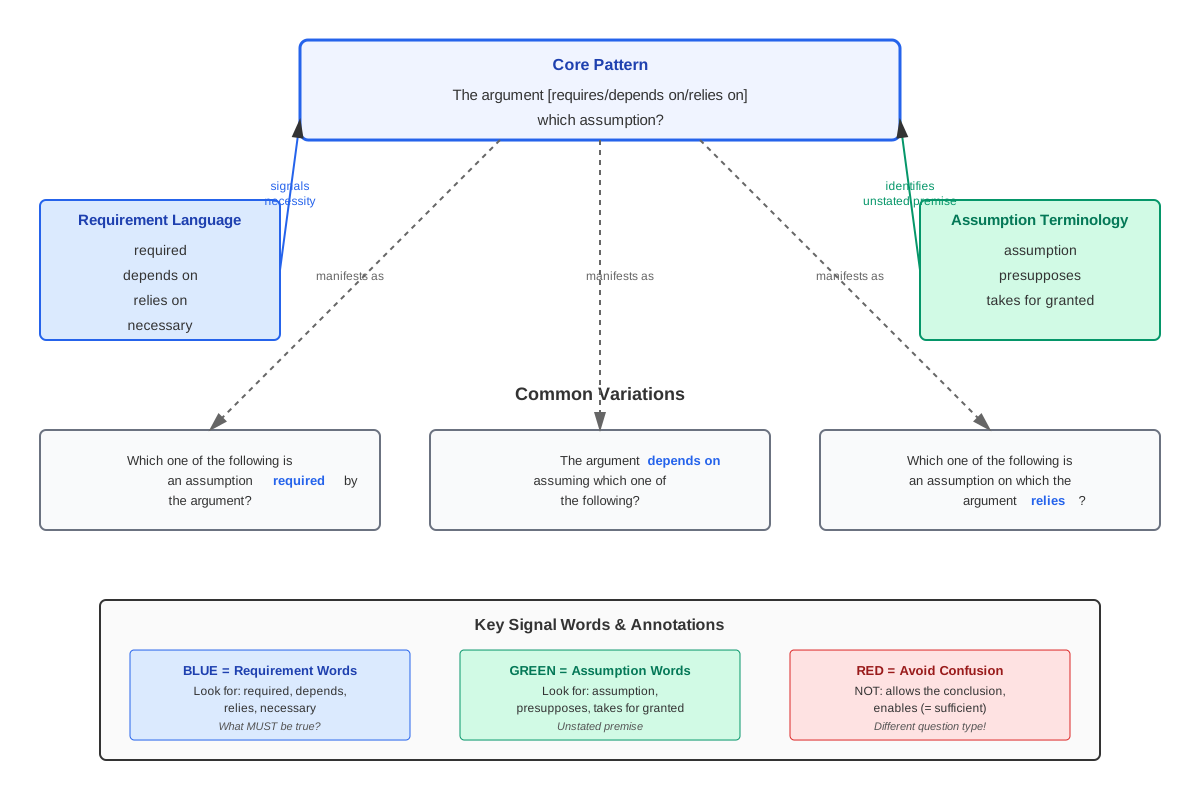
Necessary assumption question stems follow predictable linguistic patterns that signal the specific task. The most common formulations include:
- "Which one of the following is an assumption required by the argument?"
- "The argument depends on assuming which one of the following?"
- "The argument relies on which one of the following assumptions?"
- "Which one of the following is an assumption on which the argument depends?"
- "The conclusion follows logically if which one of the following is assumed?"
The critical keywords that identify necessary assumption questions are: "required," "depends," "relies," "assumption on which," and "necessary." These terms explicitly signal that the correct answer must be true for the argument to work. Some stems use conditional language: "The argument requires the assumption that..." or "The argument presupposes which of the following?"
Distinguishing from Similar Question Types
Confusion between necessary assumptions and related question types causes significant score loss. Understanding the distinctions is crucial:
| Question Type | Task | Relationship to Argument | Test Method |
|---|---|---|---|
| Necessary Assumption | Find what must be true | Required for validity | Negation destroys argument |
| Sufficient Assumption | Find what proves conclusion | Guarantees validity | Makes argument airtight |
| Strengthen | Find what supports argument | Adds evidence | Makes conclusion more likely |
| Justify/Principle | Find what proves conclusion | Provides complete logical bridge | Often uses formal logic |
Sufficient assumption questions use language like "allows the conclusion to be properly drawn," "enables the conclusion to be properly inferred," or "justifies the conclusion." These questions ask for more than necessary—they want an answer that completely proves the conclusion.
Strengthen questions ask what "most supports" or "provides evidence for" the conclusion. These answers make the argument better but aren't required—the argument could still work without them.
The Logical Gap Concept
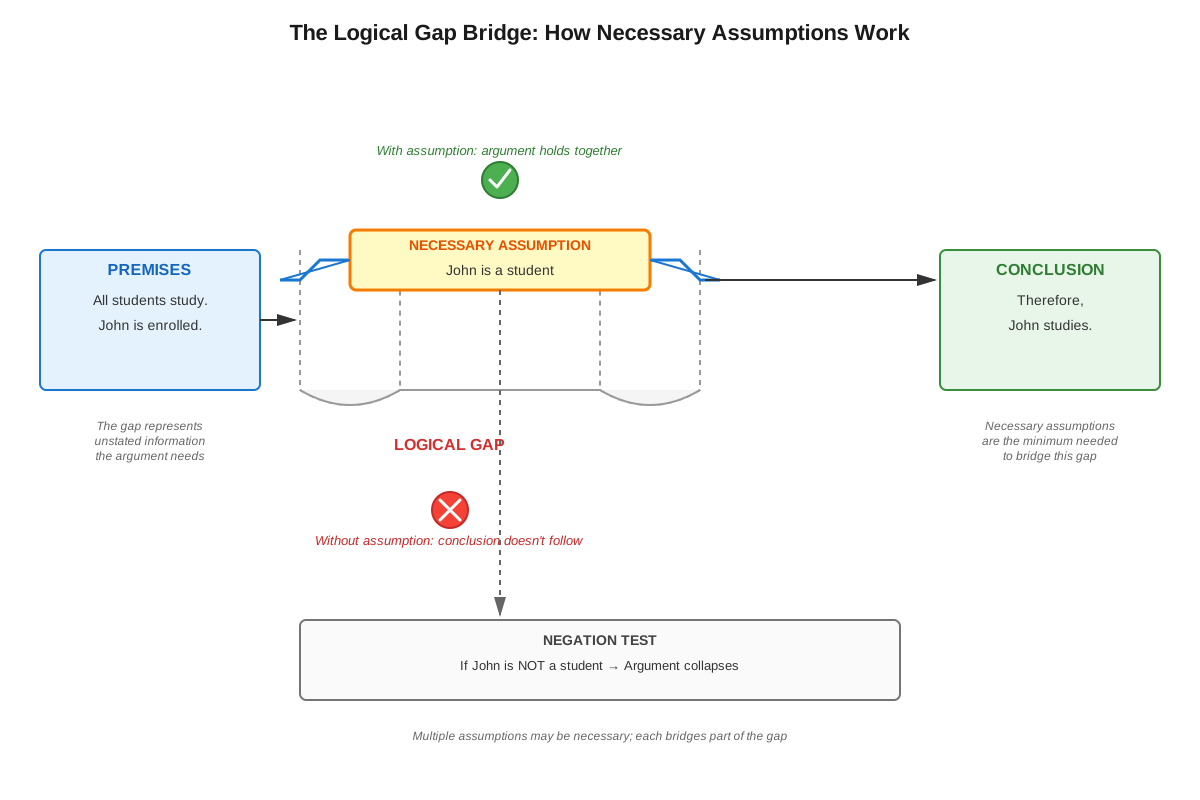
Every LSAT argument with a necessary assumption contains a logical gap—a disconnect between the evidence provided and the conclusion drawn. Identifying this gap is the key to finding necessary assumptions. Common gap patterns include:
- Scope shifts: The premises discuss one concept, but the conclusion discusses a related but different concept
- Causal gaps: The premises show correlation, but the conclusion claims causation
- Representativeness gaps: The premises provide limited evidence, but the conclusion generalizes broadly
- Feasibility gaps: The premises establish a goal, but the conclusion assumes it's achievable
- Comparison gaps: The premises compare two things, assuming they're comparable in relevant ways
For example, if premises discuss "economic growth" but the conclusion discusses "prosperity," the argument assumes these concepts are connected. If premises show "students who study more get higher grades" and the conclusion states "studying causes higher grades," the argument assumes no confounding variables explain both.
The Negation Test
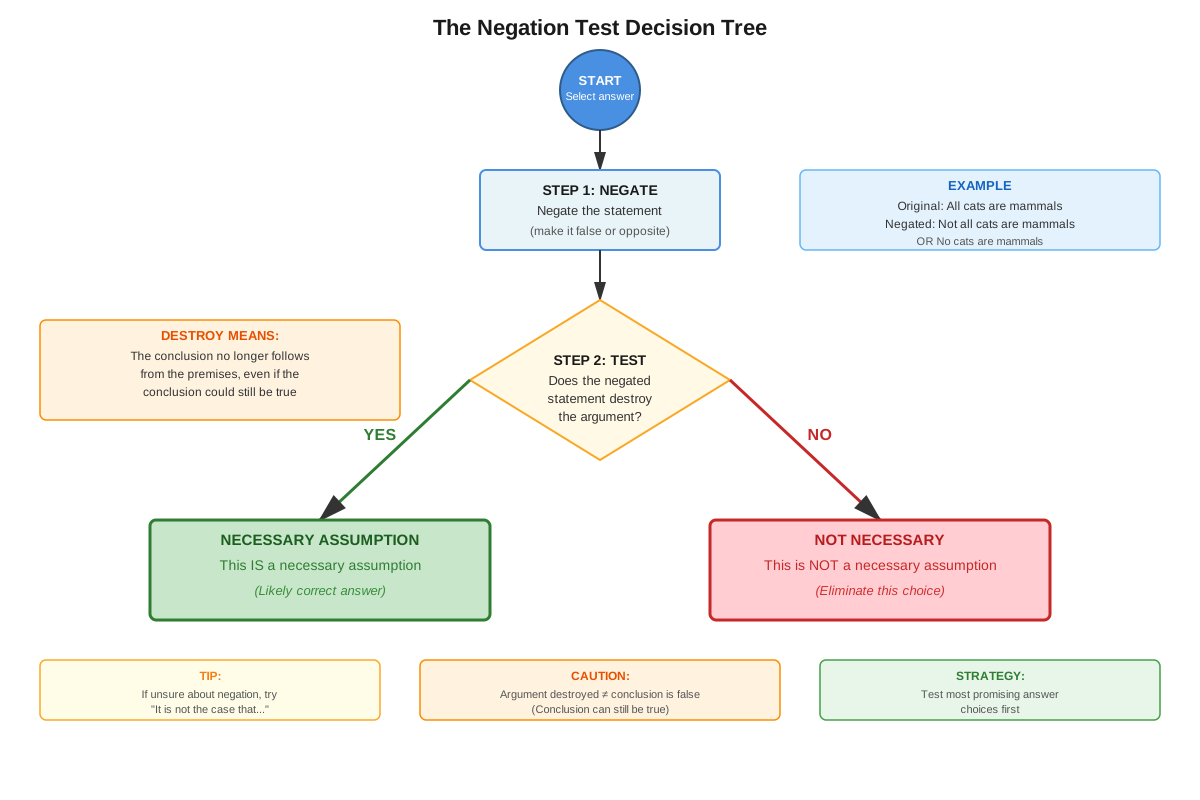
The negation test is the definitive method for verifying necessary assumptions. To apply it:
- Take the answer choice
- Negate it (make it false or opposite)
- Ask: "Does this negation destroy the argument?"
- If yes, it's a necessary assumption; if no, it's not
For example, if an answer choice states "No other factors contributed to the result," its negation is "Other factors did contribute to the result." If this negation makes the argument fall apart, the original statement is a necessary assumption.
The negation test works because necessary assumptions are, by definition, required. If something is required, its absence (negation) must cause failure. This test is particularly useful for eliminating attractive wrong answers that strengthen the argument but aren't required.
Common Assumption Categories
LSAT necessary assumptions fall into predictable categories:
Defender assumptions protect the argument from potential objections. They assume away alternative explanations, counterexamples, or undermining factors. Example: "No other cause explains the phenomenon."
Connector assumptions link concepts that shift between premises and conclusion. They bridge scope changes or establish relationships between different terms. Example: "Economic growth leads to increased prosperity."
Feasibility assumptions establish that proposed actions or outcomes are possible. They assume no insurmountable obstacles exist. Example: "The proposed policy can be implemented."
Representativeness assumptions establish that samples or examples are typical of larger groups. Example: "The surveyed group is representative of the population."
Concept Relationships
Necessary assumption questions build directly on fundamental argument analysis skills. The ability to identify premises and conclusions (prerequisite knowledge) enables recognition of what's stated versus what's unstated. Once the explicit argument structure is clear, the logical gap becomes visible—this gap is what necessary assumptions must fill.
The relationship flows: Argument Structure Recognition → Gap Identification → Assumption Recognition → Negation Test Verification. Each step depends on the previous one. Students cannot identify gaps without understanding argument structure, cannot recognize assumptions without identifying gaps, and cannot verify assumptions without applying the negation test.
Necessary assumption questions connect intimately with other Logical Reasoning question types. Strengthen questions often have correct answers that state necessary assumptions—if something is required for an argument, providing it certainly strengthens the argument. However, strengthen questions also accept answers that help but aren't required. Weaken questions often attack necessary assumptions—showing an assumption is false destroys arguments that depend on it. Flaw questions frequently identify failures to establish necessary assumptions as the argument's error.
The distinction between necessary and sufficient assumptions represents a crucial conceptual relationship. Both deal with unstated premises, but necessary assumptions identify the minimum required (what must be true), while sufficient assumptions identify what would be enough (what guarantees the conclusion). This distinction parallels the broader logical concept of necessary versus sufficient conditions, making it a foundational relationship in logical reasoning.
Question stem recognition serves as the gateway skill. Accurate identification of necessary assumption stems triggers the appropriate strategy (gap identification and negation test) rather than incorrect approaches (looking for proof or mere support). This makes stem recognition the first and most critical step in the concept chain.
High-Yield Facts
⭐ Necessary assumption questions appear 4-6 times per LSAT, making them one of the three most common question types
⭐ The negation test is the definitive verification method: if negating an answer destroys the argument, it's a necessary assumption
⭐ Key stem language includes "required," "depends on," "relies on," and "assumption on which"
⭐ Every necessary assumption fills a logical gap between premises and conclusion
⭐ Necessary assumptions must be true but don't have to prove the conclusion (unlike sufficient assumptions)
- Defender assumptions protect arguments from potential objections or alternative explanations
- Connector assumptions bridge scope shifts between premises and conclusions
- Causal arguments typically assume no alternative causes and no reverse causation
- Arguments from analogy assume relevant similarities and no relevant differences
- Statistical arguments assume representative samples and proper methodology
- The correct answer to a necessary assumption question often seems "obvious" or "minimal"—it's the least the argument needs
- Wrong answers often strengthen the argument but aren't required, or address issues outside the argument's scope
- Necessary assumption questions typically appear in the medium-to-difficult range on the LSAT
- Scope shifts are the most common type of logical gap tested in necessary assumption questions
- The phrase "takes for granted" in a question stem indicates a necessary assumption question disguised as a flaw question
Quick check — test yourself on Necessary assumption question stems so far.
Try Flashcards →Common Misconceptions
Misconception: Necessary assumptions must provide strong support for the conclusion → Correction: Necessary assumptions only need to be minimally required. They often seem weak or obvious because they represent the bare minimum the argument needs. A necessary assumption might be something as simple as "The terms used mean the same thing throughout the argument."
Misconception: If an answer choice strengthens the argument, it must be a necessary assumption → Correction: Many statements strengthen arguments without being required. The negation test distinguishes necessary assumptions from mere strengtheners. If the argument could still work (even if weakened) without the statement, it's not necessary.
Misconception: Necessary assumption questions and sufficient assumption questions require the same approach → Correction: These question types demand opposite strategies. Necessary assumptions identify the minimum required (use negation test), while sufficient assumptions identify what would prove the conclusion (use formal logic to close all gaps). The stems use distinctly different language.
Misconception: The correct answer will explicitly connect all the premises to the conclusion → Correction: Necessary assumptions typically address one specific gap, not the entire argument. They might connect just two concepts or rule out just one alternative explanation. Looking for an answer that "does everything" leads to choosing sufficient assumptions or overly strong answers.
Misconception: Necessary assumptions are always explicitly related to the conclusion → Correction: Some necessary assumptions address the validity of premises rather than the connection to the conclusion. For example, if a premise relies on survey data, a necessary assumption might be that the survey was conducted properly, even though this doesn't directly link to the conclusion.
Misconception: Extreme language ("all," "every," "never") in answer choices means they can't be necessary assumptions → Correction: While extreme language often signals wrong answers in other question types, necessary assumptions can use strong language if the argument truly requires it. For example, a causal argument might necessarily assume "No other factors caused the effect." Apply the negation test rather than eliminating based on language strength alone.
Worked Examples
Example 1: Causal Argument
Argument: "City traffic congestion decreased by 15% after the new subway line opened. Therefore, the subway line caused the reduction in traffic congestion."
Question Stem: "The argument depends on which one of the following assumptions?"
Analysis Process:
- Identify the conclusion: The subway line caused the reduction in traffic congestion
- Identify the premises: Traffic decreased 15% after the subway opened
- Identify the logical gap: The argument moves from correlation (timing) to causation, assuming no other factors explain the decrease
- Predict the assumption: Something like "No other factors caused the traffic reduction"
Answer Choices:
- (A) The subway line is more efficient than bus transportation
- (B) No other significant changes occurred that would reduce traffic congestion
- (C) The subway line will continue to reduce traffic congestion in the future
- (D) Traffic congestion had been increasing before the subway line opened
- (E) Most commuters prefer subway transportation to driving
Applying the Negation Test:
(A) Negation: "The subway is not more efficient than buses." Does this destroy the argument? No—the subway could still cause traffic reduction even if buses are equally efficient. Not necessary.
(B) Negation: "Other significant changes did occur that would reduce traffic congestion." Does this destroy the argument? Yes—if other factors caused the reduction, we can't conclude the subway caused it. This is necessary.
(C) Negation: "The subway won't continue reducing traffic." Does this destroy the argument? No—the argument is about what caused the past reduction, not future effects. Not necessary.
(D) Negation: "Traffic was stable or decreasing before the subway." Does this destroy the argument? No—the subway could still cause the 15% reduction regardless of prior trends. Not necessary.
(E) Negation: "Most commuters don't prefer subways to driving." Does this destroy the argument? No—even if fewer prefer it, enough people might use it to reduce traffic. Not necessary.
Correct Answer: (B) - This is a classic defender assumption that rules out alternative causes in a causal argument.
Example 2: Scope Shift Argument
Argument: "The new medication reduced patients' reported pain levels by 40% in clinical trials. Therefore, the medication is effective at treating the underlying condition causing the pain."
Question Stem: "Which one of the following is an assumption required by the argument?"
Analysis Process:
- Identify the conclusion: The medication treats the underlying condition
- Identify the premises: The medication reduced reported pain levels
- Identify the logical gap: Scope shift from "reducing pain symptoms" to "treating underlying condition"—these are different concepts
- Predict the assumption: Something connecting pain reduction to treating the actual condition
Answer Choices:
- (A) Patients accurately reported their pain levels
- (B) The clinical trials included a sufficient number of participants
- (C) Reducing pain levels indicates treatment of the underlying condition
- (D) The medication has fewer side effects than alternative treatments
- (E) Pain is the most significant symptom of the condition
Applying the Negation Test:
(A) Negation: "Patients didn't accurately report pain levels." Does this destroy the argument? Partially—it undermines the premise, but the argument's main gap is the leap from pain reduction to treating the condition. Possibly necessary but not the main assumption.
(B) Negation: "The trials didn't include sufficient participants." Does this destroy the argument? This weakens confidence but doesn't address the logical gap between pain reduction and treating the condition. Not the key assumption.
(C) Negation: "Reducing pain levels does not indicate treatment of the underlying condition." Does this destroy the argument? Absolutely—if pain reduction doesn't indicate treating the condition, the conclusion can't follow from the premise. This is necessary.
(D) Negation: "The medication has more side effects than alternatives." Does this destroy the argument? No—it could still be effective at treating the condition even with more side effects. Not necessary.
(E) Negation: "Pain is not the most significant symptom." Does this destroy the argument? No—the medication could still treat the condition even if pain isn't the main symptom. Not necessary.
Correct Answer: (C) - This is a connector assumption that bridges the scope shift between "reducing pain" and "treating the underlying condition."
Exam Strategy
When approaching necessary assumption questions on the LSAT, follow this systematic process:
Step 1: Confirm the Question Type (5-10 seconds)
Read the question stem carefully and identify trigger words: "required," "depends," "relies," "assumption on which." Distinguish from sufficient assumption stems ("allows the conclusion to be properly drawn") and strengthen stems ("most supports"). Misidentifying the question type leads to using the wrong strategy.
Step 2: Analyze the Argument (20-30 seconds)
- Identify the conclusion (what is the author trying to prove?)
- Identify the premises (what evidence is provided?)
- Identify the logical gap (what's the disconnect between evidence and conclusion?)
- Predict the assumption type (defender, connector, feasibility, representativeness)
Step 3: Predict Before Reading Answers (10-15 seconds)
Form a rough prediction of what the assumption should do. You don't need the exact wording, but knowing "this argument needs to rule out alternative causes" or "this argument needs to connect economic growth to prosperity" prevents you from being seduced by attractive wrong answers.
Step 4: Eliminate and Apply Negation Test (30-45 seconds)
- Quickly eliminate answers that are clearly out of scope or address the wrong gap
- For remaining contenders, apply the negation test
- The correct answer, when negated, must destroy the argument
- If negating an answer merely weakens the argument, it's not necessary—it's just a strengthener
Exam Tip: If you're torn between two answers, both of which seem to weaken the argument when negated, choose the one that addresses the most obvious gap between premises and conclusion. The correct necessary assumption typically bridges the main logical leap.
Trigger Words to Watch For:
- In question stems: "required," "depends," "relies," "presupposes," "takes for granted"
- In arguments: Causal language ("caused," "led to," "resulted in") signals you'll need to assume away alternative causes
- Scope shifts: Different terms in premises versus conclusion signal connector assumptions
- Recommendations or predictions: Signal feasibility assumptions
Process of Elimination Tips:
- Eliminate answers that go beyond the scope of the argument—necessary assumptions are minimal
- Eliminate answers that would be nice to have but aren't required
- Eliminate answers that address a different gap than the main logical leap
- Be suspicious of answers that seem to prove the conclusion—those are likely sufficient assumptions
- Don't eliminate based on extreme language alone—apply the negation test
Time Allocation:
Necessary assumption questions should take 1:15-1:30 on average. They require careful analysis but shouldn't consume excessive time. If you're spending over 2 minutes, you're likely overthinking. Make your best choice using the negation test and move forward.
Memory Techniques
DRAIN Mnemonic for types of necessary assumptions:
- Defender (rules out alternatives)
- Representativeness (sample represents population)
- Analogical (relevant similarities exist)
- Implementation (feasibility of proposals)
- Nexus (connects scope-shifted concepts)
"NEGATION DEVASTATION" Rule: If negating an answer doesn't devastate (destroy) the argument, it's not a necessary assumption. This memorable phrase helps you remember that the negation test must completely undermine the argument, not just weaken it.
Question Stem Recognition Acronym - RDR:
- Required
- Depends
- Relies
If you see any of these three words in a question stem, you're dealing with a necessary assumption question.
Visual Memory Technique: Picture an argument as a bridge with the premises on one side and the conclusion on the other. The necessary assumption is the single critical support beam—remove it (negate it) and the entire bridge collapses. This visualization helps distinguish necessary (one critical beam) from sufficient (adding extra support beams that make the bridge stronger but aren't individually required).
The "Minimum Requirement" Reminder: Whenever you're tempted by a strong answer that seems to prove the conclusion, remind yourself: "Necessary = Minimum." You're looking for the least the argument needs, not the most it could have.
Summary
Necessary assumption question stems represent a high-frequency, high-value question type on the LSAT that tests the fundamental skill of identifying unstated premises required for arguments to work. These questions are recognizable through specific trigger language including "required," "depends on," and "relies on," which distinguishes them from sufficient assumption and strengthen questions. The core task involves identifying logical gaps between premises and conclusions, then finding the minimal assumption that bridges that gap. The definitive verification method is the negation test: if negating an answer choice destroys the argument, that choice is a necessary assumption. Common assumption types include defenders (ruling out alternatives), connectors (bridging scope shifts), and feasibility assumptions (establishing that proposals are possible). Success requires accurate question stem recognition, systematic gap identification, prediction before reading answers, and disciplined application of the negation test to verify choices.
Key Takeaways
- Necessary assumption questions appear 4-6 times per LSAT and are identifiable by trigger words "required," "depends," and "relies"
- The negation test is the gold standard: negate the answer and ask if it destroys the argument
- Every necessary assumption fills a specific logical gap between premises and conclusion
- Necessary assumptions represent the minimum required, not proof of the conclusion (that's sufficient assumptions)
- Common gaps include causal leaps, scope shifts, and failures to rule out alternatives
- Predict the type of assumption needed before reading answer choices to avoid attractive wrong answers
- The correct answer often seems obvious or minimal—that's appropriate for something that's merely necessary
Related Topics
Sufficient Assumption Questions: After mastering necessary assumptions, students should study sufficient assumptions, which ask what would prove the conclusion rather than what's merely required. Understanding the distinction between these question types is crucial for avoiding strategic errors.
Strengthen and Weaken Questions: These question types build on assumption recognition skills. Strengthen questions often include necessary assumptions as correct answers, while weaken questions often attack necessary assumptions. Mastering necessary assumptions provides a foundation for these related question types.
Flaw Questions: Many flaw questions identify failures to establish necessary assumptions. Understanding what assumptions arguments require helps identify when arguments fail to establish those assumptions, making flaw questions more approachable.
Conditional Reasoning: Advanced necessary assumption questions often involve conditional logic. Mastering basic necessary assumptions enables progression to more complex questions involving formal logic relationships.
Practice CTA
Now that you understand necessary assumption question stems, it's time to put this knowledge into practice. Attempt the practice questions to reinforce your ability to recognize these stems, identify logical gaps, and apply the negation test. The flashcards will help you memorize key trigger words and assumption types. Remember: recognizing the question type correctly is the first step toward consistent performance. Each practice question you complete strengthens your pattern recognition and builds the confidence you need for test day. You've learned the strategy—now make it automatic through deliberate practice!
Sign up free to keep reading
Create a free AnvayaPrep account to finish this LSAT guide on Necessary assumption question stems — plus flashcards and practice questions.