Overview
Parallel flaw question stems represent one of the most challenging and strategically important question types in LSAT Logical Reasoning. These questions require test-takers to identify an argument that contains the same logical error as the stimulus argument, demanding both pattern recognition skills and a deep understanding of logical fallacies. Unlike standard parallel reasoning questions that ask students to match valid argument structures, parallel flaw questions specifically target flawed reasoning patterns, making them a unique test of analytical ability.
The importance of mastering parallel flaw questions cannot be overstated for LSAT success. These questions typically appear 2-4 times per test across the Logical Reasoning sections, and they consistently challenge even high-scoring test-takers due to their complexity. Students must simultaneously understand the flaw in the original argument, abstract that flaw into a general logical pattern, and then recognize that same pattern embedded in a completely different context with different subject matter. This multi-layered cognitive task makes parallel flaw questions among the most time-consuming and difficult question types on the exam.
Within the broader landscape of question stem recognition, parallel flaw questions occupy a critical position. They build upon foundational skills in identifying argument structure, recognizing common logical fallacies, and understanding formal and informal reasoning patterns. Mastery of parallel flaw questions demonstrates advanced logical reasoning ability and directly correlates with performance on other high-difficulty question types, including flaw questions, strengthen/weaken questions, and principle questions. The skills developed through parallel flaw practice—particularly the ability to abstract logical structures from content—transfer broadly across the entire Logical Reasoning section.
Learning Objectives
- [ ] Identify how parallel flaw question stems appear in LSAT questions
- [ ] Explain the reasoning pattern behind parallel flaw question stems
- [ ] Apply parallel flaw question stems to solve LSAT-style problems accurately
- [ ] Distinguish between parallel flaw questions and standard parallel reasoning questions
- [ ] Abstract logical structures from content-specific arguments to identify matching flaws
- [ ] Recognize the most common logical fallacies that appear in parallel flaw questions
- [ ] Develop efficient strategies for eliminating incorrect answer choices in parallel flaw questions
Prerequisites
- Understanding of basic argument structure: Recognition of premises, conclusions, and intermediate conclusions is essential because parallel flaw questions require matching the structural components of arguments.
- Familiarity with common logical fallacies: Knowledge of fallacy types (ad hominem, false dichotomy, circular reasoning, etc.) enables quick identification of the flaw pattern to match.
- Experience with standard flaw questions: The ability to identify what makes an argument flawed provides the foundation for finding parallel flawed reasoning.
- Basic formal logic concepts: Understanding conditional reasoning, necessary vs. sufficient conditions, and quantifier relationships helps recognize structural parallels.
- Question stem recognition fundamentals: The ability to quickly categorize question types ensures efficient test-taking and appropriate strategy application.
Why This Topic Matters
Parallel flaw questions serve as a comprehensive test of logical reasoning mastery. In real-world applications, the ability to recognize when two different situations share the same logical structure—particularly when both are flawed—is crucial for critical thinking in law, policy analysis, business decision-making, and everyday argumentation. Legal professionals constantly encounter situations where precedent cases must be distinguished or applied based on structural similarities in reasoning, making this skill directly relevant to law school and legal practice.
From an exam perspective, parallel flaw questions appear with high regularity on the LSAT. Statistical analysis of recent tests shows that these questions constitute approximately 4-8% of all Logical Reasoning questions, with typically 2-4 questions per complete LSAT. More importantly, these questions have a lower average accuracy rate than most other question types, with many test-takers scoring below 60% on parallel flaw questions even when they perform well on other question types. This difficulty creates an opportunity: students who master parallel flaw questions gain a significant competitive advantage.
Parallel flaw questions commonly appear in several recognizable formats. The stimulus argument typically contains a clear logical error—often involving conditional reasoning mistakes, sampling errors, causal fallacies, or equivocation. The answer choices present five different arguments, each with different subject matter, and exactly one will contain the same logical flaw in the same structural position. The test makers deliberately craft wrong answers that may contain flaws but not the same flaw, or that match the content but not the structure, making careful analysis essential.
Core Concepts
Recognizing Parallel Flaw Question Stems
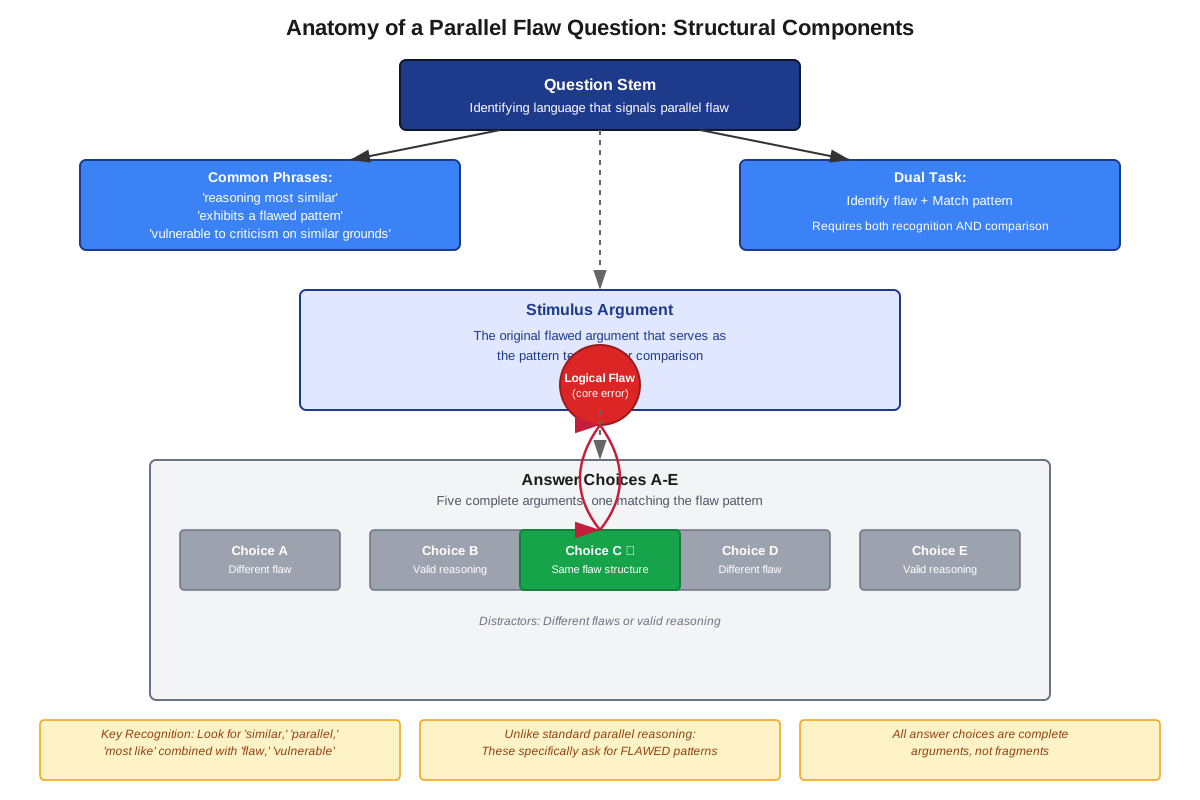
LSAT parallel flaw question stems follow predictable patterns that allow for immediate recognition. The most common formulations include:
- "Which one of the following arguments is most similar in its flawed reasoning to the argument above?"
- "The flawed pattern of reasoning in the argument above is most similar to that in which one of the following?"
- "Which one of the following exhibits a flawed pattern of reasoning most similar to that exhibited by the argument above?"
- "The reasoning in the argument is most vulnerable to criticism on the grounds that it is similar to which one of the following?"
The key identifying features are: (1) explicit mention of "flawed" or "vulnerable" reasoning, (2) request for similarity or parallel structure, and (3) comparison to answer choice arguments. This distinguishes parallel flaw questions from standard parallel reasoning questions, which ask for matching valid reasoning patterns.
The Structure of Parallel Flaw Questions
Every parallel flaw question contains three essential components:
- The stimulus argument: Contains a specific logical flaw embedded in a particular context
- The question stem: Explicitly asks for a parallel flawed reasoning pattern
- Five answer choices: Each presenting a complete argument, with one matching the flaw structure
The challenge lies in the abstraction requirement. Test-takers must move from the specific content of the stimulus (e.g., an argument about city planning) to an abstract logical structure (e.g., "assumes that what is true of parts must be true of the whole"), then recognize that structure in completely different content (e.g., an argument about team sports).
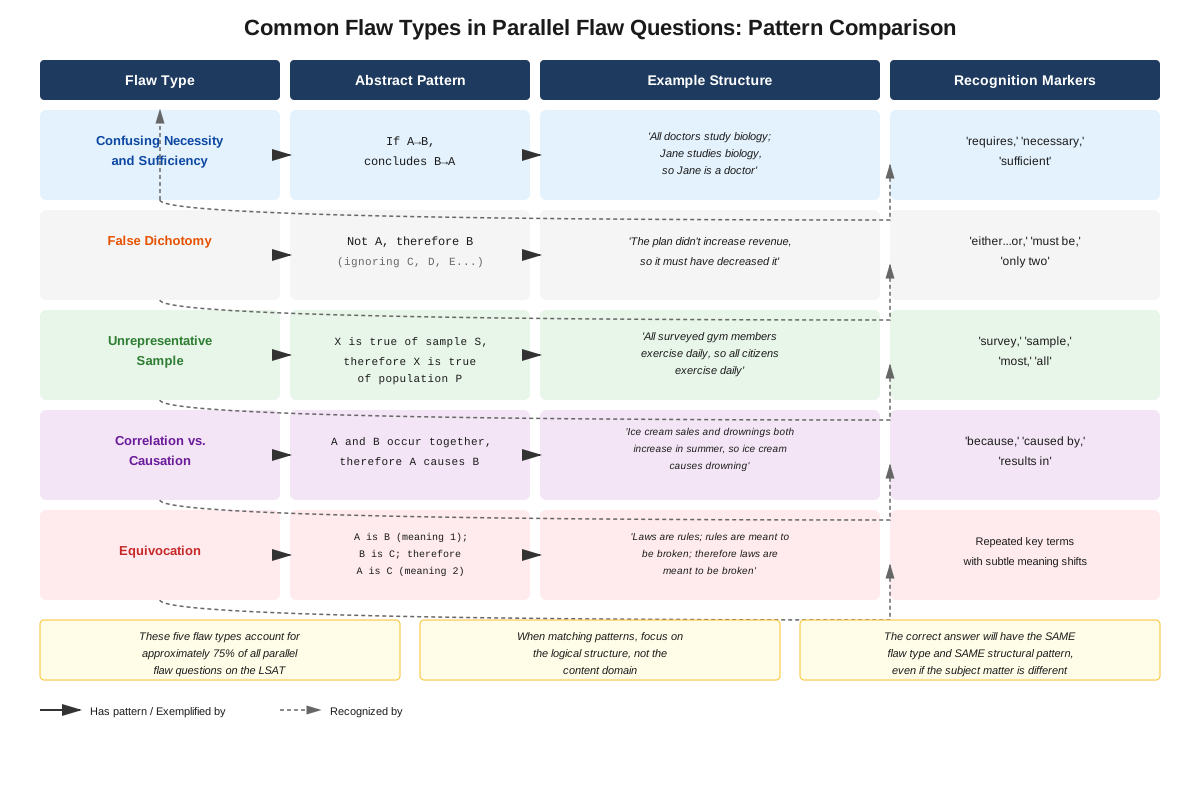
Common Flaw Types in Parallel Questions
Certain logical fallacies appear repeatedly in parallel flaw questions because they have clear, recognizable structures:
| Flaw Type | Structure | Example Pattern |
|---|---|---|
| Conditional reasoning error | Confuses necessary and sufficient conditions | If A→B, concludes if B→A (affirming consequent) |
| Part-to-whole fallacy | Assumes properties of parts apply to whole | Each ingredient is healthy, so the meal is healthy |
| Sampling error | Generalizes from unrepresentative sample | Survey of gym members concludes all citizens are fit |
| False dichotomy | Presents two options as exhaustive when others exist | Either we ban cars or accept pollution |
| Circular reasoning | Conclusion restates premise without new support | X is true because X is the case |
| Equivocation | Uses same term with different meanings | "Light" feathers and "light" colors |
| Ad hominem | Attacks person rather than argument | Expert is biased, so claim must be false |
The Abstraction Process
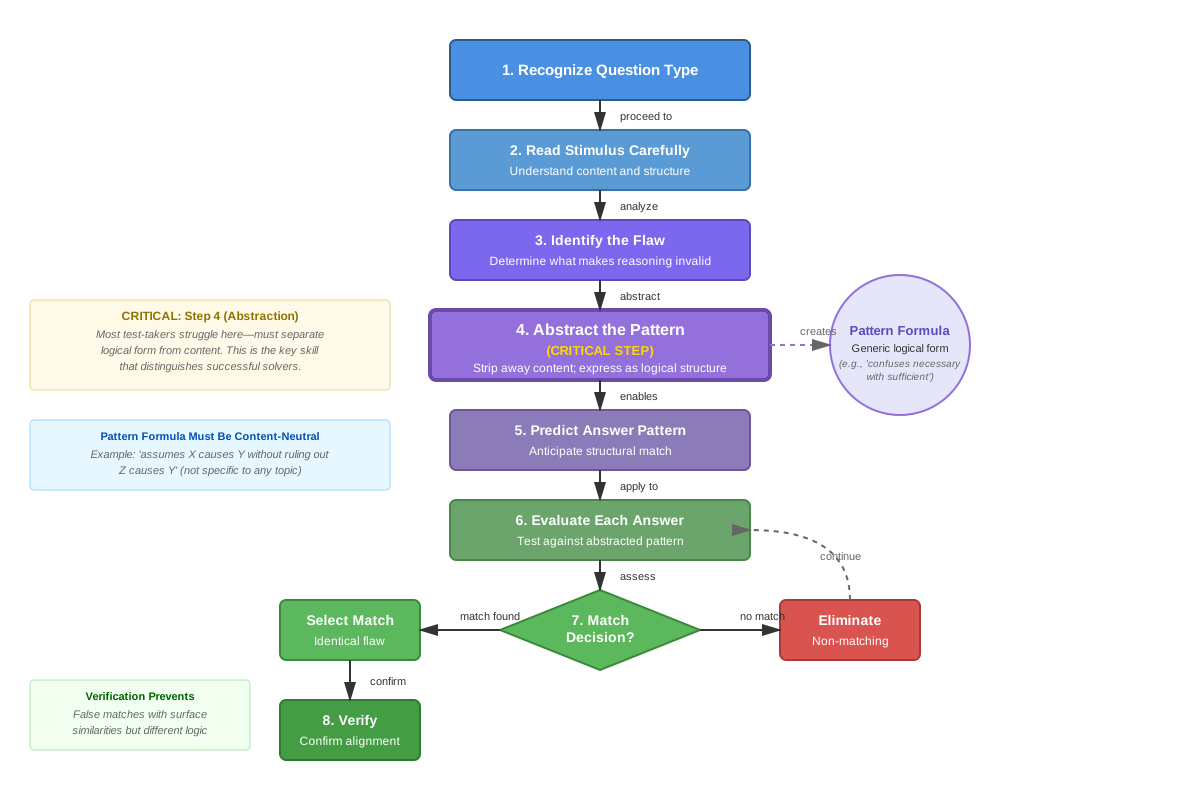
Successful parallel flaw solving requires systematic abstraction:
- Identify the conclusion of the stimulus argument
- Identify the premises supporting that conclusion
- Locate the logical gap or error in reasoning
- Abstract the flaw into a general pattern independent of content
- Match the pattern in the answer choices, ignoring content differences
For example, if the stimulus argues "All successful entrepreneurs take risks; Maria takes risks; therefore, Maria is a successful entrepreneur," the abstraction would be: "All A are B; X is B; therefore, X is A" (affirming the consequent). The correct answer will follow this exact pattern with different content.
Structural Matching Requirements
For an answer choice to be correct, it must match the stimulus on multiple dimensions:
- Flaw type: The same logical error must be present
- Structural position: The flaw must occur at the same point in the reasoning
- Quantifier matching: "All," "some," "most," "none" must correspond
- Number of premises: The argument structure should have the same complexity
- Conclusion type: Categorical, conditional, or causal conclusions should match
Even one structural mismatch eliminates an answer choice, making systematic comparison essential.
Content vs. Structure Distinction
The most critical skill in parallel flaw questions is distinguishing content from structure. Test makers exploit the natural tendency to focus on content by creating wrong answers that:
- Discuss similar topics but have different logical structures
- Contain flaws but not the same flaw as the stimulus
- Match the conclusion type but not the reasoning pattern
- Use similar language but different logical relationships
Training the mind to "see through" content to underlying structure is the key to consistent success on these questions.
Concept Relationships
The concepts within parallel flaw questions form an interconnected hierarchy. Question stem recognition serves as the entry point, enabling immediate identification of the task requirements. This recognition triggers the abstraction process, which depends on understanding common flaw types and argument structure. The abstraction process produces a logical pattern that guides structural matching across answer choices, while maintaining strict content vs. structure distinction prevents distraction by superficial similarities.
Parallel flaw questions connect directly to prerequisite topics: basic flaw identification provides the foundation for recognizing what makes the stimulus argument flawed, while formal logic supplies the tools for precise structural analysis. Conditional reasoning knowledge is particularly crucial since conditional errors constitute a large percentage of parallel flaw questions.
The relationship map flows as follows:
Question Stem Recognition → Argument Structure Analysis → Flaw Identification → Abstraction to General Pattern → Structural Matching in Answer Choices → Elimination of Mismatches → Selection of Parallel Flaw
This process also connects forward to advanced topics: mastery of parallel flaw questions enhances performance on principle questions (which require similar abstraction skills), method of reasoning questions (which test structural understanding), and complex argumentation passages (which demand quick pattern recognition).
High-Yield Facts
⭐ Parallel flaw questions explicitly mention "flawed" or "vulnerable" reasoning in the question stem, distinguishing them from standard parallel reasoning questions.
⭐ The correct answer must match both the type of flaw AND the structural position where the flaw occurs in the argument.
⭐ Conditional reasoning errors (affirming the consequent, denying the antecedent) are the most frequently tested flaw types in parallel questions.
⭐ Content similarity between stimulus and answer choice is irrelevant and often used as a distractor by test makers.
⭐ Quantifiers ("all," "some," "most," "none") must match exactly between stimulus and correct answer for proper structural parallel.
- Parallel flaw questions typically appear 2-4 times per LSAT, representing 4-8% of Logical Reasoning questions.
- The abstraction process should be completed before examining answer choices to avoid content-based distraction.
- Wrong answers often contain flaws but not the same flaw as the stimulus argument.
- Part-to-whole fallacies and whole-to-part fallacies are distinct flaw types that must be carefully distinguished.
- Circular reasoning in parallel flaw questions often appears disguised with different wording between premise and conclusion.
- The number of premises in the stimulus should match the number in the correct answer choice.
- Time investment in thoroughly understanding the stimulus flaw pays dividends in faster answer choice elimination.
- Ad hominem attacks and appeals to authority represent distinct flaw patterns that should not be confused.
- Sampling errors require matching both the unrepresentative nature of the sample and the scope of the conclusion.
- False dichotomies must present exactly two options as exhaustive when more exist; three-option arguments are not false dichotomies.
Quick check — test yourself on Parallel flaw question stems so far.
Try Flashcards →Common Misconceptions
Misconception: Parallel flaw questions require finding an argument about a similar topic to the stimulus.
Correction: Content is completely irrelevant in parallel flaw questions. The correct answer will almost always discuss a completely different topic while maintaining identical logical structure. Test makers deliberately use content similarity as a trap in wrong answers.
Misconception: If an answer choice contains any logical flaw, it could be correct.
Correction: The answer choice must contain the same specific flaw as the stimulus. An argument might be flawed in multiple ways, but only one answer choice will have the identical flaw in the identical structural position. A circular reasoning flaw does not parallel a conditional reasoning error.
Misconception: Matching the conclusion type is sufficient to identify the correct answer.
Correction: While the conclusion type should match (categorical, conditional, causal), this is only one component of structural parallel. The premises, the reasoning pattern, the quantifiers, and the specific location of the logical gap must all correspond.
Misconception: Parallel flaw questions are just harder versions of regular flaw questions.
Correction: Parallel flaw questions test a fundamentally different skill set. While flaw questions require identifying what makes an argument weak, parallel flaw questions require abstracting that flaw into a general pattern and recognizing it in a new context. This demands higher-order pattern recognition abilities.
Misconception: The correct answer will use similar language or phrasing to the stimulus.
Correction: Test makers intentionally vary language to test true structural understanding. An argument using "if...then" language might parallel one using "all...are" language if the underlying logical structure is identical. Focus on relationships, not words.
Misconception: Longer or more complex answer choices are more likely to be correct.
Correction: Answer choice length has no correlation with correctness. Test makers sometimes use complexity as a distractor, making wrong answers appear sophisticated while the correct answer might be relatively straightforward. Judge based on structural match alone.
Worked Examples
Example 1: Conditional Reasoning Error
Stimulus Argument:
"All professional athletes maintain rigorous training schedules. Jennifer maintains a rigorous training schedule. Therefore, Jennifer must be a professional athlete."
Step 1 - Identify the Conclusion:
Jennifer must be a professional athlete.
Step 2 - Identify the Premises:
- All professional athletes maintain rigorous training schedules
- Jennifer maintains a rigorous training schedule
Step 3 - Locate the Flaw:
This commits the fallacy of affirming the consequent. The argument treats a necessary condition (rigorous training) as if it were sufficient. Structure: All A are B; X is B; therefore X is A.
Step 4 - Abstract the Pattern:
The argument incorrectly assumes that because something has a characteristic that all members of a group possess, it must be a member of that group. This confuses necessary and sufficient conditions.
Step 5 - Evaluate Answer Choices:
(A) "All roses are flowers. This plant is a flower. Therefore, this plant is a rose."
- Analysis: Perfect match! All A are B; X is B; therefore X is A. This commits the identical conditional reasoning error in the same structural position. CORRECT
(B) "All roses are flowers. This plant is a rose. Therefore, this plant is a flower."
- Analysis: This is valid reasoning (affirming the antecedent), not flawed. Eliminated.
(C) "All roses are flowers. This plant is not a flower. Therefore, this plant is not a rose."
- Analysis: This is also valid reasoning (denying the consequent via contrapositive). Eliminated.
(D) "Some roses are red. This flower is red. Therefore, this flower is a rose."
- Analysis: While flawed, this involves "some" rather than "all," changing the quantifier structure. Not a match.
(E) "All roses need water. All flowers need water. Therefore, all roses are flowers."
- Analysis: This is a different flaw (assuming shared properties indicate category membership). Not the same pattern.
Connection to Learning Objectives: This example demonstrates how to identify the question type, abstract the logical structure, and systematically match patterns while ignoring content differences.
Example 2: Part-to-Whole Fallacy
Stimulus Argument:
"Each individual musician in the orchestra is highly talented. Therefore, the orchestra as a whole must deliver an outstanding performance."
Step 1 - Identify the Conclusion:
The orchestra as a whole must deliver an outstanding performance.
Step 2 - Identify the Premises:
Each individual musician in the orchestra is highly talented.
Step 3 - Locate the Flaw:
This commits a composition fallacy (part-to-whole error). The argument assumes that what is true of each part must be true of the whole, ignoring that collective performance depends on coordination, not just individual talent.
Step 4 - Abstract the Pattern:
The argument incorrectly infers that because each component has a property, the composite entity must have that property. Structure: Each part has quality Q; therefore, the whole has quality Q.
Step 5 - Evaluate Answer Choices:
(A) "Every ingredient in this dish is organic. Therefore, this dish is healthy."
- Analysis: This moves from parts (ingredients) to whole (dish) but shifts the property from "organic" to "healthy." Not a perfect match because the property changes.
(B) "Every player on the team is an excellent defender. Therefore, the team has an excellent defense."
- Analysis: Perfect match! Each part (player) has a quality (excellent at defending); conclusion: the whole (team) has that quality (excellent defense). This commits the identical composition fallacy. CORRECT
(C) "The team has won every game this season. Therefore, each player on the team is excellent."
- Analysis: This is a whole-to-part fallacy (division), the reverse of what we need. Eliminated.
(D) "Every player on the team practices daily. Most players are improving. Therefore, the team will win the championship."
- Analysis: This has multiple premises and a different conclusion type (predictive rather than descriptive). Structure doesn't match.
(E) "Some players on the team are injured. Therefore, the team's performance will suffer."
- Analysis: Uses "some" rather than "each/every," and the reasoning is actually more sound (acknowledging that parts affect the whole). Not the same flaw.
Connection to Learning Objectives: This example shows how to distinguish between similar-seeming fallacies (composition vs. division) and recognize when property shifts in answer choices eliminate them from consideration.
Exam Strategy
Initial Approach
When encountering a parallel flaw question, invest time upfront in thoroughly understanding the stimulus. Spend 30-45 seconds analyzing the argument structure and identifying the specific flaw before looking at answer choices. This investment prevents the common mistake of getting lost in answer choice content.
Exam Tip: Write a one-sentence abstraction of the flaw on your scratch paper before evaluating answer choices. This serves as an anchor preventing content-based distraction.
Trigger Words and Phrases
Watch for these question stem indicators:
- "flawed reasoning" or "flawed pattern of reasoning"
- "most similar in its reasoning" combined with "vulnerable to criticism"
- "exhibits a pattern of reasoning most parallel to"
- "reasoning is questionable because it is similar to"
These phrases definitively identify parallel flaw questions and should trigger the abstraction-focused approach.
Process of Elimination Strategy
Eliminate answer choices systematically using these criteria in order:
- Validity check: Eliminate any answer choice that presents valid reasoning (no flaw present)
- Flaw type match: Eliminate choices with different types of flaws than the stimulus
- Quantifier match: Eliminate choices where "all," "some," "most," or "none" don't correspond
- Structural position: Eliminate choices where the flaw occurs at a different point in the reasoning
- Premise count: Eliminate choices with significantly different numbers of premises
This systematic approach typically eliminates 3-4 answer choices quickly, leaving a focused comparison between the remaining options.
Time Allocation
Parallel flaw questions deserve above-average time investment due to their complexity. Allocate:
- 30-45 seconds: Stimulus analysis and flaw identification
- 45-60 seconds: Answer choice evaluation and elimination
- Total: 75-105 seconds (compared to 60-90 seconds for average questions)
This time investment is justified by the difficulty and point value. Rushing through parallel flaw questions leads to predictable errors.
Common Trap Patterns
Test makers consistently use these wrong answer patterns:
- Content match trap: Similar topic to stimulus but different logical structure
- Different flaw trap: Contains a flaw but not the same flaw
- Partial match trap: Matches some structural elements but not all
- Reversed structure trap: Has the same elements but in reversed order (e.g., whole-to-part instead of part-to-whole)
- Valid reasoning trap: Presents sound reasoning that superficially resembles the stimulus
Awareness of these patterns accelerates elimination and prevents second-guessing.
Memory Techniques
The MATCH Acronym
Use MATCH to remember the five essential components that must correspond between stimulus and correct answer:
- Main flaw type (conditional error, composition, etc.)
- Argument structure (number and type of premises)
- Type of conclusion (categorical, conditional, causal)
- Conditions and quantifiers (all, some, most, none)
- Hierarchy of reasoning (where the flaw occurs in the logical chain)
Visualization Strategy
Picture the argument as a physical structure—a building with foundation (premises), support beams (reasoning), and roof (conclusion). The flaw is a crack in a specific location. The correct answer is a different building with the same crack in the same structural position, even though the building materials (content) differ completely.
The "Content Blindfold" Technique
When evaluating answer choices, mentally replace all content words with variables (A, B, X, Y) to force focus on structure. For example, "All dogs are mammals" becomes "All A are B." This prevents content-based distraction and highlights structural parallels.
Common Flaw Quick Reference
Memorize these high-frequency flaw patterns with simple examples:
- Affirming consequent: If A→B, B, therefore A (If rain→wet, wet, therefore rain)
- Denying antecedent: If A→B, not A, therefore not B (If rain→wet, no rain, therefore not wet)
- Composition: Parts have Q, therefore whole has Q (Each brick is light, therefore wall is light)
- Division: Whole has Q, therefore parts have Q (Team is good, therefore each player is good)
- False dichotomy: Either A or B, not A, therefore B (when C, D, E also exist)
Summary
Parallel flaw question stems represent a sophisticated test of logical reasoning ability, requiring students to identify flawed arguments, abstract their logical structure, and recognize that structure in completely different contexts. Success depends on mastering the distinction between content and structure, understanding common logical fallacies, and applying systematic elimination strategies. These questions appear 2-4 times per LSAT and consistently challenge test-takers due to their multi-layered cognitive demands. The key to mastery lies in investing time upfront to thoroughly understand the stimulus flaw, abstracting that flaw into a general pattern independent of content, and then methodically matching that pattern across answer choices while ignoring superficial content similarities. Students must recognize that the correct answer will almost always discuss a completely different topic while maintaining identical logical structure, including matching flaw type, quantifiers, premise structure, and the specific position where the reasoning breaks down. By developing strong abstraction skills and avoiding common traps like content matching and different-flaw distractors, students can transform parallel flaw questions from a weakness into a competitive advantage on test day.
Key Takeaways
- Parallel flaw questions explicitly mention "flawed" reasoning in the stem and require matching both flaw type and structural position
- Content is completely irrelevant; the correct answer will typically discuss an entirely different topic while maintaining identical logical structure
- Conditional reasoning errors (affirming consequent, denying antecedent) are the most frequently tested flaw types
- Invest 30-45 seconds analyzing the stimulus and abstracting the flaw before examining answer choices
- Systematic elimination using validity checks, flaw type matching, quantifier correspondence, and structural position comparison efficiently narrows choices
- The MATCH acronym (Main flaw, Argument structure, Type of conclusion, Conditions/quantifiers, Hierarchy) ensures comprehensive structural comparison
- Wrong answers often contain flaws but not the same flaw, or match content but not structure—both are predictable traps to avoid
Related Topics
Standard Parallel Reasoning Questions: These questions ask for matching valid reasoning patterns rather than flawed ones. Mastering parallel flaw questions provides the structural analysis skills needed for parallel reasoning questions, though the task shifts from matching errors to matching sound logic.
Flaw Question Types: Understanding how to identify and articulate logical flaws in arguments is the direct prerequisite for parallel flaw questions. Deepening flaw identification skills enhances parallel flaw performance.
Method of Reasoning Questions: These questions ask students to describe how an argument proceeds, requiring similar structural analysis skills without the matching component. The abstraction abilities developed through parallel flaw practice transfer directly.
Principle Questions (Parallel Principle): These questions require abstracting general principles from specific situations and applying them to new contexts, using the same abstraction and pattern-matching skills as parallel flaw questions.
Formal Logic and Conditional Reasoning: Since conditional errors constitute a large percentage of parallel flaw questions, deepening formal logic knowledge directly improves parallel flaw performance and enables faster pattern recognition.
Practice CTA
Now that you understand the structure and strategy behind parallel flaw question stems, it's time to put this knowledge into practice. Attempt the practice questions associated with this topic, focusing on applying the systematic approach outlined in this guide: identify the flaw, abstract the pattern, and match the structure while ignoring content. Use the MATCH acronym to ensure comprehensive comparison, and time yourself to build the efficiency needed for test day. Remember that parallel flaw questions reward careful analysis over speed—invest the time to truly understand each stimulus before evaluating answer choices. Each practice question you complete strengthens your pattern recognition abilities and builds the confidence needed to tackle these challenging questions successfully. Your mastery of this high-value question type will significantly impact your overall Logical Reasoning score!
Sign up free to keep reading
Create a free AnvayaPrep account to finish this LSAT guide on Parallel flaw question stems — plus flashcards and practice questions.