Overview
Role question stems represent a critical category within LSAT Logical Reasoning that tests a student's ability to identify the function or purpose of a specific statement, claim, or piece of evidence within an argument. Unlike questions that ask what strengthens or weakens an argument, role questions require examinees to step back and analyze the structural relationship between different parts of an argument. These questions typically present a complete argument and then ask students to identify what role a particular statement plays—whether it's a conclusion, premise, intermediate conclusion, counterexample, objection being addressed, or background information.
Understanding role questions is essential for LSAT success because they appear with considerable frequency on every administration of the exam, typically comprising 2-4 questions per Logical Reasoning section. More importantly, mastering role questions develops the fundamental skill of question stem recognition—the ability to quickly identify what a question is asking before analyzing the stimulus. This meta-skill improves performance across all Logical Reasoning question types because it allows test-takers to read strategically, focusing on the elements most relevant to answering the specific question being asked.
Role questions connect intimately to the broader landscape of Logical Reasoning by requiring students to understand argument structure, identify conclusions and premises, recognize counterarguments and rebuttals, and distinguish between main points and supporting evidence. They serve as a bridge between basic argument analysis skills and more complex question types like Method of Reasoning and Parallel Reasoning questions. Students who excel at role questions demonstrate sophisticated comprehension of how arguments are constructed and how different components work together to support or challenge a position.
Learning Objectives
- [ ] Identify how Role question stems appears in LSAT questions
- [ ] Explain the reasoning pattern behind Role question stems
- [ ] Apply Role question stems to solve LSAT-style problems accurately
- [ ] Distinguish between different types of roles that statements can play within arguments (premise, conclusion, objection, rebuttal, etc.)
- [ ] Recognize common language patterns and trigger phrases that signal role questions
- [ ] Evaluate answer choices by matching them to the precise structural function of the referenced statement
- [ ] Analyze complex arguments with multiple layers to identify the role of intermediate conclusions
Prerequisites
- Basic argument structure: Understanding the distinction between premises and conclusions is fundamental because role questions ask students to identify which function a statement serves
- Indicator words: Familiarity with conclusion indicators (therefore, thus, hence) and premise indicators (because, since, for) helps quickly map argument structure
- Reading comprehension: The ability to parse complex sentences and identify the main point of a passage is necessary before analyzing component roles
- Logical relationships: Understanding how evidence supports claims and how objections challenge arguments provides the foundation for recognizing different statement roles
Why This Topic Matters
Role questions appear on every LSAT administration, typically accounting for 10-15% of all Logical Reasoning questions. This translates to approximately 4-6 questions across both Logical Reasoning sections, making them a high-yield topic that directly impacts overall scores. Students who master role questions gain a reliable source of points because these questions follow predictable patterns and reward systematic analysis rather than creative insight.
Beyond their direct point value, role questions develop transferable skills essential for law school and legal practice. Attorneys must constantly analyze the structure of arguments—identifying which statements serve as evidence, which represent conclusions, which address potential objections, and which provide necessary background. The ability to dissect complex arguments into their component parts and understand how those parts relate to one another is fundamental to legal reasoning, brief writing, and oral advocacy.
On the LSAT, role questions most commonly appear in passages that present complex arguments with multiple layers, counterarguments, or rebuttals. Test-makers favor stimuli where a statement could plausibly serve multiple functions, requiring careful analysis to determine its actual role. These questions frequently appear in the middle to later portions of Logical Reasoning sections and often feature arguments from philosophy, science, or public policy where multiple perspectives are presented and evaluated.
Core Concepts
Defining Role Questions
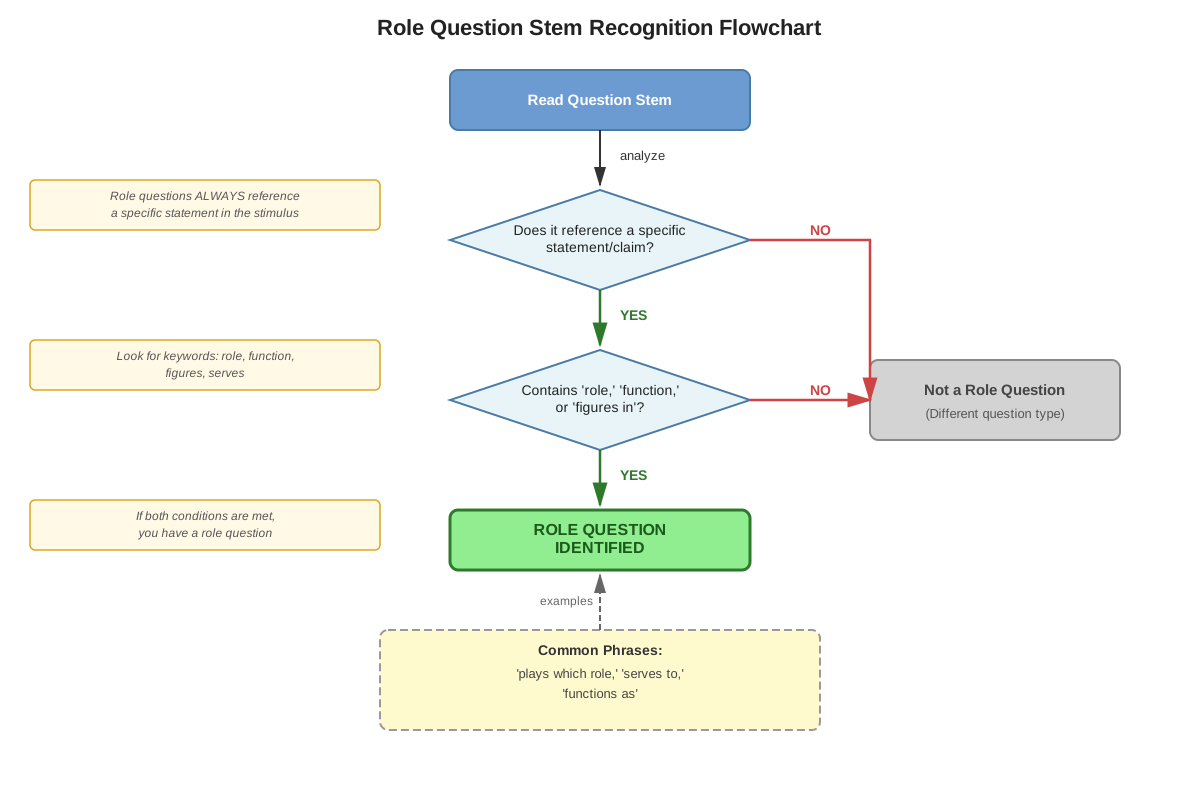
Role question stems ask test-takers to identify the function or purpose that a specific statement serves within an argument. These questions explicitly reference a particular claim, usually by quoting it directly or describing it as "the claim that..." or "the statement that..." The question then asks what role this statement plays in the overall argument structure. Common phrasings include "plays which one of the following roles," "functions in the argument to," or "serves which one of the following purposes."
The key distinguishing feature of role questions is that they focus on structural function rather than content evaluation. The question doesn't ask whether the statement is true, whether it strengthens the argument, or whether it's supported by evidence—it asks what job the statement performs within the argument's architecture.
Common Roles Statements Can Play
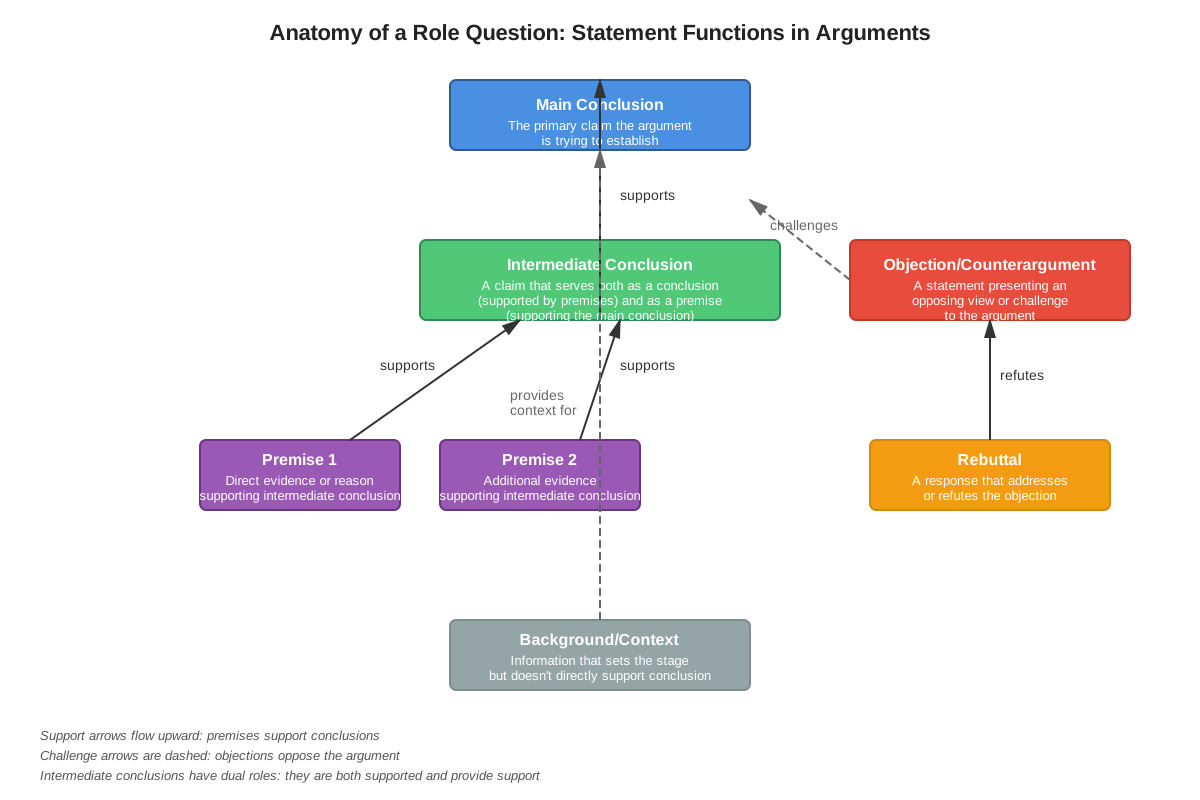
Understanding the various roles statements can serve is essential for answering role questions accurately. The following table outlines the most frequently tested roles:
| Role Type | Definition | Typical Indicators |
|---|---|---|
| Main Conclusion | The primary claim the argument seeks to establish | "Therefore," "thus," "consequently," "it follows that" |
| Intermediate Conclusion | A claim supported by some premises and used to support the main conclusion | Serves as both conclusion and premise |
| Premise/Evidence | A statement offered as support for a conclusion | "Because," "since," "given that," "for" |
| Background/Context | Information that sets up the argument but doesn't directly support the conclusion | Often appears at the beginning; no logical indicators |
| Objection/Counterargument | A position the argument opposes or addresses | "Some argue," "critics claim," "it might be objected" |
| Rebuttal | A response that counters an objection | "However," "but," "yet," "nevertheless" |
| Concession | A point granted to the opposing view | "Admittedly," "granted," "it's true that" |
| Illustration/Example | A specific instance that clarifies or supports a general claim | "For example," "for instance," "such as" |
Identifying the Referenced Statement
Role questions always reference a specific statement within the stimulus. This reference typically appears in one of three formats:
- Direct quotation: The question stem includes the exact wording from the stimulus, often in quotation marks
- Paraphrase: The question stem describes the statement's content without quoting it directly
- Positional reference: The question stem refers to "the claim in the first sentence" or "the final statement"
The first step in answering any role question is locating the referenced statement in the stimulus and marking it clearly. Many students lose points by identifying the role of the wrong statement, so precision in this initial step is crucial.
Analyzing Argument Structure
To determine a statement's role, students must map the entire argument structure. This process involves:
- Identifying the main conclusion: What is the argument's ultimate point? This is typically the statement the author most wants the reader to accept.
- Locating supporting premises: Which statements provide direct evidence or reasons for accepting the conclusion?
- Recognizing intermediate steps: Are there any sub-conclusions that are supported by some premises and then used to support the main conclusion?
- Noting counterarguments and rebuttals: Does the argument acknowledge opposing views? Does it respond to them?
- Distinguishing background from argument: Which statements merely set context versus actively contributing to the logical structure?
The Relationship Between Form and Function
A critical insight for role questions is that a statement's grammatical form doesn't always match its logical function. A sentence phrased as a question can function as a conclusion (rhetorical questions). A statement appearing early in a passage might be the main conclusion rather than background. A claim introduced with "because" might be an objection the author is presenting (not endorsing) rather than a premise the author accepts.
This disconnect between form and function is precisely what makes role questions challenging and why they effectively test logical reasoning skills. Students must look beyond surface features to understand the underlying logical relationships.
Special Case: Intermediate Conclusions
Intermediate conclusions deserve special attention because they represent a hybrid role that frequently appears in LSAT role questions. An intermediate conclusion is a statement that functions as both a conclusion (supported by some premises) and a premise (used to support the main conclusion).
For example: "All mammals are warm-blooded. Whales are mammals. Therefore, whales are warm-blooded. Since whales are warm-blooded, they must regulate their body temperature actively."
In this argument, "whales are warm-blooded" is an intermediate conclusion—it's supported by the first two statements and then used to support the final claim about temperature regulation.
Concept Relationships
The concepts within role questions form a hierarchical and interconnected system. At the foundation lies argument structure recognition—the ability to distinguish conclusions from premises. This foundational skill enables students to identify the main conclusion, which serves as the reference point for determining all other roles.
Premises connect directly to conclusions through support relationships, while intermediate conclusions create a chain: premises → intermediate conclusion → main conclusion. This chaining relationship is crucial because intermediate conclusions are among the most commonly tested roles in LSAT questions.
Objections and rebuttals form a dialectical pair—objections present opposing views, and rebuttals respond to them. Understanding this relationship helps students recognize when a statement functions as part of a counterargument structure rather than the main argument line. Concessions relate closely to objections but differ in that the author accepts them as true while arguing they don't undermine the main conclusion.
Background information connects to the entire argument by providing necessary context but doesn't participate in the logical structure itself. Distinguishing background from premises is essential because both appear early in arguments, but only premises provide logical support.
The relationship map flows as follows:
Background/Context → Sets stage for → Main Argument Structure (Premises → Intermediate Conclusions → Main Conclusion) ← Challenged by ← Objections ← Countered by ← Rebuttals, with Concessions acknowledged throughout.
These concepts connect to prerequisite knowledge of indicator words (which signal logical relationships) and basic argument structure (which provides the framework for understanding roles). They also connect forward to more advanced question types like Method of Reasoning (which asks how an argument proceeds) and Parallel Reasoning (which requires matching argument structures).
High-Yield Facts
⭐ Role questions always reference a specific statement from the stimulus—locating this statement accurately is the essential first step
⭐ The most commonly tested roles are: main conclusion, premise, intermediate conclusion, objection, and rebuttal
⭐ Intermediate conclusions serve dual functions: they are supported by some premises and support the main conclusion
⭐ A statement's position in the passage doesn't determine its role—conclusions can appear first, and premises can appear last
⭐ Background information provides context but doesn't logically support the conclusion; premises provide logical support
- Role questions typically use phrases like "plays which one of the following roles," "functions in the argument to," or "serves to"
- Objections are positions the author opposes; rebuttals are the author's responses to objections
- Concessions acknowledge points in favor of opposing views while maintaining the main conclusion
- Examples and illustrations support general claims by providing specific instances
⭐ The correct answer to a role question must precisely match both the content and structural function of the referenced statement
- Wrong answers often describe the role of a different statement in the argument
- Some role questions ask about the relationship between two statements rather than identifying a single statement's role
- Understanding the author's overall purpose helps determine whether a statement supports or opposes the main argument
- Indicator words provide clues but aren't definitive—context determines actual logical relationships
- Role questions reward systematic analysis over intuitive reading
Quick check — test yourself on Role question stems so far.
Try Flashcards →Common Misconceptions
Misconception: The first statement in an argument is always background information or a premise, never the conclusion.
Correction: Conclusions can appear anywhere in an argument, including at the very beginning. The logical structure, not the physical position, determines a statement's role. Many LSAT arguments present the conclusion first, then provide supporting evidence.
Misconception: If a statement is introduced with "because" or "since," it must be a premise the author accepts.
Correction: These words indicate a logical relationship but don't necessarily mean the author endorses the claim. An author might present an opponent's reasoning using "because" when describing an objection: "Critics argue that X because Y" presents Y as the opponent's premise, not the author's.
Misconception: Intermediate conclusions are rare and only appear in very complex arguments.
Correction: Intermediate conclusions appear frequently on the LSAT and are among the most commonly tested roles. Many arguments use a two-step structure where one claim is established and then used to support a further claim.
Misconception: Background information and premises are essentially the same thing.
Correction: Background provides context and sets up the discussion but doesn't logically support the conclusion. Premises provide reasons or evidence that, if true, make the conclusion more likely to be true. This distinction is crucial for role questions.
Misconception: The correct answer to a role question should use the same words as the stimulus.
Correction: Correct answers typically paraphrase the role using different language. Test-makers deliberately avoid repeating exact wording to ensure students understand the concept rather than matching words. Students must focus on functional equivalence, not verbal similarity.
Misconception: If a statement appears after "however" or "but," it must be the main conclusion.
Correction: While these words often introduce important claims, they can signal various roles including rebuttals to objections, intermediate conclusions, or qualifications. The statement's relationship to other parts of the argument determines its role, not the transition word alone.
Worked Examples
Example 1: Identifying an Intermediate Conclusion
Stimulus: "Recent studies show that regular exercise reduces stress hormones in the bloodstream. Since reduced stress hormones lead to better sleep quality, people who exercise regularly should experience improved sleep. Therefore, doctors should recommend regular exercise to patients complaining of insomnia."
Question: The claim that people who exercise regularly should experience improved sleep plays which one of the following roles in the argument?
Step 1 - Locate the referenced statement: "people who exercise regularly should experience improved sleep"
Step 2 - Identify the main conclusion: The main conclusion is the ultimate point the argument wants to establish. Here, it's "doctors should recommend regular exercise to patients complaining of insomnia" (signaled by "therefore").
Step 3 - Map the argument structure:
- Premise 1: Regular exercise reduces stress hormones
- Premise 2: Reduced stress hormones lead to better sleep quality
- Intermediate conclusion: People who exercise regularly should experience improved sleep (supported by premises 1 and 2)
- Main conclusion: Doctors should recommend exercise for insomnia (supported by the intermediate conclusion)
Step 4 - Determine the role: The referenced statement is supported by the first two claims (making it a conclusion) and is used to support the final claim (making it a premise). This dual function identifies it as an intermediate conclusion.
Correct Answer: "It is a conclusion supported by some of the evidence presented, and it in turn supports the argument's main conclusion."
Connection to Learning Objectives: This example demonstrates how to identify role question stems (the phrase "plays which one of the following roles"), explains the reasoning pattern (mapping argument structure to identify relationships), and applies the concept to solve an LSAT-style problem.
Example 2: Distinguishing Objection from Rebuttal
Stimulus: "The city council proposes installing speed cameras at major intersections to reduce accidents. Critics argue that speed cameras are primarily revenue-generating devices rather than safety measures, pointing to cities that have shortened yellow light times to increase ticket revenue. However, studies from cities that maintained standard yellow light times show a 30% reduction in intersection accidents after camera installation. The council's proposal should therefore be adopted."
Question: The statement that critics argue speed cameras are primarily revenue-generating devices plays which one of the following roles?
Step 1 - Locate the referenced statement: "Critics argue that speed cameras are primarily revenue-generating devices rather than safety measures"
Step 2 - Identify the main conclusion: "The council's proposal should therefore be adopted"
Step 3 - Analyze the argument structure:
- Background: Council proposes speed cameras to reduce accidents
- Objection: Critics say cameras are for revenue, not safety (with supporting evidence about yellow lights)
- Rebuttal: Studies show 30% accident reduction when yellow lights aren't shortened
- Main conclusion: Proposal should be adopted
Step 4 - Determine the role: The referenced statement presents a view that opposes the main conclusion. It's introduced as something "critics argue," not something the author endorses. The author then rebuts this objection with contrary evidence. This makes it an objection or counterargument.
Step 5 - Eliminate wrong answers:
- Not the main conclusion (that comes at the end)
- Not a premise supporting the conclusion (it opposes the conclusion)
- Not background (it takes a position rather than just providing context)
- Not the rebuttal (the rebuttal is the statement about studies showing accident reduction)
Correct Answer: "It is an objection to the main conclusion that the argument attempts to counter."
Connection to Learning Objectives: This example shows how to recognize role questions, demonstrates the reasoning pattern of identifying dialectical structures (objection-rebuttal pairs), and applies systematic analysis to distinguish between statements that oppose versus support the conclusion.
Exam Strategy
Pre-Reading Strategy
Before reading the stimulus, identify that you're dealing with a role question by scanning the question stem for trigger phrases like "plays which one of the following roles," "functions in the argument to," or "serves which one of the following purposes." Once identified, note which statement the question references—this allows you to pay special attention to that statement while reading.
Active Reading Approach
As you read the stimulus, actively map the argument structure:
- Bracket the main conclusion
- Underline premises
- Circle indicator words (therefore, because, however, etc.)
- Mark the referenced statement with a star or arrow
- Note any objections or counterarguments
This physical marking creates a visual map that makes relationships clear and prevents confusion when evaluating answer choices.
Trigger Words and Phrases
Question Stem Triggers:
- "plays which one of the following roles"
- "functions in the argument to"
- "serves which one of the following purposes"
- "is used in the argument to"
- "figures in the argument in which one of the following ways"
Stimulus Triggers for Different Roles:
- Conclusions: therefore, thus, hence, consequently, so, it follows that
- Premises: because, since, for, given that, as indicated by
- Objections: critics argue, some claim, it might be objected, opponents say
- Rebuttals: however, but, yet, nevertheless, on the contrary
- Concessions: admittedly, granted, although, while it's true that
Process of Elimination Strategy
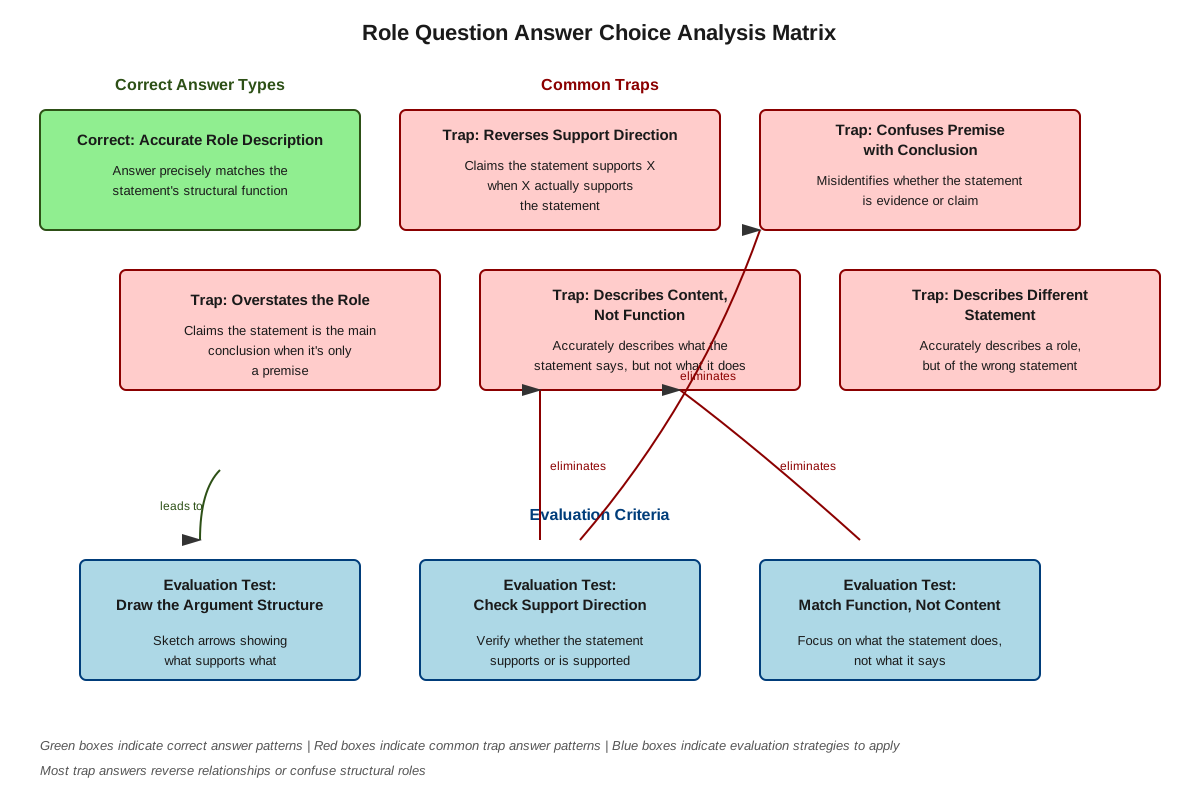
- Eliminate answers describing the wrong statement: Many wrong answers accurately describe the role of a different statement in the argument. Always verify that the answer describes the specific referenced statement.
- Eliminate answers with incorrect logical relationships: If the referenced statement supports the conclusion, eliminate answers saying it opposes or challenges the conclusion.
- Check for precision: The correct answer must capture both what the statement does and how it relates to other parts of the argument. Partial descriptions are incorrect.
- Watch for scope mismatches: If the referenced statement is an intermediate conclusion, answers describing it as "the main conclusion" or "merely a premise" are both wrong.
Time Allocation
Role questions typically require 60-90 seconds. Spend:
- 20-30 seconds reading and mapping the stimulus
- 10-15 seconds locating and analyzing the referenced statement
- 30-45 seconds evaluating answer choices
If you're spending more than 90 seconds, you likely haven't clearly identified the argument structure. In this case, quickly re-read focusing only on logical relationships, then make your best choice and move on.
Exam Tip: If you're stuck between two answers, ask yourself: "Does this statement support or oppose the main conclusion?" This single question eliminates roughly half of all wrong answers on role questions.
Memory Techniques
The PICOR Mnemonic
Remember the five most common roles with PICOR:
- Premise (supports the conclusion)
- Intermediate conclusion (both supported and supporting)
- Conclusion (the main point)
- Objection (opposes the conclusion)
- Rebuttal (counters an objection)
The "Job Description" Visualization
Think of each statement as an employee in a company, and the argument as a project. Ask: "What's this statement's job?"
- Premises are workers providing materials
- Intermediate conclusions are middle managers who receive materials and pass them up
- The main conclusion is the CEO's final decision
- Objections are complaints from outside the company
- Rebuttals are responses to those complaints
- Background is the office building—necessary but not doing the work
The Two-Question Test for Intermediate Conclusions
When determining if a statement is an intermediate conclusion, ask:
- "Is this statement supported by other statements?" (If yes, it's a conclusion)
- "Does this statement support another statement?" (If yes, it's a premise)
If both answers are "yes," you've found an intermediate conclusion.
The "Author's Voice" Technique
For distinguishing objections from the author's own claims, ask: "Is the author saying this, or is the author reporting what someone else says?" Phrases like "critics argue," "some claim," or "it might be objected" signal the author is presenting someone else's view (an objection), not endorsing it.
Summary
Role question stems constitute a high-yield LSAT Logical Reasoning question type that tests the ability to identify the structural function of specific statements within arguments. These questions require students to move beyond content comprehension to analyze how different components of an argument relate to one another. Success depends on recognizing role questions through characteristic phrasings, systematically mapping argument structure, and precisely matching the referenced statement's function to the correct answer choice. The most commonly tested roles include premises, conclusions, intermediate conclusions, objections, and rebuttals, with intermediate conclusions being particularly frequent because they serve the dual function of being both supported and supporting. Students must distinguish between a statement's grammatical form and its logical function, recognize that position within a passage doesn't determine role, and understand that background information differs from premises in that it provides context rather than logical support. Mastering role questions develops fundamental argument analysis skills that transfer to other Logical Reasoning question types and to legal reasoning more broadly.
Key Takeaways
- Role questions ask about the structural function of a specific statement, not whether it's true or well-supported
- The five most common roles are premise, intermediate conclusion, main conclusion, objection, and rebuttal (remember: PICOR)
- Intermediate conclusions are both supported by some statements and used to support other statements—they're among the most frequently tested roles
- A statement's position in the passage doesn't determine its role; logical relationships determine function
- Correct answers must precisely describe both what the statement does and how it relates to the rest of the argument
- Mapping argument structure before evaluating answer choices prevents confusion and saves time
- Background information provides context but doesn't logically support the conclusion, while premises provide logical support
Related Topics
Method of Reasoning Questions: These questions ask how an argument proceeds or what argumentative technique it employs. Mastering role questions provides the foundation for method questions because both require understanding argument structure, though method questions focus on overall strategy rather than individual statement functions.
Parallel Reasoning Questions: These questions require matching the structure of one argument to another. Understanding roles helps identify structural parallels because students must recognize when statements in different arguments serve equivalent functions.
Argument Structure Diagramming: This advanced skill involves creating visual representations of complex arguments. Role question mastery naturally leads to diagramming because both require identifying relationships between argument components.
Flaw Questions: Many flaws involve misunderstanding the role of evidence or treating background as premises. Understanding roles helps identify these structural errors.
Strengthen/Weaken Questions: Knowing which statements are premises versus conclusions helps determine what type of information would strengthen or weaken an argument.
Practice CTA
Now that you've mastered the core concepts of role question stems, it's time to put your knowledge into practice. Work through the practice questions to reinforce your ability to identify different roles, map argument structures, and select precise answer choices. The flashcards will help you internalize the characteristics of each role type and the trigger phrases that signal role questions. Remember: role questions reward systematic analysis and careful attention to logical relationships. With practice, you'll develop the pattern recognition skills that make these questions a reliable source of points on test day. Each practice question you complete strengthens your ability to dissect arguments quickly and accurately—a skill that will serve you throughout the LSAT and in law school.
Sign up free to keep reading
Create a free AnvayaPrep account to finish this LSAT guide on Role question stems — plus flashcards and practice questions.