Overview
Strengthen question stems represent one of the most frequently tested question types in LSAT Logical Reasoning sections, appearing in approximately 10-15% of all Logical Reasoning questions. These questions require test-takers to identify answer choices that provide additional evidence, support, or justification for an argument's conclusion. Mastering strengthen questions is essential because they test the fundamental skill of recognizing how new information can bolster the logical connection between premises and conclusions—a core competency that the LSAT measures across multiple question types.
Understanding strengthen question stems goes beyond simple memorization of question formats. These questions assess whether students can analyze argumentative structure, identify logical gaps or assumptions, and determine what type of evidence would make an argument more convincing. The ability to strengthen arguments demonstrates sophisticated reasoning skills that law schools value highly, as legal practice frequently requires building persuasive cases by marshaling supporting evidence and addressing potential weaknesses in reasoning.
Within the broader landscape of question stem recognition, strengthen questions form a critical counterpart to weaken questions and are closely related to assumption questions. All three question types require identifying the logical structure of arguments and understanding the relationship between premises and conclusions. However, strengthen questions specifically test the ability to recognize what additional information would increase the probability that a conclusion follows from its premises, making them an indispensable component of LSAT preparation.
Learning Objectives
- [ ] Identify how Strengthen question stems appears in LSAT questions
- [ ] Explain the reasoning pattern behind Strengthen question stems
- [ ] Apply Strengthen question stems to solve LSAT-style problems accurately
- [ ] Distinguish strengthen question stems from other question types (weaken, assumption, inference)
- [ ] Recognize the various phrasings and formulations used in strengthen questions
- [ ] Evaluate answer choices systematically to identify the strongest support for an argument
- [ ] Identify the logical gaps in arguments that strengthen answer choices typically address
Prerequisites
- Basic argument structure: Understanding premises, conclusions, and how they relate is essential because strengthen questions require identifying what additional support would help the conclusion follow from the premises.
- Conditional reasoning fundamentals: Recognizing sufficient and necessary conditions helps evaluate how new information affects argument validity.
- Assumption identification: Knowing how to spot unstated assumptions is relevant because strengthen questions often provide evidence that supports these implicit assumptions.
- Causal reasoning patterns: Understanding cause-and-effect relationships matters because many strengthen questions involve arguments making causal claims that require additional support.
Why This Topic Matters
Strengthen questions appear with remarkable consistency on every LSAT administration, typically comprising 4-6 questions per test across both Logical Reasoning sections. This frequency makes them one of the highest-yield question types for focused study. Unlike some question types that appear sporadically, strengthen questions are virtually guaranteed to appear multiple times on test day, making mastery of this topic a reliable path to score improvement.
In legal practice, attorneys constantly engage in the process of strengthening arguments—gathering evidence to support claims, anticipating counterarguments, and building persuasive cases. The LSAT tests this skill because it directly correlates with success in law school and legal careers. Whether drafting a motion, preparing for oral arguments, or advising clients, lawyers must identify what additional information would make their position more compelling.
On the LSAT, strengthen questions typically appear in several common formats: arguments about causal relationships that need additional support, statistical or survey-based arguments requiring validation, analogical reasoning that needs reinforcement, and explanatory hypotheses that require corroborating evidence. Recognizing these patterns allows test-takers to anticipate what type of strengthening information will be most effective, significantly improving accuracy and speed.
Core Concepts
Defining Strengthen Questions
LSAT strengthen question stems ask test-takers to identify information that, if true, would make an argument's conclusion more likely to be valid or would provide additional support for the reasoning presented. These questions do not require finding information that proves the conclusion definitively; rather, they seek evidence that increases the probability or plausibility of the conclusion. The correct answer will always make the argument stronger than it was before, even if the argument remains imperfect or vulnerable to criticism.
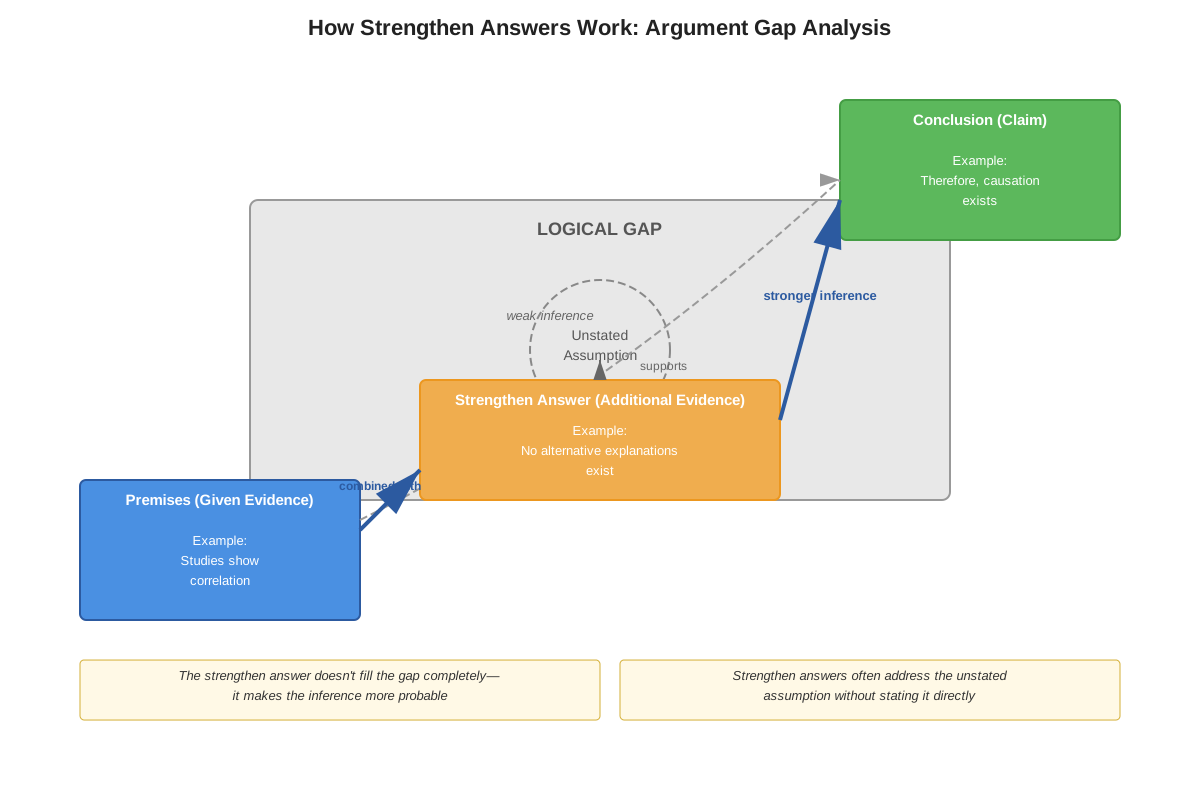
The fundamental mechanism behind strengthen questions involves identifying the logical gap between premises and conclusions, then selecting information that bridges or narrows that gap. Every argument on the LSAT contains some degree of logical space between what is stated (premises) and what is concluded. Strengthen questions test whether students can recognize what type of additional evidence would reduce this gap and make the inferential leap more justified.
Common Strengthen Question Stem Formulations
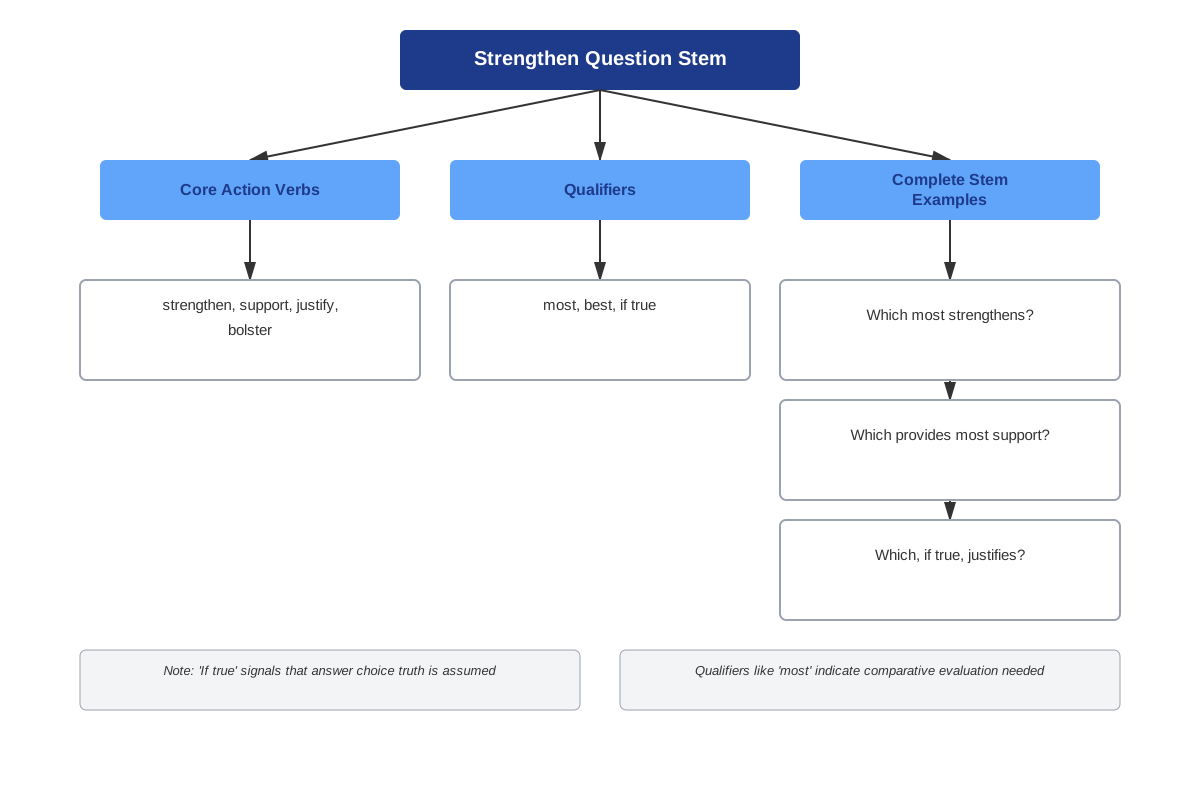
Strengthen questions appear in numerous phrasings, but all share the common feature of asking which answer choice provides additional support. Recognizing these variations is crucial for question stem recognition:
Direct strengthen stems:
- "Which one of the following, if true, most strengthens the argument?"
- "Which one of the following, if true, most strongly supports the conclusion?"
- "Which one of the following, if true, provides the most support for the argument?"
Justification and validation stems:
- "Which one of the following, if true, most helps to justify the reasoning above?"
- "Which one of the following, if true, most helps to establish that the conclusion is properly drawn?"
- "Which one of the following principles, if valid, most helps to justify the reasoning?"
Defense and bolstering stems:
- "Which one of the following, if true, most helps to resolve the apparent discrepancy described above?"
- "Which one of the following, if true, does most to support the claim that...?"
- "Which one of the following, if discovered, would provide the best reason for accepting the conclusion?"
The Reasoning Pattern in Strengthen Questions
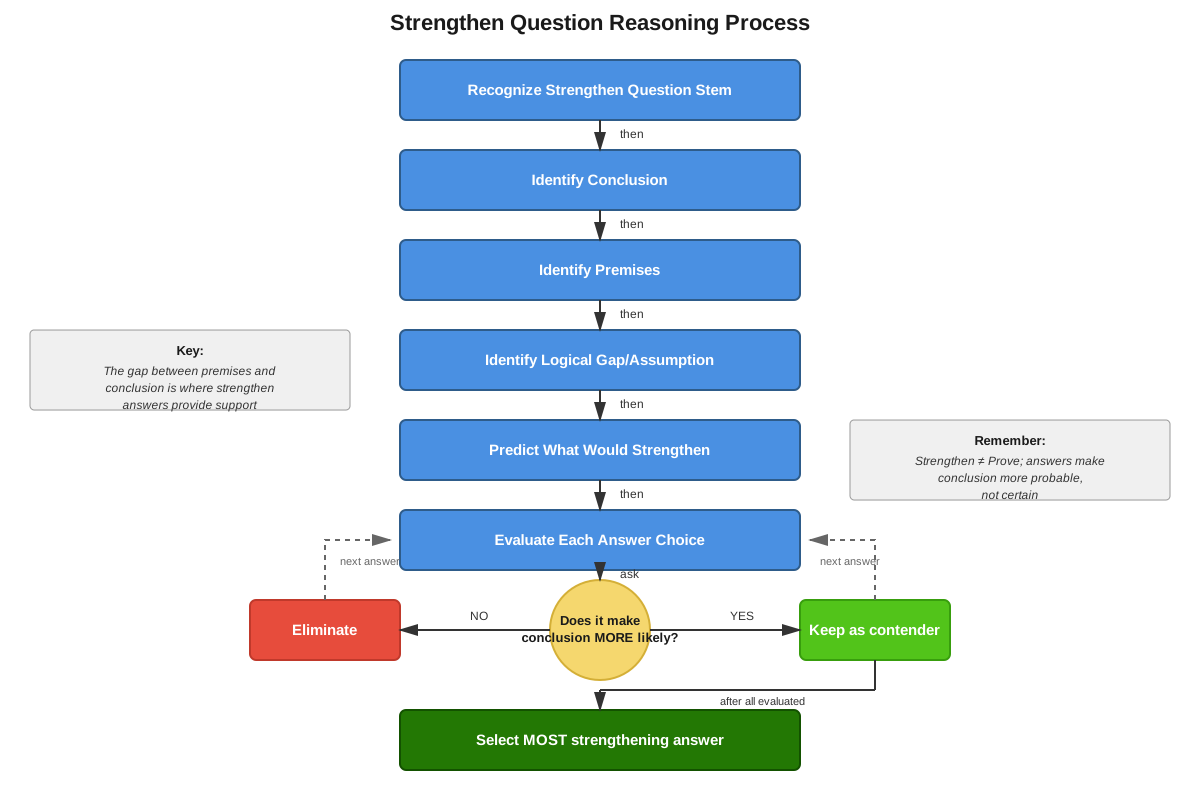
The cognitive process for solving strengthen questions follows a systematic pattern. First, identify the argument's conclusion—this is what needs to be strengthened. Second, identify the premises—the evidence already provided. Third, analyze the logical gap: What assumption does the argument make? What alternative explanations exist? What potential objections could be raised? Fourth, predict what type of information would address these vulnerabilities. Finally, evaluate answer choices against this prediction, selecting the option that most effectively supports the conclusion.
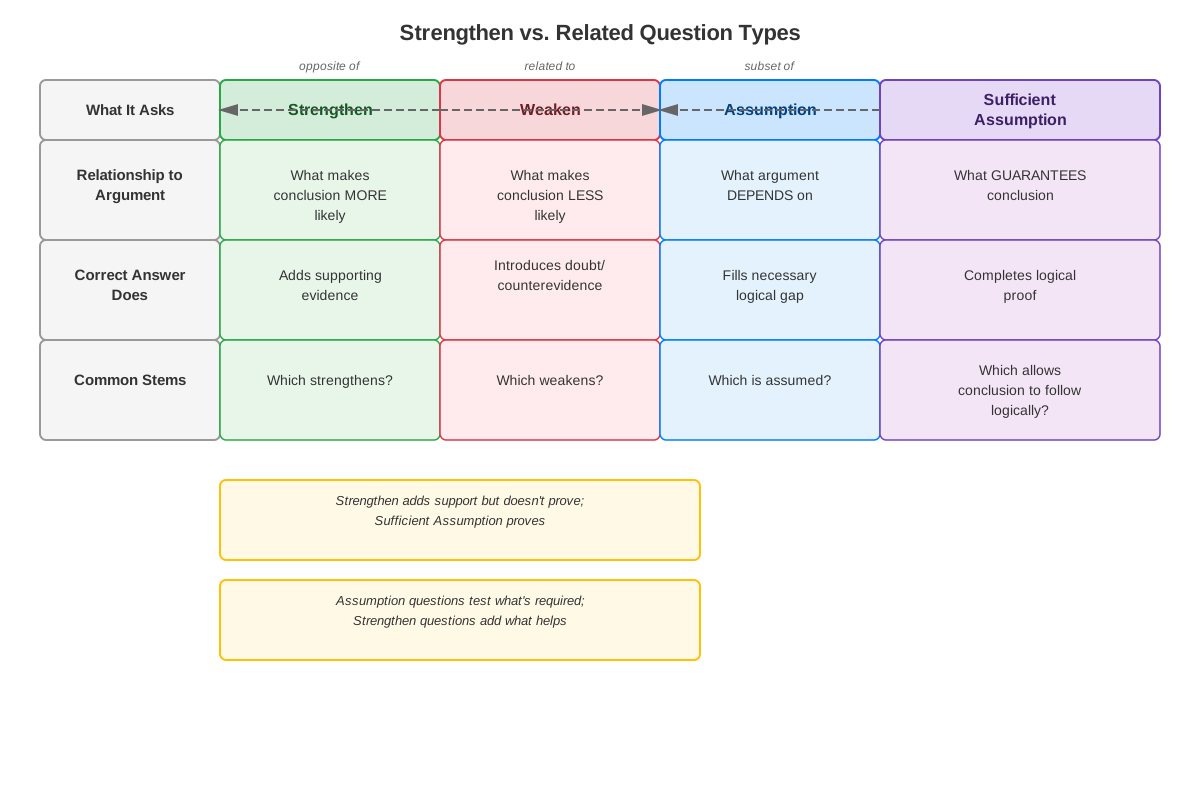
This reasoning pattern differs from other question types in important ways. Unlike assumption questions, which seek necessary conditions for the argument to work, strengthen questions seek sufficient additional support—information that helps but may not be absolutely required. Unlike inference questions, which ask what must be true based on the stimulus, strengthen questions ask what would make the stimulus more convincing if it were true.
Types of Strengthening Evidence
Different arguments require different types of strengthening evidence. Understanding these categories helps predict correct answers:
| Argument Type | Strengthening Strategy | Example |
|---|---|---|
| Causal Claims | Rule out alternative causes; show correlation persists in varied conditions | If arguing A causes B, show B doesn't occur without A |
| Statistical Arguments | Validate sample representativeness; confirm methodology | If citing a survey, show the sample wasn't biased |
| Analogies | Strengthen relevant similarities; minimize relevant differences | If comparing X to Y, show additional important commonalities |
| Explanatory Hypotheses | Provide corroborating evidence; rule out competing explanations | If proposing theory T explains phenomenon P, show T predicts other observed facts |
| Predictions | Show past pattern reliability; demonstrate relevant similarity | If predicting future based on past, show conditions remain comparable |
Degrees of Strengthening
Not all strengthening is equal. The LSAT often includes multiple answer choices that provide some support, requiring test-takers to identify which provides the most support. Strong strengtheners typically address the argument's central assumption or most significant vulnerability. Weak strengtheners might provide tangential support or address minor concerns. The correct answer doesn't need to make the argument perfect—it simply needs to strengthen it more than the other options.
Consider an argument concluding that a new medication is safe based on a six-month trial. An answer stating "no participants experienced side effects during the trial" provides some support but doesn't address long-term safety. An answer stating "participants monitored for five years after the trial showed no adverse effects" provides much stronger support because it directly addresses the temporal limitation in the original evidence.
Concept Relationships
The concepts within strengthen questions form an interconnected system. Question stem recognition serves as the entry point—correctly identifying that a question asks for strengthening determines the entire approach. This recognition leads directly to argument analysis, where the conclusion and premises are identified. Argument analysis reveals the logical gap, which represents the space between what's stated and what's concluded. Understanding the logical gap enables prediction of strengthening evidence, which guides efficient evaluation of answer choices.
Strengthen questions connect intimately with prerequisite topics. Assumption identification is particularly crucial because the correct answer in strengthen questions often provides evidence supporting the argument's unstated assumptions. If an argument assumes X, then evidence that X is true strengthens the argument. Similarly, causal reasoning patterns frequently appear in strengthen questions, as many arguments make causal claims requiring additional support to rule out alternative explanations or confounding variables.
The relationship to other question types is also significant. Strengthen questions form a natural pair with weaken questions—the same logical gaps that weaken questions exploit are the gaps that strengthen questions fill. Understanding both question types together provides deeper insight into argument structure. Additionally, strengthen questions relate to sufficient assumption questions, though sufficient assumptions provide complete logical bridges while strengthen answers provide partial support.
Textual relationship map: Question Stem Recognition → Argument Structure Analysis → Logical Gap Identification → Prediction of Strengthening Evidence → Answer Choice Evaluation → Selection of Strongest Support
High-Yield Facts
⭐ Strengthen questions appear in 10-15% of all Logical Reasoning questions, making them one of the most frequently tested question types.
⭐ The correct answer does not need to prove the conclusion—it only needs to make the conclusion more likely or better supported than before.
⭐ Strengthen questions often ask for the answer that "most strengthens" or "most supports," requiring comparison between multiple answers that provide some degree of support.
⭐ The correct answer typically addresses the argument's central assumption or most significant logical gap.
⭐ For causal arguments, strengthening evidence often rules out alternative causes or shows the correlation persists across different conditions.
- Strengthen question stems always include conditional language like "if true" or "if valid" because the truth of answer choices is assumed for evaluation purposes.
- Wrong answers in strengthen questions may be irrelevant, may weaken the argument, may restate premises without adding new support, or may provide minimal support compared to the correct answer.
- Arguments involving surveys or studies are strengthened by evidence that the methodology was sound, the sample was representative, or potential biases were controlled.
- Analogical arguments are strengthened by evidence highlighting additional relevant similarities or minimizing relevant differences between the compared items.
⭐ Prediction before evaluating answer choices significantly improves accuracy—anticipating what type of evidence would help allows for more efficient elimination.
- Strengthen questions never require outside knowledge; all necessary information appears in the stimulus and answer choices.
- The correct answer may strengthen the argument by providing new evidence, by ruling out objections, or by validating assumptions.
Quick check — test yourself on Strengthen question stems so far.
Try Flashcards →Common Misconceptions
Misconception: The correct answer must prove the conclusion beyond all doubt. → Correction: Strengthen questions only require making the argument better supported than it was initially. The conclusion can remain vulnerable to criticism even after strengthening; the correct answer simply needs to provide more support than the other options.
Misconception: Any answer choice that is true or reasonable must be correct. → Correction: The correct answer must specifically strengthen the particular argument presented in the stimulus. An answer can be factually accurate or generally reasonable but still be wrong if it doesn't address the logical gap in the argument at hand.
Misconception: Strengthen questions and sufficient assumption questions are essentially the same. → Correction: Sufficient assumption questions require answers that completely bridge the logical gap, making the conclusion follow with certainty from the premises. Strengthen questions only require partial support that makes the conclusion more plausible without necessarily guaranteeing it.
Misconception: The longest or most detailed answer choice is usually correct. → Correction: Answer length has no correlation with correctness. The LSAT deliberately includes lengthy wrong answers and concise correct answers to test whether students evaluate substance rather than superficial features.
Misconception: If an answer choice introduces new information not mentioned in the stimulus, it must be wrong. → Correction: Strengthen questions specifically require new information that wasn't in the original argument—that's what provides additional support. The key is whether this new information makes the conclusion more likely, not whether it was previously mentioned.
Misconception: Strengthen questions always have obvious correct answers. → Correction: Many strengthen questions require careful analysis to distinguish between answers providing minimal support and those providing substantial support. The LSAT frequently includes multiple answers that strengthen to some degree, requiring precise evaluation of which strengthens most.
Worked Examples
Example 1: Causal Argument
Stimulus: "City officials attribute the 30% reduction in traffic accidents over the past year to the installation of new traffic cameras at major intersections. The cameras were installed at the beginning of last year, and accident rates have declined steadily since then."
Question Stem: "Which one of the following, if true, most strengthens the city officials' explanation?"
Analysis Process:
- Identify the conclusion: The traffic cameras caused the reduction in accidents.
- Identify the premises: Cameras were installed; accidents decreased afterward.
- Identify the logical gap: This is a classic causal reasoning gap. The argument assumes that correlation equals causation and doesn't consider alternative explanations for the accident reduction. What if weather patterns changed? What if gas prices increased, reducing traffic volume? What if a new public transportation system opened?
- Predict strengthening evidence: The correct answer should either (a) rule out alternative causes, (b) show the correlation persists across varied conditions, or (c) provide additional evidence linking cameras specifically to accident reduction.
- Evaluate answer choices:
(A) "Traffic volume remained constant throughout the year." - This strengthens by ruling out one alternative explanation (that fewer cars caused fewer accidents), but doesn't address other possibilities.
(B) "Intersections with cameras showed a 35% accident reduction, while intersections without cameras showed only a 5% reduction." - This is very strong evidence because it shows the effect is specifically associated with camera presence, not general factors affecting all intersections.
(C) "The cameras are manufactured by a company with an excellent reputation." - Irrelevant to whether cameras actually reduced accidents.
(D) "Drivers report being more aware of traffic laws since the cameras were installed." - This provides some support by suggesting a mechanism, but driver self-reports are less reliable than actual accident data.
(E) "Other cities have also installed traffic cameras." - Irrelevant to whether cameras caused the reduction in this city.
Correct Answer: (B) - This provides the strongest support by showing the accident reduction is specifically associated with camera presence, effectively ruling out alternative explanations that would have affected all intersections equally.
Example 2: Statistical Argument
Stimulus: "A recent survey found that 75% of respondents who regularly drink green tea report higher energy levels than they had five years ago. The researchers concluded that drinking green tea increases energy levels."
Question Stem: "Which one of the following, if true, would most strengthen the researchers' conclusion?"
Analysis Process:
- Identify the conclusion: Green tea increases energy levels.
- Identify the premises: Survey shows 75% of green tea drinkers report higher energy than five years ago.
- Identify the logical gap: Multiple issues exist here. First, this is self-reported data about subjective feelings. Second, there's no control group—maybe everyone's energy increased for other reasons. Third, correlation doesn't prove causation—maybe people who started drinking green tea also made other lifestyle changes. Fourth, the sample might be biased—maybe only health-conscious people drink green tea regularly.
- Predict strengthening evidence: The correct answer should address one of these gaps, ideally by providing a control group comparison, ruling out alternative explanations, or validating the survey methodology.
- Evaluate answer choices:
(A) "The survey included 10,000 participants from diverse geographic regions." - This addresses sample size and diversity but doesn't address the lack of a control group or alternative explanations.
(B) "Green tea contains caffeine, which is known to affect energy levels." - This provides a mechanism but doesn't strengthen the specific claim that the tea drinkers' increased energy came from the tea rather than other factors.
(C) "Respondents who do not drink green tea reported no change in energy levels over the same five-year period." - This is strong evidence because it provides a control group comparison, suggesting the energy increase is specific to green tea drinkers.
(D) "Green tea has been consumed for thousands of years in various cultures." - Historical information is irrelevant to whether it increases energy.
(E) "The researchers who conducted the survey are experts in nutrition." - Researcher credentials don't address the methodological gaps in the study.
Correct Answer: (C) - This provides crucial control group data, showing that the energy increase is specific to green tea drinkers rather than a general trend affecting everyone, which significantly strengthens the causal claim.
Exam Strategy
When approaching strengthen questions on the LSAT, begin by carefully reading the question stem to confirm it's asking for strengthening rather than weakening or another task. Look for trigger words like "strengthens," "supports," "justifies," "most helps," or "provides reason for." These phrases signal that the correct answer will make the argument more convincing.
Exam Tip: Always identify the conclusion before reading answer choices. Underline or mentally note the specific claim that needs strengthening. This prevents confusion when answer choices introduce new information.
After identifying the question type, read the stimulus with a critical eye toward the argument's vulnerabilities. Ask: What is this argument assuming? What alternative explanations exist? What objections might someone raise? What evidence is missing? This critical reading naturally leads to prediction—before looking at answer choices, formulate a general sense of what type of information would help the argument.
Process-of-elimination strategy for strengthen questions:
- Eliminate irrelevant answers first: These are often easiest to spot and removing them quickly narrows the field.
- Eliminate answers that weaken: Sometimes the LSAT includes answers that actually hurt the argument; these are clearly wrong.
- Eliminate answers that merely restate premises: New information is required; restating what's already said provides no additional support.
- Compare remaining answers: If multiple answers provide some support, carefully evaluate which addresses the most significant gap or provides the strongest evidence.
Time Management: Spend 1:15-1:30 on strengthen questions. They require careful analysis but shouldn't consume excessive time. If stuck between two answers, choose the one that addresses the argument's central assumption rather than a peripheral concern.
Watch for common wrong answer patterns: answers that are too extreme (using "always," "never," "only"), answers that address a different conclusion than the one stated, answers that provide support for premises rather than the conclusion, and answers that introduce irrelevant distinctions or information.
Memory Techniques
STRENGTHEN mnemonic for the systematic approach:
- Spot the conclusion that needs support
- Trace the premises already provided
- Recognize the logical gap or assumption
- Evaluate what evidence would help
- Narrow choices by eliminating irrelevant options
- Gauge which answer provides most support
- Test the winner by confirming it makes the conclusion more likely
- Hesitate if an answer seems too extreme or off-topic
- Eliminate answers that restate or weaken
- Note that proof isn't required—just improvement
Visualization technique: Picture the argument as a bridge with a gap in the middle. The premises are on one side, the conclusion on the other. The correct answer in a strengthen question adds planks to the bridge, making it sturdier (though not necessarily complete). This visual helps distinguish strengthen questions from sufficient assumption questions (which would complete the bridge entirely).
Acronym for common strengthening strategies - RACE:
- Rule out alternative explanations
- Add corroborating evidence
- Confirm assumptions are valid
- Establish methodology or sample quality
Summary
Strengthen question stems represent a high-frequency, high-value question type on the LSAT Logical Reasoning sections, appearing in approximately 10-15% of questions. These questions test the ability to identify information that makes an argument's conclusion more likely or better supported, though not necessarily proven. Success requires systematic analysis: identifying the conclusion, recognizing the logical gap between premises and conclusion, predicting what type of evidence would help, and evaluating answer choices to find the strongest support. The correct answer typically addresses the argument's central assumption, rules out alternative explanations, or provides corroborating evidence. Unlike sufficient assumption questions, strengthen questions only require partial support that improves the argument rather than completing the logical bridge. Mastery involves recognizing various question stem formulations, understanding different types of arguments and their corresponding strengthening strategies, and efficiently eliminating wrong answers that are irrelevant, restate premises, or actually weaken the argument.
Key Takeaways
- Strengthen questions ask for information that makes a conclusion more likely, not necessarily proven—partial support is sufficient
- The correct answer typically addresses the argument's central assumption or most significant logical gap
- Always identify the conclusion before evaluating answer choices to maintain focus on what needs strengthening
- For causal arguments, strengthening evidence often rules out alternative causes or shows the correlation persists across varied conditions
- Prediction before reading answer choices significantly improves accuracy and efficiency
- Multiple answers may provide some support; the correct answer provides the most support relative to the other options
- Strengthen questions differ from sufficient assumption questions in degree—strengthening requires improvement, not logical completion
Related Topics
Weaken Questions: The mirror image of strengthen questions, these ask for information that undermines arguments. Mastering strengthen questions naturally facilitates understanding weaken questions, as both require identifying logical gaps—strengthen questions fill them while weaken questions exploit them.
Assumption Questions: These ask for unstated premises necessary for arguments to work. Understanding assumptions is crucial for strengthen questions because correct answers often provide evidence supporting these implicit assumptions.
Sufficient Assumption Questions: These require answers that completely bridge logical gaps, making conclusions follow with certainty. Distinguishing these from strengthen questions (which require only partial support) is essential for accurate question stem recognition.
Causal Reasoning: Many strengthen questions involve causal arguments requiring additional support. Deeper study of causal reasoning patterns enhances the ability to predict what evidence would strengthen causal claims.
Flaw Questions: Understanding common logical flaws helps identify what types of evidence would address those flaws, directly supporting strengthen question analysis.
Practice CTA
Now that you've mastered the fundamentals of strengthen question stems, it's time to put this knowledge into practice. Attempt the practice questions to reinforce your understanding and build the pattern recognition that leads to consistent accuracy. Each practice question you complete strengthens your ability to quickly identify strengthen questions, analyze arguments efficiently, and select correct answers confidently. The flashcards will help cement the key concepts and common question stem formulations in your memory. Remember: strengthen questions are highly predictable once you understand the underlying patterns—consistent practice transforms this knowledge into automatic, test-day performance. Your investment in mastering this high-frequency question type will pay dividends across every LSAT Logical Reasoning section you encounter.
Sign up free to keep reading
Create a free AnvayaPrep account to finish this LSAT guide on Strengthen question stems — plus flashcards and practice questions.