Overview
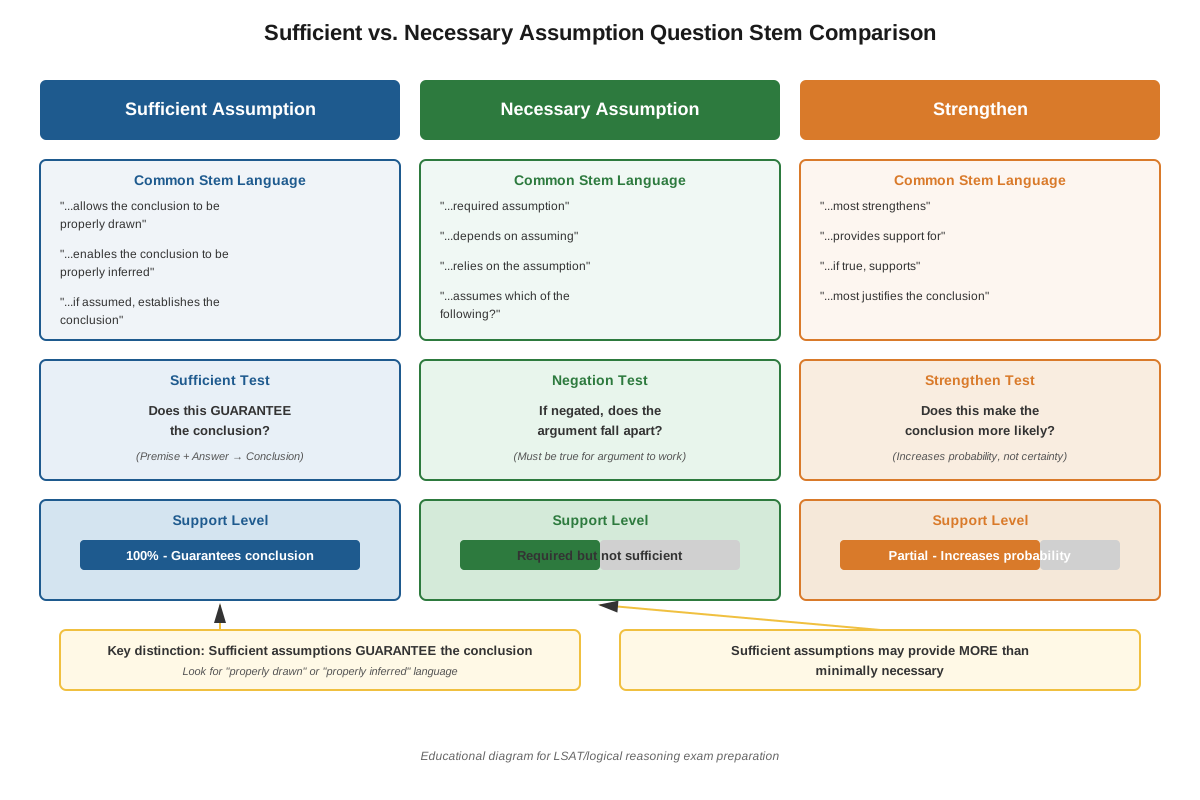
Sufficient assumption question stems represent one of the most critical and frequently tested question types in LSAT Logical Reasoning sections. These questions ask test-takers to identify an assumption that, if added to the argument, would make the conclusion follow logically and with certainty from the premises. Unlike necessary assumptions (which must be true for the argument to work), sufficient assumptions provide enough additional information to guarantee the conclusion's validity, even if they introduce more than the bare minimum required.
Mastering sufficient assumption questions is essential for LSAT success because they appear in virtually every Logical Reasoning section and test fundamental skills in formal logic, conditional reasoning, and argument structure analysis. These questions require students to recognize gaps in reasoning and identify precisely what information would bridge those gaps completely. The ability to spot these logical leaps and fill them appropriately demonstrates the kind of analytical thinking that law schools value and that the LSAT is designed to measure.
Within the broader landscape of question stem recognition, sufficient assumption questions occupy a unique position. They share characteristics with necessary assumption questions (both deal with unstated premises) but require a different strategic approach. They also connect closely to strengthen questions (both add support to arguments) and formal logic questions (both often involve conditional reasoning). Understanding how to identify and approach sufficient assumption question stems provides a foundation for tackling multiple question types and developing a comprehensive strategy for the Logical Reasoning section as a whole.
Learning Objectives
By the end of this study guide, students will be able to:
- [ ] Identify how sufficient assumption question stems appears in LSAT questions
- [ ] Explain the reasoning pattern behind sufficient assumption question stems
- [ ] Apply sufficient assumption question stems to solve LSAT-style problems accurately
- [ ] Distinguish sufficient assumption questions from necessary assumption and strengthen questions based on stem language
- [ ] Predict the logical structure of correct answers before reviewing answer choices
- [ ] Evaluate answer choices using the "sufficient test" to confirm logical completeness
Prerequisites
Students should have foundational knowledge in the following areas:
- Basic argument structure: Understanding premises, conclusions, and how they relate is essential because sufficient assumption questions require identifying what's missing between these components
- Conditional logic fundamentals: Familiarity with if-then statements and their contrapositives helps recognize when sufficient assumptions create logical bridges through conditional relationships
- Question stem recognition basics: General ability to categorize question types ensures students can quickly identify sufficient assumption questions and apply the appropriate strategy
- Formal logic notation: Understanding symbolic representation of logical relationships (A→B) aids in visualizing how sufficient assumptions complete argument chains
Why This Topic Matters
Sufficient assumption questions appear with remarkable consistency on the LSAT, typically comprising 3-5 questions per test across both Logical Reasoning sections. This frequency makes them one of the highest-yield question types to master, as proficiency directly translates to multiple correct answers per exam. The skills developed through practicing these questions—identifying logical gaps, understanding formal relationships, and evaluating completeness of reasoning—transfer directly to law school case analysis and legal argumentation.
In real-world legal practice, attorneys constantly construct arguments that must be logically airtight. Identifying what assumptions would make an argument conclusive mirrors the process of building a legal case where every element must be proven beyond doubt. Judges and opposing counsel scrutinize arguments for logical gaps, making the ability to recognize and fill these gaps a fundamental lawyering skill.
On the LSAT, sufficient assumption questions commonly appear in several formats: arguments about causal relationships requiring assumptions that rule out alternative causes, categorical arguments needing assumptions that connect different classes or groups, and conditional reasoning chains requiring assumptions that link separate conditional statements. The test makers frequently embed these questions in contexts involving scientific reasoning, policy recommendations, and historical explanations, requiring students to apply logical analysis across diverse content areas while maintaining focus on argument structure rather than subject matter expertise.
Core Concepts
Defining Sufficient Assumptions
A sufficient assumption is a piece of information that, when added to an argument's premises, guarantees the truth of the conclusion. The term "sufficient" indicates that this assumption is enough—by itself—to make the argument logically valid, even if it provides more information than strictly necessary. This distinguishes sufficient assumptions from necessary assumptions, which identify the minimum requirements for an argument to work but may not be enough alone to ensure the conclusion.
The mathematical analogy helps clarify this distinction: if you need at least $10 to buy lunch, having $10 is necessary, but having $20 is sufficient (and more than necessary). In logical terms, a sufficient assumption creates a complete logical bridge from premises to conclusion, leaving no gaps in the reasoning chain.
Recognizing Sufficient Assumption Question Stems
LSAT sufficient assumption question stems follow predictable patterns that signal the specific task required. The most common formulations include:
| Question Stem Language | What It Signals |
|---|---|
| "Which one of the following, if assumed, allows the conclusion to be properly drawn?" | Classic sufficient assumption—looking for what makes the argument work |
| "The conclusion follows logically if which one of the following is assumed?" | Direct sufficient assumption identification |
| "Which one of the following principles, if valid, most helps to justify the reasoning?" | Principle-based sufficient assumption (broader rule application) |
| "The argument's conclusion can be properly inferred if which one of the following is assumed?" | Inference-focused sufficient assumption |
| "Which one of the following, if assumed, enables the conclusion to be properly drawn?" | Action-oriented sufficient assumption language |
The key linguistic markers include "if assumed," "allows/enables the conclusion," "follows logically," and "properly drawn/inferred." These phrases indicate that the correct answer will complete the argument's logic entirely, not merely strengthen it or identify a necessary component.
The Logical Structure of Sufficient Assumption Questions
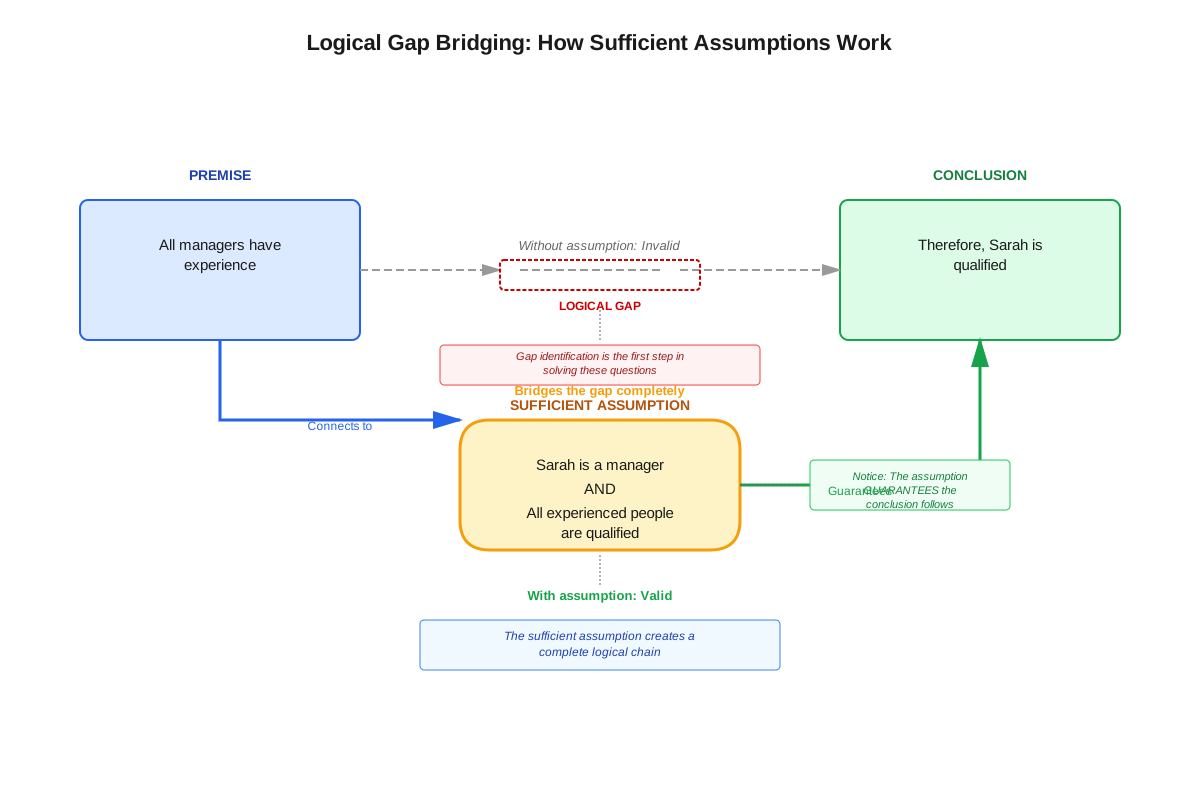
Sufficient assumption questions present arguments with identifiable gaps between premises and conclusions. Understanding these gap types helps predict what the correct answer must accomplish:
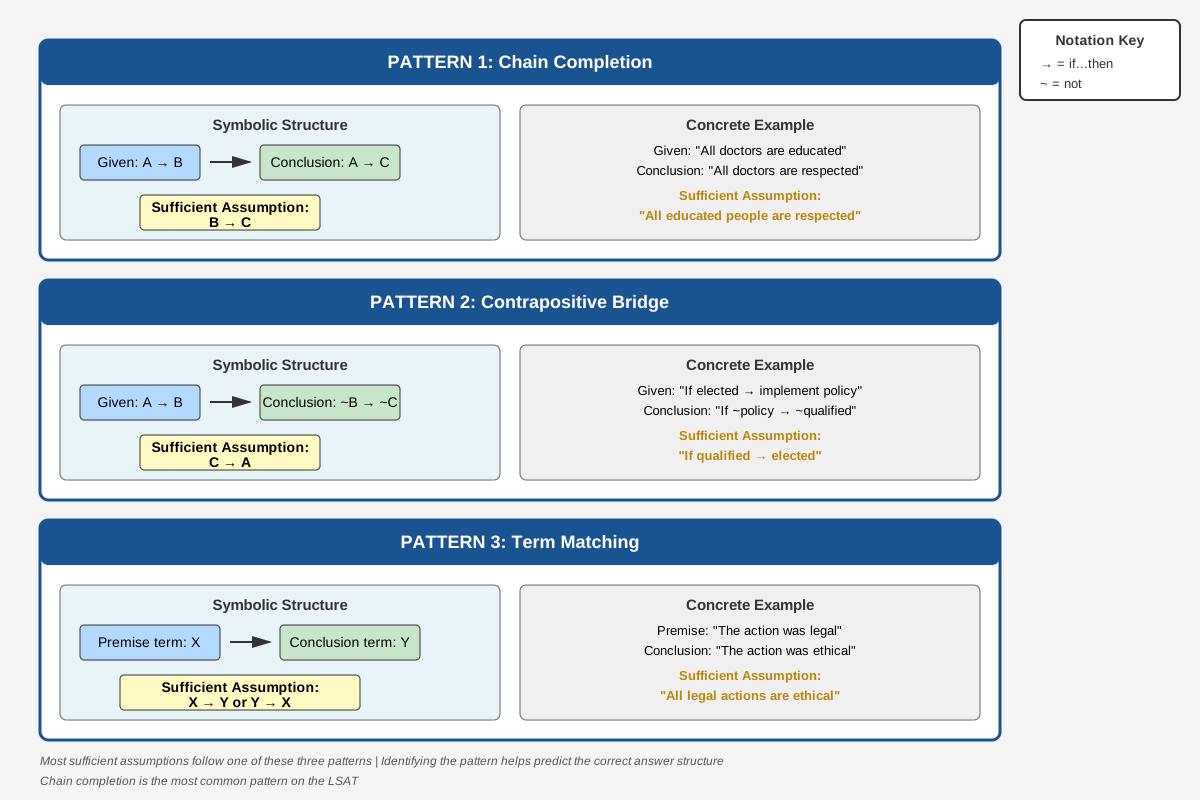
Gap Type 1: Categorical/Class Connections
The premises discuss one category or group, while the conclusion discusses a different category. The sufficient assumption must connect these categories explicitly.
Example structure:
- Premise: All A are B
- Conclusion: Therefore, all A are C
- Gap: No connection established between B and C
- Sufficient assumption needed: All B are C (or something that establishes this relationship)
Gap Type 2: Conditional Chain Completion
The argument presents conditional statements that don't fully connect, requiring an assumption to complete the logical chain.
Example structure:
- Premise: If X, then Y
- Conclusion: If X, then Z
- Gap: No connection between Y and Z
- Sufficient assumption needed: If Y, then Z
Gap Type 3: Causal Reasoning Gaps
The premises present evidence, and the conclusion draws a causal claim requiring assumptions about alternative explanations or necessary conditions.
Example structure:
- Premise: Event A occurred, then Event B occurred
- Conclusion: Event A caused Event B
- Gap: No elimination of alternative causes or establishment of causal mechanism
- Sufficient assumption needed: Nothing else could have caused B, or A is sufficient to produce B
The Sufficient Test
When evaluating answer choices, apply the sufficient test: add the answer choice to the argument as an additional premise and determine whether the conclusion now must be true. If the conclusion becomes logically necessary (not just more likely or better supported), the answer choice is sufficient. This test distinguishes sufficient assumptions from strengthen answers, which make conclusions more probable but not certain.
The sufficient test requires rigorous logical thinking:
- Read the argument and identify the conclusion
- Identify the premises (evidence provided)
- Recognize the logical gap between premises and conclusion
- For each answer choice, mentally add it as a new premise
- Determine whether the conclusion now follows with logical necessity
- Select the answer that creates complete logical validity
Principle Questions as Sufficient Assumptions
A subset of sufficient assumption questions presents the task as identifying a principle that justifies the reasoning. These questions function identically to standard sufficient assumption questions but frame the correct answer as a broader rule or general principle rather than a specific factual claim. The principle, when applied to the specific situation in the argument, must make the conclusion follow logically.
Principle-based sufficient assumptions often take the form of conditional statements or general rules: "Any action that produces X should be treated as Y" or "Whenever condition A holds, conclusion B is justified." The correct principle must be broad enough to apply to the argument's situation while specific enough to bridge the exact logical gap present.
Concept Relationships
The concepts within sufficient assumption questions form an interconnected system. Question stem recognition serves as the entry point, enabling students to identify that a sufficient (rather than necessary or strengthen) approach is required. This recognition triggers the appropriate analytical framework: identifying the logical gap between premises and conclusion. Understanding gap types (categorical, conditional, causal) determines what kind of assumption will be sufficient—a category connection, conditional chain link, or causal mechanism.
The sufficient test serves as the validation mechanism, confirming whether a potential answer truly makes the conclusion follow with necessity. This test relies on understanding formal logic and conditional reasoning, as students must trace whether adding the assumption creates logical validity. Principle-based questions represent an application of the same underlying logic but require recognizing that abstract rules function as sufficient assumptions when properly applied.
Relationship to prerequisite knowledge: Basic argument structure enables identification of premises and conclusions, which is the foundation for recognizing gaps. Conditional logic provides the tools for understanding how assumptions create logical bridges, particularly in chain-completion scenarios. Question stem recognition skills allow rapid categorization, ensuring students apply sufficient assumption strategies rather than necessary assumption or strengthen approaches.
Relationship map:
Question Stem Recognition → Identifies Sufficient Assumption Task → Triggers Gap Analysis → Determines Gap Type (Categorical/Conditional/Causal) → Predicts Assumption Structure → Applies Sufficient Test → Validates Logical Completeness → Selects Correct Answer
High-Yield Facts
⭐ Sufficient assumption questions ask for information that, if added, makes the conclusion follow with logical necessity, not just probability
⭐ The most common question stem language includes "if assumed, allows the conclusion to be properly drawn" and "the conclusion follows logically if which is assumed"
⭐ Sufficient assumptions often connect two different categories, groups, or concepts mentioned separately in premises and conclusion
⭐ The correct answer to a sufficient assumption question may provide more information than minimally necessary—it need only guarantee the conclusion
⭐ Applying the sufficient test (adding the answer as a premise and checking if the conclusion must follow) is the most reliable way to confirm correct answers
- Sufficient assumption questions typically appear 3-5 times per LSAT across both Logical Reasoning sections
- Principle-based sufficient assumption questions function identically to standard sufficient assumptions but frame answers as general rules
- Conditional reasoning chains frequently appear in sufficient assumption questions, requiring assumptions that complete "if-then" sequences
- Wrong answers in sufficient assumption questions often strengthen the argument without making it logically complete
- Sufficient assumptions differ from necessary assumptions in that they guarantee conclusions rather than identifying minimum requirements
- Categorical gaps (connecting different groups or classes) represent the most common gap type in sufficient assumption questions
- The conclusion of the argument is always the most important element to identify, as the sufficient assumption must make this specific claim follow logically
Quick check — test yourself on Sufficient assumption question stems so far.
Try Flashcards →Common Misconceptions
Misconception: Sufficient assumption questions are the same as strengthen questions because both add support to arguments.
Correction: While both add support, sufficient assumptions must make the conclusion follow with complete logical necessity, creating validity. Strengthen questions only need to make the conclusion more likely or better supported. A strengthen answer might increase probability from 40% to 70%, but a sufficient assumption must take it to 100% logical certainty.
Misconception: The correct answer to a sufficient assumption question must be the minimum assumption needed.
Correction: Sufficient assumptions need only be enough to guarantee the conclusion; they can provide more than the minimum necessary. An answer that gives more information than strictly required can still be correct if it makes the conclusion follow logically. This distinguishes sufficient from necessary assumptions, where minimalism is key.
Misconception: If an answer choice seems too strong or extreme, it cannot be correct.
Correction: Sufficient assumptions often appear strong or absolute because they must guarantee conclusions. Statements like "all," "only," "never," or "always" frequently appear in correct answers because they create the logical certainty required. Test-takers trained to avoid extreme answers in other contexts must adjust this instinct for sufficient assumption questions.
Misconception: The sufficient assumption must be something the author actually believes or would agree with.
Correction: The question asks what assumption would make the argument work logically, not what the author actually assumes or believes. The correct answer creates logical validity regardless of whether it's realistic, true, or something the author would endorse. Focus on logical structure, not plausibility or authorial intent.
Misconception: Sufficient assumption questions require finding hidden assumptions already implicit in the argument.
Correction: Unlike necessary assumption questions (which identify what must already be assumed), sufficient assumption questions ask what could be added to complete the logic. The correct answer introduces new information that bridges the gap, rather than revealing something already implicitly present. This is an additive rather than detective task.
Worked Examples
Example 1: Categorical Gap
Argument: "All the members of the city council support the new zoning regulations. Therefore, the new zoning regulations will benefit the city's residents."
Question Stem: "The conclusion follows logically if which one of the following is assumed?"
Analysis:
Step 1: Identify the conclusion: "The new zoning regulations will benefit the city's residents"
Step 2: Identify the premises: "All city council members support the new zoning regulations"
Step 3: Recognize the gap: The premise discusses what council members support, while the conclusion discusses what will benefit residents. There's no established connection between "council member support" and "resident benefit."
Step 4: Predict the assumption structure: We need something that connects council member support to resident benefit. Likely a statement like "Whatever all council members support will benefit residents" or "The council members only support things that benefit residents."
Step 5: Evaluate answer choices using the sufficient test:
(A) "Most city residents support the new zoning regulations"
- Test: Add this to the argument. Does the conclusion now follow necessarily? No—resident support doesn't guarantee resident benefit.
(B) "The city council members always act in the best interests of residents"
- Test: Add this. Does the conclusion follow? Not quite—acting in best interests doesn't guarantee that what they support will actually benefit residents (they could be mistaken).
(C) "Any policy supported by all city council members will benefit the city's residents"
- Test: Add this. Does the conclusion follow? Yes! If all council members support the regulations (given premise) and anything supported by all council members benefits residents (this assumption), then the regulations must benefit residents. This creates logical necessity.
(D) "The new zoning regulations are similar to regulations that have benefited other cities"
- Test: Add this. Does the conclusion follow necessarily? No—similarity to other beneficial regulations doesn't guarantee benefit in this city.
Correct Answer: (C)
This example demonstrates a categorical gap where the sufficient assumption must explicitly connect two different categories (council support and resident benefit) mentioned in different parts of the argument.
Example 2: Conditional Chain Completion
Argument: "If the company implements the new software system, employee productivity will increase. The company should do whatever will increase employee productivity. Therefore, the company should implement the new software system."
Question Stem: "Which one of the following is an assumption required for the conclusion to follow logically?"
Analysis:
Step 1: Identify the conclusion: "The company should implement the new software system"
Step 2: Identify the premises:
- Premise 1: If new software → increased productivity
- Premise 2: The company should do whatever increases productivity
Step 3: Recognize the gap: This is a conditional reasoning structure. We have "new software → productivity" and "should do what increases productivity," but we need to connect these to reach "should implement new software." The gap is that we haven't established that implementing the software is something the company should do based on the productivity principle.
Step 4: Predict the assumption: We need something that connects the conditional chain. Specifically, we need to establish that since the software would increase productivity, and the company should do what increases productivity, therefore the company should implement the software. The missing link is that the productivity increase from the software is sufficient reason to implement it.
Step 5: Evaluate answer choices:
(A) "Employee productivity is the most important factor in company success"
- Test: This doesn't complete the logical chain from the premises to the conclusion. It's about importance, not about whether the company should implement the software.
(B) "The company should implement the new software system only if it will increase employee productivity"
- Test: This gives us "should implement → increases productivity" (the contrapositive would be "doesn't increase productivity → shouldn't implement"). But we need the reverse direction to reach our conclusion.
(C) "If implementing a measure will increase employee productivity, the company should implement that measure"
- Test: Add this. Now we have: (1) new software → increased productivity [given], (2) if something increases productivity → company should do it [this assumption], (3) company should do what increases productivity [given]. The conclusion "company should implement new software" now follows necessarily. This completes the conditional chain.
(D) "No other measure would increase employee productivity as much as the new software system"
- Test: This is about comparative effectiveness, but doesn't establish that the company should implement the software based on the productivity principle.
Correct Answer: (C)
This example illustrates how sufficient assumptions complete conditional reasoning chains by providing the missing link that connects separate conditional statements into a valid argument structure.
Exam Strategy
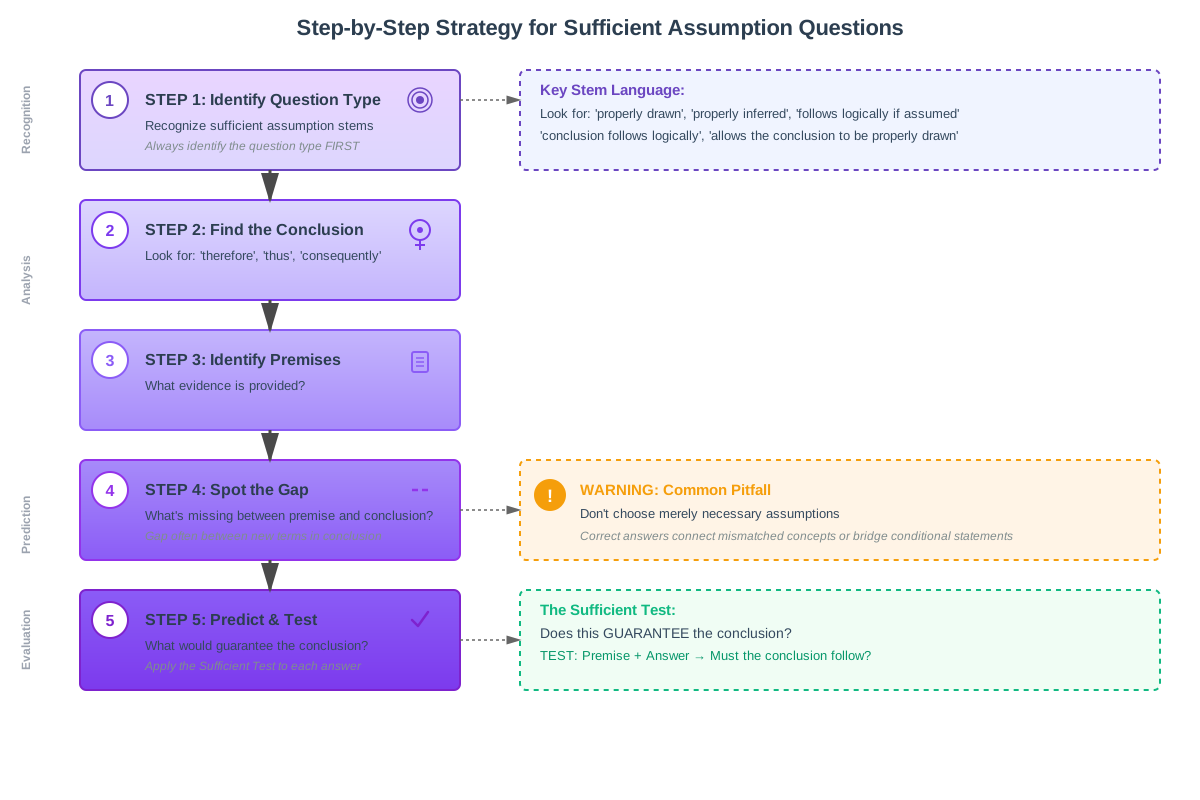
When approaching sufficient assumption questions on the LSAT, implement this systematic process:
Step 1: Confirm Question Type (5-10 seconds)
Look for trigger phrases: "if assumed, allows the conclusion," "follows logically if," "enables the conclusion to be properly drawn," or "principle that justifies." These confirm you're dealing with a sufficient assumption question requiring logical completeness, not mere strengthening.
Step 2: Identify Conclusion First (10-15 seconds)
Always locate the conclusion before analyzing premises. The sufficient assumption must make this specific claim follow necessarily. Underline or mentally note the exact conclusion statement, as this is your target.
Step 3: Map the Logical Gap (15-20 seconds)
Identify what's discussed in the premises versus what's claimed in the conclusion. Look for:
- Different categories or groups (categorical gap)
- Incomplete conditional chains (conditional gap)
- Causal claims without mechanism or alternative elimination (causal gap)
Step 4: Predict the Answer Structure (10 seconds)
Before reading answer choices, predict what type of statement would bridge the gap. This prediction prevents distraction from attractive wrong answers and speeds evaluation.
Step 5: Apply the Sufficient Test to Each Answer (10-15 seconds per choice)
For each answer choice, mentally add it as a new premise and ask: "Does the conclusion now follow with logical necessity?" Eliminate any answer that merely strengthens without guaranteeing.
Exam Tip: If you're between two answers, both of which seem to help the argument, choose the one that creates absolute logical certainty rather than high probability. Sufficient assumptions must guarantee, not just support.
Time Allocation: Allocate 1:20-1:40 for sufficient assumption questions (slightly more than average). The upfront investment in gap analysis pays off with confident answer selection and high accuracy.
Process of Elimination Strategies:
- Eliminate answers that introduce irrelevant new concepts not connected to the premise-conclusion gap
- Eliminate answers that strengthen but don't guarantee (watch for "may," "could," "likely")
- Eliminate answers that reverse the needed logical direction (especially in conditional reasoning)
- Eliminate answers that address necessary conditions when sufficient conditions are needed
Red Flag Phrases in Wrong Answers:
- "Most," "many," "some" (usually insufficient for logical certainty)
- "May," "might," "could" (indicate possibility, not necessity)
- Comparative language ("more than," "better than") when absolute connection is needed
Green Light Phrases in Correct Answers:
- "All," "any," "every" (create categorical connections)
- "Only," "only if" (establish sufficient or necessary conditions)
- "If...then" structures (complete conditional chains)
- "Whatever," "whenever" (universal principles)
Memory Techniques
BRIDGE Acronym for Sufficient Assumption Strategy:
- Bridge the gap between premises and conclusion
- Recognize the question stem language ("if assumed, allows")
- Identify what's missing (categorical, conditional, or causal link)
- Determine what would guarantee (not just strengthen) the conclusion
- Guarantee test: add the answer and check for logical necessity
- Eliminate answers that merely strengthen without completing logic
Visualization Technique: Picture the argument as a bridge with the premises on one side and the conclusion on the other. The sufficient assumption is the missing span that completes the bridge entirely, allowing you to walk from premises to conclusion with complete certainty. Partial supports (strengthen answers) are like ropes that help but don't create a solid walkway.
Sufficient vs. Necessary Memory Aid:
- Sufficient = Sufficient = Solid guarantee = Strong enough to complete
- Necessary = Necessary = Needed minimum = Narrow requirement
The "100% Rule": Remember that sufficient assumptions must take the argument to 100% logical validity. If adding the answer gets you to 80% or 90% confidence, it's wrong. This mental benchmark helps distinguish sufficient from strengthen answers.
Summary
Sufficient assumption question stems represent a high-frequency, high-value question type on the LSAT Logical Reasoning section, requiring test-takers to identify information that, when added to an argument, makes the conclusion follow with complete logical necessity. Recognition of these questions depends on identifying characteristic stem language including "if assumed, allows the conclusion to be properly drawn" and "the conclusion follows logically if which is assumed." The core skill involves analyzing arguments to identify logical gaps—typically categorical disconnections, incomplete conditional chains, or unsupported causal claims—and then selecting the answer choice that bridges these gaps entirely. Unlike necessary assumptions (which identify minimum requirements) or strengthen questions (which increase probability), sufficient assumptions must guarantee conclusions with 100% logical certainty. Success requires systematic application of the sufficient test: adding each answer choice as a premise and determining whether the conclusion becomes logically necessary. Mastery of sufficient assumption questions develops fundamental analytical skills applicable throughout the LSAT and in legal reasoning more broadly.
Key Takeaways
- Sufficient assumption questions ask for information that guarantees the conclusion's logical validity, not just makes it more likely or better supported
- Recognize these questions through stem language: "if assumed, allows/enables the conclusion," "follows logically if," and "principle that justifies the reasoning"
- The three most common gap types are categorical (connecting different groups), conditional (completing if-then chains), and causal (establishing mechanisms or eliminating alternatives)
- Apply the sufficient test rigorously: add the answer choice as a premise and confirm the conclusion must follow with logical necessity
- Correct answers often appear strong or absolute because they must create certainty—don't eliminate answers merely for being "extreme"
- Distinguish sufficient from necessary assumptions: sufficient assumptions can provide more than the minimum needed, while necessary assumptions identify bare requirements
- Systematic gap analysis before reviewing answer choices dramatically improves accuracy and speed by creating clear predictions of what the correct answer must accomplish
Related Topics
Necessary Assumption Questions: These questions ask for assumptions that must be true for the argument to work, representing the minimum logical requirements rather than sufficient guarantees. Mastering sufficient assumptions provides contrast that clarifies necessary assumption identification.
Strengthen Questions: While similar to sufficient assumptions in adding support to arguments, strengthen questions only require making conclusions more probable rather than logically certain. Understanding the distinction between strengthening and guaranteeing is crucial for both question types.
Formal Logic and Conditional Reasoning: Many sufficient assumption questions involve completing conditional chains or establishing categorical relationships, making advanced formal logic skills directly applicable and highly valuable.
Flaw Questions: Identifying logical flaws is the inverse of finding sufficient assumptions—flaws represent the gaps that sufficient assumptions would fill. Proficiency in one area enhances performance in the other.
Principle Questions (Application and Identification): Principle-based sufficient assumptions require applying general rules to specific situations, connecting to broader principle question strategies while maintaining the sufficient assumption framework.
Practice CTA
Now that you've mastered the recognition and strategic approach to sufficient assumption question stems, it's time to put these skills into practice. Work through the practice questions and flashcards designed specifically for this topic, applying the BRIDGE acronym and sufficient test to each question. Remember that sufficient assumption questions reward systematic analysis and careful logical thinking—skills that improve dramatically with deliberate practice. Each question you work through strengthens your ability to recognize gaps, predict answers, and confidently select the choice that guarantees logical validity. Your investment in mastering this high-yield question type will pay dividends across multiple questions on test day!
Sign up free to keep reading
Create a free AnvayaPrep account to finish this LSAT guide on Sufficient assumption question stems — plus flashcards and practice questions.