Overview
Attacking representativeness is a critical reasoning pattern that appears frequently in LSAT Logical Reasoning sections, particularly within strengthen and weaken questions. This concept involves challenging whether a sample, study, or subset accurately reflects the larger population or phenomenon it claims to represent. When an argument draws conclusions about a broad group based on evidence from a smaller sample, the representativeness of that sample becomes a potential vulnerability. Understanding how to identify and exploit this vulnerability is essential for success on the LSAT.
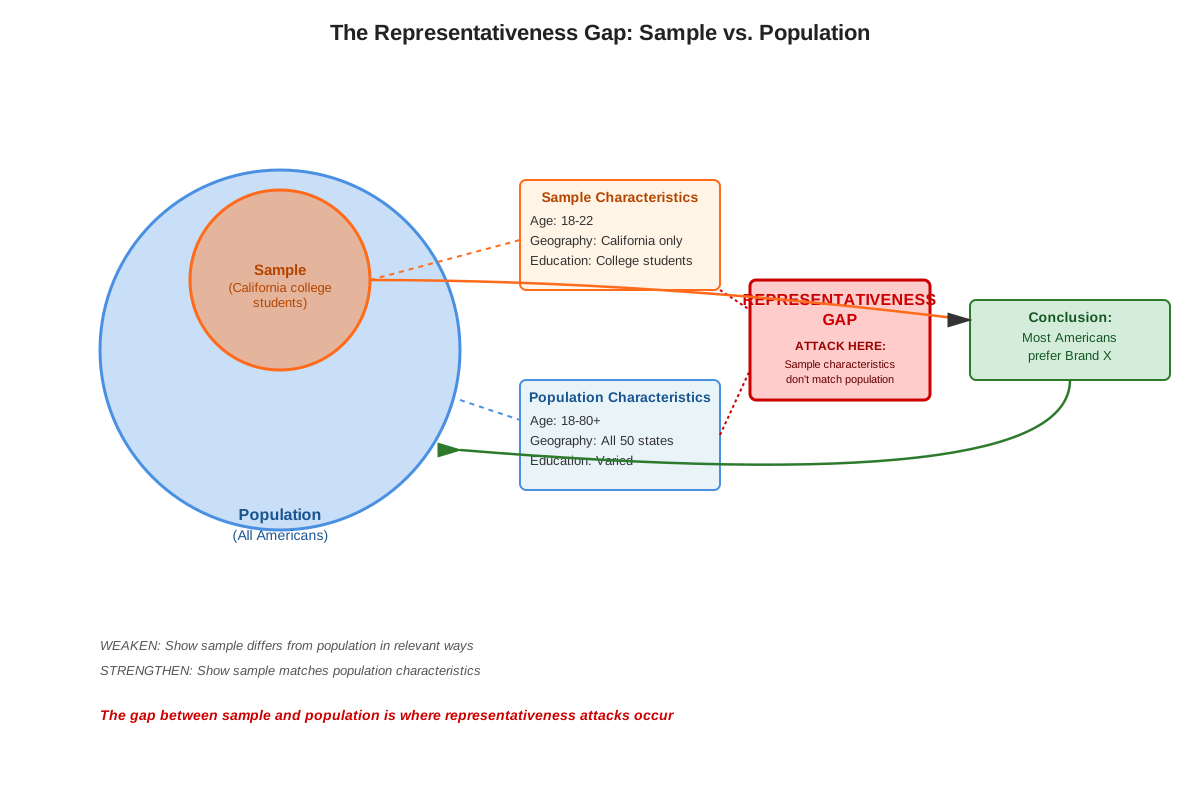
The LSAT regularly tests whether test-takers can recognize when an argument's evidence comes from a biased, unrepresentative, or inadequately selected sample. For instance, if a study concludes that "most Americans prefer brand X" based solely on surveying college students in California, the sample may not represent the broader American population. Questions testing this concept ask students to either strengthen an argument by showing the sample is representative, or weaken it by demonstrating the sample is biased or atypical. This reasoning pattern appears across multiple question types, including Weaken, Strengthen, Flaw, and Assumption questions.
Within the broader landscape of Logical Reasoning, attacking representativeness connects to fundamental principles of inductive reasoning and statistical argumentation. It requires understanding how evidence supports conclusions and recognizing the gap between limited observations and general claims. This topic builds upon basic argument structure analysis while preparing students for more complex reasoning about causation, correlation, and statistical inference that appears throughout the LSAT.
Learning Objectives
- [ ] Identify how attacking representativeness appears in LSAT questions
- [ ] Explain the reasoning pattern behind attacking representativeness
- [ ] Apply attacking representativeness to solve LSAT-style problems accurately
- [ ] Distinguish between representative and unrepresentative samples in argument structures
- [ ] Recognize the specific characteristics that make a sample biased or atypical
- [ ] Evaluate answer choices that either support or undermine sample representativeness
- [ ] Predict common ways the LSAT will test representativeness vulnerabilities
Prerequisites
- Basic argument structure: Understanding premises, conclusions, and how evidence supports claims is essential because attacking representativeness involves analyzing the relationship between sample evidence and broader conclusions.
- Inductive vs. deductive reasoning: Recognizing that arguments from samples are inductive (probabilistic rather than certain) helps identify why representativeness matters for argument strength.
- Strengthen and weaken question fundamentals: Familiarity with how answer choices can make arguments more or less convincing provides the framework for applying representativeness attacks.
- Statistical reasoning basics: Understanding concepts like "sample," "population," and "generalization" enables recognition of when arguments make claims beyond their evidence base.
Why This Topic Matters
Attacking representativeness appears in approximately 15-20% of Logical Reasoning questions on any given LSAT, making it one of the highest-yield reasoning patterns to master. This frequency reflects the LSAT's emphasis on evaluating real-world argumentation, where conclusions about large groups are routinely drawn from limited samples. Legal reasoning frequently involves assessing whether evidence from specific cases, studies, or examples can support broader legal principles or policy decisions, making this skill directly relevant to law school and legal practice.
In real-world applications, representativeness concerns arise constantly in legal contexts: Are the plaintiffs in a class-action lawsuit representative of all affected parties? Does a study cited in litigation accurately reflect the broader population? Can precedent from one jurisdiction apply to another? The ability to identify and articulate representativeness problems is fundamental to critical thinking in law and beyond.
On the LSAT, this topic most commonly appears in Weaken questions (where answer choices show the sample is unrepresentative), Strengthen questions (where answer choices confirm representativeness), Flaw questions (where the correct answer identifies the representativeness problem), and Assumption questions (where the argument depends on the sample being representative). The pattern also appears in Method of Reasoning and Parallel Reasoning questions, though less frequently. Test-takers who master this concept gain a significant advantage because these questions follow predictable patterns once the underlying reasoning structure is understood.
Core Concepts
The Basic Structure of Representativeness Arguments
LSAT attacking representativeness questions involve arguments that follow a specific structure: evidence is gathered from a subset (the sample), and a conclusion is drawn about a larger group (the population). The logical gap in these arguments is the assumption that the sample accurately reflects the population's characteristics. For example:
Premise: A survey of 100 doctors at urban teaching hospitals found that 80% support Policy X.
Conclusion: Therefore, most doctors support Policy X.
The argument assumes that doctors at urban teaching hospitals are representative of all doctors—an assumption that can be attacked by showing these doctors differ systematically from doctors in rural areas, private practices, or other settings.
Key Characteristics of Unrepresentative Samples
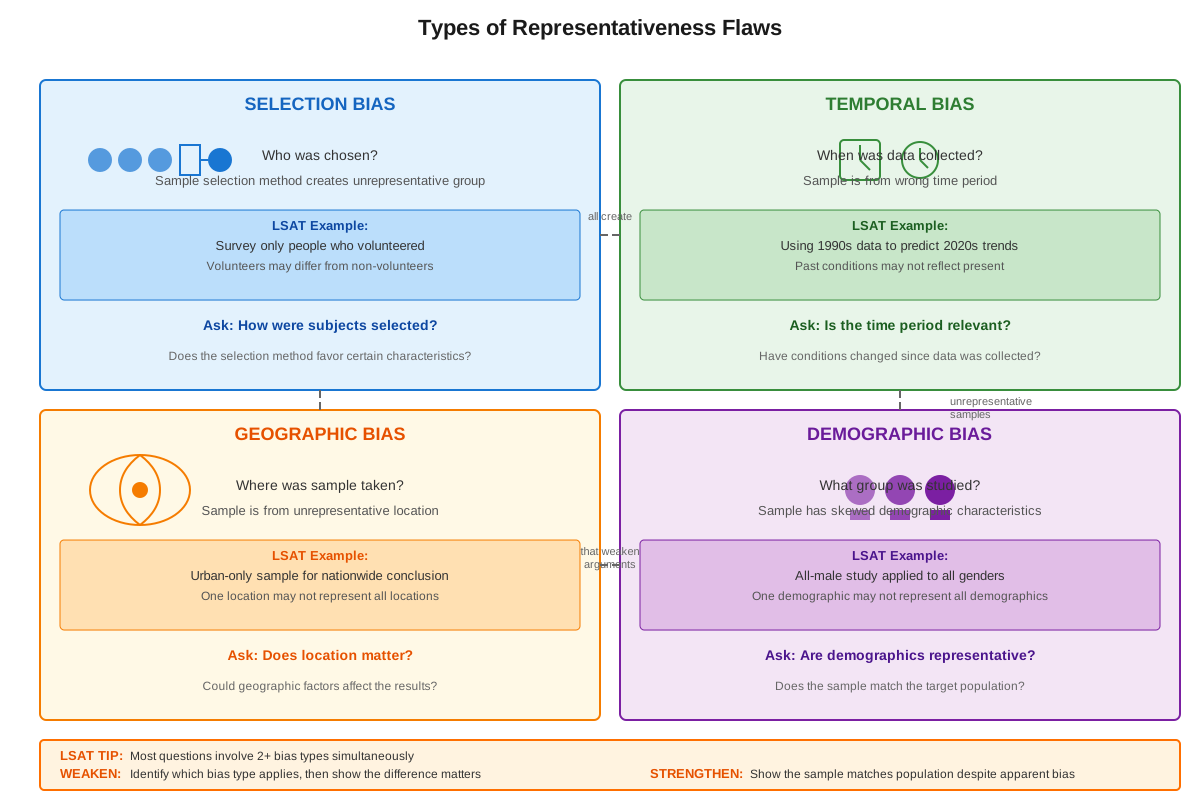
Several factors can make a sample unrepresentative, and the LSAT tests each regularly:
Selection bias occurs when the method of choosing sample members systematically excludes or overrepresents certain groups. A survey conducted only among volunteers, for instance, may overrepresent people with strong opinions on the topic.
Demographic mismatch happens when the sample differs from the population in relevant characteristics such as age, location, income, education, or profession. A study of college students' spending habits may not represent all consumers.
Temporal mismatch involves using data from one time period to draw conclusions about another, when relevant conditions may have changed. Consumer preferences from five years ago may not reflect current preferences.
Contextual differences arise when the sample comes from a setting or situation that differs meaningfully from the broader context. Laboratory results may not predict real-world outcomes; behavior in experimental conditions may differ from natural behavior.
How the LSAT Tests Representativeness
The LSAT presents representativeness vulnerabilities in several standard formats:
| Question Type | How Representativeness Appears | What Correct Answers Do |
|---|---|---|
| Weaken | Argument assumes sample is representative | Show the sample differs from population in relevant ways |
| Strengthen | Argument's sample might be unrepresentative | Confirm the sample matches the population or differences don't matter |
| Flaw | Argument treats sample as representative without justification | Identify that the argument improperly generalizes from an unrepresentative sample |
| Assumption | Argument depends on sample being representative | State that the sample is representative or that no relevant differences exist |
The Relevance Requirement
A crucial aspect of attacking representativeness is understanding that not all differences between sample and population matter. The LSAT tests whether students can distinguish between relevant and irrelevant differences. A difference is relevant only if it would plausibly affect the characteristic being measured or the conclusion being drawn.
For example, if an argument concludes that "most voters support Candidate A" based on a poll of voters in one state, the fact that the polled voters have different average heights than the national population is irrelevant. However, if the polled state has dramatically different political leanings, economic conditions, or demographic composition, these differences are relevant to voting preferences.
Common Representativeness Patterns on the LSAT
Several recurring patterns appear across LSAT questions:
- Geographic limitation: Sample from one region used to conclude about a broader area
- Voluntary response bias: Conclusions drawn from self-selected respondents who may have stronger opinions
- Convenience sampling: Using easily accessible subjects who may differ from the general population
- Historical data misapplication: Using past data to predict current or future conditions when circumstances have changed
- Subset-to-whole generalization: Studying one subgroup (e.g., employees at large companies) and concluding about all members of a category (all employees)
- Extreme case generalization: Drawing conclusions from unusual, extreme, or exceptional cases
Strengthening Representativeness
While attacking representativeness involves showing a sample is biased or atypical, strengthening representativeness requires demonstrating that the sample adequately reflects the population. Correct answers in Strengthen questions might:
- Show the sample was randomly selected
- Demonstrate that the sample matches the population in relevant characteristics
- Establish that known differences between sample and population don't affect the measured outcome
- Indicate that the sample size is sufficiently large and diverse
- Confirm that the sampling method avoided systematic biases
Concept Relationships
The concept of attacking representativeness connects to several other logical reasoning patterns. It fundamentally relies on understanding argument structure → which enables recognition of the gap between sample evidence and general conclusions. This gap creates the need for an assumption about representativeness → which can be either attacked (in Weaken questions) or supported (in Strengthen questions).
Attacking representativeness relates closely to causal reasoning because unrepresentative samples can lead to false causal conclusions. If a study finds a correlation in a biased sample, that correlation may not exist in the general population. The concept also connects to statistical reasoning more broadly, as it involves understanding how sample properties relate to population parameters.
Within the strengthen and weaken question family, attacking representativeness is one of several common reasoning vulnerabilities, alongside alternative explanations, implementation problems, and reversed causation. However, representativeness attacks are distinctive because they challenge the evidence itself rather than the reasoning from evidence to conclusion.
The relationship map flows as follows:
Inductive reasoning → creates need for → representative samples → which can be challenged by → attacking representativeness → which appears in → strengthen/weaken questions → requiring understanding of → relevant vs. irrelevant differences → which connects back to → argument evaluation skills
High-Yield Facts
⭐ Attacking representativeness challenges whether a sample accurately reflects the population about which conclusions are drawn.
⭐ A sample is unrepresentative when it systematically differs from the population in ways relevant to the conclusion.
⭐ Geographic, demographic, temporal, and contextual differences are the most common sources of unrepresentativeness on the LSAT.
⭐ Not all differences between sample and population matter—only those relevant to the characteristic being measured.
⭐ Weaken questions often present answer choices showing the sample differs from the population in a relevant way.
- Strengthen questions may confirm representativeness by showing the sample was randomly selected or matches the population in key characteristics.
- Voluntary response samples (self-selected participants) are typically unrepresentative because they overrepresent people with strong opinions.
- Historical data becomes unrepresentative when relevant conditions have changed between the time of data collection and the time about which conclusions are drawn.
- Small samples from homogeneous subgroups are particularly vulnerable to representativeness attacks.
- The LSAT rarely requires statistical knowledge beyond understanding basic concepts of samples and populations.
⭐ Flaw questions may describe representativeness problems as "generalizing from an unrepresentative sample" or "treating a biased sample as typical."
- Assumption questions about representativeness typically require assuming that no relevant differences exist between sample and population.
- Convenience samples (using easily accessible subjects) often fail to represent broader populations.
- Arguments that use extreme, unusual, or exceptional cases to draw general conclusions are vulnerable to representativeness attacks.
- The correct answer in a representativeness question must identify a difference that would plausibly affect the conclusion, not just any difference.
Quick check — test yourself on Attacking representativeness so far.
Try Flashcards →Common Misconceptions
Misconception: Any difference between a sample and population makes the sample unrepresentative.
Correction: Only differences relevant to the conclusion matter. If studying voting preferences, differences in height between sample and population are irrelevant, but differences in political affiliation are highly relevant.
Misconception: Larger samples are always more representative than smaller samples.
Correction: Sample size matters less than selection method. A large sample from a biased source (e.g., 10,000 volunteers from one website) may be less representative than a smaller random sample. The LSAT tests understanding of selection bias more than sample size.
Misconception: Attacking representativeness only appears in Weaken questions.
Correction: This reasoning pattern appears across multiple question types including Strengthen, Flaw, Assumption, Method of Reasoning, and occasionally Parallel Reasoning questions. Each question type tests representativeness differently.
Misconception: Random sampling guarantees representativeness.
Correction: While random sampling reduces bias, it doesn't guarantee representativeness, especially with small samples or when the sampling frame (the group from which the sample is drawn) itself is unrepresentative of the target population.
Misconception: Historical data is always unrepresentative of current conditions.
Correction: Historical data can be representative if relevant conditions haven't changed. The key question is whether factors affecting the conclusion have changed between the time of data collection and the time about which conclusions are drawn.
Misconception: Expert opinions or specialized samples are automatically unrepresentative.
Correction: Whether experts or specialists constitute a representative sample depends on the conclusion. If the conclusion is about experts themselves, they're perfectly representative. If the conclusion is about the general public, they may be unrepresentative.
Misconception: Representativeness only concerns demographic characteristics.
Correction: Representativeness involves any characteristic relevant to the conclusion, including behaviors, attitudes, circumstances, contexts, time periods, and conditions—not just demographic factors like age or location.
Worked Examples
Example 1: Weaken Question
Argument:
"A recent study found that employees who work from home are 25% more productive than those who work in offices. The study surveyed 200 employees at a technology company who had requested to work from home. Based on these findings, the company should allow all employees to work from home to increase overall productivity."
Question: Which of the following, if true, most weakens the argument?
Answer Choices:
(A) Some employees who work from home report feeling isolated
(B) The technology company has a larger budget than most companies
(C) Employees who requested to work from home were already the company's most productive workers before working remotely
(D) Working from home requires reliable internet access
(E) The study was conducted over a six-month period
Analysis:
The argument concludes that allowing all employees to work from home will increase productivity, based on a study of employees who requested to work from home. The sample (employees who requested remote work) may not represent all employees.
Step 1: Identify the sample and population
- Sample: 200 employees who requested to work from home
- Population: All employees
- Conclusion: What's true of the sample will be true of the population
Step 2: Look for relevant differences between sample and population
The key vulnerability is whether employees who request remote work differ from all employees in ways relevant to productivity.
Step 3: Evaluate answer choices
- (A) Addresses a side effect but doesn't challenge representativeness
- (B) Irrelevant comparison to other companies
- (C) CORRECT - Shows the sample was already atypical (more productive) before working from home, so their productivity gains may not generalize to all employees
- (D) Identifies a requirement but doesn't challenge whether the sample represents all employees
- (E) Addresses study duration but not sample representativeness
Answer: (C) directly attacks representativeness by showing the sample differs from the general employee population in the exact characteristic being measured (productivity). The high productivity observed might reflect who chose to work from home rather than the effect of working from home itself.
Example 2: Strengthen Question
Argument:
"City officials surveyed residents in three neighborhoods about their support for a new public transportation initiative. The survey found that 65% of respondents support the initiative. Therefore, the initiative is likely to pass in a citywide referendum."
Question: Which of the following, if true, most strengthens the argument?
Answer Choices:
(A) The three neighborhoods surveyed were randomly selected from all city neighborhoods
(B) The survey was conducted by an independent polling organization
(C) Public transportation initiatives have passed in other cities
(D) The survey included 500 residents
(E) The three neighborhoods are all located in the northern part of the city
Analysis:
The argument concludes that citywide support will match the 65% found in three neighborhoods. This assumes the three neighborhoods represent the entire city.
Step 1: Identify the representativeness assumption
The argument assumes the three surveyed neighborhoods are representative of all city neighborhoods regarding support for public transportation.
Step 2: Determine what would strengthen this assumption
Evidence that the sample neighborhoods match the broader city or were selected without bias would strengthen the argument.
Step 3: Evaluate answer choices
- (A) CORRECT - Random selection reduces selection bias and makes it more likely the sample represents the population
- (B) Addresses survey credibility but not whether the neighborhoods represent the city
- (C) Provides precedent but doesn't address whether this sample represents this city
- (D) Addresses sample size but not whether the neighborhoods are representative
- (E) WEAKENS the argument by suggesting geographic bias (all northern neighborhoods)
Answer: (A) strengthens by confirming the sample was selected in a way that promotes representativeness. Random selection means the neighborhoods weren't chosen based on characteristics that might correlate with support for the initiative.
Exam Strategy
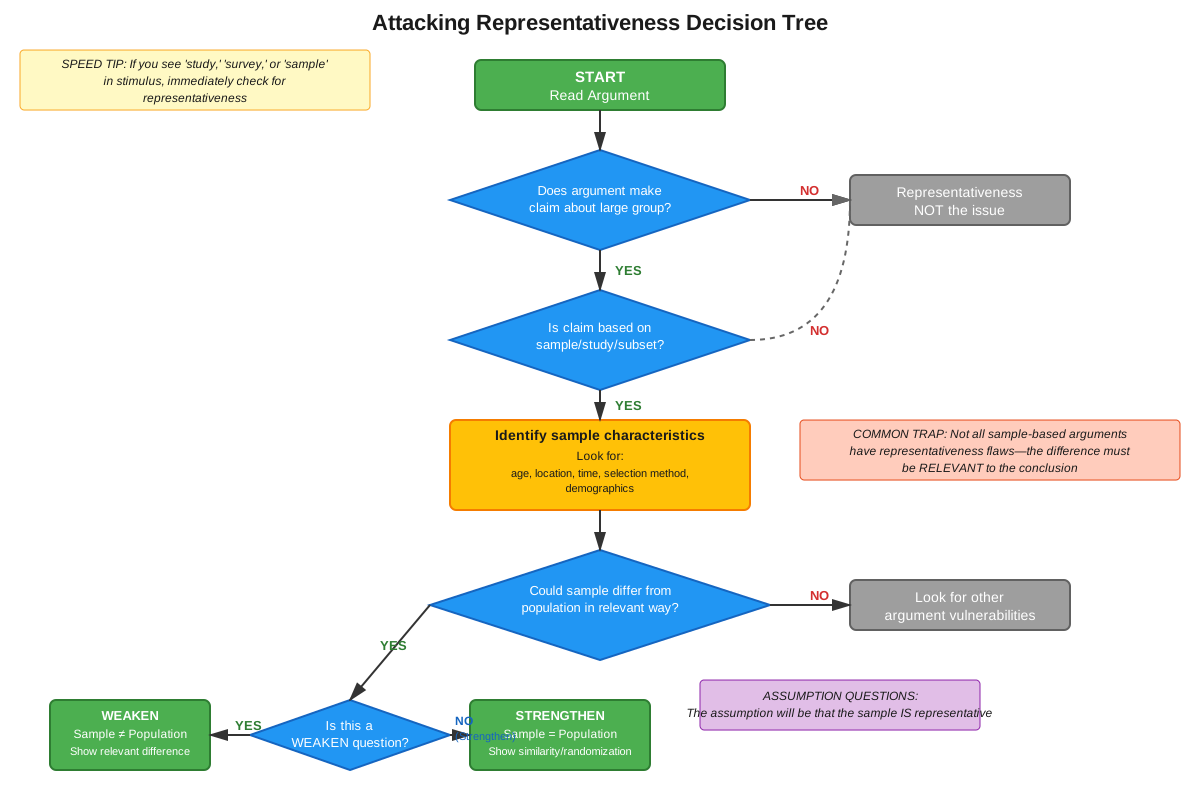
When approaching LSAT questions involving representativeness, follow this systematic process:
Step 1: Identify sample-to-population arguments
Watch for trigger phrases indicating generalization from a subset:
- "A study of X found..."
- "A survey of [specific group] showed..."
- "Based on data from [limited source]..."
- "Researchers examined [subset] and concluded..."
- "In [specific location/time], therefore [general claim]..."
Step 2: Map the logical structure
Clearly identify:
- What is the sample? (the group actually studied/surveyed)
- What is the population? (the broader group about which conclusions are drawn)
- What characteristic is being generalized? (productivity, preferences, behavior, etc.)
Step 3: Assess potential differences
Consider how the sample might differ from the population:
- Geographic differences (one region vs. entire country)
- Demographic differences (age, profession, income, education)
- Selection method (volunteers vs. random selection)
- Temporal differences (past vs. present conditions)
- Contextual differences (experimental vs. natural settings)
Step 4: Apply the relevance filter
Ask: "Would this difference plausibly affect the characteristic being measured?" Eliminate answer choices that identify irrelevant differences.
Exam Tip: In Weaken questions, the correct answer often shows the sample was self-selected, came from an extreme subgroup, or differs from the population in a way that directly relates to the conclusion.
Exam Tip: In Strengthen questions, look for answer choices that confirm random selection, demonstrate similarity between sample and population, or rule out systematic biases.
Time allocation: Representativeness questions should take 60-90 seconds once you recognize the pattern. Spend 20 seconds identifying the sample/population structure, 30 seconds predicting the vulnerability, and 30 seconds evaluating answer choices.
Process of elimination: Quickly eliminate answer choices that:
- Identify irrelevant differences between sample and population
- Address side issues without touching representativeness
- Strengthen when you need to weaken (or vice versa)
- Introduce new topics rather than addressing the sample's typicality
Memory Techniques
SAMPLE Mnemonic for identifying unrepresentative samples:
- Selection bias (self-selected, volunteers, convenience sampling)
- Atypical subgroup (extreme cases, specialized groups)
- Mismatch in demographics (age, location, profession)
- Past data for present conclusions (temporal mismatch)
- Limited context (lab vs. real-world, one setting vs. many)
- Exclusionary method (systematic exclusion of certain groups)
Visualization Strategy: Picture a puzzle where the sample is one piece and the population is the complete picture. Ask: "Does this piece match the colors, patterns, and characteristics of the whole puzzle?" If the piece comes from a corner (extreme case) or has unique coloring (atypical characteristics), it won't represent the whole.
The "Would This Matter?" Test: For every potential difference between sample and population, ask "Would this matter for the conclusion?" This simple question helps distinguish relevant from irrelevant differences.
Acronym for Strengthen answers: RANDOM
- Randomly selected
- All relevant characteristics matched
- No systematic bias in selection
- Differences shown to be irrelevant
- Other potential biases ruled out
- Method of selection was appropriate
Summary
Attacking representativeness is a high-yield LSAT reasoning pattern that challenges whether a sample accurately reflects the population about which conclusions are drawn. Arguments vulnerable to this attack draw general conclusions based on evidence from potentially biased, atypical, or limited samples. The LSAT tests this concept across multiple question types, most commonly in Weaken, Strengthen, Flaw, and Assumption questions. Success requires identifying the sample-to-population structure, recognizing relevant differences between sample and population, and distinguishing these from irrelevant differences. The most common sources of unrepresentativeness are selection bias, demographic mismatches, temporal differences, and contextual limitations. Mastering this topic provides a significant advantage because these questions follow predictable patterns: Weaken answers show the sample is atypical, Strengthen answers confirm representativeness, Flaw answers identify improper generalization, and Assumption answers state that no relevant differences exist. Understanding representativeness is essential not only for LSAT success but also for legal reasoning, where evaluating whether evidence from specific cases can support broader conclusions is fundamental.
Key Takeaways
- Attacking representativeness challenges whether a sample accurately reflects the population about which an argument draws conclusions
- Identify sample-to-population arguments by watching for studies, surveys, or data from limited sources used to support general claims
- Only differences between sample and population that are relevant to the conclusion matter—irrelevant differences don't affect representativeness
- Common sources of unrepresentativeness include selection bias, geographic limitations, demographic mismatches, temporal differences, and self-selected samples
- In Weaken questions, correct answers typically show the sample differs from the population in ways relevant to the conclusion
- In Strengthen questions, correct answers confirm the sample was appropriately selected or matches the population in relevant characteristics
- This reasoning pattern appears in approximately 15-20% of Logical Reasoning questions, making it one of the highest-yield topics to master
Related Topics
Alternative Explanations: After mastering representativeness, study how arguments can be weakened by providing alternative causes or explanations for observed phenomena. This builds on the same strengthen/weaken framework while introducing different reasoning vulnerabilities.
Causal Reasoning: Understanding representativeness prepares students for more complex causal arguments, where unrepresentative samples can lead to false causal conclusions. Causal reasoning questions often combine representativeness issues with other logical vulnerabilities.
Necessary vs. Sufficient Assumptions: Representativeness questions often involve necessary assumptions (the sample must be representative for the argument to work). Studying assumption types deepens understanding of what arguments require to succeed.
Statistical Reasoning and Surveys: Building on representativeness, this topic explores additional ways survey and statistical arguments can be flawed, including question wording, response rates, and margin of error.
Sampling Methods and Research Design: For students seeking deeper understanding, studying various sampling methods (random, stratified, cluster, convenience) and their strengths and weaknesses provides additional context for LSAT questions.
Practice CTA
Now that you understand the concept of attacking representativeness, it's time to apply this knowledge to actual LSAT questions. Work through the practice questions to reinforce your ability to identify sample-to-population arguments, recognize relevant differences, and select correct answers across different question types. Use the flashcards to memorize key patterns and trigger phrases. Remember: recognizing representativeness vulnerabilities becomes faster and more intuitive with practice. Each question you analyze strengthens your pattern recognition and builds the confidence needed for test day success. You've learned a high-yield concept that will serve you well across numerous LSAT questions—now make it automatic through deliberate practice!
Sign up free to keep reading
Create a free AnvayaPrep account to finish this LSAT guide on Attacking representativeness — plus flashcards and practice questions.