Overview
Evidence relevance in weaken questions represents one of the most critical skills tested in LSAT Logical Reasoning sections. These questions assess a test-taker's ability to identify which piece of new information, when introduced to an argument, would most effectively undermine the reasoning or conclusion presented. Unlike questions that test formal logic or structural flaws, evidence relevance questions specifically evaluate whether a student can recognize what type of evidence would cast doubt on the relationship between premises and conclusion.
The LSAT frequently tests this concept because it mirrors the analytical thinking required in legal practice: attorneys must constantly evaluate which evidence strengthens or weakens a case, and they must anticipate counterarguments that could undermine their position. Understanding evidence relevance requires recognizing not just what an argument says, but what it assumes, what scope limitations exist, and what alternative explanations might exist. This skill forms the foundation for approximately 25-30% of all Logical Reasoning questions, making it one of the highest-yield topics for score improvement.
Within the broader context of strengthen and weaken questions, evidence relevance specifically focuses on the "weaken" dimension—identifying information that makes a conclusion less likely to be true or less well-supported by its premises. This topic connects intimately with assumption identification, causal reasoning, and argument structure analysis. Mastering evidence relevance in weaken questions provides the analytical framework necessary for tackling not only explicit weaken questions but also flaw questions, assumption questions, and even some inference questions where understanding what would undermine a claim helps identify what must be true.
Learning Objectives
- [ ] Identify how Evidence relevance in weaken questions appears in LSAT questions
- [ ] Explain the reasoning pattern behind Evidence relevance in weaken questions
- [ ] Apply Evidence relevance in weaken questions to solve LSAT-style problems accurately
- [ ] Distinguish between relevant and irrelevant weakening evidence in complex arguments
- [ ] Predict the types of evidence that would weaken specific argument structures before reviewing answer choices
- [ ] Evaluate the degree to which different pieces of evidence weaken an argument's conclusion
Prerequisites
- Basic argument structure: Understanding premises, conclusions, and how they connect is essential because weaken questions require identifying which component of an argument to target
- Assumption identification: Recognizing unstated assumptions allows students to find the gaps where weakening evidence can be most effective
- Causal reasoning fundamentals: Many weaken questions target causal claims, so understanding cause-effect relationships helps identify relevant counterevidence
- Conditional logic basics: Some arguments contain conditional statements that can be weakened by specific types of evidence
- Scope and degree concepts: Recognizing the boundaries of an argument helps determine whether evidence is truly relevant to weakening it
Why This Topic Matters
Evidence relevance in weaken questions appears with remarkable frequency on the LSAT, typically comprising 4-6 questions per Logical Reasoning section, or roughly 20-25% of all scored questions. This translates to approximately 8-12 questions across both Logical Reasoning sections on a typical LSAT administration. Given that each question contributes equally to the scaled score, mastering this single topic can directly impact 10-15% of a test-taker's overall LSAT performance.
In legal practice, the ability to identify weakening evidence manifests in numerous contexts: evaluating witness testimony credibility, assessing the strength of opposing counsel's arguments, identifying gaps in legal precedent, and determining which facts undermine a legal theory. Attorneys must constantly ask "what evidence would make this claim less convincing?" when building or defending cases. This skill extends beyond law into policy analysis, business strategy, scientific research evaluation, and any field requiring critical assessment of arguments.
On the LSAT, evidence relevance in weaken questions appears in several distinct formats. The most common question stems include "Which of the following, if true, most weakens the argument?", "Which of the following, if true, casts the most doubt on the conclusion?", and "Which of the following, if true, most seriously undermines the argument?" These questions may target arguments about causation, statistical reasoning, analogies, plans and proposals, explanations, or general reasoning patterns. The arguments themselves span diverse content areas—from archaeology to zoology—but the underlying logical structures remain consistent, making pattern recognition a high-yield study strategy.
Core Concepts
Understanding Argument Vulnerability
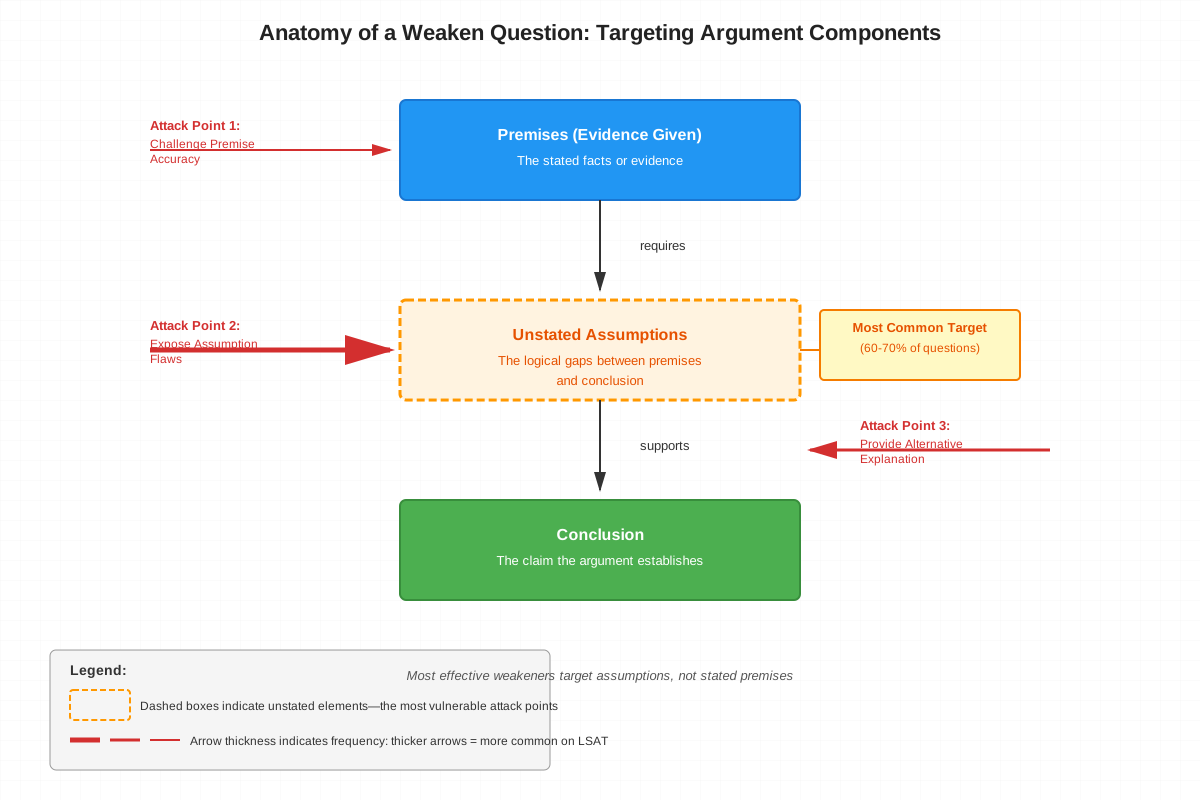
Every argument on the LSAT contains potential points of vulnerability where evidence could weaken its reasoning. Argument vulnerability refers to the logical gaps, unstated assumptions, or reasoning patterns that make a conclusion susceptible to doubt. Identifying these vulnerabilities requires analyzing three key components: the conclusion (what the argument claims), the premises (the evidence provided), and the gap between them (what must be assumed for the premises to support the conclusion).
The most common vulnerabilities include: unwarranted causal claims (assuming X causes Y without ruling out alternative explanations), representativeness issues (generalizing from an unrepresentative sample), scope mismatches (premises that don't fully support the breadth of the conclusion), overlooked alternatives (failing to consider other possibilities), and temporal assumptions (assuming past patterns will continue). Recognizing these vulnerability types allows test-takers to predict what kind of evidence would be relevant for weakening before even reading the answer choices.
The Relevance Criterion
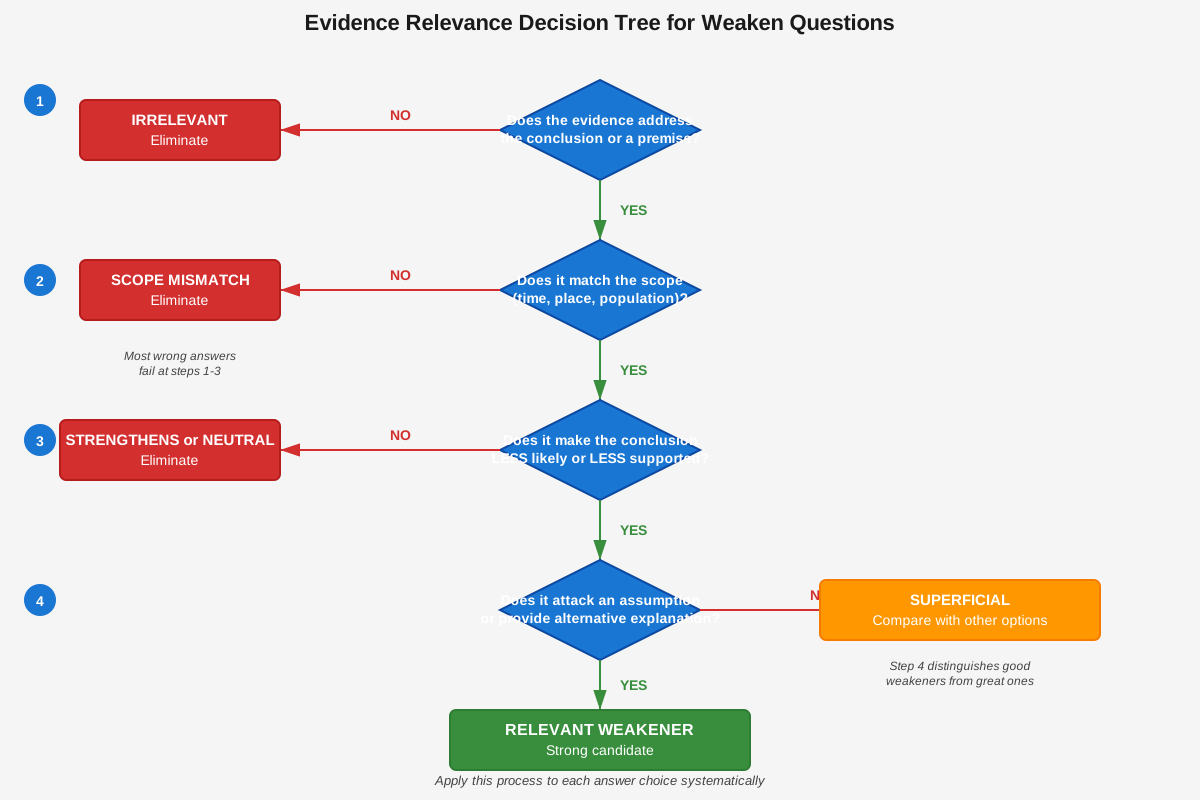
Not all evidence that relates to an argument's topic actually weakens the argument. Relevant weakening evidence must directly impact the logical connection between premises and conclusion or must directly challenge the conclusion itself. Evidence can be topically related yet logically irrelevant if it doesn't affect whether the conclusion follows from the premises.
For evidence to be relevant in weakening an argument, it must satisfy at least one of these conditions: (1) it provides an alternative explanation for the phenomenon described in the premises, (2) it demonstrates that a key assumption is false or questionable, (3) it shows that the premises, even if true, don't make the conclusion more likely, (4) it provides direct counterexamples to the conclusion, or (5) it reveals that the reasoning pattern used is unreliable in this context.
Consider this distinction: If an argument concludes that "reducing speed limits will decrease traffic fatalities" based on the premise that "lower speeds reduce accident severity," then evidence showing "many drivers ignore speed limits" is relevant because it challenges whether the proposed cause (reduced speed limits) will actually produce the effect (lower speeds). However, evidence showing "traffic fatalities have increased over the past decade" is irrelevant because it doesn't address whether the proposed intervention would work—it's merely background information about the problem's magnitude.
Types of Weakening Evidence
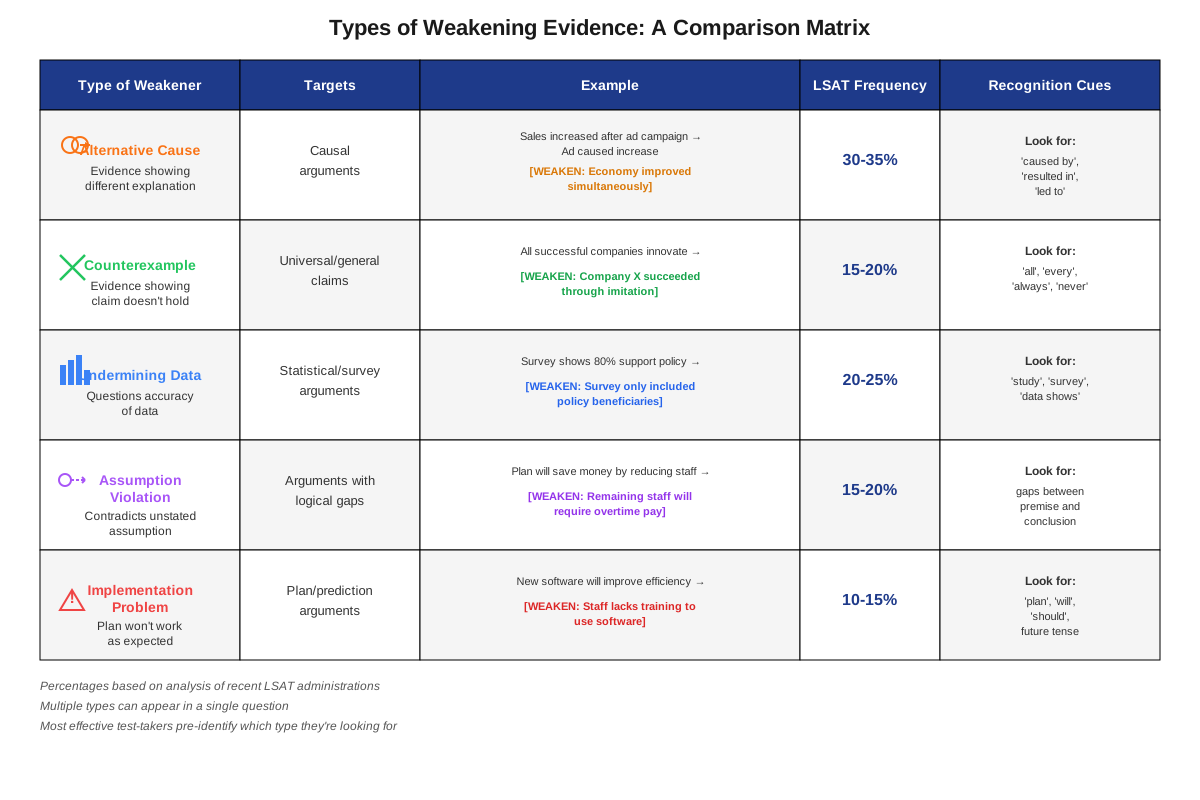
Different argument structures are vulnerable to different types of weakening evidence. Understanding these patterns dramatically improves efficiency and accuracy.
| Argument Type | Vulnerable To | Example Weakener |
|---|---|---|
| Causal Claims | Alternative causes, correlation without causation, reversed causation | "The observed effect occurred before the supposed cause" |
| Statistical Arguments | Sample bias, unrepresentative data, confounding variables | "The sample consisted entirely of atypical cases" |
| Analogies | Relevant differences between compared items | "The two situations differ in a way that affects the outcome" |
| Plans/Proposals | Unintended consequences, implementation problems, false assumptions | "The plan's success depends on a condition unlikely to be met" |
| Explanations | Alternative explanations that better fit the evidence | "Another factor better accounts for all the observed phenomena" |
The Degree of Weakening
LSAT weaken questions typically ask for the answer choice that "most weakens" or "most seriously undermines" the argument, indicating that degree matters. Degree of weakening refers to how much an answer choice reduces the probability that the conclusion is true or well-supported. The correct answer doesn't need to completely destroy the argument—it merely needs to weaken it more than the other options.
Evidence that directly contradicts a necessary assumption typically weakens more strongly than evidence that merely raises questions. Evidence that provides a complete alternative explanation typically weakens more than evidence that suggests additional factors might be involved. Evidence that shows the reasoning pattern is fundamentally flawed typically weakens more than evidence that identifies a single exception.
When evaluating degree, consider: Does this evidence make the conclusion significantly less likely to be true? Does it undermine the core reasoning or just a peripheral point? Does it apply to the entire argument or just a subset of cases? Does it directly challenge the logical connection or merely introduce tangential concerns?
Scope Matching in Weaken Questions
One of the most common errors in weaken questions involves selecting answer choices that don't match the argument's scope. Scope matching requires ensuring that the weakening evidence addresses the same subject matter, time frame, population, and degree as the original argument.
If an argument concludes that "most companies will benefit from remote work policies," then evidence about "some employees preferring office work" doesn't match the scope—it addresses employee preferences rather than company benefits. Similarly, evidence about "small startups struggling with remote coordination" is too narrow if the argument concerns "most companies" generally. The weakening evidence must target the actual claim being made, not a related but distinct claim.
Scope mismatches often appear in wrong answer choices as attractive distractors. They may weaken a claim similar to the argument's conclusion but not the actual conclusion stated. Careful attention to qualifiers (most, some, all), subject matter (companies vs. employees), and specific claims (will benefit vs. prefer) prevents these errors.
Assumption-Based Weakening
Many of the strongest weaken answer choices work by attacking an argument's unstated assumptions. Assumption-based weakening involves identifying what the argument takes for granted and then providing evidence that this assumption is false or questionable.
The process follows these steps:
- Identify the argument's conclusion and premises
- Determine what must be assumed for the premises to support the conclusion
- Recognize which assumption, if false, would most damage the argument
- Select the answer choice that provides evidence against this critical assumption
For example, if an argument concludes "Installing security cameras will reduce theft" based on "security cameras deter criminals," it assumes that potential thieves will know about and be influenced by the cameras. Evidence showing "the cameras will be hidden and unmarked" attacks this assumption and thereby weakens the argument.
Causal Weakening Patterns
Causal arguments appear frequently in LSAT weaken questions and follow predictable vulnerability patterns. Causal weakening typically involves one of five strategies:
- Alternative cause: Showing that something other than the proposed cause could produce the observed effect
- Reversed causation: Demonstrating that the supposed effect actually causes what was claimed as the cause
- Correlation without causation: Revealing that both the supposed cause and effect result from a third factor
- Temporal problems: Showing the effect occurred before the cause or that the cause didn't precede the effect
- Mechanism failure: Demonstrating that the proposed causal mechanism doesn't actually work as claimed
When an argument claims "X causes Y," the most effective weakening evidence typically shows that Y occurs without X, that X occurs without Y, that something else causes both X and Y, or that the mechanism connecting X to Y is flawed.
Concept Relationships
The concepts within evidence relevance in weaken questions form an interconnected system. Argument vulnerability serves as the foundation—without identifying where an argument is vulnerable, determining relevant evidence becomes impossible. This vulnerability identification directly depends on assumption-based weakening, since assumptions represent the primary points where arguments are vulnerable.
The relevance criterion acts as a filter that operates after vulnerability identification. Once potential weaknesses are identified, the relevance criterion determines which evidence actually impacts those weaknesses versus which evidence merely relates to the topic. This filtering process requires scope matching to ensure the evidence addresses the actual argument rather than a related but distinct claim.
Types of weakening evidence and causal weakening patterns represent specific applications of the general principles. These patterns provide shortcuts for recognizing common argument structures and predicting their vulnerabilities. Degree of weakening operates as the final evaluation criterion when multiple answer choices provide relevant weakening evidence—it determines which option most effectively undermines the argument.
The relationship flows: Argument Structure → Vulnerability Identification → Assumption Recognition → Relevance Filtering → Scope Verification → Degree Evaluation → Answer Selection. Each step depends on the previous steps, making this a sequential yet integrated analytical process.
These concepts connect to prerequisite knowledge in specific ways. Basic argument structure provides the framework for identifying conclusions and premises, which enables vulnerability identification. Assumption identification skills directly transfer to assumption-based weakening. Causal reasoning fundamentals underpin causal weakening patterns. Conditional logic helps recognize when evidence contradicts necessary conditions. Scope and degree concepts enable scope matching and degree evaluation.
High-Yield Facts
⭐ The correct answer in a weaken question must be relevant to the logical connection between premises and conclusion, not merely related to the topic
⭐ Evidence that provides an alternative explanation for the premises typically weakens causal arguments more effectively than evidence that merely questions the proposed cause
⭐ Weaken questions ask for the answer that "most weakens" the argument—the correct answer doesn't need to completely destroy the argument, just weaken it more than other options
⭐ Scope mismatches are the most common type of wrong answer in weaken questions—evidence must address the same population, time frame, and degree as the argument's conclusion
⭐ Attacking a necessary assumption typically weakens an argument more effectively than attacking a peripheral point
- Evidence showing that a key term is used differently in premises versus conclusion can weaken by revealing equivocation
- Statistical arguments are particularly vulnerable to evidence about sample representativeness and confounding variables
- Plan and proposal arguments are vulnerable to evidence about implementation problems and unintended consequences
- Evidence that the supposed effect occurred before the supposed cause strongly weakens causal arguments
- Analogical arguments are weakened by evidence showing relevant differences between the compared situations
- Evidence that contradicts what the argument explicitly states is usually too strong—weaken questions typically target assumptions rather than stated premises
- Temporal scope matters: evidence about past patterns may not weaken claims about future outcomes unless the argument assumes continuity
- Evidence about exceptions to a general rule weakens arguments claiming universal patterns but may not weaken arguments claiming typical patterns
- The strength of weakening evidence often depends on whether it's about a necessary condition versus a sufficient condition
- Evidence that shows the argument's reasoning pattern is unreliable in similar cases can weaken even without directly addressing the specific conclusion
Quick check — test yourself on Evidence relevance in weaken questions so far.
Try Flashcards →Common Misconceptions
Misconception: Any evidence that makes the conclusion seem less appealing or desirable weakens the argument → Correction: Weaken questions target logical support, not practical desirability. Evidence showing a conclusion would have negative consequences doesn't weaken the logical reasoning unless those consequences affect whether the premises support the conclusion. An argument that "sales will increase" isn't weakened by evidence that "increased sales would strain resources"—that addresses whether increased sales would be good, not whether they will occur.
Misconception: Evidence that contradicts the conclusion always weakens the argument more than evidence that questions an assumption → Correction: Evidence that directly contradicts an explicitly stated conclusion often represents an unrealistic scenario that test-makers avoid. The LSAT typically constructs arguments where the premises are stipulated as true, so the vulnerability lies in the reasoning gap. Evidence targeting assumptions usually provides more realistic and effective weakening.
Misconception: Longer, more detailed answer choices weaken arguments more effectively than shorter ones → Correction: Length and complexity don't correlate with weakening strength. The LSAT often uses detailed answer choices as distractors that introduce irrelevant information. The most effective weakening evidence is often stated concisely and directly addresses the argument's core vulnerability.
Misconception: If an answer choice is true in the real world, it must weaken the argument if it relates to the topic → Correction: Real-world truth doesn't determine logical relevance. The question stem specifies "if true" to indicate that all answer choices should be treated as true for the purpose of the question. The issue is whether the information, assuming it's true, actually impacts the logical relationship between premises and conclusion.
Misconception: Evidence that weakens one premise weakens the entire argument → Correction: Arguments often contain multiple premises, and weakening one premise may not significantly impact the conclusion if other premises provide independent support. Effective weakening evidence typically targets the connection between premises and conclusion or attacks an assumption necessary for that connection, rather than merely questioning a single premise.
Misconception: Weaken questions require finding evidence that proves the conclusion false → Correction: Weakening means reducing the degree to which premises support a conclusion, not proving the conclusion false. An argument can be weakened even if its conclusion remains possibly or even probably true. The focus is on logical support, not truth value.
Misconception: Evidence about a different time period or population than mentioned in the argument is automatically irrelevant → Correction: While scope matching is crucial, evidence about different contexts can be relevant if the argument assumes similarity across contexts. If an argument generalizes from one population to another, evidence showing relevant differences between those populations is highly relevant weakening evidence.
Worked Examples
Example 1: Causal Argument
Argument: "City officials concluded that the new traffic light at the intersection of Main and Oak Streets caused the 30% reduction in accidents at that intersection over the past year. After all, the accident rate dropped immediately after the light was installed, and no other changes were made to the intersection."
Question: Which of the following, if true, most weakens the city officials' conclusion?
Analysis Process:
Step 1: Identify the conclusion and premises
- Conclusion: The new traffic light caused the 30% reduction in accidents
- Premises: (1) Accident rate dropped immediately after installation, (2) No other changes were made to the intersection
Step 2: Identify the argument's vulnerability
This is a causal argument claiming the traffic light caused the reduction. The argument assumes: (a) no other factors could explain the reduction, (b) the temporal correlation indicates causation, (c) the intersection itself was the relevant unit of analysis.
Step 3: Predict effective weakening evidence
Strong weakeners would: provide an alternative explanation for the reduction, show the reduction occurred for reasons unrelated to the light, or demonstrate that similar reductions occurred where no lights were installed.
Step 4: Evaluate answer choices (hypothetical options)
(A) "Traffic volume at the intersection decreased by 40% during the same period due to a new highway bypass opening nearby"
- This provides a strong alternative explanation. Fewer cars means fewer opportunities for accidents, which could fully explain the reduction without the traffic light playing any causal role. This attacks the assumption that no other factors explain the reduction.
(B) "The traffic light was installed at the recommendation of a traffic safety expert"
- This is irrelevant to whether the light actually caused the reduction. Expert recommendations don't determine causal relationships.
(C) "Some drivers have complained that the traffic light causes delays during off-peak hours"
- This addresses consequences of the light but doesn't affect whether it caused the accident reduction. Scope mismatch: this is about delays, not accidents.
(D) "The intersection had experienced a particularly high number of accidents in the year before the light was installed"
- This might suggest regression to the mean but doesn't directly provide an alternative explanation. It's weaker than (A).
(E) "Traffic lights at other intersections in the city have also been associated with accident reductions"
- This actually strengthens the argument by suggesting traffic lights generally reduce accidents.
Correct Answer: (A)
Connection to Learning Objectives: This example demonstrates how to identify evidence relevance (the alternative explanation is relevant while expert opinions and driver complaints are not), explains the reasoning pattern (causal arguments are vulnerable to alternative explanations), and applies the concept to solve the problem by systematically evaluating each option's impact on the argument's logical structure.
Example 2: Plan/Proposal Argument
Argument: "The university should require all students to complete an internship before graduation. A recent survey found that 85% of employers prefer to hire candidates with internship experience, and students who completed internships reported higher job satisfaction in their first positions. Therefore, making internships mandatory will improve employment outcomes for our graduates."
Question: Which of the following, if true, most seriously undermines the argument?
Analysis Process:
Step 1: Identify the conclusion and premises
- Conclusion: Making internships mandatory will improve employment outcomes
- Premises: (1) 85% of employers prefer candidates with internship experience, (2) Students with internships reported higher job satisfaction
Step 2: Identify the argument's vulnerability
This is a plan/proposal argument. It assumes: (a) the correlation between internships and outcomes indicates internships cause better outcomes, (b) mandatory internships would be similar to voluntary internships, (c) the benefits observed in voluntary internships would transfer to mandatory ones, (d) implementation is feasible.
Step 3: Predict effective weakening evidence
Strong weakeners would: show that mandatory internships differ from voluntary ones in ways that affect outcomes, reveal that self-selection explains the correlation (motivated students choose internships AND succeed), demonstrate implementation problems, or show that the assumed causal mechanism doesn't work.
Step 4: Evaluate answer choices (hypothetical options)
(A) "Students who voluntarily pursued internships were already more motivated and career-focused than average students, traits that independently predict employment success"
- This is a strong weakener. It suggests self-selection bias: the internships didn't cause the better outcomes; rather, the type of student who chooses internships would succeed anyway. Making internships mandatory wouldn't replicate this self-selection effect. This attacks the causal assumption underlying the plan.
(B) "Some academic programs already require internships as part of their curriculum"
- This doesn't weaken the argument. If anything, it suggests the plan is feasible. It doesn't address whether mandatory internships would improve outcomes.
(C) "The survey of employers was conducted by a reputable research organization"
- This strengthens rather than weakens by supporting the reliability of the premise.
(D) "Internship opportunities in the local area are limited and could not accommodate all students"
- This is a practical implementation concern and does weaken the argument somewhat, but it doesn't address whether the plan would work if implemented. It's a weaker objection than (A).
(E) "Job satisfaction is only one measure of employment outcomes"
- This is too weak. The argument also cites employer preferences, and even if job satisfaction is just one measure, the argument would still be supported by improved outcomes on that measure.
Correct Answer: (A)
Connection to Learning Objectives: This example shows how to identify that self-selection evidence is relevant to plan arguments (identifying relevance), explains that plans assuming causation are vulnerable to evidence showing correlation without causation (explaining the reasoning pattern), and demonstrates systematic application by working through why each answer choice does or doesn't effectively weaken the argument.
Exam Strategy
When approaching weaken questions on the LSAT, employ a systematic process that maximizes accuracy while managing time effectively. Begin by reading the question stem first to confirm it's asking for weakening evidence—this primes the mind to look for vulnerabilities rather than support. Common trigger phrases include "weakens," "undermines," "casts doubt on," "calls into question," and "most seriously challenges."
Read the argument carefully and identify the conclusion explicitly. Many test-takers lose points by attacking the wrong claim. Underline or mentally note the conclusion, then identify the premises. As you read, actively think about the gap between premises and conclusion—what must be assumed for this reasoning to work?
Before looking at answer choices, predict the type of evidence that would weaken the argument. Ask yourself: "What would make this conclusion less likely to follow from these premises?" This prediction step dramatically improves accuracy because it prevents answer choices from manipulating your thinking. Even a general prediction like "something showing an alternative explanation" or "evidence that the key assumption is false" helps.
When evaluating answer choices, use the "Relevance First, Degree Second" approach. First, eliminate any choices that are irrelevant to the logical connection between premises and conclusion, regardless of how they relate to the topic. Topical relevance doesn't equal logical relevance. Second, among the remaining relevant options, determine which weakens most strongly.
Watch for scope mismatches carefully. The LSAT frequently includes wrong answers that would weaken a similar but not identical argument. Pay attention to qualifiers (most, some, many, all), subject matter (companies vs. employees, causes vs. effects), and temporal scope (past, present, future). The weakening evidence must match the conclusion's scope.
Be suspicious of answer choices that seem to completely destroy the argument or that contradict explicit premises. The LSAT typically constructs weaken questions where the correct answer reduces support rather than eliminating it entirely. If an answer seems too strong, it's often wrong.
Time allocation for weaken questions should average 1:20-1:30 per question. If you find yourself spending more than two minutes, make your best prediction and move on. Weaken questions are high-yield for improvement but not worth sacrificing time needed for other questions.
Use the "Opposite Test" for confirmation: if the opposite of an answer choice would strengthen the argument, then the answer choice itself likely weakens it. This test helps confirm that you've correctly identified the logical relationship.
Memory Techniques
CASTE - Remember the five main types of causal weakening:
- Correlation without causation (third factor causes both)
- Alternative cause (different explanation)
- Sample problems (unrepresentative data)
- Temporal issues (timing problems)
- Effect causes cause (reversed causation)
RADS - Remember what makes evidence relevant:
- Relates to the logical connection (not just the topic)
- Addresses the actual conclusion (scope matching)
- Directly impacts an assumption
- Shows the reasoning pattern is unreliable
The Bridge Visualization: Picture the argument as a bridge from premises (one side) to conclusion (other side). Assumptions are the support beams underneath. Weakening evidence either: (1) shows the bridge doesn't actually reach the conclusion (scope problem), (2) damages a support beam (attacks an assumption), or (3) shows there's another bridge that better explains how to get across (alternative explanation). This visualization helps identify where evidence needs to target.
The "So What?" Test: When evaluating whether evidence is relevant, ask "So what? How does this affect whether the conclusion follows from the premises?" If you can't articulate a clear connection, the evidence is likely irrelevant regardless of how interesting or topically related it seems.
Assumption = Vulnerability: Remember this equation. Wherever an argument makes an assumption, it creates a vulnerability. The strongest weakening evidence typically attacks the strongest assumption. To find the best weakener, find the biggest assumption.
Summary
Evidence relevance in weaken questions requires understanding that effective weakening evidence must impact the logical relationship between an argument's premises and conclusion, not merely relate to the argument's topic. The key to mastering these questions lies in identifying argument vulnerabilities—particularly unstated assumptions—and recognizing which types of evidence target those specific vulnerabilities. Different argument structures (causal claims, statistical reasoning, plans, analogies) are vulnerable to different types of weakening evidence, making pattern recognition a high-yield strategy. Scope matching is critical: evidence must address the same population, time frame, and degree as the argument's actual conclusion. The correct answer in weaken questions doesn't need to destroy the argument completely; it merely needs to reduce the degree to which premises support the conclusion more than other answer choices do. Success requires a systematic approach: identify the conclusion, recognize the reasoning pattern, predict vulnerabilities, evaluate answer choices for relevance before degree, and watch for scope mismatches that make topically related evidence logically irrelevant.
Key Takeaways
- Evidence relevance in weaken questions depends on logical connection to the argument's reasoning, not topical relationship to the subject matter
- The strongest weakening evidence typically attacks necessary assumptions rather than explicit premises or peripheral points
- Causal arguments are particularly vulnerable to alternative explanations, reversed causation, and evidence of correlation without causation
- Scope mismatches represent the most common wrong answer type—evidence must match the conclusion's qualifiers, subject matter, and temporal frame
- Predicting the type of weakening evidence before reading answer choices dramatically improves accuracy and efficiency
- Degree matters: the correct answer "most weakens" the argument, requiring comparison among relevant options
- Plan and proposal arguments are vulnerable to evidence about implementation problems, unintended consequences, and differences between voluntary and mandatory versions
Related Topics
Strengthen Questions: The mirror image of weaken questions, where evidence must increase rather than decrease the degree to which premises support a conclusion. Mastering weaken questions provides the foundation for strengthen questions since the same vulnerability points become targets for supporting evidence.
Necessary Assumption Questions: These questions explicitly ask for assumptions that arguments depend on. Understanding evidence relevance in weaken questions helps identify necessary assumptions because evidence that would weaken an argument often does so by showing a necessary assumption is false.
Flaw Questions: These questions ask test-takers to identify the reasoning error in an argument. The vulnerabilities targeted by weakening evidence often correspond to the flaws that flaw questions ask about, making these topics mutually reinforcing.
Evaluate Questions: These questions ask what information would be most useful in assessing an argument's strength. Understanding what would weaken an argument helps identify what information would be relevant for evaluation.
Causal Reasoning Advanced Topics: Deeper exploration of complex causal patterns, including multiple causation, causal chains, and probabilistic causation, builds on the causal weakening patterns introduced here.
Practice CTA
Now that you've mastered the conceptual framework for evidence relevance in weaken questions, it's time to apply these principles to actual LSAT-style problems. The practice questions and flashcards will reinforce your ability to quickly identify argument vulnerabilities, distinguish relevant from irrelevant evidence, and select the answer choice that most effectively weakens each argument. Remember: understanding the concepts is only the first step—developing the pattern recognition and analytical speed necessary for test day requires deliberate practice. Each practice question you work through strengthens the neural pathways that enable you to execute this systematic approach automatically under time pressure. You've built the foundation; now build the skill through application.
Sign up free to keep reading
Create a free AnvayaPrep account to finish this LSAT guide on Evidence relevance in weaken questions — plus flashcards and practice questions.