Overview
Strengthening surveys is a critical subtopic within LSAT Logical Reasoning that tests a student's ability to evaluate and improve arguments based on survey data. On the LSAT, approximately 15-20% of Logical Reasoning questions involve strengthen and weaken questions, and a significant portion of these feature survey-based arguments. These questions require test-takers to identify which answer choice, when added to the argument, makes the conclusion more likely to be true or better supported by the evidence presented.
Survey-based arguments are particularly common on the LSAT because they mirror real-world reasoning patterns used in policy-making, scientific research, and everyday decision-making. The test-makers favor these questions because they efficiently assess multiple reasoning skills simultaneously: understanding statistical reasoning, recognizing sampling issues, evaluating methodology, and identifying relevant versus irrelevant information. When an argument relies on survey data to reach a conclusion, the LSAT expects students to recognize what additional information would make that conclusion more credible or reliable.
Within the broader landscape of LSAT strengthening surveys questions, this topic connects directly to fundamental principles of argument analysis, evidence evaluation, and critical thinking. Mastering strengthening surveys requires understanding not just what makes an argument stronger, but also recognizing the specific vulnerabilities inherent in survey-based reasoning. This skill set transfers directly to other Logical Reasoning question types, including assumption questions, flaw questions, and necessary assumption questions, making it a high-leverage area of study for test preparation.
Learning Objectives
- [ ] Identify how Strengthening surveys appears in LSAT questions
- [ ] Explain the reasoning pattern behind Strengthening surveys
- [ ] Apply Strengthening surveys to solve LSAT-style problems accurately
- [ ] Recognize the five most common vulnerabilities in survey-based arguments
- [ ] Distinguish between answer choices that strengthen versus those that are merely consistent with the argument
- [ ] Evaluate the relative strength of different answer choices when multiple options provide some support
Prerequisites
- Basic argument structure: Understanding premises, conclusions, and how evidence supports claims is essential because strengthening questions require identifying what additional evidence would improve the argument's support structure.
- Survey methodology fundamentals: Familiarity with concepts like sample size, representativeness, and response rates matters because these are the primary vulnerabilities that strengthening answer choices address.
- Distinction between correlation and causation: This background knowledge is relevant because many survey arguments make causal claims that require specific types of strengthening evidence.
- Understanding of strengthen question stems: Recognizing question types is necessary because the approach to strengthening differs from weakening, assumption, or flaw questions.
Why This Topic Matters
Survey-based reasoning pervades modern decision-making across law, public policy, business, and scientific research. Legal professionals regularly encounter survey evidence in cases involving trademark confusion, employment discrimination, consumer protection, and public opinion. Understanding how to evaluate and strengthen survey-based arguments is therefore not merely an academic exercise but a practical skill that law students and attorneys use throughout their careers.
On the LSAT specifically, strengthening surveys questions appear with remarkable frequency. Recent LSAT administrations have featured 3-5 survey-based strengthen questions per test, representing approximately 8-12% of all Logical Reasoning questions. These questions typically appear in the medium-to-difficult range, making them crucial for students aiming for scores above the 160 threshold. The LSAT tests this concept because it efficiently assesses multiple competencies that predict law school success: analytical reasoning, attention to methodological detail, and the ability to distinguish strong from weak evidence.
Common manifestations in LSAT passages include: consumer preference surveys used to support marketing claims, employee satisfaction surveys used to evaluate workplace policies, public opinion polls used to justify political decisions, and research surveys used to establish causal relationships. The test-makers consistently exploit the same vulnerabilities in these arguments, making pattern recognition a powerful tool for test-takers who invest time in mastering this topic.
Core Concepts
Understanding Survey-Based Arguments
A survey-based argument uses data collected from a sample of individuals to draw a conclusion about a larger population or to support a specific claim. The fundamental structure involves: (1) a survey methodology (how data was collected), (2) survey results (what the data showed), and (3) a conclusion drawn from those results. The strength of such arguments depends critically on whether the survey was conducted properly and whether the conclusion follows logically from the data.
When the LSAT asks students to strengthen a survey-based argument, the correct answer will address one of the argument's vulnerabilities by providing information that makes the conclusion more likely to be true. This differs from assumption questions (which ask what must be true for the argument to work) and from sufficient assumption questions (which ask what would guarantee the conclusion). Strengthening answers make the conclusion more probable without necessarily making it certain.
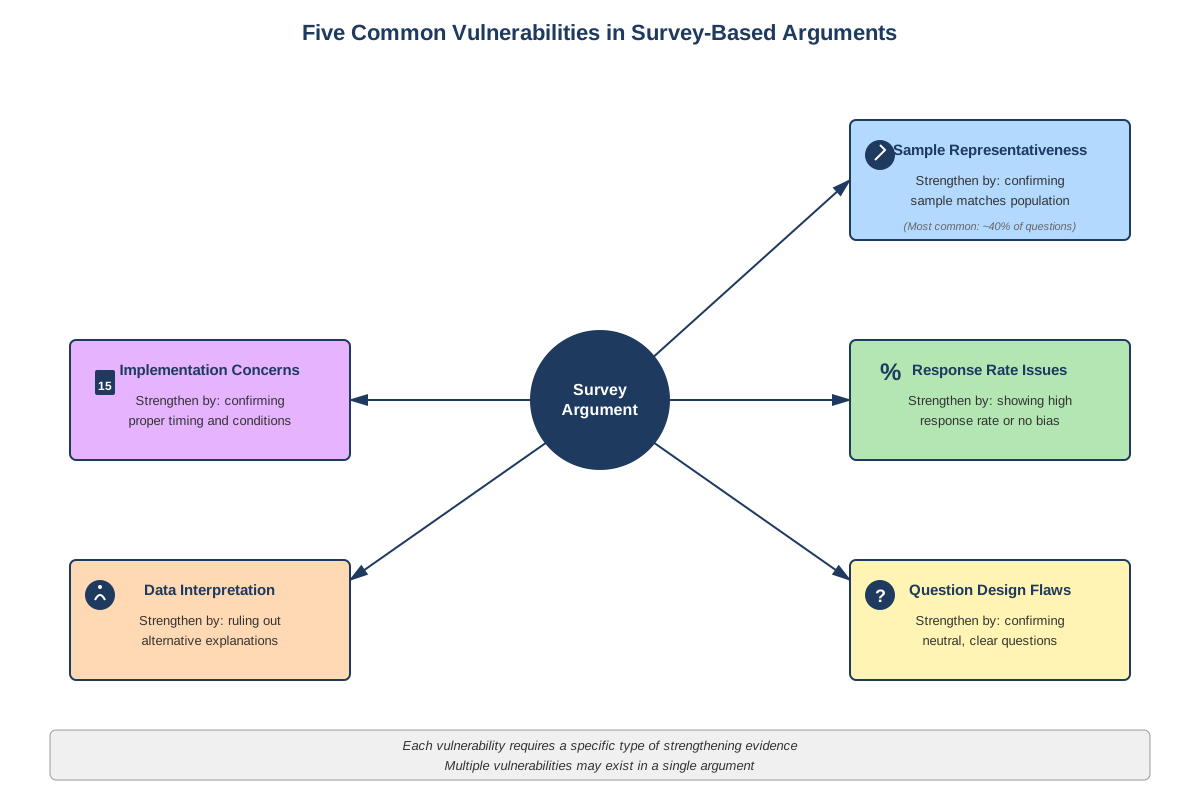
The Five Primary Survey Vulnerabilities
Understanding what can go wrong with survey-based arguments is essential for identifying what would strengthen them. The LSAT exploits these vulnerabilities consistently:
1. Sample Representativeness
The most frequently tested vulnerability concerns whether the survey sample accurately represents the population about which the conclusion is drawn. If a survey of college students is used to draw conclusions about all adults, the argument is vulnerable. A strengthening answer might establish that college students' views on this issue mirror those of the general population, or that the characteristic being measured doesn't vary significantly across demographic groups.
2. Response Rate and Self-Selection Bias
Surveys often suffer from low response rates or self-selection problems where only people with strong opinions respond. If only 5% of surveyed individuals responded, those respondents might not represent the views of non-respondents. Strengthening answers address this by showing high response rates, demonstrating that respondents and non-respondents share relevant characteristics, or establishing that the issue being measured doesn't correlate with likelihood of responding.
3. Question Wording and Survey Design
How survey questions are phrased dramatically affects responses. Leading questions, ambiguous terms, or confusing formats can produce unreliable data. Strengthening answers might establish that questions were neutrally worded, that terms were clearly defined, or that the survey format was tested for reliability.
4. Timing and Context
When a survey is conducted can affect results. A survey about job satisfaction conducted immediately after annual bonuses might yield different results than one conducted during layoffs. Strengthening answers address timing by showing the survey was conducted during a typical period, that the timing doesn't affect the measured variable, or that results have been consistent across multiple time periods.
5. Honesty and Accuracy of Responses
Survey respondents may lie, misremember, or lack knowledge about what they're asked. This is particularly problematic for surveys about sensitive topics or future behavior. Strengthening answers might establish that respondents had no incentive to be dishonest, that their responses were verified against objective data, or that the survey design minimized social desirability bias.
The Strengthening Mechanism
When evaluating answer choices for lsat strengthening surveys questions, the correct answer operates through one of three mechanisms:
Mechanism 1: Eliminating Alternative Explanations
The answer shows that factors other than what the argument claims cannot explain the survey results. For example, if an argument concludes that a new policy caused increased satisfaction based on a survey, a strengthening answer might show that no other changes occurred during the relevant period.
Mechanism 2: Validating Methodology
The answer provides information confirming that the survey was conducted properly and that its results are reliable. This might involve establishing sample representativeness, high response rates, or proper question design.
Mechanism 3: Establishing Relevance
The answer demonstrates that the survey results are actually relevant to the conclusion being drawn. This might show that survey respondents' stated preferences predict their actual behavior, or that the measured variable correlates with the outcome the argument discusses.
Distinguishing Strength Levels
Not all strengthening answers strengthen equally. The LSAT sometimes includes multiple answer choices that provide some support, requiring students to identify which provides the most support. Consider these levels:
| Strength Level | Characteristics | Example |
|---|---|---|
| Strong | Directly addresses the primary vulnerability; makes conclusion much more likely | "The survey sample was randomly selected from the entire population" |
| Moderate | Addresses a secondary concern; provides meaningful but limited support | "Most respondents had direct experience with the issue" |
| Weak | Tangentially related; provides minimal support | "The survey was conducted by a reputable firm" |
| Irrelevant | Consistent with argument but doesn't strengthen | "Other surveys on different topics have been conducted" |
Common Wrong Answer Patterns
Understanding what doesn't strengthen helps identify what does. Common trap answers include:
- Merely consistent information: Details that fit with the argument but don't make the conclusion more likely
- Addressing the wrong vulnerability: Fixing a problem the argument doesn't have while ignoring its actual weakness
- Weakening disguised as strengthening: Information that actually undermines the argument
- Irrelevant comparisons: Information about different surveys, populations, or time periods that doesn't bear on this argument
- Premise boosters: Information that makes a premise more believable without strengthening the connection between premises and conclusion
Concept Relationships
The concepts within strengthening surveys form an interconnected system. Survey vulnerabilities (representativeness, response rate, question design, timing, and honesty) represent the potential weaknesses in any survey-based argument. These vulnerabilities directly determine what strengthening mechanisms (eliminating alternatives, validating methodology, establishing relevance) will be effective. The strengthening mechanism employed depends on which vulnerability is most salient in the specific argument.
This topic connects to prerequisite knowledge of argument structure because identifying what would strengthen an argument requires first understanding the argument's logical structure—what conclusion is being drawn and what evidence supports it. The connection to survey methodology is direct: each methodological principle (random sampling, high response rates, neutral question wording) corresponds to a potential strengthening answer.
Strengthening surveys also relates closely to other Logical Reasoning topics. Assumption questions ask what must be true for a survey-based argument to work; these assumptions often become explicit statements in strengthening answer choices. Flaw questions identify what's wrong with survey arguments; strengthening answers fix these flaws. Weaken questions exploit the same vulnerabilities but in reverse—where a strengthening answer shows the sample was representative, a weakening answer shows it wasn't.
The relationship map flows as follows:
Survey-based argument → Contains inherent vulnerabilities → Vulnerabilities create opportunities for strengthening → Strengthening answers address vulnerabilities through specific mechanisms → Correct answer provides most support by addressing primary vulnerability → Mastery requires distinguishing strong from weak support
Quick check — test yourself on Strengthening surveys so far.
Try Flashcards →High-Yield Facts
⭐ The most common vulnerability in LSAT survey arguments is sample representativeness—approximately 40% of survey strengthen questions test whether the sample accurately represents the relevant population.
⭐ High response rates strengthen survey arguments by reducing self-selection bias and making results more likely to represent the entire surveyed population.
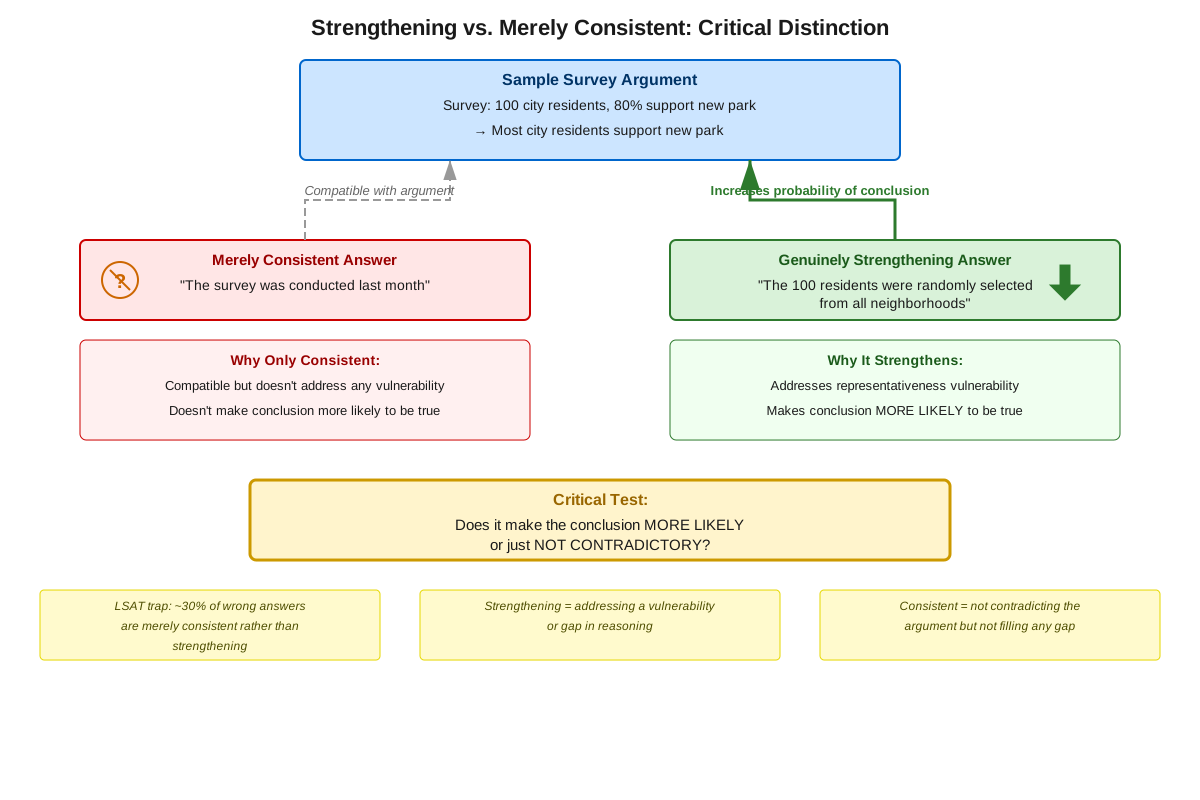
⭐ Strengthening answers must make the conclusion more likely to be true, not merely provide information consistent with the argument.
⭐ Random sampling is the gold standard for representativeness and frequently appears in correct strengthening answers.
⭐ The correct strengthening answer addresses the argument's primary vulnerability, not secondary or tangential concerns.
- Survey timing affects results, and showing the survey was conducted during a typical or neutral period strengthens the argument.
- Establishing that respondents had accurate knowledge or no incentive to lie strengthens arguments relying on self-reported data.
- Neutral question wording strengthens survey arguments by reducing bias in how respondents interpret and answer questions.
- Showing that stated preferences predict actual behavior strengthens arguments that use survey responses to predict future actions.
- Large sample sizes alone don't strengthen arguments if the sample isn't representative of the relevant population.
- Verification of survey responses against objective data strengthens arguments by confirming response accuracy.
- Demonstrating consistency across multiple surveys or time periods strengthens conclusions drawn from survey data.
Common Misconceptions
Misconception: Any information about survey methodology strengthens the argument.
Correction: Only information that addresses the specific vulnerability in the argument provides strengthening support. Details about methodology that don't relate to the argument's weakness are irrelevant.
Misconception: Larger sample sizes always strengthen survey-based arguments.
Correction: Sample size matters less than sample representativeness. A small random sample is stronger than a large biased sample. The LSAT frequently includes wrong answers that mention large samples without addressing whether those samples are representative.
Misconception: If an answer choice is true and consistent with the argument, it strengthens the argument.
Correction: Strengthening requires making the conclusion more likely to be true, not merely being consistent with it. An answer can be true and consistent while providing zero strengthening support.
Misconception: The correct answer must completely eliminate all doubts about the conclusion.
Correction: Strengthening answers make conclusions more likely, not certain. The LSAT asks which answer "most strengthens" or "provides the most support," not which proves the conclusion.
Misconception: Information about the survey conductor's reputation or credentials strengthens the argument.
Correction: Who conducted the survey rarely matters as much as how it was conducted. The LSAT uses this as a trap answer because students assume credibility equals methodological soundness.
Misconception: Showing that survey respondents were honest automatically strengthens any survey-based argument.
Correction: Honesty only matters if the argument's vulnerability relates to response accuracy. If the primary issue is sample representativeness or question design, establishing honesty doesn't address the main weakness.
Worked Examples
Example 1: Consumer Preference Survey
Argument: "A recent survey found that 78% of respondents prefer Brand X coffee to Brand Y coffee. Therefore, Brand X will likely outsell Brand Y in the national market this year."
Question: Which of the following, if true, most strengthens the argument?
Answer Choices:
(A) The survey was conducted by a well-known market research firm.
(B) Brand X coffee costs less than Brand Y coffee.
(C) The survey respondents were randomly selected from coffee drinkers nationwide.
(D) Previous surveys have shown similar preferences for Brand X.
(E) Brand X has been on the market longer than Brand Y.
Analysis:
First, identify the argument structure:
- Premise: Survey shows 78% prefer Brand X
- Conclusion: Brand X will outsell Brand Y nationally
- Gap: The survey sample must represent national coffee drinkers for the preference data to predict national sales
Next, identify the primary vulnerability: We don't know if the survey sample represents the national market. If the survey only included Brand X's existing customers or people in one region, the results wouldn't predict national sales.
Evaluate each answer:
(A) The firm's reputation doesn't address whether the sample was representative. This is a classic trap—credibility doesn't equal methodological soundness. Eliminate.
(B) This provides an alternative reason Brand X might outsell Brand Y (price), but it doesn't strengthen the survey-based reasoning. If anything, it suggests factors other than preference might drive sales. Eliminate.
(C) This directly addresses the representativeness vulnerability. Random selection from coffee drinkers nationwide means the sample likely represents the national market, making the preference data a better predictor of national sales. Strong candidate.
(D) Consistency across surveys provides some support, but it doesn't address whether any of these surveys used representative samples. Multiple flawed surveys don't strengthen the argument. Weaker than C.
(E) Market tenure is irrelevant to whether survey preferences predict sales. Eliminate.
Correct Answer: (C)
This answer strengthens by validating methodology—specifically, by establishing sample representativeness, which is the argument's primary vulnerability.
Example 2: Employee Satisfaction Survey
Argument: "Company Z conducted an employee satisfaction survey and found that 85% of respondents reported being satisfied with their jobs. The CEO concluded that the company's new workplace policies have been successful in improving employee morale."
Question: Which of the following, if true, most strengthens the CEO's conclusion?
Answer Choices:
(A) The survey was anonymous, encouraging honest responses.
(B) The response rate to the survey was 92%, with respondents representing all departments and seniority levels.
(C) Similar companies have reported lower satisfaction rates.
(D) The new policies were implemented six months before the survey.
(E) Employees who reported satisfaction cited the new policies as the primary reason.
Analysis:
Identify the argument structure:
- Premise: 85% of survey respondents reported job satisfaction
- Conclusion: The new policies successfully improved morale
- Gap: The conclusion assumes the policies caused the satisfaction, but the survey only shows correlation
The primary vulnerability is causal reasoning: even if satisfaction is high, we don't know if the policies caused it. Other factors might explain the satisfaction, or satisfaction might have been equally high before the policies.
Evaluate each answer:
(A) Anonymity addresses response honesty, which strengthens confidence in the 85% figure. However, it doesn't address whether the policies caused the satisfaction. Addresses wrong vulnerability.
(B) High response rate and broad representation strengthen confidence that 85% reflects true company-wide satisfaction. But again, this doesn't establish that policies caused the satisfaction. Addresses wrong vulnerability.
(C) Comparisons to other companies don't establish causation within Company Z. Other companies might have different circumstances. Irrelevant comparison.
(D) Timing information shows the policies preceded the satisfaction, which is necessary for causation but doesn't rule out alternative explanations. Weak support.
(E) This directly addresses the causal gap. If employees themselves attribute their satisfaction to the new policies, this provides strong evidence that the policies caused the satisfaction rather than other factors. Strong candidate.
Correct Answer: (E)
This answer strengthens by eliminating alternative explanations—it establishes that the policies, specifically, caused the satisfaction rather than other factors. While (B) might seem tempting because it addresses methodology, the argument's primary vulnerability is causal, not methodological.
Exam Strategy
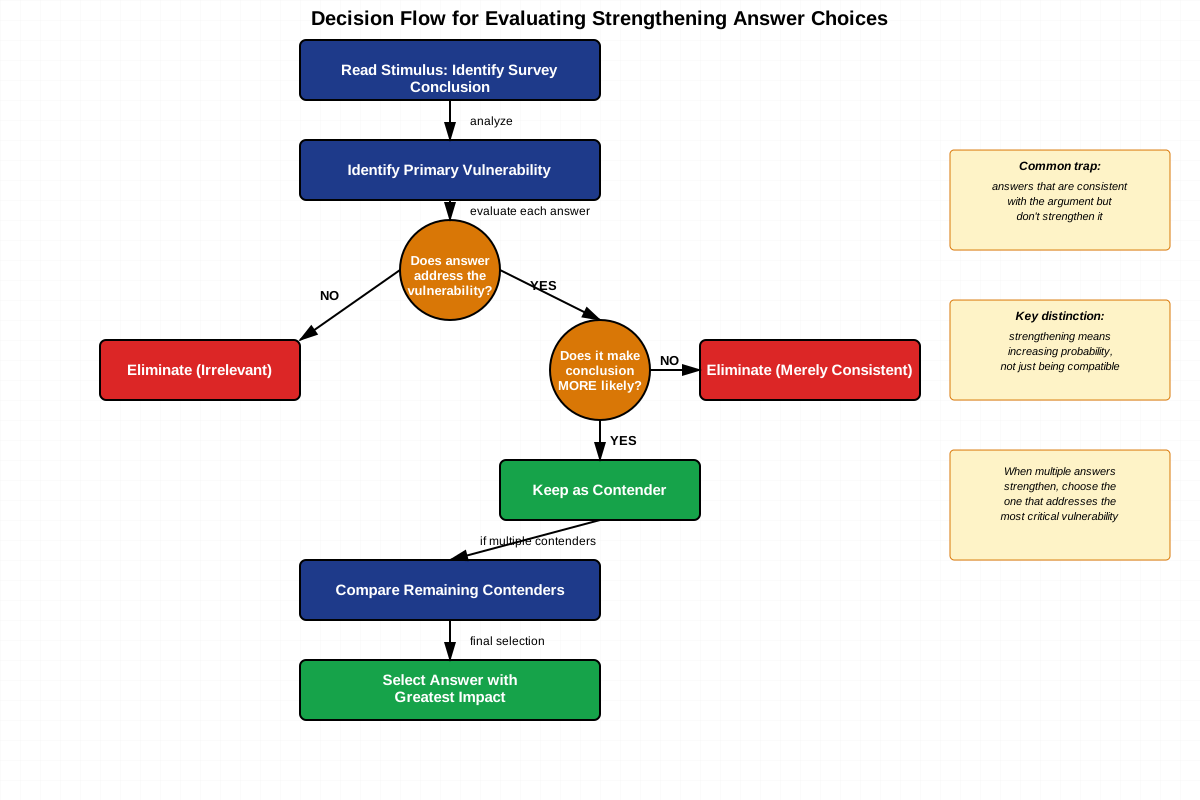
When approaching strengthen and weaken questions involving surveys on the LSAT, follow this systematic process:
Step 1: Identify the conclusion and evidence (15 seconds)
Determine exactly what the argument concludes and what survey data supports it. Pay special attention to scope—does the conclusion match the survey's scope?
Step 2: Spot the vulnerability (15 seconds)
Ask: What could go wrong with this survey-based reasoning? Is it representativeness, response rate, question design, timing, or honesty? Most arguments have one primary vulnerability.
Step 3: Predict the strengthening answer (10 seconds)
Before looking at choices, predict what information would address the vulnerability. This prevents trap answers from seeming attractive.
Step 4: Eliminate aggressively (30 seconds)
Remove answers that are merely consistent, address the wrong vulnerability, or are irrelevant. Often 3-4 answers can be eliminated quickly.
Step 5: Compare remaining choices (20 seconds)
If multiple answers provide some support, identify which addresses the primary vulnerability most directly.
Exam Tip: Watch for these trigger phrases in question stems: "most strengthens," "provides the most support," "if true, would most justify," or "best supports the conclusion." These all indicate strengthen questions.
Key trigger words in passages that signal survey vulnerabilities:
- "Survey respondents" → check representativeness
- "Those who responded" → check response rate
- "When asked" → check question design
- "Recently surveyed" → check timing
- "Reported that" → check honesty/accuracy
Time allocation: Spend no more than 90 seconds per strengthen question. If you're stuck between two answers after 90 seconds, choose the one that addresses representativeness (the most commonly tested vulnerability) and move on.
Process of elimination tips specific to surveys:
- Eliminate answers about survey conductor credentials (rarely relevant)
- Eliminate answers that strengthen a premise without strengthening the conclusion
- Eliminate answers about different surveys unless they establish a relevant pattern
- Eliminate answers that introduce new information without connecting it to the argument's reasoning
Memory Techniques
Mnemonic for the five survey vulnerabilities: "R-R-Q-T-H"
- Representativeness (Is the sample like the population?)
- Response rate (Did enough people respond?)
- Question design (Were questions neutral and clear?)
- Timing (When was the survey conducted?)
- Honesty (Were responses accurate?)
Visualization strategy: Picture a survey as a bridge connecting sample data (one side) to a conclusion about a population (other side). The bridge has five support pillars (R-R-Q-T-H). A strengthening answer reinforces one of these pillars. Identify which pillar is weakest, and look for the answer that reinforces it.
Acronym for strengthening mechanisms: "EVE"
- Eliminate alternative explanations
- Validate methodology
- Establish relevance
Memory aid for wrong answers: "CRIMP" your wrong answer choices:
- Consistent but not strengthening
- Reputation/credentials (usually irrelevant)
- Irrelevant comparisons
- Mismatched vulnerability (addresses wrong problem)
- Premise boosters (strengthen premise, not conclusion)
Summary
Strengthening surveys is a high-yield LSAT topic that tests the ability to identify what additional information would make survey-based arguments more convincing. The key to mastering these questions lies in recognizing that survey arguments have predictable vulnerabilities: sample representativeness, response rate, question design, timing, and response accuracy. The LSAT consistently exploits these vulnerabilities, with representativeness being the most frequently tested. Correct strengthening answers address the argument's primary vulnerability through one of three mechanisms: eliminating alternative explanations, validating methodology, or establishing relevance. Success requires distinguishing between answers that merely provide consistent information and those that genuinely make the conclusion more likely to be true. Students must avoid common traps like credibility appeals, irrelevant comparisons, and answers that address secondary rather than primary vulnerabilities. By systematically identifying the argument's structure, spotting its main weakness, and predicting what would fix that weakness, test-takers can efficiently navigate these medium-difficulty questions that appear frequently on every LSAT administration.
Key Takeaways
- Survey representativeness is the most commonly tested vulnerability—always check whether the sample matches the population about which conclusions are drawn
- Strengthening means making the conclusion more likely, not proving it—the correct answer provides the most support among the options, not absolute certainty
- Address the primary vulnerability, not secondary concerns—identify the argument's main weakness and find the answer that fixes it
- High response rates and random sampling are gold-standard strengtheners for survey methodology
- Eliminate answers that are merely consistent with the argument—consistency doesn't equal strengthening
- Causal survey arguments require evidence linking the cause to the effect—correlation in survey data doesn't establish causation without additional support
- Use the R-R-Q-T-H framework to quickly identify vulnerabilities and predict strengthening answers before reviewing choices
Related Topics
Weakening Surveys: The mirror image of this topic, where answer choices undermine rather than support survey-based arguments. Mastering strengthening surveys provides the foundation for recognizing what weakens them, as the same vulnerabilities are exploited in reverse.
Assumption Questions with Surveys: These questions ask what must be true for survey-based arguments to work. The assumptions in these questions often become explicit statements in strengthening answer choices, making the topics closely related.
Causal Reasoning: Many survey arguments make causal claims (X caused Y), requiring understanding of how to establish causation versus mere correlation. Strengthening causal survey arguments requires specific types of evidence.
Statistical Reasoning: A broader category that includes surveys but also encompasses studies, experiments, and other data-driven arguments. The principles learned here transfer to strengthening other statistical arguments.
Flaw Questions: Understanding survey flaws helps identify what would strengthen survey arguments, as strengthening answers often fix the flaws that flaw questions identify.
Practice CTA
Now that you've mastered the core concepts of strengthening surveys, it's time to put your knowledge into practice. Work through the practice questions to reinforce your understanding of survey vulnerabilities and strengthening mechanisms. Use the flashcards to memorize the R-R-Q-T-H framework and common wrong answer patterns. Remember: recognizing these patterns quickly is what separates good LSAT scores from great ones. Each practice question you complete builds the pattern recognition skills that will make these questions feel automatic on test day. You've invested the time to understand the concepts—now invest the time to make them second nature through deliberate practice.
Sign up free to keep reading
Create a free AnvayaPrep account to finish this LSAT guide on Strengthening surveys — plus flashcards and practice questions.