Overview
Weakening surveys is a critical subtopic within LSAT Logical Reasoning that tests a student's ability to identify flaws in survey-based arguments and recognize answer choices that undermine the validity or reliability of survey conclusions. Survey questions appear frequently on the LSAT, and understanding how to weaken them is essential for success on strengthen and weaken questions—one of the most common question types on the exam.
Survey-based arguments present unique vulnerabilities that differ from other argument types. These arguments rely on data collection methods, sample selection, question design, and interpretation of results. Each of these elements can be attacked in specific ways. When the LSAT asks test-takers to weaken a survey-based argument, it's testing whether students can identify methodological flaws, sampling biases, response issues, or interpretive errors that cast doubt on the survey's conclusions. Mastering this skill requires understanding both general weakening strategies and survey-specific vulnerabilities.
This topic sits at the intersection of critical reasoning and statistical literacy. While the LSAT doesn't require advanced statistical knowledge, it does expect students to recognize common sense problems with how surveys are conducted and interpreted. LSAT weakening surveys questions connect to broader Logical Reasoning skills including identifying assumptions, recognizing scope problems, and evaluating evidence quality. Students who master weakening surveys will find these skills transfer to other question types involving empirical evidence, causal reasoning, and generalization from samples.
Learning Objectives
- [ ] Identify how Weakening surveys appears in LSAT questions
- [ ] Explain the reasoning pattern behind Weakening surveys
- [ ] Apply Weakening surveys to solve LSAT-style problems accurately
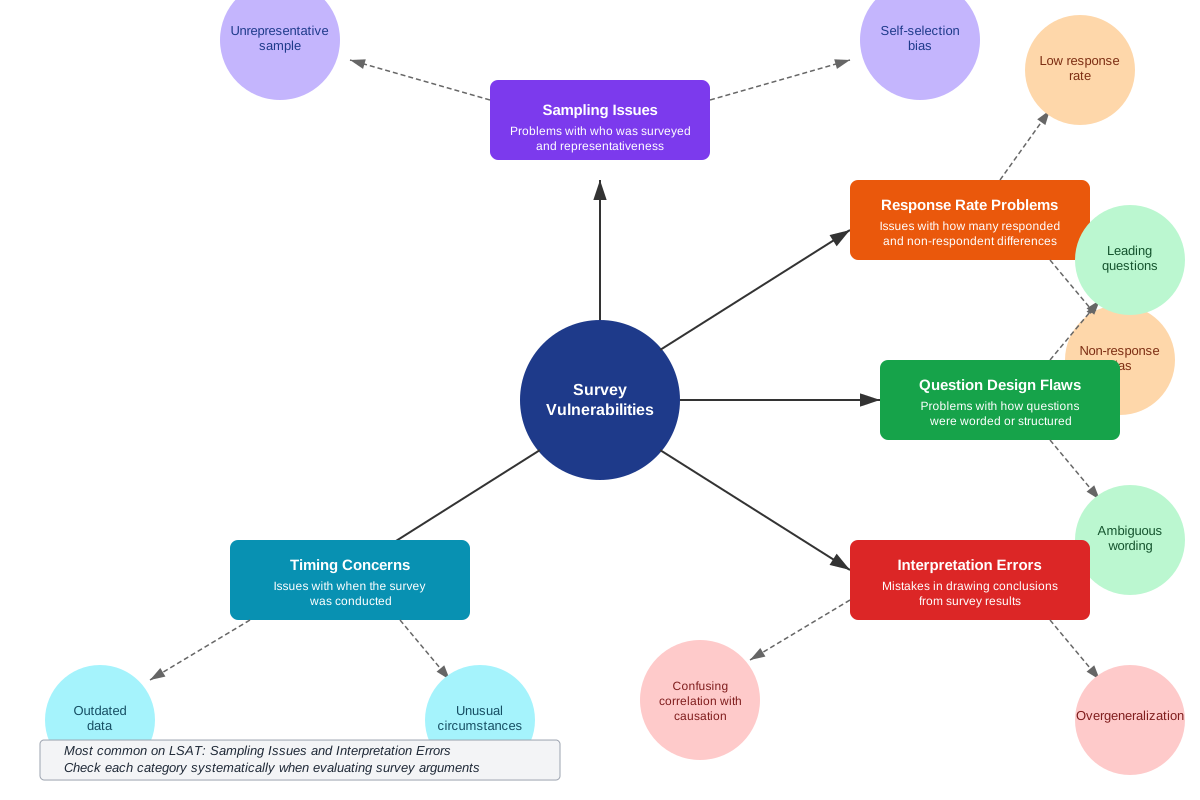
- [ ] Recognize the five major categories of survey vulnerabilities (sampling, response rate, question design, interpretation, and timing)
- [ ] Distinguish between answer choices that weaken survey methodology versus those that attack unrelated aspects of the argument
- [ ] Evaluate whether a given weakness is relevant to the specific conclusion drawn from survey data
Prerequisites
- Basic argument structure: Understanding premises, conclusions, and assumptions is essential because survey arguments follow standard argument patterns with survey data serving as evidence
- Strengthen and weaken fundamentals: Students must know what it means to weaken an argument generally before applying survey-specific weakening strategies
- Scope recognition: Identifying what a conclusion actually claims versus what it doesn't claim is crucial for determining whether a potential weakness is relevant
- Evidence evaluation: Basic understanding of how evidence supports conclusions helps students recognize when survey evidence is insufficient or flawed
Why This Topic Matters
Survey-based arguments appear in real-world contexts constantly—from political polling to market research to public health studies. The ability to critically evaluate survey methodology is a fundamental skill for lawyers, who must assess the reliability of survey evidence in litigation, evaluate expert testimony based on surveys, and construct arguments about the validity of empirical claims. This practical reasoning skill extends beyond law to any field requiring evidence-based decision-making.
On the LSAT specifically, survey questions appear in approximately 10-15% of Logical Reasoning questions, making them a high-frequency topic. They most commonly appear as Weaken questions, but also show up in Flaw, Strengthen, and Assumption question types. Survey arguments are particularly popular on the LSAT because they allow test-makers to create questions with clear right answers based on methodological principles while still requiring careful reasoning.
Survey questions typically appear in several formats: arguments concluding that a population holds certain beliefs based on survey responses, arguments about trends over time based on multiple surveys, arguments comparing different groups based on survey data, and arguments making causal claims supported by survey correlations. Each format has characteristic vulnerabilities that test-takers must recognize quickly under time pressure.
Core Concepts
Understanding Survey-Based Arguments
A survey-based argument uses data collected from a sample of respondents to draw conclusions about a larger population, a trend, or a relationship between variables. The basic structure involves: (1) describing how survey data was collected, (2) presenting the survey results, and (3) drawing a conclusion based on those results. The strength of such arguments depends entirely on whether the survey methodology supports the specific conclusion drawn.
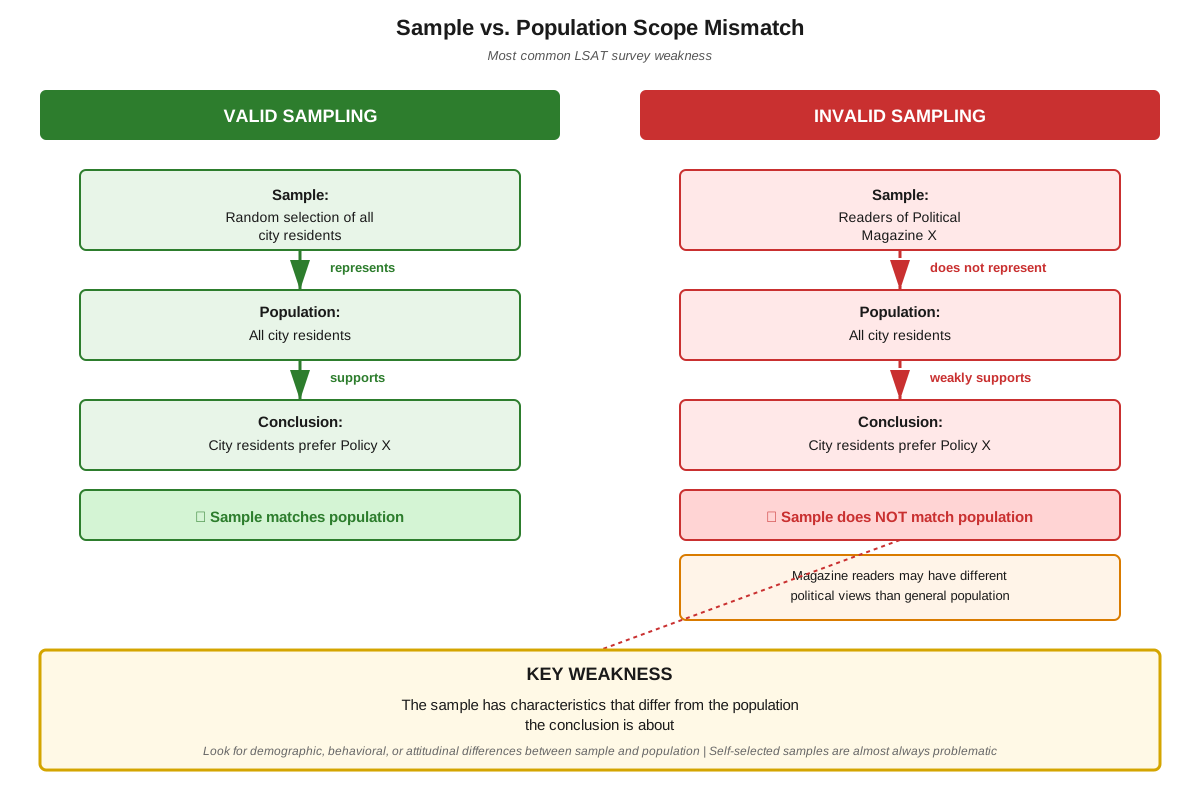
The fundamental assumption underlying all survey arguments is that the sample surveyed is representative of the population about which conclusions are drawn. This assumption can fail in numerous ways, creating opportunities for weakening. Additionally, survey arguments assume that respondents answered honestly and accurately, that questions were properly designed to elicit meaningful information, and that the data has been correctly interpreted.
The Five Major Categories of Survey Vulnerabilities
1. Sampling Problems
Sampling bias occurs when the group surveyed differs systematically from the population about which conclusions are drawn. This is the most common vulnerability in LSAT survey questions. Types of sampling problems include:
- Self-selection bias: When respondents choose whether to participate, those who respond may differ from non-respondents in ways relevant to the survey topic
- Convenience sampling: Surveying only easily accessible groups (e.g., surveying only people at a shopping mall to draw conclusions about all city residents)
- Unrepresentative demographics: When the sample differs from the target population in age, income, education, or other relevant characteristics
- Geographic limitations: Drawing broad conclusions from surveys conducted in limited locations
For example, if a survey concludes "most Americans prefer Brand X" based on responses from mall shoppers in one city, the sampling is clearly problematic. A weakening answer might point out that mall shoppers differ from the general population in relevant ways.
2. Response Rate and Non-Response Bias
Even when a sample is initially well-designed, low response rates can undermine representativeness. If only 5% of surveyed individuals respond, those who took the time to respond may differ systematically from the 95% who didn't. This creates non-response bias.
Key considerations include:
- The absolute response rate (what percentage responded)
- Whether non-respondents might differ from respondents on the issue being studied
- Whether the conclusion accounts for non-response
An LSAT question might present a survey where 1,000 questionnaires were mailed but only 50 returned, yet the argument treats the 50 responses as representative. A correct weakening answer would highlight that non-respondents likely differ from respondents.
3. Question Design and Wording Issues
How survey questions are phrased dramatically affects responses. Leading questions, ambiguous wording, and loaded language can bias results. Common problems include:
- Leading questions: Questions that suggest a desired answer ("Don't you agree that...")
- Ambiguous terms: Using words that different respondents interpret differently
- Double-barreled questions: Asking about two issues simultaneously
- Social desirability bias: Questions on sensitive topics where respondents may not answer honestly
For instance, if a survey asks "Do you support the mayor's excellent education initiative?" the word "excellent" leads respondents toward a positive answer. A weakening answer might point out that differently worded questions could yield different results.
4. Interpretation and Scope Problems
Even valid survey data can be misinterpreted. Interpretation errors occur when conclusions go beyond what the data actually shows. Common issues include:
- Confusing correlation with causation: Survey shows two things occur together, conclusion claims one causes the other
- Overgeneralization: Applying findings beyond the surveyed population
- Temporal mismatches: Using old survey data to draw conclusions about current conditions
- Ignoring alternative explanations: Failing to consider other reasons for survey results
For example, a survey might show that people who drink coffee are more alert, and the argument concludes coffee causes alertness. A weakening answer might suggest that naturally alert people choose to drink coffee (reverse causation).
5. Timing and Context Issues
When a survey is conducted matters. Timing problems include:
- Surveying during atypical periods (holidays, crises, special events)
- Using outdated survey data for current conclusions
- Failing to account for recent changes in circumstances
- Comparing surveys conducted at different times without accounting for temporal factors
If a survey about restaurant preferences was conducted during a food safety scare, responses might not reflect normal preferences. A weakening answer might point out the unusual timing.
The Anatomy of Survey Weaken Questions
LSAT survey weaken questions typically follow this structure:
- Context: Background information about the survey topic
- Survey description: How the survey was conducted (often brief, sometimes omitting crucial details)
- Results: What the survey found
- Conclusion: What the argument claims based on the survey
- Question stem: Asks which answer weakens the argument
The correct answer will identify a flaw in one of the five vulnerability categories that specifically undermines the connection between the survey evidence and the stated conclusion.
Concept Relationships
The five categories of survey vulnerabilities are interconnected and sometimes overlap. Sampling problems → affect → representativeness → which determines → validity of generalizations. Similarly, question design issues → create → response bias → which undermines → data reliability.
Survey weakening connects to broader Logical Reasoning concepts: assumption identification (recognizing unstated assumptions about representativeness), scope analysis (determining whether conclusions exceed what data supports), and alternative explanation (considering other reasons for survey results). These skills developed through survey questions transfer directly to other evidence-based arguments.
The relationship to strengthen questions is inverse: anything that weakens a survey argument (showing sampling bias, low response rates, etc.) would be strengthened by evidence eliminating those concerns (showing representative sampling, high response rates, etc.). Understanding weakening therefore simultaneously builds strengthening skills.
Survey questions also connect to causal reasoning when surveys are used to support causal claims, to statistical reasoning when surveys involve numerical data interpretation, and to generalization when survey samples are used to draw conclusions about populations. Mastering survey weakening thus reinforces multiple Logical Reasoning competencies.
Quick check — test yourself on Weakening surveys so far.
Try Flashcards →High-Yield Facts
⭐ The most common way to weaken a survey argument is to show the sample is unrepresentative of the population about which conclusions are drawn
⭐ Low response rates weaken survey arguments because non-respondents may differ systematically from respondents
⭐ Question wording can bias results; differently phrased questions might yield different responses
⭐ Survey data showing correlation does not establish causation; alternative explanations weaken causal conclusions
⭐ Timing matters; surveys conducted during atypical periods may not reflect normal conditions
- Self-selected samples (where respondents choose to participate) are particularly vulnerable to bias
- Ambiguous terms in survey questions undermine reliability because different respondents interpret them differently
- Surveys of easily accessible groups (convenience samples) often fail to represent broader populations
- Old survey data may not support conclusions about current conditions
- Social desirability bias can cause respondents to answer dishonestly on sensitive topics
- Comparing surveys with different methodologies can yield misleading conclusions
- Small sample sizes increase the likelihood that results don't reflect the true population
- Geographic limitations in sampling restrict the scope of valid conclusions
Common Misconceptions
Misconception: Any flaw in survey methodology automatically weakens the argument equally.
Correction: Only flaws relevant to the specific conclusion drawn weaken the argument. If a survey of doctors concludes something about doctors (not the general public), the fact that non-doctors weren't surveyed doesn't weaken it.
Misconception: A low response rate always weakens a survey argument.
Correction: Low response rates only weaken the argument if there's reason to believe non-respondents differ from respondents in ways relevant to the conclusion. If the argument already accounts for this or if non-response is random, it may not weaken significantly.
Misconception: Showing that a survey has any limitation is sufficient to weaken the argument.
Correction: The weakness must specifically undermine the connection between the evidence and the conclusion. Irrelevant limitations don't weaken the argument.
Misconception: Survey questions must be perfectly neutral to be valid.
Correction: While question bias is a legitimate concern, the issue is whether the specific wording would systematically bias results in a way that affects the conclusion. Minor imperfections don't necessarily invalidate findings.
Misconception: Larger samples are always better and smaller samples always weaken arguments.
Correction: Sample size matters, but representativeness matters more. A small but representative sample can be stronger than a large but biased sample. The LSAT rarely focuses on sample size alone.
Misconception: If a survey shows correlation, claiming causation is always wrong.
Correction: While correlation doesn't prove causation, survey data can support causal claims when combined with other evidence or when alternative explanations are ruled out. The issue is whether the specific conclusion is justified by the specific evidence.
Worked Examples
Example 1: Sampling Bias
Argument: A survey was conducted by calling 500 randomly selected telephone numbers in Riverside County between 9 AM and 5 PM on weekdays. Of those who answered, 78% said they were satisfied with local government services. The survey concludes that most Riverside County residents are satisfied with local government services.
Question: Which of the following, if true, most weakens the argument?
Analysis:
The conclusion is about "Riverside County residents" generally, but the survey only reached people who (1) were home and (2) answered their phones between 9 AM and 5 PM on weekdays. This is a sampling problem.
Step 1: Identify the conclusion - "most Riverside County residents are satisfied"
Step 2: Identify the evidence - survey of people answering phones during weekday business hours
Step 3: Recognize the gap - the sample may not represent all residents
Step 4: Predict the weakness - people home during business hours may differ from those at work
Correct Answer Type: "People who are home during weekday business hours are more likely to be retired or unemployed, and these groups tend to have different views about government services than working residents."
This weakens the argument by showing the sample is systematically unrepresentative of the population about which the conclusion is drawn. The sampling method excluded or underrepresented working people, who may have different opinions.
Example 2: Question Design and Interpretation
Argument: A consumer research firm asked 1,000 randomly selected shoppers: "Given the current economic challenges, do you think it's wise to spend money on luxury items?" Only 15% answered yes. The firm concluded that demand for luxury goods is declining.
Question: Which of the following, if true, most weakens the argument?
Analysis:
This argument has two potential vulnerabilities: question design (leading/loaded language) and interpretation (confusing what people say with what they do).
Step 1: Identify the conclusion - "demand for luxury goods is declining"
Step 2: Identify the evidence - survey responses about whether luxury spending is "wise"
Step 3: Recognize the gaps:
- The question uses loaded language ("current economic challenges," "wise")
- The question asks about beliefs, but the conclusion is about behavior (demand)
Step 4: Predict weaknesses:
- The question wording may have led respondents toward "no"
- People may not think luxury spending is wise but still do it
Correct Answer Type: "Many people who believe luxury spending is unwise during economic challenges nonetheless continue to purchase luxury items."
This weakens by showing that the survey measured attitudes, not behavior, and that attitudes don't necessarily predict demand. The conclusion about declining demand isn't supported by data about what people think is wise.
Alternative Correct Answer: "When asked a neutrally worded question about their luxury purchase intentions, the same shoppers showed high interest in luxury goods."
This weakens by showing the question wording biased the results.
Exam Strategy
Trigger Words and Phrases
When reading Logical Reasoning stimuli, certain phrases signal survey-based arguments:
- "A survey/poll/study found..."
- "Respondents were asked..."
- "X% of those surveyed said..."
- "According to a recent poll..."
- "Researchers surveyed..."
When these appear in a Weaken question, immediately think through the five vulnerability categories.
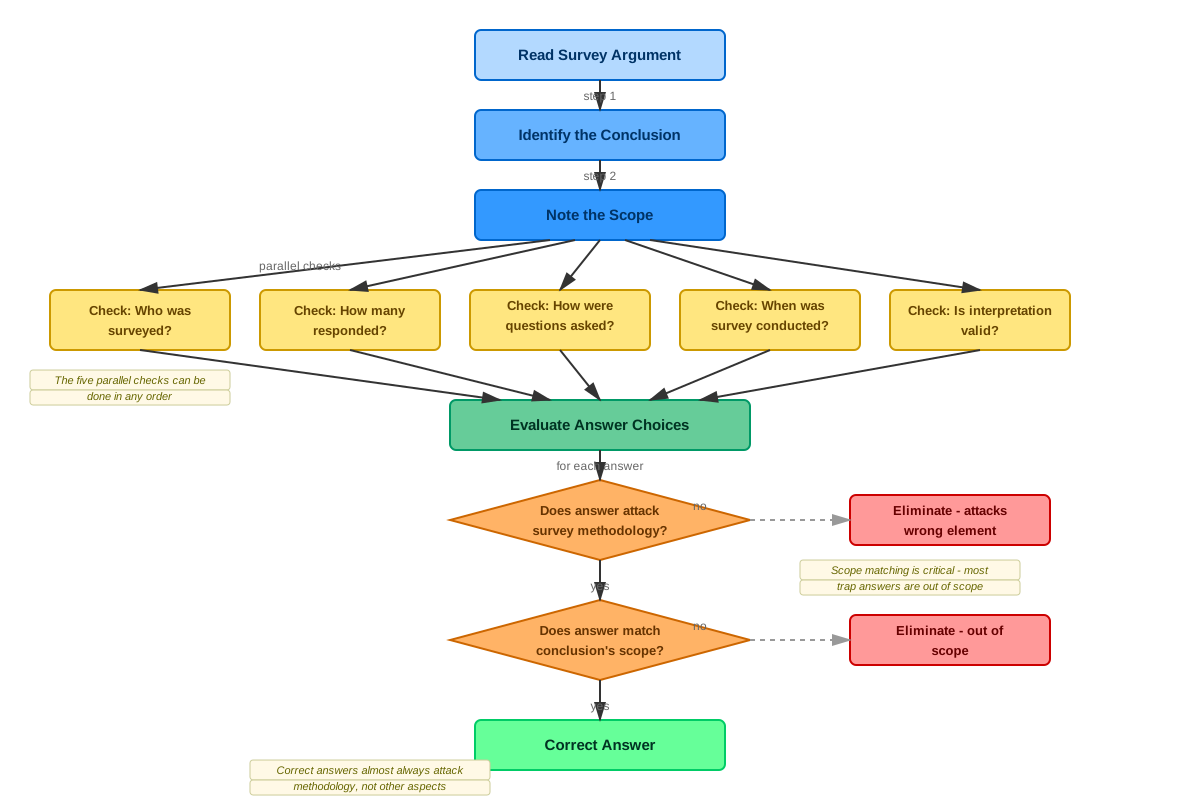
Systematic Approach
Step 1: Read the argument and identify it as survey-based
Step 2: Identify the specific conclusion (What exactly is being claimed?)
Step 3: Note the survey methodology details provided (Who was surveyed? How? When?)
Step 4: Identify the gap between the sample and the conclusion (Does the conclusion go beyond what the sample represents?)
Step 5: Predict the category of weakness before reading answer choices
Step 6: Eliminate answers that:
- Strengthen rather than weaken
- Are irrelevant to the specific conclusion
- Address the wrong aspect of the argument
- Are too weak to significantly impact the argument
Process of Elimination Tips
Eliminate answers that:
- Discuss issues unrelated to the survey methodology or interpretation
- Would affect all surveys equally (not specific to this argument's weakness)
- Actually strengthen the argument by confirming representativeness
- Address populations or issues outside the scope of the conclusion
- Are about the survey topic generally rather than the survey methodology
Keep answers that:
- Identify specific ways the sample differs from the population in the conclusion
- Show response bias or low response rates with relevant implications
- Reveal question wording that could bias results
- Provide alternative explanations for the survey findings
- Show timing or context issues that affect interpretation
Time Allocation
Survey weaken questions are typically medium difficulty. Allocate 1:15-1:30 for these questions. Spend:
- 30-40 seconds reading and analyzing the argument
- 10-15 seconds predicting the weakness category
- 30-40 seconds evaluating answer choices
Don't get stuck trying to find the "perfect" weakness. The correct answer only needs to weaken the argument, not destroy it completely.
Memory Techniques
The SQRIT Mnemonic
Remember the five major vulnerability categories with SQRIT:
- Sampling (Is the sample representative?)
- Question design (Are questions biased or ambiguous?)
- Response rate (Did enough people respond? Are non-respondents different?)
- Interpretation (Does the conclusion match what the data shows?)
- Timing (Was the survey conducted at an appropriate time?)
The "Three R's" for Quick Analysis
When evaluating survey arguments, check the Three R's:
- Representative: Is the sample representative of the population?
- Reliable: Are the questions designed to get accurate information?
- Relevant: Does the data actually support the specific conclusion?
Visualization Strategy
Picture a survey as a bridge connecting a sample (one side) to a conclusion about a population (other side). Weakening the argument means showing the bridge has structural problems:
- Sampling issues = wrong starting point (bridge begins at wrong location)
- Response issues = missing planks (incomplete bridge)
- Question design = warped materials (bridge built with flawed components)
- Interpretation = wrong destination (bridge leads somewhere other than claimed)
- Timing = temporary bridge (only valid at certain times)
Summary
Weakening surveys is a high-yield LSAT Logical Reasoning skill that requires understanding how survey-based arguments can fail. The five major vulnerability categories—sampling problems, response rate issues, question design flaws, interpretation errors, and timing concerns—provide a systematic framework for analyzing these arguments. The most common weakness is showing that the sample is unrepresentative of the population about which conclusions are drawn, but test-takers must remain flexible and identify which specific vulnerability undermines each particular argument. Success requires carefully matching the weakness to the specific conclusion, not just identifying any flaw in the survey. By systematically checking whether the sample is representative, whether response rates are adequate, whether questions are properly designed, whether interpretation is justified, and whether timing is appropriate, students can efficiently identify correct answers. The key is recognizing that only weaknesses relevant to the specific conclusion matter—a survey of doctors that draws conclusions about doctors isn't weakened by not including non-doctors. Mastering this topic strengthens broader Logical Reasoning skills including assumption identification, scope analysis, and evidence evaluation.
Key Takeaways
- Survey arguments are weakened most commonly by showing the sample is unrepresentative of the population in the conclusion
- The five vulnerability categories (SQRIT: Sampling, Question design, Response rate, Interpretation, Timing) provide a systematic analysis framework
- Only weaknesses relevant to the specific conclusion weaken the argument; irrelevant flaws don't matter
- Low response rates weaken arguments when non-respondents likely differ from respondents in relevant ways
- Question wording can systematically bias results, undermining the reliability of survey data
- Correlation shown in surveys doesn't establish causation without ruling out alternative explanations
- Survey timing matters; data collected during atypical periods may not reflect normal conditions
Related Topics
Strengthening Surveys: The inverse skill of identifying what would make survey-based arguments stronger, including evidence of representative sampling, high response rates, and neutral question design. Mastering weakening surveys directly enables understanding strengthening.
Causal Reasoning: Many survey arguments make causal claims based on correlational data. Understanding how to weaken causal reasoning complements survey weakening skills.
Necessary Assumption Questions: Survey arguments rely on assumptions about representativeness and reliability. Identifying these assumptions builds on survey weakening skills.
Flaw Questions: Survey methodology flaws appear frequently in Flaw questions. The same analytical framework applies to both weakening and flaw identification.
Statistical Reasoning: More advanced questions may involve numerical data interpretation, percentages, and rates. Survey weakening provides foundation for these more complex statistical arguments.
Practice CTA
Now that you understand the systematic approach to weakening survey-based arguments, it's time to apply these concepts to actual LSAT questions. Work through the practice questions carefully, using the SQRIT framework to analyze each survey argument. Pay special attention to matching the weakness to the specific conclusion—this is where many students lose points. The flashcards will help reinforce the five vulnerability categories and common patterns. Remember, survey questions appear frequently on the LSAT, so mastering this topic will directly improve your score. Each practice question you complete strengthens your pattern recognition and speeds up your analysis. You've got the tools—now build the skill through deliberate practice!
Sign up free to keep reading
Create a free AnvayaPrep account to finish this LSAT guide on Weakening surveys — plus flashcards and practice questions.