Overview
Author response questions represent a sophisticated question type within LSAT reading comprehension, particularly prominent in comparative reading passages. These questions ask test-takers to predict how one author would respond to claims, arguments, or viewpoints presented by another author. This question type demands more than simple comprehension of two separate texts; it requires synthesizing both passages, understanding each author's perspective, reasoning patterns, and underlying assumptions, then projecting how these perspectives would interact in dialogue.
The significance of author response questions on the LSAT cannot be overstated. They appear with high frequency in the comparative reading section, which comprises one of the four reading comprehension passages on every modern LSAT. These questions test critical thinking at its highest level—requiring students to move beyond passive reading into active analysis of argumentative structures, authorial intent, and logical relationships between competing viewpoints. Success on these questions directly correlates with overall reading comprehension performance and demonstrates the analytical reasoning skills that law schools value most.
Within the broader landscape of LSAT reading comprehension, author response questions build upon foundational skills like identifying main ideas, recognizing tone and purpose, and understanding argument structure. However, they elevate these skills by requiring comparative analysis across texts. Mastering this question type strengthens abilities that transfer to other reading comprehension challenges, including inference questions, application questions, and passage organization questions. The mental framework developed for author response questions—tracking multiple perspectives simultaneously and predicting logical extensions of arguments—proves invaluable throughout the entire LSAT and in legal reasoning generally.
Learning Objectives
- [ ] Identify how Author response questions appears in LSAT questions
- [ ] Explain the reasoning pattern behind Author response questions
- [ ] Apply Author response questions to solve LSAT-style problems accurately
- [ ] Distinguish between direct textual evidence and reasonable inferences when predicting author responses
- [ ] Evaluate answer choices by assessing consistency with each author's established viewpoint and argumentative approach
- [ ] Synthesize information from both passages to construct accurate predictions about inter-author dialogue
- [ ] Recognize common trap answers that misrepresent authorial positions or create false equivalencies
Prerequisites
- Basic passage comprehension skills: Understanding main ideas, supporting details, and passage structure forms the foundation for tracking individual author perspectives before comparing them.
- Argument identification and analysis: Recognizing premises, conclusions, and reasoning patterns enables students to understand not just what authors say, but why they say it—essential for predicting responses.
- Tone and purpose recognition: Identifying whether an author is critical, supportive, neutral, or nuanced toward their subject matter provides crucial context for anticipating how they would engage with opposing views.
- Comparative reading passage structure: Familiarity with how LSAT presents paired passages (typically two shorter passages on related topics with contrasting or complementary perspectives) allows efficient navigation during timed conditions.
Why This Topic Matters
Author response questions assess skills that extend far beyond standardized testing into the core competencies required for legal practice. Attorneys must constantly anticipate opposing counsel's arguments, predict judicial responses to legal theories, and synthesize competing precedents—all skills directly tested by these questions. The ability to inhabit multiple perspectives simultaneously while maintaining analytical clarity represents a hallmark of sophisticated legal reasoning.
On the LSAT itself, author response questions appear in approximately 60-70% of comparative reading passages, with most passages containing at least one such question. They typically constitute 2-3 questions per comparative reading set, making them among the highest-yield question types for focused preparation. The LSAT has shown increasing emphasis on these questions in recent years, reflecting the exam's evolution toward testing more complex analytical skills.
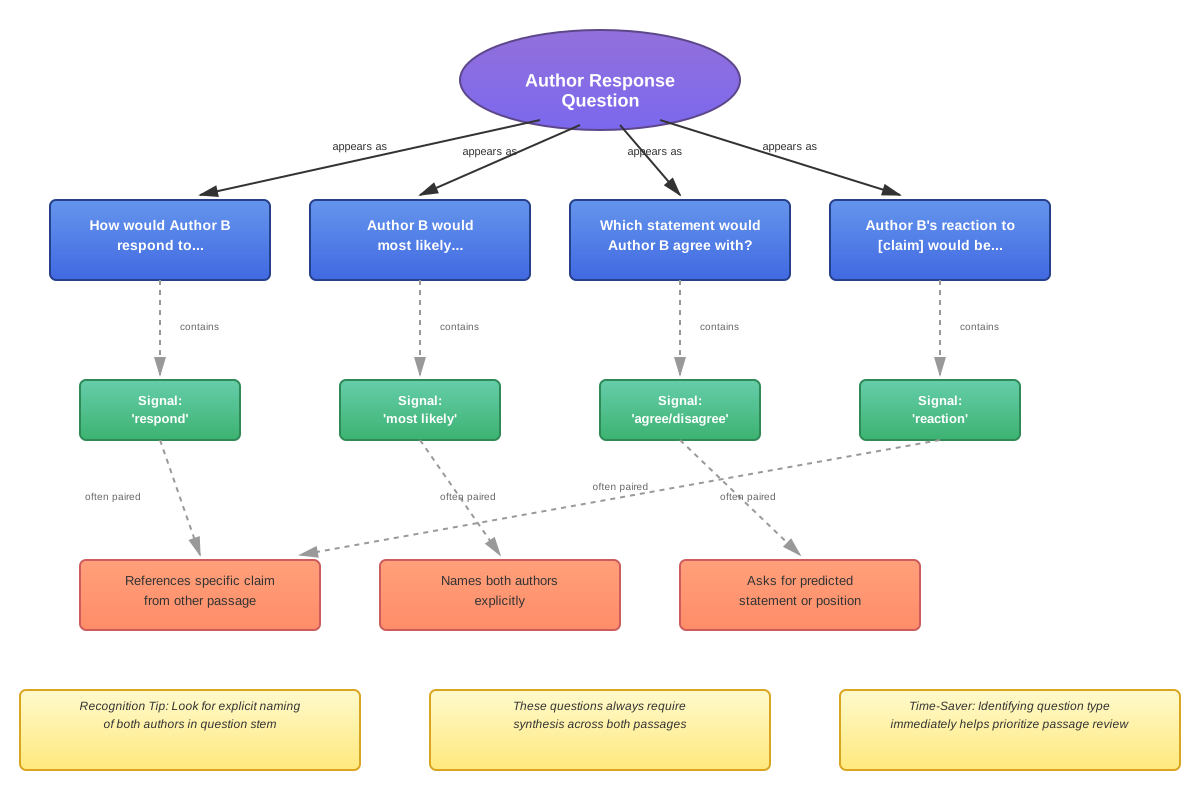
These questions commonly appear in several recognizable formats: "How would Author B most likely respond to Author A's claim that...?", "With which of the following statements would both authors agree?", "Author A's argument provides support for preferring which of the following responses to Author B's position?", and "The relationship between the two passages is most analogous to which of the following?" Each format tests the same underlying skill—synthesizing perspectives and projecting logical interactions—but requires slightly different analytical approaches.
Core Concepts
Understanding Author Response Question Structure
LSAT author response questions follow predictable structural patterns that, once recognized, significantly improve accuracy and efficiency. The question stem typically identifies a specific claim, argument, or position from one passage, then asks how the other author would respond. The key analytical move involves two distinct steps: first, accurately characterizing the referenced claim within its original context; second, identifying the relevant perspective from the responding author's passage that would apply to that claim.
The most sophisticated author response questions don't simply ask about explicit disagreements. Instead, they require applying one author's reasoning framework to evaluate another author's position. For example, if Author A advocates for strict regulatory oversight based on market failure concerns, and Author B emphasizes innovation benefits from minimal regulation, a question might ask how Author B would respond to a specific regulatory proposal mentioned by Author A. The answer requires understanding not just that they disagree, but why they disagree—the underlying values, assumptions, and reasoning patterns that drive their positions.
The Three-Layer Analysis Framework
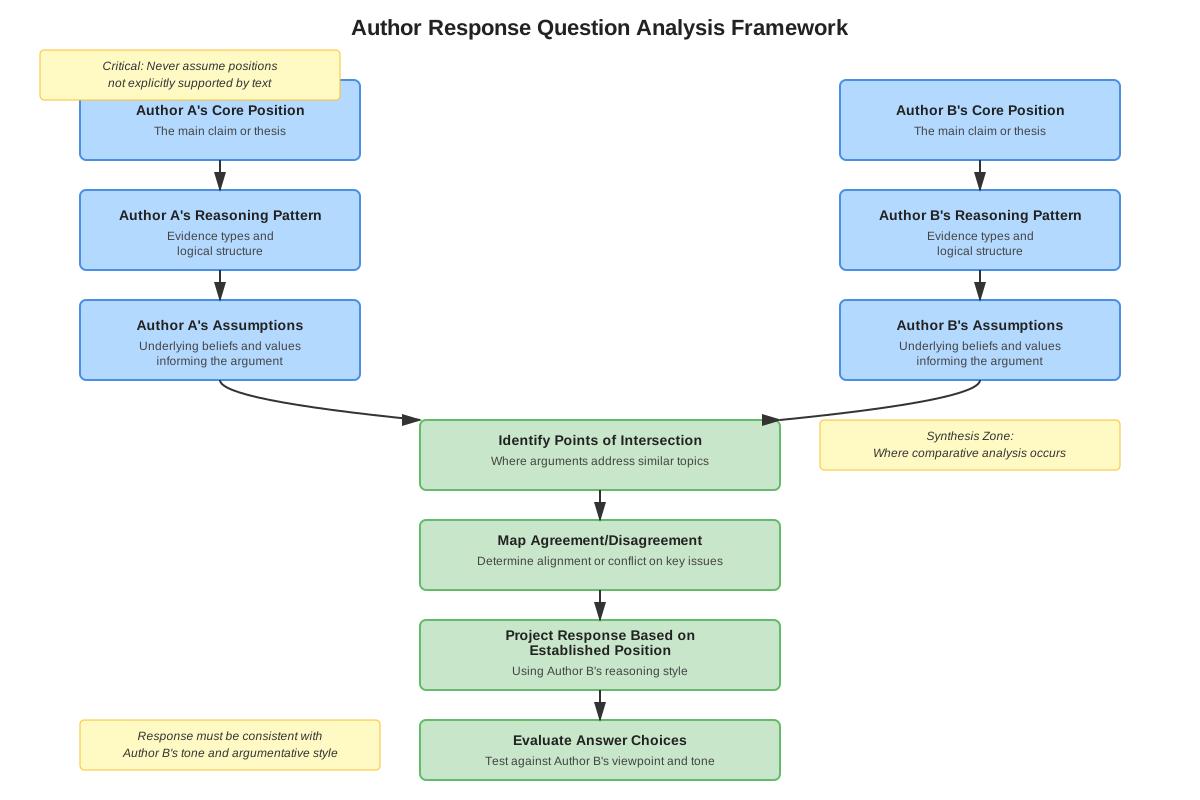
Successful navigation of author response questions requires analyzing each passage at three distinct levels: surface claims (what the author explicitly states), reasoning patterns (how the author supports their claims and what types of evidence they value), and underlying assumptions (unstated premises that ground the author's perspective). Most incorrect answer choices exploit confusion between these levels.
Surface claims represent the most straightforward layer—the explicit statements authors make. However, author response questions rarely test mere recognition of whether authors agree or disagree on surface-level facts. Instead, they probe deeper analytical layers.
Reasoning patterns reveal how authors construct arguments. Does the author rely primarily on empirical evidence, theoretical principles, historical precedent, or practical consequences? Does the author employ analogical reasoning, causal analysis, or comparative evaluation? Understanding these patterns allows prediction of how an author would approach new scenarios or evaluate different arguments. For instance, an author who consistently emphasizes empirical data would likely respond to a theoretical argument by questioning its practical evidence base.
Underlying assumptions represent the deepest analytical layer—the foundational beliefs and values that shape an author's entire perspective. These assumptions often remain implicit but drive all surface claims and reasoning patterns. An author might assume that individual liberty should be prioritized over collective welfare, that scientific expertise should guide policy decisions, or that historical context determines contemporary meaning. Identifying these assumptions enables accurate prediction of author responses even to scenarios not explicitly addressed in the passage.
Mapping Authorial Relationships
The relationship between paired passages falls into several common patterns, each creating different dynamics for author response questions:
| Relationship Type | Characteristics | Response Question Focus |
|---|---|---|
| Direct Opposition | Authors take contradictory positions on the same issue | Explicit disagreements; competing evidence evaluation |
| Complementary Perspectives | Authors address different aspects of the same topic without direct conflict | Areas of potential agreement; how perspectives could be synthesized |
| Qualified Agreement | Authors share basic positions but differ on nuances, scope, or implications | Subtle distinctions; conditions under which agreement holds |
| Different Frameworks | Authors approach the same topic using entirely different analytical lenses | How one framework would evaluate claims made within another |
| Temporal or Contextual Variation | Authors discuss the same issue in different time periods or contexts | How changed circumstances affect argument applicability |
Identifying the relationship type early in passage reading provides a strategic framework for anticipating question types and organizing information efficiently.
Evidence Tracking and Attribution
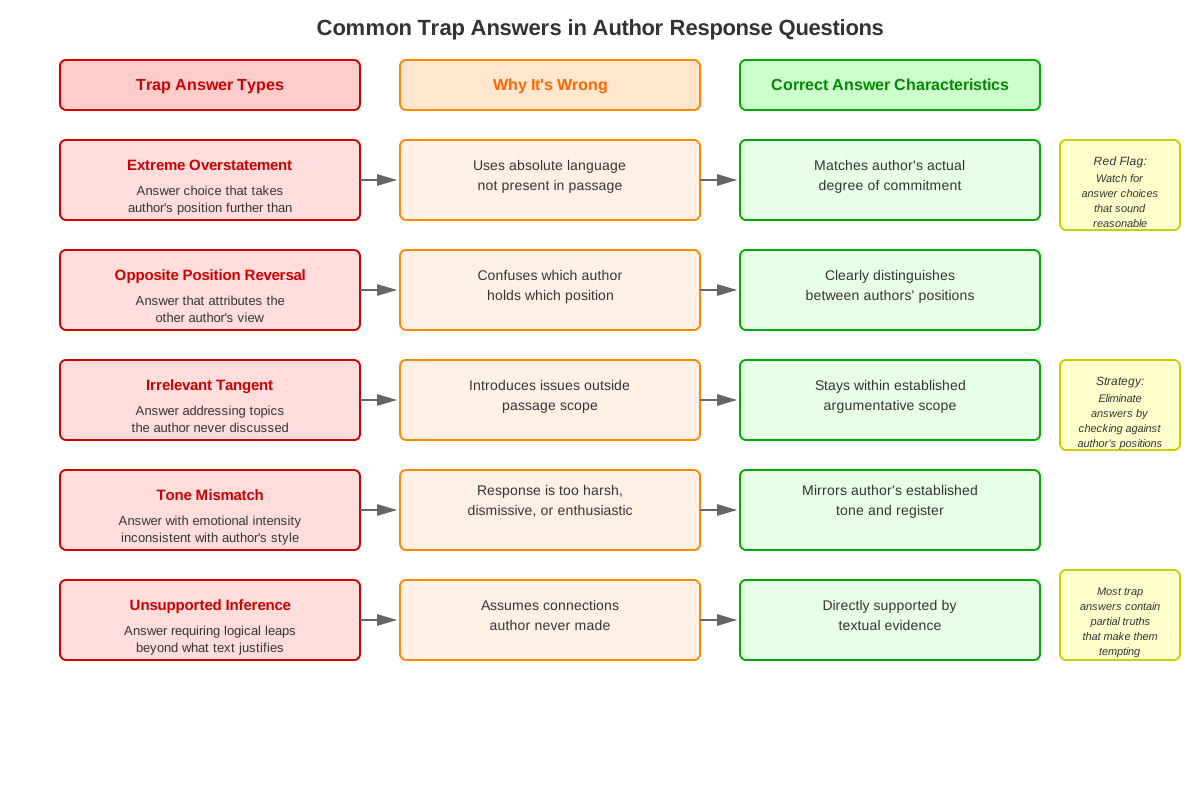
A critical skill for author response questions involves precise evidence tracking—knowing not just what information appears in the passages, but which author presents which evidence and how they use it. Many trap answers exploit attribution errors, presenting accurate information but misattributing it to the wrong author or mischaracterizing how an author would use that information.
Effective evidence tracking requires active annotation during passage reading. Mark each author's key claims, supporting evidence, and evaluative language. Note particularly where authors address similar topics using different evidence or where they interpret the same evidence differently. These points of intersection typically generate author response questions.
Tone and Degree Calibration
Author response questions frequently hinge on subtle distinctions in tone and degree. An author might not completely reject an opposing view but rather qualify it, partially accept it with reservations, or redirect it toward different conclusions. Answer choices often present responses that are directionally correct but too extreme, too mild, or mischaracterized in tone.
Consider these gradations of response: complete agreement, qualified agreement, neutral acknowledgment, mild skepticism, significant disagreement, and complete rejection. Most author responses fall somewhere in the middle range rather than at extremes. Authors in LSAT passages typically maintain academic or professional tone, avoiding absolute dismissals or unqualified endorsements. Answer choices suggesting extreme responses ("would completely reject," "would enthusiastically endorse") should trigger careful scrutiny.
Logical Extension vs. Unsupported Inference
The most challenging aspect of author response questions involves distinguishing between logical extensions of an author's stated position (legitimate inferences about how they would respond) and unsupported inferences that go beyond what the passage justifies. The LSAT tests this boundary deliberately, creating answer choices that sound plausible but lack sufficient textual support.
A logical extension maintains consistency with the author's reasoning patterns, assumptions, and explicitly stated views while applying them to new scenarios. An unsupported inference introduces new assumptions, contradicts established patterns, or requires speculative leaps. The key question: "Given everything this author has said and how they've reasoned, would this response be consistent and predictable?" If the answer requires adding new assumptions not grounded in the passage, the inference likely exceeds what the question permits.
Concept Relationships
The concepts within author response questions form an interconnected analytical system. Understanding question structure provides the entry point, revealing what the question asks and where to focus attention. This understanding activates the three-layer analysis framework, which organizes how to read and interpret each passage. The framework operates simultaneously with evidence tracking, ensuring accurate attribution and preventing confusion between authors' positions.
Mapping authorial relationships provides the strategic context that shapes all other analysis—the relationship type determines which aspects of each passage matter most for predicting responses. This mapping directly influences tone and degree calibration, as different relationship types generate different response patterns (direct opposition typically produces stronger disagreement than complementary perspectives).
All these concepts converge in the critical skill of distinguishing logical extension from unsupported inference. This distinction requires applying the three-layer framework (ensuring consistency with reasoning patterns and assumptions), precise evidence tracking (grounding predictions in textual support), and tone calibration (matching response strength to authorial style).
These concepts also connect to prerequisite knowledge: basic comprehension skills enable the three-layer analysis; argument identification supports evidence tracking and logical extension evaluation; tone recognition feeds directly into tone calibration; and familiarity with comparative reading structure facilitates efficient relationship mapping.
The progression flows: Question Structure → Relationship Mapping → Three-Layer Analysis → Evidence Tracking → Tone Calibration → Logical Extension Evaluation → Answer Selection. Each step builds on previous steps while informing subsequent ones, creating a comprehensive analytical framework.
High-Yield Facts
⭐ Author response questions appear in 60-70% of comparative reading passages, typically 2-3 questions per passage set.
⭐ The correct answer must be consistent with the responding author's reasoning patterns, not just their surface-level claims.
⭐ Extreme answer choices (complete rejection, enthusiastic endorsement) are rarely correct; most responses involve qualified positions.
⭐ Attribution errors—confusing which author said what—represent the most common mistake on these questions.
⭐ The question stem always provides specific textual reference; locate and understand that reference before evaluating answer choices.
- Author response questions test synthesis and projection, not mere comprehension of isolated passages.
- Tone consistency matters: if an author maintains measured, academic tone throughout, their predicted response should match that tone.
- Evidence from both passages must support the correct answer; one-sided analysis leads to errors.
- The responding author's underlying assumptions often determine their response more than their explicit claims.
- Wrong answers frequently present accurate statements that don't actually answer the specific question asked.
⭐ When authors use different analytical frameworks, response questions often test how one framework would evaluate claims made within another.
- Temporal and contextual differences between passages affect how authors would respond to each other's arguments.
- The correct answer represents what the author would say, not necessarily what they did say in the passage.
- Questions asking what "both authors would agree with" require finding common ground despite surface-level differences.
- The most challenging questions involve predicting responses to scenarios neither author explicitly addressed.
Quick check — test yourself on Author response questions so far.
Try Flashcards →Common Misconceptions
Misconception: Author response questions simply ask whether authors agree or disagree on explicit claims. → Correction: These questions test deeper analytical skills—how authors would apply their reasoning frameworks, assumptions, and values to evaluate each other's positions, often regarding scenarios not explicitly discussed in either passage.
Misconception: The correct answer must be directly stated somewhere in the responding author's passage. → Correction: Correct answers represent logical extensions of the author's stated position, reasoning patterns, and assumptions. The response must be consistent with and supported by the passage, but need not be explicitly stated.
Misconception: If two authors discuss the same topic, they must fundamentally disagree. → Correction: Authors in comparative passages may have complementary perspectives, qualified agreement, or disagreement on some points while agreeing on others. The relationship is often nuanced rather than simply oppositional.
Misconception: Stronger, more definitive answer choices are more likely to be correct. → Correction: LSAT passages typically feature measured, qualified positions. Answer choices with extreme language ("completely reject," "entirely support," "would never agree") are usually incorrect. Look for appropriately calibrated responses.
Misconception: Personal opinion about which author is "right" should influence answer selection. → Correction: Author response questions test analytical reading, not personal judgment. The correct answer reflects what the author would say based on their established position, regardless of whether that position seems persuasive or correct.
Misconception: All information in both passages is equally relevant to every author response question. → Correction: Each question focuses on specific claims or arguments. Efficient test-takers identify the relevant portions of each passage rather than attempting to synthesize everything simultaneously.
Misconception: If an answer choice contains accurate information from the passage, it must be correct. → Correction: Wrong answers often include accurate statements that don't answer the specific question asked, misattribute positions, or present information out of context. Accuracy alone doesn't ensure correctness.
Worked Examples
Example 1: Direct Opposition Scenario
Passage A Summary: Author A argues that artificial intelligence development should be heavily regulated by government agencies because the technology poses existential risks that market forces alone cannot adequately address. The author cites historical examples of technologies (nuclear weapons, genetic engineering) where regulation proved essential and emphasizes that AI's potential for autonomous decision-making creates unprecedented dangers requiring proactive oversight.
Passage B Summary: Author B contends that innovation in artificial intelligence flourishes best under minimal regulatory constraints. The author argues that premature regulation stifles beneficial development, that industry self-regulation has proven effective in technology sectors, and that government agencies lack the technical expertise and adaptability to regulate rapidly evolving AI systems effectively.
Question: Author B would most likely respond to Author A's comparison of AI to nuclear weapons by:
Analysis Process:
- Locate the specific claim: Author A uses nuclear weapons as a historical analogy to support the need for AI regulation.
- Understand the claim's function: This analogy serves as evidence that some technologies require government oversight due to existential risks.
- Identify Author B's relevant perspective: Author B emphasizes that government regulation stifles innovation and that agencies lack technical expertise. Author B also suggests industry self-regulation works effectively.
- Predict response type: Author B would likely challenge the analogy's applicability rather than accepting the premise. The response should be critical but measured (consistent with academic tone).
- Consider reasoning patterns: Author B consistently emphasizes practical consequences (innovation effects) and questions government capability. The response should reflect these patterns.
Predicted Response: Author B would likely argue that the nuclear weapons analogy is inapplicable because nuclear technology was developed primarily for military purposes with clear catastrophic potential, whereas AI development is commercially driven with diverse beneficial applications. Author B might also note that nuclear regulation involved relatively static technology, while AI's rapid evolution makes government oversight impractical.
Correct Answer Type: An answer choice suggesting Author B would question the analogy's relevance by distinguishing AI's characteristics from nuclear weapons, emphasizing differences in development context, application diversity, or regulatory feasibility.
Wrong Answer Types to Avoid:
- Suggesting Author B would completely dismiss all concerns about AI risks (too extreme)
- Indicating Author B would accept the analogy but draw different conclusions (inconsistent with B's rejection of regulation premise)
- Proposing Author B would offer a different historical analogy supporting regulation (contradicts B's anti-regulation position)
Example 2: Complementary Perspectives Scenario
Passage A Summary: Author A examines the psychological benefits of urban green spaces, presenting research showing that access to parks and natural areas reduces stress, improves mental health outcomes, and enhances community well-being. The author focuses on individual and community psychological effects.
Passage B Summary: Author B analyzes the economic value of urban green spaces, demonstrating that parks increase nearby property values, attract businesses, reduce healthcare costs through improved public health, and generate tourism revenue. The author focuses on measurable economic impacts.
Question: Both authors would most likely agree with which of the following statements?
Analysis Process:
- Identify the relationship type: These are complementary perspectives—different analytical lenses (psychological vs. economic) applied to the same topic (urban green spaces) without direct conflict.
- Find common ground: Both authors view urban green spaces positively and present evidence of their benefits. Neither questions whether green spaces are valuable; they differ only in which benefits they emphasize.
- Look for overlap: Both mention health-related benefits (Author A: mental health; Author B: healthcare costs). Both implicitly assume that urban planning should consider green space allocation.
- Avoid overreach: The correct answer must be supported by both passages without requiring either author to adopt the other's analytical framework.
- Check for implicit agreement: Sometimes authors agree on foundational premises even while focusing on different aspects.
Predicted Agreement: Both authors would likely agree that urban green spaces provide significant benefits that justify their inclusion in city planning, though they emphasize different types of benefits. They might also agree that green spaces affect urban residents' quality of life, though they measure this impact differently.
Correct Answer Type: A statement acknowledging that urban green spaces generate important benefits for cities and residents, phrased broadly enough to encompass both psychological and economic dimensions without requiring either author to endorse the other's specific framework.
Wrong Answer Types to Avoid:
- Statements exclusively about psychological benefits (only Author A's focus)
- Statements exclusively about economic benefits (only Author B's focus)
- Statements suggesting one type of benefit is more important than another (neither author makes this comparison)
- Statements about implementation details neither author addresses
Exam Strategy
Systematic Approach to Author Response Questions
Step 1: Identify the question type immediately. Author response questions use characteristic language: "Author B would most likely respond," "both authors would agree," "Author A's argument supports which response to Author B." Recognizing the question type activates the appropriate analytical framework.
Step 2: Locate the specific reference in the question stem. These questions always point to particular claims, arguments, or positions. Find and reread that specific portion of the passage before evaluating answer choices. Understanding the reference in context prevents mischaracterization.
Step 3: Identify the responding author's relevant perspective. Don't attempt to synthesize the entire passage; focus on the portions directly relevant to the referenced claim. What has this author said about this topic? What reasoning patterns and assumptions apply?
Step 4: Predict the response before reading answer choices. Formulate a general prediction: "Author B would likely challenge this by emphasizing X" or "Both authors would probably agree that Y." This prediction serves as an anchor, preventing answer choices from leading analysis astray.
Step 5: Evaluate answer choices systematically. Check each choice against both the referenced claim and the responding author's established position. Eliminate choices that mischaracterize either author, introduce unsupported assumptions, or fail to answer the specific question asked.
Trigger Words and Phrases
Watch for these question stem patterns:
- "Most likely respond" → requires logical extension consistent with author's reasoning
- "Would agree/disagree" → tests understanding of positions and their boundaries
- "Provides support for" → asks how one author's argument could be used by another
- "Most analogous to" → tests understanding of relationship structure
- "Both authors" → requires finding common ground or shared assumptions
In answer choices, be cautious of:
- Extreme language: "completely," "entirely," "never," "always," "only"
- Attribution shifts: answers that accurately describe one author's view but attribute it to the other
- Scope changes: answers that are too broad or too narrow relative to the question's focus
- Tone mismatches: responses that are more aggressive, dismissive, or enthusiastic than the author's established tone
Process of Elimination Strategies
Eliminate answers that require new assumptions. If an answer choice introduces information, values, or reasoning patterns not grounded in the passage, it exceeds what the question permits. The correct answer extends the author's position but doesn't transform it.
Eliminate answers with attribution errors. Carefully track which author holds which position. Wrong answers frequently present accurate information but attribute it to the wrong author or mischaracterize how an author would use that information.
Eliminate answers that don't address the specific question. Many wrong answers present true statements about the passages that simply don't answer what was asked. Always return to the question stem to verify that an answer choice actually responds to the specific query.
Eliminate answers with tone inconsistencies. If an author maintains measured, qualified language throughout the passage, eliminate answer choices suggesting extreme responses. Match the response's tone and degree to the author's established style.
Time Allocation
Author response questions typically require more time than straightforward comprehension questions because they demand synthesis across passages. Allocate approximately 60-75 seconds per author response question, slightly above the average 50-60 seconds for other reading comprehension questions.
However, invest time efficiently: spend 15-20 seconds locating and understanding the referenced claim, 15-20 seconds identifying the responding author's relevant perspective, 10-15 seconds formulating a prediction, and 20-25 seconds evaluating answer choices. This structured approach prevents the scattered, inefficient reading that consumes time without improving accuracy.
Exam Tip: If stuck between two answer choices, return to the question stem and the specific textual reference. The correct answer must be directly responsive to what was asked and fully supported by the passages. Often, one choice answers a related but different question, while the other directly addresses the specific query.
Memory Techniques
The TRACE Acronym for analyzing author response questions:
- Tone: Match the response to the author's established tone
- Reasoning: Apply the author's reasoning patterns, not just surface claims
- Attribution: Verify which author said what
- Consistency: Ensure the response is consistent with all established positions
- Evidence: Ground predictions in textual support from both passages
The Three-Layer Pyramid Visualization: Picture each passage as a pyramid with three layers. The base (largest layer) represents underlying assumptions—the foundation of everything. The middle layer represents reasoning patterns—how the author builds arguments. The top (smallest layer) represents surface claims—what's explicitly stated. Author response questions usually test the middle and base layers, not just the top.
The Dialogue Imagination Technique: After reading both passages, imagine the authors in conversation. What would they say to each other? Where would they nod in agreement? Where would they shake their heads? This mental simulation activates the same analytical skills the questions test.
The "Both/Neither/One" Framework for agreement questions: Quickly categorize each answer choice:
- Both authors would support this (potential correct answer)
- Neither author would support this (eliminate)
- Only one author would support this (eliminate)
This rapid categorization focuses attention on viable choices while efficiently eliminating impossible ones.
The Attribution Color-Coding Method: During passage reading, mentally (or physically, if allowed) associate each author with a color. When evaluating answer choices, visualize whether the response "matches" the responding author's color. This creates a mental check against attribution errors.
Summary
Author response questions represent the highest level of analytical reading tested in LSAT comparative reading passages, requiring synthesis of multiple perspectives and projection of how authors would engage with each other's arguments. Success demands moving beyond surface-level comprehension to analyze reasoning patterns, underlying assumptions, and the logical extensions of established positions. The key analytical framework involves three layers: surface claims (what authors explicitly state), reasoning patterns (how they construct arguments), and underlying assumptions (foundational beliefs driving their perspectives). Effective approach requires identifying the specific claim referenced in the question, locating the responding author's relevant perspective, predicting the response based on established patterns, and evaluating answer choices for consistency with both authors' positions. Common pitfalls include attribution errors, accepting extreme responses inconsistent with measured authorial tone, confusing logical extensions with unsupported inferences, and selecting answers that are accurate but don't address the specific question asked. The correct answer must be fully supported by textual evidence, consistent with the responding author's reasoning patterns and assumptions, appropriately calibrated in tone and degree, and directly responsive to the question stem's specific query.
Key Takeaways
- Author response questions test synthesis and projection, requiring understanding of reasoning patterns and assumptions, not just surface-level claims
- The correct answer must be consistent with the responding author's established perspective while remaining appropriately qualified in tone and degree
- Attribution accuracy is critical—track which author presents which evidence and arguments to avoid confusion
- Extreme answer choices rarely succeed; LSAT authors typically maintain measured, qualified positions
- Predict the response before reading answer choices to avoid being led astray by plausible-sounding but incorrect options
- The three-layer analysis framework (surface claims, reasoning patterns, underlying assumptions) provides systematic structure for analyzing both passages
- Time investment in understanding the specific referenced claim and the responding author's relevant perspective pays dividends in accuracy
Related Topics
Inference Questions in Single Passages: Mastering author response questions strengthens inference skills generally, as both require distinguishing logical extensions from unsupported leaps. The same analytical framework—grounding predictions in reasoning patterns and assumptions—applies to both question types.
Argument Structure and Function Questions: Understanding how authors construct arguments (the reasoning patterns layer) directly supports both author response questions and questions asking about argument structure, function of specific paragraphs, or rhetorical strategies.
Tone and Attitude Questions: The tone calibration skills developed for author response questions transfer directly to questions asking about an author's attitude toward their subject matter or toward positions they discuss.
Application Questions: Both author response and application questions require projecting how passage content would apply to new scenarios. The logical extension skills developed for author response questions enable more sophisticated handling of application questions.
Parallel Reasoning Questions in Logical Reasoning: The skill of identifying reasoning patterns and applying them to new contexts—central to author response questions—directly parallels the analytical moves required for parallel reasoning questions in the Logical Reasoning section.
Practice CTA
Now that you've mastered the conceptual framework for author response questions, it's time to apply these skills to actual LSAT-style passages and questions. The practice questions and flashcards will reinforce the analytical patterns you've learned, build recognition of common question formats and trap answers, and develop the timing and efficiency essential for test-day success. Remember: understanding the concepts is the first step, but fluency comes through deliberate practice. Each practice question you work through strengthens the neural pathways that enable quick, accurate analysis under timed conditions. Approach the practice materials systematically, reviewing not just which answers are correct but why they're correct and why the wrong answers fail. This metacognitive approach—thinking about your thinking—transforms practice into genuine mastery. You've built the foundation; now construct the skills that will earn you points on test day.
Sign up free to keep reading
Create a free AnvayaPrep account to finish this LSAT guide on Author response questions — plus flashcards and practice questions.