Overview
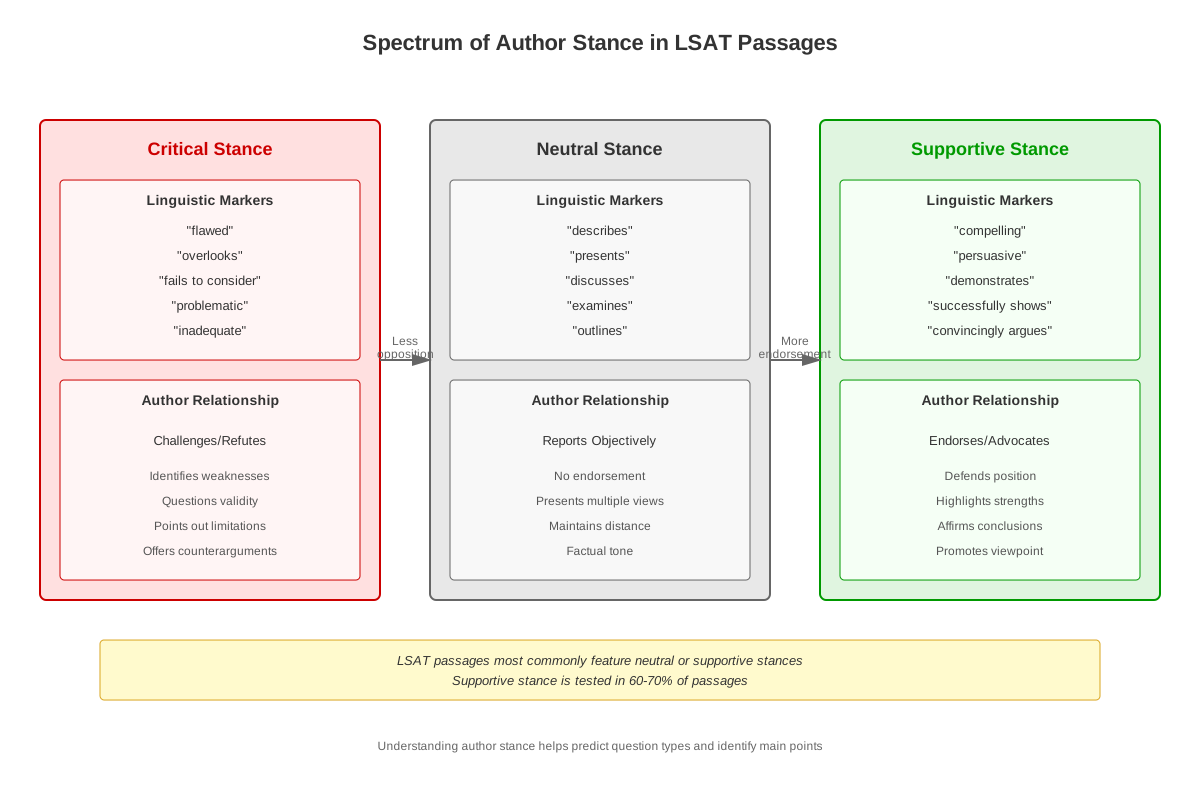
The supportive author stance is one of the most frequently tested concepts in LSAT reading comprehension passages. When an author adopts a supportive stance, they present ideas, theories, or arguments with approval, endorsement, or advocacy. Understanding this stance is critical because the LSAT regularly asks test-takers to identify the author's attitude, evaluate the author's purpose, and distinguish between neutral reporting and active endorsement of ideas. Recognizing a supportive stance allows students to accurately answer questions about tone, purpose, and the author's relationship to the material presented.
This concept sits at the heart of passage fundamentals because author stance determines how information should be interpreted throughout a passage. A supportive author doesn't merely describe a theory—they champion it, defend it against criticism, or present it as superior to alternatives. This distinction becomes crucial when answering questions about the author's primary purpose, the function of specific paragraphs, or how the author would likely respond to new information. Misidentifying a supportive stance as neutral or critical can cascade into multiple wrong answers on a single passage.
The supportive author stance connects intimately with other reading comprehension skills, including identifying main ideas, understanding passage structure, and recognizing rhetorical strategies. When an author supports a position, they typically employ specific linguistic markers, organizational patterns, and argumentative techniques that signal their endorsement. Mastering the recognition of these patterns enables students to move through passages more efficiently and answer questions with greater confidence, particularly on the challenging comparative passages where contrasting author stances frequently appear.
Learning Objectives
- [ ] Identify how supportive author stance appears in LSAT questions
- [ ] Explain the reasoning pattern behind supportive author stance
- [ ] Apply supportive author stance to solve LSAT-style problems accurately
- [ ] Distinguish between supportive, neutral, and critical author stances in complex passages
- [ ] Recognize linguistic markers and rhetorical devices that signal author support
- [ ] Predict how a supportive author would respond to counterarguments or new evidence
- [ ] Evaluate answer choices by eliminating options inconsistent with a supportive stance
Prerequisites
- Basic passage structure recognition: Understanding how LSAT passages are organized (introduction, body, conclusion) provides the framework for identifying where author stance typically appears most clearly
- Vocabulary comprehension: Recognizing tone words (e.g., "compelling," "unfortunately," "merely") is essential for detecting subtle stance indicators
- Argument identification: The ability to distinguish between claims, evidence, and conclusions helps separate what the author supports from what they simply report
- Question stem interpretation: Familiarity with how LSAT questions are phrased ensures recognition of when stance is being tested
Why This Topic Matters
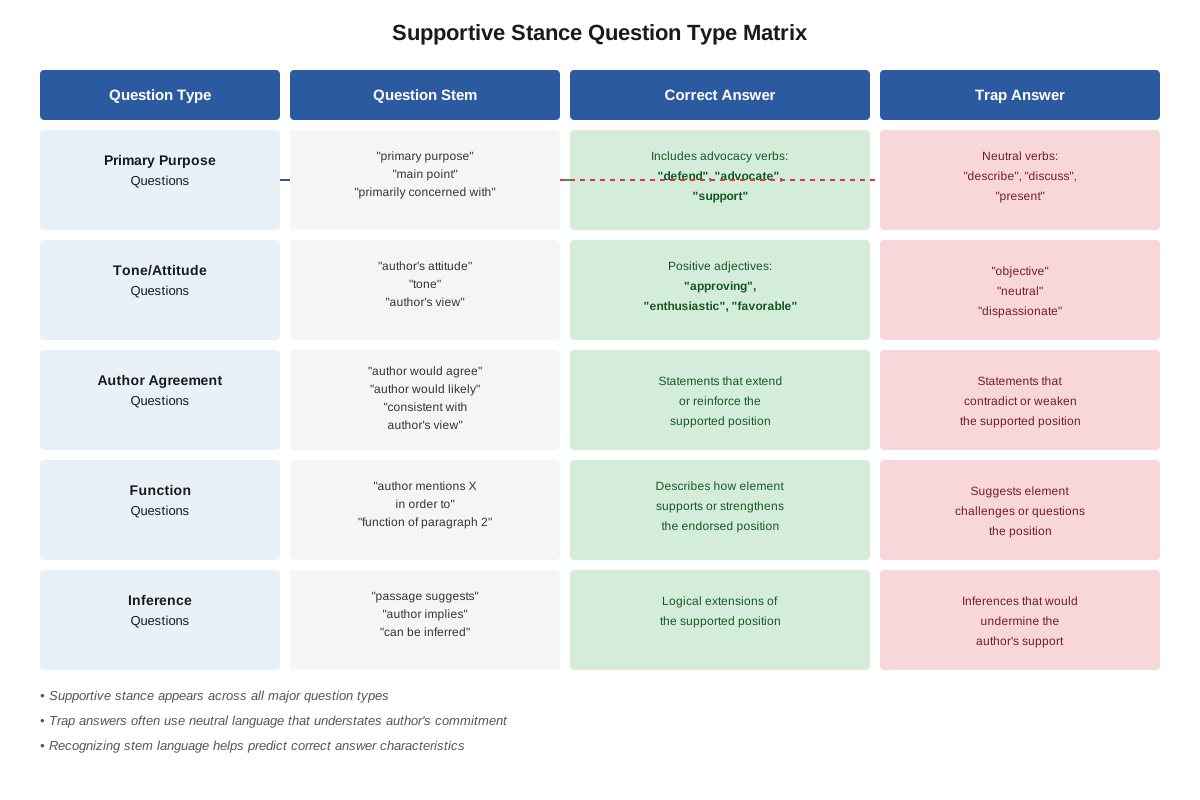
Author stance questions appear in approximately 60-70% of LSAT reading comprehension passages, making this one of the highest-yield topics for test preparation. The LSAT tests supportive author stance through multiple question types: primary purpose questions, tone/attitude questions, author agreement questions, and inference questions about how the author would respond to new scenarios. A single passage may contain 2-3 questions that directly or indirectly test understanding of the author's supportive position.
In real-world applications, recognizing author stance is fundamental to critical reading in legal contexts. Attorneys must constantly evaluate whether legal scholars, judges, or opposing counsel are neutrally presenting information or advocating for specific positions. This skill translates directly to reading case law, legal briefs, and scholarly articles where understanding the author's position determines how to use or counter their arguments.
Common manifestations of supportive author stance in LSAT passages include: authors defending new scientific theories against traditional views, advocating for revised interpretations of historical events, championing underappreciated artists or literary movements, supporting policy reforms, or endorsing novel legal frameworks. The LSAT particularly favors passages where the author supports a position that challenges conventional wisdom, as this creates opportunities for nuanced questions about the author's relationship to both the supported view and the opposing perspective.
Core Concepts
Defining Supportive Author Stance
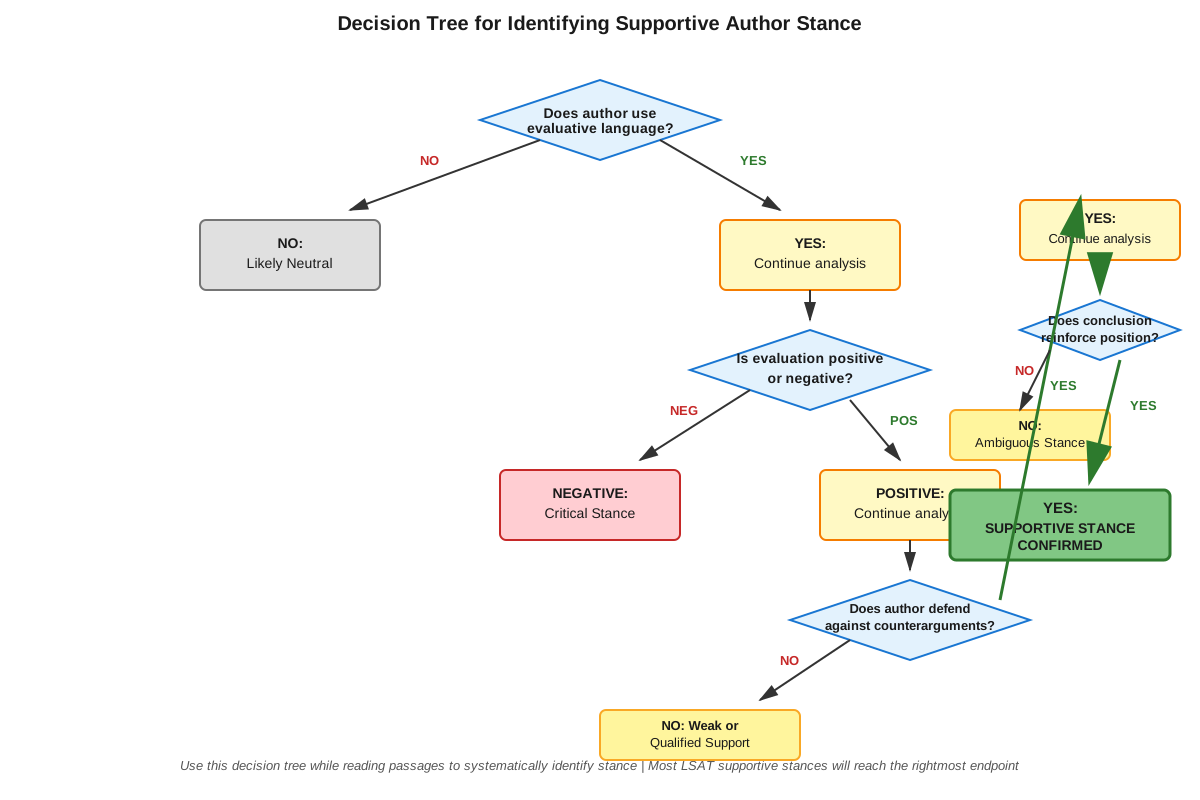
A supportive author stance occurs when the author of an LSAT passage actively endorses, advocates for, or presents favorable evaluation of a particular idea, theory, person, or position. This goes beyond neutral description or objective reporting. The author with a supportive stance has "skin in the game"—they want readers to accept the validity, importance, or superiority of the position they're presenting. This stance manifests through word choice, organizational structure, treatment of counterarguments, and the balance of evidence presented.
The key distinction lies between reporting and endorsing. An author might describe a controversial theory in detail without supporting it, or they might present that same theory while clearly signaling their approval. The LSAT tests whether students can detect this crucial difference, as it fundamentally changes how passages should be interpreted and how questions should be answered.
Linguistic Markers of Support
Supportive authors employ specific language patterns that signal their endorsement. Positive evaluative language includes words like "compelling," "persuasive," "important," "significant," "valuable," "insightful," "innovative," and "groundbreaking." These adjectives don't merely describe—they praise. When an author writes that a theory is "compelling" rather than simply "interesting," they signal support.
Hedging language around opposing views provides another marker. Supportive authors often use qualifiers when presenting counterarguments: "some critics claim," "traditionally believed," "the conventional view holds," or "it has been argued." These phrases create distance between the author and opposing positions. Conversely, when presenting the supported view, the author uses more direct, confident language: "research demonstrates," "evidence shows," or "the theory establishes."
Contrastive structures frequently signal support. Phrases like "however," "in fact," "actually," "rather," and "instead" often introduce the author's preferred position after presenting an opposing or inadequate view. The pattern typically follows: [Weak/wrong view] + contrastive marker + [Supported view]. For example: "Traditional interpretations focused solely on economic factors; however, recent scholarship demonstrates the crucial role of cultural dynamics."
Structural Indicators of Support
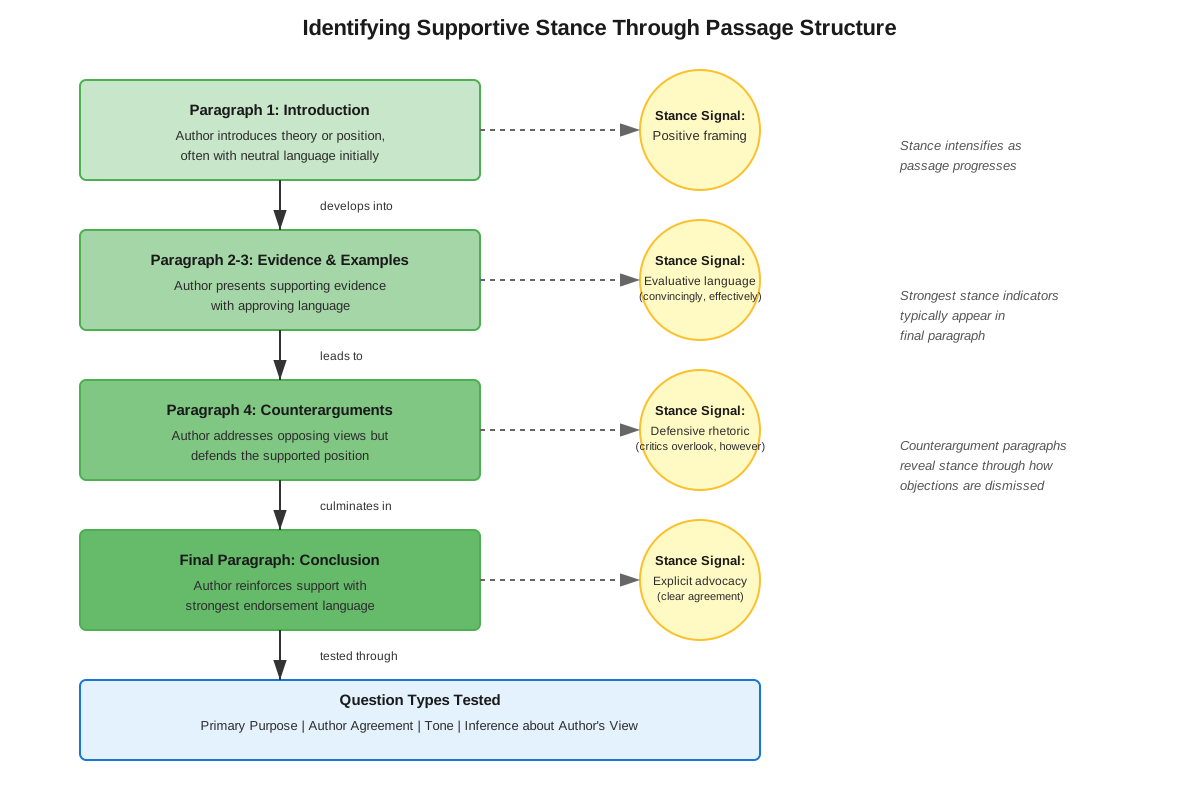
The organization of evidence reveals author stance. Supportive authors typically devote more space to explaining and defending their preferred position than to opposing views. They present multiple forms of evidence for the supported view (empirical data, expert testimony, logical reasoning, historical examples) while treating counterarguments more briefly or superficially. This asymmetry in treatment signals where the author's sympathies lie.
Paragraph positioning matters significantly. Authors often place their supported position in structurally prominent locations: the final paragraph (leaving readers with the endorsed view), immediately after presenting and dismissing alternatives (creating a "solution" structure), or in the opening paragraph followed by detailed defense. The LSAT frequently tests whether students recognize that placement itself can signal importance and endorsement.
Counterargument handling provides perhaps the clearest structural indicator. Supportive authors acknowledge opposing views but then refute, qualify, or minimize them. Common patterns include: presenting counterarguments as outdated, showing they rest on faulty assumptions, demonstrating they fail to account for important evidence, or conceding minor points while maintaining the core supported position. The author who supports a view doesn't ignore criticism—they address it to strengthen their endorsed position.
Degrees of Support
Not all supportive stances are equally strong. The LSAT tests recognition of support intensity. Some authors offer enthusiastic, unqualified endorsement: "This theory successfully explains all major phenomena in the field." Others provide measured, qualified support: "While some questions remain, this approach offers the most promising framework currently available." Both are supportive, but the degree differs significantly.
| Support Level | Characteristics | Example Language |
|---|---|---|
| Strong Support | Unqualified endorsement, minimal concessions | "definitively proves," "clearly superior," "fully accounts for" |
| Moderate Support | Endorsement with minor qualifications | "largely successful," "generally persuasive," "most compelling available" |
| Cautious Support | Endorsement with significant qualifications | "promising despite limitations," "valuable though incomplete," "merits serious consideration" |
| Neutral | Objective presentation without evaluation | "the theory proposes," "researchers found," "the data shows" |
Understanding these gradations prevents students from selecting answer choices that overstate or understate the author's position. An author with moderate support wouldn't "wholeheartedly endorse" a theory, nor would they merely "acknowledge its existence."
Supportive Stance vs. Neutral Reporting
The distinction between support and neutrality creates frequent LSAT traps. A neutral author presents information objectively, describes multiple perspectives without favoring one, and uses balanced language throughout. They might explain a theory thoroughly without ever indicating whether they think it's correct. The neutral author acts as a reporter or educator rather than an advocate.
Test-makers exploit this distinction by offering answer choices that confuse description with endorsement. An author might spend three paragraphs explaining a theory in detail, leading hasty readers to assume support, when the language remains entirely neutral and the fourth paragraph presents an equally detailed alternative view. The LSAT rewards careful attention to whether the author's language signals approval or merely conveys information.
Supportive Stance in Comparative Passages
Comparative passages (Passage A and Passage B on related topics) frequently feature contrasting author stances. One author might support a position while the other critiques it, or both might be supportive but of different positions. Questions on comparative passages often ask students to identify how the authors' stances differ, what each author would think of the other's position, or which author would agree with a particular statement.
The key skill involves tracking each author's stance independently while noting points of agreement and disagreement. A common pattern: Passage A supports a traditional view, Passage B supports a revisionist challenge to that view. Questions then test whether students can predict how Author A would respond to Author B's evidence or arguments.
Concept Relationships
The supportive author stance concept connects hierarchically and laterally to multiple reading comprehension skills. At the foundational level, vocabulary knowledge enables recognition of the evaluative language that signals support. This feeds into tone identification, which distinguishes positive, negative, and neutral attitudes. Tone identification combines with structural analysis (understanding how passages are organized) to reveal supportive stance through both word choice and organizational patterns.
Supportive stance directly influences main point identification. When an author supports a position, that position typically constitutes or heavily influences the passage's main point. The relationship flows: Author stance → Main point → Primary purpose. Understanding what the author supports clarifies why they wrote the passage (to advocate for that position) and what they're trying to accomplish (persuading readers of its validity).
The concept also connects laterally to argument analysis. Supportive authors construct arguments for their preferred positions, so recognizing support triggers deeper analysis of the evidence and reasoning presented. This relationship works bidirectionally: identifying strong evidence and reasoning can signal author support, while recognizing support prompts closer examination of how the author builds their case.
Textual relationship map: Vocabulary/Tone Recognition → Supportive Stance Identification → Main Point Determination → Primary Purpose Understanding → Accurate Question Answering. Simultaneously: Supportive Stance → Argument Structure Analysis → Counterargument Evaluation → Inference Generation about Author's Likely Responses.
High-Yield Facts
⭐ Supportive author stance appears in 60-70% of LSAT reading comprehension passages, making it one of the most frequently tested concepts.
⭐ Positive evaluative adjectives (compelling, persuasive, significant, valuable) are the most reliable linguistic markers of author support.
⭐ Contrastive structures (however, in fact, rather, instead) typically introduce the author's supported position after presenting weaker alternatives.
⭐ Asymmetric treatment of evidence—more space and detail for one position than alternatives—signals which position the author supports.
⭐ Counterargument refutation is a hallmark of supportive stance; authors who support a view acknowledge but then dismiss or minimize opposing arguments.
- Supportive authors often use hedging language (some claim, traditionally believed, it has been argued) when presenting views they don't endorse.
- Paragraph positioning matters: supported positions often appear in final paragraphs or immediately after refutation of alternatives.
- Degrees of support vary from enthusiastic endorsement to cautious approval; answer choices must match the intensity level.
- In comparative passages, authors frequently adopt contrasting stances toward the same topic or related issues.
- Neutral reporting uses balanced language and equal treatment of multiple perspectives, lacking the evaluative markers of supportive stance.
- Questions testing supportive stance include primary purpose, tone/attitude, author agreement, and inference questions about hypothetical scenarios.
- Authors can support multiple related positions simultaneously (e.g., supporting both a general approach and a specific application of that approach).
Quick check — test yourself on Supportive author stance so far.
Try Flashcards →Common Misconceptions
Misconception: If an author describes a theory in detail, they must support it.
Correction: Detailed description doesn't equal endorsement. Authors can thoroughly explain positions they don't support, especially when setting up a critique or presenting multiple perspectives. Look for evaluative language and treatment of alternatives, not just length of discussion.
Misconception: Acknowledging limitations or counterarguments means the author doesn't support the position.
Correction: Supportive authors regularly acknowledge limitations while maintaining overall endorsement. Phrases like "despite some remaining questions" or "while not perfect" often precede continued support. The key is whether the author ultimately defends the position after acknowledging challenges.
Misconception: Neutral, academic language means the author has no stance.
Correction: LSAT passages use formal academic prose, but supportive authors still signal their positions through subtle markers. Words like "importantly," "significantly," or "successfully" carry evaluative weight even in formal contexts. The absence of emotional language doesn't mean the absence of stance.
Misconception: The author supports whatever position appears in the final paragraph.
Correction: While final paragraphs often contain supported positions, this isn't universal. Some passages end with open questions, future research directions, or summaries that don't signal support. Always verify with linguistic markers rather than assuming based on position alone.
Misconception: If the author presents both sides of a debate, they must be neutral.
Correction: Presenting multiple perspectives is common in supportive passages. The author might present opposing views to refute them or to show their supported position is superior by comparison. Examine how each perspective is treated, not just whether it's mentioned.
Misconception: Strong support means the author thinks the position is perfect or complete.
Correction: Authors can strongly support positions they acknowledge as incomplete or imperfect. Support means the author views the position as valuable, important, or superior to alternatives—not necessarily flawless. Phrases like "the best available explanation" signal strong support despite acknowledged limitations.
Worked Examples
Example 1: Identifying Supportive Stance
Passage Excerpt: "Traditional approaches to urban planning prioritized automobile traffic, treating pedestrian needs as secondary concerns. However, recent research demonstrates that pedestrian-centered design not only improves quality of life but also enhances economic vitality in urban cores. Cities that have implemented such designs have seen significant increases in local business revenue and resident satisfaction. While some critics worry about reduced parking availability, these concerns have proven largely unfounded in practice, as improved public transportation and bicycle infrastructure adequately compensate for any parking reductions."
Question: The author's attitude toward pedestrian-centered urban design can most accurately be described as:
Analysis Process:
- Identify evaluative language: "demonstrates" (strong evidential claim), "not only...but also" (emphasizing multiple benefits), "significant increases" (positive outcome), "largely unfounded" (dismissing criticism)
- Examine structure: Opens with traditional approach (presented neutrally), uses "However" to introduce alternative (contrastive marker signals preference), devotes most space to benefits of pedestrian-centered design, briefly mentions and dismisses counterarguments
- Assess counterargument treatment: Critics' concerns are acknowledged but characterized as "largely unfounded" and countered with evidence of adequate alternatives
- Determine support level: Strong support—the author presents pedestrian-centered design as superior to traditional approaches, backed by evidence, with counterarguments minimized
Correct answer type: "Enthusiastic approval" or "Strong advocacy" (exact wording varies by question)
Incorrect answer traps: "Neutral description" (ignores evaluative language), "Cautious optimism" (understates the strength of support), "Balanced consideration" (misses the clear preference for one approach)
Connection to learning objectives: This example demonstrates how supportive stance appears through linguistic markers (evaluative language), structural patterns (contrastive organization), and counterargument handling (dismissal of criticism).
Example 2: Distinguishing Support Levels in Comparative Passages
Passage A Excerpt: "Quantum computing represents a revolutionary breakthrough that will fundamentally transform information processing. The technology has already achieved results impossible for classical computers, and continued development will inevitably lead to solutions for currently intractable problems in cryptography, drug discovery, and climate modeling."
Passage B Excerpt: "While quantum computing shows promise for specific applications, enthusiasm should be tempered by recognition of substantial remaining challenges. The technology has demonstrated advantages in narrow domains, but significant technical obstacles—including error correction and scalability—must be overcome before practical applications become widespread. Quantum computing may eventually prove valuable, but predictions of imminent revolution appear premature."
Question: Compared to Author B, Author A's stance toward quantum computing is:
Analysis Process:
- Analyze Author A's stance:
- Language: "revolutionary breakthrough," "fundamentally transform," "inevitably lead"
- Qualifications: None—unqualified predictions of success
- Support level: Strong, enthusiastic endorsement
- Analyze Author B's stance:
- Language: "shows promise," "may eventually prove valuable"
- Qualifications: "enthusiasm should be tempered," "substantial remaining challenges," "predictions...appear premature"
- Support level: Cautious, qualified support with significant reservations
- Compare stances:
- Both authors support quantum computing to some degree (neither is purely critical)
- Author A: Strong, unqualified support
- Author B: Weak, heavily qualified support
- Key difference: Certainty and enthusiasm level
Correct answer type: "More optimistic and less qualified" or "More enthusiastic and certain"
Incorrect answer traps: "Completely opposed" (both authors show some support), "Essentially similar" (ignores the dramatic difference in support strength), "Neutral while Author B is supportive" (Author A clearly supports, not neutral)
Connection to learning objectives: This example shows how to distinguish degrees of supportive stance and apply that understanding to comparative passage questions, demonstrating the reasoning pattern behind different support levels.
Exam Strategy
Question Stem Recognition
Supportive author stance is tested through specific question stem patterns. Watch for: "The author's attitude toward X can best be described as," "The author would most likely agree with which of the following," "The primary purpose of the passage is to," "The author mentions X in order to," and "The author's tone in discussing X is." These stems directly or indirectly test whether students recognize the author's supportive position.
Inference questions about hypothetical scenarios also test stance: "The author would most likely respond to [new evidence] by..." requires understanding whether the author supports a position strongly enough to defend it against challenges or would modify their view. Supportive authors typically defend their endorsed positions when presented with counterevidence.
Trigger Word Strategy
Create a mental checklist of positive evaluative triggers: compelling, persuasive, significant, important, valuable, insightful, innovative, groundbreaking, successful, effective, promising. When these appear, mark them and note what they're describing—that's likely what the author supports.
Similarly, track distancing language for opposing views: merely, simply, traditionally, some critics, it has been claimed, supposedly, purportedly. These words create space between the author and the ideas described, signaling lack of support.
Contrastive markers deserve special attention: however, yet, but, in fact, actually, rather, instead. The material following these markers typically represents the author's preferred position, especially when it follows presentation of an alternative view.
Process of Elimination
When evaluating answer choices for stance questions:
- Eliminate extremes first: Unless the passage language is extremely strong, eliminate "complete endorsement" or "unqualified enthusiasm." Similarly, eliminate "neutral" or "objective" if any evaluative language appears.
- Match intensity: If the author uses qualified language ("largely successful," "generally effective"), eliminate answers suggesting unqualified support. If the author uses strong language ("definitively proves," "clearly superior"), eliminate answers suggesting mere "cautious interest."
- Check consistency: The correct answer must align with how the author treats counterarguments. If the author dismisses criticism, eliminate answers suggesting "balanced consideration" or "acknowledgment of equal validity."
- Verify with evidence: Before selecting an answer, identify 2-3 specific phrases from the passage that support it. If you can't find textual evidence, reconsider.
Time Allocation
Don't spend excessive time debating between "strong support" and "moderate support" if both are clearly supportive and other answers are obviously wrong. The LSAT occasionally includes two defensible answers where one is slightly better; if you've eliminated clearly wrong choices and identified textual support for your selection, move forward confidently.
However, do invest time distinguishing support from neutrality, as this distinction creates the most common wrong answer traps. Thirty seconds verifying whether evaluative language exists can prevent a costly error.
Memory Techniques
The SUPPORT Acronym
Structure: Where does the idea appear? (Final paragraph, after refutation = likely supported)
Upbeat language: Positive adjectives signal endorsement
Positioning of evidence: More evidence for one view = author supports that view
Pushback against critics: Refuting counterarguments signals support
Opposing views: How are alternatives treated? (Briefly, dismissively = author supports different view)
Rhetorical questions: Often used to support a position by making alternatives seem unreasonable
Tone words: Compelling, significant, valuable = supportive stance
Visualization Strategy
Picture the author as a lawyer in court. A supportive author is like a lawyer advocating for their client—they present the strongest case possible, acknowledge but minimize weaknesses, and refute opposing arguments. A neutral author is like a court reporter—they record what happens without taking sides. When reading, ask: "Is this author acting as an advocate or a reporter?"
The "However Test"
When you see "however," "but," "yet," or similar contrastive markers, the material after the marker typically represents what the author supports (or at least prefers to what came before). Mentally highlight these transitions and note what follows—it's often the key to understanding author stance.
Color-Coding Mental Strategy
Mentally assign colors while reading: Green for positive evaluative language about a position (signals support), Red for negative language or distancing phrases (signals lack of support or opposition), Yellow for neutral descriptive language. If one position gets mostly green while alternatives get red or yellow, you've identified the supported view.
Summary
Supportive author stance represents one of the highest-yield concepts in LSAT reading comprehension, appearing in the majority of passages and tested through multiple question types. A supportive stance occurs when the author actively endorses, advocates for, or favorably evaluates a particular position, theory, or idea—going beyond neutral description to signal approval. This stance manifests through linguistic markers (positive evaluative language, hedging around opposing views, contrastive structures), structural indicators (asymmetric evidence treatment, strategic positioning, counterargument refutation), and degrees of intensity (from cautious to enthusiastic support). Distinguishing supportive stance from neutral reporting requires careful attention to whether the author's language evaluates or merely describes, and whether evidence treatment favors one position over alternatives. Success on stance questions demands recognition of these patterns, accurate matching of answer choice intensity to passage language, and systematic elimination of options inconsistent with how the author treats the supported position and its alternatives. Mastering supportive author stance enables accurate answering of primary purpose, tone, author agreement, and inference questions—collectively representing a substantial portion of reading comprehension points.
Key Takeaways
- Supportive author stance means active endorsement, not just detailed description; look for evaluative language that signals approval beyond neutral reporting
- Linguistic markers are the most reliable indicators: positive adjectives (compelling, significant, valuable), hedging around opposing views (some claim, traditionally), and contrastive structures (however, in fact, rather)
- Asymmetric treatment reveals support: authors devote more space, evidence, and favorable language to positions they endorse while treating alternatives briefly or critically
- Counterargument handling is diagnostic: supportive authors acknowledge but then refute, minimize, or qualify opposing views rather than treating them as equally valid
- Support intensity varies: distinguish strong, unqualified endorsement from cautious, qualified support, and match answer choices to the specific degree of support expressed
- Structure signals stance: supported positions often appear in final paragraphs, after refutation of alternatives, or following contrastive markers like "however"
- Comparative passages frequently contrast stances: track each author's position independently and predict how they would respond to each other's arguments
Related Topics
Critical Author Stance: The opposite of supportive stance, where authors express skepticism, opposition, or negative evaluation of positions. Understanding both supportive and critical stances enables recognition of the full spectrum of author attitudes and improves accuracy on tone questions.
Neutral Author Stance: When authors present information objectively without endorsement or criticism. Mastering the distinction between neutral and supportive stances prevents the most common wrong answer traps in reading comprehension.
Primary Purpose Questions: These questions directly test understanding of why the author wrote the passage, which is intimately connected to what position they support. Recognizing supportive stance makes primary purpose questions significantly easier.
Tone and Attitude Questions: These explicitly test author stance, asking students to characterize the author's attitude as enthusiastic, skeptical, ambivalent, etc. Supportive stance mastery directly translates to success on these questions.
Inference Questions: Understanding what the author supports enables accurate predictions about how they would respond to new evidence, counterarguments, or hypothetical scenarios—all common inference question types.
Practice CTA
Now that you understand the core concepts, patterns, and strategies for identifying supportive author stance, it's time to apply this knowledge. Work through the practice questions and flashcards to reinforce these skills and build the pattern recognition that leads to automatic, confident identification of author stance on test day. Each practice question you complete strengthens your ability to spot the linguistic and structural markers that signal support, making you faster and more accurate on actual LSAT passages. Remember: recognizing supportive author stance isn't just about answering stance questions—it's a foundational skill that improves performance across all reading comprehension question types. Your investment in mastering this concept will pay dividends throughout the reading comprehension section.
Sign up free to keep reading
Create a free AnvayaPrep account to finish this LSAT guide on Supportive author stance — plus flashcards and practice questions.