Overview
Local questions represent one of the most frequently tested question types in LSAT reading comprehension, appearing in nearly every Reading Comprehension section of the exam. These questions direct test-takers to a specific portion of the passage—typically a particular paragraph, sentence, or line reference—and ask about the content, purpose, or meaning within that limited scope. Unlike global questions that require understanding the entire passage, local questions test the ability to comprehend and analyze discrete textual segments while maintaining awareness of their relationship to the broader argument.
Mastering local questions is essential for LSAT success because they constitute approximately 40-50% of all reading comprehension question types. These questions reward careful, precise reading and punish those who rely on vague impressions or memory. The LSAT deliberately crafts wrong answer choices that either misrepresent details, import information from other parts of the passage, or make subtle logical errors that only close reading can detect. Students who excel at local questions demonstrate the analytical reading skills that law schools value: the ability to parse complex text, identify relevant information quickly, and distinguish between what a passage actually states versus what it might imply.
The relationship between local questions and other reading comprehension concepts is foundational. Local questions require the same close reading skills needed for inference questions, but with a narrower textual focus. They often serve as building blocks for understanding global structure questions, since mastering individual passage segments naturally leads to comprehending the whole. Additionally, local questions frequently test the same logical reasoning skills assessed in the Logical Reasoning section, particularly when asking about the function or purpose of specific textual elements within an argument.
Learning Objectives
- [ ] Identify how Local questions appears in LSAT questions
- [ ] Explain the reasoning pattern behind Local questions
- [ ] Apply Local questions to solve LSAT-style problems accurately
- [ ] Distinguish between local questions and other reading comprehension question types based on question stem language
- [ ] Evaluate answer choices for local questions using textual evidence and elimination strategies
- [ ] Recognize common trap patterns in local question answer choices
Prerequisites
- Basic reading comprehension skills: The ability to understand complex academic prose is fundamental to engaging with LSAT passages at any level.
- Familiarity with LSAT passage structure: Understanding how LSAT passages are organized (introduction, development, conclusion) helps locate relevant information quickly.
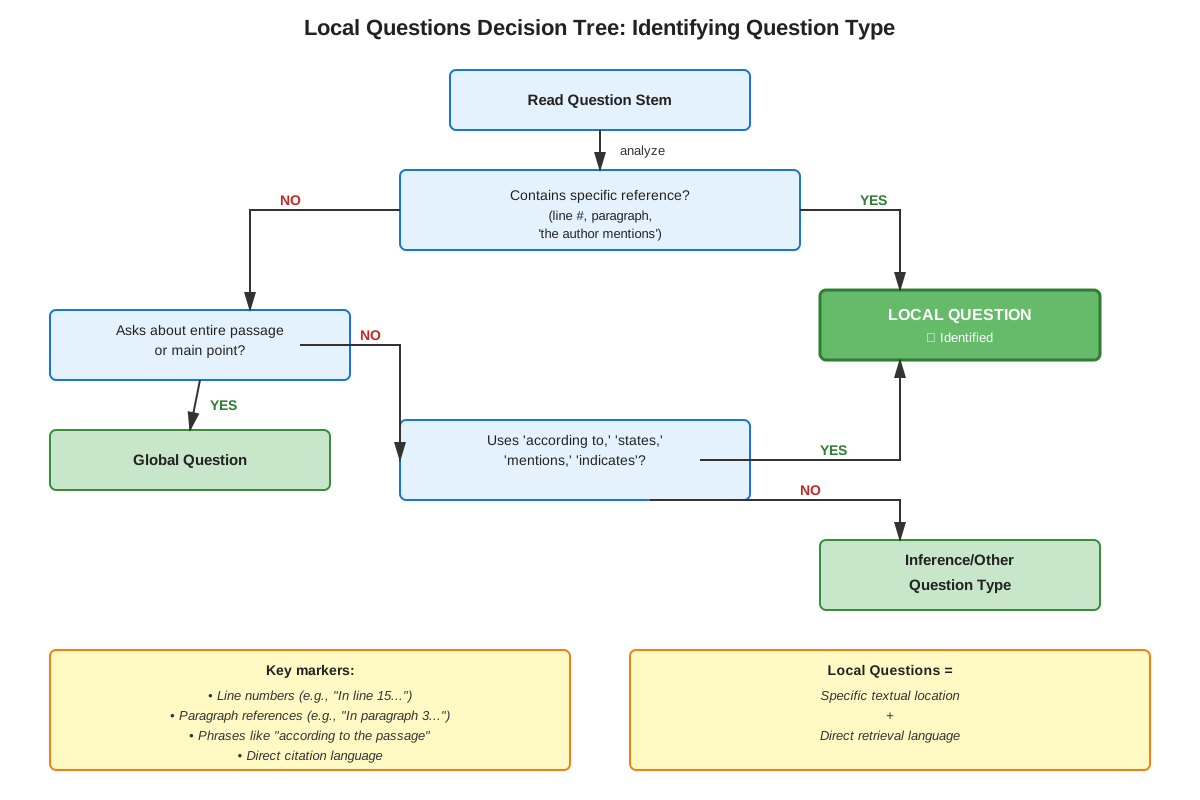
- Knowledge of question stem terminology: Recognizing words like "according to the passage," "the author mentions," and "the passage states" signals question type.
- Understanding of wrong answer patterns: General awareness of how the LSAT constructs incorrect answer choices provides a foundation for elimination strategies.
Why This Topic Matters
Local questions represent the most direct test of reading accuracy on the LSAT. While other question types require inference, synthesis, or structural analysis, local questions primarily assess whether test-takers can locate and correctly interpret specific textual information. This skill directly translates to legal practice, where attorneys must extract precise information from statutes, contracts, case law, and other legal documents without misrepresentation or distortion.
From an exam statistics perspective, local questions appear with remarkable consistency. Each Reading Comprehension section typically contains 4-6 local questions across its four passages, making them the most common question type alongside inference questions. The LSAT tests local questions in several formats: detail questions asking what the passage states, function questions asking why the author includes specific information, and meaning questions asking what particular phrases or terms signify within context.
Common manifestations in exam passages include questions about specific examples the author provides, particular objections or counterarguments mentioned, definitions of technical terms, descriptions of research findings, or explanations of theoretical positions. The LSAT particularly favors local questions in science passages (where precise details matter) and comparative reading passages (where distinguishing between the two passages' specific claims is crucial). Understanding local questions is not merely about answering one question type—it's about developing the foundational reading precision that supports success across all Reading Comprehension questions.
Core Concepts
Defining Local Questions
Local questions are reading comprehension questions that direct test-takers to a specific, limited portion of the passage and ask about information contained within that scope. The defining characteristic is the narrow textual focus: rather than asking about the passage as a whole, these questions reference particular paragraphs, lines, examples, or concepts. The question stem typically includes explicit references like "according to the passage," "the author mentions," "the passage states," or "in line 23, the author suggests." This specificity distinguishes local questions from global questions (which ask about main point or primary purpose) and inference questions (which require drawing conclusions beyond what's explicitly stated, though the line between local and inference questions can sometimes blur).
Types of Local Questions
LSAT local questions fall into several distinct subcategories, each testing slightly different skills:
| Question Type | What It Tests | Typical Question Stems |
|---|---|---|
| Detail Questions | Ability to locate and accurately restate specific information | "According to the passage..."; "The author states that..."; "Which of the following does the passage mention..." |
| Function Questions | Understanding of why the author includes specific information | "The author mentions X in order to..."; "The primary function of the second paragraph is to..."; "The author discusses X primarily to..." |
| Meaning-in-Context Questions | Interpretation of words or phrases within their specific textual environment | "In line 15, 'revolution' most nearly means..."; "The phrase 'X' (line 23) refers to..." |
| Example/Illustration Questions | Recognition of what specific examples demonstrate or support | "The author's discussion of X serves as an example of..."; "Which of the following is presented as an instance of..." |
The Reasoning Pattern Behind Local Questions
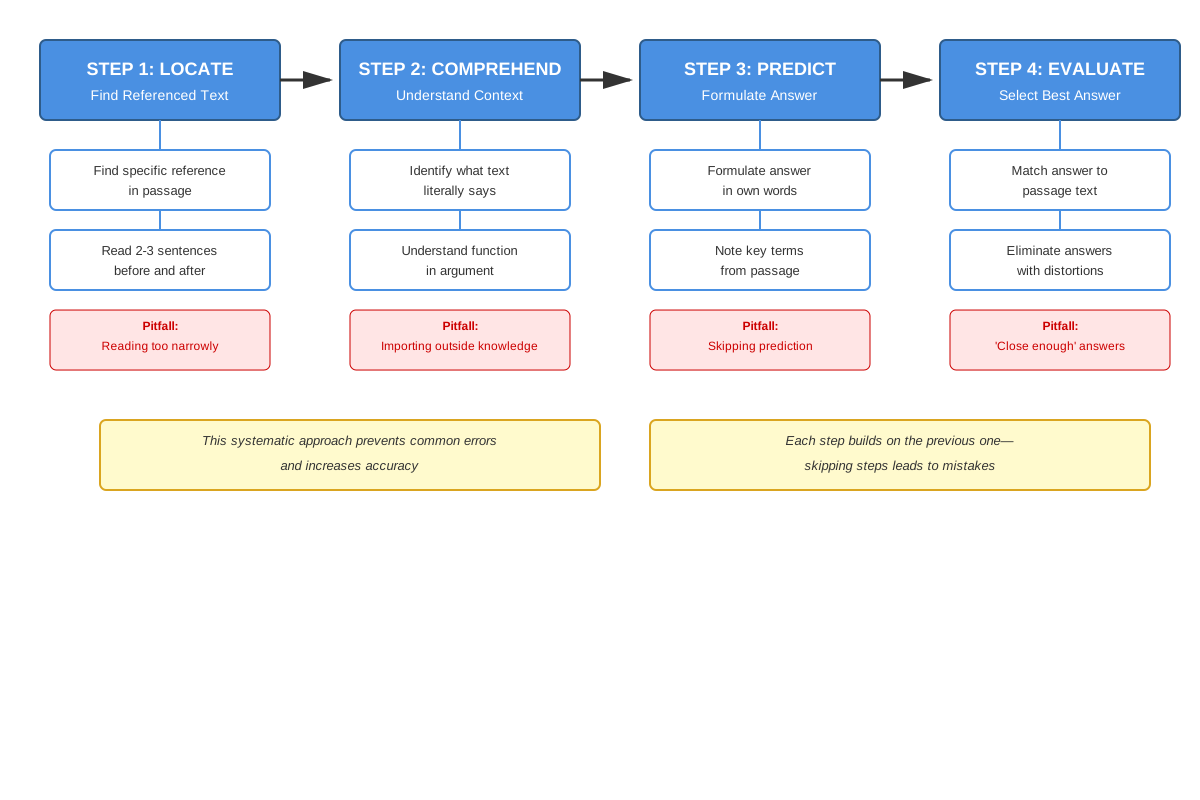
The fundamental reasoning pattern for local questions follows a straightforward but rigorous process:
- Identify the specific textual location referenced in the question stem
- Read the relevant portion carefully, including surrounding context (usually 2-3 sentences before and after)
- Paraphrase or summarize what the passage actually says in that location
- Predict an answer based on this understanding before looking at choices
- Match the prediction to the answer choice that most closely aligns with the passage text
- Eliminate wrong answers that distort, contradict, or import irrelevant information
This pattern emphasizes returning to the passage rather than relying on memory. The LSAT deliberately constructs wrong answers that "sound right" based on vague recollection but don't accurately reflect what the passage states. Successful test-takers develop the discipline to verify every answer against the actual text, even when time pressure mounts.
Locating Relevant Information
Efficient location of relevant passage content is crucial for local questions. The LSAT provides several types of locational cues:
- Line references: Direct citations like "line 23" or "lines 15-18"
- Paragraph references: "In the second paragraph" or "The final paragraph"
- Content references: "The author's discussion of quantum mechanics" or "the example of the 1929 stock market crash"
- Structural references: "The objection mentioned in the passage" or "the alternative explanation"
When no explicit line reference appears, test-takers must use content knowledge from their initial passage reading to locate the relevant section quickly. This is where effective passage mapping during the first read-through pays dividends—noting where key concepts, examples, and arguments appear enables rapid navigation when answering questions.
Context Is Critical
A common error in approaching local questions is reading the referenced sentence in isolation. The LSAT frequently tests whether students understand how specific statements function within their broader argumentative context. A sentence might appear to say one thing when read alone but serve a different purpose within the passage's logical flow. For example, an author might mention a theory not to endorse it but to critique it, or present a fact not as a conclusion but as evidence for a larger claim.
Effective local question strategy therefore requires reading approximately 2-3 sentences before and after any referenced location. This context reveals:
- The purpose of the referenced information (support, contrast, example, objection, etc.)
- The author's attitude toward the information (endorsement, skepticism, neutrality)
- The logical relationship between the referenced content and surrounding ideas
- Qualifying language that might limit or specify the claim being made
Common Wrong Answer Patterns
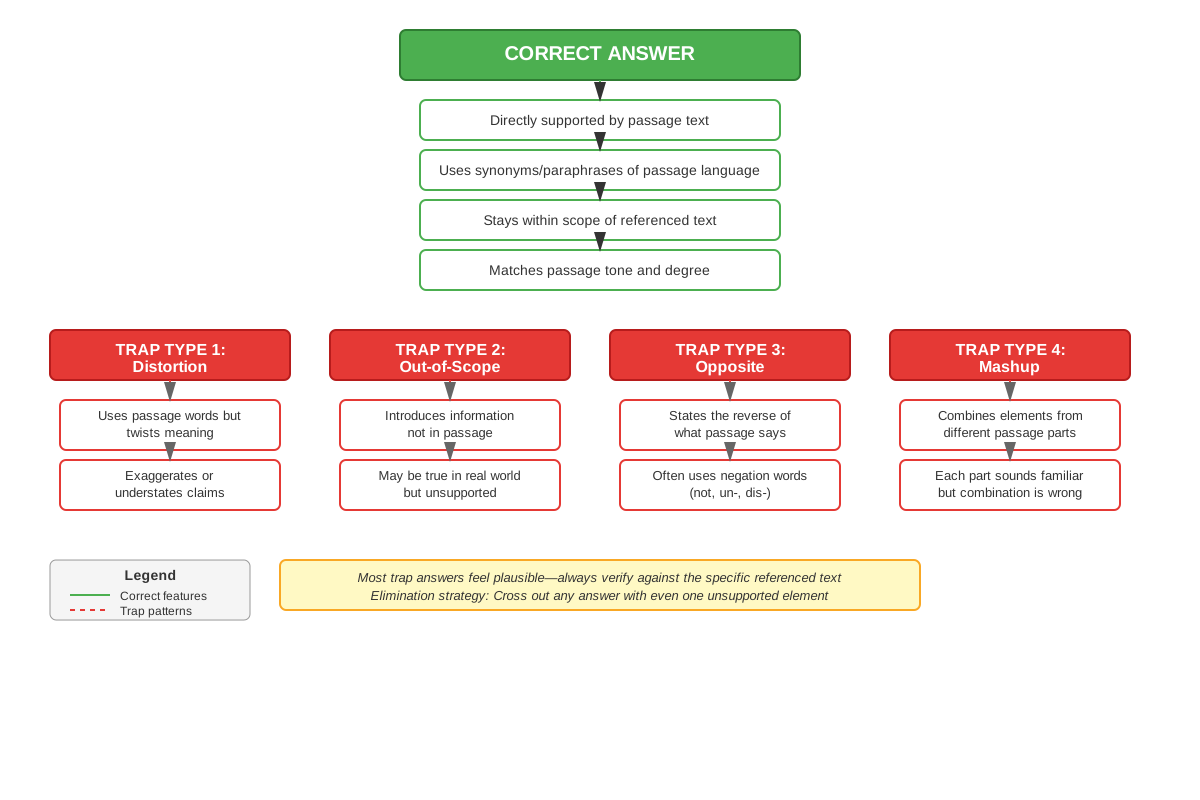
Understanding how the LSAT constructs incorrect answer choices for local questions dramatically improves accuracy. The most frequent wrong answer patterns include:
Distortions: Answer choices that take passage information and subtly twist it, often by changing degree words (some → all, may → must), reversing relationships (cause and effect), or adding unsupported elements.
Out-of-Scope: Choices that introduce information not discussed in the relevant passage section, even if the information might be true or appears elsewhere in the passage.
Opposite: Choices that contradict what the passage states, sometimes by confusing the author's view with an opposing view mentioned in the passage.
Too Extreme: Choices that overstate the passage's claims, using absolute language where the passage is qualified or tentative.
Wrong Location: Choices that accurately reflect passage content but from a different section than what the question references.
Concept Relationships
Local questions connect to broader reading comprehension skills through multiple pathways. At the foundation, close reading ability → enables → accurate answering of local questions → which builds → confidence and efficiency → leading to → better performance on inference and application questions. The precision required for local questions trains the careful textual analysis needed throughout the Reading Comprehension section.
Within the topic itself, understanding question stem language → allows → quick identification of question type → which determines → appropriate strategy selection → resulting in → efficient, accurate responses. Similarly, mastering wrong answer patterns → improves → elimination speed → which creates → more time for difficult questions → ultimately enhancing → overall section performance.
Local questions also connect to prerequisite knowledge: passage structure awareness → facilitates → rapid location of relevant text → enabling → quick verification of answer choices. The relationship flows bidirectionally as well: practice with local questions → reinforces → understanding of how LSAT passages are constructed → improving → initial passage comprehension.
Finally, local questions relate to other question types through shared skills. The textual precision required for local questions supports inference questions (which build on stated information), structure questions (which require understanding how parts relate to the whole), and even Logical Reasoning questions (which demand similar careful reading of stimulus text).
High-Yield Facts
⭐ Local questions constitute 40-50% of all Reading Comprehension questions, making them the most frequently tested question type alongside inference questions.
⭐ The correct answer to a local question must be directly supported by the passage text—if you cannot point to specific words or sentences that support an answer, it's wrong.
⭐ Always return to the passage rather than relying on memory; the LSAT deliberately creates wrong answers that match vague recollections but not actual passage content.
⭐ Read 2-3 sentences before and after any referenced location to understand context, purpose, and the author's attitude toward the information.
⭐ Question stems containing "according to the passage," "the passage states," or "the author mentions" signal local questions requiring textual verification rather than inference.
- Function questions (asking why the author includes information) are a subtype of local questions that require understanding argumentative purpose, not just content.
- Wrong answers frequently distort passage information by changing degree words, reversing relationships, or adding unsupported elements.
- Comparative reading passages heavily feature local questions that test whether students can distinguish which passage makes which specific claim.
- Science and technical passages tend to include more detail-oriented local questions about specific research findings, methodologies, or technical definitions.
- The LSAT often places correct answers in unexpected passage locations—the relevant information might appear several sentences away from the most obvious reference point.
- Extreme language in answer choices (all, none, must, never, only) is often—but not always—a sign of an incorrect answer for local questions.
- Predicting an answer before reading choices dramatically improves accuracy by preventing wrong answers from seeming plausible.
Quick check — test yourself on Local questions so far.
Try Flashcards →Common Misconceptions
Misconception: Local questions are easier than other question types because they just ask what the passage says.
Correction: While local questions test stated information, the LSAT makes them challenging through subtle distortions in answer choices, requiring precise reading and careful verification. Many students miss local questions by selecting answers that "sound right" without checking against the actual text.
Misconception: If information appears anywhere in the passage, it's a valid answer to a local question.
Correction: Local questions reference specific passage locations, and the correct answer must be supported by information in or immediately around that location. Information from other parts of the passage, even if accurate, is incorrect if it doesn't address the specific textual reference in the question.
Misconception: You should read the entire passage section referenced before looking at answer choices.
Correction: While context matters, reading too broadly wastes time and introduces irrelevant information. The optimal approach is reading the specific reference plus 2-3 sentences of surrounding context, then predicting an answer before evaluating choices.
Misconception: Function questions require inference about the author's unstated intentions.
Correction: Function questions are still local questions grounded in textual evidence. The passage structure and explicit language reveal why information is included—to provide evidence, present an objection, offer an example, etc. These purposes are determinable from the text itself.
Misconception: If an answer choice uses different words than the passage, it must be wrong.
Correction: Correct answers typically paraphrase passage content rather than quoting it directly. The LSAT tests whether students understand concepts, not just whether they can match identical words. What matters is whether the answer choice accurately represents the passage's meaning, not whether it uses the same vocabulary.
Worked Examples
Example 1: Detail Question
Passage Excerpt:
"The traditional view of coral reefs as stable, unchanging ecosystems has been challenged by recent research. Marine biologists now recognize that reef systems undergo constant transformation, with coral colonies expanding and contracting in response to environmental fluctuations. While catastrophic events like hurricanes can cause dramatic short-term damage, the more significant threat to reef health comes from gradual changes in water temperature and chemistry. These slow-moving alterations, often linked to climate change, can fundamentally alter the symbiotic relationships between coral polyps and the algae that provide them with nutrients."
Question: According to the passage, which of the following poses the most significant threat to coral reef health?
Step 1 - Identify the question type: The phrase "according to the passage" signals a local detail question requiring textual support.
Step 2 - Locate relevant information: The passage discusses threats in the middle section, specifically mentioning "catastrophic events" and "gradual changes."
Step 3 - Read with context: The passage explicitly states "the more significant threat to reef health comes from gradual changes in water temperature and chemistry."
Step 4 - Predict the answer: The correct answer will identify gradual environmental changes, particularly temperature and chemistry alterations, as the most significant threat.
Step 5 - Evaluate answer choices (hypothetical):
- (A) Hurricanes and other catastrophic weather events → Wrong: The passage states these cause "dramatic short-term damage" but are less significant than gradual changes
- (B) Disruption of symbiotic relationships between coral and algae → Wrong: This is presented as a consequence of the threat, not the threat itself
- (C) Slow changes in water temperature and chemistry → Correct: Directly matches the passage's statement about "the more significant threat"
- (D) The traditional view of reefs as unchanging ecosystems → Wrong: This is a scientific perspective, not a threat to reef health
- (E) Expansion and contraction of coral colonies → Wrong: This is described as a normal process, not a threat
Key Takeaway: The correct answer directly reflects passage language while the wrong answers either contradict the passage, confuse cause and effect, or reference irrelevant information.
Example 2: Function Question
Passage Excerpt:
"Proponents of universal basic income (UBI) argue that providing all citizens with unconditional cash payments would reduce poverty and increase economic security. However, critics raise several concerns about implementation. The most frequently cited objection involves cost: funding UBI would require either massive tax increases or reallocation of existing social programs. Additionally, opponents worry that guaranteed income might reduce work incentives, though pilot programs in Finland and Kenya have not shown significant decreases in employment. Despite these concerns, the concept continues to gain traction among policymakers seeking solutions to technological unemployment."
Question: The author mentions the pilot programs in Finland and Kenya primarily in order to:
Step 1 - Identify the question type: "The author mentions...primarily in order to" signals a function question, a subtype of local questions asking about purpose.
Step 2 - Locate relevant information: The pilot programs appear in the middle of the paragraph, specifically in the sentence about work incentive concerns.
Step 3 - Analyze context and structure: The sentence structure is "opponents worry that X, though pilot programs have not shown X." This "though" signals a contrast—the pilot programs are mentioned to counter or qualify the opponents' concern.
Step 4 - Predict the answer: The correct answer will indicate that the pilot programs are mentioned to challenge, question, or provide evidence against the concern about reduced work incentives.
Step 5 - Evaluate answer choices (hypothetical):
- (A) Provide evidence supporting critics' concerns about UBI → Wrong: The pilot programs actually contradict critics' concerns
- (B) Illustrate the widespread international interest in UBI → Wrong: While the programs are international, this isn't their function in the argument
- (C) Challenge the objection that UBI reduces work incentives → Correct: The programs are cited specifically to counter this concern
- (D) Demonstrate the high cost of implementing UBI programs → Wrong: The programs aren't discussed in relation to cost
- (E) Show that UBI can eliminate technological unemployment → Wrong: The programs test work incentives, not technological unemployment
Key Takeaway: Function questions require understanding not just what information appears but why the author includes it within the argumentative structure. The word "though" was the key structural signal revealing the contrasting, counter-evidence function.
Exam Strategy
Approaching Local Questions Systematically
Develop a consistent process for every local question:
- Read the question stem carefully to identify the specific location or content referenced
- Return to the passage immediately—never answer from memory alone
- Read the referenced section plus surrounding context (2-3 sentences before and after)
- Formulate your own answer in simple language before looking at choices
- Match your prediction to the answer choices, looking for accurate paraphrasing
- Eliminate wrong answers using common trap patterns
- Verify the remaining answer against the passage text one final time
Trigger Words and Phrases
Recognize these question stem indicators of local questions:
Definite local question signals: "According to the passage," "The passage states," "The author mentions," "The passage indicates," "Which of the following is mentioned," "The passage describes"
Function question signals: "in order to," "primarily to," "serves to," "functions to," "the purpose of," "the role of"
Meaning-in-context signals: "most nearly means," "refers to," "the author uses the term X to mean"
Process of Elimination Tips
For local questions specifically:
- Eliminate answers with extreme language unless the passage itself uses extreme language
- Eliminate answers that import information from other passage sections not referenced by the question
- Eliminate answers that reverse relationships or confuse the author's view with opposing views mentioned in the passage
- Eliminate answers that add unsupported elements not present in the relevant text
- Keep answers that accurately paraphrase passage content, even if they use different words
Time Allocation Advice
Local questions should generally be among your faster questions because they require less synthesis than inference or application questions. Aim for:
- 45-60 seconds for straightforward detail questions with clear line references
- 60-90 seconds for function questions requiring structural analysis
- 90 seconds maximum for any local question—if you're taking longer, you may be overthinking or looking in the wrong passage location
If you cannot locate the relevant information quickly, mark the question and return to it after completing easier questions. Sometimes answering other questions about the passage refreshes your memory of where specific content appears.
Memory Techniques
The LOCATE Acronym
For approaching any local question:
- Locate the specific reference in the passage
- Observe the surrounding context (2-3 sentences)
- Consider the author's purpose and attitude
- Anticipate an answer before reading choices
- Test each answer against the passage text
- Eliminate answers that distort or add information
The "Three-Sentence Rule"
Visualize a spotlight illuminating the referenced sentence plus one sentence before and one after. This spotlight contains the context you need—anything outside it is likely irrelevant to the specific question.
Function Question Framework
Remember that function questions ask WHY, not WHAT. Visualize the passage as a building where each piece of information serves a structural purpose:
- Foundation: Background information or context
- Support Beams: Evidence and examples
- Counterweights: Objections or alternative views
- Roof: Conclusions or implications
When asked about function, identify which structural role the referenced information plays.
The Paraphrase Test
Before selecting an answer, mentally paraphrase both the passage content and the answer choice in your own simple words. If the paraphrases match, the answer is likely correct. If they diverge, the answer probably distorts the passage.
Summary
Local questions represent the most direct test of reading accuracy on the LSAT, requiring test-takers to locate specific passage information and identify answer choices that accurately reflect that content. These questions appear with high frequency (40-50% of Reading Comprehension questions) and come in several varieties: detail questions asking what the passage states, function questions asking why information is included, and meaning-in-context questions asking how terms are used. Success requires a disciplined approach: always returning to the passage rather than relying on memory, reading referenced sections with surrounding context, predicting answers before evaluating choices, and systematically eliminating wrong answers that distort, contradict, or import irrelevant information. The LSAT constructs challenging local questions not by asking about obscure details but by creating plausible-sounding wrong answers that subtly misrepresent passage content. Mastering local questions builds the foundational reading precision necessary for all Reading Comprehension question types and directly develops the textual analysis skills essential for legal practice.
Key Takeaways
- Local questions test specific passage content rather than overall structure or main ideas, requiring precise location and verification of textual information
- Always return to the passage to verify answers—the LSAT deliberately creates wrong answers that match vague memory but not actual text
- Context is crucial: read 2-3 sentences surrounding any referenced location to understand purpose, attitude, and logical relationships
- Predict your answer before reading choices to avoid being swayed by plausible-sounding distortions
- Common wrong answer patterns include distortions (subtle changes to passage claims), out-of-scope information, opposites, extreme language, and content from wrong passage locations
- Function questions are local questions asking why information appears, requiring analysis of argumentative structure and purpose
- Efficient time management means spending 45-90 seconds per local question, making them among your faster questions in the section
Related Topics
Inference Questions: Building on local questions, inference questions require drawing conclusions that go beyond what's explicitly stated while remaining grounded in passage evidence. Mastering local questions provides the textual precision necessary for making valid inferences.
Global Questions (Main Point and Primary Purpose): While local questions focus on specific passage segments, global questions require synthesizing the entire passage. Understanding individual parts through local questions naturally supports comprehension of the whole.
Comparative Reading Questions: These questions frequently test local question skills by asking students to identify which passage makes which specific claim, requiring precise textual verification across two related passages.
Logical Reasoning Stimulus Analysis: The close reading skills developed through local questions directly transfer to analyzing Logical Reasoning stimuli, where precise understanding of premises and conclusions is essential.
Reading Comprehension Passage Mapping: Effective initial passage reading and notation strategies enable quick location of information when answering local questions, creating a synergistic relationship between reading strategy and question-answering technique.
Practice CTA
Now that you understand the fundamentals of local questions, it's time to apply these concepts to actual LSAT passages. Complete the practice questions associated with this topic, focusing on implementing the systematic approach outlined in this guide: locate, read with context, predict, and verify. Pay special attention to wrong answer patterns—understanding why incorrect answers are wrong is just as valuable as identifying correct answers. Use the flashcards to reinforce key concepts and trigger words. Remember, local questions reward precision and discipline, skills that improve dramatically with focused practice. Each question you work through builds the reading accuracy that will serve you throughout the LSAT and in law school. You've got this!
Sign up free to keep reading
Create a free AnvayaPrep account to finish this LSAT guide on Local questions — plus flashcards and practice questions.