Overview
Cyclic sugars represent one of the most fundamental structural transformations in carbohydrates, where linear monosaccharides spontaneously convert into ring structures through intramolecular reactions. This cyclization process is not merely a structural curiosity—it is the predominant form in which sugars exist in aqueous solution and biological systems. Understanding cyclic sugar formation, nomenclature, and stereochemistry is essential for mastering Biochemistry concepts tested on the MCAT, particularly those involving carbohydrate metabolism, glycosidic bond formation, and the structural basis of polysaccharides.
The MCAT frequently tests cyclic sugar concepts through passage-based questions involving carbohydrate structure determination, anomeric carbon identification, and the interconversion between different sugar forms. Questions may present Haworth projections or chair conformations and ask students to identify specific stereochemical features, predict reactivity patterns, or explain the biological significance of particular sugar configurations. The ability to rapidly recognize and manipulate cyclic sugar structures is crucial for success on biochemistry passages, particularly those involving glycobiology, metabolism, or structural biology.
Within the broader context of Biochemistry, cyclic sugars serve as the building blocks for complex carbohydrates including disaccharides, oligosaccharides, and polysaccharides such as glycogen, starch, and cellulose. The stereochemistry at the anomeric carbon—the carbon that becomes chiral upon cyclization—determines the type of glycosidic linkages that can form, which in turn dictates the three-dimensional structure and biological function of carbohydrate polymers. Mastery of cyclic sugar structure provides the foundation for understanding enzyme-substrate specificity, cellular recognition processes, and energy storage mechanisms.
Learning Objectives
- [ ] Define cyclic sugars using accurate Biochemistry terminology, including hemiacetal and hemiketal formation
- [ ] Explain why cyclic sugars matter for the MCAT, including their frequency in exam passages and question types
- [ ] Apply cyclic sugars concepts to exam-style questions involving structure determination and stereochemistry
- [ ] Identify common mistakes related to cyclic sugars, particularly regarding anomeric carbon configuration
- [ ] Connect cyclic sugars to related Biochemistry concepts including glycosidic bonds and polysaccharide structure
- [ ] Distinguish between α and β anomers and predict their relative stability in different sugar systems
- [ ] Interconvert between Fischer projections, Haworth projections, and chair conformations of cyclic sugars
- [ ] Predict the predominant cyclic form (furanose vs. pyranose) for common monosaccharides
- [ ] Explain mutarotation and calculate equilibrium compositions of anomeric mixtures
Prerequisites
- Fischer projections and D/L nomenclature: Essential for understanding the starting linear sugar structures that undergo cyclization and for determining the stereochemistry of the resulting cyclic forms
- Carbonyl chemistry (aldehydes and ketones): Necessary to comprehend the nucleophilic addition mechanism by which hydroxyl groups attack carbonyl carbons to form hemiacetals and hemiketals
- Stereochemistry and chirality: Required to identify chiral centers, assign R/S configurations, and understand how new stereocenters are created at the anomeric carbon during cyclization
- Basic organic functional groups: Needed to recognize hydroxyl groups, ethers, and the hemiacetal/hemiketal functional groups that characterize cyclic sugars
Why This Topic Matters
Clinical and Real-World Significance
Cyclic sugars are ubiquitous in biological systems and play critical roles in energy metabolism, cellular recognition, and structural support. Glucose exists predominantly in its cyclic pyranose form in blood and tissues, where it serves as the primary energy currency. The specific anomeric configuration of glucose affects its recognition by enzymes such as hexokinase and glucose transporters. Glycoproteins and glycolipids on cell surfaces contain cyclic sugars that mediate cell-cell recognition, immune responses, and pathogen binding. Understanding cyclic sugar structure is essential for comprehending how blood type antigens function, how influenza virus recognizes host cells through sialic acid residues, and how glycogen's branched structure enables rapid glucose mobilization during exercise or fasting.
MCAT Exam Statistics and Question Types
Cyclic sugars appear in approximately 15-20% of MCAT biochemistry passages, making them a medium-to-high-yield topic. Questions typically fall into three categories: (1) structure identification and nomenclature, where students must recognize or draw specific cyclic forms; (2) mechanistic questions about hemiacetal formation or mutarotation; and (3) application questions linking cyclic sugar structure to biological function, such as explaining why α-1,4-glycosidic bonds in amylose produce a helical structure while β-1,4-bonds in cellulose yield linear chains. Discrete questions often test the ability to identify anomeric carbons, distinguish α from β anomers, or predict the products of glycosidic bond formation.
Common Passage Contexts
MCAT passages featuring cyclic sugars often appear in contexts involving: carbohydrate metabolism pathways (glycolysis, gluconeogenesis), where understanding glucose structure is essential; glycobiology and cell surface markers, requiring knowledge of how cyclic sugars link to proteins and lipids; structural biochemistry passages comparing polysaccharide properties; and experimental passages describing carbohydrate analysis techniques such as mutarotation measurements or glycosidic bond hydrolysis. Passages may present novel sugar derivatives and expect students to apply cyclization principles to unfamiliar structures.
Core Concepts
Hemiacetal and Hemiketal Formation
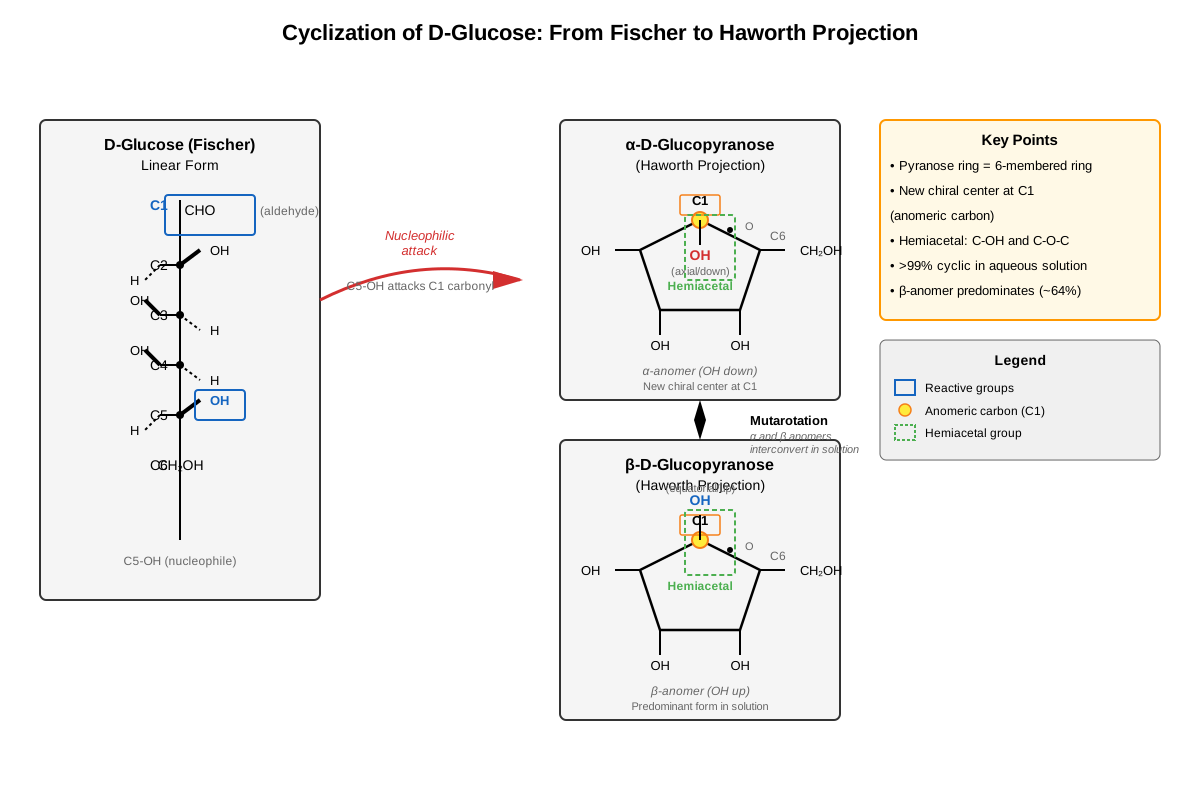
Cyclic sugars form through an intramolecular nucleophilic addition reaction where a hydroxyl group within the sugar molecule attacks the carbonyl carbon (aldehyde or ketone). For aldoses (sugars with aldehyde groups), this reaction produces a hemiacetal functional group, characterized by a carbon bonded to one hydroxyl group (-OH), one hydrogen atom (-H), and two other carbon-containing groups (one via an ether linkage -OR). For ketoses (sugars with ketone groups), the analogous reaction yields a hemiketal, where the central carbon is bonded to one hydroxyl group, one ether linkage, and two carbon-containing groups (no hydrogen on the central carbon).
The driving force for cyclization is the favorable entropy of forming a ring structure compared to maintaining an extended chain, combined with the relief of carbonyl group reactivity. In aqueous solution, the linear form of most monosaccharides exists in equilibrium with cyclic forms, but the cyclic forms predominate overwhelmingly—typically more than 99% of glucose molecules exist in cyclic form at any given moment.
Pyranose and Furanose Ring Systems
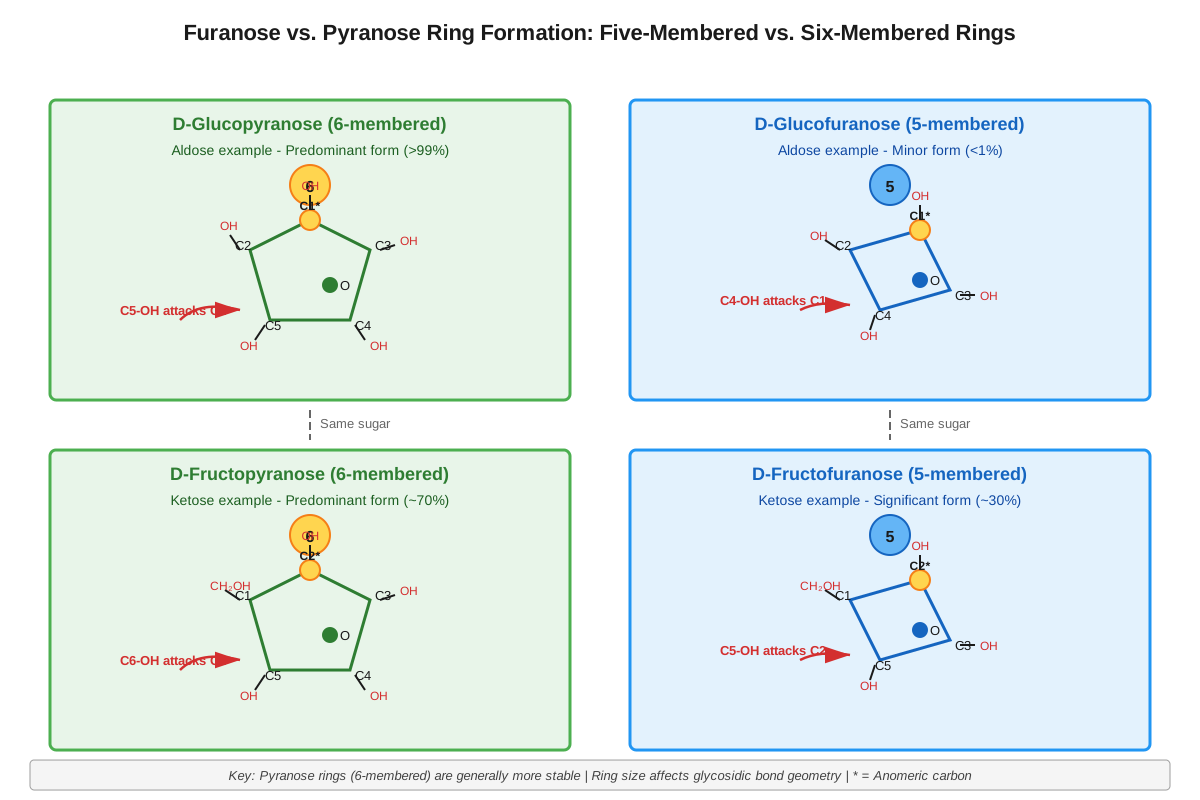
Monosaccharides can form either six-membered rings called pyranoses (analogous to pyran, a six-membered ring with one oxygen) or five-membered rings called furanoses (analogous to furan, a five-membered ring with one oxygen). The ring size depends on which hydroxyl group performs the nucleophilic attack on the carbonyl carbon.
For aldohexoses like glucose, the C5 hydroxyl group typically attacks the C1 aldehyde carbon, forming a six-membered pyranose ring. This is the thermodynamically favored form because six-membered rings adopt stable chair conformations with minimal angle strain and torsional strain. Glucose exists predominantly as glucopyranose (>99%) with only trace amounts of the furanose form.
For ketohexoses like fructose, both pyranose and furanose forms are significant. The C6 hydroxyl can attack the C2 ketone to form a six-membered ring (fructopyranose), or the C5 hydroxyl can attack to form a five-membered ring (fructofuranose). In solution, fructose exists as approximately 67% β-fructopyranose, 25% β-fructofuranose, and smaller amounts of α-anomers and linear form.
For aldopentoses like ribose, the C4 hydroxyl attacks the C1 aldehyde, forming a five-membered furanose ring. Ribose and deoxyribose exist predominantly in furanose forms, which is biologically significant because these are the sugar components of RNA and DNA, respectively.
The Anomeric Carbon and Anomers
When a sugar cyclizes, the carbonyl carbon becomes a new chiral center called the anomeric carbon. This carbon can adopt two different configurations, creating two stereoisomers called anomers. The α-anomer has the hydroxyl group on the anomeric carbon positioned on the opposite side (trans) of the ring from the CH₂OH group that determines D/L configuration. The β-anomer has the anomeric hydroxyl on the same side (cis) as the reference CH₂OH group.
For D-sugars in Haworth projection (the standard representation with the ring drawn as a flat hexagon or pentagon viewed from an angle):
- α-anomer: anomeric -OH points DOWN
- β-anomer: anomeric -OH points UP
This relationship reverses for L-sugars, though L-sugars are rare in human biochemistry. The anomeric carbon is the most reactive position in a cyclic sugar because the hemiacetal/hemiketal functional group can readily open and reform, allowing interconversion between anomers.
Haworth Projections
Haworth projections provide a simplified two-dimensional representation of cyclic sugars, depicting the ring as a flat polygon viewed at an angle. For pyranoses, the ring is drawn as a hexagon with the oxygen at the back right position. For furanoses, the ring is drawn as a pentagon with the oxygen at the back.
To convert a Fischer projection to a Haworth projection:
- Identify which hydroxyl group will attack the carbonyl (typically C5-OH for aldohexoses)
- Curl the Fischer projection into a ring, bringing the attacking hydroxyl near the carbonyl
- Groups on the RIGHT in Fischer projection point DOWN in Haworth projection
- Groups on the LEFT in Fischer projection point UP in Haworth projection
- The CH₂OH group (C6 in glucose) points UP for D-sugars, DOWN for L-sugars
- The anomeric hydroxyl can point either UP (β) or DOWN (α)
Chair Conformations
While Haworth projections are useful for showing stereochemistry, they inaccurately represent the three-dimensional shape of pyranose rings. Six-membered rings actually adopt chair conformations to minimize angle strain and torsional strain, similar to cyclohexane. In chair conformations, substituents occupy either axial positions (perpendicular to the ring plane) or equatorial positions (roughly in the ring plane).
For β-D-glucopyranose, the most stable chair conformation has all large substituents (hydroxyl groups and the CH₂OH group) in equatorial positions, minimizing steric interactions. This "all-equatorial" arrangement makes β-D-glucose exceptionally stable and explains why glucose is the most abundant monosaccharide in nature.
The anomeric effect influences the stability of different anomers. For glucose, β-D-glucopyranose is more stable than α-D-glucopyranose in aqueous solution (β:α ratio of approximately 64:36 at equilibrium) because the β-anomer can achieve the all-equatorial conformation. However, the α-anomer is stabilized by the anomeric effect—a stereoelectronic interaction where the axial anomeric hydroxyl is stabilized by orbital overlap with the ring oxygen's lone pairs.
Mutarotation
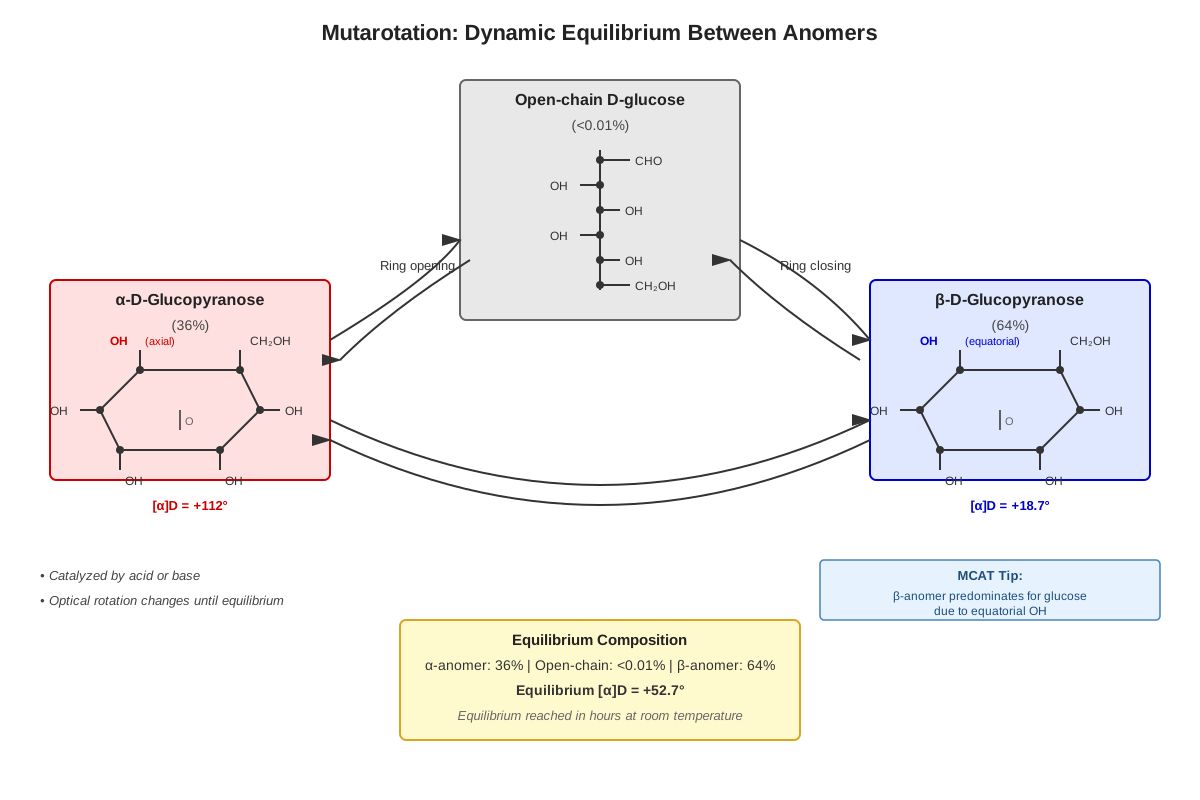
Mutarotation is the spontaneous interconversion between α and β anomers through the transient opening of the ring to the linear form. When pure α-D-glucopyranose is dissolved in water, its optical rotation gradually changes from +112° to an equilibrium value of +52.7°. Similarly, pure β-D-glucopyranose (initial rotation +18.7°) also equilibrates to +52.7°. This change in optical rotation reflects the establishment of equilibrium between anomers.
The mechanism involves:
- Ring opening: The hemiacetal breaks, regenerating the linear aldehyde form
- Free rotation: The carbonyl carbon is no longer chiral, allowing free rotation
- Ring closure: The hydroxyl attacks from either face, forming α or β anomer
At equilibrium in aqueous solution at 25°C, D-glucose exists as approximately 36% α-anomer, 64% β-anomer, and <0.01% linear form. The equilibrium composition reflects the relative thermodynamic stabilities of the anomers.
Glycosidic Bond Formation
When the anomeric hydroxyl group of a cyclic sugar reacts with an alcohol (including another sugar's hydroxyl group), a glycosidic bond forms, creating an acetal or ketal (depending on whether the sugar is an aldose or ketose). Unlike hemiacetals, acetals are stable in aqueous solution and do not undergo mutarotation. The configuration at the anomeric carbon is "locked in" when a glycosidic bond forms.
Glycosidic bonds are named by:
- The configuration at the anomeric carbon (α or β)
- The carbon number of the anomeric carbon
- The carbon number of the hydroxyl group that was attacked (if linking two sugars)
For example, maltose contains an α-1,4-glycosidic bond (α-configuration at the anomeric carbon of the first glucose, linking C1 of the first glucose to C4 of the second glucose). Lactose contains a β-1,4-glycosidic bond. Sucrose contains an α-1,2-glycosidic bond linking glucose C1 to fructose C2.
Reducing and Non-Reducing Sugars
Reducing sugars are carbohydrates that can act as reducing agents because they possess a free anomeric carbon (hemiacetal or hemiketal) that can open to reveal a reactive aldehyde or ketone. All monosaccharides are reducing sugars, as are disaccharides with one free anomeric carbon (maltose, lactose, cellobiose).
Non-reducing sugars have both anomeric carbons involved in glycosidic bonds, preventing ring opening. Sucrose is a non-reducing sugar because its glycosidic bond links the anomeric carbons of both glucose (C1) and fructose (C2), leaving no free hemiacetal or hemiketal group.
This distinction is biochemically important: reducing sugars can participate in non-enzymatic glycation reactions with proteins (contributing to diabetic complications), while non-reducing sugars cannot. The Benedict's test and Fehling's test, which detect reducing sugars, rely on the ability of the free carbonyl group to reduce copper(II) ions.
Concept Relationships
The formation of cyclic sugars begins with linear monosaccharides in Fischer projection, which undergo intramolecular nucleophilic addition to form hemiacetals or hemiketals. This cyclization creates the anomeric carbon, a new stereocenter that can adopt α or β configurations, producing anomers. These anomers interconvert through mutarotation, establishing an equilibrium mixture in aqueous solution.
The cyclic structure can be represented as Haworth projections (simplified 2D) or chair conformations (accurate 3D), with the latter revealing the thermodynamic preferences that explain why certain sugars and anomers predominate. The stability differences between chair conformations, influenced by the anomeric effect, determine the equilibrium ratios of α and β forms.
When cyclic sugars react at their anomeric carbon to form glycosidic bonds, they create disaccharides and polysaccharides. The configuration (α or β) and position of these glycosidic bonds determine the properties of the resulting polymers: α-1,4-bonds produce digestible starch and glycogen, while β-1,4-bonds create indigestible cellulose. The presence or absence of free anomeric carbons distinguishes reducing sugars from non-reducing sugars, affecting their chemical reactivity and biological behavior.
This entire system connects to broader biochemistry through carbohydrate metabolism (glucose in its cyclic form enters glycolysis), structural biology (polysaccharide architecture depends on glycosidic bond geometry), and molecular recognition (cell surface glycoproteins use specific cyclic sugar configurations for signaling).
Relationship Map:
Linear sugar (Fischer projection) → Cyclization (nucleophilic addition) → Hemiacetal/hemiketal formation → Anomeric carbon creation → α and β anomers → Mutarotation (equilibrium) → Haworth/chair representations → Glycosidic bond formation → Disaccharides/polysaccharides → Biological function
Quick check — test yourself on Cyclic sugars so far.
Try Flashcards →High-Yield Facts
⭐ Glucose exists >99% in cyclic form in aqueous solution, predominantly as β-D-glucopyranose (64%) and α-D-glucopyranose (36%)
⭐ The anomeric carbon is the carbonyl carbon that becomes a new chiral center upon cyclization; it is the most reactive position in a cyclic sugar
⭐ In Haworth projections of D-sugars, the β-anomer has the anomeric -OH pointing UP, while the α-anomer has it pointing DOWN
⭐ Mutarotation is the interconversion between α and β anomers through transient ring opening; it changes optical rotation until equilibrium is reached
⭐ Glycosidic bonds lock the anomeric configuration and convert hemiacetals to acetals, preventing mutarotation and creating non-reducing sugars if both anomeric carbons are involved
- Aldohexoses (like glucose) form predominantly six-membered pyranose rings; aldopentoses (like ribose) form predominantly five-membered furanose rings
- β-D-glucopyranose is exceptionally stable because all substituents can occupy equatorial positions in the chair conformation
- The anomeric effect provides stabilization to axial anomeric substituents through orbital overlap with the ring oxygen's lone pairs
- Reducing sugars have a free anomeric carbon (hemiacetal/hemiketal) that can open to reveal a reactive carbonyl group
- Fructose exists as a mixture of pyranose and furanose forms, with β-fructopyranose predominating in solution (67%)
- Sucrose is a non-reducing sugar because both anomeric carbons (glucose C1 and fructose C2) are involved in the glycosidic bond
- The configuration of glycosidic bonds (α vs. β) determines polysaccharide digestibility: humans can digest α-1,4-bonds (starch) but not β-1,4-bonds (cellulose)
Common Misconceptions
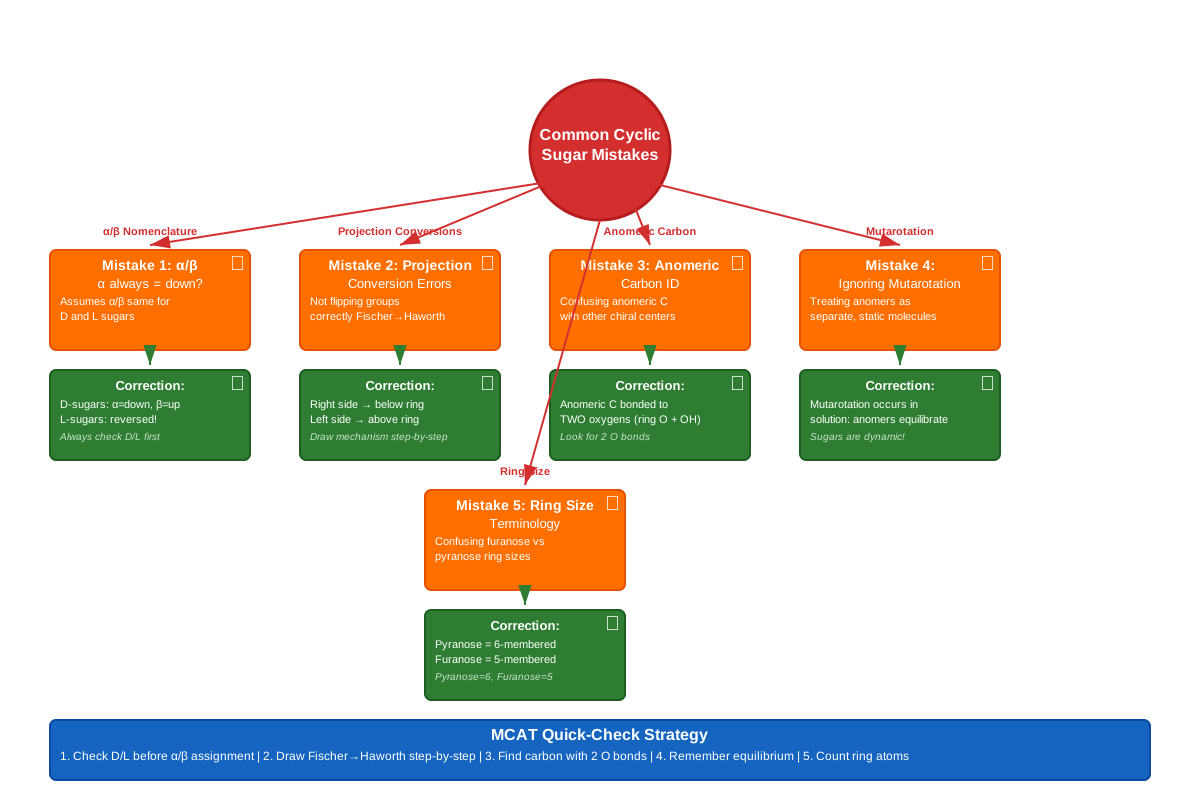
Misconception: The anomeric carbon is always C1 in all sugars.
Correction: The anomeric carbon is the carbonyl carbon that becomes a hemiacetal/hemiketal upon cyclization. For aldoses, this is C1 (the aldehyde carbon). For ketoses like fructose, this is C2 (the ketone carbon). Always identify the original carbonyl position to locate the anomeric carbon.
Misconception: In Haworth projections, "up" and "down" have the same meaning as "right" and "left" in Fischer projections.
Correction: Groups on the RIGHT in Fischer projections point DOWN in Haworth projections, while groups on the LEFT point UP. This is because the Fischer projection is "curled" to form the ring, inverting the orientation. The reference CH₂OH group points UP for D-sugars and DOWN for L-sugars.
Misconception: α and β anomers are enantiomers.
Correction: α and β anomers are diastereomers, not enantiomers. They differ in configuration at only one stereocenter (the anomeric carbon) while having identical configurations at all other chiral centers. Enantiomers differ at all chiral centers and are non-superimposable mirror images.
Misconception: Once a sugar forms a glycosidic bond, it can still undergo mutarotation.
Correction: Glycosidic bond formation converts the hemiacetal to an acetal, which is stable in aqueous solution and cannot spontaneously open. Only sugars with free anomeric carbons (hemiacetals/hemiketals) can undergo mutarotation. This is why the reducing end of a disaccharide can mutarotate, but the non-reducing end cannot.
Misconception: All six-membered sugar rings are more stable than five-membered rings.
Correction: While pyranoses are generally more stable than furanoses for aldohexoses due to favorable chair conformations, this is not universal. Ribose and deoxyribose exist predominantly as furanoses because the five-membered ring is geometrically favorable for these aldopentoses. Additionally, when incorporated into nucleotides, the furanose form is stabilized by the overall molecular structure.
Misconception: The linear form of glucose is insignificant and can be ignored.
Correction: Although the linear form represents <0.01% of glucose molecules at equilibrium, it is biochemically essential. The linear form is the reactive species in mutarotation, glycosidic bond formation, and non-enzymatic glycation reactions. Enzymes that modify glucose (like glucose oxidase) often act on the linear form, and the equilibrium shifts to replenish it as it is consumed.
Worked Examples
Example 1: Identifying Anomers and Predicting Stability
Question: β-D-glucopyranose is dissolved in water and allowed to reach equilibrium. Explain the process that occurs and predict the final composition. Why is β-D-glucopyranose more abundant than α-D-glucopyranose at equilibrium?
Solution:
Step 1 - Identify the process: When β-D-glucopyranose dissolves in water, mutarotation occurs. The hemiacetal at the anomeric carbon (C1) is in equilibrium with the linear aldehyde form, which can then re-cyclize to form either the α or β anomer.
Step 2 - Describe the mechanism:
- Ring opening: The C1-O bond breaks, and the C1 aldehyde reforms
- The molecule exists transiently in linear form with free rotation around C1-C2
- Ring closure: The C5 hydroxyl attacks C1 from either face, forming α-anomer (attack from one face) or β-anomer (attack from opposite face)
Step 3 - Predict equilibrium composition: At equilibrium at 25°C, the mixture will contain approximately 36% α-D-glucopyranose, 64% β-D-glucopyranose, and <0.01% linear form. The optical rotation will stabilize at +52.7°.
Step 4 - Explain β-anomer predominance: β-D-glucopyranose is more stable because in its chair conformation, all five substituents (four -OH groups and one -CH₂OH group) can occupy equatorial positions, minimizing steric interactions. In contrast, α-D-glucopyranose must have the anomeric hydroxyl in the axial position, creating some steric strain. Although the anomeric effect partially stabilizes the α-anomer, the all-equatorial advantage of the β-anomer outweighs this, resulting in β predominance.
Connection to learning objectives: This example demonstrates understanding of mutarotation mechanism, anomer interconversion, and the structural factors (chair conformation preferences) that determine equilibrium composition—all essential for MCAT questions on cyclic sugar stability.
Example 2: Glycosidic Bond Analysis
Question: Lactose is a disaccharide composed of galactose and glucose linked by a β-1,4-glycosidic bond. Is lactose a reducing sugar? Explain your reasoning and describe what happens when lactose is dissolved in water.
Solution:
Step 1 - Analyze the glycosidic bond: A β-1,4-glycosidic bond means:
- The anomeric carbon of galactose (C1) is in β-configuration
- This C1 is linked to the C4 hydroxyl of glucose
- The galactose anomeric carbon is "locked" as an acetal and cannot open
Step 2 - Identify free anomeric carbons:
- Galactose C1: involved in glycosidic bond → NOT free
- Glucose C1: NOT involved in glycosidic bond → FREE (still a hemiacetal)
Step 3 - Determine reducing sugar status: Lactose IS a reducing sugar because the glucose unit retains a free anomeric carbon (hemiacetal at C1). This hemiacetal can open to reveal an aldehyde group, which can act as a reducing agent.
Step 4 - Predict behavior in water: When lactose dissolves in water:
- The galactose unit cannot undergo mutarotation (acetal is stable)
- The glucose unit CAN undergo mutarotation between α and β forms
- Lactose will show mutarotation and give a positive Benedict's test
- The glucose end is called the "reducing end" while the galactose end is the "non-reducing end"
Step 5 - Contrast with non-reducing sugar: If we compare to sucrose (α-1,2-glycosidic bond linking glucose C1 to fructose C2), both anomeric carbons are involved in the bond, leaving no free hemiacetal/hemiketal. Sucrose cannot undergo mutarotation and is not a reducing sugar.
Connection to learning objectives: This example applies cyclic sugar concepts to disaccharide structure, demonstrates understanding of how glycosidic bonds affect reactivity, and connects to the biochemically important distinction between reducing and non-reducing sugars—a common MCAT question type.
Exam Strategy
Approaching MCAT Questions on Cyclic Sugars
Step 1 - Identify the question type: Quickly determine whether the question asks about structure (identify anomers, draw projections), mechanism (explain mutarotation, glycosidic bond formation), or application (predict properties, explain biological function).
Step 2 - Locate the anomeric carbon: In any cyclic sugar structure, immediately identify the anomeric carbon—it's the carbon bonded to two oxygens (one in the ring, one as a hydroxyl or glycosidic bond). This is your reference point for determining α/β configuration and predicting reactivity.
Step 3 - Use systematic conversion methods: When converting between representations:
- Fischer → Haworth: Remember "right goes down, left goes up"
- Haworth → Chair: Place the ring oxygen at the back, then assign axial/equatorial positions
- Always check the CH₂OH orientation to confirm D/L configuration
Step 4 - Apply elimination strategies:
- If a question asks about reducing sugars, eliminate any options where both anomeric carbons are involved in glycosidic bonds
- If asked about mutarotation, eliminate structures with acetals/ketals (glycosidic bonds) at the anomeric position
- For stability questions, favor β-anomers of glucose and structures with equatorial substituents
Trigger Words and Phrases
- "Anomeric carbon" → Look for the carbon with two oxygen bonds; determine α/β configuration
- "Mutarotation" → Expect questions about equilibrium, optical rotation changes, or hemiacetal ring opening
- "Reducing sugar" → Check for free anomeric carbons (hemiacetals/hemiketals)
- "Glycosidic bond" → Identify which carbons are linked and the configuration (α or β)
- "Haworth projection" → Prepare to analyze or draw ring structures with up/down orientation
- "Pyranose/furanose" → Determine ring size (six-membered vs. five-membered)
- "Chair conformation" → Consider axial/equatorial positions and stability
Process-of-Elimination Tips
- For anomer identification: If the anomeric -OH and reference CH₂OH are on the same side (cis) in Haworth projection, it's β; if opposite (trans), it's α. Eliminate options that reverse this relationship.
- For reducing sugar questions: Any disaccharide with a free anomeric carbon is reducing. Eliminate options that claim maltose, lactose, or cellobiose are non-reducing (they all have one free anomeric carbon). Only sucrose and trehalose are common non-reducing disaccharides.
- For stability questions: β-D-glucopyranose is more stable than α-D-glucopyranose in solution. Eliminate options suggesting α-glucose predominates at equilibrium (unless discussing solid crystalline form, where α can predominate due to crystal packing).
- For mechanism questions: Mutarotation requires ring opening to a linear form. Eliminate options suggesting direct α-to-β conversion without ring opening.
Time Allocation Advice
Spend 30-45 seconds analyzing any given cyclic sugar structure. Use 10-15 seconds to identify the anomeric carbon and configuration, then 20-30 seconds to apply the relevant concept (stability, reactivity, or nomenclature). For complex passage-based questions involving multiple sugars or polysaccharides, allocate 90-120 seconds, spending the first 30 seconds mapping out the structures before addressing the specific question. Don't get bogged down drawing perfect chair conformations unless explicitly required—Haworth projections are usually sufficient for MCAT questions.
Memory Techniques
Mnemonics for Key Concepts
"BATS Drink Blood" - For remembering β-anomer orientation in D-sugars:
- Beta
- Anomeric hydroxyl
- Toward
- Same side (as reference CH₂OH)
- D-sugars: β-OH points UP
"Right DOWN, Left UP" - For Fischer to Haworth conversion:
- Groups on the Right in Fischer → point DOWN in Haworth
- Groups on the Left in Fischer → point UP in Haworth
"FARM" - For remembering furanose vs. pyranose:
- Five-membered = Furanose
- Aldopentoses (like Ribose)
- Mostly furanose
"HEAL" - For identifying hemiacetals:
- Hydroxyl group (-OH)
- Ether linkage (-OR)
- Attached to same carbon
- Leaves one H on that carbon (for aldoses)
Visualization Strategies
The "Claw" Method for Cyclization: Visualize the linear sugar as a claw that closes to grab the carbonyl carbon. The C5 hydroxyl (for aldohexoses) reaches up like a claw to attack C1, forming the ring. This mental image helps remember which hydroxyl attacks which carbon.
The "Equatorial Advantage": Picture β-D-glucopyranose as a chair with all substituents sitting comfortably in equatorial "seats" around the ring. The α-anomer has one substituent forced to stand in an uncomfortable axial position. This visualization reinforces why β-glucose is more stable.
The "Lock and Key" for Glycosidic Bonds: Imagine the anomeric carbon as a lock that can be in two positions (α or β). When a glycosidic bond forms, the lock "clicks" into place and cannot change positions anymore. This helps remember that glycosidic bonds prevent mutarotation.
Acronyms
"CHAMP" - For remembering what makes a sugar reducing:
- Carbonyl
- Hemiacetal (or hemiketal)
- Able to
- Mutarotate and
- Provide electrons (reducing agent)
Summary
Cyclic sugars represent the predominant form of monosaccharides in biological systems, formed through intramolecular nucleophilic addition of hydroxyl groups to carbonyl carbons, creating hemiacetals (from aldoses) or hemiketals (from ketoses). The cyclization process generates a new chiral center called the anomeric carbon, which can adopt α or β configurations, producing anomers that interconvert through mutarotation in aqueous solution. These cyclic structures are represented as Haworth projections or chair conformations, with the latter revealing the thermodynamic preferences that determine equilibrium compositions. For D-glucose, the β-anomer predominates (64%) because it achieves an all-equatorial chair conformation. When cyclic sugars form glycosidic bonds, the anomeric configuration becomes fixed, creating acetals that cannot undergo mutarotation. The presence or absence of free anomeric carbons distinguishes reducing from non-reducing sugars, affecting their chemical reactivity and biological function. Mastery of cyclic sugar structure, nomenclature, and stereochemistry is essential for understanding carbohydrate metabolism, polysaccharide architecture, and molecular recognition processes tested on the MCAT.
Key Takeaways
- Cyclic sugars form through intramolecular hemiacetal/hemiketal formation, with the anomeric carbon as the new chiral center that determines α/β configuration
- In Haworth projections of D-sugars, β-anomers have the anomeric -OH pointing UP (same side as CH₂OH), while α-anomers have it pointing DOWN
- Mutarotation is the equilibrium interconversion between α and β anomers through transient ring opening; β-D-glucopyranose predominates (64%) due to its all-equatorial chair conformation
- Glycosidic bonds convert hemiacetals to acetals, locking the anomeric configuration and preventing mutarotation
- Reducing sugars possess free anomeric carbons (hemiacetals/hemiketals) that can open to reveal reactive carbonyl groups; non-reducing sugars have both anomeric carbons involved in glycosidic bonds
- Aldohexoses predominantly form six-membered pyranose rings, while aldopentoses form five-membered furanose rings; fructose exists as a mixture of both forms
- The configuration (α vs. β) and position of glycosidic bonds determine polysaccharide properties, including digestibility and three-dimensional structure
Related Topics
Glycosidic Bonds and Disaccharides: Building on cyclic sugar structure, this topic explores how monosaccharides link to form maltose, lactose, and sucrose, with emphasis on bond nomenclature and the distinction between reducing and non-reducing disaccharides. Mastering cyclic sugars provides the foundation for understanding disaccharide structure and reactivity.
Polysaccharides (Starch, Glycogen, Cellulose): The biological functions of polysaccharides depend entirely on the type of glycosidic bonds linking cyclic sugar units. Understanding why α-1,4-bonds create digestible, helical starch while β-1,4-bonds produce indigestible, linear cellulose requires mastery of cyclic sugar stereochemistry.
Carbohydrate Metabolism (Glycolysis): Glucose enters glycolysis in its cyclic form and must be phosphorylated by hexokinase. Understanding the structure of β-D-glucopyranose and how enzymes recognize specific anomeric configurations is essential for comprehending metabolic regulation.
Nucleotides and Nucleic Acids: Ribose and deoxyribose exist as furanose rings in RNA and DNA. The stereochemistry of these cyclic sugars determines the structure of the sugar-phosphate backbone and affects nucleic acid stability and function.
Glycoproteins and Glycolipids: Cell surface carbohydrates exist as cyclic sugars attached to proteins and lipids through glycosidic bonds. Understanding cyclic sugar structure enables comprehension of blood type antigens, cell recognition, and immune system function.
Practice CTA
Now that you've mastered the fundamental concepts of cyclic sugars, it's time to reinforce your understanding through active practice. Work through the accompanying practice questions, which include MCAT-style discrete questions and passage-based problems covering anomer identification, mutarotation, glycosidic bond analysis, and structure-function relationships. Use the flashcards to drill high-yield facts about anomeric carbon identification, Haworth projection interpretation, and reducing sugar recognition. Remember: understanding cyclic sugars unlocks comprehension of all higher-order carbohydrate structures and metabolism—invest the time now to build a rock-solid foundation that will serve you throughout your MCAT preparation and medical career. You've got this!
Sign up free to keep reading
Create a free AnvayaPrep account to finish this MCAT guide on Cyclic sugars — plus flashcards and practice questions.