Overview
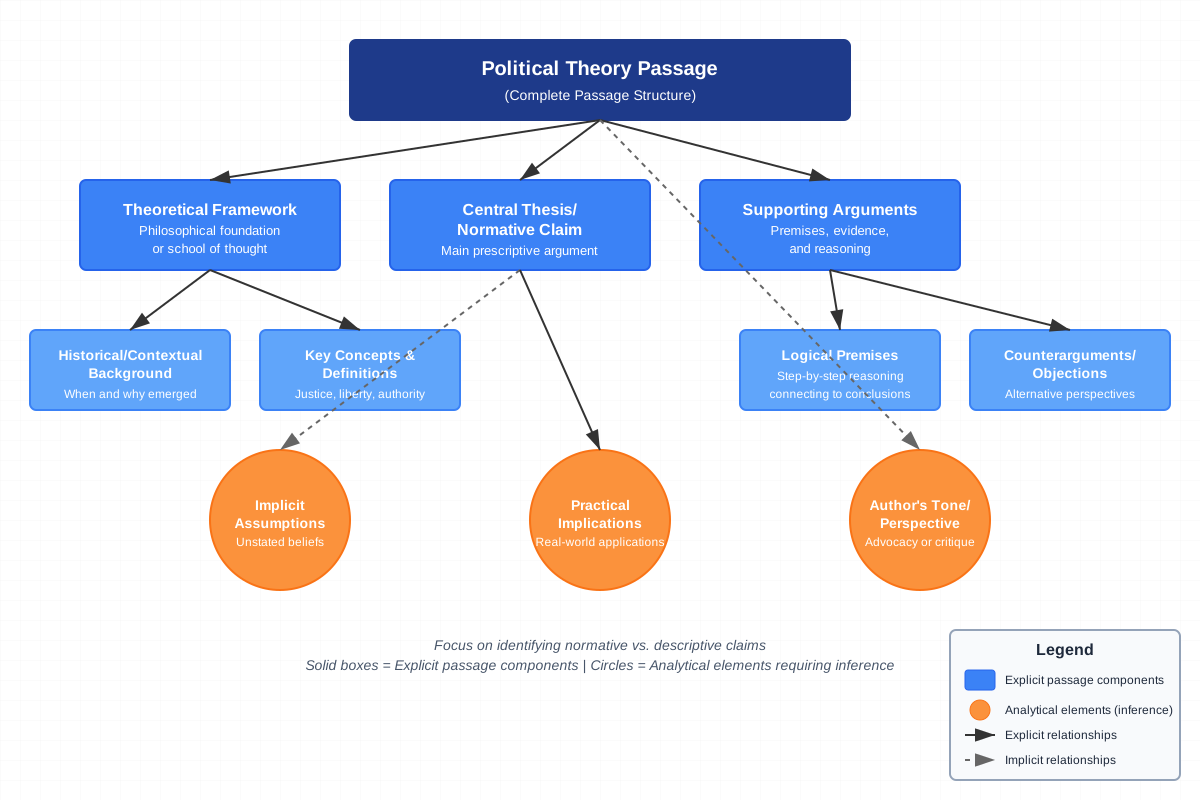
Political theory passages represent one of the most intellectually demanding passage types encountered in the Critical Analysis and Reasoning Skills (CARS) section of the MCAT. These passages explore fundamental questions about governance, justice, power, authority, citizenship, and the relationship between individuals and the state. Drawing from classical and contemporary political philosophers—from Plato and Aristotle to Rawls and Foucault—these passages require test-takers to navigate complex arguments about how societies should be organized, what constitutes legitimate authority, and how competing values like liberty, equality, and security should be balanced.
Understanding political theory passages is essential for MCAT success because they frequently appear in the CARS section and test multiple high-level reasoning skills simultaneously. These passages demand that students identify implicit assumptions, trace logical arguments through multiple premises, distinguish between normative and descriptive claims, and evaluate the strength of philosophical reasoning. Political theory passages often present abstract concepts that must be applied to concrete scenarios, requiring the synthesis of theoretical frameworks with practical implications. The ability to analyze these passages translates directly to the critical thinking skills necessary for medical ethics, healthcare policy discussions, and understanding the social determinants of health that physicians encounter throughout their careers.
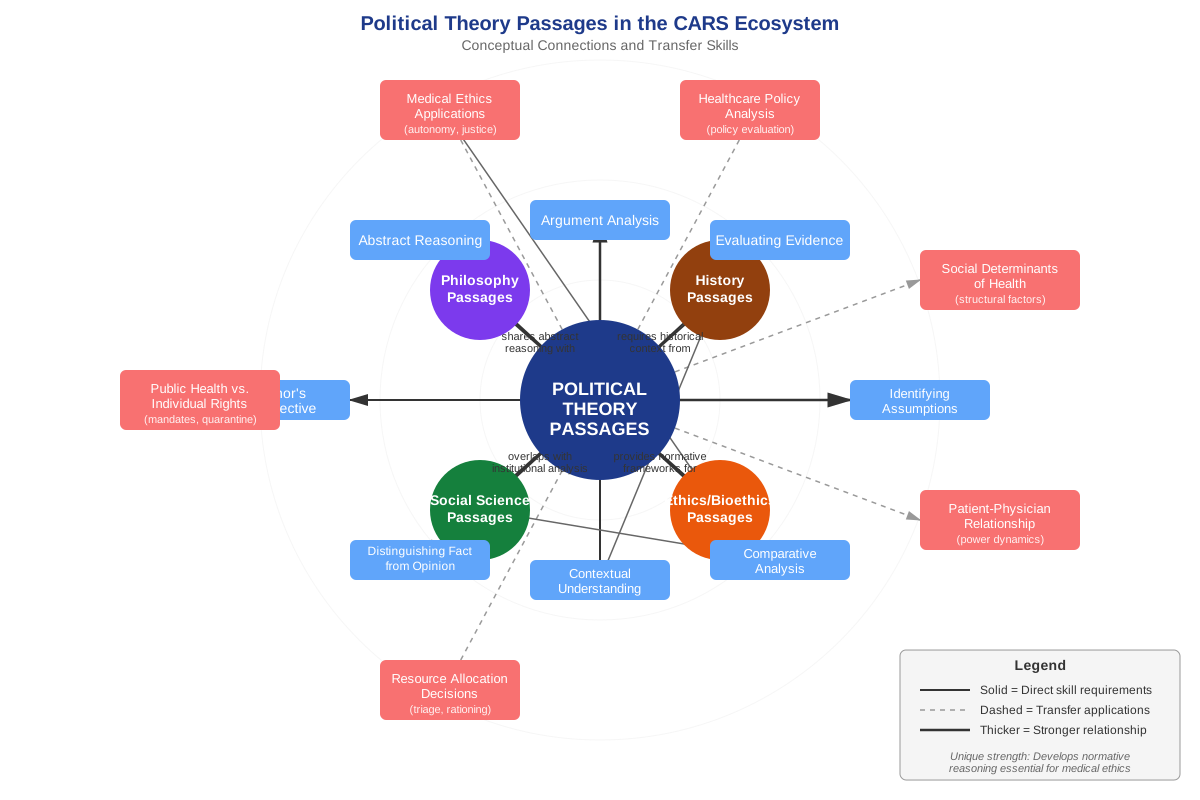
Within the broader landscape of CARS Skills, political theory passages serve as a bridge between humanities and social sciences content. They share analytical demands with philosophy passages while incorporating historical context similar to history passages and sociological considerations found in social science texts. Mastering political theory passages strengthens overall CARS performance by developing the ability to handle abstract reasoning, evaluate normative arguments, and distinguish between what "is" and what "ought to be"—skills that transfer across all CARS passage types.
Learning Objectives
- [ ] Define Political theory passages using accurate Critical Analysis and Reasoning Skills terminology
- [ ] Explain why Political theory passages matters for the MCAT
- [ ] Apply Political theory passages to exam-style questions
- [ ] Identify common mistakes related to Political theory passages
- [ ] Connect Political theory passages to related Critical Analysis and Reasoning Skills concepts
- [ ] Distinguish between normative and descriptive claims within political theory arguments
- [ ] Analyze the logical structure of political philosophy arguments, including premises, conclusions, and underlying assumptions
- [ ] Evaluate counterarguments and alternative perspectives presented in political theory passages
Prerequisites
- Basic reading comprehension skills: Ability to understand complex sentence structures and academic vocabulary is foundational for parsing dense philosophical prose
- Familiarity with argument structure: Understanding premises, conclusions, and logical connections enables identification of the passage's reasoning chain
- General knowledge of Western history: Contextual awareness of major historical periods (Enlightenment, Industrial Revolution, etc.) helps situate political theories in their proper context
- Understanding of abstract vs. concrete thinking: Political theory operates at high levels of abstraction, requiring comfort with theoretical concepts before application
Why This Topic Matters
Political theory passages appear with moderate frequency on the MCAT, typically comprising 1-2 passages per CARS section. These passages are strategically important because they often serve as the most challenging passages in a given section, designed to differentiate high-scoring test-takers from average performers. The AAMC includes political theory content to assess whether future physicians can engage with complex ethical frameworks, policy debates, and philosophical reasoning—skills directly applicable to medical ethics, healthcare policy, and patient autonomy discussions.
In clinical practice, physicians regularly encounter situations requiring political theory concepts: debates about healthcare as a right versus a commodity, questions of distributive justice in resource allocation, considerations of state authority in public health mandates, and discussions of individual liberty versus collective welfare. Understanding how political theorists construct and defend arguments about these issues provides a framework for navigating similar debates in medical contexts.
On the MCAT, political theory passages commonly appear in several formats: excerpts from classical political philosophers discussing ideal government structures, contemporary analyses of democratic theory, examinations of power relationships and authority, discussions of rights and justice, or critiques of existing political systems. Questions typically test the ability to identify main arguments, recognize implicit assumptions, apply theoretical frameworks to new scenarios, evaluate the strength of reasoning, and distinguish between what the author claims versus what the author assumes. Approximately 15-20% of CARS passages contain significant political theory content, making this a medium-yield but high-difficulty topic area.
Core Concepts
Defining Political Theory Passages
Political theory passages are CARS passages that engage with systematic thinking about politics, governance, justice, rights, and the organization of society. These passages differ from descriptive political science or historical accounts by focusing on normative questions—what should be rather than merely what is. The defining characteristic of political theory content is its engagement with fundamental questions about legitimacy, authority, obligation, and the proper relationship between individuals and collective institutions.
Within the MCAT context, political theory passages typically range from 500-600 words and present a coherent philosophical argument or framework. They may introduce a political theorist's position, defend it against objections, apply it to specific cases, or critique alternative viewpoints. The passage structure usually follows classical argumentative patterns: establishing premises, developing reasoning, addressing counterarguments, and reaching conclusions about political principles or practices.
Key Themes in Political Theory Passages
Authority and Legitimacy
Political theory passages frequently explore what makes governmental authority legitimate. This involves examining the basis for political obligation—why citizens should obey laws and governmental directives. Classical social contract theories (Hobbes, Locke, Rousseau) argue that legitimate authority derives from consent, whether actual or hypothetical. Alternative theories ground legitimacy in tradition, divine right, utilitarian outcomes, or procedural justice.
MCAT passages on this theme typically present an argument about the source of legitimate authority and ask test-takers to identify the underlying assumptions, apply the framework to new scenarios, or evaluate objections. Key concepts include consent theory, social contract, political obligation, and sovereignty.
Justice and Rights
Questions of distributive justice—how benefits and burdens should be allocated in society—form another major category. Passages may contrast different theories: egalitarian approaches emphasizing equality, libertarian frameworks prioritizing liberty and property rights, utilitarian models maximizing overall welfare, or communitarian perspectives emphasizing shared values and the common good.
Rights-based arguments distinguish between negative rights (freedoms from interference) and positive rights (entitlements to goods or services). MCAT passages often present debates about whether certain goods (healthcare, education, basic income) should be considered rights and what implications follow from such designations.
Liberty and Equality
The tension between liberty and equality represents a recurring theme. Classical liberalism emphasizes individual freedom and limited government, while egalitarian theories prioritize reducing inequalities even when this requires restricting certain liberties. Passages may explore how different political theories balance these values or argue that apparent conflicts can be resolved through proper understanding of the concepts.
Freedom itself divides into multiple concepts: negative freedom (absence of external constraints), positive freedom (capacity for self-determination), and republican freedom (non-domination by others). MCAT passages may present arguments distinguishing these concepts or applying them to specific political questions.
Power and Domination
Critical political theory examines power relationships, often questioning whose interests existing institutions serve. Passages may draw on thinkers like Foucault to analyze how power operates through discourse, knowledge production, and institutional practices rather than merely through coercion. Other passages examine hegemony, ideology, and how dominant groups maintain power through cultural and intellectual means.
Analytical Approaches to Political Theory Passages
Identifying Normative vs. Descriptive Claims
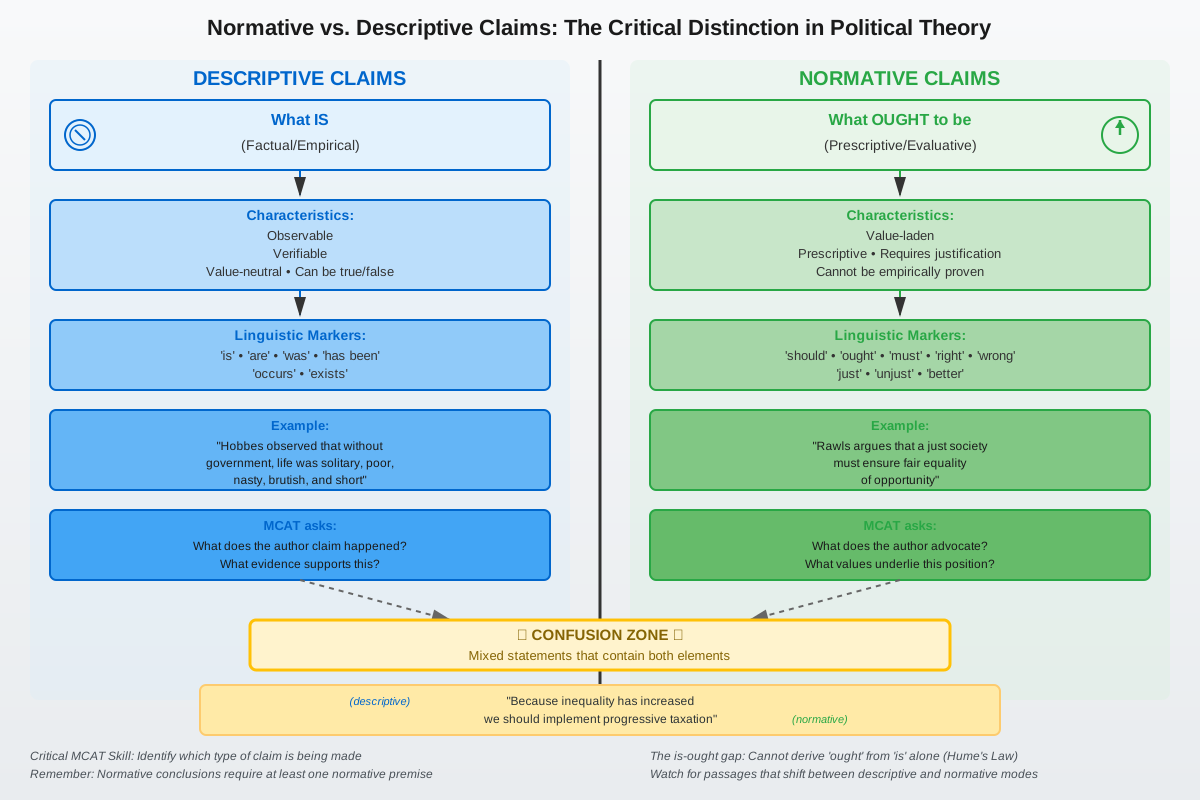
A crucial skill for political theory passages involves distinguishing normative claims (statements about what should be, what is right, or what is valuable) from descriptive claims (statements about what is the case). Political theory passages blend both types, but the core arguments typically rest on normative foundations.
Normative indicators include: "ought," "should," "must," "right," "wrong," "just," "unjust," "legitimate," "illegitimate." Descriptive indicators include: "is," "are," "has been," "will be," "causes," "results in." MCAT questions frequently test whether students can identify which type of claim the author makes and recognize when normative conclusions require normative premises.
Tracing Argument Structure
Political theory arguments typically follow deductive patterns:
- Major premise (general principle): "All legitimate governments require consent of the governed"
- Minor premise (specific case): "Government X lacks consent of the governed"
- Conclusion: "Government X is illegitimate"
MCAT questions test whether students can identify these components, recognize unstated assumptions, and evaluate whether conclusions follow from premises. Passages may present complete arguments or leave key premises implicit, requiring inference.
Recognizing Philosophical Assumptions
Political theories rest on deeper philosophical commitments about human nature, rationality, morality, and epistemology. A passage arguing for strong property rights may assume humans are fundamentally self-interested, while a communitarian argument may assume humans are essentially social beings. MCAT questions frequently ask what the author must assume for their argument to work or what would most weaken the author's position—both requiring identification of underlying assumptions.
Common Theoretical Frameworks
| Framework | Core Principle | Key Thinkers | MCAT Application |
|---|---|---|---|
| Social Contract Theory | Political authority derives from agreement among individuals | Hobbes, Locke, Rousseau, Rawls | Identifying consent-based arguments; evaluating legitimacy claims |
| Utilitarianism | Maximize overall welfare or happiness | Bentham, Mill | Analyzing cost-benefit reasoning in policy contexts |
| Libertarianism | Maximize individual liberty; minimize state interference | Nozick, Hayek | Evaluating arguments about property rights and limited government |
| Egalitarianism | Reduce inequalities; ensure fair distribution | Rawls, Dworkin | Assessing distributive justice arguments |
| Communitarianism | Emphasize shared values and common good over individual rights | MacIntyre, Sandel | Analyzing critiques of liberal individualism |
| Critical Theory | Examine power structures and domination | Marx, Foucault | Identifying arguments about ideology and hegemony |
Concept Relationships
Political theory passages integrate multiple interconnected concepts that build upon each other hierarchically. At the foundation lie questions of human nature and rationality—assumptions about whether humans are fundamentally self-interested or cooperative, rational or emotional, individualistic or social. These foundational assumptions → shape theories of political obligation and legitimacy—explanations for why governmental authority should be obeyed. Legitimacy theories → inform frameworks of justice and rights—principles for distributing benefits and burdens and determining what individuals are owed. Justice frameworks → generate specific policy positions—concrete stances on taxation, property, welfare, and regulation.
The relationship between liberty and equality operates dialectically throughout political theory. Classical liberal emphasis on liberty → generates inequalities through differential talents and efforts → prompts egalitarian responses emphasizing equality → raises questions about restricting liberty to achieve equality → leads to attempts at synthesis (like Rawls's theory combining both values). MCAT passages often present one position in this dialectic and ask students to identify objections from alternative perspectives.
Normative and descriptive claims interact in political theory arguments. Descriptive claims about human nature or social conditions → serve as premises in arguments → leading to normative conclusions about proper political arrangements. However, the is-ought gap (Hume's problem) indicates that purely descriptive premises cannot logically generate normative conclusions without normative premises. MCAT questions exploit this relationship by asking what additional assumptions would be needed for an argument to succeed.
Political theory passages connect to other CARS Skills content areas. Philosophy passages share the abstract reasoning and argument analysis demands. Ethics passages overlap in discussing rights, justice, and moral principles. History passages provide context for political theories' development. Social science passages examine empirical questions about political behavior that political theory addresses normatively. Strengthening skills in one area transfers to others through shared analytical approaches.
Quick check — test yourself on Political theory passages so far.
Try Flashcards →High-Yield Facts
⭐ Political theory passages focus on normative questions (what should be) rather than merely descriptive accounts (what is)
⭐ Social contract theory grounds political legitimacy in consent, whether actual, hypothetical, or tacit
⭐ Negative rights require non-interference; positive rights require provision of goods or services
⭐ The is-ought gap means descriptive premises alone cannot generate normative conclusions without normative assumptions
⭐ Distributive justice concerns how benefits and burdens should be allocated across society
- Liberty and equality often exist in tension, with different theories prioritizing one over the other
- Political obligation refers to the moral duty to obey governmental authority and laws
- Legitimacy concerns whether governmental authority is rightful and deserves obedience
- Utilitarianism evaluates political arrangements by their consequences for overall welfare
- Communitarianism emphasizes shared values and the common good over individual rights
- Power can operate through discourse and institutions, not merely through coercion
- Republican freedom emphasizes non-domination rather than mere absence of interference
- Rawls's veil of ignorance is a thought experiment for determining fair principles of justice
- Libertarianism prioritizes individual liberty and property rights with minimal state interference
- Hegemony refers to dominance maintained through cultural and ideological means rather than force
Common Misconceptions
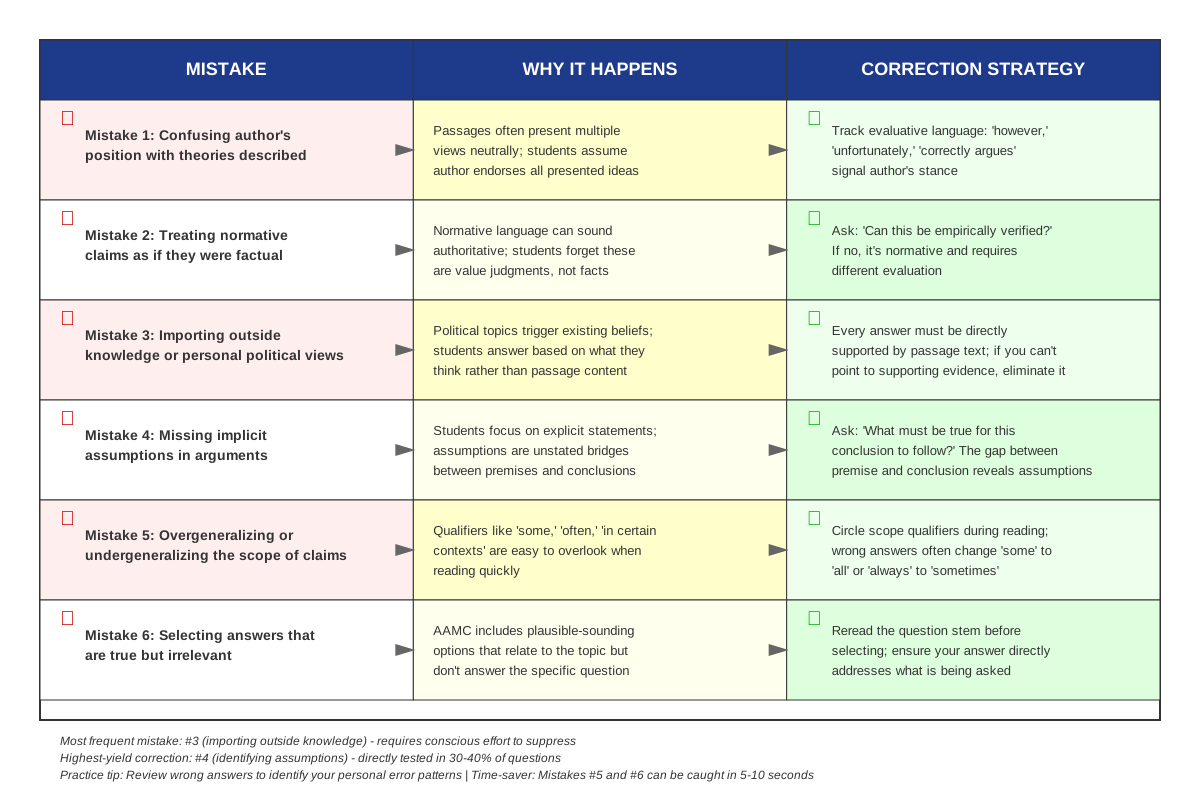
Misconception: Political theory passages are just about opinions, so any interpretation is equally valid → Correction: Political theory presents structured arguments with premises and conclusions that can be evaluated for logical validity and soundness. MCAT questions have definitively correct answers based on what the passage actually states and implies, not on personal political beliefs.
Misconception: Understanding political theory requires agreeing with the author's position → Correction: CARS tests comprehension and analysis, not agreement. Students must accurately represent positions they may personally reject and evaluate arguments on their internal logic rather than personal preferences.
Misconception: Normative claims are just subjective preferences without rational basis → Correction: Political theorists provide reasoned arguments for normative positions, grounding them in principles, consistency requirements, and philosophical frameworks. MCAT passages present these arguments as subject to rational evaluation.
Misconception: Political theory passages require extensive background knowledge of specific philosophers → Correction: MCAT passages are self-contained. While recognizing names like Rawls or Mill provides context, all necessary information appears in the passage. Questions test passage comprehension, not outside knowledge.
Misconception: The author's conclusion is always explicitly stated in the final paragraph → Correction: Political theory passages may build toward implicit conclusions, present conclusions early and then defend them, or explore tensions without resolving them. Students must identify the main argument through careful analysis rather than assuming a standard structure.
Misconception: Descriptive claims about how things are can directly prove normative claims about how things should be → Correction: The is-ought gap means normative conclusions require normative premises. Recognizing this logical principle helps identify unstated assumptions in political theory arguments.
Misconception: All political theory passages present a single unified argument → Correction: Passages may present multiple perspectives, explore objections, or examine tensions between principles. Students must track which claims belong to which position and how the author relates them.
Worked Examples
Example 1: Social Contract and Legitimacy
Passage Excerpt: "Hobbes argues that in the state of nature, without governmental authority, life would be 'solitary, poor, nasty, brutish, and short.' Rational individuals would therefore agree to surrender certain liberties to a sovereign power in exchange for security. This social contract establishes the legitimacy of governmental authority. However, critics contend that actual historical governments arose through conquest and coercion rather than agreement, undermining the consent-based justification."
Question: Which of the following, if true, would most strengthen the author's presentation of the Hobbesian position against the critics' objection?
A) Historical evidence shows most governments originated through gradual evolution rather than explicit agreement
B) Legitimacy can be based on hypothetical consent—what rational people would agree to—rather than actual historical consent
C) Many citizens today explicitly consent to governmental authority through oaths and participation
D) The state of nature is a theoretical construct rather than a historical reality
Analysis:
Step 1: Identify the argument structure. Hobbes claims: (1) State of nature is terrible, (2) Rational people would agree to government for security, (3) This agreement legitimates authority. Critics object: Historical governments didn't actually arise from agreement.
Step 2: Determine what would strengthen Hobbes against this objection. The objection targets the factual claim about how governments arose. A strong response would show why actual historical origins don't matter for legitimacy.
Step 3: Evaluate each option:
- Option A actually supports the critics by confirming governments didn't arise from explicit agreement
- Option B directly addresses the objection by distinguishing hypothetical from actual consent—legitimacy depends on what people would rationally agree to, not historical facts
- Option C makes an empirical claim about current consent but doesn't address the historical objection
- Option D clarifies that state of nature is theoretical but doesn't explain why this answers the critics
Step 4: Select the best answer. Option B most strengthens the Hobbesian position by showing that the critics' factual objection misses the point—social contract theory concerns hypothetical rational agreement, not historical origins.
Connection to Learning Objectives: This example demonstrates applying political theory concepts to exam-style questions, distinguishing between types of claims (hypothetical vs. actual consent), and analyzing argument structure.
Example 2: Justice and Rights
Passage Excerpt: "Libertarian theorists argue that justice requires respecting individual property rights acquired through legitimate means. Redistributive taxation, even for worthy causes, violates these rights by taking from some to give to others without consent. Egalitarians respond that this view ignores how initial distributions of property reflect morally arbitrary factors like natural talents and family circumstances. True justice requires correcting these arbitrary inequalities through redistribution."
Question: The egalitarian response assumes which of the following?
A) Property rights are absolute and cannot be overridden by other considerations
B) Morally arbitrary factors should not determine individuals' life prospects
C) All inequalities are unjust and should be eliminated
D) Consent is unnecessary for legitimate governmental action
Analysis:
Step 1: Identify what the egalitarian argument claims. The egalitarians argue: (1) Initial property distributions reflect morally arbitrary factors, (2) Therefore redistribution is justified to correct these inequalities.
Step 2: Recognize the logical gap. The argument moves from "distributions reflect arbitrary factors" to "redistribution is justified." What principle bridges this gap?
Step 3: Evaluate each option as a potential assumption:
- Option A contradicts the egalitarian position, which supports overriding property rights for redistribution
- Option B provides the needed normative principle: if arbitrary factors shouldn't determine outcomes, then distributions based on them require correction
- Option C overstates the position—egalitarians may accept some inequalities (e.g., based on effort)
- Option D addresses consent but doesn't connect to the specific argument about arbitrary factors
Step 4: Select the best answer. Option B identifies the crucial assumption linking the descriptive claim (distributions are arbitrary) to the normative conclusion (redistribution is justified).
Connection to Learning Objectives: This example demonstrates identifying implicit assumptions in political theory arguments, distinguishing normative from descriptive claims, and recognizing how different theoretical frameworks (libertarian vs. egalitarian) generate different conclusions.
Exam Strategy
Approaching Political Theory Passages
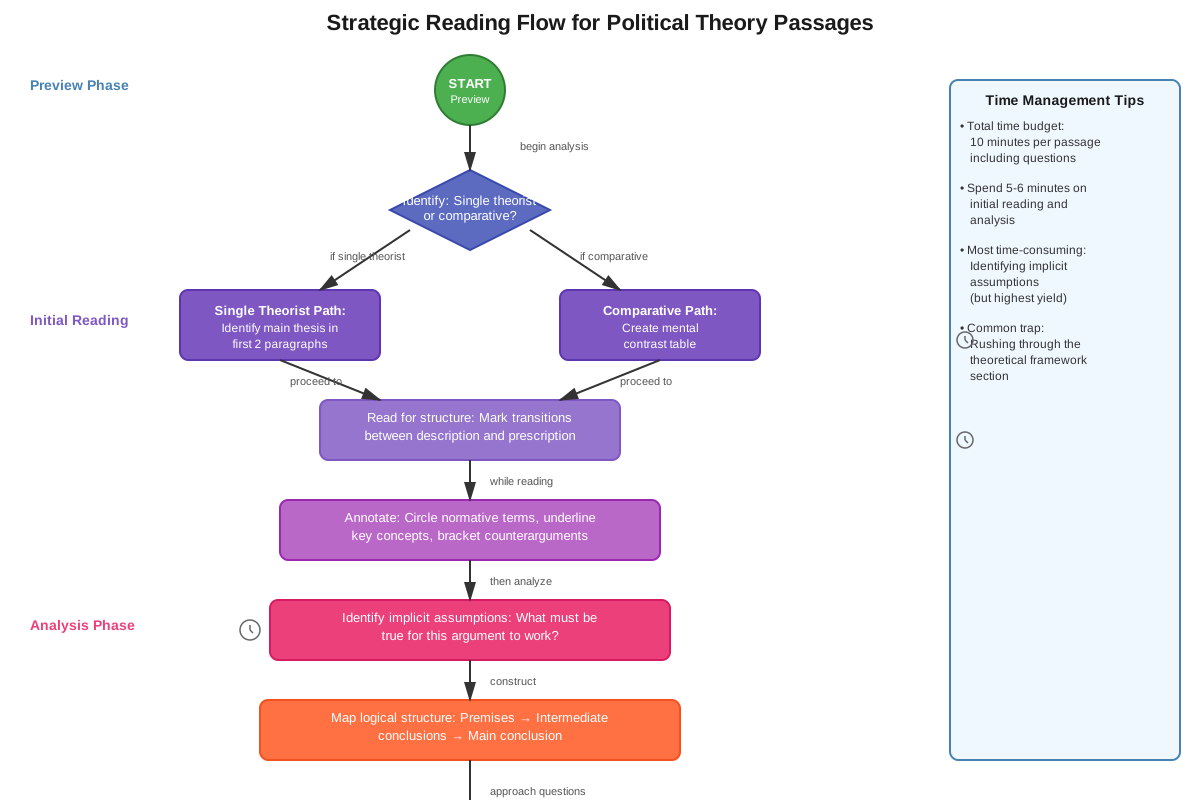
First reading strategy: Read political theory passages slightly more slowly than other CARS passages, focusing on identifying the main argument's structure. Mark transitions between the author's position, alternative views, and objections. Note normative language ("should," "ought," "just") that signals key claims.
Trigger words for political theory content: Watch for terms like "legitimacy," "authority," "justice," "rights," "liberty," "equality," "consent," "obligation," "power," "sovereignty," and philosopher names (Hobbes, Locke, Rousseau, Rawls, Mill, Nozick). These signal that the passage will test political theory reasoning skills.
Question type patterns: Political theory passages frequently generate questions asking:
- What does the author assume? (testing identification of implicit premises)
- What would most weaken/strengthen the argument? (testing understanding of logical structure)
- How would the author respond to X? (testing application of theoretical framework)
- What is the main point? (testing comprehension of complex arguments)
- What is the relationship between concepts? (testing understanding of theoretical connections)
Process of Elimination Strategies
For assumption questions: Eliminate options that the author explicitly states (assumptions are unstated), that contradict the author's position, or that are irrelevant to the argument's logic. The correct answer will be a principle or claim that, if false, would make the argument fail.
For application questions: Eliminate options that contradict principles established in the passage or that introduce considerations the author never addresses. The correct answer will consistently apply the theoretical framework to the new scenario.
For main point questions: Eliminate options that are too narrow (covering only part of the passage), too broad (going beyond what the passage addresses), or that confuse the author's view with opposing views presented. The correct answer captures the central argument or thesis.
Time Management
Allocate approximately 10 minutes per political theory passage (including questions). If a passage seems particularly dense or abstract, don't get stuck trying to understand every nuance on first reading. Focus on the main argument structure and return to specific details when questions direct attention to them. Political theory passages reward careful analysis more than speed, so invest time in understanding the argument's logic rather than rushing through.
Exam Tip: When stuck between two answers on political theory questions, return to the passage and identify the specific sentence or phrase that addresses the question. MCAT answers are always defensible from passage content, not from outside knowledge or personal interpretation.
Memory Techniques
SCAN for Political Theory Analysis:
- Structure: Identify premises and conclusions
- Claims: Distinguish normative from descriptive
- Assumptions: Find unstated principles
- Normative framework: Determine which theory (social contract, utilitarian, etc.)
The Three L's of Political Theory:
- Legitimacy: Why should government be obeyed?
- Liberty: What freedoms should individuals have?
- Leveling: How should benefits and burdens be distributed? (justice/equality)
Rights Recognition - PANDA:
- Positive rights: Require provision (healthcare, education)
- Absolute vs. prima facie: Can rights be overridden?
- Negative rights: Require non-interference (free speech, property)
- Distinction matters: Different implications for government action
- Arguments differ: Theorists disagree on which rights exist
Visualizing Social Contract: Picture three stages: (1) State of nature (chaos/insecurity), (2) Agreement/contract (rational choice), (3) Political society (order/authority). This sequence helps track social contract arguments.
Is-Ought Bridge: Visualize a gap between "IS" (descriptive facts) and "OUGHT" (normative conclusions) with a bridge labeled "normative premise" connecting them. This image reinforces that normative conclusions require normative assumptions.
Summary
Political theory passages in MCAT CARS test the ability to analyze complex philosophical arguments about governance, justice, rights, and political obligation. These passages present normative frameworks—theories about how society should be organized—and require distinguishing between descriptive and normative claims, identifying implicit assumptions, tracing argument structure, and applying theoretical principles to new scenarios. Key themes include legitimacy and authority (especially social contract theory), distributive justice and rights (including the distinction between negative and positive rights), the tension between liberty and equality, and critical analyses of power relationships. Success requires recognizing that political theory passages present structured arguments subject to logical evaluation rather than mere opinions, understanding common theoretical frameworks (social contract, utilitarian, libertarian, egalitarian, communitarian), and applying careful analytical skills to identify what authors claim, assume, and conclude. The is-ought gap principle—that normative conclusions require normative premises—frequently underlies correct answers to assumption and reasoning questions. While these passages can be abstract and challenging, they are self-contained and test passage comprehension rather than outside knowledge of political philosophy.
Key Takeaways
- Political theory passages focus on normative questions about how society should be organized, requiring distinction between "is" and "ought" claims
- Social contract theory grounds political legitimacy in consent (actual, hypothetical, or tacit) among rational individuals
- Negative rights require non-interference while positive rights require provision of goods or services—a distinction with major implications
- The is-ought gap means descriptive premises alone cannot generate normative conclusions without normative assumptions
- Common theoretical frameworks (social contract, utilitarian, libertarian, egalitarian) provide different answers to questions of justice, rights, and legitimate authority
- Success requires identifying argument structure (premises, conclusions, assumptions) rather than agreeing or disagreeing with positions
- MCAT questions test passage comprehension and logical analysis, not outside knowledge of political philosophers
Related Topics
Philosophy Passages: Political theory represents a subset of philosophy, sharing analytical demands while focusing specifically on political questions. Mastering political theory passages strengthens skills for broader philosophical content including epistemology, metaphysics, and ethics.
Ethics Passages: Significant overlap exists between political theory and ethics, particularly regarding rights, justice, and moral obligations. Understanding political theory frameworks enhances analysis of ethical arguments about individual and collective responsibilities.
Social Science Passages: While political theory addresses normative questions, social science passages examine empirical questions about political behavior, institutions, and outcomes. Understanding both perspectives provides comprehensive grasp of political content.
Argument Analysis Skills: Political theory passages intensively develop argument analysis abilities—identifying premises, conclusions, assumptions, and logical relationships—that transfer to all CARS passage types and strengthen overall critical reasoning.
Practice CTA
Now that you've mastered the core concepts of political theory passages, it's time to apply these skills to practice questions and flashcards. Political theory passages become significantly more manageable once you've internalized the common frameworks, learned to distinguish normative from descriptive claims, and developed systematic approaches to identifying argument structure. Each practice passage you complete strengthens your ability to navigate abstract reasoning and complex philosophical arguments—skills that will serve you not only on the MCAT but throughout medical school and your career as a physician engaging with healthcare policy and medical ethics. Approach practice with confidence, knowing that political theory passages, while challenging, follow predictable patterns that you can master through deliberate practice and application of the strategies outlined in this guide.
Sign up free to keep reading
Create a free AnvayaPrep account to finish this MCAT guide on Political theory passages — plus flashcards and practice questions.