Overview
pKb is a fundamental quantitative measure in General Chemistry that describes the strength of a base. Just as pKa quantifies acid strength, pKb provides a logarithmic scale for expressing the base dissociation constant (Kb), making it easier to compare bases of vastly different strengths. Understanding pKb is essential for predicting the behavior of bases in aqueous solutions, calculating pH and pOH values, and solving equilibrium problems that frequently appear on the MCAT. The concept bridges mathematical rigor with chemical intuition, requiring students to interpret numerical values in the context of molecular behavior and solution chemistry.
For the MCAT, pKb represents more than just a calculation—it's a gateway to understanding buffer systems, titration curves, and the behavior of amino acids and other biological molecules. The exam frequently tests the relationship between pKb and pKa, the inverse relationship between base strength and pKb values, and the ability to predict reaction direction based on these constants. Questions may appear in both discrete format and within passage-based contexts, particularly in biochemistry passages involving amino acid side chains or physiological buffer systems.
Within the broader framework of Acids and Bases in General Chemistry, pKb connects directly to equilibrium concepts, Le Chatelier's principle, and the autoionization of water. Mastery of pKb enables students to tackle complex problems involving weak bases, conjugate acid-base pairs, and polyprotic systems. The relationship pKa + pKb = 14 (at 25°C) serves as a critical bridge between acid and base chemistry, allowing students to approach problems from multiple angles and verify their answers using complementary methods.
Learning Objectives
- [ ] Define pKb using accurate General Chemistry terminology
- [ ] Explain why pKb matters for the MCAT
- [ ] Apply pKb to exam-style questions
- [ ] Identify common mistakes related to pKb
- [ ] Connect pKb to related General Chemistry concepts
- [ ] Calculate pKb from Kb values and vice versa with precision
- [ ] Predict relative base strength by comparing pKb values
- [ ] Interconvert between pKa and pKb for conjugate acid-base pairs
- [ ] Determine the pH of weak base solutions using pKb
Prerequisites
- pH and pOH scales: Understanding these logarithmic scales is essential because pKb calculations often require conversion to pH or pOH values
- Equilibrium constants (K): The base dissociation constant Kb is the foundation of pKb, requiring comfort with equilibrium expressions
- Logarithmic functions: Since pKb = -log(Kb), facility with logarithms and their properties is necessary for calculations
- Acid-base definitions (Brønsted-Lowry): Recognizing bases as proton acceptors provides the conceptual framework for understanding base dissociation
- Conjugate acid-base pairs: The relationship between a base and its conjugate acid is central to the pKa + pKb = 14 relationship
- ICE tables: Systematic equilibrium problem-solving using Initial, Change, Equilibrium tables is required for pKb applications
Why This Topic Matters
Clinical and Real-World Significance
Base strength and pKb values are critical in pharmaceutical chemistry, where drug absorption depends on the ionization state of basic functional groups. Many medications contain amine groups that act as weak bases, and their bioavailability is directly influenced by their pKb values and the pH of different body compartments. For example, local anesthetics like lidocaine contain basic amine groups, and their effectiveness depends on the equilibrium between ionized and unionized forms, which is governed by pKb. Understanding pKb also helps explain how antacids work, why certain drugs are better absorbed in the intestine versus the stomach, and how the body maintains pH homeostasis through buffer systems involving weak bases like bicarbonate and phosphate.
MCAT Exam Statistics
Questions involving pKb appear with moderate to high frequency on the MCAT, particularly in the Chemical and Physical Foundations of Biological Systems section. Approximately 15-20% of acid-base questions directly or indirectly involve base dissociation constants. The exam tests pKb through multiple question formats: discrete questions requiring direct calculation, passage-based questions involving experimental data interpretation, and integrated problems that combine pKb with buffer chemistry or amino acid behavior. Questions often require students to recognize when to use pKb versus pKa, convert between the two, or predict the predominant species at a given pH.
Common Exam Contexts
The MCAT frequently embeds pKb in passages about amino acid chemistry, where students must identify whether side chains are protonated or deprotonated at physiological pH. Titration curve passages may present data for weak bases and require interpretation of equivalence points and buffer regions using pKb. Experimental passages might describe the synthesis of pharmaceutical compounds containing basic functional groups, requiring students to predict solubility or reactivity based on pKb values. Additionally, pKb appears in questions about physiological buffer systems, particularly when comparing the buffering capacity of different weak base/conjugate acid pairs.
Core Concepts
Definition and Mathematical Expression of pKb
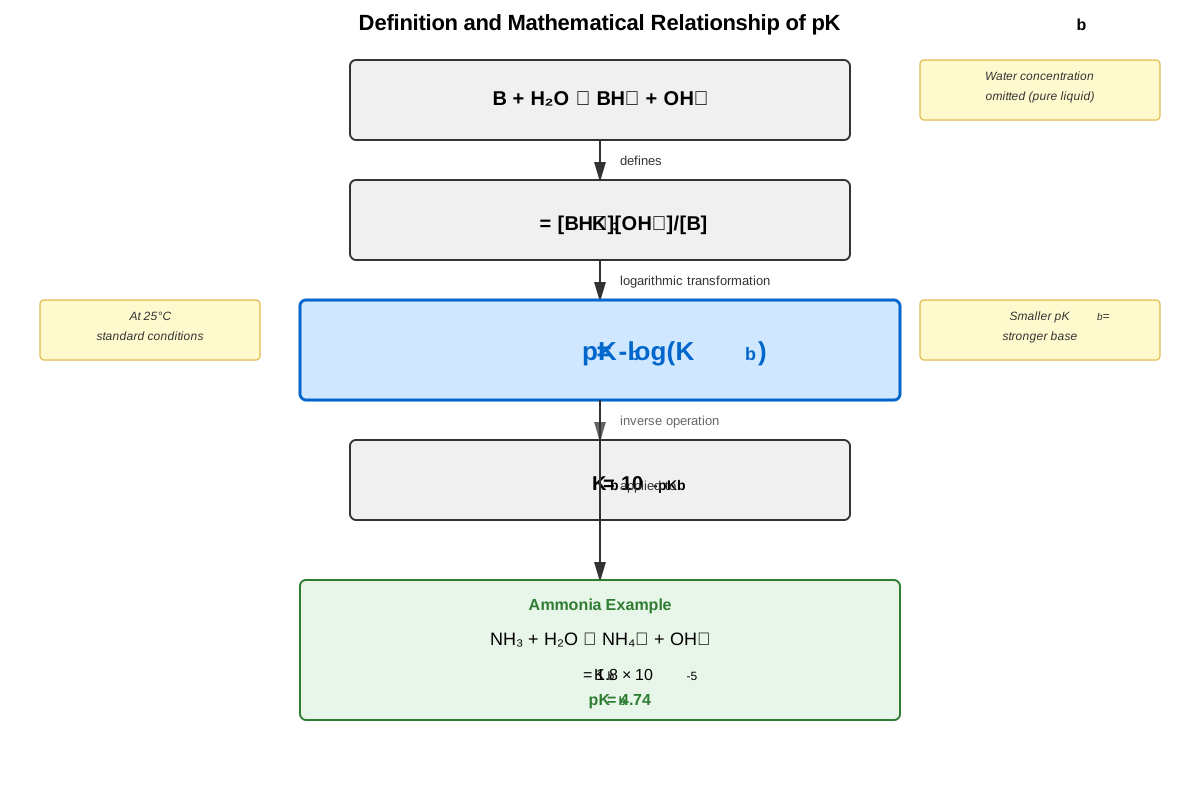
pKb is defined as the negative base-10 logarithm of the base dissociation constant (Kb). Mathematically:
pKb = -log₁₀(Kb)This logarithmic transformation converts Kb values, which can span many orders of magnitude (from 10⁻¹⁴ to 10⁻¹), into a more manageable scale typically ranging from 0 to 14. The base dissociation constant (Kb) itself describes the equilibrium for a base (B) accepting a proton from water:
B + H₂O ⇌ BH⁺ + OH⁻The equilibrium expression is:
Kb = [BH⁺][OH⁻] / [B]Note that water is omitted from the equilibrium expression because it's the solvent and its concentration remains essentially constant. A smaller pKb value indicates a stronger base (larger Kb), while a larger pKb value indicates a weaker base (smaller Kb). This inverse relationship is crucial for MCAT problem-solving.
The Relationship Between pKb and Base Strength
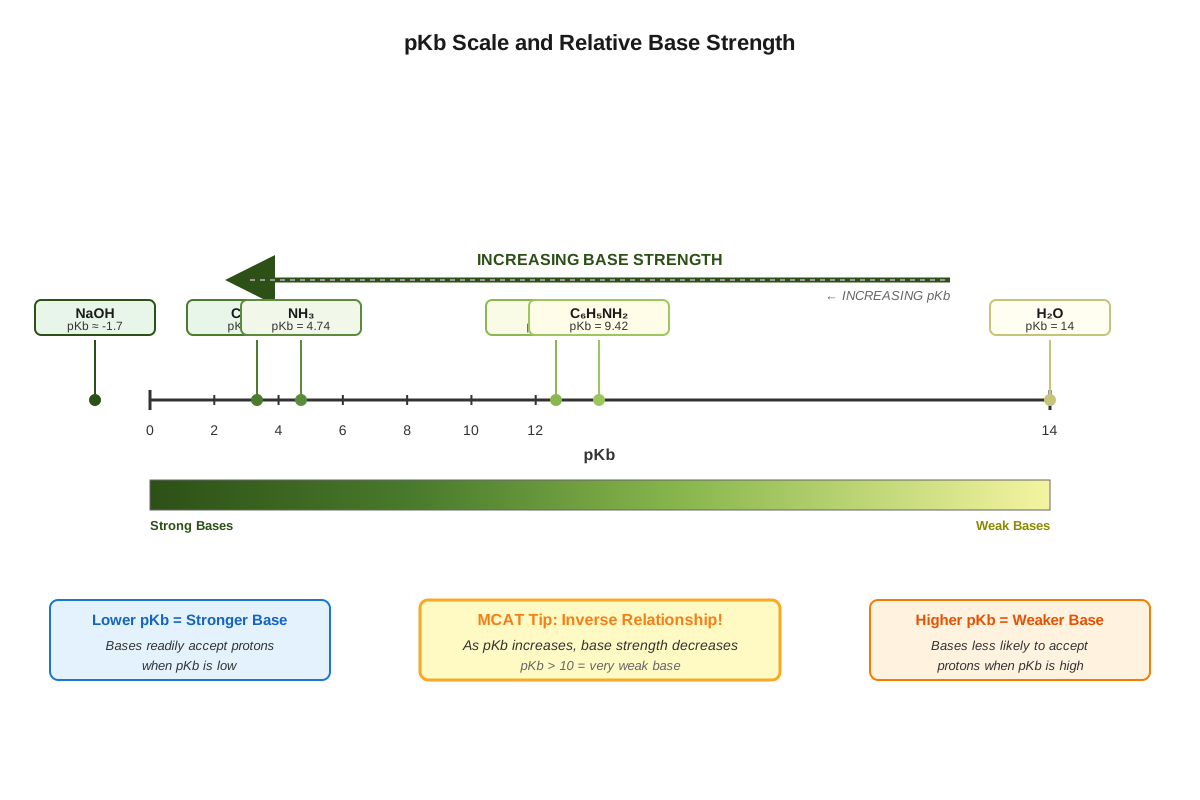
Understanding the inverse relationship between pKb and base strength is essential for qualitative predictions. Strong bases have small pKb values (approaching negative numbers for very strong bases, though these are rarely encountered in MCAT contexts), while weak bases have larger pKb values. For example:
| Base | Kb | pKb | Relative Strength |
|---|---|---|---|
| Methylamine (CH₃NH₂) | 4.4 × 10⁻⁴ | 3.36 | Stronger |
| Ammonia (NH₃) | 1.8 × 10⁻⁵ | 4.74 | Moderate |
| Pyridine (C₅H₅N) | 1.7 × 10⁻⁹ | 8.77 | Weaker |
| Aniline (C₆H₅NH₂) | 4.0 × 10⁻¹⁰ | 9.40 | Very weak |
This table illustrates that as pKb increases, base strength decreases. On the MCAT, students must quickly recognize that a base with pKb = 5 is stronger than one with pKb = 9, without necessarily calculating exact concentrations.
The pKa + pKb = 14 Relationship
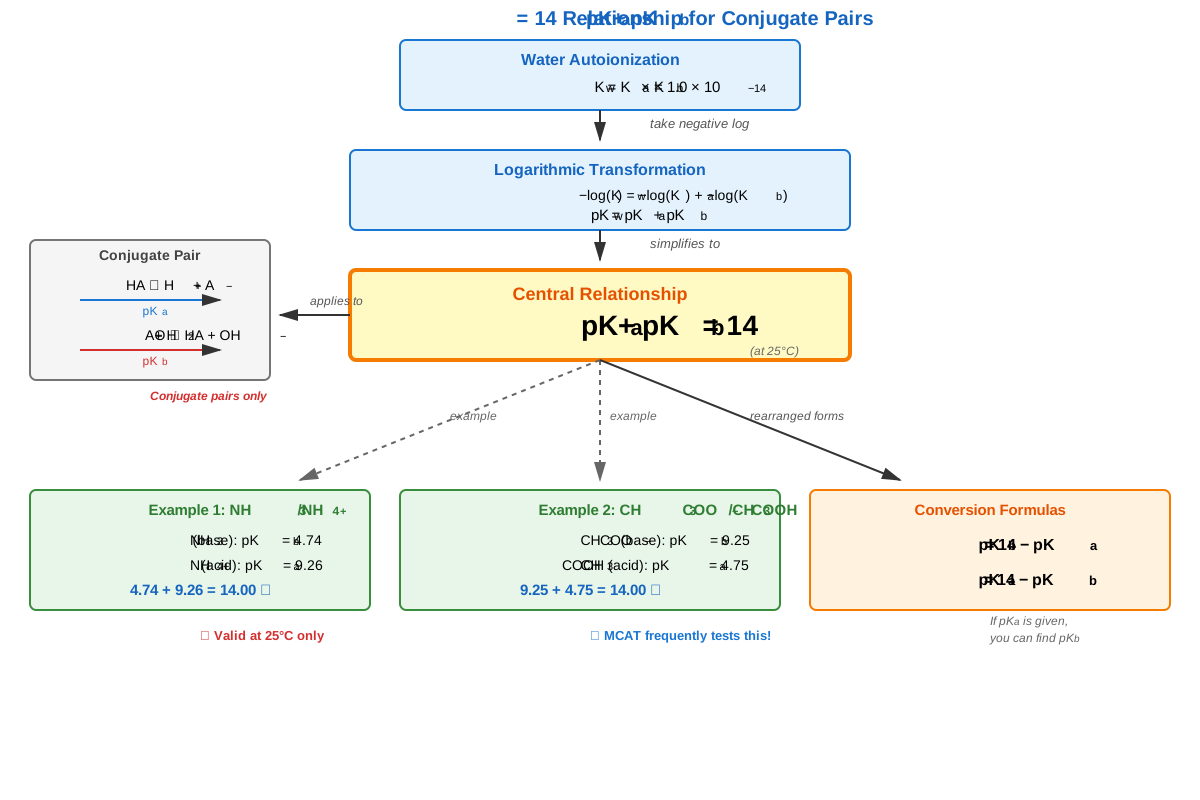
One of the most high-yield relationships in Acids and Bases chemistry is the complementary nature of pKa and pKb for conjugate acid-base pairs. At 25°C:
pKa + pKb = pKw = 14This relationship derives from the autoionization of water (Kw = 1.0 × 10⁻¹⁴ at 25°C) and the mathematical relationship between Ka and Kb for conjugate pairs:
Ka × Kb = KwTaking the negative logarithm of both sides yields the pKa + pKb = 14 relationship. This is extraordinarily useful on the MCAT because:
- If given the pKa of an acid, the pKb of its conjugate base can be immediately calculated
- Problems can be approached from either the acid or base perspective
- It provides a check for answer reasonableness
For example, if ammonia (NH₃) has pKb = 4.74, its conjugate acid (NH₄⁺) has pKa = 14 - 4.74 = 9.26. This means NH₄⁺ is a weak acid, which makes chemical sense since NH₃ is a weak base.
Calculating pH from pKb
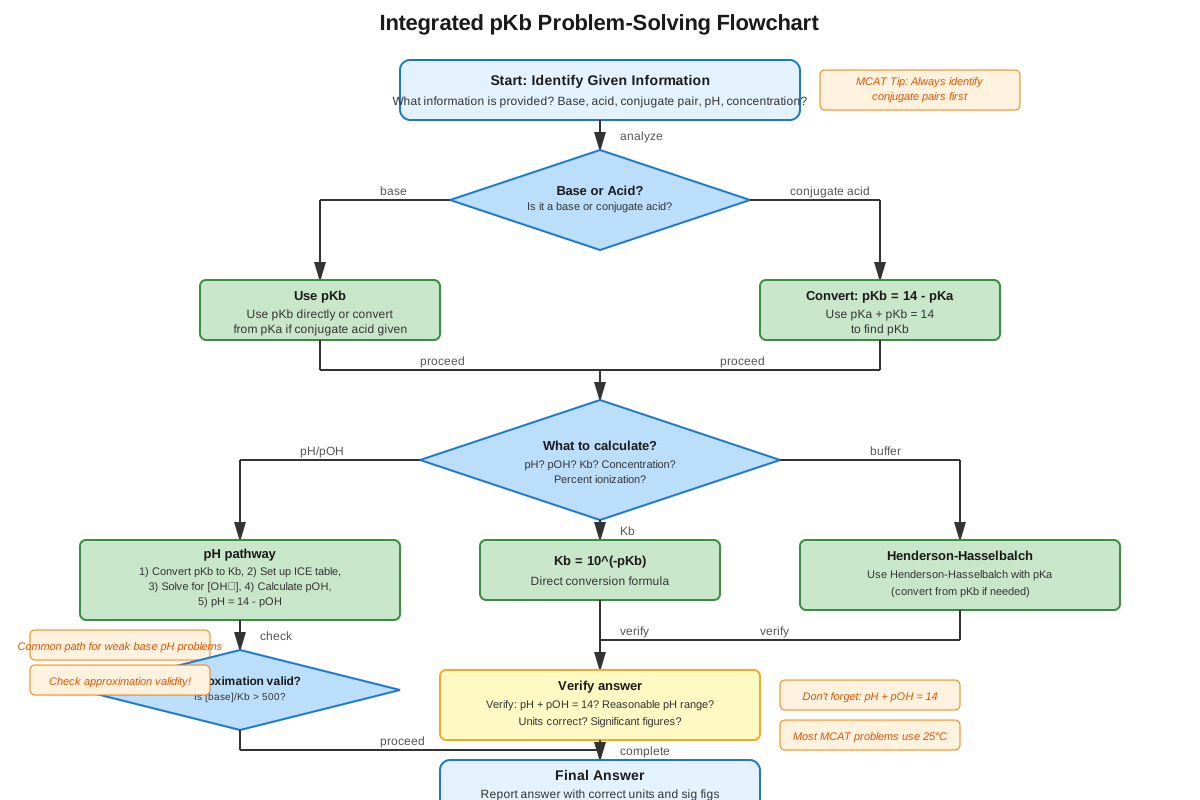
When dealing with weak base solutions, pKb is used to calculate the hydroxide ion concentration, which is then converted to pOH and finally to pH. The systematic approach involves:
- Write the base dissociation equilibrium
- Set up an ICE table
- Write the Kb expression and substitute equilibrium concentrations
- Solve for [OH⁻] (often using the approximation that x << initial concentration)
- Calculate pOH = -log[OH⁻]
- Calculate pH = 14 - pOH
For a weak base with initial concentration C and pKb:
Kb = 10^(-pKb)If the base is weak enough that the approximation [B]equilibrium ≈ [B]initial is valid:
[OH⁻] = √(Kb × C)Then:
pOH = -log[OH⁻]
pH = 14 - pOH
Henderson-Hasselbalch Equation for Bases
While the Henderson-Hasselbalch equation is typically written for acids, it can be adapted for bases. For a buffer containing a weak base (B) and its conjugate acid (BH⁺):
pOH = pKb + log([BH⁺]/[B])Or, converting to pH:
pH = pKa + log([B]/[BH⁺])where pKa refers to the conjugate acid. This form is often more convenient for MCAT problems because pH is more commonly used than pOH. The equation reveals that when [B] = [BH⁺], pH = pKa of the conjugate acid, which is a key point in buffer chemistry.
Structural Factors Affecting pKb
The pKb of a base depends on its molecular structure and the stability of its conjugate acid. Factors that increase base strength (decrease pKb) include:
- Electron-donating groups: Alkyl groups donate electron density to nitrogen in amines, increasing basicity (lowering pKb)
- Decreased resonance stabilization: Bases whose lone pairs are localized (not delocalized by resonance) are stronger
- Inductive effects: Electron-withdrawing groups decrease basicity (increase pKb)
- Hybridization: sp³-hybridized nitrogen (as in amines) is more basic than sp²-hybridized nitrogen (as in pyridine)
For example, aliphatic amines (pKb ≈ 3-4) are stronger bases than aromatic amines like aniline (pKb ≈ 9.4) because the lone pair on nitrogen in aniline is delocalized into the aromatic ring, making it less available for protonation.
Concept Relationships
The concept of pKb sits at the intersection of multiple fundamental chemistry principles. pKb directly derives from Kb through logarithmic transformation, making it a quantitative expression of equilibrium principles. This connection to equilibrium constants means that Le Chatelier's principle applies—adding acid to a base solution shifts the equilibrium, which can be predicted using pKb values.
The relationship flows as follows: Base dissociation equilibrium → Kb expression → pKb calculation → pOH determination → pH calculation. Each step builds on the previous one, creating a logical chain that students must master for MCAT success.
pKb is inextricably linked to pKa through the relationship pKa + pKb = 14, which itself derives from the autoionization of water (Kw). This means that understanding conjugate acid-base pairs requires facility with both concepts. When approaching a problem, students can choose to work with either the acid or base perspective, whichever is more convenient.
Within buffer chemistry, pKb connects to the Henderson-Hasselbalch equation, allowing prediction of pH in solutions containing weak bases and their conjugate acids. This is particularly important for biological buffers and amino acid chemistry, where the same molecule may act as both an acid and a base.
The structural factors affecting pKb connect to organic chemistry concepts including resonance, inductive effects, and hybridization. This interdisciplinary connection is frequently tested on the MCAT, requiring students to predict relative base strengths based on molecular structure.
Finally, pKb relates to solubility and precipitation through the common ion effect and the behavior of basic salts. Understanding pKb helps predict whether a salt will create an acidic, basic, or neutral solution when dissolved in water.
High-Yield Facts
⭐ pKb = -log(Kb), where Kb is the base dissociation constant; smaller pKb means stronger base
⭐ pKa + pKb = 14 for conjugate acid-base pairs at 25°C; this allows rapid interconversion
⭐ Strong bases have pKb < 0, weak bases have pKb between 0-14, and very weak bases have pKb > 14
⭐ Ammonia (NH₃) has pKb ≈ 4.74, making it a weak base and a common reference point
⭐ Aliphatic amines are stronger bases (lower pKb) than aromatic amines due to resonance delocalization in aromatic systems
- For a weak base solution, [OH⁻] = √(Kb × C) when the approximation that dissociation is small is valid
- The pKb of water is 14 (since Kb = 1.0 × 10⁻¹⁴), making it an extremely weak base
- Electron-withdrawing groups increase pKb (decrease basicity), while electron-donating groups decrease pKb (increase basicity)
- At pH = pKa of the conjugate acid, a weak base exists in equal concentrations with its conjugate acid
- Pyridine (pKb ≈ 8.8) is a much weaker base than ammonia due to sp² hybridization of the nitrogen
- The Henderson-Hasselbalch equation for bases: pOH = pKb + log([BH⁺]/[B])
- Hydroxide ion (OH⁻) is a strong base with pKb < 0, so it dissociates completely in water
Quick check — test yourself on pKb so far.
Try Flashcards →Common Misconceptions
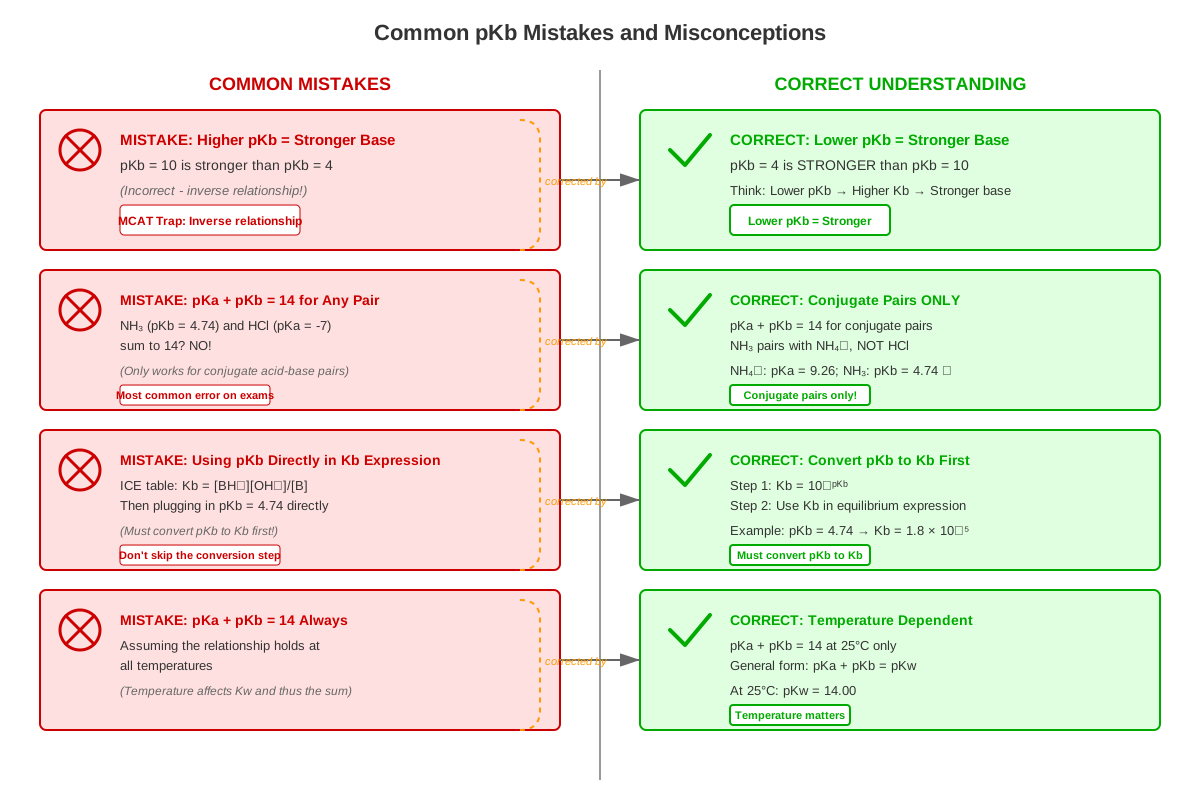
Misconception: A higher pKb value means a stronger base.
Correction: pKb is inversely related to base strength. A higher pKb indicates a weaker base because it corresponds to a smaller Kb value. Think of it like pH—higher pH means more basic, but higher pKb means less basic (as a base itself).
Misconception: pKa and pKb can be used interchangeably for the same species.
Correction: pKa describes the acidity of a species, while pKb describes the basicity of its conjugate base. For a conjugate acid-base pair, pKa + pKb = 14, but they describe different species. For example, NH₄⁺ has a pKa of 9.26, while NH₃ (its conjugate base) has a pKb of 4.74.
Misconception: All nitrogen-containing compounds have similar pKb values.
Correction: The pKb of nitrogen bases varies dramatically based on structure. Aliphatic amines have pKb ≈ 3-4, pyridine has pKb ≈ 8.8, and aniline has pKb ≈ 9.4. Resonance, hybridization, and inductive effects cause these large differences.
Misconception: The pKa + pKb = 14 relationship applies to any acid and any base.
Correction: This relationship only applies to conjugate acid-base pairs. You cannot add the pKa of acetic acid to the pKb of ammonia and expect to get 14. The relationship specifically connects an acid to its conjugate base (or a base to its conjugate acid).
Misconception: Strong bases have pKb values around 7.
Correction: Strong bases have pKb values less than 0 (or even negative). A pKb of 7 indicates a very weak base. The confusion may arise from thinking of pH 7 as neutral, but the scales work differently—neutral on the pKb scale would be around 14, not 7.
Misconception: You can directly calculate pH from pKb without considering pOH.
Correction: pKb directly gives you information about [OH⁻] and pOH, not pH. You must first calculate [OH⁻], then pOH, and finally use pH = 14 - pOH. Skipping the pOH step leads to errors, especially under time pressure on the MCAT.
Worked Examples
Example 1: Calculating pH of a Weak Base Solution
Problem: Calculate the pH of a 0.10 M solution of methylamine (CH₃NH₂), which has a pKb of 3.36.
Solution:
Step 1: Convert pKb to Kb
Kb = 10^(-pKb) = 10^(-3.36) = 4.37 × 10^(-4)Step 2: Write the equilibrium expression
CH₃NH₂ + H₂O ⇌ CH₃NH₃⁺ + OH⁻Step 3: Set up an ICE table
| CH₃NH₂ | CH₃NH₃⁺ | OH⁻ | |
|---|---|---|---|
| Initial | 0.10 | 0 | 0 |
| Change | -x | +x | +x |
| Equilibrium | 0.10-x | x | x |
Step 4: Write the Kb expression
Kb = [CH₃NH₃⁺][OH⁻] / [CH₃NH₂] = x² / (0.10 - x)Step 5: Check if approximation is valid
Since Kb is relatively small, assume x << 0.10, so 0.10 - x ≈ 0.10
4.37 × 10^(-4) = x² / 0.10
x² = 4.37 × 10^(-5)
x = 6.61 × 10^(-3) M = [OH⁻]
Check: 6.61 × 10⁻³ / 0.10 = 6.6%, which is borderline but acceptable for MCAT purposes.
Step 6: Calculate pOH
pOH = -log(6.61 × 10^(-3)) = 2.18Step 7: Calculate pH
pH = 14 - pOH = 14 - 2.18 = 11.82Answer: The pH is approximately 11.8, which makes sense for a weak base solution—it's basic but not extremely so.
Connection to Learning Objectives: This problem demonstrates the application of pKb to calculate pH (LO 3, 6, 9), requires accurate use of General Chemistry terminology (LO 1), and connects pKb to equilibrium concepts (LO 5).
Example 2: Comparing Base Strengths and Predicting Reaction Direction
Problem: Consider two bases: ammonia (NH₃, pKb = 4.74) and acetate ion (CH₃COO⁻, pKa of acetic acid = 4.76). Which is the stronger base? If these two bases compete for a proton, which will preferentially accept it?
Solution:
Step 1: Determine the pKb of acetate
Since we're given the pKa of acetic acid (the conjugate acid of acetate), we can find the pKb of acetate:
pKb(acetate) = 14 - pKa(acetic acid) = 14 - 4.76 = 9.24Step 2: Compare pKb values
- NH₃: pKb = 4.74
- CH₃COO⁻: pKb = 9.24
Since ammonia has the smaller pKb, it is the stronger base.
Step 3: Predict reaction direction
When competing for a proton, the stronger base (ammonia) will preferentially accept it. If both bases are present with a limited amount of acid, ammonia will be protonated first. The equilibrium:
NH₃ + CH₃COOH ⇌ NH₄⁺ + CH₃COO⁻will lie to the right because the stronger base (NH₃) reacts with the stronger acid (CH₃COOH) to form the weaker base (CH₃COO⁻) and weaker acid (NH₄⁺).
Step 4: Verify using pKa values
We can verify this by comparing the pKa values of the conjugate acids:
- NH₄⁺: pKa = 14 - 4.74 = 9.26
- CH₃COOH: pKa = 4.76
Since acetic acid has the lower pKa, it's the stronger acid and will donate its proton to the stronger base (ammonia).
Answer: Ammonia is the stronger base (pKb = 4.74 vs. 9.24), and it will preferentially accept protons when competing with acetate ion.
Connection to Learning Objectives: This problem requires defining and comparing pKb values (LO 1, 7), demonstrates why pKb matters for predicting chemical behavior (LO 2), applies the pKa + pKb = 14 relationship (LO 8), and connects pKb to acid-base equilibrium concepts (LO 5).
Exam Strategy
Approaching MCAT Questions on pKb
When encountering pKb questions on the MCAT, follow this systematic approach:
- Identify what's being asked: pH calculation, base strength comparison, or equilibrium prediction
- Determine if you need pKb or pKa: If dealing with a base accepting a proton, use pKb; if dealing with an acid donating a proton, use pKa
- Check if you can use the pKa + pKb = 14 relationship: Often it's easier to work with pKa values
- Assess whether approximations are valid: For weak bases with Kb < 10⁻⁴ and concentrations > 0.01 M, the approximation that dissociation is minimal usually works
Trigger Words and Phrases
Watch for these key phrases that signal pKb-related questions:
- "Weak base" or "base dissociation constant" → directly indicates pKb usage
- "Conjugate acid of..." → signals you may need to use pKa + pKb = 14
- "Compare the basicity" → requires comparing pKb values (lower = stronger)
- "pH of a solution containing..." → may require pKb calculations if the species is a base
- "Amine" or "amino group" → these are bases, so think pKb
- "Buffer containing a weak base" → Henderson-Hasselbalch with pKb or converted to pKa
Process of Elimination Tips
When using process of elimination on pKb questions:
- Eliminate answers with pH < 7 for weak base solutions: Pure weak base solutions are always basic
- Eliminate pKb values that don't make chemical sense: If comparing similar structures, eliminate answers that reverse expected trends
- Check magnitude: If calculating Kb from pKb, remember that pKb = 4 gives Kb = 10⁻⁴, not 10⁴
- Use the pKa + pKb = 14 rule: If given pKa = 10, pKb must be 4, so eliminate other options
- Consider limiting cases: For very dilute solutions or very weak bases, pH approaches 7 from above
Time Allocation
For discrete pKb questions, allocate 60-90 seconds. For passage-based questions:
- Spend 30 seconds identifying relevant information in the passage
- 60-90 seconds for calculation or conceptual reasoning
- 15-30 seconds to verify your answer makes chemical sense
If a calculation seems too complex, look for a conceptual shortcut or use the pKa + pKb = 14 relationship to simplify.
Memory Techniques
Mnemonics
"Small pKb, Big Basicity": Remember that smaller pKb values indicate stronger bases (inverse relationship)
"14 is the Key": For any conjugate acid-base pair, pKa + pKb = 14 at 25°C
"BOHP" (Base → OH⁻ → pOH → pH): The sequence for calculating pH from a base: start with the Base, calculate [OH⁻], find pOH, then convert to pH
"ARED" (Aliphatic > Resonance = Electron-withdrawing Decreases): Aliphatic amines are stronger bases than aromatic ones; Resonance and Electron-withdrawing groups Decrease basicity (increase pKb)
Visualization Strategies
The pKb Number Line: Visualize a number line from 0 to 14, with strong bases on the left (low pKb) and weak bases on the right (high pKb). This mirrors the pH scale but inverted—low pKb = high basicity, just as high pH = high basicity.
The Conjugate Pair Seesaw: Imagine a seesaw with pKa on one side and pKb on the other, balanced at 14. When pKa goes up, pKb must go down to maintain balance. This visualizes the complementary nature of conjugate pairs.
The Electron Density Cloud: For structural effects, visualize electron density around the basic atom (usually nitrogen). More electron density = stronger base = lower pKb. Electron-withdrawing groups pull the cloud away, increasing pKb.
Acronyms
PKAB: PKb Knowledge Allows Buffer calculations—remember that understanding pKb is essential for buffer problems
LOWS: Lower pKb, OH⁻ production, Weaker conjugate acid, Stronger base—characteristics that go together
Summary
pKb is the negative logarithm of the base dissociation constant (Kb) and serves as a quantitative measure of base strength in General Chemistry. Smaller pKb values indicate stronger bases, while larger values indicate weaker bases. The relationship pKa + pKb = 14 for conjugate acid-base pairs is fundamental to solving MCAT problems efficiently, allowing interconversion between acid and base perspectives. Calculating pH from pKb requires determining [OH⁻] from the equilibrium expression, converting to pOH, and then using pH = 14 - pOH. Structural factors including resonance, inductive effects, and hybridization significantly affect pKb values, with aliphatic amines being stronger bases than aromatic amines. Understanding pKb is essential for predicting reaction direction, analyzing buffer systems, and solving equilibrium problems involving weak bases. The concept connects to broader themes in Acids and Bases including the Henderson-Hasselbalch equation, titration curves, and the behavior of biological molecules like amino acids. Mastery requires both computational facility and conceptual understanding of the inverse relationship between pKb and base strength.
Key Takeaways
- pKb = -log(Kb) quantifies base strength; smaller pKb means stronger base (inverse relationship)
- pKa + pKb = 14 for conjugate acid-base pairs at 25°C enables rapid problem-solving and answer verification
- To calculate pH from pKb: find [OH⁻] using Kb, calculate pOH = -log[OH⁻], then pH = 14 - pOH
- Aliphatic amines (pKb ≈ 3-4) are stronger bases than aromatic amines (pKb ≈ 9-10) due to resonance effects
- Electron-donating groups decrease pKb (increase basicity), while electron-withdrawing groups increase pKb (decrease basicity)
- The Henderson-Hasselbalch equation can be adapted for bases: pOH = pKb + log([BH⁺]/[B])
- On the MCAT, pKb appears in buffer problems, amino acid chemistry, titration curves, and drug solubility questions
Related Topics
pKa and Acid Strength: The complementary concept to pKb, essential for understanding conjugate acid-base pairs and the pKa + pKb = 14 relationship. Mastering pKb naturally leads to deeper understanding of pKa.
Henderson-Hasselbalch Equation: This equation for buffer pH calculations can be expressed using either pKa or pKb, making it a direct application of pKb concepts to physiologically relevant systems.
Amino Acid Chemistry: Amino acids contain both acidic (carboxyl) and basic (amino) groups, each with characteristic pKa and pKb values. Understanding pKb is essential for predicting amino acid charge states at different pH values.
Titration Curves: The shape of titration curves for weak bases depends on pKb values, particularly the location of the equivalence point and buffer region. This topic builds directly on pKb fundamentals.
Solubility and the Common Ion Effect: Basic salts affect solution pH based on the pKb of the base formed. This connects pKb to solubility equilibria and precipitation reactions.
Organic Chemistry of Amines: The basicity of amines, determined by their pKb values, affects their reactivity, nomenclature, and behavior in biological systems, bridging General Chemistry and Organic Chemistry.
Practice CTA
Now that you've mastered the fundamentals of pKb, it's time to solidify your understanding through active practice. Challenge yourself with the practice questions and flashcards designed specifically for this topic. Focus on problems that require you to interconvert between pKa and pKb, calculate pH from pKb values, and predict relative base strengths from molecular structures. Remember, the MCAT rewards not just knowledge but the ability to apply concepts quickly and accurately under pressure. Each practice problem you work through builds the pattern recognition and problem-solving speed you'll need on test day. You've got this—transform your understanding into mastery through deliberate practice!
Sign up free to keep reading
Create a free AnvayaPrep account to finish this MCAT guide on pKb — plus flashcards and practice questions.