Overview
Molecular geometry is a foundational concept in General Chemistry that describes the three-dimensional arrangement of atoms within a molecule. Understanding molecular geometry is essential for predicting molecular properties such as polarity, reactivity, intermolecular forces, and biological activity. On the MCAT, molecular geometry appears frequently in questions involving Bonding and Molecular Structure, as well as in passages that require students to predict molecular behavior, understand enzyme-substrate interactions, or explain physical properties of compounds. The ability to rapidly determine molecular shapes using VSEPR theory (Valence Shell Electron Pair Repulsion theory) is a high-yield skill that connects directly to organic chemistry, biochemistry, and even biological sciences passages.
The study of molecular geometry MCAT questions requires both conceptual understanding and practical application skills. Students must be able to visualize three-dimensional structures from two-dimensional representations, count electron domains correctly, and distinguish between electron geometry and molecular geometry. This topic bridges fundamental concepts like Lewis structures and hybridization with more advanced topics such as molecular polarity, dipole moments, and intermolecular forces. Mastery of molecular geometry enables students to predict whether molecules will be polar or nonpolar, which directly impacts solubility, boiling points, and biological membrane permeability—all testable concepts on the MCAT.
Within the broader context of General Chemistry, molecular geometry represents the spatial consequence of chemical bonding. It builds upon electron configuration, Lewis structures, and formal charge concepts while providing the foundation for understanding hybridization, resonance, and molecular orbital theory. The MCAT frequently tests molecular geometry in conjunction with these related topics, making it a central hub concept that students must master to achieve competitive scores in the Chemical and Physical Foundations of Biological Systems section.
Learning Objectives
- [ ] Define molecular geometry using accurate General Chemistry terminology
- [ ] Explain why molecular geometry matters for the MCAT
- [ ] Apply molecular geometry to exam-style questions
- [ ] Identify common mistakes related to molecular geometry
- [ ] Connect molecular geometry to related General Chemistry concepts
- [ ] Determine molecular geometry from Lewis structures using VSEPR theory
- [ ] Distinguish between electron geometry and molecular geometry for molecules with lone pairs
- [ ] Predict molecular polarity based on molecular geometry and bond dipoles
- [ ] Correlate molecular geometry with hybridization states of central atoms
Prerequisites
- Lewis structures: Essential for identifying bonding and lone pairs, which determine electron domains
- Electronegativity and bond polarity: Necessary for understanding how molecular geometry affects overall molecular polarity
- Valence electrons and the octet rule: Required to correctly draw Lewis structures before determining geometry
- Basic three-dimensional visualization: Needed to mentally rotate and understand spatial arrangements of atoms
- Formal charge calculations: Helps identify the most stable Lewis structure when multiple resonance forms exist
Why This Topic Matters
Molecular geometry has profound clinical and real-world significance. The three-dimensional shape of molecules determines how drugs interact with receptors, how enzymes recognize substrates, and how neurotransmitters fit into synaptic receptors. For example, the difference between therapeutic and toxic effects often depends on molecular geometry—enantiomers with different spatial arrangements can have dramatically different biological activities. The tragic case of thalidomide, where one enantiomer was therapeutic while its mirror image caused birth defects, illustrates the critical importance of molecular shape in medicine.
On the MCAT, molecular geometry appears in approximately 3-5% of Chemical and Physical Foundations questions, making it a medium-yield topic that nonetheless appears on virtually every exam. Questions typically present Lewis structures or molecular formulas and ask students to identify the geometry, predict polarity, or explain physical properties. Molecular geometry also appears indirectly in passages about protein structure, enzyme kinetics, and drug design in the Biological and Biochemical Foundations section. The MCAT favors questions that require multi-step reasoning: students might need to draw a Lewis structure, determine geometry, assess polarity, and then predict solubility or intermolecular forces.
Common question formats include: discrete questions asking for the geometry of a specific molecule; passage-based questions requiring students to predict how molecular shape affects biological function; and questions that test the relationship between geometry and properties like boiling point or dipole moment. The exam particularly favors molecules with lone pairs (where electron geometry differs from molecular geometry) and molecules where students must distinguish between similar geometries like trigonal planar versus trigonal pyramidal.
Core Concepts
VSEPR Theory Fundamentals
VSEPR theory (Valence Shell Electron Pair Repulsion theory) is the primary tool for predicting molecular geometry. The central principle states that electron pairs around a central atom arrange themselves to minimize repulsion, maximizing the distance between electron domains. An electron domain (also called electron group or steric number) includes any region of electron density: single bonds, double bonds, triple bonds, or lone pairs each count as one domain. The total number of electron domains determines the electron geometry, while the arrangement of only the atoms (ignoring lone pairs) determines the molecular geometry.
The distinction between electron geometry and molecular geometry is crucial for MCAT success. Electron geometry describes the spatial arrangement of all electron domains, while molecular geometry describes only the positions of atoms. For molecules without lone pairs on the central atom, these geometries are identical. However, when lone pairs are present, molecular geometry differs from electron geometry because lone pairs occupy space but are not "visible" in the molecular shape.
Electron Domain Geometries
The number of electron domains dictates the electron geometry according to the following patterns:
| Electron Domains | Electron Geometry | Bond Angles | Example |
|---|---|---|---|
| 2 | Linear | 180° | BeCl₂ |
| 3 | Trigonal planar | 120° | BF₃ |
| 4 | Tetrahedral | 109.5° | CH₄ |
| 5 | Trigonal bipyramidal | 90°, 120°, 180° | PCl₅ |
| 6 | Octahedral | 90°, 180° | SF₆ |
These electron geometries represent the ideal arrangements that minimize electron-electron repulsion. The MCAT primarily tests 2-6 electron domains, with tetrahedral and trigonal planar being the most frequently encountered.
Molecular Geometries with Lone Pairs
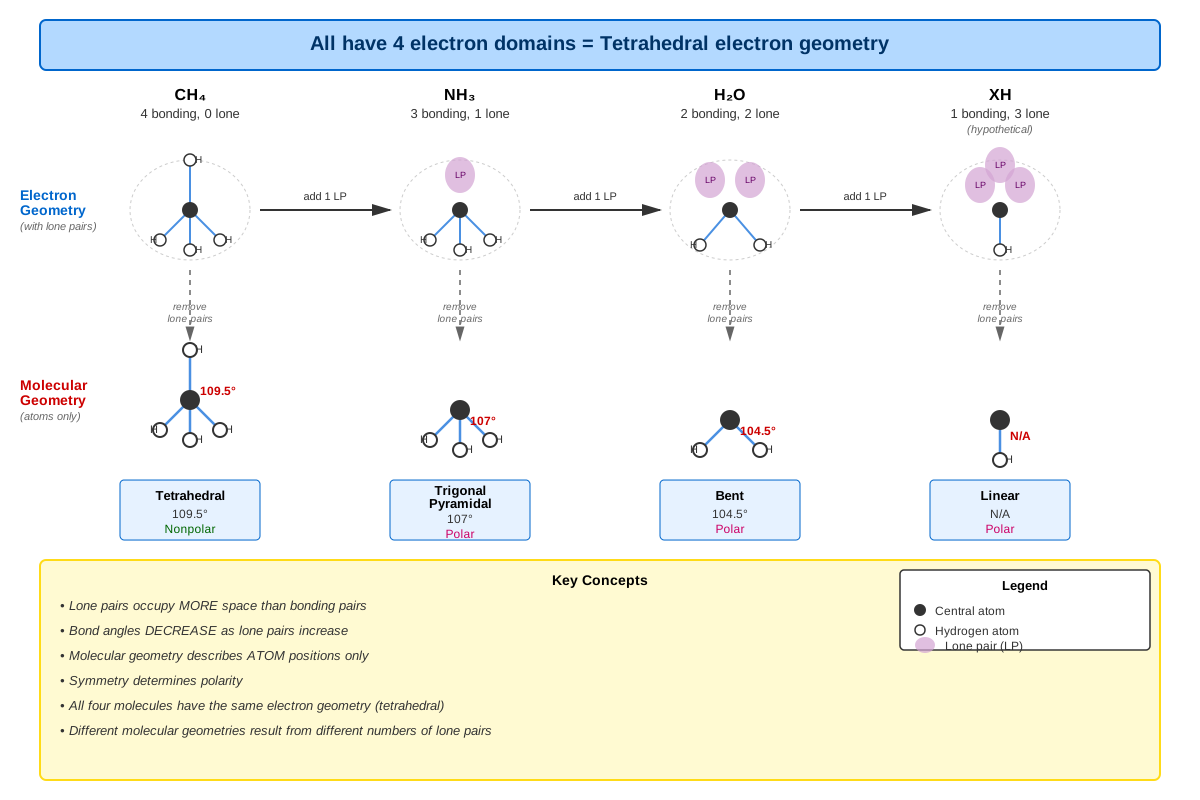
When lone pairs are present on the central atom, the molecular geometry name changes to reflect only the atomic positions. Lone pairs exert greater repulsive force than bonding pairs because they are held closer to the nucleus and occupy more space. This causes bond angle compression—actual bond angles become slightly smaller than ideal values.
For four electron domains (tetrahedral electron geometry):
- 4 bonding pairs, 0 lone pairs: tetrahedral (CH₄, 109.5°)
- 3 bonding pairs, 1 lone pair: trigonal pyramidal (NH₃, 107°)
- 2 bonding pairs, 2 lone pairs: bent (H₂O, 104.5°)
For three electron domains (trigonal planar electron geometry):
- 3 bonding pairs, 0 lone pairs: trigonal planar (BF₃, 120°)
- 2 bonding pairs, 1 lone pair: bent (SO₂, <120°)
For five electron domains (trigonal bipyramidal electron geometry):
- 5 bonding pairs, 0 lone pairs: trigonal bipyramidal (PCl₅)
- 4 bonding pairs, 1 lone pair: seesaw (SF₄)
- 3 bonding pairs, 2 lone pairs: T-shaped (ClF₃)
- 2 bonding pairs, 3 lone pairs: linear (XeF₂)
For six electron domains (octahedral electron geometry):
- 6 bonding pairs, 0 lone pairs: octahedral (SF₆)
- 5 bonding pairs, 1 lone pair: square pyramidal (BrF₅)
- 4 bonding pairs, 2 lone pairs: square planar (XeF₄)
Lone Pair Positioning in Trigonal Bipyramidal Geometry
In trigonal bipyramidal electron geometry, there are two distinct positions: axial (top and bottom, 90° from equatorial positions) and equatorial (around the middle, 120° from each other). Lone pairs preferentially occupy equatorial positions because this minimizes 90° repulsions. A lone pair in an equatorial position has two 90° interactions, while a lone pair in an axial position would have three 90° interactions. This preference explains why SF₄ adopts a seesaw shape rather than an alternative arrangement.
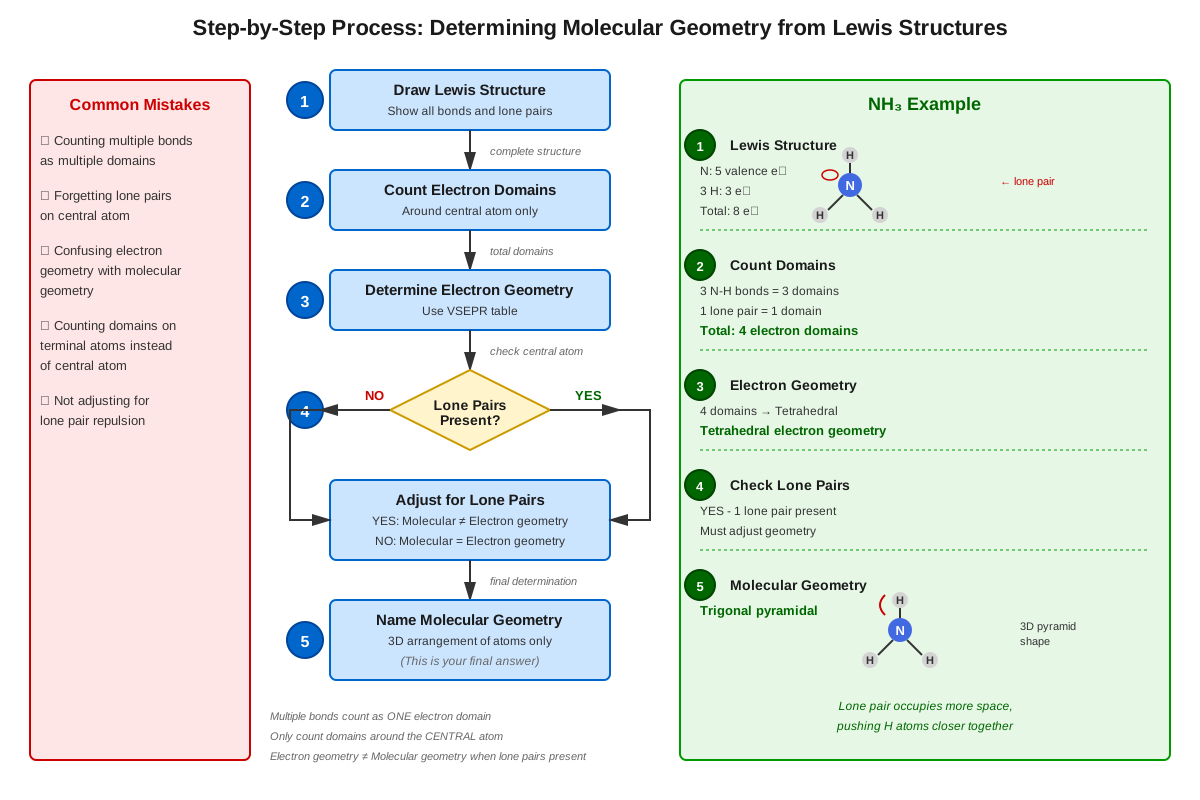
Determining Molecular Geometry: Step-by-Step Process
- Draw the Lewis structure of the molecule, ensuring proper octet fulfillment and minimal formal charges
- Count electron domains around the central atom (each bond counts as one domain regardless of bond order; each lone pair counts as one domain)
- Determine electron geometry based on the total number of electron domains
- Identify the number of bonding pairs and lone pairs
- Determine molecular geometry based on the positions of atoms only
- Adjust bond angles if lone pairs are present (expect compression from ideal angles)
Multiple Bonds and Electron Domains
A critical point for MCAT success: multiple bonds count as a single electron domain. A double bond (C=O) counts as one electron domain, not two. A triple bond (C≡N) counts as one electron domain, not three. This is because all electrons in a multiple bond occupy the same region of space between the two bonded atoms. Students frequently make errors by counting each bond in a multiple bond separately.
Molecular Polarity and Geometry
Molecular geometry directly determines whether a molecule is polar or nonpolar. A molecule is polar if it has a net dipole moment—a vector sum of all bond dipoles that does not equal zero. Even if a molecule contains polar bonds, it can be nonpolar if the geometry causes bond dipoles to cancel.
Symmetrical geometries with identical surrounding atoms produce nonpolar molecules:
- Linear with identical atoms (CO₂)
- Trigonal planar with identical atoms (BF₃)
- Tetrahedral with identical atoms (CH₄)
- Trigonal bipyramidal with identical atoms (PCl₅)
- Octahedral with identical atoms (SF₆)
Asymmetrical geometries or geometries with lone pairs typically produce polar molecules:
- Bent (H₂O, SO₂)
- Trigonal pyramidal (NH₃)
- Seesaw (SF₄)
- T-shaped (ClF₃)
- Square pyramidal (BrF₅)
The presence of lone pairs on the central atom almost always results in molecular polarity because lone pairs create asymmetry. The exception is square planar geometry with two lone pairs opposite each other (XeF₄), which remains nonpolar due to symmetry.
Concept Relationships
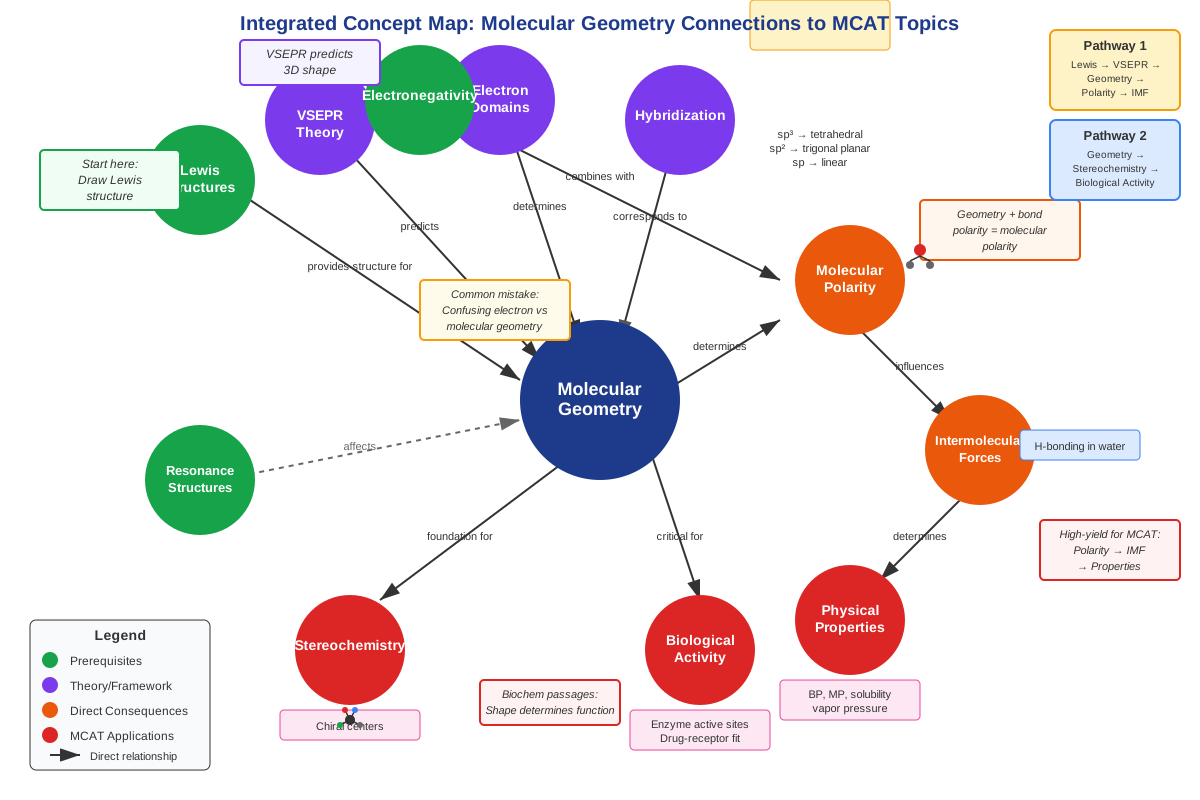
Molecular geometry serves as a central connecting concept in Bonding and Molecular Structure. The relationship flow begins with electron configuration → determines valence electrons → used to construct Lewis structures → electron domains counted → VSEPR theory applied → electron geometry determined → molecular geometry identified → molecular polarity predicted → physical properties explained.
Molecular geometry connects directly to hybridization: the geometry dictates the hybridization state of the central atom. Linear geometry corresponds to sp hybridization, trigonal planar to sp², tetrahedral to sp³, trigonal bipyramidal to sp³d, and octahedral to sp³d². This relationship works bidirectionally—knowing hybridization allows prediction of geometry and vice versa.
The connection to intermolecular forces is equally important. Molecular geometry determines polarity, which determines the types of intermolecular forces present. Polar molecules exhibit dipole-dipole interactions and potentially hydrogen bonding, while nonpolar molecules exhibit only London dispersion forces. These intermolecular forces then determine physical properties like boiling point, melting point, and solubility—all testable on the MCAT.
Within the topic itself, electron geometry → molecular geometry → bond angles → molecular polarity represents the internal logical flow. Each step depends on the previous one, and errors early in the sequence propagate through all subsequent determinations. Understanding that lone pairs occupy space but don't define molecular shape is the key conceptual bridge between electron and molecular geometry.
Quick check — test yourself on Molecular geometry so far.
Try Flashcards →High-Yield Facts
⭐ Electron domains include all bonds (regardless of bond order) and lone pairs; each counts as exactly one domain
⭐ Electron geometry describes all electron domain positions; molecular geometry describes only atomic positions
⭐ Lone pairs cause bond angle compression because they exert greater repulsive force than bonding pairs
⭐ Tetrahedral electron geometry with one lone pair produces trigonal pyramidal molecular geometry (NH₃)
⭐ Tetrahedral electron geometry with two lone pairs produces bent molecular geometry (H₂O)
- Linear electron geometry occurs with 2 electron domains and has 180° bond angles
- Trigonal planar electron geometry occurs with 3 electron domains and has 120° bond angles
- Tetrahedral electron geometry occurs with 4 electron domains and has 109.5° bond angles
- In trigonal bipyramidal geometry, lone pairs preferentially occupy equatorial positions to minimize 90° repulsions
- Symmetrical molecular geometries with identical surrounding atoms are nonpolar even if bonds are polar
- Bent molecular geometry can arise from either 3 or 4 electron domains (SO₂ vs. H₂O)
- Square planar geometry (XeF₄) is nonpolar despite having polar bonds due to symmetry
- Seesaw molecular geometry (SF₄) is always polar due to asymmetry
- Bond angles in molecules with lone pairs are smaller than ideal angles (H₂O is 104.5°, not 109.5°)
- Multiple bonds count as one electron domain regardless of whether they are double or triple bonds
Common Misconceptions
Misconception: Multiple bonds count as multiple electron domains (e.g., a double bond counts as two domains).
Correction: All bonds between the same two atoms, regardless of bond order, count as a single electron domain because they occupy the same region of space. CO₂ has 2 electron domains (two double bonds), not 4.
Misconception: Electron geometry and molecular geometry are the same thing.
Correction: Electron geometry describes the arrangement of all electron domains (bonds and lone pairs), while molecular geometry describes only the positions of atoms. They are identical only when no lone pairs are present on the central atom.
Misconception: All bent molecules have the same electron geometry.
Correction: Bent molecular geometry can arise from either 3 electron domains (trigonal planar electron geometry, like SO₂) or 4 electron domains (tetrahedral electron geometry, like H₂O). The bond angles differ significantly: ~120° for the former, ~104.5° for the latter.
Misconception: If a molecule has polar bonds, it must be polar.
Correction: Molecular polarity depends on both bond polarity and molecular geometry. Symmetrical molecules like CO₂ and CCl₄ have polar bonds but are nonpolar overall because bond dipoles cancel due to geometry.
Misconception: Lone pairs don't affect bond angles because they're not part of the molecular geometry.
Correction: While lone pairs don't appear in the molecular geometry name, they strongly affect bond angles by exerting greater repulsive force than bonding pairs. This is why H₂O has 104.5° bond angles instead of the ideal tetrahedral 109.5°.
Misconception: All tetrahedral molecules have 109.5° bond angles.
Correction: Only tetrahedral molecules with no lone pairs have ideal 109.5° angles. Trigonal pyramidal molecules (tetrahedral electron geometry with one lone pair) have compressed angles around 107°, and bent molecules (tetrahedral electron geometry with two lone pairs) have angles around 104.5°.
Misconception: The central atom in a molecule is always the least electronegative element.
Correction: While this is often true, the central atom is typically the element that can form the most bonds or the element present in the lowest quantity. In some cases, like H₂O, oxygen is central despite being highly electronegative because hydrogen can only form one bond.
Worked Examples
Example 1: Determining Geometry and Polarity of Ammonia (NH₃)
Problem: Determine the electron geometry, molecular geometry, approximate bond angles, and molecular polarity of ammonia (NH₃).
Solution:
Step 1: Draw the Lewis structure.
- Nitrogen has 5 valence electrons
- Each hydrogen contributes 1 valence electron
- Total: 5 + 3(1) = 8 valence electrons
- Nitrogen forms three single bonds to hydrogen atoms
- One lone pair remains on nitrogen
- Lewis structure: H-N-H with one H below and one lone pair on top
Step 2: Count electron domains around the central nitrogen atom.
- Three N-H single bonds = 3 electron domains
- One lone pair = 1 electron domain
- Total electron domains = 4
Step 3: Determine electron geometry.
- 4 electron domains → tetrahedral electron geometry
Step 4: Determine molecular geometry.
- 4 electron domains with 3 bonding pairs and 1 lone pair → trigonal pyramidal molecular geometry
Step 5: Predict bond angles.
- Ideal tetrahedral angle is 109.5°
- Lone pair compression reduces this to approximately 107°
Step 6: Determine molecular polarity.
- N-H bonds are polar (nitrogen is more electronegative than hydrogen)
- Trigonal pyramidal geometry is asymmetrical
- Bond dipoles do not cancel
- Molecule is polar with the negative end at nitrogen and positive ends at hydrogens
Answer: NH₃ has tetrahedral electron geometry, trigonal pyramidal molecular geometry, bond angles of approximately 107°, and is a polar molecule. This connects to the learning objective of distinguishing electron geometry from molecular geometry and predicting polarity based on shape.
Example 2: Comparing CO₂ and SO₂
Problem: Both CO₂ and SO₂ contain double bonds and have similar molecular formulas. Explain why CO₂ is nonpolar while SO₂ is polar.
Solution:
For CO₂:
Step 1: Draw the Lewis structure.
- Carbon has 4 valence electrons
- Each oxygen has 6 valence electrons
- Total: 4 + 2(6) = 16 valence electrons
- Carbon forms double bonds to each oxygen: O=C=O
- Each oxygen has two lone pairs
Step 2: Count electron domains around carbon.
- Two double bonds = 2 electron domains (each double bond counts as one domain)
- No lone pairs on carbon
- Total electron domains = 2
Step 3: Determine geometries.
- 2 electron domains → linear electron geometry
- 2 bonding pairs, 0 lone pairs → linear molecular geometry
- Bond angle: 180°
Step 4: Assess polarity.
- C=O bonds are polar (oxygen is more electronegative)
- Linear geometry with identical surrounding atoms
- Bond dipoles point in opposite directions and cancel completely
- CO₂ is nonpolar
For SO₂:
Step 1: Draw the Lewis structure.
- Sulfur has 6 valence electrons
- Each oxygen has 6 valence electrons
- Total: 6 + 2(6) = 18 valence electrons
- Sulfur forms double bonds to each oxygen
- One lone pair remains on sulfur
- Lewis structure: O=S=O with one lone pair on sulfur
Step 2: Count electron domains around sulfur.
- Two double bonds = 2 electron domains
- One lone pair = 1 electron domain
- Total electron domains = 3
Step 3: Determine geometries.
- 3 electron domains → trigonal planar electron geometry
- 2 bonding pairs, 1 lone pair → bent molecular geometry
- Bond angle: approximately 119° (slightly less than ideal 120° due to lone pair repulsion)
Step 4: Assess polarity.
- S=O bonds are polar (oxygen is more electronegative)
- Bent geometry is asymmetrical
- Bond dipoles do not cancel; they add to create a net dipole pointing toward the oxygen atoms
- SO₂ is polar
Answer: CO₂ is nonpolar because its linear geometry causes the two C=O bond dipoles to cancel completely. SO₂ is polar because the lone pair on sulfur creates a bent molecular geometry, preventing the S=O bond dipoles from canceling. This example demonstrates how lone pairs create asymmetry that leads to molecular polarity, addressing the learning objective of connecting geometry to molecular properties.
Exam Strategy
When approaching molecular geometry MCAT questions, begin by quickly sketching the Lewis structure—even a rough sketch helps prevent counting errors. The MCAT rarely requires perfect artistic Lewis structures; focus on correct electron domain counting. Watch for trigger phrases like "three-dimensional shape," "spatial arrangement," or "molecular structure," which signal geometry questions.
Process of elimination strategies: If a question asks about molecular geometry and you see "tetrahedral" as an answer choice, check whether lone pairs are present. If lone pairs exist, eliminate "tetrahedral" unless there are exactly four bonding pairs and zero lone pairs. Similarly, if you see both "trigonal planar" and "bent" as options, determine whether the central atom has lone pairs—their presence indicates bent geometry.
Time-saving approach: For discrete questions, use the electron domain count as your primary decision point. Memorize the five basic electron geometries (2-6 domains) and their corresponding molecular geometries with different numbers of lone pairs. This allows rapid elimination of incorrect answers without drawing complete Lewis structures.
Common MCAT traps: The exam frequently tests molecules where students might miscount electron domains (especially with multiple bonds) or confuse electron geometry with molecular geometry. Questions may also present molecules with similar formulas but different geometries (like CO₂ vs. SO₂) to test whether students understand the role of lone pairs. Be especially careful with questions that ask about bond angles—remember that lone pairs compress angles below ideal values.
Passage-based strategy: In passages about biochemistry or organic chemistry, molecular geometry often appears indirectly. Look for discussions of enzyme active sites, receptor binding, or molecular recognition—these all depend on three-dimensional shape. When a passage describes a molecule's properties (solubility, boiling point, reactivity), consider whether geometry and resulting polarity explain the observations.
Allocate approximately 30-45 seconds for straightforward geometry identification questions and up to 90 seconds for questions requiring multiple steps (Lewis structure → geometry → polarity → property prediction). If a question requires extensive Lewis structure drawing for a complex molecule, consider flagging it and returning after completing easier questions.
Memory Techniques
Mnemonic for electron domain geometries: "L-T-T-T-O" represents the progression: Linear (2), Trigonal planar (3), Tetrahedral (4), Trigonal bipyramidal (5), Octahedral (6).
Mnemonic for tetrahedral derivatives: "T-T-P-B" = Tetrahedral (0 lone pairs), Trigonal Pyramidal (1 lone pair), Bent (2 lone pairs). All have tetrahedral electron geometry with 4 electron domains.
Visualization strategy for trigonal bipyramidal: Picture a "bow tie with a belt"—the two axial positions form the bow tie ends, and the three equatorial positions form the belt around the middle. Lone pairs always go in the belt (equatorial) first.
Acronym for polarity assessment: "SANE" molecules are nonpolar: Symmetrical Arrangement, No lone pairs (on central atom), Equal surrounding atoms. If any condition fails, check carefully for polarity.
Bond angle memory aid: "109-107-104" represents the progression of bond angles in tetrahedral electron geometry as lone pairs increase: tetrahedral (109.5°), trigonal pyramidal (107°), bent (104.5°). Each lone pair compresses angles by approximately 2-3°.
Lone pair positioning rule: "Equatorial is better" for trigonal bipyramidal geometry. Lone pairs prefer equatorial positions because they minimize 90° repulsions (the most destabilizing interactions).
Summary
Molecular geometry describes the three-dimensional arrangement of atoms in a molecule and is determined using VSEPR theory, which states that electron domains arrange themselves to minimize repulsion. The number of electron domains (bonds and lone pairs) around the central atom determines electron geometry, while the positions of atoms alone determine molecular geometry. When lone pairs are present, molecular geometry differs from electron geometry, and bond angles compress below ideal values due to greater lone pair repulsion. The five primary electron geometries are linear (2 domains), trigonal planar (3 domains), tetrahedral (4 domains), trigonal bipyramidal (5 domains), and octahedral (6 domains). Molecular geometry directly determines molecular polarity: symmetrical geometries with identical surrounding atoms are nonpolar, while asymmetrical geometries or those with lone pairs are typically polar. This topic is essential for MCAT success because it connects bonding theory to molecular properties and appears in both discrete questions and passage-based contexts across chemistry and biology sections.
Key Takeaways
- Electron domains (bonds and lone pairs) determine electron geometry; only atomic positions determine molecular geometry
- Multiple bonds count as a single electron domain regardless of bond order
- Lone pairs exert greater repulsive force than bonding pairs, causing bond angle compression
- Tetrahedral electron geometry produces three different molecular geometries depending on lone pairs: tetrahedral (0 LP), trigonal pyramidal (1 LP), or bent (2 LP)
- Molecular polarity depends on both bond polarity and molecular geometry; symmetrical molecules with identical surrounding atoms are nonpolar even with polar bonds
- In trigonal bipyramidal geometry, lone pairs preferentially occupy equatorial positions to minimize 90° repulsions
- The systematic approach—Lewis structure → count domains → electron geometry → molecular geometry → predict polarity—prevents errors on MCAT questions
Related Topics
Hybridization: Molecular geometry directly corresponds to hybridization states (sp for linear, sp² for trigonal planar, sp³ for tetrahedral). Mastering geometry enables rapid determination of hybridization, which is frequently tested alongside geometry on the MCAT.
Molecular Orbital Theory: While VSEPR provides a simple model for predicting geometry, molecular orbital theory offers a more sophisticated explanation of bonding that accounts for delocalized electrons and magnetic properties.
Intermolecular Forces: Molecular geometry determines polarity, which determines the types and strengths of intermolecular forces. This connection is essential for predicting physical properties like boiling points and solubility.
Resonance Structures: Some molecules have multiple valid Lewis structures. Understanding how to identify the most stable resonance form is necessary before determining molecular geometry.
Dipole Moments: The quantitative measure of molecular polarity, dipole moments depend on both bond polarity and molecular geometry. This topic extends the qualitative polarity predictions from geometry.
Practice CTA
Now that you've mastered the fundamentals of molecular geometry, it's time to solidify your understanding through active practice. Attempt the practice questions and flashcards associated with this topic to reinforce your ability to rapidly determine geometries, predict polarities, and connect structure to properties. Remember that molecular geometry is a skill that improves dramatically with repetition—each practice problem strengthens your spatial visualization abilities and speeds up your problem-solving process. The investment you make in practicing this medium-yield topic will pay dividends not only in direct geometry questions but also in organic chemistry, biochemistry, and passage analysis throughout the MCAT. You've built a strong foundation; now apply it with confidence!
Sign up free to keep reading
Create a free AnvayaPrep account to finish this MCAT guide on Molecular geometry — plus flashcards and practice questions.