Overview
Covalent bonds represent one of the fundamental pillars of chemical bonding and are essential for understanding molecular structure, reactivity, and properties across all domains of chemistry tested on the MCAT. Unlike ionic bonds where electrons are transferred between atoms, covalent bonds involve the sharing of electron pairs between atoms, typically nonmetals, to achieve stable electron configurations. This sharing creates discrete molecular units with specific geometries, polarities, and chemical behaviors that govern everything from drug-receptor interactions to enzyme catalysis.
For the MCAT, mastery of covalent bonds General Chemistry concepts is non-negotiable. Questions involving covalent bonding appear across multiple sections of the exam—not just in the Chemical and Physical Foundations section, but also in passages dealing with biochemistry (peptide bonds, disulfide bridges), organic chemistry (carbon-carbon bonds), and even biological systems (hydrogen bonding in DNA). The MCAT frequently tests the ability to predict bond properties, molecular geometry, polarity, and reactivity based on covalent bonding principles. Understanding these concepts provides the foundation for more advanced topics like resonance structures, molecular orbital theory, and reaction mechanisms.
Within the broader context of Bonding and Molecular Structure, covalent bonds serve as the bridge between atomic structure and molecular properties. This topic connects directly to electronegativity, Lewis structures, VSEPR theory, hybridization, and intermolecular forces. A solid grasp of covalent bonds MCAT principles enables students to predict molecular behavior, understand reaction mechanisms, and interpret experimental data presented in passage-based questions—skills that are repeatedly assessed throughout the examination.
Learning Objectives
- [ ] Define covalent bonds using accurate General Chemistry terminology
- [ ] Explain why covalent bonds matter for the MCAT
- [ ] Apply covalent bonds to exam-style questions
- [ ] Identify common mistakes related to covalent bonds
- [ ] Connect covalent bonds to related General Chemistry concepts
- [ ] Distinguish between different types of covalent bonds (single, double, triple, polar, nonpolar)
- [ ] Calculate formal charges and predict the most stable Lewis structures for covalently bonded molecules
- [ ] Predict relative bond strengths, bond lengths, and bond energies based on bond order and atomic properties
Prerequisites
- Atomic structure and electron configuration: Understanding electron shells, subshells, and valence electrons is essential because covalent bonding involves the sharing of valence electrons between atoms
- Electronegativity trends: Knowledge of periodic trends in electronegativity is necessary to predict bond polarity and distinguish between polar and nonpolar covalent bonds
- Octet rule and stability: Familiarity with the tendency of atoms to achieve noble gas electron configurations provides the driving force for covalent bond formation
- Basic periodic trends: Understanding atomic radius, ionization energy, and electron affinity helps predict bonding behavior and molecular properties
Why This Topic Matters
Clinical and Real-World Significance
Covalent bonds form the structural backbone of virtually all biological molecules. Proteins are held together by peptide bonds (covalent C-N bonds), DNA strands contain phosphodiester bonds linking nucleotides, and disulfide bridges (S-S covalent bonds) stabilize protein tertiary structure. Drug molecules interact with biological targets through a combination of covalent and non-covalent interactions, and understanding covalent bond properties helps predict drug stability, metabolism, and mechanism of action. Many toxins and therapeutic agents work by forming or breaking specific covalent bonds in biological systems.
MCAT Exam Statistics
Covalent bonding concepts appear in approximately 15-20% of General Chemistry questions on the MCAT and are integrated into another 10-15% of Organic Chemistry and Biochemistry questions. The topic appears in both discrete questions and passage-based formats. Common question types include:
- Predicting molecular geometry and polarity based on covalent bonding patterns
- Comparing bond strengths and lengths across different molecules
- Identifying the most stable Lewis structure using formal charge calculations
- Explaining reactivity patterns based on bond polarity and strength
- Interpreting spectroscopic data related to bond vibrations and energies
Common Exam Presentations
The MCAT typically presents covalent bonding concepts through:
- Research passages describing novel compounds or materials with specific bonding characteristics
- Biochemistry passages involving enzyme mechanisms where covalent bonds are formed or broken
- Organic chemistry passages requiring understanding of functional groups and their covalent bonding patterns
- Discrete questions testing fundamental principles like bond order, polarity, and formal charge
- Data interpretation questions involving bond dissociation energies or spectroscopic analysis
Core Concepts
Definition and Nature of Covalent Bonds
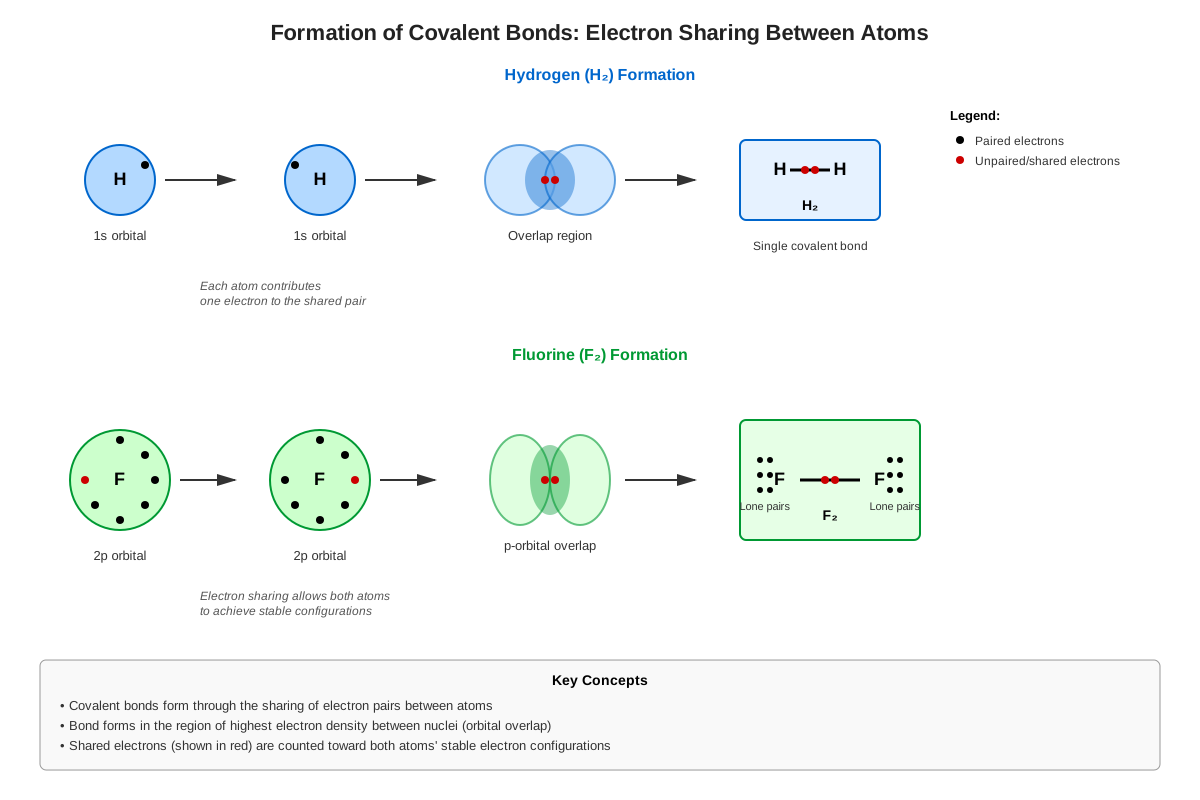
A covalent bond is a chemical bond formed by the sharing of one or more pairs of electrons between two atoms, typically nonmetals with similar electronegativities. This electron sharing allows both atoms to achieve more stable electron configurations, usually satisfying the octet rule (eight valence electrons) or duet rule (two valence electrons for hydrogen and helium). The shared electron pair is attracted to the nuclei of both bonding atoms, creating a region of high electron density between the nuclei that holds the atoms together.
The fundamental distinction between covalent and ionic bonding lies in electron behavior: ionic bonds involve complete electron transfer creating oppositely charged ions, while covalent bonds involve electron sharing creating neutral molecules. The boundary between these bonding types is not absolute but exists on a continuum determined by the electronegativity difference between bonding atoms.
Types of Covalent Bonds
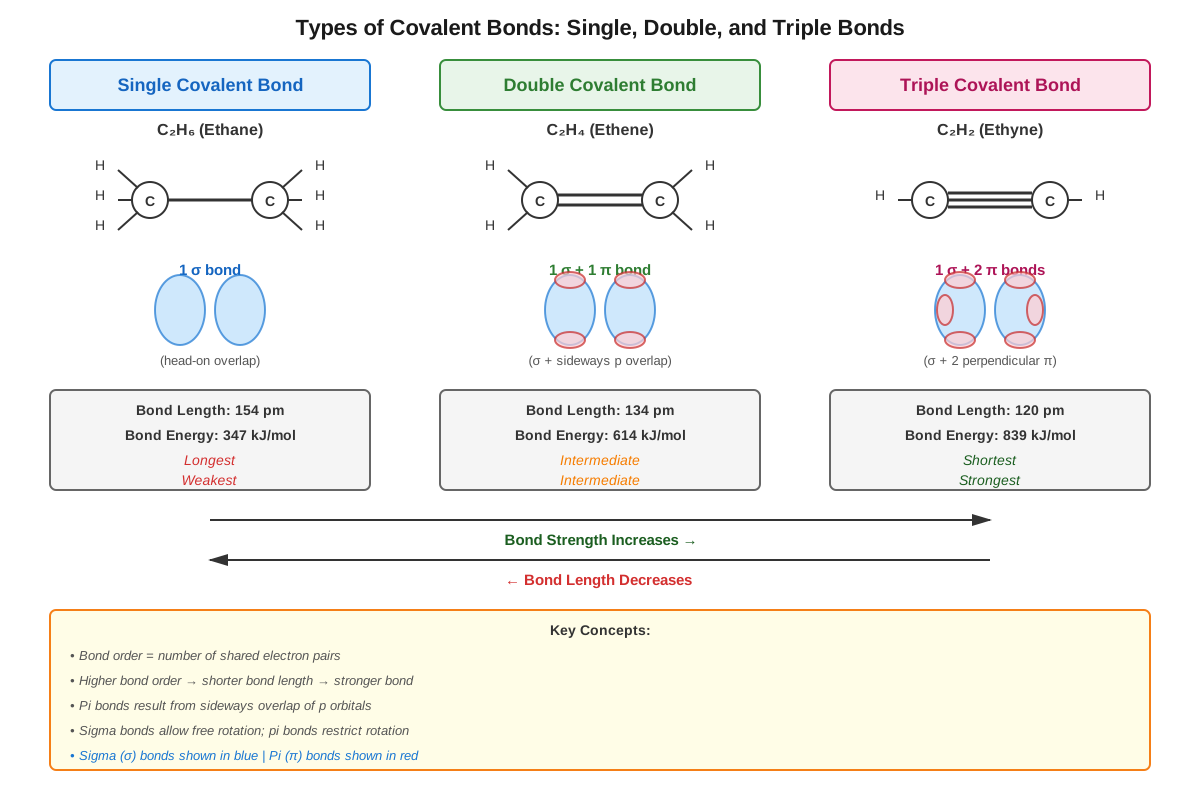
Single bonds consist of one shared electron pair (two electrons total) and are represented by a single line between atoms (e.g., H-H, C-C, C-H). These bonds allow for free rotation around the bond axis and are generally the longest and weakest type of covalent bond between any two given atoms.
Double bonds involve two shared electron pairs (four electrons total) and are represented by two parallel lines (e.g., C=C, C=O, O=O). Double bonds are shorter and stronger than single bonds between the same atoms and restrict rotation around the bond axis, leading to geometric isomerism in some molecules.
Triple bonds contain three shared electron pairs (six electrons total) and are shown as three parallel lines (e.g., C≡C, C≡N, N≡N). These are the shortest and strongest covalent bonds between any two given atoms and completely prevent rotation around the bond axis.
Bond Polarity and Electronegativity
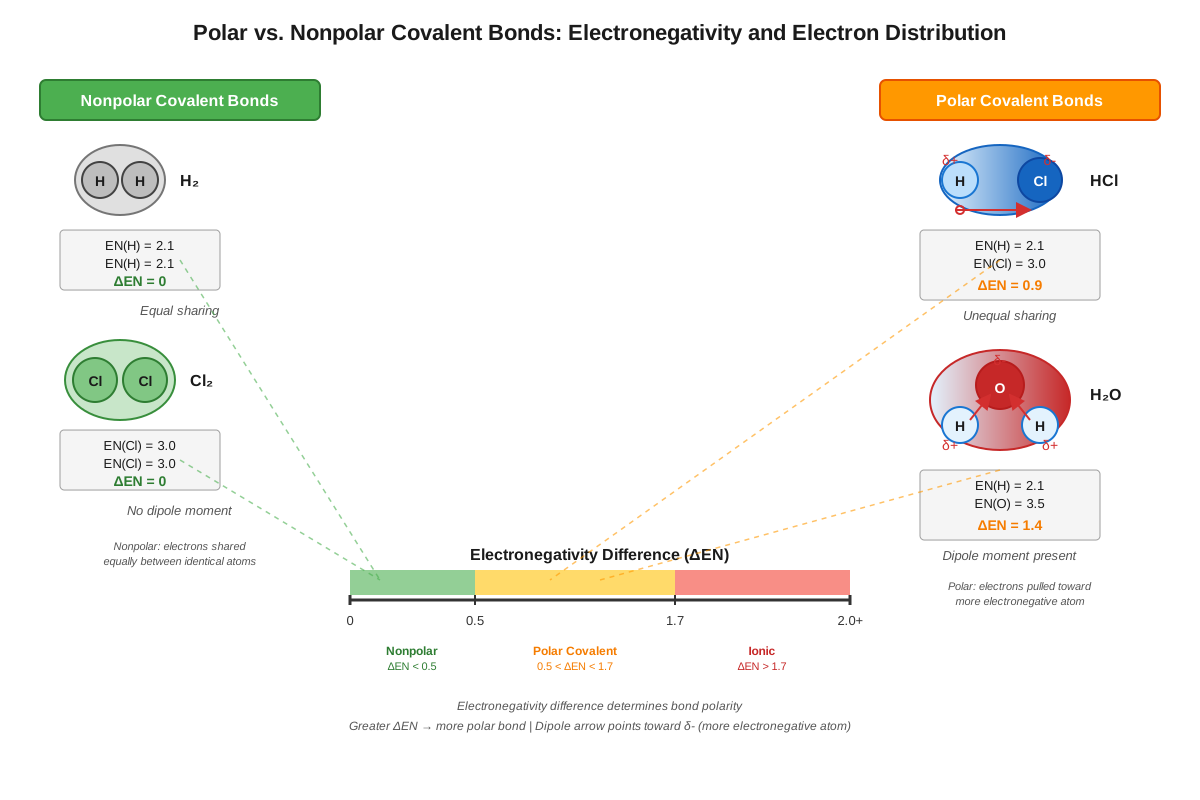
Polar covalent bonds form when electrons are shared unequally between atoms with different electronegativities. The more electronegative atom attracts the shared electrons more strongly, creating a partial negative charge (δ-) on that atom and a partial positive charge (δ+) on the less electronegative atom. This charge separation creates a bond dipole moment, a vector quantity pointing from the positive to the negative end.
Nonpolar covalent bonds occur when electrons are shared equally between atoms with identical or very similar electronegativities (typically a difference < 0.4). Examples include H₂, O₂, N₂, and C-H bonds. These bonds have no significant charge separation and no dipole moment.
The degree of bond polarity can be estimated using electronegativity differences:
- Difference 0-0.4: Nonpolar covalent
- Difference 0.4-1.7: Polar covalent
- Difference > 1.7: Predominantly ionic (though some covalent character remains)
Bond Properties: Length, Strength, and Energy
Bond length is the average distance between the nuclei of two bonded atoms. Bond length decreases with:
- Increasing bond order (triple < double < single)
- Decreasing atomic size of bonding atoms
- Increasing s-character in hybrid orbitals
Bond strength (or bond energy) is the energy required to break one mole of bonds in the gas phase, measured in kJ/mol or kcal/mol. Bond strength increases with:
- Increasing bond order (triple > double > single)
- Decreasing bond length
- Greater orbital overlap between bonding atoms
Bond dissociation energy is the specific energy required to homolytically cleave a particular bond, producing two radicals. This value varies depending on the molecular environment and is crucial for understanding reaction thermodynamics.
| Bond Type | Approximate Length (pm) | Approximate Energy (kJ/mol) |
|---|---|---|
| C-C | 154 | 347 |
| C=C | 134 | 614 |
| C≡C | 120 | 839 |
| C-O | 143 | 358 |
| C=O | 120 | 745 |
| C-N | 147 | 305 |
| C≡N | 116 | 891 |
Lewis Structures and Formal Charge
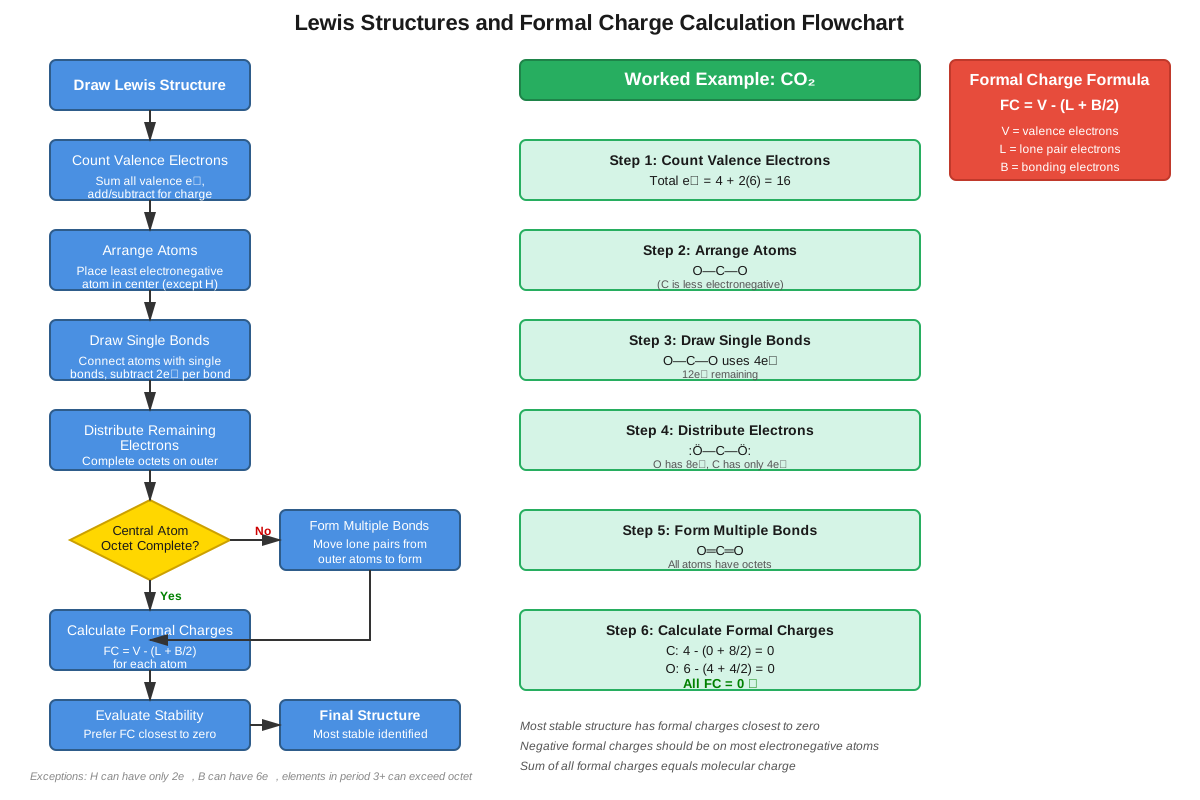
Lewis structures are diagrams showing the arrangement of valence electrons in molecules, with bonding pairs shown as lines and nonbonding pairs (lone pairs) shown as dots. Constructing accurate Lewis structures is essential for predicting molecular geometry and reactivity.
Formal charge is a bookkeeping method to track electron distribution in molecules and determine the most stable Lewis structure. The formula is:
Formal Charge = (Valence electrons) - (Nonbonding electrons) - ½(Bonding electrons)The most stable Lewis structure typically has:
- Formal charges closest to zero on all atoms
- Negative formal charges on more electronegative atoms
- Positive formal charges on less electronegative atoms
- Minimal charge separation
Coordinate Covalent Bonds
A coordinate covalent bond (or dative bond) is a special type of covalent bond where both electrons in the shared pair come from the same atom. Once formed, coordinate covalent bonds are indistinguishable from regular covalent bonds. Common examples include:
- Formation of ammonium ion (NH₄⁺) from ammonia and a proton
- Metal-ligand bonds in coordination complexes
- Bonding in molecules like ozone (O₃) and sulfur trioxide (SO₃)
Resonance and Electron Delocalization
Resonance occurs when a molecule cannot be adequately represented by a single Lewis structure and requires multiple contributing structures to describe the true electron distribution. The actual structure is a resonance hybrid—a weighted average of all resonance contributors. Key principles:
- Resonance structures differ only in electron positions, not atom positions
- More stable resonance contributors have greater weight in the hybrid
- The true structure has lower energy than any single resonance contributor
- Resonance stabilization increases molecular stability
Common resonance-stabilized species include benzene, carboxylate ions, carbonate ion, and peptide bonds.
Concept Relationships
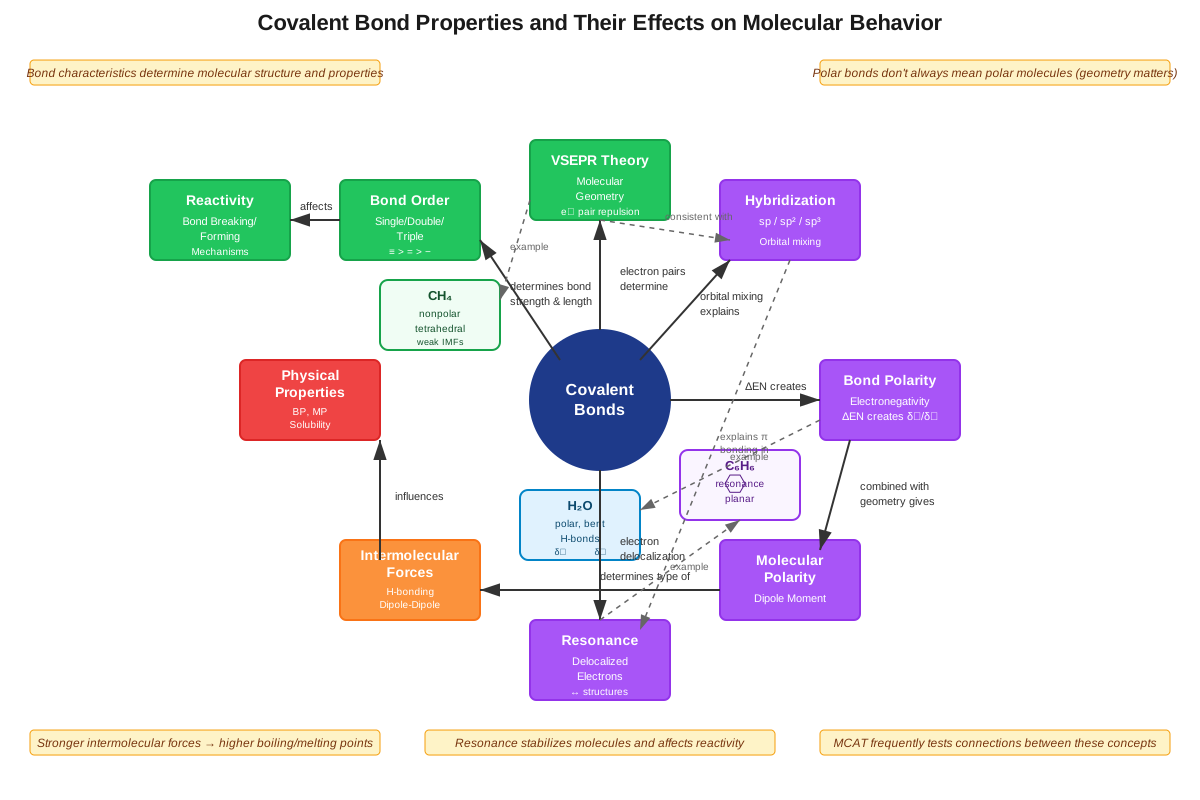
Covalent bonding concepts form an interconnected web within General Chemistry. The formation of covalent bonds begins with atomic structure—specifically the number and arrangement of valence electrons, which determines bonding capacity. Electronegativity directly influences bond polarity, which in turn affects molecular polarity and intermolecular forces.
The relationship flow can be mapped as:
Valence electrons → Lewis structures → Formal charge calculations → Most stable structure prediction → Molecular geometry (VSEPR) → Hybridization → Molecular polarity → Intermolecular forces → Physical properties
Within covalent bonding itself: Bond order (single, double, triple) → Bond length (inversely related) → Bond strength (directly related to bond order) → Reactivity patterns
Covalent bonds connect to thermodynamics through bond dissociation energies, which determine reaction enthalpies. They connect to kinetics through the concept that bonds must be broken (activation energy) before new bonds form. In organic chemistry, understanding covalent bond properties enables prediction of reaction mechanisms, while in biochemistry, covalent bonds explain protein structure, enzyme catalysis, and metabolic pathways.
Quick check — test yourself on Covalent bonds so far.
Try Flashcards →High-Yield Facts
⭐ Bond order is inversely proportional to bond length and directly proportional to bond strength: Triple bonds are shortest and strongest; single bonds are longest and weakest.
⭐ Electronegativity difference determines bond polarity: Differences < 0.4 are nonpolar covalent; 0.4-1.7 are polar covalent; > 1.7 are predominantly ionic.
⭐ The most stable Lewis structure minimizes formal charges and places negative charges on more electronegative atoms.
⭐ Coordinate covalent bonds form when both electrons come from the same atom but are indistinguishable from regular covalent bonds once formed.
⭐ Resonance stabilization lowers molecular energy and increases stability compared to any single contributing structure.
- Breaking covalent bonds requires energy input (endothermic), while forming covalent bonds releases energy (exothermic).
- Carbon forms four covalent bonds due to its four valence electrons and tendency to achieve an octet.
- Nonpolar covalent bonds occur between identical atoms or atoms with very similar electronegativities (e.g., C-H bonds).
- Bond dissociation energy varies with molecular context—the same type of bond can have different strengths in different molecules.
- Pi (π) bonds in double and triple bonds are weaker than sigma (σ) bonds and are more reactive sites.
- Formal charge calculation: FC = V - N - B/2, where V = valence electrons, N = nonbonding electrons, B = bonding electrons.
- Molecules with resonance structures are more stable than predicted by any single Lewis structure alone.
Common Misconceptions
Misconception: All covalent bonds involve equal sharing of electrons.
Correction: Only nonpolar covalent bonds involve equal sharing. Polar covalent bonds involve unequal sharing due to electronegativity differences, creating partial charges on the bonded atoms.
Misconception: Double bonds are exactly twice as strong as single bonds.
Correction: While double bonds are stronger than single bonds between the same atoms, they are not exactly twice as strong. For example, a C=C bond (~614 kJ/mol) is less than twice the strength of a C-C bond (~347 kJ/mol) because the second bond (π bond) is weaker than the first (σ bond).
Misconception: The Lewis structure with the most bonds is always the most stable.
Correction: The most stable Lewis structure is determined by formal charge distribution, not just the number of bonds. A structure with more bonds but unfavorable formal charges (e.g., positive charge on oxygen) is less stable than one with fewer bonds but formal charges closer to zero.
Misconception: Coordinate covalent bonds are fundamentally different from regular covalent bonds.
Correction: Once formed, coordinate covalent bonds are identical to regular covalent bonds in strength and properties. The distinction only matters during bond formation—both electrons come from one atom rather than one from each atom.
Misconception: Resonance structures represent molecules rapidly switching between different forms.
Correction: Resonance structures are not real, separate forms that interconvert. They are human-drawn representations of a single, stable structure where electrons are delocalized. The actual molecule is a resonance hybrid with properties intermediate between all contributors.
Misconception: Atoms always follow the octet rule in covalent compounds.
Correction: While the octet rule is useful, many stable molecules violate it. Hydrogen follows the duet rule (2 electrons), boron often has only 6 electrons (electron-deficient), and elements in period 3 and beyond can expand their octets using d-orbitals (e.g., PCl₅, SF₆).
Worked Examples
Example 1: Determining the Most Stable Lewis Structure
Question: Draw the Lewis structure for the cyanate ion (OCN⁻) and determine which resonance structure is most stable.
Solution:
Step 1: Count total valence electrons
- O: 6 valence electrons
- C: 4 valence electrons
- N: 5 valence electrons
- Negative charge: +1 electron
- Total: 16 valence electrons
Step 2: Draw possible resonance structures
Structure A: [O=C=N]⁻ (with lone pairs on O and N)
Structure B: [O-C≡N]⁻ (with lone pairs on O)
Structure C: [O≡C-N]⁻ (with lone pairs on N)
Step 3: Calculate formal charges for each structure
Structure A: O=C=N
- O: 6 - 4 - 4/2 = 0
- C: 4 - 0 - 8/2 = 0
- N: 5 - 4 - 4/2 = -1
Structure B: O-C≡N
- O: 6 - 6 - 2/2 = -1
- C: 4 - 0 - 8/2 = 0
- N: 5 - 2 - 6/2 = 0
Structure C: O≡C-N
- O: 6 - 2 - 6/2 = +1
- C: 4 - 0 - 8/2 = 0
- N: 5 - 6 - 2/2 = -2
Step 4: Evaluate stability
Structure B is most stable because:
- The negative formal charge is on oxygen, the most electronegative atom
- Formal charges are minimized (only -1 on O)
- Structure C is least stable due to charge separation and positive charge on the more electronegative oxygen
Answer: Structure B [O-C≡N]⁻ is the most stable resonance contributor, though the actual ion is a resonance hybrid with Structure A also contributing.
Example 2: Comparing Bond Properties
Question: Rank the following bonds in order of increasing bond length and explain your reasoning: C-C, C=C, C≡C, C-O
Solution:
Step 1: Apply the relationship between bond order and bond length
- Higher bond order → shorter bond length
- Triple bonds < double bonds < single bonds
Step 2: Consider atomic size
- Oxygen is smaller than carbon
- C-O bonds will be shorter than C-C bonds of the same order
Step 3: Rank the bonds
Increasing bond length: C≡C < C=C < C-O < C-C
Reasoning:
- C≡C (120 pm): Triple bond, highest bond order, shortest length
- C=C (134 pm): Double bond, intermediate bond order
- C-O (143 pm): Single bond, but oxygen is smaller than carbon, making it shorter than C-C
- C-C (154 pm): Single bond between two carbons, longest
Step 4: Connect to bond strength
This ranking would be reversed for bond strength: C-C < C-O < C=C < C≡C
The triple bond is not only shortest but also strongest, requiring the most energy to break.
Answer: C≡C < C=C < C-O < C-C (increasing bond length)
This example demonstrates the inverse relationship between bond length and bond strength, and how both bond order and atomic size influence bond properties—concepts frequently tested on the MCAT.
Exam Strategy
Approaching MCAT Questions on Covalent Bonds
For Lewis structure questions:
- Count total valence electrons first (don't forget to add/subtract for charges)
- Connect atoms with single bonds initially
- Distribute remaining electrons to satisfy octets
- Form multiple bonds if needed to complete octets
- Calculate formal charges to verify the most stable structure
For bond property questions:
- Immediately identify bond order (single, double, triple)
- Remember: bond order ↑ → length ↓ → strength ↑
- Consider atomic size for bonds between different elements
- Check for resonance, which affects bond properties
For polarity questions:
- Calculate or estimate electronegativity difference
- Draw the bond dipole direction (toward more electronegative atom)
- Remember that molecular polarity depends on both bond polarity and geometry
Trigger Words and Phrases
- "Most stable structure" → Calculate formal charges
- "Bond strength" or "bond energy" → Consider bond order and length
- "Polar covalent" → Think electronegativity difference between 0.4-1.7
- "Resonance" → Draw multiple Lewis structures, identify the hybrid
- "Coordinate covalent" → Look for lone pair donation
- "Bond order" → Count shared electron pairs
- "Homolytic cleavage" → Each atom gets one electron (forms radicals)
- "Heterolytic cleavage" → One atom gets both electrons (forms ions)
Process of Elimination Tips
- Eliminate Lewis structures with incorrect total electron counts
- Eliminate structures with formal charges on the wrong atoms (negative on less electronegative, positive on more electronegative)
- Eliminate bond length rankings that violate the bond order principle
- Eliminate polarity predictions that ignore electronegativity differences
- For resonance questions, eliminate structures where atoms have moved (only electrons move in resonance)
Time Allocation
- Lewis structure questions: 60-90 seconds for simple molecules, up to 2 minutes for complex resonance structures
- Bond property comparisons: 30-45 seconds once you identify the key principle
- Formal charge calculations: 45-60 seconds per structure
- Don't spend more than 90 seconds on any discrete question; flag and return if needed
Memory Techniques
Mnemonics
"HONC 1234" - Remember common bonding patterns:
- Hydrogen forms 1 bond
- Oxygen forms 2 bonds
- Nitrogen forms 3 bonds
- Carbon forms 4 bonds
"FONClBrISCH" (pronounced "foncle-brish") - Elements that commonly form covalent bonds (nonmetals): Fluorine, Oxygen, Nitrogen, Chlorine, Bromine, Iodine, Sulfur, Carbon, Hydrogen
"VSEPR" for formal charge: Valence minus Solo (nonbonding) minus Each Pair Reduced (bonding electrons divided by 2)
Visualization Strategies
Bond strength ladder: Visualize a ladder where each rung represents increasing bond order:
- Bottom rung: Single bonds (longest, weakest)
- Middle rung: Double bonds (intermediate)
- Top rung: Triple bonds (shortest, strongest)
Electronegativity tug-of-war: Picture two atoms pulling on shared electrons like a rope in tug-of-war. The stronger puller (more electronegative) gets the electrons closer, creating polarity.
Resonance blending: Imagine resonance structures as different colored transparencies. When overlaid, they create a blended image (the resonance hybrid) that shows electron delocalization.
Acronyms
LESS for stable Lewis structures:
- Low formal charges
- Electronegative atoms get negative charges
- Symmetry when possible
- Satisfy octets (when possible)
Summary
Covalent bonds form the foundation of molecular chemistry and are essential for MCAT success across multiple disciplines. These bonds involve electron sharing between atoms, typically nonmetals, creating discrete molecular units with specific properties. The key to mastering covalent bonds lies in understanding the relationships between bond order, length, and strength; recognizing how electronegativity differences create bond polarity; and applying formal charge calculations to identify the most stable Lewis structures. Bond order directly correlates with bond strength and inversely correlates with bond length—triple bonds are shortest and strongest, while single bonds are longest and weakest. Polar covalent bonds result from unequal electron sharing due to electronegativity differences, while nonpolar covalent bonds involve equal sharing. Resonance structures represent electron delocalization that stabilizes molecules beyond what any single Lewis structure predicts. Understanding these principles enables prediction of molecular geometry, polarity, reactivity, and physical properties—all frequently tested concepts on the MCAT that appear in general chemistry, organic chemistry, and biochemistry contexts.
Key Takeaways
- Covalent bonds involve electron sharing between atoms, typically nonmetals, to achieve stable electron configurations
- Bond order (single < double < triple) is inversely proportional to bond length and directly proportional to bond strength
- Electronegativity difference determines bond polarity: < 0.4 nonpolar, 0.4-1.7 polar covalent, > 1.7 predominantly ionic
- The most stable Lewis structure minimizes formal charges and places negative charges on more electronegative atoms
- Resonance structures show electron delocalization; the true structure is a hybrid that is more stable than any single contributor
- Coordinate covalent bonds form when both electrons come from one atom but are indistinguishable from regular covalent bonds once formed
- Understanding covalent bond properties enables prediction of molecular behavior, reactivity, and physical properties across all MCAT science sections
Related Topics
VSEPR Theory and Molecular Geometry: Building on covalent bonding, VSEPR theory predicts three-dimensional molecular shapes based on electron pair repulsion, which determines molecular polarity and reactivity.
Hybridization and Molecular Orbital Theory: These advanced bonding theories explain the geometry and properties of covalent bonds through orbital mixing and electron delocalization, providing deeper insight into molecular structure.
Intermolecular Forces: Understanding covalent bond polarity is essential for predicting intermolecular forces (dipole-dipole, hydrogen bonding, London dispersion), which determine physical properties like boiling point and solubility.
Organic Chemistry Functional Groups: Mastery of covalent bonding enables recognition and understanding of functional groups, which are the reactive sites in organic molecules and biochemical compounds.
Thermochemistry and Bond Energies: Bond dissociation energies derived from covalent bond strengths are used to calculate reaction enthalpies and predict reaction spontaneity.
Acid-Base Chemistry: Covalent bond polarity influences acid strength, base strength, and proton transfer reactions, connecting bonding concepts to reactivity patterns.
Practice CTA
Now that you've mastered the core concepts of covalent bonds, it's time to solidify your understanding through active practice. Challenge yourself with MCAT-style practice questions that test your ability to draw Lewis structures, calculate formal charges, predict bond properties, and analyze molecular polarity. Use flashcards to drill high-yield facts like bond order relationships and electronegativity ranges. Remember, understanding covalent bonds is not just about memorizing facts—it's about developing the analytical skills to approach any molecule systematically and predict its behavior. The more you practice applying these concepts, the more automatic your reasoning will become on test day. You've built a strong foundation; now strengthen it through deliberate practice!
Sign up free to keep reading
Create a free AnvayaPrep account to finish this MCAT guide on Covalent bonds — plus flashcards and practice questions.