Overview
Polar covalent bonds represent one of the most fundamental concepts in General Chemistry and serve as a critical bridge between atomic structure and molecular behavior. Unlike purely ionic or purely covalent bonds, polar covalent bonds exist along a continuum where electrons are shared unequally between atoms due to differences in electronegativity. This unequal sharing creates partial charges (δ+ and δ−) within molecules, profoundly influencing molecular geometry, intermolecular forces, solubility, reactivity, and biological function.
Understanding polar covalent bonds is essential for the MCAT because they underpin numerous testable concepts across multiple sections of the exam. In the Chemical and Physical Foundations section, questions frequently test the ability to predict bond polarity, relate it to molecular polarity, and explain physical properties like boiling point and solubility. In the Biological and Biochemical Foundations section, polar covalent bonds explain why water is the universal biological solvent, how proteins fold into functional conformations, and why certain drugs can cross lipid membranes while others cannot. The MCAT consistently presents passages requiring students to analyze molecular interactions, predict reaction mechanisms, or explain physiological phenomena—all of which depend on recognizing and applying principles of bond polarity.
Within Bonding and Molecular Structure, polar covalent bonds connect directly to electronegativity trends, dipole moments, intermolecular forces (hydrogen bonding, dipole-dipole interactions), molecular geometry (VSEPR theory), and solution chemistry. Mastering this topic enables students to predict and explain molecular behavior from first principles rather than relying on memorization, a skill the MCAT rewards heavily. This guide provides comprehensive coverage of polar covalent bonds with an emphasis on high-yield, exam-relevant applications.
Learning Objectives
- [ ] Define polar covalent bonds using accurate General Chemistry terminology
- [ ] Explain why polar covalent bonds matter for the MCAT
- [ ] Apply polar covalent bonds to exam-style questions
- [ ] Identify common mistakes related to polar covalent bonds
- [ ] Connect polar covalent bonds to related General Chemistry concepts
- [ ] Calculate and interpret electronegativity differences to predict bond polarity
- [ ] Distinguish between bond polarity and molecular polarity in complex molecules
- [ ] Predict physical and chemical properties based on the presence of polar covalent bonds
- [ ] Analyze biological systems using principles of polar covalent bonding
Prerequisites
- Atomic structure and electron configuration: Understanding electron distribution is essential because polar covalent bonds involve unequal sharing of valence electrons between atoms
- Periodic trends (especially electronegativity): Electronegativity differences between bonded atoms determine the degree of bond polarity and are the fundamental cause of polar covalent character
- Basic bonding theory (ionic vs. covalent): Polar covalent bonds represent an intermediate case between purely ionic and purely covalent bonding, requiring familiarity with both extremes
- Lewis structures: The ability to draw Lewis structures is necessary to identify which atoms are bonded and to visualize electron distribution in molecules
- Molecular geometry (VSEPR theory basics): Bond polarity alone does not determine molecular polarity; three-dimensional molecular shape must be considered to determine net dipole moments
Why This Topic Matters
Clinical and Real-World Significance
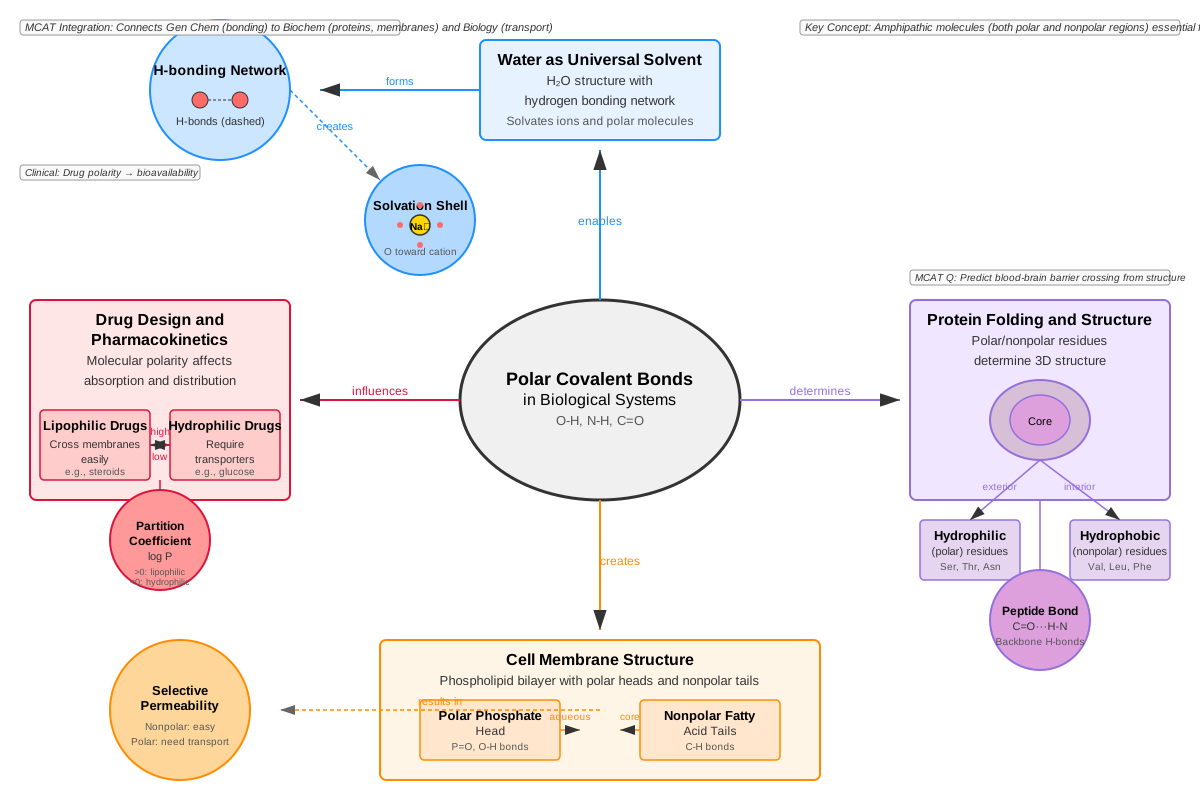
Polar covalent bonds are fundamental to life itself. Water's unique properties—high specific heat, excellent solvent capabilities, cohesion, and surface tension—all stem from the polar covalent O-H bonds that enable extensive hydrogen bonding networks. In pharmacology, drug design relies heavily on understanding polar covalent bonds to predict drug solubility, membrane permeability, and receptor binding. For example, the blood-brain barrier selectively permits molecules with appropriate polarity, making bond polarity a critical consideration in neurological drug development. Enzyme-substrate interactions, protein folding, DNA base pairing, and membrane structure all depend on the precise arrangement of polar and nonpolar regions within biological molecules.
Exam Statistics and Question Types
Polar covalent bonds appear in approximately 15-20% of General Chemistry questions on the MCAT and are integrated into numerous biochemistry and organic chemistry questions. The MCAT tests this concept through:
- Discrete questions asking students to rank molecules by bond polarity or predict physical properties
- Passage-based questions requiring analysis of molecular interactions in biological systems, chromatography, or solution chemistry
- Data interpretation questions presenting experimental results (e.g., boiling points, solubility data) that must be explained using bonding principles
- Pseudo-discrete questions embedded in biochemistry passages about protein structure, membrane transport, or drug mechanisms
Common Exam Appearances
The MCAT frequently presents polar covalent bonds in contexts such as:
- Explaining why certain amino acids are hydrophobic while others are hydrophilic
- Predicting the relative boiling points of organic compounds
- Analyzing chromatography results based on polarity
- Explaining membrane permeability and transport mechanisms
- Interpreting spectroscopic data (IR spectroscopy shows characteristic stretches for polar bonds)
- Describing acid-base chemistry (polar covalent bonds in O-H, N-H, and S-H groups)
Core Concepts
Definition and Fundamental Nature of Polar Covalent Bonds
A polar covalent bond forms when two atoms share electrons unequally due to a difference in their electronegativities. Electronegativity is the measure of an atom's ability to attract shared electrons in a chemical bond. When atoms with different electronegativities form a covalent bond, the shared electron pair is drawn more strongly toward the more electronegative atom, creating a dipole—a separation of charge with partial positive (δ+) and partial negative (δ−) regions.
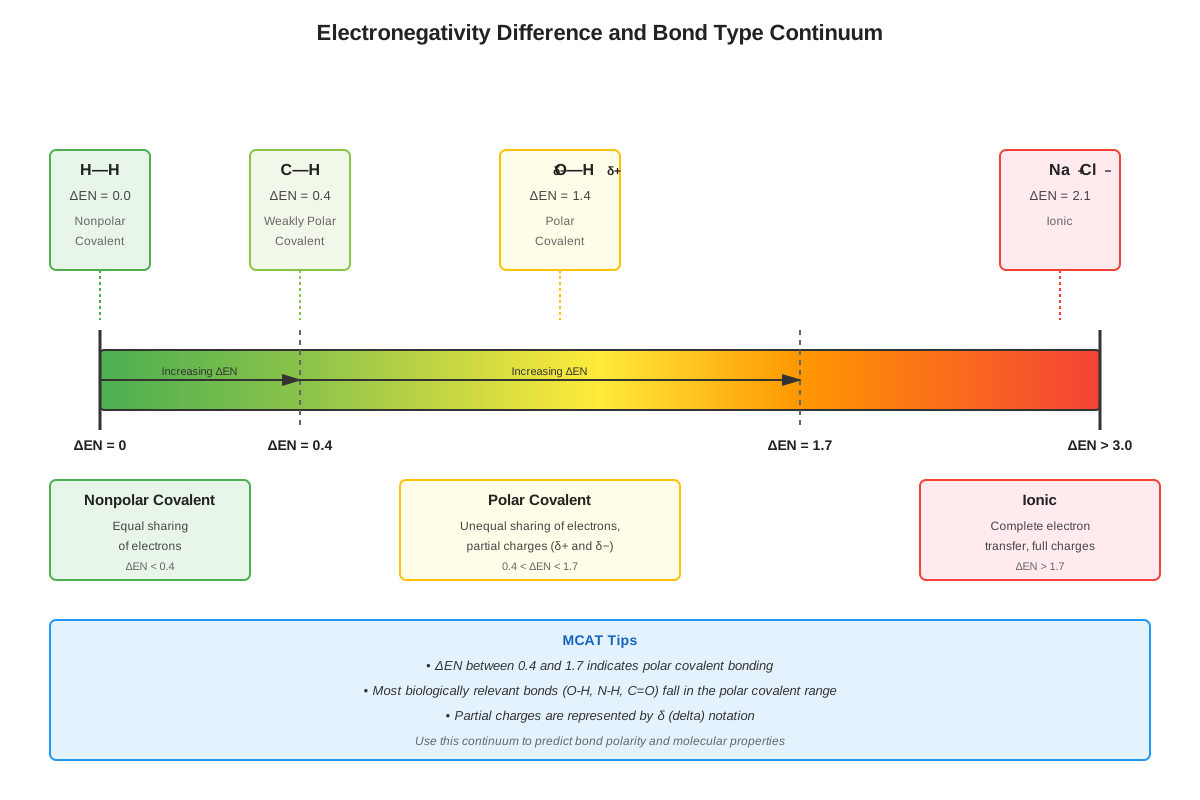
The degree of bond polarity exists on a continuum:
- Nonpolar covalent bonds: Electronegativity difference (ΔEN) < 0.4 (e.g., C-H, C-C)
- Polar covalent bonds: ΔEN between 0.4 and 1.7 (e.g., O-H, N-H, C-O)
- Ionic bonds: ΔEN > 1.7 (e.g., Na-Cl, Mg-O)
These ranges are approximate guidelines rather than absolute cutoffs. The MCAT expects students to recognize that bonding exists along a spectrum and that even "ionic" compounds often have some covalent character.
Electronegativity and Predicting Bond Polarity
Electronegativity increases across a period (left to right) and decreases down a group in the periodic table. The most electronegative element is fluorine (EN = 4.0), followed by oxygen (EN = 3.5), nitrogen (EN = 3.0), and chlorine (EN = 3.0). Carbon has an electronegativity of 2.5, and hydrogen is 2.1.
To predict bond polarity:
- Identify the two atoms forming the bond
- Determine their electronegativity values
- Calculate ΔEN = |EN₁ - EN₂|
- Apply the guidelines above to classify the bond
Example: In an O-H bond, oxygen (EN = 3.5) is more electronegative than hydrogen (EN = 2.1), giving ΔEN = 1.4. This falls in the polar covalent range, with oxygen bearing a partial negative charge (δ−) and hydrogen bearing a partial positive charge (δ+).
Dipole Moments and Quantifying Polarity
The dipole moment (μ) quantifies the polarity of a bond or molecule. It is calculated as:
μ = q × dwhere q is the magnitude of the partial charges and d is the distance between them. Dipole moments are measured in Debye units (D). A larger dipole moment indicates greater polarity.
For individual bonds, dipole moments are represented as vectors pointing from the positive end (δ+) to the negative end (δ−). The MCAT frequently requires students to consider vector addition of individual bond dipoles to determine the overall molecular dipole moment.
Bond Polarity vs. Molecular Polarity
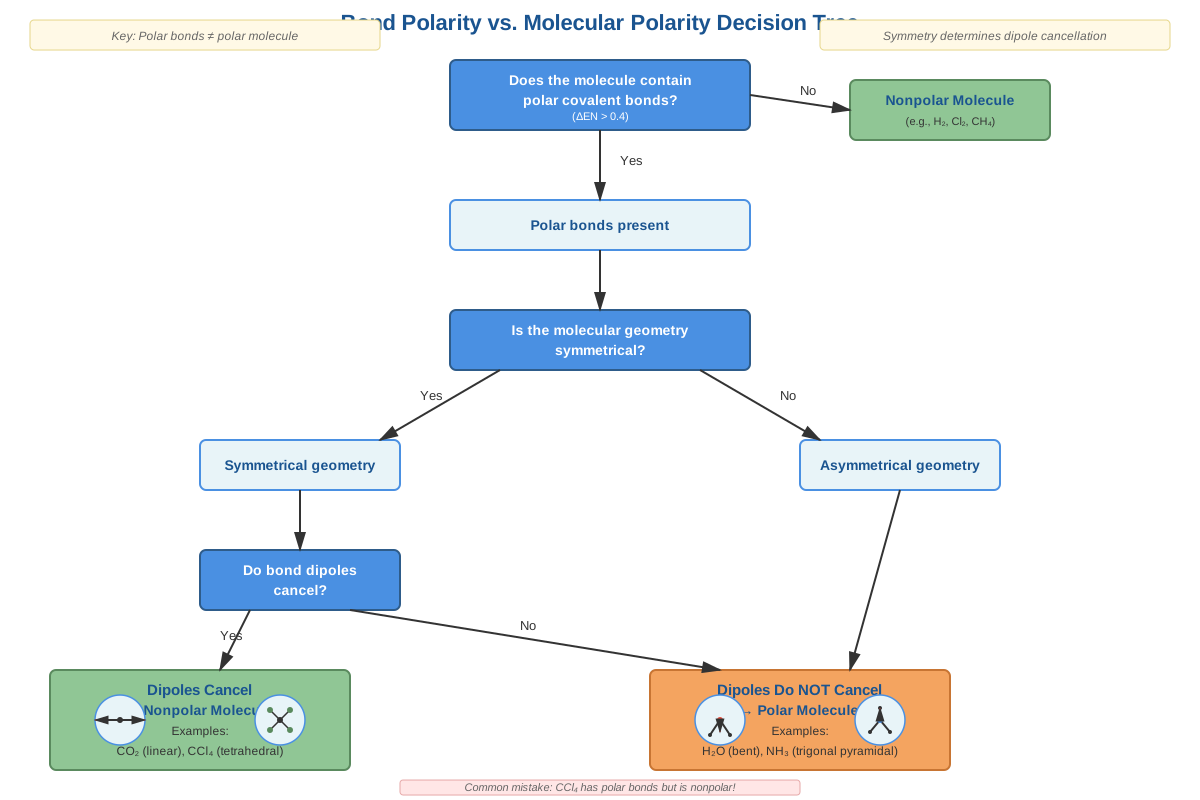
A critical distinction for the MCAT is that bond polarity does not automatically mean molecular polarity. A molecule is polar only if it has a net dipole moment, which depends on both bond polarity and molecular geometry.
Key principle: Symmetrical molecules with polar bonds can be nonpolar overall if the bond dipoles cancel due to geometric arrangement.
| Molecule | Bond Polarity | Molecular Geometry | Molecular Polarity | Explanation |
|---|---|---|---|---|
| CO₂ | C=O bonds are polar | Linear | Nonpolar | Two equal dipoles point in opposite directions and cancel |
| H₂O | O-H bonds are polar | Bent | Polar | Two dipoles do not cancel due to bent geometry |
| CCl₄ | C-Cl bonds are polar | Tetrahedral | Nonpolar | Four equal dipoles arranged symmetrically cancel |
| CHCl₃ | C-Cl and C-H bonds are polar | Tetrahedral | Polar | Asymmetric distribution of dipoles creates net dipole |
| NH₃ | N-H bonds are polar | Trigonal pyramidal | Polar | Three dipoles plus lone pair create net dipole |
Physical Properties Influenced by Polar Covalent Bonds
Polar covalent bonds profoundly affect physical properties through their influence on intermolecular forces:
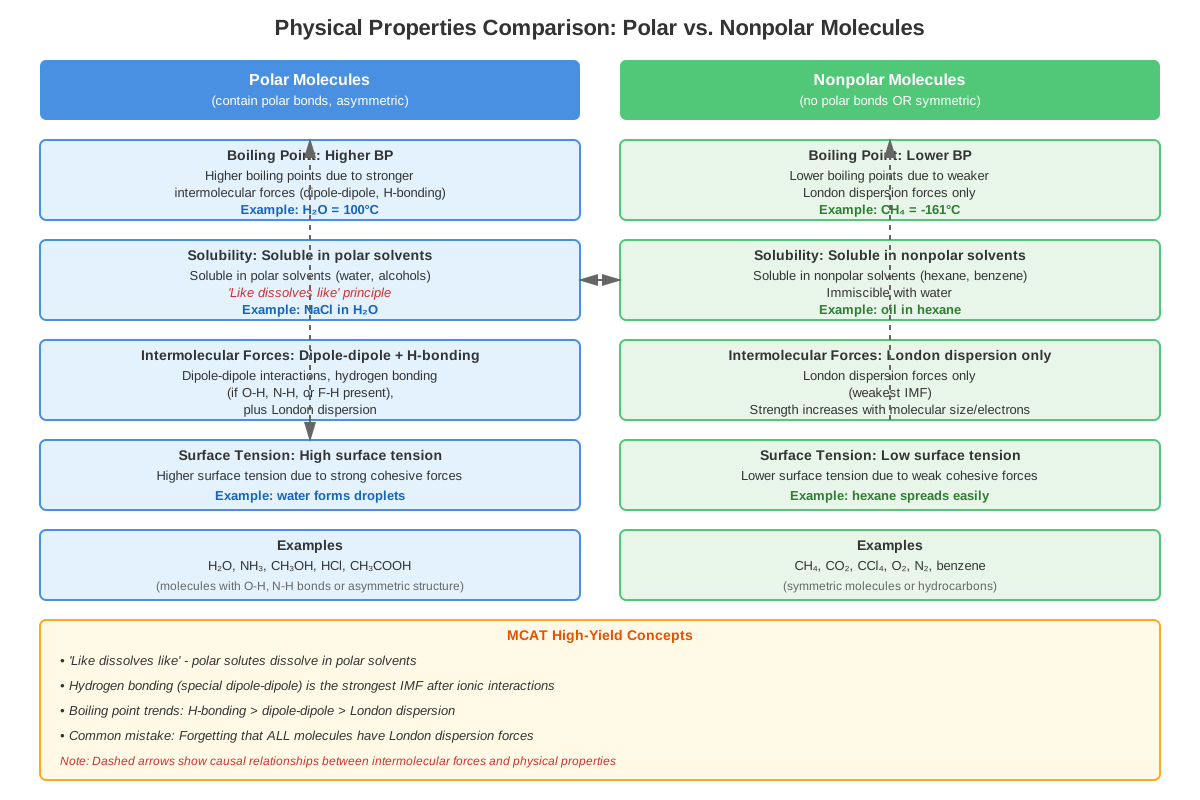
Boiling and Melting Points: Molecules with polar covalent bonds typically have higher boiling and melting points than nonpolar molecules of similar molecular weight because polar molecules experience stronger intermolecular forces (dipole-dipole interactions). When polar bonds involve hydrogen bonded to N, O, or F, hydrogen bonding occurs—the strongest type of dipole-dipole interaction—leading to dramatically elevated boiling points.
Solubility: The principle "like dissolves like" is fundamentally about polarity. Polar molecules with polar covalent bonds dissolve readily in polar solvents (especially water) because favorable dipole-dipole interactions between solute and solvent molecules offset the energy required to separate solvent molecules. Nonpolar molecules do not dissolve well in polar solvents because they cannot form these favorable interactions.
Viscosity and Surface Tension: Liquids with extensive polar covalent bonding (particularly those capable of hydrogen bonding) exhibit higher viscosity and surface tension due to stronger intermolecular attractions.
Polar Covalent Bonds in Biological Molecules
In biochemistry, polar covalent bonds are essential for:
Protein Structure: The peptide bond (C=O and N-H groups) contains polar covalent bonds that participate in hydrogen bonding, stabilizing secondary structures (α-helices and β-sheets). Side chains containing O-H, N-H, or S-H groups are hydrophilic and typically found on protein surfaces.
Nucleic Acid Structure: The phosphodiester backbone of DNA and RNA contains highly polar P-O bonds, making the backbone hydrophilic and charged. Hydrogen bonds between complementary base pairs (involving N-H and C=O polar covalent bonds) stabilize the double helix.
Membrane Structure: Phospholipid bilayers organize based on polarity—polar head groups (containing P-O bonds) face the aqueous environment, while nonpolar tails cluster in the membrane interior. This organization is driven by the favorable interactions between polar groups and water.
Enzyme Catalysis: Active sites often contain amino acids with polar covalent bonds (Ser, Thr, Tyr, Cys) that participate in catalytic mechanisms through nucleophilic attack, proton transfer, or stabilization of charged intermediates.
Concept Relationships
The concept of polar covalent bonds is deeply interconnected with multiple areas of General Chemistry and biochemistry:
Electronegativity → Polar Covalent Bonds → Dipole Moments: Electronegativity differences between atoms create polar covalent bonds, which possess dipole moments that can be quantified and vectorially added.
Polar Covalent Bonds → Intermolecular Forces: The presence of polar covalent bonds enables dipole-dipole interactions and hydrogen bonding, which are specific types of intermolecular forces stronger than London dispersion forces.
Intermolecular Forces → Physical Properties: The strength and type of intermolecular forces (determined by bond polarity) directly influence boiling point, melting point, vapor pressure, viscosity, and surface tension.
Polar Covalent Bonds + Molecular Geometry → Molecular Polarity: Bond polarity combined with three-dimensional molecular shape (from VSEPR theory) determines whether a molecule has a net dipole moment.
Molecular Polarity → Solubility: The polarity of a molecule (determined by polar covalent bonds and geometry) predicts its solubility in various solvents according to "like dissolves like."
Polar Covalent Bonds → Acid-Base Chemistry: Bonds involving hydrogen (O-H, N-H, S-H) can be polar and potentially acidic, with bond polarity influencing the ease of proton donation.
Polar Covalent Bonds → Biological Function: The distribution of polar and nonpolar regions in biological macromolecules determines their folding, interactions, and function in aqueous environments.
High-Yield Facts
⭐ Electronegativity difference (ΔEN) between 0.4 and 1.7 indicates a polar covalent bond
⭐ The most electronegative elements are F > O > N ≈ Cl, following the trend of increasing across periods and decreasing down groups
⭐ Bond polarity does not equal molecular polarity; symmetrical molecules with polar bonds can be nonpolar overall (e.g., CO₂, CCl₄)
⭐ Hydrogen bonding requires H bonded to N, O, or F—the strongest intermolecular force involving polar covalent bonds
⭐ "Like dissolves like": polar molecules dissolve in polar solvents; nonpolar molecules dissolve in nonpolar solvents
- Dipole moments are vector quantities pointing from δ+ to δ− and must be added vectorially to determine molecular polarity
- Water's unique properties (high specific heat, excellent solvent, high surface tension) result from polar O-H bonds enabling extensive hydrogen bonding
- C-H bonds are considered nonpolar (ΔEN ≈ 0.4) despite a small electronegativity difference, making hydrocarbons nonpolar
- Polar covalent bonds in functional groups (hydroxyl, carbonyl, amino, carboxyl) determine the chemical reactivity and physical properties of organic molecules
- The partial charges (δ+ and δ−) in polar covalent bonds are significantly smaller than full ionic charges (+1, −1) but still create significant electrostatic interactions
- Infrared (IR) spectroscopy detects polar covalent bonds because the oscillating dipole interacts with electromagnetic radiation; nonpolar bonds are IR-inactive
- Increasing bond polarity generally correlates with increasing bond strength and decreasing bond length due to greater electrostatic attraction
Quick check — test yourself on Polar covalent bonds so far.
Try Flashcards →Common Misconceptions
Misconception: All covalent bonds are nonpolar because electrons are shared rather than transferred.
Correction: Covalent bonds exist on a spectrum from nonpolar (equal sharing) to polar (unequal sharing) to ionic (essentially complete transfer). Most covalent bonds have some degree of polarity due to electronegativity differences.
Misconception: If a molecule contains polar bonds, the molecule must be polar.
Correction: Molecular polarity depends on both bond polarity and molecular geometry. Symmetrical molecules like CO₂, CCl₄, and BF₃ contain polar bonds but are nonpolar overall because the bond dipoles cancel vectorially.
Misconception: Electronegativity differences can be ignored for bonds between similar elements.
Correction: Even small electronegativity differences create measurable polarity. For example, C-H bonds (ΔEN ≈ 0.4) are at the boundary between nonpolar and polar, and this subtle polarity affects properties like acidity of terminal alkynes.
Misconception: The atom with more electrons in a bond is the one with the partial negative charge.
Correction: The partial negative charge (δ−) is on the more electronegative atom, which attracts the shared electrons more strongly, not necessarily the atom that contributed more electrons to the bond.
Misconception: Polar molecules always have higher boiling points than nonpolar molecules.
Correction: While polarity generally increases boiling point through stronger intermolecular forces, molecular weight and surface area also matter significantly. Large nonpolar molecules can have higher boiling points than small polar molecules due to extensive London dispersion forces.
Misconception: Hydrogen bonding can occur with any hydrogen atom in a molecule.
Correction: Hydrogen bonding specifically requires hydrogen covalently bonded to N, O, or F (highly electronegative atoms). Hydrogen bonded to carbon cannot participate in hydrogen bonding as a donor because the C-H bond is not sufficiently polar.
Misconception: Dipole moments always point from negative to positive.
Correction: By convention, dipole moment vectors point from the positive end (δ+) to the negative end (δ−), which can be counterintuitive but is the standard representation in chemistry.
Worked Examples
Example 1: Predicting Bond and Molecular Polarity
Question: Consider the molecule CHCl₃ (chloroform). (a) Identify the polar covalent bonds and indicate the direction of each bond dipole. (b) Determine whether the molecule is polar or nonpolar overall. (c) Compare the boiling point of CHCl₃ to CCl₄ and explain the difference.
Solution:
(a) First, identify the bonds and their polarities:
- C-H bond: Carbon (EN = 2.5) and hydrogen (EN = 2.1) have ΔEN = 0.4, making this bond weakly polar or nonpolar. The dipole points from H (δ+) toward C (δ−).
- C-Cl bonds: Carbon (EN = 2.5) and chlorine (EN = 3.0) have ΔEN = 0.5, making these bonds polar. Each dipole points from C (δ+) toward Cl (δ−).
(b) To determine molecular polarity, consider the geometry:
- CHCl₃ has a tetrahedral geometry around the central carbon
- Three C-Cl bond dipoles point toward the chlorine atoms
- One C-H bond dipole points toward the carbon (or weakly toward carbon)
- The molecule is asymmetric because the C-H bond differs from the three C-Cl bonds
- The three C-Cl dipoles do not fully cancel the C-H dipole
- CHCl₃ is polar with a net dipole moment pointing from the hydrogen end toward the chlorine end
(c) Comparing boiling points:
- CHCl₃: BP = 61°C
- CCl₄: BP = 77°C
- Despite CHCl₃ being polar and CCl₄ being nonpolar, CCl₄ has a higher boiling point
- This occurs because CCl₄ has greater molecular weight (154 g/mol vs. 119 g/mol) and larger surface area, leading to stronger London dispersion forces that outweigh the dipole-dipole interactions in CHCl₃
- This example illustrates that polarity is not the only factor determining boiling point; molecular size and shape also matter significantly
Example 2: Analyzing Solubility Based on Polar Covalent Bonds
Question: A biochemistry researcher is trying to purify a protein from a cell lysate. The protein has a hydrophobic core and a hydrophilic surface with many amino acids containing O-H and N-H groups. Explain: (a) Why the protein is soluble in aqueous buffer. (b) What would happen if the researcher added a nonpolar organic solvent like hexane. (c) How the principle of polar covalent bonds explains protein folding.
Solution:
(a) Protein solubility in aqueous buffer:
- The protein surface contains amino acids with polar covalent bonds in O-H groups (serine, threonine, tyrosine) and N-H groups (asparagine, glutamine, lysine, arginine)
- These polar bonds create partial charges (δ+ on H, δ− on O or N)
- Water molecules, which have polar O-H bonds, can form hydrogen bonds with these surface groups
- The favorable interactions between the polar protein surface and polar water molecules (dipole-dipole interactions and hydrogen bonding) provide the energy needed to dissolve the protein
- The hydrophobic core is shielded from water by the hydrophilic surface, maintaining solubility
(b) Effect of adding hexane:
- Hexane is a nonpolar solvent composed of C-H and C-C bonds with minimal polarity
- The protein's hydrophilic surface cannot form favorable interactions with nonpolar hexane molecules
- According to "like dissolves like," the polar protein surface is incompatible with the nonpolar solvent
- The protein would likely precipitate out of solution or denature
- If denaturation occurs, the hydrophobic core might become exposed and interact with hexane, but the protein would lose its native structure and function
(c) Protein folding and polar covalent bonds:
- During protein folding, amino acids with nonpolar side chains (lacking polar covalent bonds) cluster in the interior, away from water—this is the hydrophobic effect
- Amino acids with polar covalent bonds in their side chains (O-H, N-H, S-H groups) orient toward the aqueous exterior where they can form hydrogen bonds with water
- The peptide backbone itself contains polar C=O and N-H groups that form hydrogen bonds with each other, stabilizing secondary structures (α-helices and β-sheets)
- The distribution of polar and nonpolar regions, determined by the presence or absence of polar covalent bonds, drives the three-dimensional folding that creates functional proteins
- This principle extends to all biological macromolecules: polar covalent bonds determine which regions interact favorably with water and which regions cluster away from water
Exam Strategy
Approaching MCAT Questions on Polar Covalent Bonds
Step 1: Identify the question type
- Is the question asking about bond polarity, molecular polarity, or physical properties?
- Does it require qualitative reasoning or quantitative calculation?
Step 2: Draw structures when needed
- For molecular polarity questions, quickly sketch the Lewis structure and determine geometry
- Mark bond dipoles as arrows pointing from δ+ to δ−
- Assess symmetry to determine if dipoles cancel
Step 3: Apply systematic reasoning
- For bond polarity: Calculate or estimate ΔEN
- For molecular polarity: Consider both bond polarity and geometry
- For physical properties: Think about intermolecular forces resulting from polarity
Trigger Words and Phrases
Watch for these exam triggers that signal polar covalent bond concepts:
- "Electronegativity" → Think about bond polarity and partial charges
- "Dipole moment" → Consider both bond dipoles and molecular geometry
- "Solubility in water" → Apply "like dissolves like" and assess molecular polarity
- "Boiling point comparison" → Evaluate intermolecular forces based on polarity
- "Hydrogen bonding" → Identify N-H, O-H, or F-H polar covalent bonds
- "Hydrophilic" or "hydrophobic" → Assess presence or absence of polar covalent bonds
- "Separation of charge" → Recognize description of polar covalent bonds
- "Partial charges" → Direct reference to δ+ and δ− in polar bonds
Process of Elimination Tips
When evaluating answer choices:
- Eliminate answers that confuse bond polarity with molecular polarity (very common trap)
- Eliminate answers that ignore molecular geometry when determining overall polarity
- Eliminate answers that violate "like dissolves like" for solubility questions
- Eliminate answers that claim C-H bonds are highly polar (they're at the nonpolar boundary)
- Eliminate answers that attribute hydrogen bonding to C-H bonds (only N-H, O-H, F-H)
Time Allocation
For discrete questions on polar covalent bonds: 60-90 seconds
- Quick electronegativity comparison: 15 seconds
- Geometry assessment if needed: 20 seconds
- Reasoning and answer selection: 25-35 seconds
For passage-based questions: 90-120 seconds
- Passage information integration: 30 seconds
- Application of polar bonding principles: 40-60 seconds
- Answer evaluation: 20-30 seconds
Exam Tip: If a question asks about molecular polarity, always consider geometry. The MCAT loves to test whether students remember that symmetrical molecules with polar bonds can be nonpolar overall. This is one of the highest-yield distinctions for this topic.
Memory Techniques
Mnemonics
"FON" for hydrogen bonding: Hydrogen bonding occurs when H is bonded to Fluorine, Oxygen, or Nitrogen—the three most electronegative elements that create sufficiently polar bonds.
"Like dissolves like": This simple phrase encapsulates solubility principles. Polar dissolves polar; nonpolar dissolves nonpolar. Visualize oil (nonpolar) and water (polar) separating.
"PENS" for electronegativity trend: Periodic trend: Electronegativity iNcreases across periods (left to right) and decreases down groups. Strongest at top right (fluorine).
Visualization Strategies
Dipole arrows: Always draw dipole moment arrows pointing from δ+ to δ− when analyzing molecular polarity. Visualize these as vectors that can be added or canceled based on geometry.
Tug-of-war analogy: Picture two atoms in a covalent bond engaged in a tug-of-war over electrons. The more electronegative atom "pulls harder" and wins more electron density, creating the δ− end.
Protein surface model: Visualize a protein as a ball with a "spiky" surface where the spikes are polar groups (O-H, N-H) that can grab onto water molecules through hydrogen bonding. The smooth interior is nonpolar and hides from water.
Acronyms
"BOND" for analyzing polarity:
- Bond type (identify the atoms involved)
- Obtain electronegativity values
- Note the difference (ΔEN)
- Determine polarity classification
Summary
Polar covalent bonds form when atoms with different electronegativities share electrons unequally, creating partial charges (δ+ and δ−) and dipole moments. The degree of polarity depends on the electronegativity difference (ΔEN), with values between 0.4 and 1.7 indicating polar covalent character. While bond polarity is determined by electronegativity differences, molecular polarity requires consideration of both bond polarity and three-dimensional geometry—symmetrical molecules with polar bonds can be nonpolar overall if bond dipoles cancel. Polar covalent bonds profoundly influence physical properties through their effects on intermolecular forces, particularly dipole-dipole interactions and hydrogen bonding (when H is bonded to N, O, or F). The principle "like dissolves like" governs solubility, with polar molecules dissolving in polar solvents and nonpolar molecules in nonpolar solvents. In biological systems, the distribution of polar and nonpolar regions—determined by the presence or absence of polar covalent bonds—drives protein folding, membrane organization, and molecular recognition. For the MCAT, students must be able to predict bond polarity from electronegativity, distinguish bond polarity from molecular polarity, and explain physical and biological properties based on polar covalent bonding principles.
Key Takeaways
- Polar covalent bonds result from unequal electron sharing due to electronegativity differences (ΔEN between 0.4 and 1.7), creating partial charges
- Bond polarity ≠ molecular polarity; symmetrical molecules with polar bonds can be nonpolar if dipoles cancel (e.g., CO₂, CCl₄)
- Electronegativity increases across periods and decreases down groups, with F > O > N ≈ Cl being the most electronegative elements
- Hydrogen bonding—the strongest intermolecular force—requires H bonded to N, O, or F through polar covalent bonds
- "Like dissolves like": polar molecules dissolve in polar solvents; nonpolar molecules dissolve in nonpolar solvents
- Polar covalent bonds determine the hydrophilic vs. hydrophobic character of biological molecules, driving protein folding and membrane structure
- Physical properties (boiling point, melting point, solubility) can be predicted by analyzing the polarity of covalent bonds and resulting intermolecular forces
Related Topics
Intermolecular Forces: Understanding polar covalent bonds is essential for mastering dipole-dipole interactions, hydrogen bonding, and London dispersion forces. These intermolecular forces explain physical properties and phase transitions.
Molecular Geometry and VSEPR Theory: Determining molecular polarity requires combining knowledge of polar covalent bonds with three-dimensional molecular shapes predicted by VSEPR theory.
Acid-Base Chemistry: Polar covalent bonds in O-H, N-H, and S-H groups influence acidity and basicity. The polarity of these bonds affects the ease of proton donation or acceptance.
Solution Chemistry and Colligative Properties: Solubility, which depends on molecular polarity arising from polar covalent bonds, is fundamental to understanding solution formation and colligative properties.
Organic Chemistry Functional Groups: Each functional group's reactivity and physical properties depend on the polar covalent bonds it contains (e.g., carbonyl C=O, hydroxyl O-H, amino N-H).
Biochemistry and Protein Structure: Polar covalent bonds in amino acid side chains and the peptide backbone determine protein folding, stability, and function in aqueous biological environments.
Practice CTA
Now that you've mastered the core concepts of polar covalent bonds, it's time to reinforce your understanding through active practice. Attempt the practice questions and flashcards designed specifically for this topic. Focus on questions that require you to distinguish between bond and molecular polarity, predict physical properties, and apply these principles to biological systems. Remember, the MCAT rewards not just knowledge but the ability to apply concepts quickly and accurately under time pressure. Each practice question you work through builds the pattern recognition and reasoning skills that will serve you on test day. You've built a strong foundation—now strengthen it through deliberate practice!
Sign up free to keep reading
Create a free AnvayaPrep account to finish this MCAT guide on Polar covalent bonds — plus flashcards and practice questions.