Overview
Balancing redox reactions represents one of the most fundamental and frequently tested skills in General Chemistry on the MCAT. Redox (reduction-oxidation) reactions involve the transfer of electrons between chemical species, and the ability to balance these equations systematically is essential for understanding electrochemistry, metabolism, and countless biological processes. Unlike simple stoichiometric equations, redox reactions require tracking electron flow, oxidation states, and charge balance simultaneously—making them more complex but also more predictive of real chemical behavior.
The MCAT tests balancing redox reactions both as standalone computational problems and within the context of electrochemical cells, biological electron transport chains, and metabolic pathways. Students must master two primary methods: the half-reaction method (also called the ion-electron method) and the oxidation number method. The half-reaction method is particularly high-yield because it directly connects to electrode potentials, galvanic cells, and electrolytic cells—topics that appear frequently in both the Chemical and Physical Foundations section and occasionally in Biological and Biochemical Foundations passages.
Understanding redox reaction balancing provides the foundation for calculating cell potentials, predicting spontaneity of reactions, analyzing metabolic oxidation-reduction cascades (like the electron transport chain), and interpreting experimental electrochemistry data in MCAT passages. This topic bridges stoichiometry, thermodynamics, kinetics, and biochemistry, making it one of the most integrative concepts in the entire General Chemistry curriculum.
Learning Objectives
- [ ] Define balancing redox reactions using accurate General Chemistry terminology
- [ ] Explain why balancing redox reactions matters for the MCAT
- [ ] Apply balancing redox reactions to exam-style questions
- [ ] Identify common mistakes related to balancing redox reactions
- [ ] Connect balancing redox reactions to related General Chemistry concepts
- [ ] Execute the half-reaction method to balance redox equations in both acidic and basic solutions
- [ ] Determine oxidation states for all elements in a chemical equation and identify which species are oxidized and reduced
- [ ] Calculate the number of electrons transferred in a balanced redox reaction and relate this to electrochemical cell stoichiometry
Prerequisites
- Oxidation states/oxidation numbers: Essential for identifying which atoms gain or lose electrons; the foundation of recognizing redox reactions
- Basic stoichiometry and balancing equations: Redox balancing builds upon mass balance principles while adding electron and charge balance requirements
- Acid-base chemistry: Understanding H⁺ and OH⁻ behavior is critical since these species are used to balance redox reactions in acidic and basic solutions
- Electron configuration: Helps predict which oxidation states are stable and which elements readily undergo oxidation or reduction
- Basic electrochemistry concepts: Familiarity with oxidation (loss of electrons) and reduction (gain of electrons) definitions
Why This Topic Matters
Balancing redox reactions appears in approximately 15-20% of General Chemistry questions on the MCAT, making it one of the highest-yield computational skills to master. Beyond standalone balancing problems, this skill underlies questions about galvanic cells, electrolytic cells, standard reduction potentials, the Nernst equation, and biological redox processes. Clinical applications include understanding how antioxidants work, how cellular respiration generates ATP through electron transfer, and how certain medications function through redox mechanisms (such as chemotherapy agents that generate reactive oxygen species).
In MCAT passages, redox balancing typically appears in three contexts: (1) experimental electrochemistry passages requiring students to write and balance half-reactions to calculate cell potentials; (2) biochemistry passages involving metabolic pathways where NAD⁺/NADH or FAD/FADH₂ participate in electron transfer; and (3) general chemistry passages presenting novel redox reactions where students must identify oxidizing and reducing agents, balance the equation, and predict products. The ability to quickly balance redox reactions under time pressure distinguishes high-scoring students from average performers.
The MCAT frequently tests whether students can balance equations in both acidic and basic conditions, recognize when a reaction is already balanced, identify spectator ions, and connect balanced equations to quantitative electrochemistry calculations. Mastery of this topic directly improves performance on questions worth 4-6 points per exam.
Core Concepts
Fundamental Definitions and Terminology
Balancing redox reactions is the systematic process of ensuring that a chemical equation representing an oxidation-reduction reaction conserves mass, charge, and electrons. A redox reaction involves the simultaneous transfer of electrons from one species (which becomes oxidized) to another species (which becomes reduced). The species that loses electrons is called the reducing agent or reductant, while the species that gains electrons is called the oxidizing agent or oxidant.
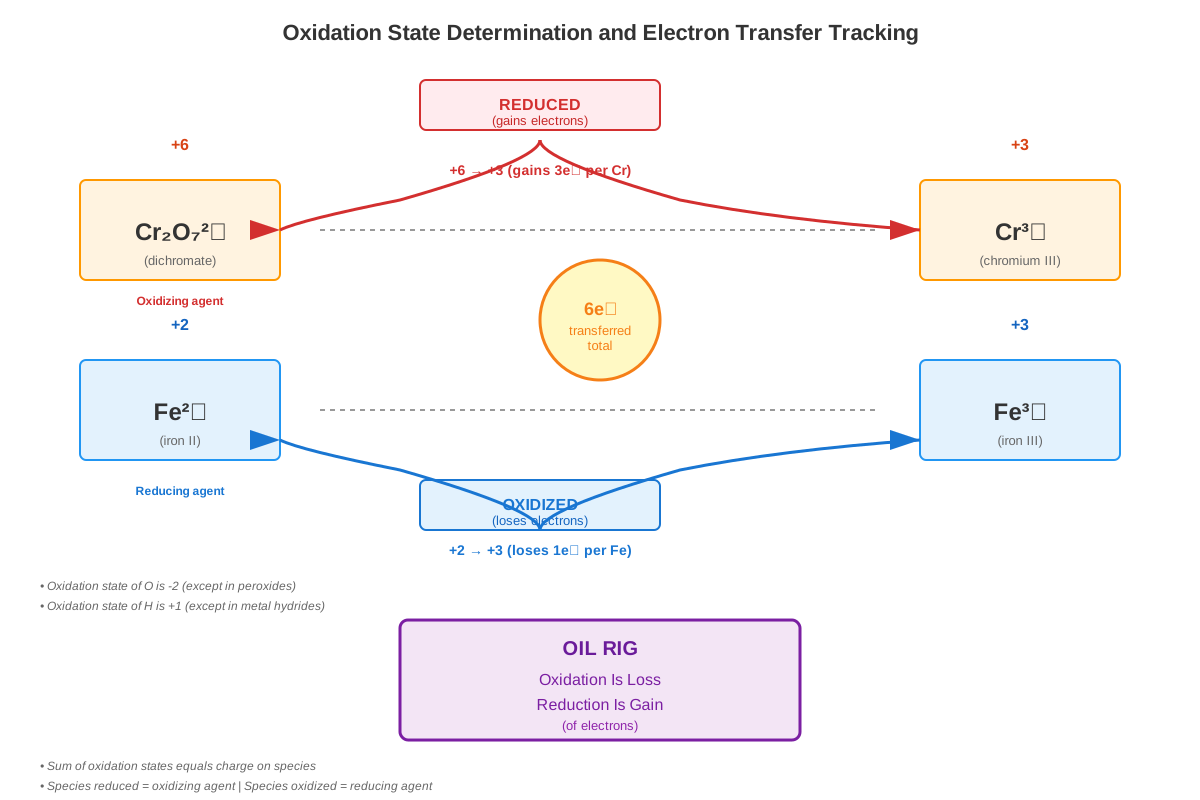
Oxidation is defined as the loss of electrons or an increase in oxidation state, while reduction is the gain of electrons or a decrease in oxidation state. The mnemonic "OIL RIG" (Oxidation Is Loss, Reduction Is Gain) or "LEO the lion says GER" (Loss of Electrons is Oxidation, Gain of Electrons is Reduction) helps students remember these definitions. Every redox reaction consists of two half-reactions: an oxidation half-reaction and a reduction half-reaction, which can be written and balanced separately before being combined.
Oxidation States: The Foundation
Before balancing any redox reaction, students must assign oxidation states (also called oxidation numbers) to all atoms in the reactants and products. Oxidation states follow specific rules:
- Elements in their standard state have oxidation state 0 (e.g., O₂, H₂, Na, Fe)
- Monatomic ions have oxidation states equal to their charge (e.g., Na⁺ = +1, Cl⁻ = -1)
- Oxygen typically has oxidation state -2 (except in peroxides where it's -1, and in OF₂ where it's +2)
- Hydrogen typically has oxidation state +1 (except in metal hydrides where it's -1)
- Alkali metals (Group 1) are always +1; alkaline earth metals (Group 2) are always +2
- Halogens are typically -1 when they're the most electronegative element in the compound
- The sum of oxidation states in a neutral molecule equals 0; in a polyatomic ion, it equals the ion's charge
By comparing oxidation states between reactants and products, students identify which atoms are oxidized (oxidation state increases) and which are reduced (oxidation state decreases).
The Half-Reaction Method: Step-by-Step
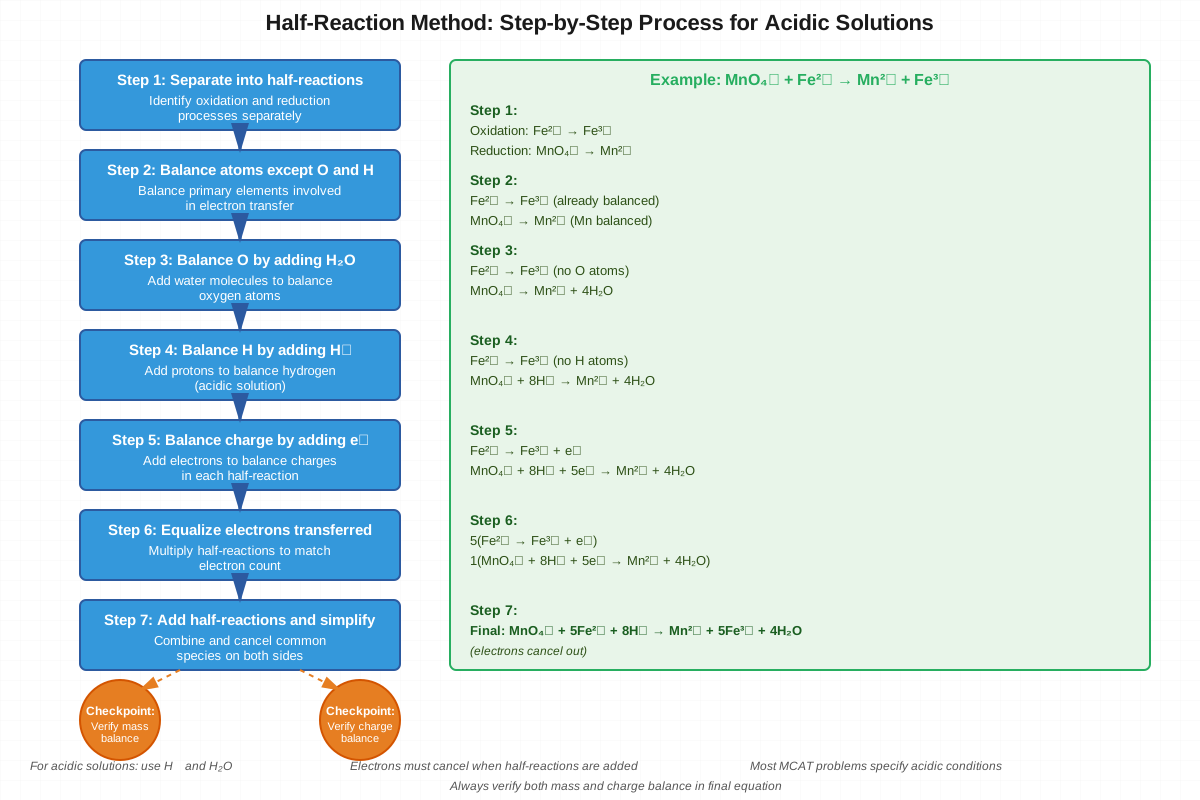
The half-reaction method is the most systematic and MCAT-relevant approach to balancing redox reactions. This method works in both acidic and basic solutions and directly connects to electrochemical cell notation.
Balancing in Acidic Solution
Step 1: Identify and separate the oxidation and reduction half-reactions
- Assign oxidation states to all atoms
- Determine which species is oxidized and which is reduced
- Write separate skeleton equations for each half-reaction
Step 2: Balance all atoms except H and O
- Use stoichiometric coefficients to balance the atoms undergoing redox changes
Step 3: Balance oxygen atoms by adding H₂O
- Add H₂O molecules to the side deficient in oxygen
Step 4: Balance hydrogen atoms by adding H⁺
- Add H⁺ ions to the side deficient in hydrogen (this is why it's called the acidic solution method)
Step 5: Balance charge by adding electrons
- Add electrons (e⁻) to the more positive side to equalize charge on both sides
- The number of electrons equals the change in oxidation state
Step 6: Equalize electrons between half-reactions
- Multiply each half-reaction by appropriate factors so both involve the same number of electrons
Step 7: Add the half-reactions and simplify
- Combine the half-reactions, canceling electrons and any species appearing on both sides
- Verify that atoms and charge are balanced
Balancing in Basic Solution
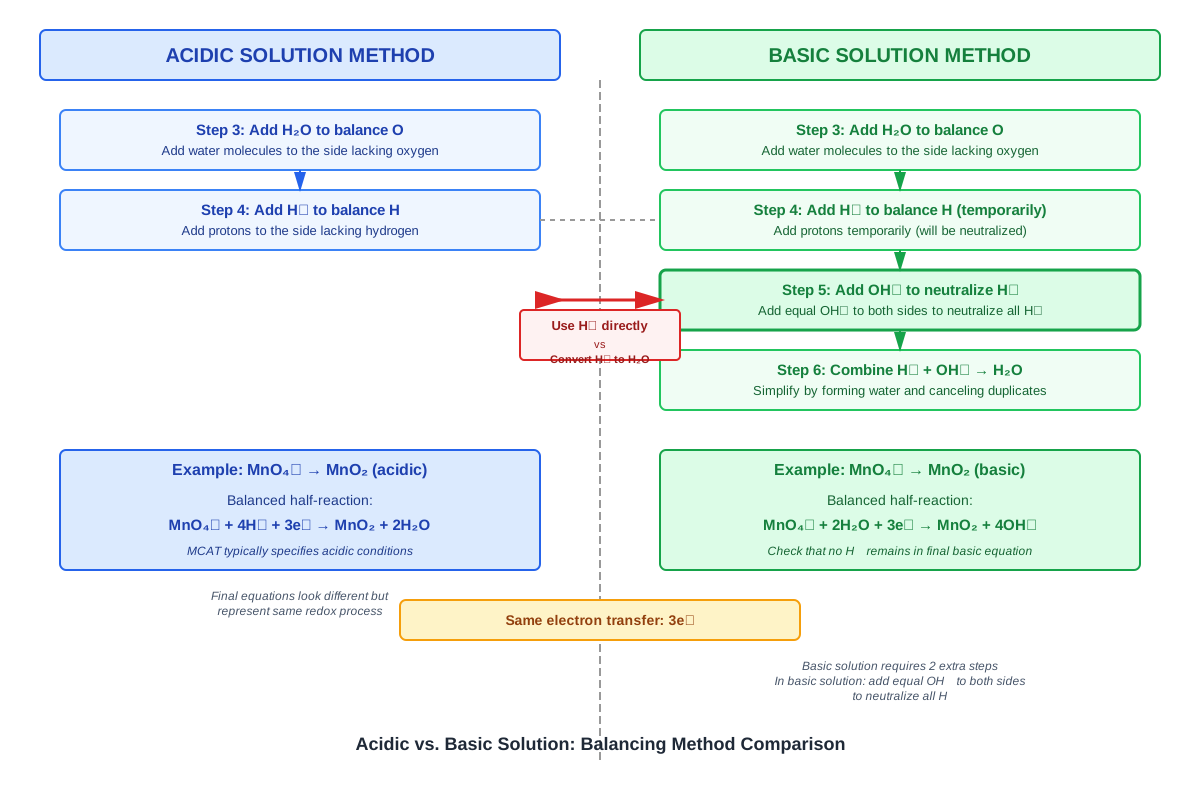
For basic solutions, follow all steps for acidic solution first, then add two additional steps:
Step 8: Add OH⁻ to both sides to neutralize H⁺
- For every H⁺ in the equation, add one OH⁻ to both sides
Step 9: Combine H⁺ and OH⁻ to form H₂O and simplify
- H⁺ + OH⁻ → H₂O
- Cancel any H₂O molecules appearing on both sides
The Oxidation Number Method
The oxidation number method provides an alternative approach that some students find faster for simple reactions. This method focuses on tracking oxidation state changes:
- Assign oxidation states to all atoms in reactants and products
- Identify which atoms change oxidation state and by how much
- Use coefficients to make the total increase in oxidation state equal the total decrease
- Balance remaining atoms by inspection
- Verify charge balance
While faster for simple reactions, this method becomes cumbersome for complex reactions and doesn't directly connect to electrochemical cell calculations, making the half-reaction method generally more valuable for the MCAT.
Electron Transfer and Stoichiometry
The number of electrons transferred in a balanced redox reaction has profound implications for electrochemistry. In electrochemical cells, the balanced equation determines:
- The stoichiometric relationship between reactants and products
- The number of moles of electrons (n) used in the Nernst equation and Faraday's laws
- The theoretical cell potential calculation
- The amount of product formed during electrolysis
For example, in the reaction: Zn(s) + Cu²⁺(aq) → Zn²⁺(aq) + Cu(s), exactly 2 electrons are transferred per zinc atom oxidized. This n = 2 value is essential for calculating cell potential using E°cell and for determining how much copper will deposit during electrolysis.
Identifying Oxidizing and Reducing Agents
In any balanced redox reaction, the oxidizing agent is the species that gets reduced (gains electrons), while the reducing agent is the species that gets oxidized (loses electrons). This seems counterintuitive at first: the oxidizing agent causes oxidation in another species by accepting electrons from it, but in doing so, the oxidizing agent itself is reduced.
For the reaction: 2Fe³⁺ + Sn²⁺ → 2Fe²⁺ + Sn⁴⁺
- Fe³⁺ is the oxidizing agent (it gets reduced from +3 to +2)
- Sn²⁺ is the reducing agent (it gets oxidized from +2 to +4)
Disproportionation Reactions
Disproportionation reactions are special redox reactions where the same element in a single species is simultaneously oxidized and reduced to form two different products. A classic example is:
3Cl₂ + 6OH⁻ → 5Cl⁻ + ClO₃⁻ + 3H₂O
Here, chlorine in Cl₂ (oxidation state 0) is both reduced to Cl⁻ (oxidation state -1) and oxidized to ClO₃⁻ (oxidation state +5). These reactions are less common on the MCAT but represent important chemistry in biological systems (such as hydrogen peroxide disproportionation by catalase).
Concept Relationships
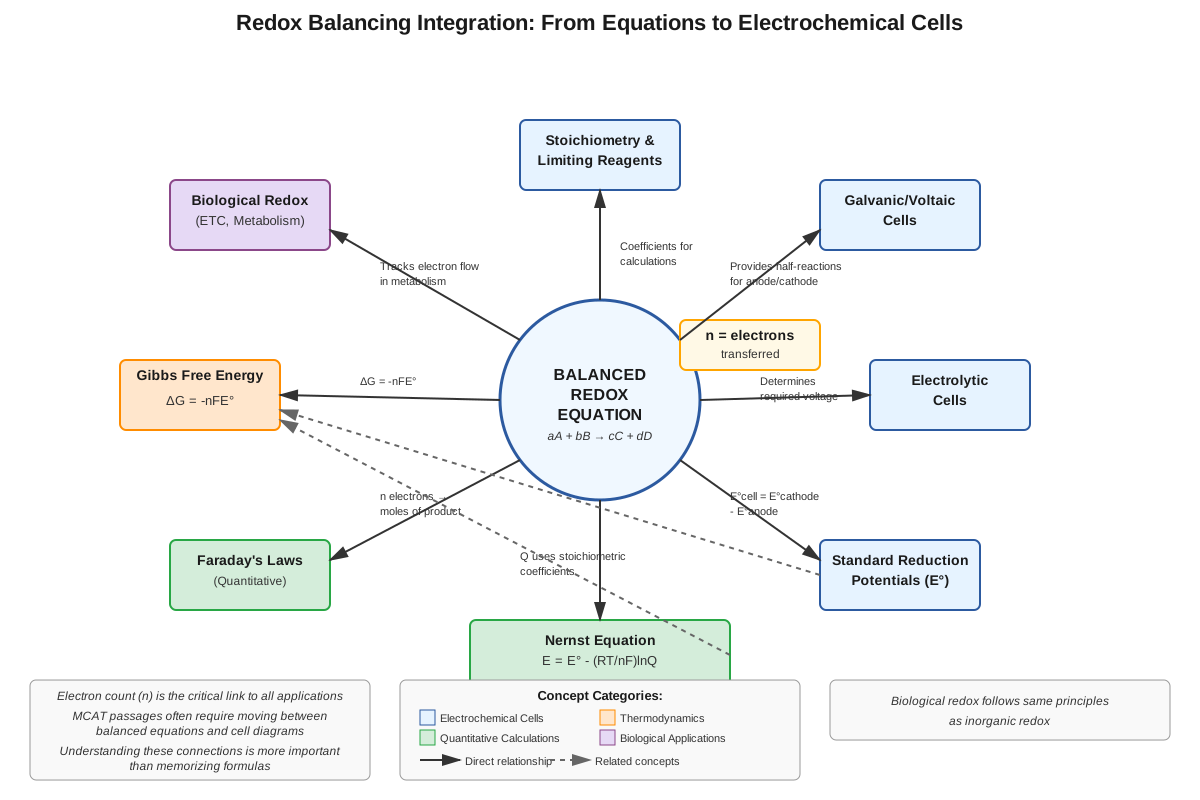
The ability to balance redox reactions serves as the central hub connecting multiple General Chemistry concepts. Oxidation states → provide the foundation for → identifying redox reactions → which enables → writing half-reactions → which directly supports → calculating standard cell potentials → which determines → reaction spontaneity through ΔG° = -nFE°.
Balanced redox equations connect to stoichiometry by determining molar relationships between reactants and products, which then enables limiting reagent calculations in electrochemical contexts. The connection to thermodynamics is profound: the number of electrons transferred (n) in the balanced equation directly appears in both the Nernst equation and the relationship between Gibbs free energy and cell potential.
In biochemistry, balanced redox reactions explain electron transport chain processes, where NADH and FADH₂ serve as reducing agents, transferring electrons through a series of protein complexes. The balancing principles learned in General Chemistry directly apply to understanding how cells extract energy from nutrients through controlled oxidation.
The half-reaction method specifically connects to electrochemical cell notation, where the oxidation half-reaction occurs at the anode and the reduction half-reaction occurs at the cathode. Understanding how to balance these half-reactions separately enables students to interpret cell diagrams and calculate cell potentials from standard reduction potential tables.
Quick check — test yourself on Balancing redox reactions so far.
Try Flashcards →High-Yield Facts
⭐ In acidic solution, balance O with H₂O and H with H⁺; in basic solution, add OH⁻ to neutralize H⁺ after balancing in acidic conditions
⭐ The number of electrons in a balanced half-reaction equals the change in oxidation state multiplied by the number of atoms changing
⭐ The oxidizing agent is the species that gets reduced; the reducing agent is the species that gets oxidized
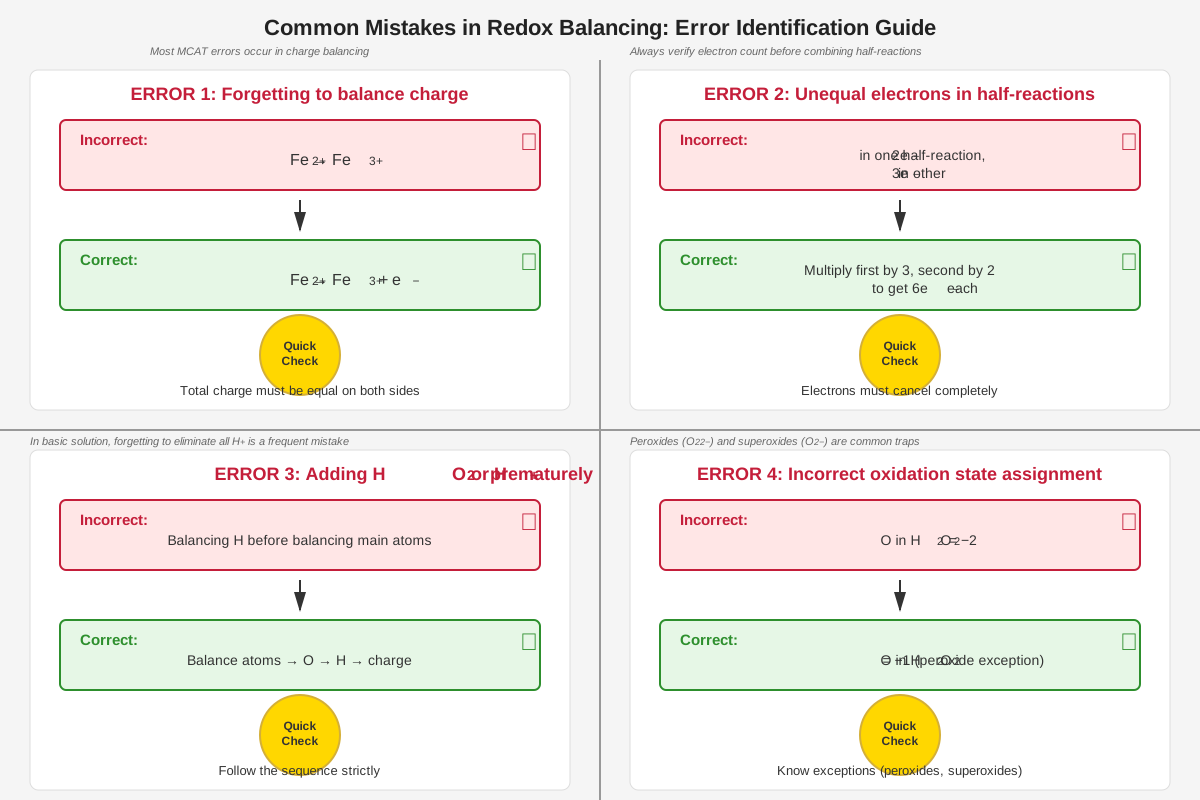
⭐ Electrons must NEVER appear in the final balanced equation—they must cancel completely when half-reactions are combined
⭐ In a balanced redox equation, both mass (atoms) and charge must be conserved on both sides
- Oxygen typically has oxidation state -2, but -1 in peroxides (H₂O₂, Na₂O₂) and +2 in OF₂
- Hydrogen typically has oxidation state +1, but -1 in metal hydrides (NaH, CaH₂)
- The sum of oxidation states in a neutral compound equals zero; in a polyatomic ion, it equals the ion's charge
- Disproportionation reactions involve the same element being simultaneously oxidized and reduced
- Spectator ions do not participate in redox reactions and should be omitted from net ionic equations
- The half-reaction method is preferred for complex reactions and directly connects to electrochemical cell calculations
- When multiplying half-reactions to equalize electrons, multiply ALL species in the half-reaction, including H₂O and H⁺
- Transition metals commonly exhibit multiple oxidation states and frequently participate in redox reactions
- The oxidation state of an element in its standard state is always zero (O₂, N₂, Fe, etc.)
- Balancing redox reactions in basic solution always starts with the acidic solution method, then converts H⁺ to H₂O using OH⁻
Common Misconceptions
Misconception: The oxidizing agent is the species that gets oxidized.
Correction: The oxidizing agent is the species that gets REDUCED (gains electrons). It causes oxidation in another species by accepting electrons from it. The reducing agent is the species that gets oxidized.
Misconception: Electrons can appear in the final balanced equation.
Correction: Electrons must cancel completely when half-reactions are combined. If electrons remain in the final equation, the half-reactions were not properly equalized or combined. Electrons are transferred, not created or destroyed.
Misconception: When balancing in basic solution, add OH⁻ instead of H⁺ in Step 4.
Correction: Always balance as if in acidic solution first (using H⁺), then convert to basic conditions by adding OH⁻ to neutralize all H⁺. Trying to balance directly in basic solution leads to errors and confusion.
Misconception: The coefficient in front of a polyatomic ion affects the oxidation state of atoms within it.
Correction: Oxidation states are assigned to individual atoms based on the compound's formula, not the stoichiometric coefficient. For example, in 2MnO₄⁻, each Mn still has oxidation state +7, regardless of the coefficient 2.
Misconception: Charge balance means both sides must have zero charge.
Correction: Charge balance means both sides must have the SAME total charge, which may be positive, negative, or zero. For example, in Fe²⁺ + Ce⁴⁺ → Fe³⁺ + Ce³⁺, both sides have a total charge of +6.
Misconception: All reactions involving oxygen are redox reactions.
Correction: Only reactions where oxidation states change are redox reactions. Acid-base reactions like HCl + NaOH → NaCl + H₂O involve no oxidation state changes and are not redox reactions, despite containing oxygen.
Misconception: The species with the higher oxidation state is always the oxidizing agent.
Correction: The oxidizing agent is determined by what gets reduced during the reaction, not by initial oxidation state. A species with a high oxidation state might not change at all and thus wouldn't be the oxidizing agent.
Worked Examples
Example 1: Balancing in Acidic Solution
Problem: Balance the following redox reaction in acidic solution:
MnO₄⁻ + Fe²⁺ → Mn²⁺ + Fe³⁺
Solution:
Step 1: Identify oxidation and reduction
- Mn: +7 → +2 (reduction, gain of 5 electrons)
- Fe: +2 → +3 (oxidation, loss of 1 electron)
Reduction half-reaction: MnO₄⁻ → Mn²⁺
Oxidation half-reaction: Fe²⁺ → Fe³⁺
Step 2: Balance atoms except H and O
Both half-reactions already have atoms balanced.
Step 3: Balance O with H₂O
Reduction: MnO₄⁻ → Mn²⁺ + 4H₂O
Step 4: Balance H with H⁺
Reduction: MnO₄⁻ + 8H⁺ → Mn²⁺ + 4H₂O
Step 5: Balance charge with electrons
Reduction: MnO₄⁻ + 8H⁺ + 5e⁻ → Mn²⁺ + 4H₂O
(Left side: -1 + 8 - 5 = +2; Right side: +2 ✓)
Oxidation: Fe²⁺ → Fe³⁺ + e⁻
(Left side: +2; Right side: +3 - 1 = +2 ✓)
Step 6: Equalize electrons
Multiply oxidation half-reaction by 5:
5Fe²⁺ → 5Fe³⁺ + 5e⁻
Step 7: Add and simplify
MnO₄⁻ + 8H⁺ + 5e⁻ → Mn²⁺ + 4H₂O
5Fe²⁺ → 5Fe³⁺ + 5e⁻
_________________________________
MnO₄⁻ + 5Fe²⁺ + 8H⁺ → Mn²⁺ + 5Fe³⁺ + 4H₂O
Verification:
- Atoms: 1 Mn, 4 O, 5 Fe, 8 H on both sides ✓
- Charge: (-1) + 5(+2) + 8(+1) = +17 on left; (+2) + 5(+3) = +17 on right ✓
Connection to learning objectives: This example demonstrates the systematic half-reaction method, shows how to identify oxidizing agent (MnO₄⁻, which gets reduced) and reducing agent (Fe²⁺, which gets oxidized), and illustrates the importance of balancing both mass and charge.
Example 2: Balancing in Basic Solution
Problem: Balance the following redox reaction in basic solution:
Cr(OH)₃ + ClO⁻ → CrO₄²⁻ + Cl⁻
Solution:
Steps 1-7: Balance in acidic solution first
Oxidation: Cr(OH)₃ → CrO₄²⁻
- Cr: +3 → +6 (loss of 3 electrons)
- Balance O: Cr(OH)₃ + H₂O → CrO₄²⁻
- Balance H: Cr(OH)₃ + H₂O → CrO₄²⁻ + 5H⁺
- Balance charge: Cr(OH)₃ + H₂O → CrO₄²⁻ + 5H⁺ + 3e⁻
Reduction: ClO⁻ → Cl⁻
- Cl: +1 → -1 (gain of 2 electrons)
- Balance O: ClO⁻ → Cl⁻ + H₂O
- Balance H: ClO⁻ + 2H⁺ → Cl⁻ + H₂O
- Balance charge: ClO⁻ + 2H⁺ + 2e⁻ → Cl⁻ + H₂O
Equalize electrons (LCM of 3 and 2 is 6):
2[Cr(OH)₃ + H₂O → CrO₄²⁻ + 5H⁺ + 3e⁻]
3[ClO⁻ + 2H⁺ + 2e⁻ → Cl⁻ + H₂O]
Combined:
2Cr(OH)₃ + 2H₂O + 3ClO⁻ + 6H⁺ → 2CrO₄²⁻ + 10H⁺ + 3Cl⁻ + 3H₂O
Simplify:
2Cr(OH)₃ + 3ClO⁻ → 2CrO₄²⁻ + 4H⁺ + 3Cl⁻ + H₂O
Step 8: Add OH⁻ to neutralize H⁺
Add 4OH⁻ to both sides:
2Cr(OH)₃ + 3ClO⁻ + 4OH⁻ → 2CrO₄²⁻ + 4H⁺ + 3Cl⁻ + H₂O + 4OH⁻
Step 9: Combine H⁺ and OH⁻ to form H₂O
4H⁺ + 4OH⁻ → 4H₂O
2Cr(OH)₃ + 3ClO⁻ + 4OH⁻ → 2CrO₄²⁻ + 3Cl⁻ + H₂O + 4H₂O
Final answer:
2Cr(OH)₃ + 3ClO⁻ + 4OH⁻ → 2CrO₄²⁻ + 3Cl⁻ + 5H₂O
Verification:
- Atoms: 2 Cr, 14 O, 10 H, 3 Cl on both sides ✓
- Charge: 0 + 3(-1) + 4(-1) = -7 on left; 2(-2) + 3(-1) = -7 on right ✓
Connection to learning objectives: This example shows the complete process for basic solutions, demonstrates that basic solution balancing always starts with acidic conditions, and reinforces the importance of systematic simplification.
Exam Strategy
When approaching balancing redox reactions questions on the MCAT, time management is critical. Allocate approximately 2-3 minutes for straightforward balancing problems and up to 4 minutes for complex problems embedded in passages. The MCAT rarely asks students to balance extremely complex reactions; instead, it tests whether students can execute the method correctly and connect balanced equations to electrochemical calculations.
Trigger words and phrases that signal redox balancing questions include: "balance the following equation," "write the half-reactions," "identify the oxidizing agent," "how many electrons are transferred," "in acidic/basic solution," and "determine the stoichiometric coefficient." When a passage describes an electrochemical cell or redox titration, expect at least one question requiring equation balancing or half-reaction identification.
Process-of-elimination strategies: If answer choices show different stoichiometric coefficients, quickly check charge balance—this eliminates 50-75% of wrong answers immediately. If choices differ in the presence of H⁺, OH⁻, or H₂O, determine whether the reaction occurs in acidic or basic solution. For questions asking about oxidizing/reducing agents, eliminate any answer that confuses which species gets oxidized versus reduced.
Time-saving techniques: For simple reactions, use the oxidation number method to save 30-60 seconds. For complex reactions or when connecting to electrochemistry, use the half-reaction method. Always verify charge balance before selecting an answer—this takes 5 seconds and prevents careless errors. If stuck, move on and return later; balancing problems don't provide information needed for other questions.
Common question formats: (1) Direct balancing: "Balance the following equation in acidic solution"; (2) Identification: "Which species is the reducing agent?"; (3) Quantitative: "How many moles of electrons are transferred when 2 moles of X react?"; (4) Conceptual: "Which half-reaction occurs at the anode?"; (5) Application: "Based on the balanced equation, calculate the cell potential."
Exam Tip: If a question asks for the number of electrons transferred, balance the equation first, then look at the coefficient of the species being oxidized or reduced and multiply by the change in oxidation state per atom.
Memory Techniques
OIL RIG: Oxidation Is Loss (of electrons), Reduction Is Gain (of electrons)
LEO the lion says GER: Loss of Electrons is Oxidation, Gain of Electrons is Reduction
AN OX and RED CAT: Anode is where Oxidation occurs; Cathode is where Reduction occurs (also useful for electrochemistry)
For the half-reaction method sequence, use "OBHCE" (pronounced "obey"):
- Other atoms (balance atoms except H and O)
- Balance oxygen with H₂O
- Hydrogen with H⁺
- Charge with electrons
- Equalize electrons between half-reactions
For oxidation state rules, remember "HOOF":
- Hydrogen is +1 (except metal hydrides)
- Oxygen is -2 (except peroxides and OF₂)
- One (Group 1) is +1
- Fluorine is always -1
Visualization strategy: Picture electrons as physical objects being handed from the reducing agent to the oxidizing agent. The species giving away electrons (reducing agent) becomes more positive (oxidized), while the species receiving electrons (oxidizing agent) becomes more negative (reduced). This concrete visualization prevents confusion about which agent does what.
For basic solution conversion: Remember "Add OH⁻ to both sides, then make water on the H⁺ side." Visualize neutralizing acid (H⁺) with base (OH⁻) to form water—this is literally an acid-base reaction happening within your redox equation.
Summary
Balancing redox reactions is a systematic, algorithmic skill that integrates oxidation state determination, electron transfer tracking, and stoichiometric principles. The half-reaction method provides the most reliable approach: separate oxidation and reduction processes, balance atoms and charge independently, equalize electrons, then combine. For acidic solutions, use H₂O to balance oxygen and H⁺ to balance hydrogen; for basic solutions, complete the acidic balancing first, then neutralize H⁺ with OH⁻ to form H₂O. Every balanced redox equation must conserve both mass and charge, with electrons canceling completely in the final equation. The oxidizing agent is the species that gets reduced (gains electrons), while the reducing agent is the species that gets oxidized (loses electrons). This skill directly enables electrochemical cell calculations, connects to biological electron transport processes, and appears frequently on the MCAT in both computational and conceptual contexts. Mastery requires understanding the underlying principles, practicing the systematic method, and recognizing common patterns in oxidation state changes.
Key Takeaways
- The half-reaction method (balance atoms → O with H₂O → H with H⁺ → charge with e⁻ → equalize electrons → combine) is the most systematic and MCAT-relevant approach to balancing redox reactions
- Oxidation states must be assigned correctly to identify which species are oxidized (oxidation state increases) and reduced (oxidation state decreases)
- The oxidizing agent gets reduced; the reducing agent gets oxidized—this counterintuitive relationship is frequently tested
- Both mass (atoms) and charge must be balanced; electrons must cancel completely in the final equation
- Basic solution balancing always starts with acidic solution method, then converts H⁺ to H₂O using OH⁻
- The number of electrons transferred (n) in the balanced equation directly connects to electrochemical calculations (Nernst equation, Faraday's laws, cell potential)
- Common errors include forgetting to multiply all species when equalizing electrons, confusing oxidizing and reducing agents, and attempting to balance directly in basic solution
Related Topics
Standard Reduction Potentials and Cell Potential Calculations: Balanced half-reactions enable calculation of E°cell using standard reduction potential tables; mastering redox balancing is prerequisite for predicting reaction spontaneity and calculating equilibrium constants from electrochemical data.
Galvanic and Electrolytic Cells: Understanding which half-reaction occurs at each electrode requires the ability to write and balance half-reactions; cell notation directly represents the balanced oxidation and reduction processes.
Faraday's Laws of Electrolysis: Quantitative relationships between charge, moles of electrons, and mass of products deposited depend on correctly balanced equations to determine the value of n (moles of electrons per mole of reactant).
Biological Oxidation-Reduction: Metabolic pathways including glycolysis, citric acid cycle, and electron transport chain involve redox reactions with NAD⁺/NADH and FAD/FADH₂; balancing these reactions reveals energy transfer mechanisms.
Thermodynamics and Gibbs Free Energy: The relationship ΔG° = -nFE° directly connects balanced redox equations (which provide n) to thermodynamic spontaneity predictions.
Practice CTA
Now that you've mastered the systematic approach to balancing redox reactions, it's time to solidify your understanding through active practice. Attempt the practice questions and flashcards associated with this topic, focusing on executing the half-reaction method efficiently and accurately. Challenge yourself with both acidic and basic solution problems, and pay special attention to identifying oxidizing and reducing agents—this conceptual understanding separates top scorers from average performers. Remember, balancing redox reactions is a skill that improves dramatically with deliberate practice. Each problem you solve strengthens your pattern recognition and speeds up your execution, giving you a significant advantage on test day. You've got this!
Sign up free to keep reading
Create a free AnvayaPrep account to finish this MCAT guide on Balancing redox reactions — plus flashcards and practice questions.