Overview
Balancing chemical equations is a foundational skill in General Chemistry that represents the law of conservation of mass in symbolic form. Every chemical reaction must account for all atoms present in the reactants and products, ensuring that matter is neither created nor destroyed during the transformation. For the MCAT, this skill extends far beyond simple arithmetic—it serves as the gateway to stoichiometric calculations, limiting reagent problems, thermochemical equations, and electrochemistry. The ability to rapidly and accurately balance equations under timed conditions is essential for success on Chemical and Physical Foundations of Biological Systems passages.
Balancing chemical equations MCAT questions appear both as discrete items and embedded within complex passages involving metabolic pathways, combustion analysis, redox reactions, and acid-base chemistry. The MCAT tests not only mechanical balancing ability but also conceptual understanding of what balanced equations reveal about reaction stoichiometry, molar relationships, and energy changes. Students who master this topic gain efficiency in solving multi-step problems and avoid cascading errors that originate from incorrectly balanced starting equations.
Within the broader context of Stoichiometry and Reactions, balancing equations represents the critical first step before any quantitative analysis can proceed. This topic connects directly to mole-to-mole conversions, percent yield calculations, solution stoichiometry, gas law applications, and thermodynamic calculations. Understanding the principles behind equation balancing also reinforces atomic theory, molecular formulas, and the particulate nature of matter—concepts that appear throughout the MCAT's chemistry and biochemistry sections.
Learning Objectives
- [ ] Define balancing chemical equations using accurate General Chemistry terminology
- [ ] Explain why balancing chemical equations matters for the MCAT
- [ ] Apply balancing chemical equations to exam-style questions
- [ ] Identify common mistakes related to balancing chemical equations
- [ ] Connect balancing chemical equations to related General Chemistry concepts
- [ ] Balance complex equations involving polyatomic ions and fractional coefficients within 90 seconds
- [ ] Determine the stoichiometric coefficients for redox reactions using both inspection and half-reaction methods
- [ ] Predict the physical states and reaction conditions from balanced equation context
Prerequisites
- Atomic structure and the periodic table: Understanding element symbols, atomic mass, and valence electrons is essential for recognizing which atoms must be balanced and how they combine in compounds
- Chemical formulas and nomenclature: The ability to interpret subscripts in molecular formulas (e.g., distinguishing between 2H₂O and H₂O₂) prevents fundamental errors in atom counting
- Basic arithmetic and algebraic manipulation: Balancing equations requires finding integer coefficients that satisfy multiple simultaneous constraints, often through systematic trial or algebraic methods
- States of matter notation: Recognizing (s), (l), (g), and (aq) designations helps contextualize reactions and connects to solubility rules and phase changes
Why This Topic Matters
Clinical and Real-World Significance: Balanced chemical equations underpin pharmaceutical dosing calculations, metabolic pathway analysis, and understanding physiological processes like cellular respiration and photosynthesis. Medical professionals use stoichiometric principles when calculating drug formulations, interpreting arterial blood gas results, and understanding acid-base disturbances. For example, the bicarbonate buffer system (H₂CO₃ ⇌ H⁺ + HCO₃⁻) must be properly balanced to calculate pH changes in respiratory and metabolic disorders.
Exam Statistics: Approximately 15-20% of General Chemistry questions on the MCAT involve stoichiometric calculations that require correctly balanced equations as the starting point. While pure balancing questions are relatively rare (2-3% of chemistry items), incorrectly balanced equations lead to wrong answers in limiting reagent problems, thermochemistry calculations, and electrochemistry questions. The Chemical and Physical Foundations section frequently embeds balancing within passages about combustion analysis, titrations, and biochemical pathways.
Common Exam Appearances: The MCAT presents balancing challenges in several formats: (1) combustion reactions requiring students to balance hydrocarbon oxidation; (2) redox reactions in electrochemical cells where half-reactions must be balanced and combined; (3) acid-base neutralization reactions in titration passages; (4) biochemical equations like glycolysis or the citric acid cycle where ATP stoichiometry matters; (5) nuclear equations requiring mass and charge balance. Passages often provide unbalanced equations and expect students to balance them mentally before proceeding with calculations.
Core Concepts
The Law of Conservation of Mass
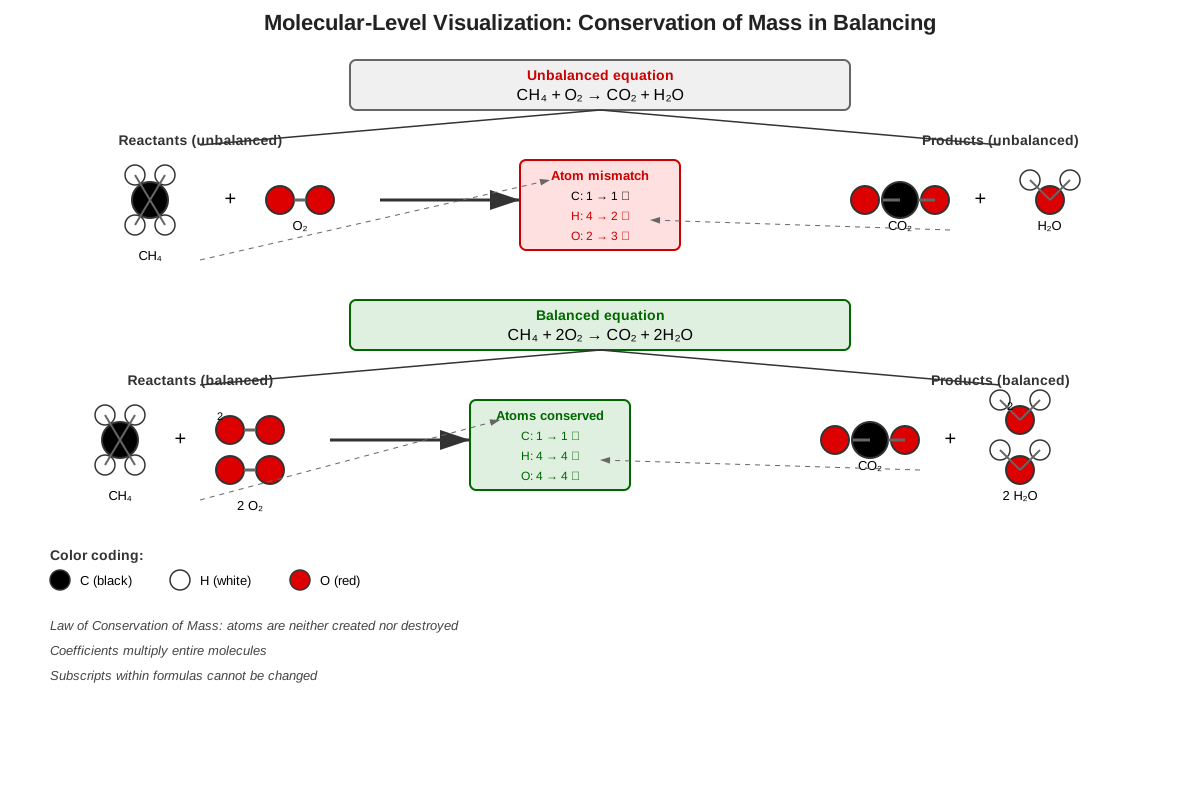
The fundamental principle underlying balancing chemical equations is the law of conservation of mass, which states that matter cannot be created or destroyed in ordinary chemical reactions. This law, established by Antoine Lavoisier in the 18th century, means that the total mass of reactants must equal the total mass of products. At the atomic level, this translates to a simple rule: the number of atoms of each element must be identical on both sides of the equation.
A chemical equation uses chemical formulas and symbols to represent a chemical reaction. The substances on the left side are reactants (starting materials), while those on the right are products (substances formed). The arrow (→ or ⇌) indicates the direction of reaction. Stoichiometric coefficients are the numbers placed before chemical formulas to indicate the relative amounts of each substance involved in the reaction.
The Balancing Process: Systematic Approach
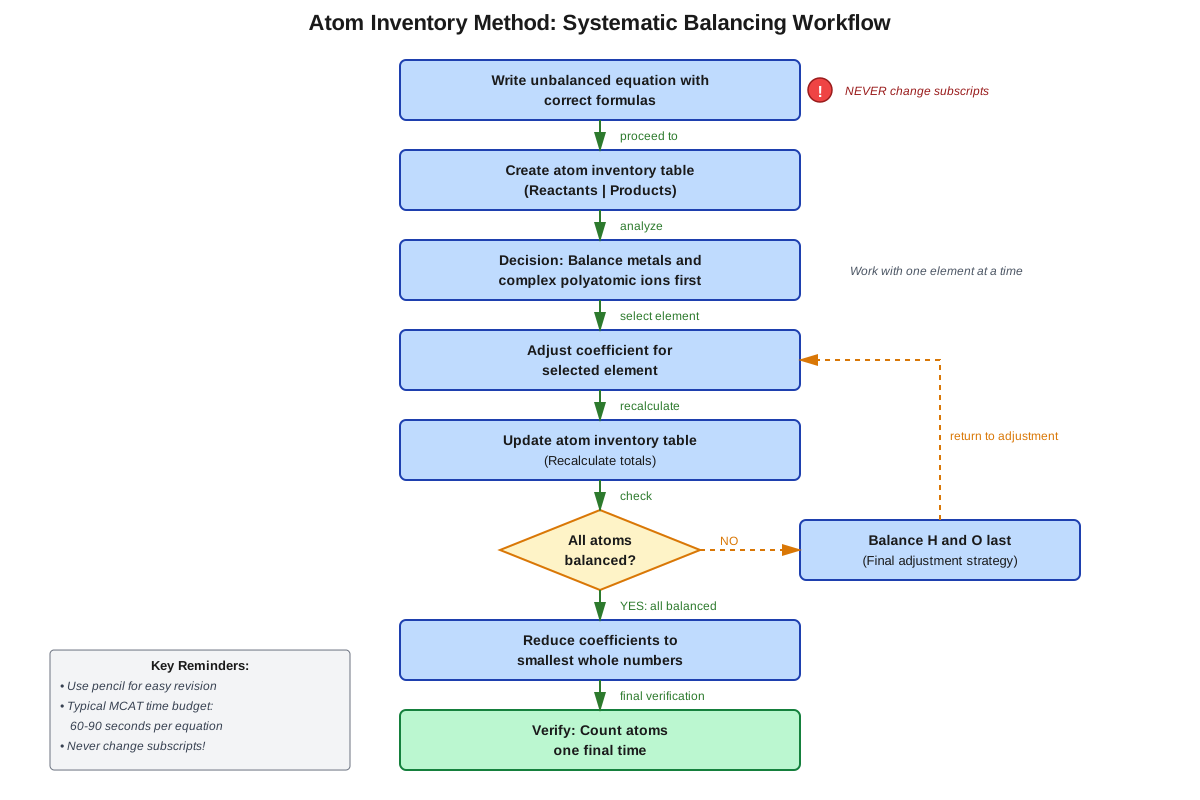
Balancing chemical equations General Chemistry follows a systematic methodology:
- Write the unbalanced equation with correct chemical formulas for all reactants and products (never change subscripts within formulas—only adjust coefficients)
- Count atoms of each element on both sides of the equation, creating an inventory
- Identify the most complex molecule (usually the one with the most elements or atoms) and assign it a coefficient of 1 initially
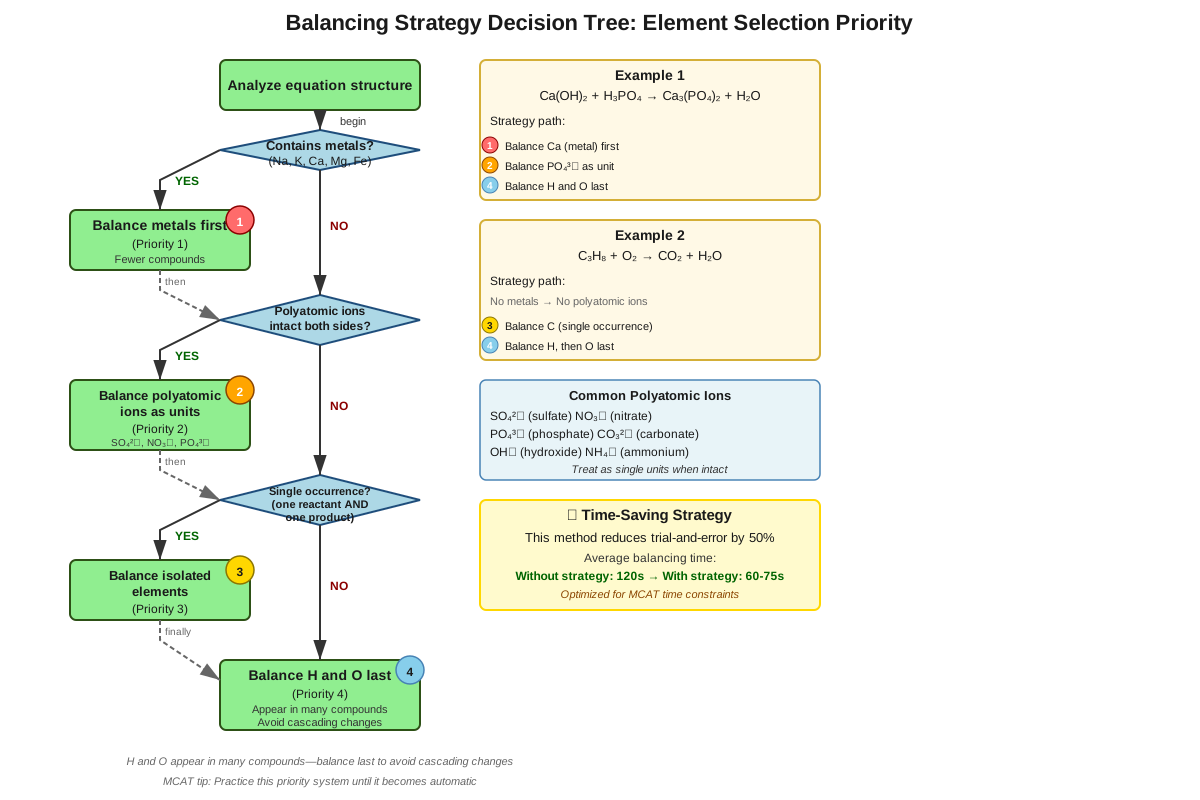
- Balance elements that appear in only one reactant and one product first, working from most complex to simplest
- Balance polyatomic ions as units when they appear unchanged on both sides (e.g., SO₄²⁻, NO₃⁻, PO₄³⁻)
- Save hydrogen and oxygen for last as they often appear in multiple compounds
- Use fractional coefficients temporarily if needed, then multiply all coefficients by the common denominator to obtain whole numbers
- Verify the final balance by recounting all atoms and checking that coefficients are in the lowest whole-number ratio
Balancing by Inspection
The inspection method (also called trial-and-error method) works well for simple equations. Consider the combustion of propane:
C₃H₈ + O₂ → CO₂ + H₂O (unbalanced)Step-by-step solution:
- Carbon: 3 C atoms on left, so need 3 CO₂ on right: C₃H₈ + O₂ → 3CO₂ + H₂O
- Hydrogen: 8 H atoms on left, so need 4 H₂O on right: C₃H₈ + O₂ → 3CO₂ + 4H₂O
- Oxygen: Right side has (3×2) + (4×1) = 10 O atoms, so need 5 O₂: C₃H₈ + 5O₂ → 3CO₂ + 4H₂O
- Verification: Left (3 C, 8 H, 10 O) = Right (3 C, 8 H, 10 O) ✓
Balancing Complex Equations with Polyatomic Ions
When polyatomic ions remain intact through a reaction, treat them as single units rather than balancing individual atoms. Consider the reaction between calcium hydroxide and phosphoric acid:
Ca(OH)₂ + H₃PO₄ → Ca₃(PO₄)₂ + H₂O (unbalanced)Strategic approach:
- Treat PO₄³⁻ as a unit: 2 phosphate groups on right, so need 2 H₃PO₄ on left
- Ca(OH)₂ + 2H₃PO₄ → Ca₃(PO₄)₂ + H₂O
- Calcium: 3 Ca on right, so need 3 Ca(OH)₂ on left
- 3Ca(OH)₂ + 2H₃PO₄ → Ca₃(PO₄)₂ + H₂O
- Hydrogen: Left has (3×2) + (2×3) = 12 H, so need 6 H₂O on right
- Final balanced equation: 3Ca(OH)₂ + 2H₃PO₄ → Ca₃(PO₄)₂ + 6H₂O
Balancing Redox Reactions
Oxidation-reduction reactions require special attention because both mass and charge must be balanced. The half-reaction method is particularly useful for complex redox equations, especially in acidic or basic solutions.
Half-reaction method steps:
- Separate the equation into oxidation and reduction half-reactions
- Balance all elements except O and H
- Balance O by adding H₂O
- Balance H by adding H⁺ (acidic) or OH⁻ (basic)
- Balance charge by adding electrons (e⁻)
- Multiply half-reactions to equalize electrons transferred
- Add half-reactions and cancel species appearing on both sides
Example: Balance the reaction between permanganate and iron(II) in acidic solution:
MnO₄⁻ + Fe²⁺ → Mn²⁺ + Fe³⁺ (acidic solution)Reduction half-reaction:
- MnO₄⁻ → Mn²⁺
- Balance O: MnO₄⁻ → Mn²⁺ + 4H₂O
- Balance H: MnO₄⁻ + 8H⁺ → Mn²⁺ + 4H₂O
- Balance charge: MnO₄⁻ + 8H⁺ + 5e⁻ → Mn²⁺ + 4H₂O
Oxidation half-reaction:
- Fe²⁺ → Fe³⁺ + e⁻
Combine (multiply oxidation by 5):
- MnO₄⁻ + 8H⁺ + 5Fe²⁺ → Mn²⁺ + 5Fe³⁺ + 4H₂O
Fractional Coefficients and Simplification
Sometimes using fractional coefficients initially simplifies the balancing process. Consider ethanol combustion:
C₂H₅OH + O₂ → CO₂ + H₂OBalancing C and H first: C₂H₅OH + O₂ → 2CO₂ + 3H₂O
Oxygen count: Right side has (2×2) + (3×1) = 7 O atoms, requiring 7/2 O₂:
C₂H₅OH + 7/2 O₂ → 2CO₂ + 3H₂O
Multiply all coefficients by 2 to clear the fraction:
2C₂H₅OH + 7O₂ → 4CO₂ + 6H₂O
Special Cases and Considerations
| Situation | Approach | Example |
|---|---|---|
| Diatomic elements | Remember O₂, H₂, N₂, F₂, Cl₂, Br₂, I₂ exist as molecules | 2H₂ + O₂ → 2H₂O |
| Hydrates | Balance the compound and water separately | CuSO₄·5H₂O → CuSO₄ + 5H₂O |
| Combustion | Balance C, then H, then O last | CₓHᵧ + O₂ → CO₂ + H₂O |
| Decomposition | Often produces multiple products from one reactant | 2KClO₃ → 2KCl + 3O₂ |
| Synthesis | Multiple reactants combine to one product | 2Mg + O₂ → 2MgO |
Concept Relationships
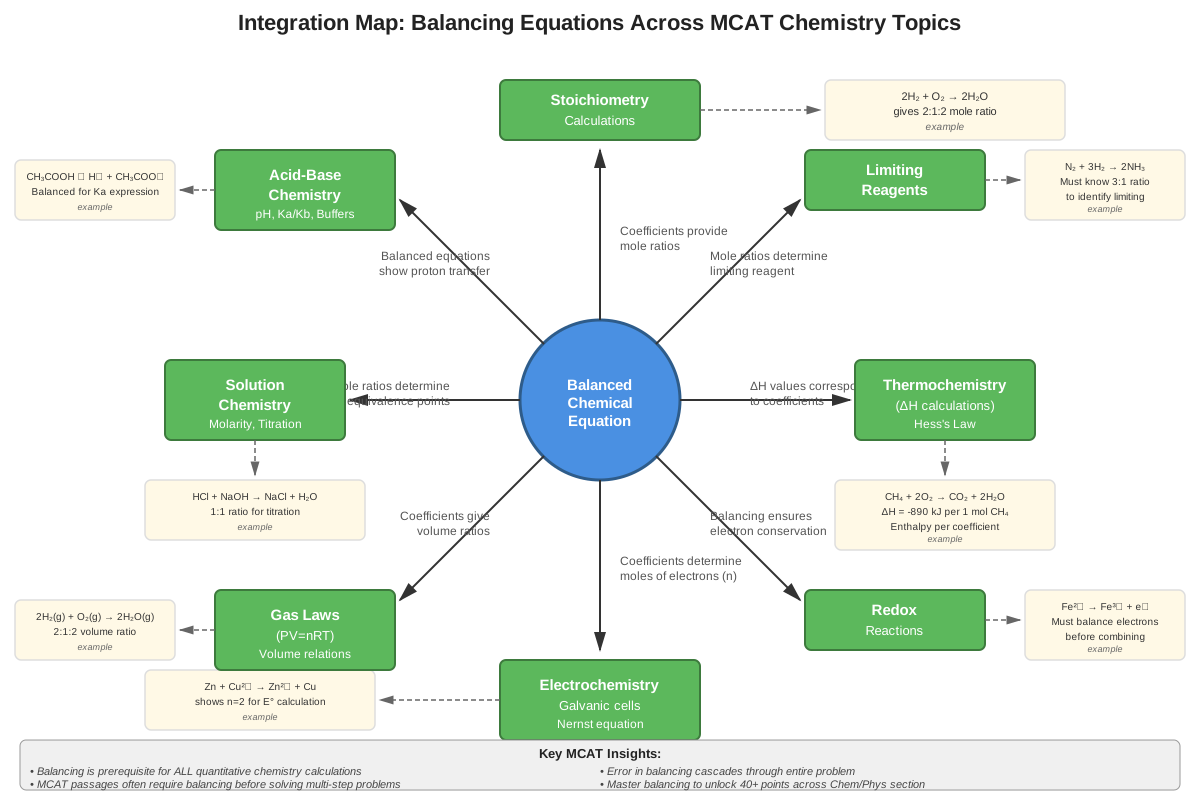
Balancing chemical equations serves as the foundational skill that enables all quantitative stoichiometry. The relationship flows as follows:
Balanced Equation → Mole Ratios → Mass Relationships → Limiting Reagents → Percent Yield
The stoichiometric coefficients in a balanced equation directly establish the mole-to-mole ratios between reactants and products. For example, in 2H₂ + O₂ → 2H₂O, the coefficients tell us that 2 moles of hydrogen react with 1 mole of oxygen to produce 2 moles of water. These ratios become conversion factors in dimensional analysis problems.
Connection to Thermochemistry: Balanced equations are essential for thermochemical equations where enthalpy changes (ΔH) correspond to the specific stoichiometric coefficients shown. Doubling all coefficients doubles the enthalpy change. The equation CH₄ + 2O₂ → CO₂ + 2H₂O (ΔH = -890 kJ) indicates that 890 kJ is released per mole of methane combusted.
Connection to Electrochemistry: In galvanic and electrolytic cells, balanced redox equations reveal the number of electrons transferred, which directly relates to cell potential calculations and Faraday's laws. The balanced equation determines the stoichiometry for calculating theoretical yields in electrolysis.
Connection to Gas Laws: When reactions involve gases, balanced equations combined with ideal gas law principles allow calculation of volumes, pressures, and temperatures. The coefficients represent volume ratios for gases at constant temperature and pressure (Avogadro's law).
Connection to Solution Stoichiometry: In titration problems, balanced equations establish the equivalence point relationships. For example, knowing that H₂SO₄ + 2NaOH → Na₂SO₄ + 2H₂O reveals that one mole of sulfuric acid neutralizes two moles of sodium hydroxide.
Connection to Biochemistry: Metabolic pathways like glycolysis and cellular respiration require balanced equations to track ATP production, electron carriers (NADH, FADH₂), and carbon flow through intermediates. The overall equation for cellular respiration (C₆H₁₂O₆ + 6O₂ → 6CO₂ + 6H₂O) must be balanced to calculate respiratory quotients and energy yields.
Quick check — test yourself on Balancing chemical equations so far.
Try Flashcards →High-Yield Facts
⭐ The law of conservation of mass requires that the number of atoms of each element must be equal on both sides of a balanced chemical equation
⭐ Stoichiometric coefficients represent mole ratios and can be used as conversion factors in dimensional analysis
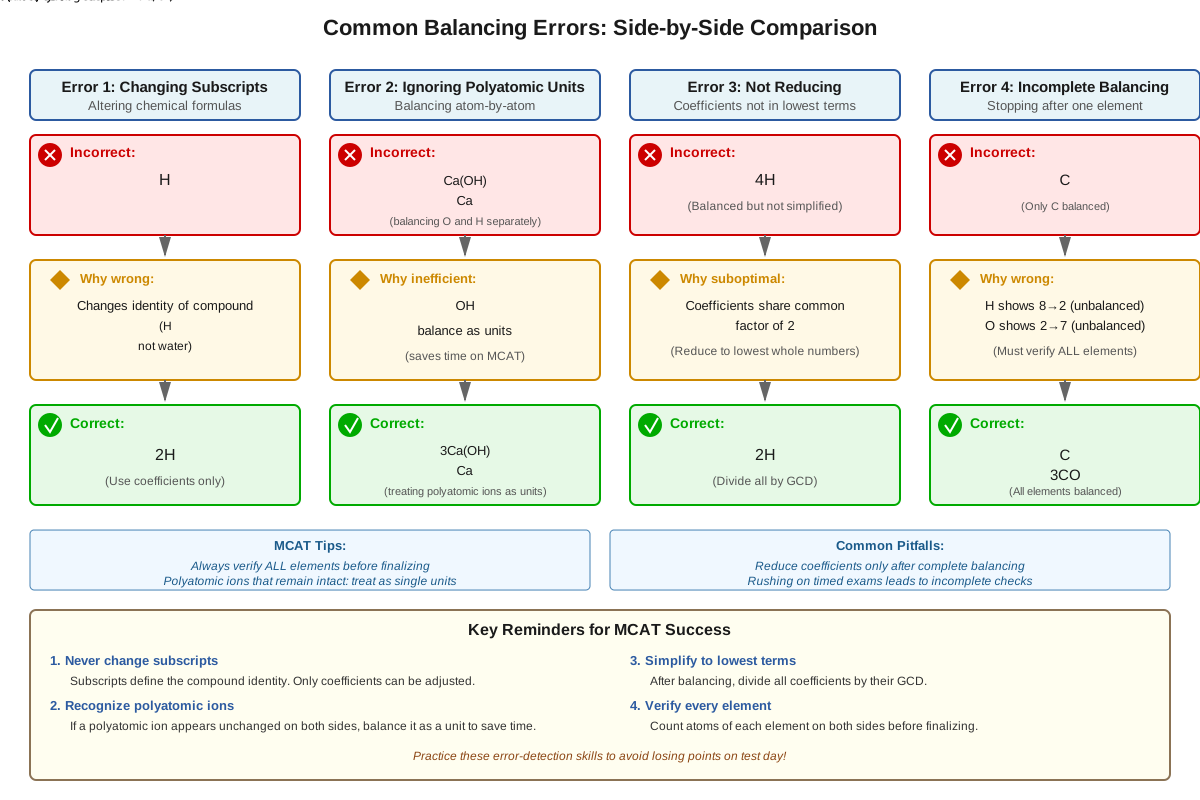
⭐ Subscripts in chemical formulas can never be changed when balancing equations—only coefficients can be adjusted
⭐ In combustion reactions, balance carbon first, then hydrogen, and oxygen last
⭐ Polyatomic ions that appear unchanged on both sides of an equation should be balanced as units rather than individual atoms
- Fractional coefficients are acceptable as intermediate steps but must be converted to whole numbers in the final answer
- Diatomic elements (H₂, N₂, O₂, F₂, Cl₂, Br₂, I₂) must be written as molecules, not single atoms
- The sum of charges must be equal on both sides of ionic equations (mass and charge balance)
- In redox reactions, the number of electrons lost in oxidation must equal the number gained in reduction
- Balanced equations provide the theoretical stoichiometry; actual yields may differ due to side reactions, incomplete reactions, or product loss
- The coefficients in a balanced equation must be in the lowest whole-number ratio (divide all by the greatest common factor)
- State symbols (s, l, g, aq) do not affect the balancing process but provide important context about reaction conditions
Common Misconceptions
Misconception: Subscripts in chemical formulas can be changed to balance equations → Correction: Only coefficients (numbers in front of formulas) can be adjusted. Changing subscripts creates different substances entirely. For example, changing H₂O to H₂O₂ changes water to hydrogen peroxide, a completely different compound with different properties.
Misconception: A balanced equation means equal numbers of molecules on each side → Correction: A balanced equation means equal numbers of each type of atom on both sides, not equal numbers of molecules. The equation 2H₂ + O₂ → 2H₂O has 3 molecules on the left and 2 on the right, but it is properly balanced because atoms are conserved (4 H and 2 O on each side).
Misconception: Coefficients of 1 must be written explicitly → Correction: A coefficient of 1 is implied and typically omitted. Writing "1H₂O" is redundant; simply write "H₂O." However, explicitly writing 1 during the balancing process can help avoid errors.
Misconception: Balancing must always start with the first reactant → Correction: The most efficient strategy is to start with the most complex molecule (the one containing the most elements or atoms) and work toward simpler substances. Balancing hydrogen and oxygen last is often most efficient since they appear in many compounds.
Misconception: All balanced equations have unique coefficient sets → Correction: While the lowest whole-number ratio is unique, any multiple of these coefficients also balances the equation. For example, both H₂ + ½O₂ → H₂O and 2H₂ + O₂ → 2H₂O are balanced, but the second is preferred because it uses whole numbers in the lowest ratio.
Misconception: Redox reactions can be balanced by inspection alone → Correction: Complex redox reactions, especially those in acidic or basic solutions, require the half-reaction method to ensure both mass and charge are balanced. Attempting to balance these by inspection often leads to incorrect electron transfer stoichiometry.
Misconception: The physical states (s, l, g, aq) affect the balancing process → Correction: State symbols provide information about reaction conditions but do not influence the atom count. The equation 2H₂(g) + O₂(g) → 2H₂O(l) is balanced the same way as 2H₂ + O₂ → 2H₂O, regardless of states.
Worked Examples
Example 1: Combustion of a Hydrocarbon
Problem: Balance the combustion equation for butane (C₄H₁₀) in oxygen to produce carbon dioxide and water.
Solution:
Step 1: Write the unbalanced equation with correct formulas
C₄H₁₀ + O₂ → CO₂ + H₂OStep 2: Balance carbon atoms
- 4 carbon atoms on the left require 4 CO₂ on the right
C₄H₁₀ + O₂ → 4CO₂ + H₂OStep 3: Balance hydrogen atoms
- 10 hydrogen atoms on the left require 5 H₂O on the right
C₄H₁₀ + O₂ → 4CO₂ + 5H₂OStep 4: Balance oxygen atoms
- Right side: (4 × 2) + (5 × 1) = 13 oxygen atoms
- Need 13/2 O₂ molecules on the left
C₄H₁₀ + 13/2 O₂ → 4CO₂ + 5H₂OStep 5: Clear fractions by multiplying all coefficients by 2
2C₄H₁₀ + 13O₂ → 8CO₂ + 10H₂OStep 6: Verify the balance
- Left: C = 8, H = 20, O = 26
- Right: C = 8, H = 20, O = (16 + 10) = 26 ✓
Connection to Learning Objectives: This example demonstrates the systematic approach to balancing combustion reactions, a high-yield MCAT topic. The strategy of balancing C, then H, then O applies to all hydrocarbon combustion problems.
Example 2: Redox Reaction in Acidic Solution
Problem: Balance the reaction between dichromate ion and iodide ion in acidic solution:
Cr₂O₇²⁻ + I⁻ → Cr³⁺ + I₂Solution:
Step 1: Identify oxidation and reduction half-reactions
- Reduction: Cr₂O₇²⁻ → Cr³⁺ (Cr goes from +6 to +3)
- Oxidation: I⁻ → I₂ (I goes from -1 to 0)
Step 2: Balance the reduction half-reaction
- Balance Cr: Cr₂O₇²⁻ → 2Cr³⁺
- Balance O with H₂O: Cr₂O₇²⁻ → 2Cr³⁺ + 7H₂O
- Balance H with H⁺: Cr₂O₇²⁻ + 14H⁺ → 2Cr³⁺ + 7H₂O
- Balance charge with electrons: Cr₂O₇²⁻ + 14H⁺ + 6e⁻ → 2Cr³⁺ + 7H₂O
Step 3: Balance the oxidation half-reaction
- Balance I: 2I⁻ → I₂
- Balance charge: 2I⁻ → I₂ + 2e⁻
Step 4: Equalize electrons (multiply oxidation by 3)
- Reduction: Cr₂O₇²⁻ + 14H⁺ + 6e⁻ → 2Cr³⁺ + 7H₂O
- Oxidation: 6I⁻ → 3I₂ + 6e⁻
Step 5: Add half-reactions and cancel electrons
Cr₂O₇²⁻ + 14H⁺ + 6I⁻ → 2Cr³⁺ + 3I₂ + 7H₂OStep 6: Verify mass and charge balance
- Mass: Left (2 Cr, 7 O, 14 H, 6 I) = Right (2 Cr, 7 O, 14 H, 6 I) ✓
- Charge: Left (-2 + 14 - 6 = +6) = Right (2 × 3 = +6) ✓
Connection to Learning Objectives: This example illustrates the half-reaction method essential for electrochemistry problems on the MCAT. Understanding electron transfer stoichiometry connects to cell potential calculations and Faraday's laws.
Exam Strategy
Approaching MCAT Questions: When encountering stoichiometry problems, immediately check if the equation is balanced. Many students waste time performing calculations on unbalanced equations, leading to incorrect answers. If the passage provides an unbalanced equation, balance it in the margin before proceeding.
Trigger Words and Phrases:
- "Complete combustion" → balance to produce CO₂ and H₂O (not CO)
- "In acidic solution" → use H⁺ and H₂O in half-reaction method
- "In basic solution" → use OH⁻ and H₂O in half-reaction method
- "Stoichiometric ratio" → refers to coefficients in balanced equation
- "Theoretical yield" → requires balanced equation for mole ratio calculations
- "Limiting reagent" → must have balanced equation to compare mole ratios
Process-of-Elimination Tips:
- Eliminate answer choices with incorrect atom counts immediately
- Check if coefficients are in lowest whole-number ratio (eliminate if not)
- For redox reactions, verify that charge is balanced (eliminate if charge doesn't match)
- Look for diatomic elements written as single atoms (incorrect)
- Verify that subscripts haven't been changed from the original formulas
Time Allocation: Spend no more than 30-45 seconds balancing simple equations by inspection. For complex redox reactions, allocate up to 90 seconds using the half-reaction method. If balancing is taking longer, mark the question and return to it later—the MCAT rewards efficient time management.
Exam Tip: Practice balancing equations without writing every intermediate step. Develop the ability to track atom counts mentally for simple reactions, reserving written work for complex redox equations. This skill saves precious seconds during the exam.
Common Question Formats:
- Direct balancing: "Which set of coefficients balances the equation?"
- Embedded in calculations: "How many moles of O₂ are required to completely combust 2 moles of C₃H₈?"
- Conceptual understanding: "If the coefficient of H₂O is doubled, what must happen to maintain balance?"
- Passage-based: Providing unbalanced equations in biochemical pathways or industrial processes
Memory Techniques
CARBON Mnemonic for Combustion Balancing:
- Carbon first
- Always count carefully
- Remember hydrogen second
- Balance oxygen last
- Only coefficients change
- Never alter subscripts
"HOPE" for Half-Reaction Method:
- Hydrogen and oxygen balance with H₂O and H⁺/OH⁻
- Oxidation loses electrons (LEO)
- Products gain electrons in reduction (GER)
- Equalize electrons before combining
Visualization Strategy: Picture atoms as colored balls that must be conserved. Imagine physically counting red oxygen balls, blue nitrogen balls, and white hydrogen balls on each side of the equation. This concrete visualization prevents abstract counting errors.
"Never Change Underwear" Reminder: Never Change Underlying subscripts—only adjust coefficients. This silly phrase helps students remember the cardinal rule of balancing.
Diatomic Elements Mnemonic: "Have No Fear Of Ice Clold Brisk Icy weather" (H₂, N₂, F₂, O₂, Cl₂, Br₂, I₂)
Polyatomic Ion Strategy: Create a mental "package" around polyatomic ions that stay together. Visualize SO₄²⁻ as a single unit wrapped in a box, reminding you to balance it as a group rather than separating S and O.
Summary
Balancing chemical equations represents the mathematical expression of the law of conservation of mass, ensuring that all atoms present in reactants are accounted for in products. This fundamental skill in General Chemistry serves as the prerequisite for all stoichiometric calculations on the MCAT, including limiting reagent problems, percent yield, thermochemical equations, and electrochemistry. The systematic approach involves writing correct chemical formulas, counting atoms methodically, adjusting only coefficients (never subscripts), and verifying that both mass and charge are balanced. For simple reactions, the inspection method suffices, balancing the most complex molecule first and saving hydrogen and oxygen for last. Complex redox reactions require the half-reaction method, where oxidation and reduction are balanced separately before combining. Mastery of this topic enables rapid problem-solving under timed conditions and prevents cascading errors in multi-step calculations. Students must recognize that stoichiometric coefficients establish mole ratios that connect to every quantitative aspect of chemistry tested on the MCAT.
Key Takeaways
- The law of conservation of mass requires equal numbers of each type of atom on both sides of a chemical equation, achieved by adjusting coefficients only
- Stoichiometric coefficients in balanced equations represent mole ratios that serve as conversion factors for all quantitative stoichiometry problems
- The systematic balancing approach prioritizes complex molecules first, treats polyatomic ions as units, and balances hydrogen and oxygen last
- Redox reactions require the half-reaction method to ensure both mass and charge balance, with electrons equalized before combining half-reactions
- Common MCAT applications include combustion analysis, titration stoichiometry, thermochemical equations, electrochemistry, and biochemical pathway analysis
- Efficient balancing under timed conditions requires recognizing patterns (combustion, synthesis, decomposition) and avoiding common errors like changing subscripts
- Verification of balanced equations by recounting atoms and checking lowest whole-number ratios prevents errors in subsequent calculations
Related Topics
Stoichiometric Calculations and Mole Conversions: Once equations are balanced, the coefficients enable conversion between moles of different substances using dimensional analysis. This topic builds directly on balanced equations to solve limiting reagent and percent yield problems.
Thermochemistry and Enthalpy Changes: Balanced equations are essential for thermochemical equations where ΔH values correspond to specific stoichiometric coefficients. Understanding how to manipulate equations (reversing, multiplying) affects enthalpy calculations.
Redox Reactions and Electrochemistry: The half-reaction method for balancing redox equations connects to calculating cell potentials, using the Nernst equation, and applying Faraday's laws in electrolysis problems.
Gas Stoichiometry and Ideal Gas Law: When reactions involve gases, balanced equations combined with PV=nRT enable calculation of volumes, pressures, and temperatures at various conditions.
Acid-Base Titrations: Balanced neutralization equations establish equivalence point relationships and enable calculation of unknown concentrations from titration data.
Solution Stoichiometry and Molarity: Balanced equations combined with molarity concepts allow calculation of volumes and concentrations in solution-phase reactions.
Practice CTA
Now that you've mastered the principles of balancing chemical equations, it's time to solidify your understanding through active practice. Attempt the practice questions and flashcards associated with this topic to reinforce the systematic approach and build speed under timed conditions. Focus on recognizing patterns in combustion reactions, applying the half-reaction method to redox equations, and connecting balanced equations to stoichiometric calculations. Remember that consistent practice transforms mechanical balancing into an automatic skill, freeing cognitive resources for the complex reasoning required on MCAT passages. Your investment in mastering this foundational topic will pay dividends throughout your chemistry preparation and on test day!
Sign up free to keep reading
Create a free AnvayaPrep account to finish this MCAT guide on Balancing chemical equations — plus flashcards and practice questions.