Overview
Alcohol dehydration is a fundamental elimination reaction in Organic Chemistry that transforms alcohols into alkenes through the loss of a water molecule. This reaction represents one of the most important synthetic pathways for creating carbon-carbon double bonds and serves as a cornerstone concept within the Alcohols and Ethers unit. Understanding alcohol dehydration requires mastery of reaction mechanisms, carbocation stability, stereochemistry, and regiochemistry—all high-yield topics for the MCAT.
On the Alcohol dehydration MCAT questions, students must recognize reaction conditions, predict major and minor products using Zaitsev's rule, identify carbocation rearrangements, and distinguish between E1 and E2 mechanisms. The reaction typically occurs under acidic conditions with heat, making it distinct from other alcohol transformations. This topic bridges multiple areas of Organic Chemistry, connecting acid-base chemistry, carbocation chemistry, stereochemistry, and alkene stability principles.
The significance of alcohol dehydration extends beyond pure synthesis. This reaction mechanism appears in biological systems, industrial processes (such as ethanol conversion to ethylene), and pharmaceutical synthesis. For MCAT success, students must not only memorize the reaction conditions but also develop the ability to predict products, explain mechanistic steps, and troubleshoot when unexpected products form due to carbocation rearrangements—a favorite testing point for exam writers.
Learning Objectives
- [ ] Define Alcohol dehydration using accurate Organic Chemistry terminology
- [ ] Explain why Alcohol dehydration matters for the MCAT
- [ ] Apply Alcohol dehydration to exam-style questions
- [ ] Identify common mistakes related to Alcohol dehydration
- [ ] Connect Alcohol dehydration to related Organic Chemistry concepts
- [ ] Predict major and minor products of alcohol dehydration reactions using Zaitsev's rule
- [ ] Distinguish between E1 and E2 mechanisms in alcohol dehydration contexts
- [ ] Recognize and predict carbocation rearrangements during dehydration reactions
- [ ] Evaluate the effect of alcohol structure (primary, secondary, tertiary) on reaction mechanism and rate
Prerequisites
- Acid-base chemistry: Understanding protonation of alcohols is essential since dehydration begins with the alcohol acting as a base
- Carbocation stability: Ranking carbocation stability (3° > 2° > 1°) determines reaction pathways and rearrangement likelihood
- Alkene stability: Knowledge of Zaitsev's rule and hyperconjugation explains product distribution
- Elimination reactions (E1 and E2): Alcohol dehydration follows elimination mechanisms, requiring familiarity with these reaction types
- Functional group identification: Distinguishing primary, secondary, and tertiary alcohols determines mechanism and reactivity
- Stereochemistry basics: Understanding anti-periplanar geometry in E2 reactions affects product formation
Why This Topic Matters
Clinical and Real-World Significance
Alcohol dehydration reactions occur throughout biological systems and industrial chemistry. In metabolism, alcohol dehydrogenase enzymes catalyze related transformations during ethanol processing. The industrial production of ethylene from ethanol via dehydration represents one of the largest-scale applications of this reaction, producing billions of pounds of this essential chemical feedstock annually. Pharmaceutical synthesis frequently employs dehydration reactions to construct complex molecular architectures, particularly in steroid and terpene synthesis.
MCAT Exam Statistics
Alcohol dehydration appears in approximately 15-20% of Organic Chemistry passages on the MCAT, making it a medium-yield topic that students cannot afford to skip. Questions typically test:
- Mechanism identification (40% of questions): Distinguishing E1 vs E2 pathways
- Product prediction (35% of questions): Applying Zaitsev's rule and identifying rearrangements
- Reaction condition recognition (15% of questions): Identifying acidic conditions and heat
- Stereochemistry (10% of questions): Predicting geometric isomers in products
Common Exam Presentations
MCAT passages present alcohol dehydration in several contexts:
- Synthetic schemes: Multi-step synthesis where dehydration creates an alkene intermediate
- Mechanism comparison passages: Contrasting elimination and substitution reactions
- Biological chemistry contexts: Enzyme-catalyzed dehydration in metabolic pathways
- Industrial chemistry: Large-scale production scenarios requiring mechanistic understanding
- Troubleshooting scenarios: Explaining unexpected products due to carbocation rearrangements
Core Concepts
Definition and General Reaction
Alcohol dehydration is an elimination reaction in which an alcohol loses a water molecule (H₂O) to form an alkene. The general reaction can be represented as:
R-CH₂-CH(OH)-R' + H⁺/heat → R-CH=CH-R' + H₂OThis transformation converts a saturated alcohol (sp³ hybridized carbon) into an unsaturated alkene (sp² hybridized carbons). The reaction is classified as an elimination reaction because two groups (H and OH) are removed from adjacent carbons. The term "dehydration" specifically refers to the loss of water as the leaving group.
Reaction Conditions
Alcohol dehydration requires acidic conditions and heat. Common reagents include:
- Concentrated sulfuric acid (H₂SO₄): Most frequently used, typically at 170-180°C
- Concentrated phosphoric acid (H₃PO₄): Milder alternative, useful for acid-sensitive substrates
- p-Toluenesulfonic acid (TsOH): Organic-soluble acid catalyst
- Alumina (Al₂O₃): Solid acid catalyst for gas-phase reactions
The acidic conditions serve to protonate the hydroxyl group, converting the poor leaving group (OH⁻) into an excellent leaving group (H₂O). Heat provides the activation energy necessary for the elimination process.
Mechanism: E1 Pathway
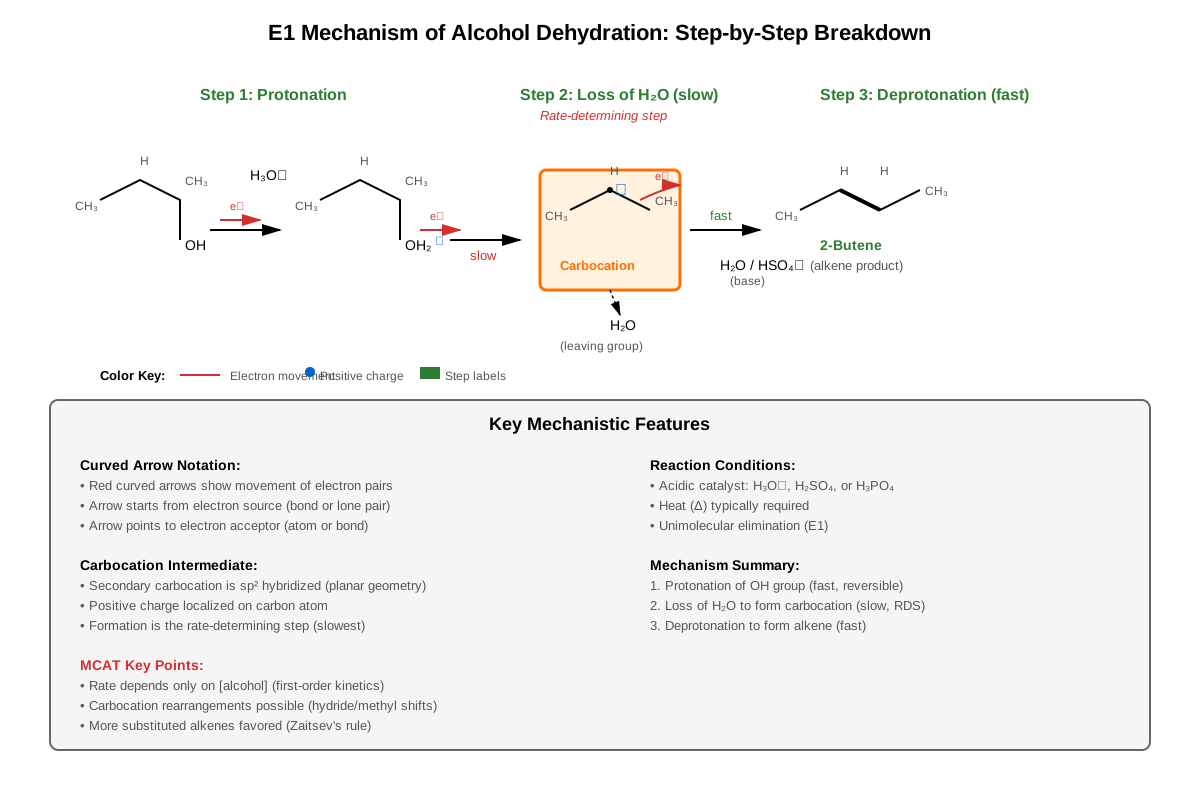
Secondary and tertiary alcohols typically undergo dehydration via an E1 mechanism (unimolecular elimination). This mechanism proceeds through three distinct steps:
Step 1: Protonation
The alcohol oxygen acts as a Brønsted-Lowry base, accepting a proton from the acid catalyst. This converts -OH into -OH₂⁺, transforming a poor leaving group into water, an excellent leaving group.
Step 2: Carbocation Formation (Rate-Determining Step)
Water departs as a leaving group, generating a carbocation intermediate. This step is unimolecular (depends only on substrate concentration) and represents the slowest step, making it rate-determining. The stability of the carbocation intermediate determines the reaction rate: tertiary > secondary > primary.
Step 3: Deprotonation
A base (often water or HSO₄⁻) abstracts a proton from a β-carbon (carbon adjacent to the carbocation), forming the π bond of the alkene. This step is fast and determines product distribution.
Mechanism: E2 Pathway
Primary alcohols may undergo dehydration via an E2 mechanism (bimolecular elimination) under certain conditions, though this is less common. The E2 mechanism is concerted (single step):
The base removes a β-proton while simultaneously the C-O bond breaks and the π bond forms. This requires anti-periplanar geometry: the hydrogen and leaving group must be on opposite sides of the molecule (180° dihedral angle). Primary alcohols react more slowly than secondary or tertiary alcohols because they cannot form stable carbocations.
Carbocation Rearrangements
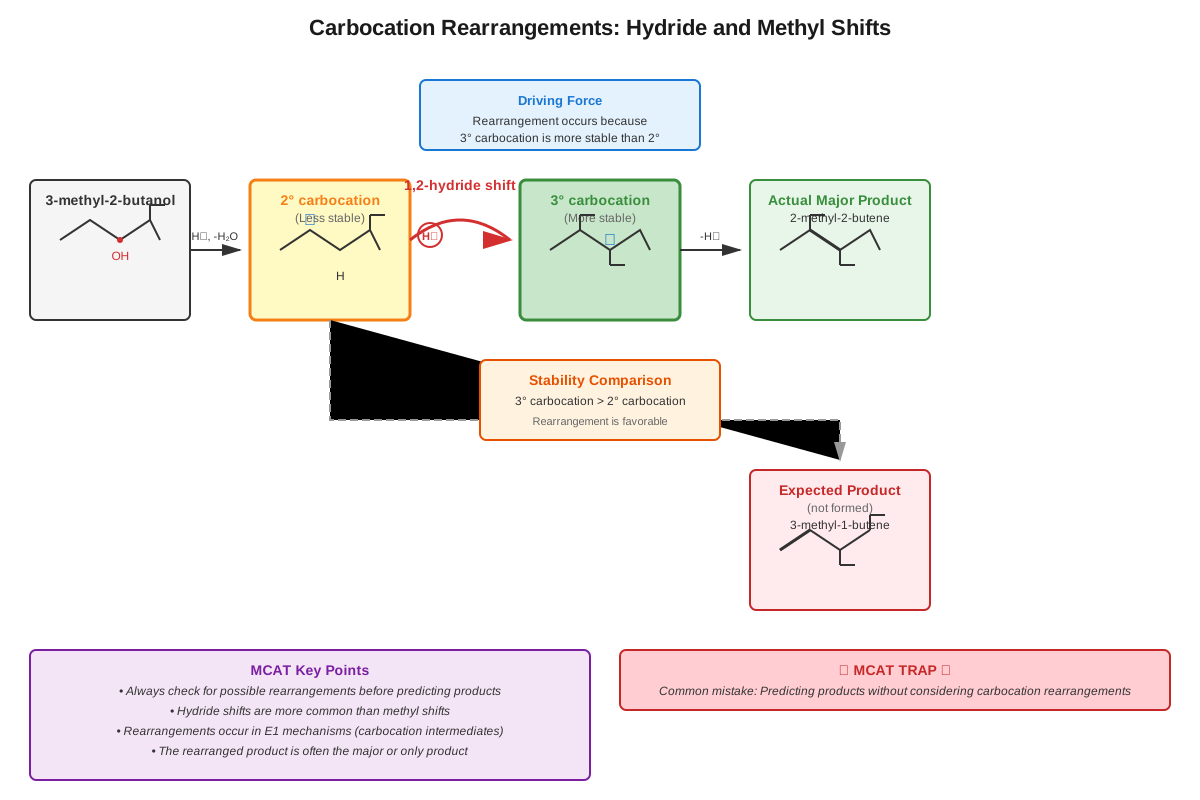
One of the most MCAT-testable aspects of alcohol dehydration involves carbocation rearrangements. When a carbocation intermediate can rearrange to a more stable carbocation, it will do so via hydride shifts (H⁻ movement) or alkyl shifts (R⁻ movement).
Hydride Shift Example:
A secondary carbocation adjacent to a tertiary carbon can undergo a 1,2-hydride shift, moving a hydrogen with its bonding electrons to form a more stable tertiary carbocation.
Alkyl Shift Example:
A secondary carbocation can undergo a 1,2-alkyl shift (methyl or other alkyl group migration) to form a tertiary carbocation.
These rearrangements explain why the major product sometimes differs from the expected product based solely on the original alcohol structure. MCAT questions frequently test whether students recognize when rearrangement is possible and predict the rearranged product.
Zaitsev's Rule and Product Distribution
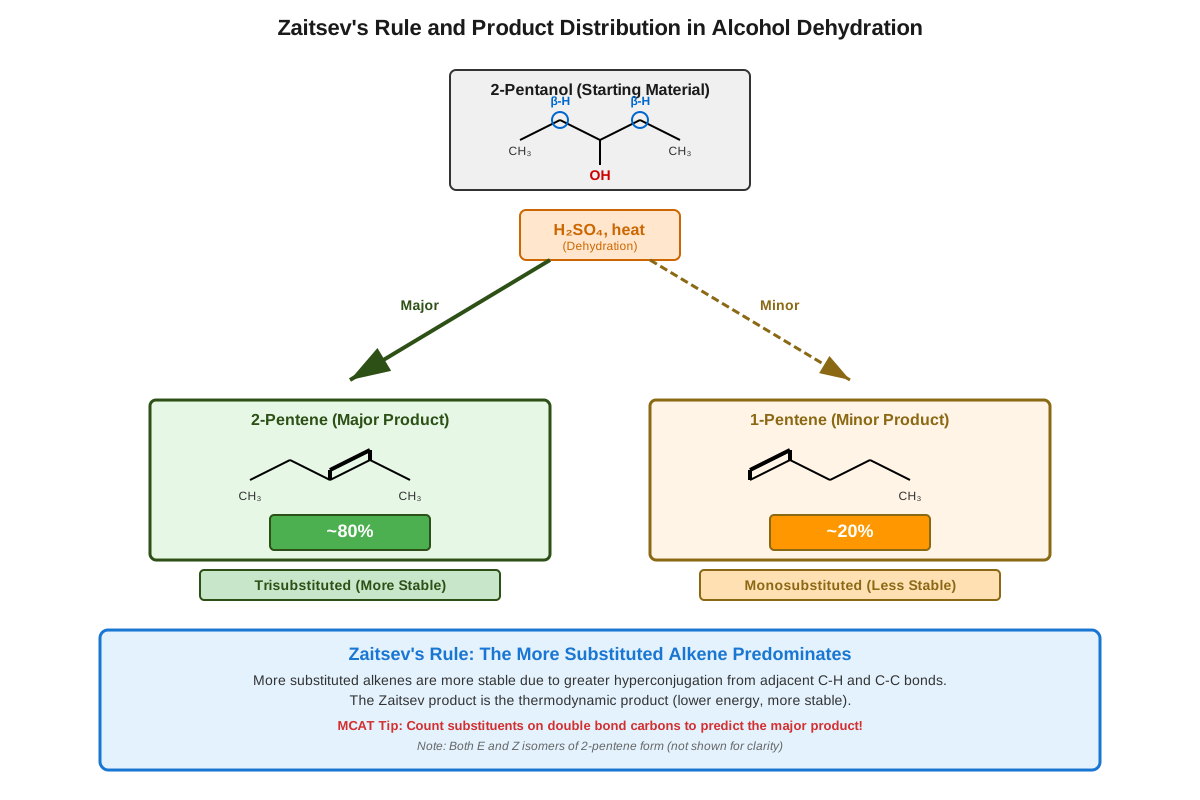
When multiple alkene products are possible, Zaitsev's rule predicts that the major product will be the most substituted (most stable) alkene. Alkene stability follows the order:
Tetrasubstituted > Trisubstituted > Disubstituted > Monosubstituted
This stability arises from hyperconjugation: more alkyl substituents provide more C-H bonds that can donate electron density into the empty π* orbital, stabilizing the alkene.
Example:
Dehydration of 2-butanol produces both 2-butene (trisubstituted, major) and 1-butene (disubstituted, minor). The 2-butene predominates because it is more substituted and therefore more stable.
Alcohol Structure and Reactivity
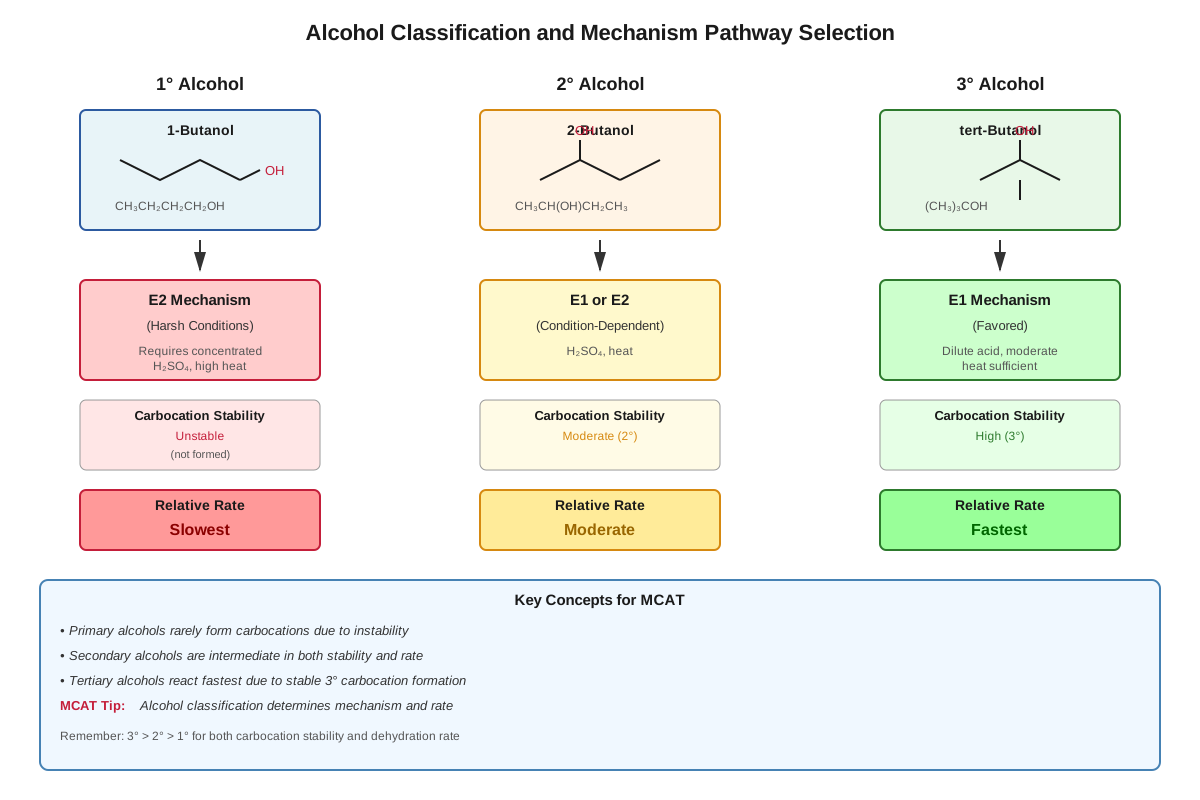
The structure of the alcohol dramatically affects both the mechanism and reaction rate:
| Alcohol Type | Mechanism | Relative Rate | Carbocation Stability | Rearrangement Risk |
|---|---|---|---|---|
| Tertiary (3°) | E1 | Fastest | Most stable (3°) | Moderate |
| Secondary (2°) | E1 | Moderate | Moderate (2°) | High |
| Primary (1°) | E2 or E1 | Slowest | Least stable (1°) | Very High |
Tertiary alcohols react fastest because they form the most stable carbocations. Primary alcohols react slowest and may require more forcing conditions (higher temperature). Secondary alcohols represent an intermediate case and are most prone to rearrangement because they can shift to tertiary carbocations.
Stereochemistry Considerations
For E2 mechanisms, anti-periplanar geometry is required, which can lead to stereospecific product formation. When the starting alcohol has defined stereochemistry, the E2 mechanism will produce specific geometric isomers (E or Z alkenes) based on which β-hydrogen is anti-periplanar to the leaving group.
For E1 mechanisms, the carbocation intermediate is planar (sp² hybridized), and the base can abstract a proton from either face, potentially leading to mixtures of E and Z isomers. However, the more stable geometric isomer typically predominates.
Competing Reactions
Under certain conditions, alcohol dehydration competes with substitution reactions (SN1 or SN2). The key factors determining elimination vs. substitution include:
- Temperature: Higher temperatures favor elimination (dehydration)
- Base strength: Stronger, bulkier bases favor elimination
- Substrate structure: More substituted alcohols favor elimination
- Nucleophile concentration: Lower nucleophile concentration favors elimination
For MCAT purposes, remember that concentrated acid + heat strongly favors elimination (dehydration) over substitution.
Concept Relationships
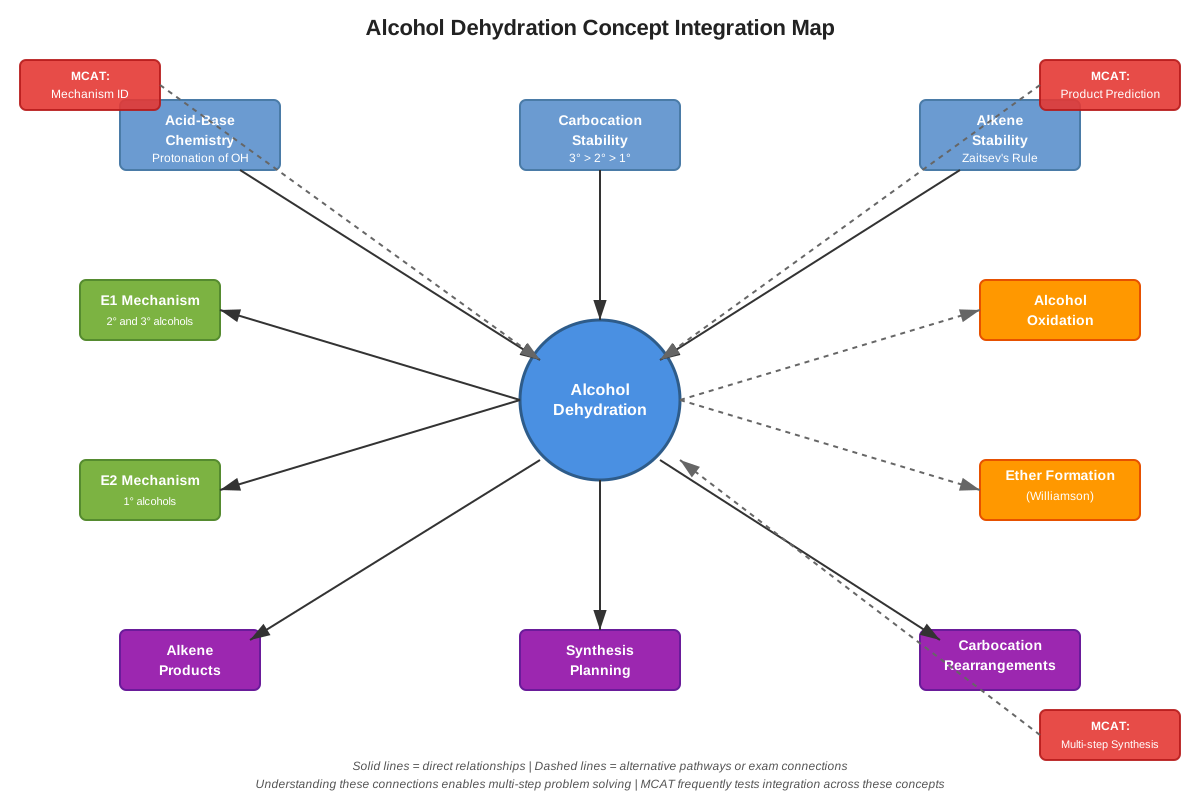
Alcohol dehydration sits at the intersection of multiple organic chemistry concepts, creating a web of interconnected knowledge essential for MCAT mastery.
Acid-Base Chemistry → Alcohol Dehydration: The reaction begins with protonation, demonstrating how acid-base principles enable subsequent transformations. The alcohol's oxygen lone pairs act as the base, accepting a proton to activate the molecule for elimination.
Alcohol Dehydration → Carbocation Chemistry: E1 dehydration mechanisms generate carbocation intermediates, connecting directly to carbocation stability principles (3° > 2° > 1°) and rearrangement patterns.
Carbocation Chemistry → Rearrangement Products: Unstable carbocations undergo hydride or alkyl shifts to form more stable carbocations, which then determines the final alkene product structure.
Alcohol Dehydration → Alkene Stability: Product distribution follows Zaitsev's rule, requiring understanding of alkene stability through hyperconjugation and substitution patterns.
Elimination Mechanisms (E1/E2) → Alcohol Dehydration: Dehydration exemplifies elimination reactions, with mechanism selection depending on alcohol structure and reaction conditions.
Stereochemistry → Product Geometry: Anti-periplanar requirements in E2 and carbocation planarity in E1 determine whether E or Z alkene isomers form.
Alcohol Dehydration ↔ Alkene Hydration: These reactions are reverse processes; understanding dehydration helps predict hydration outcomes and vice versa, demonstrating Le Chatelier's principle in organic synthesis.
Functional Group Transformations → Synthetic Strategy: Dehydration represents a key method for introducing C=C double bonds, enabling subsequent reactions like addition, oxidation, or polymerization.
Quick check — test yourself on Alcohol dehydration so far.
Try Flashcards →High-Yield Facts
⭐ Alcohol dehydration requires acidic conditions (H₂SO₄, H₃PO₄) and heat to proceed
⭐ Tertiary and secondary alcohols undergo E1 dehydration; primary alcohols react via E2 or require forcing conditions
⭐ The major product follows Zaitsev's rule: the most substituted (most stable) alkene predominates
⭐ Carbocation rearrangements via 1,2-hydride or 1,2-alkyl shifts occur when a more stable carbocation can form
⭐ The rate-determining step in E1 dehydration is carbocation formation (loss of water)
- Protonation converts the poor leaving group (OH⁻) into an excellent leaving group (H₂O)
- Alkene stability order: tetrasubstituted > trisubstituted > disubstituted > monosubstituted
- E1 mechanisms produce carbocation intermediates that are planar (sp² hybridized)
- Higher temperatures favor elimination over substitution reactions
- Anti-periplanar geometry (180° dihedral angle) is required for E2 elimination mechanisms
- Secondary alcohols are most prone to carbocation rearrangement because they can shift to tertiary carbocations
- Concentrated sulfuric acid (H₂SO₄) at 170-180°C is the most common dehydration condition
- The reaction is reversible; removing water (Le Chatelier's principle) drives the reaction toward alkene formation
- Dehydration is the reverse of acid-catalyzed alkene hydration (Markovnikov addition)
- Ring expansion can occur during dehydration when carbocation rearrangement creates a more stable ring size
Common Misconceptions
Misconception: Alcohol dehydration occurs under basic conditions.
Correction: Dehydration requires acidic conditions to protonate the hydroxyl group, converting it from a poor leaving group (OH⁻) into an excellent leaving group (H₂O). Basic conditions would deprotonate the alcohol, making it even less likely to leave.
Misconception: Primary alcohols react faster than tertiary alcohols in dehydration reactions.
Correction: Tertiary alcohols react fastest because they form the most stable carbocations (3° > 2° > 1°). Primary alcohols react slowest and often require more forcing conditions because primary carbocations are highly unstable.
Misconception: The major product is always the alkene formed by removing water from the original alcohol position without rearrangement.
Correction: Carbocation rearrangements frequently occur, especially with secondary alcohols. Always check if a hydride or alkyl shift can produce a more stable carbocation before predicting the final product. The major product comes from the most stable carbocation, which may be rearranged.
Misconception: Zaitsev's rule means removing the hydrogen from the carbon with the most hydrogens.
Correction: Zaitsev's rule states that the most substituted alkene (the one with the most alkyl groups on the double bond carbons) will be the major product. This often means removing a hydrogen from the carbon with fewer hydrogens, creating more substitution around the double bond.
Misconception: All alcohol dehydration reactions proceed through E1 mechanisms.
Correction: While secondary and tertiary alcohols typically undergo E1 dehydration, primary alcohols may react via E2 mechanisms or require different conditions entirely. The mechanism depends on the alcohol structure and ability to form stable carbocations.
Misconception: The hydroxyl group leaves directly as OH⁻ during dehydration.
Correction: The hydroxyl group must first be protonated to form -OH₂⁺, which then leaves as neutral water (H₂O). Hydroxide (OH⁻) is a poor leaving group and would not depart under normal dehydration conditions.
Misconception: Heat is optional in alcohol dehydration reactions.
Correction: Heat is essential for alcohol dehydration. It provides the activation energy needed for the elimination process and shifts the equilibrium toward alkene formation. Higher temperatures favor elimination over substitution.
Worked Examples
Example 1: Predicting Products with Zaitsev's Rule
Problem: Predict the major and minor products when 2-methylcyclohexanol undergoes dehydration with concentrated H₂SO₄ and heat.
Solution:
Step 1: Identify the alcohol type
2-methylcyclohexanol is a secondary alcohol (the -OH is attached to a secondary carbon). This means the reaction will proceed via an E1 mechanism.
Step 2: Protonate the alcohol
The -OH group accepts a proton from H₂SO₄, forming -OH₂⁺.
Step 3: Form the carbocation
Water leaves, creating a secondary carbocation at C-2 of the cyclohexane ring.
Step 4: Check for possible rearrangements
In this case, no rearrangement to a more stable carbocation is possible (the adjacent carbons would form less stable or equally stable carbocations).
Step 5: Identify possible elimination sites
The base can remove a proton from either:
- C-1 (creating a double bond between C-1 and C-2, with the methyl group on the double bond)
- C-3 (creating a double bond between C-2 and C-3, with the methyl group adjacent to the double bond)
Step 6: Apply Zaitsev's rule
The major product is 1-methylcyclohexene (double bond between C-1 and C-2) because this alkene is trisubstituted (three alkyl groups attached to the double bond carbons).
The minor product is 3-methylcyclohexene (double bond between C-2 and C-3) because this alkene is disubstituted (two alkyl groups attached to the double bond carbons).
Answer: Major product = 1-methylcyclohexene; Minor product = 3-methylcyclohexene
Learning Objective Connection: This example demonstrates applying Zaitsev's rule to predict product distribution and recognizing that the most substituted alkene predominates.
Example 2: Recognizing Carbocation Rearrangement
Problem: When 3,3-dimethyl-2-butanol is treated with H₂SO₄ and heat, the major product is 2,3-dimethyl-2-butene rather than 3,3-dimethyl-1-butene. Explain this observation using mechanistic reasoning.
Solution:
Step 1: Analyze the starting material
3,3-dimethyl-2-butanol is a secondary alcohol. The structure is:
    CH₃
     |
CH₃-C-CH(OH)-CH₃
     |
    CH₃
Step 2: Initial carbocation formation
After protonation and water loss, a secondary carbocation forms at C-2:
    CH₃
     |
CH₃-C-CH⁺-CH₃
     |
    CH₃
Step 3: Recognize rearrangement opportunity
The secondary carbocation is adjacent to a tertiary carbon (C-3). A 1,2-methyl shift can occur, where a methyl group migrates with its bonding electrons from C-3 to C-2.
Step 4: Rearranged carbocation
After the methyl shift, a tertiary carbocation forms at C-3:
    CH₃  CH₃
     |    |
CH₃-C⁺-CH-CH₃
     |
    CH₃
This tertiary carbocation is more stable than the original secondary carbocation, making the rearrangement favorable.
Step 5: Product formation
Deprotonation of the rearranged carbocation produces 2,3-dimethyl-2-butene, a tetrasubstituted alkene (four alkyl groups on the double bond carbons).
Without rearrangement, the product would be 3,3-dimethyl-1-butene, a monosubstituted alkene.
Step 6: Explain major product
The rearranged product (2,3-dimethyl-2-butene) is the major product because:
- It forms from a more stable tertiary carbocation
- It is a more substituted (more stable) alkene
- Both thermodynamic and kinetic factors favor this pathway
Answer: Carbocation rearrangement via 1,2-methyl shift converts a secondary carbocation to a more stable tertiary carbocation, which then forms the highly substituted alkene 2,3-dimethyl-2-butene as the major product.
Learning Objective Connection: This example illustrates identifying carbocation rearrangements, predicting when they occur, and understanding how they affect product distribution—a high-yield MCAT concept.
Exam Strategy
Question Recognition
MCAT questions on alcohol dehydration typically include these trigger phrases:
- "Heated with concentrated sulfuric acid"
- "Dehydration conditions"
- "Elimination reaction of an alcohol"
- "Major alkene product"
- "Treatment with H₃PO₄ and heat"
When you see these phrases, immediately activate your dehydration reaction framework: check alcohol type → predict mechanism → look for rearrangements → apply Zaitsev's rule.
Systematic Approach
Use this four-step process for every alcohol dehydration question:
- Classify the alcohol (1°, 2°, or 3°) → determines mechanism and relative rate
- Draw the carbocation (for E1) → identifies the intermediate
- Check for rearrangements → look for adjacent tertiary carbons or ring expansion opportunities
- Apply Zaitsev's rule → identify the most substituted alkene as the major product
Process of Elimination Tips
When evaluating answer choices:
Eliminate immediately if:
- The answer shows a substitution product (unless specifically asked about competing reactions)
- The product has the wrong number of carbons (suggests you missed a rearrangement)
- The product is less substituted than another viable option (violates Zaitsev's rule)
- The mechanism shown includes OH⁻ as a leaving group without protonation
Keep in consideration if:
- The product shows a rearranged carbon skeleton (rearrangements are common)
- Multiple alkene products are shown with the most substituted labeled as major
- The mechanism includes protonation as the first step
Time Management
Alcohol dehydration questions typically require 60-90 seconds:
- 15 seconds: Read and identify as dehydration reaction
- 20 seconds: Classify alcohol and draw carbocation
- 20 seconds: Check for rearrangements
- 15 seconds: Apply Zaitsev's rule
- 20 seconds: Verify answer and eliminate wrong choices
If a question asks for both mechanism and products, allocate 2 minutes total. Don't spend excessive time drawing every resonance structure or minor product unless specifically asked.
Red Flags
Watch for these MCAT traps:
- Questions that show a secondary alcohol adjacent to a tertiary carbon (rearrangement likely)
- Answer choices that differ only in alkene substitution pattern (testing Zaitsev's rule)
- Passages mentioning "unexpected products" (signals rearrangement)
- Questions asking about "relative rates" (testing carbocation stability knowledge)
Memory Techniques
Mnemonic: "PEAR" for E1 Dehydration Steps
Protonation (make the leaving group)
Exit (water leaves, forming carbocation)
Arrange (check for rearrangements)
Remove (base removes β-proton, forming alkene)
Visualization: The Carbocation Stability Pyramid
Visualize carbocation stability as a pyramid:
        3° (top - most stable)
       /  \
      2°   (middle)
     /      \
    1°       (bottom - least stable)
Rearrangements always move up the pyramid, never down.
Acronym: "ZAPS" for Product Prediction
Zaitsev's rule applies (most substituted wins)
Adjacent carbons check (for rearrangement)
Protonation first (activate the leaving group)
Secondary and tertiary (use E1 mechanism)
Memory Hook: "Heat Beats Substitution"
Remember that high temperature favors elimination over substitution. Think: "When things heat up, relationships break apart" (elimination) rather than "new bonds form" (substitution).
Rhyme for Leaving Groups
"OH is a no, but H₂O will go"
(Hydroxide is a poor leaving group, but water is excellent)
Summary
Alcohol dehydration is an elimination reaction that converts alcohols to alkenes through loss of water under acidic conditions with heat. The reaction proceeds via E1 mechanism for secondary and tertiary alcohols, beginning with protonation of the hydroxyl group to create a good leaving group (H₂O), followed by carbocation formation (rate-determining step), and concluding with β-proton removal to form the alkene. Primary alcohols may undergo E2 dehydration or require more forcing conditions. Carbocation rearrangements via 1,2-hydride or 1,2-alkyl shifts frequently occur when a more stable carbocation can form, making this a high-yield MCAT testing point. Product distribution follows Zaitsev's rule: the most substituted (most stable) alkene predominates. Reactivity follows carbocation stability: tertiary > secondary > primary alcohols. Understanding this reaction requires integrating acid-base chemistry, carbocation stability, elimination mechanisms, and alkene stability principles—making it a cornerstone concept that connects multiple areas of organic chemistry essential for MCAT success.
Key Takeaways
- Alcohol dehydration requires acidic conditions (H₂SO₄ or H₃PO₄) and heat, converting alcohols to alkenes via elimination
- Tertiary and secondary alcohols undergo E1 dehydration with carbocation intermediates; primary alcohols react via E2 or require forcing conditions
- Carbocation rearrangements are extremely common and occur via 1,2-hydride or 1,2-alkyl shifts to form more stable carbocations
- Zaitsev's rule predicts the major product: the most substituted alkene predominates due to greater stability from hyperconjugation
- Protonation is essential to convert the poor leaving group (OH⁻) into an excellent leaving group (H₂O)
- Reactivity order follows carbocation stability: tertiary > secondary > primary alcohols, with tertiary alcohols reacting fastest
- Always check for rearrangement opportunities before predicting products, especially with secondary alcohols adjacent to tertiary carbons
Related Topics
Alkene Hydration: The reverse reaction of alcohol dehydration; understanding dehydration mechanisms helps predict hydration outcomes and demonstrates microscopic reversibility in organic reactions.
Carbocation Rearrangements: Deeper exploration of hydride shifts, alkyl shifts, and ring expansions that occur during any reaction involving carbocation intermediates.
E1 vs E2 Mechanisms: Comprehensive comparison of elimination mechanisms, including stereochemical requirements, kinetics, and substrate effects.
Zaitsev vs Hofmann Products: Advanced study of regioselectivity in elimination reactions and conditions that favor less substituted alkenes.
Substitution vs Elimination Competition: Understanding factors that determine whether alcohols undergo substitution (SN1/SN2) or elimination (E1/E2) reactions.
Protecting Groups in Synthesis: Learning when and how to protect alcohols to prevent unwanted dehydration during multi-step synthesis.
Practice CTA
Now that you've mastered the core concepts of alcohol dehydration, it's time to solidify your understanding through active practice. Attempt the practice questions to test your ability to predict products, recognize rearrangements, and apply Zaitsev's rule under exam conditions. Use the flashcards to reinforce high-yield facts and mechanisms until you can recall them instantly. Remember: understanding the mechanism deeply allows you to solve any dehydration problem, even those you've never seen before. Your investment in mastering this topic will pay dividends not only on alcohol questions but across all of organic chemistry, as these principles appear repeatedly throughout the MCAT. You've got this!
Sign up free to keep reading
Create a free AnvayaPrep account to finish this MCAT guide on Alcohol dehydration — plus flashcards and practice questions.