Overview
Distillation is a fundamental separation technique in Organic Chemistry that exploits differences in boiling points to purify and isolate liquid compounds. This physical separation method is essential for both laboratory practice and MCAT success, as it represents one of the most commonly tested purification techniques in the Separations and Spectroscopy unit. Understanding distillation requires integrating knowledge of intermolecular forces, vapor pressure, phase transitions, and thermodynamics—making it an excellent topic for testing multiple concepts simultaneously.
For the MCAT, distillation appears frequently in both discrete questions and passage-based scenarios, particularly in the Chemical and Physical Foundations of Biological Systems section. The exam tests not only the theoretical principles underlying distillation but also the practical application of choosing appropriate separation techniques for specific mixtures. Students must recognize when distillation is the optimal separation method, understand the relationship between molecular structure and boiling point, and interpret distillation curves and temperature profiles.
Distillation Organic Chemistry concepts connect directly to broader themes in organic chemistry, including molecular polarity, hydrogen bonding, molecular weight effects, and the physical properties of organic compounds. Mastery of distillation principles enables deeper understanding of other separation techniques such as extraction, chromatography, and crystallization, while reinforcing fundamental concepts about intermolecular forces that appear throughout the MCAT curriculum.
Learning Objectives
- [ ] Define Distillation using accurate Organic Chemistry terminology
- [ ] Explain why Distillation matters for the MCAT
- [ ] Apply Distillation to exam-style questions
- [ ] Identify common mistakes related to Distillation
- [ ] Connect Distillation to related Organic Chemistry concepts
- [ ] Distinguish between simple, fractional, and vacuum distillation techniques and identify appropriate applications for each
- [ ] Predict relative boiling points of organic compounds based on molecular structure and intermolecular forces
- [ ] Interpret distillation curves and temperature-composition diagrams to determine mixture purity and separation efficiency
Prerequisites
- Intermolecular forces (hydrogen bonding, dipole-dipole, London dispersion forces): Essential for predicting boiling points and understanding why compounds separate during distillation
- Phase transitions and vapor pressure: Required to understand the thermodynamic basis of distillation and the relationship between temperature and vaporization
- Colligative properties: Helps explain boiling point elevation and depression in mixtures
- Basic organic functional groups: Necessary for predicting physical properties and boiling point trends
- Raoult's Law and ideal solutions: Provides the theoretical foundation for understanding vapor-liquid equilibria in distillation
Why This Topic Matters
Distillation represents one of the oldest and most widely used purification techniques in chemistry, with applications ranging from petroleum refining to pharmaceutical manufacturing and beverage production. In clinical and research settings, distillation principles underlie many analytical techniques and purification protocols. The production of sterile water for injections, the concentration of biological samples, and the purification of reagents all rely on distillation or related evaporative techniques.
For the MCAT, distillation appears in approximately 3-5% of Chemical and Physical Foundations questions, making it a medium-yield topic that nonetheless appears on virtually every exam administration. Questions typically fall into three categories: (1) conceptual questions about the principles underlying distillation, (2) application questions requiring students to select appropriate separation techniques for specific scenarios, and (3) data interpretation questions involving distillation curves or temperature profiles.
Distillation commonly appears in MCAT passages describing laboratory purification procedures, industrial chemical processes, or experimental methodology sections. Passages may present distillation data in graphical form, requiring students to interpret temperature plateaus, identify azeotropes, or determine the purity of fractions collected. The topic frequently appears alongside other separation techniques, requiring students to compare and contrast methods or explain why one technique is superior to another for a given application.
Core Concepts
Definition and Fundamental Principles
Distillation is a separation and purification technique that exploits differences in boiling points (or more precisely, vapor pressures) between components of a liquid mixture. The process involves heating a liquid mixture to vaporize the more volatile component(s), then condensing the vapor back to liquid form in a separate container. The fundamental principle underlying distillation is that at any given temperature, different compounds have different vapor pressures, and the compound with the higher vapor pressure will preferentially enter the gas phase.
The effectiveness of distillation depends on the volatility difference between components, which is directly related to their boiling point difference. Generally, compounds must differ by at least 25°C in boiling point for simple distillation to achieve effective separation, though fractional distillation can separate compounds with smaller boiling point differences (as little as 1-2°C).
Vapor Pressure and Boiling Point Relationships
The boiling point of a liquid is defined as the temperature at which its vapor pressure equals the external atmospheric pressure. For pure compounds, this occurs at a specific, characteristic temperature. In mixtures, the relationship becomes more complex, governed by Raoult's Law for ideal solutions:
P_total = X_A × P°_A + X_B × P°_BWhere X represents mole fraction and P° represents the vapor pressure of the pure component. The composition of the vapor phase differs from the liquid phase composition, with the vapor being enriched in the more volatile (lower boiling point) component. This differential vaporization is the key to distillation's separating power.
Types of Distillation
Simple Distillation
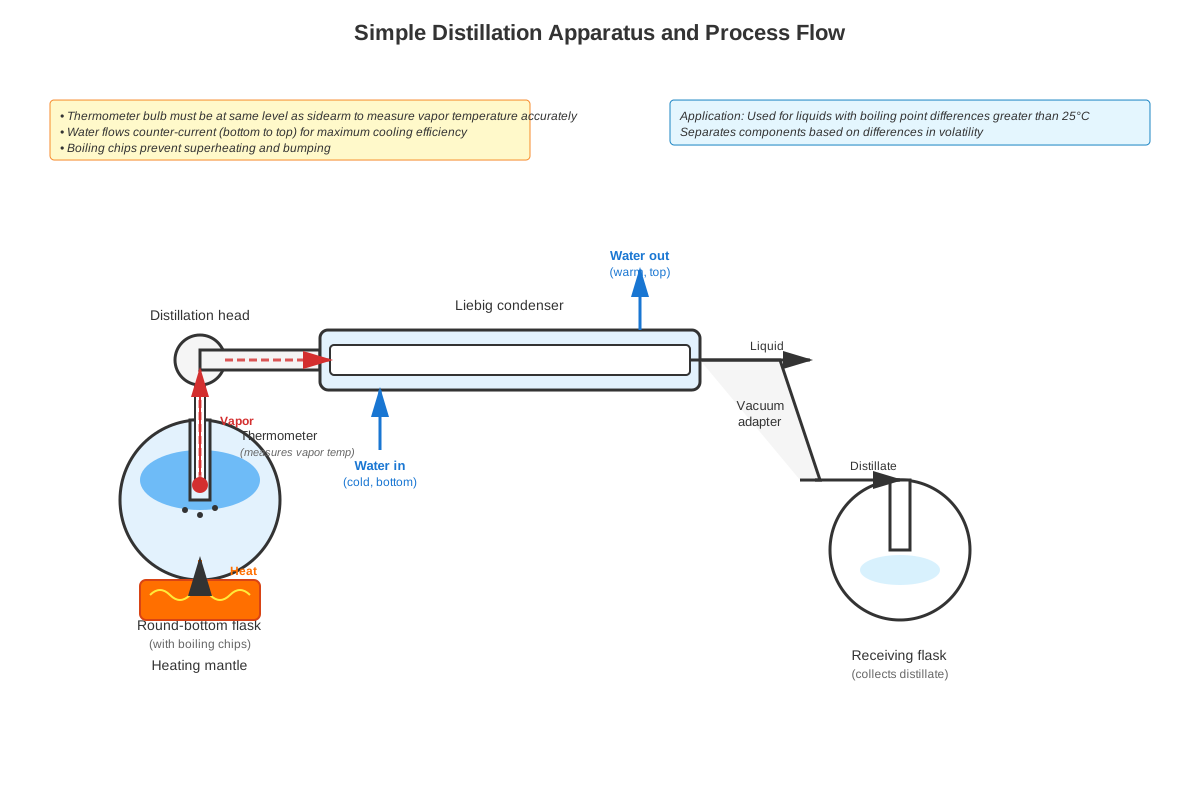
Simple distillation employs a basic apparatus consisting of a distillation flask, heat source, condenser, and receiving flask. This technique is appropriate when:
- Components differ by at least 25-30°C in boiling point
- One component is present in much greater quantity than impurities
- The mixture contains non-volatile impurities
The process involves heating the mixture until the lower-boiling component vaporizes, travels through the condenser where it cools and liquefies, then collects in the receiving flask. The temperature remains relatively constant at the boiling point of the more volatile component until most of it has distilled over.
Fractional Distillation
Fractional distillation incorporates a fractionating column between the distillation flask and condenser, providing multiple vaporization-condensation cycles. The column contains packing material (glass beads, metal rings, or specialized packing) that increases surface area for vapor-liquid contact. This technique is essential when:
- Components have similar boiling points (difference less than 25°C)
- High purity is required
- Complex mixtures contain multiple components
Each vaporization-condensation cycle in the column represents one theoretical plate, and columns are rated by their number of theoretical plates. More theoretical plates provide better separation. The column creates a temperature gradient, with the hottest region at the bottom and coolest at the top, allowing progressive enrichment of the more volatile component as vapors rise.
Vacuum Distillation
Vacuum distillation (also called reduced-pressure distillation) operates under reduced pressure, lowering the boiling points of all components. This technique is critical when:
- Compounds decompose at or near their normal boiling points
- Very high boiling point compounds need purification
- Energy efficiency is important
The relationship between pressure and boiling point follows the Clausius-Clapeyron equation. Reducing pressure from 760 mmHg (1 atm) to 20 mmHg can lower boiling points by 100-150°C, enabling distillation of heat-sensitive compounds without decomposition.
Steam Distillation
Steam distillation is a specialized technique for purifying water-immiscible organic compounds. Steam is passed through the mixture, and both water and organic compound vaporize together. The mixture distills at a temperature below the boiling point of either pure component because the total vapor pressure equals the sum of individual vapor pressures. This technique is particularly useful for:
- Natural product isolation (essential oils, terpenes)
- High-boiling compounds that are immiscible with water
- Heat-sensitive organic materials
Distillation Curves and Temperature Profiles
A distillation curve plots temperature versus volume of distillate collected (or time). For pure compounds, the curve shows a sharp temperature plateau at the boiling point. For mixtures, the curve reveals:
- Initial rise to the boiling point of the more volatile component
- Gradual temperature increase as composition changes
- Possible plateau at the boiling point of the less volatile component
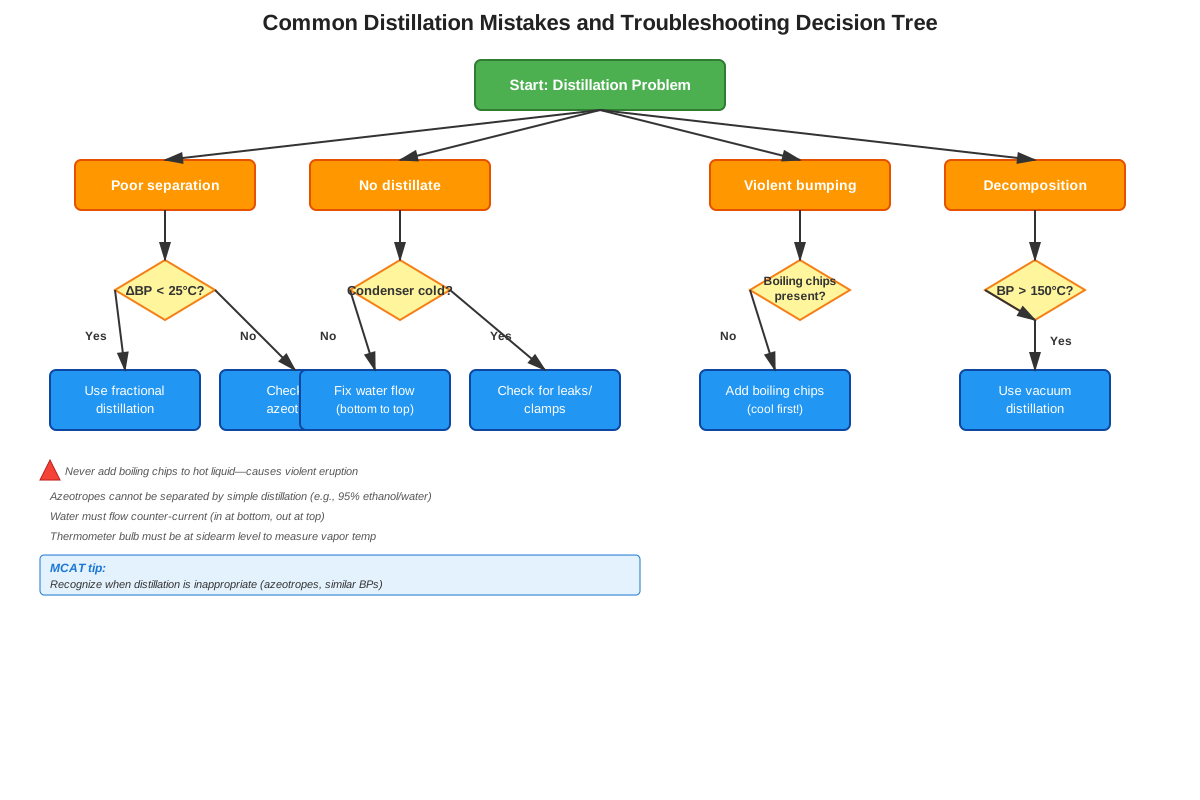
Azeotropes are special mixtures that distill at constant temperature with constant composition, behaving like pure compounds. The most common example is the ethanol-water azeotrope (95.6% ethanol, 4.4% water by mass), which boils at 78.2°C—lower than pure ethanol (78.4°C). Azeotropes cannot be separated by simple distillation.
Factors Affecting Distillation Efficiency
| Factor | Effect on Separation | Optimization Strategy |
|---|---|---|
| Boiling point difference | Larger difference = better separation | Choose appropriate distillation type |
| Heating rate | Too fast = poor separation; too slow = inefficient | Maintain steady, moderate heating |
| Column packing | More surface area = more theoretical plates | Use appropriate packing material |
| Reflux ratio | Higher ratio = better separation but lower yield | Balance purity vs. throughput |
| Pressure | Lower pressure = lower boiling points | Use vacuum for heat-sensitive compounds |
| Insulation | Prevents heat loss and maintains temperature gradient | Insulate column and connections |
Predicting Boiling Points from Structure
Understanding the relationship between molecular structure and boiling point is essential for predicting distillation behavior:
- Molecular weight: Larger molecules have higher boiling points due to increased London dispersion forces
- Hydrogen bonding: Compounds capable of hydrogen bonding (alcohols, carboxylic acids, amines) have elevated boiling points
- Polarity: Polar molecules have higher boiling points than nonpolar molecules of similar molecular weight
- Branching: Branched isomers have lower boiling points than straight-chain isomers due to decreased surface area
- Functional groups: Different functional groups contribute differently to boiling point elevation
Concept Relationships
The core concepts of distillation form an interconnected network centered on the relationship between molecular structure and physical properties. Molecular structure determines intermolecular forces, which directly control vapor pressure and boiling point. These physical properties then determine the feasibility and type of distillation appropriate for separation.
The choice between simple distillation, fractional distillation, and vacuum distillation depends on the boiling point difference between components and their thermal stability. Simple distillation connects to basic phase transition concepts, while fractional distillation extends these principles through multiple equilibration stages. Vacuum distillation integrates pressure-temperature relationships from thermodynamics.
Distillation curves serve as the analytical tool connecting theoretical principles to practical outcomes, revealing mixture composition, separation efficiency, and the presence of azeotropes. The interpretation of these curves requires understanding vapor-liquid equilibria and Raoult's Law.
Within the broader Separations and Spectroscopy unit, distillation represents the primary technique for separating volatile liquids, complementing extraction (for liquid-liquid separations based on solubility), chromatography (for complex mixture analysis), and crystallization (for solid purification). Each technique exploits different physical properties, and MCAT questions often require selecting the most appropriate method for a given scenario.
Quick check — test yourself on Distillation so far.
Try Flashcards →High-Yield Facts
⭐ Distillation separates compounds based on boiling point differences; a minimum 25°C difference is required for effective simple distillation
⭐ The compound with the lower boiling point (higher vapor pressure) distills first and is called the more volatile component
⭐ Fractional distillation uses a fractionating column to provide multiple vaporization-condensation cycles, enabling separation of compounds with similar boiling points
⭐ Vacuum distillation lowers boiling points by reducing external pressure, preventing thermal decomposition of heat-sensitive compounds
⭐ Azeotropes are constant-boiling mixtures that cannot be separated by simple distillation; the ethanol-water azeotrope (95.6% ethanol) is the most common example
- Boiling point increases with molecular weight, hydrogen bonding capability, and polarity, but decreases with branching
- Steam distillation allows purification of water-immiscible organic compounds at temperatures below their normal boiling points
- A distillation curve showing a sharp temperature plateau indicates a pure compound or azeotrope
- The reflux ratio (ratio of liquid returning to column versus liquid collected) affects separation quality in fractional distillation
- Theoretical plates measure the efficiency of a fractionating column; more plates provide better separation
- The Clausius-Clapeyron equation describes the relationship between vapor pressure and temperature
- Distillation is most effective for separating volatile liquids from non-volatile solids or liquids with significantly different boiling points
Common Misconceptions
Misconception: Distillation separates compounds based on density differences
Correction: Distillation separates based on boiling point (vapor pressure) differences, not density. Density-based separation would be decantation or centrifugation
Misconception: The thermometer in a distillation apparatus measures the temperature of the liquid in the flask
Correction: The thermometer measures the temperature of the vapor entering the condenser, which corresponds to the boiling point of the compound currently distilling over
Misconception: Fractional distillation is always better than simple distillation
Correction: Fractional distillation is more effective for similar boiling points but is unnecessary and inefficient when compounds differ by more than 25-30°C. Simple distillation is faster and adequate for large boiling point differences
Misconception: Vacuum distillation changes the relative order in which compounds distill
Correction: Vacuum distillation lowers all boiling points proportionally but does not change the relative volatility order. The compound with the lower boiling point at atmospheric pressure still has the lower boiling point under vacuum
Misconception: All liquid mixtures can be completely separated by distillation
Correction: Azeotropes cannot be separated by distillation because they have constant composition in both liquid and vapor phases. Special techniques (adding entrainers, pressure-swing distillation, or alternative separation methods) are required
Misconception: A rising temperature during distillation always indicates impure starting material
Correction: While a rising temperature can indicate a mixture, it may also result from superheating, inadequate mixing, or approaching the boiling point of a second component. A pure compound should show a constant temperature plateau
Misconception: Boiling point is solely determined by molecular weight
Correction: Boiling point depends on all intermolecular forces, not just molecular weight. Hydrogen bonding, dipole-dipole interactions, and molecular shape significantly affect boiling point. For example, ethanol (MW 46) has a higher boiling point than propane (MW 44) due to hydrogen bonding
Worked Examples
Example 1: Selecting Appropriate Distillation Technique
Question: A chemist needs to purify a sample containing three components: compound A (bp 78°C), compound B (bp 82°C), and compound C (bp 156°C). The desired product is compound B. Which distillation technique would be most appropriate, and why?
Solution:
Step 1: Analyze the boiling point differences
- Difference between A and B: 82°C - 78°C = 4°C
- Difference between B and C: 156°C - 82°C = 74°C
Step 2: Evaluate separation challenges
The small 4°C difference between compounds A and B presents the primary separation challenge. The 74°C difference between B and C is large enough for simple distillation.
Step 3: Select appropriate technique
Fractional distillation is required because compounds A and B have a boiling point difference less than 25°C. The fractionating column will provide multiple theoretical plates, allowing separation of these closely-boiling compounds.
Step 4: Describe the procedure
Heat the mixture gradually. Compound A will distill first (collect and discard this fraction). As the temperature rises to 82°C, compound B will distill (collect this fraction as the desired product). Compound C will remain in the distillation flask due to its much higher boiling point.
Key Concept Connection: This example demonstrates the critical decision-making process for selecting distillation techniques based on boiling point analysis, directly addressing the learning objective of distinguishing between distillation types and their applications.
Example 2: Interpreting a Distillation Curve
Question: A student performs a distillation and records the following temperature profile: The temperature rises from room temperature to 65°C, remains constant at 65°C while 15 mL of distillate is collected, then rises gradually from 65°C to 110°C while 30 mL is collected, and finally plateaus at 110°C while 20 mL is collected. What can be concluded about the starting mixture?
Solution:
Step 1: Analyze the first plateau (65°C, 15 mL)
A constant temperature plateau indicates a pure compound or azeotrope distilling. This represents the first, most volatile component.
Step 2: Analyze the rising temperature region (65-110°C, 30 mL)
The gradual temperature rise indicates a mixture of components with intermediate boiling points, or the transition between two components. This region contains both the first and second components in varying proportions.
Step 3: Analyze the second plateau (110°C, 20 mL)
Another constant temperature plateau indicates a second pure compound distilling.
Step 4: Draw conclusions
The starting mixture contained at least two major components:
- Component 1: bp = 65°C (approximately 15 mL pure, plus some in the middle fraction)
- Component 2: bp = 110°C (approximately 20 mL pure, plus some in the middle fraction)
The 30 mL middle fraction represents incomplete separation, containing both components. This suggests simple distillation was used; fractional distillation would have provided sharper separation with less overlap.
Step 5: Recommend improvements
To improve separation, the student should:
- Use fractional distillation instead of simple distillation
- Distill more slowly to allow better equilibration
- Discard the middle fraction and redistill it
Key Concept Connection: This example integrates distillation curve interpretation with understanding of vapor-liquid equilibria and separation efficiency, demonstrating how theoretical principles manifest in practical data.
Exam Strategy
When approaching MCAT questions on distillation, begin by identifying the key information: boiling points of components, desired purity level, and any special considerations (heat sensitivity, azeotropes). The exam frequently tests whether students can select the appropriate distillation technique for a given scenario.
Trigger words and phrases to watch for:
- "Similar boiling points" or "differ by only a few degrees" → suggests fractional distillation
- "Heat-sensitive," "decomposes upon heating," or "high boiling point" → suggests vacuum distillation
- "Water-immiscible" or "essential oil" → suggests steam distillation
- "Constant boiling mixture" or "95% ethanol" → indicates azeotrope
- "Temperature plateau" → indicates pure compound or azeotrope
- "Gradually rising temperature" → indicates mixture or incomplete separation
Process-of-elimination strategies:
- Eliminate simple distillation if boiling points differ by less than 25°C
- Eliminate vacuum distillation unless thermal decomposition or very high boiling points are mentioned
- Eliminate steam distillation unless water immiscibility is specified
- If a question asks about separating an azeotrope, eliminate any answer suggesting simple or fractional distillation alone
Time allocation: Distillation questions typically require 60-90 seconds. Spend 20 seconds identifying the scenario type, 30 seconds analyzing boiling point relationships or curve data, and 20-30 seconds selecting and confirming your answer. If a passage includes a distillation curve, spend extra time during passage reading to understand the curve's features, as multiple questions may reference it.
Common question formats:
- Technique selection: "Which separation method would be most appropriate?"
- Boiling point prediction: "Which compound would distill first?"
- Curve interpretation: "What does the temperature plateau indicate?"
- Troubleshooting: "Why did the separation fail?"
Exam Tip: When comparing boiling points, remember the hierarchy: hydrogen bonding > dipole-dipole > London dispersion forces. Within a homologous series, boiling point increases with molecular weight. Branching decreases boiling point compared to straight-chain isomers.
Memory Techniques
VAPE - Remember the factors affecting boiling point:
- Vapor pressure (inversely related to boiling point)
- Atmospheric pressure (higher pressure = higher boiling point)
- Polarity and hydrogen bonding (increase boiling point)
- Extent of molecular weight (higher MW = higher boiling point)
"Simple Separation Starts at 25" - Remember that simple distillation requires at least a 25°C boiling point difference
"Fractional For Fine Separation" - The alliteration helps remember that fractional distillation provides finer (more precise) separation
"Vacuum Vanquishes Volatility Vulnerability" - Remember that vacuum distillation protects heat-sensitive (vulnerable) compounds by lowering boiling points
Azeotrope visualization: Picture a "stuck together" mixture that refuses to separate—like two dancers moving as one unit. The ethanol-water azeotrope is "95-5 at 78" (95% ethanol, 5% water, boiling at 78°C).
Boiling point trends mnemonic - "BHMW" (pronounced "buh-hum-wuh"):
- Branching decreases boiling point
- Hydrogen bonding increases boiling point
- Molecular weight increases boiling point
- Water immiscibility suggests steam distillation
Distillation curve interpretation: Remember "Plateau = Pure" - a flat temperature region indicates a pure compound distilling
Summary
Distillation is a fundamental separation technique in organic chemistry that exploits boiling point differences to purify liquid mixtures. The process relies on differential vaporization, where the more volatile (lower boiling point) component preferentially enters the vapor phase and is collected separately. Simple distillation effectively separates compounds differing by at least 25°C in boiling point, while fractional distillation uses a fractionating column to separate compounds with similar boiling points through multiple vaporization-condensation cycles. Vacuum distillation reduces external pressure to lower boiling points, protecting heat-sensitive compounds from decomposition. Steam distillation enables purification of water-immiscible organic compounds at temperatures below their normal boiling points. Boiling point prediction requires understanding how molecular structure—including molecular weight, hydrogen bonding, polarity, and branching—affects intermolecular forces. Distillation curves reveal mixture composition and separation efficiency through temperature plateaus (pure compounds) and rising temperature regions (mixtures). Azeotropes represent special constant-boiling mixtures that cannot be separated by conventional distillation. For MCAT success, students must select appropriate distillation techniques based on scenario analysis, predict relative boiling points from molecular structure, and interpret distillation data to assess separation quality.
Key Takeaways
- Distillation separates liquid mixtures based on boiling point differences, with the lower-boiling (more volatile) component distilling first
- Simple distillation requires ≥25°C boiling point difference; fractional distillation separates compounds with smaller differences using a fractionating column
- Vacuum distillation lowers boiling points by reducing pressure, preventing thermal decomposition of heat-sensitive compounds
- Boiling point increases with molecular weight, hydrogen bonding, and polarity, but decreases with branching
- Azeotropes are constant-boiling mixtures (e.g., 95.6% ethanol-water) that cannot be separated by simple distillation
- Distillation curves show temperature plateaus for pure compounds and rising temperatures for mixtures
- Selecting the appropriate distillation technique requires analyzing boiling point differences, thermal stability, and mixture complexity
Related Topics
Extraction - Another major separation technique that uses solubility differences between immiscible solvents rather than boiling point differences. Mastering distillation provides the foundation for understanding how different physical properties enable different separation strategies.
Chromatography - A family of separation techniques (TLC, column, gas, HPLC) that separate based on differential migration through a stationary phase. Understanding distillation's use of boiling point differences helps contextualize chromatography's use of polarity and size differences.
Intermolecular Forces - The fundamental forces (hydrogen bonding, dipole-dipole, London dispersion) that determine boiling points and thus distillation behavior. Deeper study of IMFs enhances ability to predict physical properties.
Raoult's Law and Colligative Properties - The theoretical foundation for understanding vapor-liquid equilibria in distillation. Advanced study connects distillation principles to thermodynamics and physical chemistry.
Organic Compound Physical Properties - Systematic study of how functional groups and molecular structure affect solubility, boiling point, melting point, and other properties relevant to purification and identification.
Practice CTA
Now that you've mastered the principles of distillation, it's time to reinforce your understanding through active practice. Complete the practice questions to test your ability to select appropriate distillation techniques, predict boiling points from molecular structure, and interpret distillation curves. Use the flashcards to memorize high-yield facts about boiling point trends, distillation types, and common azeotropes. Remember, the MCAT rewards not just knowledge but the ability to apply concepts quickly and accurately under time pressure. Each practice question you complete builds the pattern recognition and analytical skills essential for test day success. You've built a strong foundation—now strengthen it through deliberate practice!
Sign up free to keep reading
Create a free AnvayaPrep account to finish this MCAT guide on Distillation — plus flashcards and practice questions.