Overview
High-Performance Liquid Chromatography (HPLC) is a powerful analytical technique used to separate, identify, and quantify components in a mixture. As a cornerstone method in Separations and Spectroscopy, HPLC represents an evolution of traditional column chromatography, utilizing high pressure to force mobile phase solvents through tightly packed stationary phases. This technique achieves superior resolution and speed compared to gravity-driven methods, making it indispensable in pharmaceutical analysis, biochemical research, and quality control laboratories. For the MCAT, understanding HPLC requires mastery of chromatographic principles, phase interactions, and the ability to interpret chromatogram data—skills that bridge Organic Chemistry concepts with practical analytical applications.
The MCAT frequently tests HPLC within the context of experimental passages where students must analyze separation data, predict elution orders, or troubleshoot experimental designs. Questions may require understanding how molecular properties (polarity, size, charge) influence retention times, or how modifications to mobile/stationary phases affect separation efficiency. HPLC appears most commonly in Chemical and Physical Foundations passages, though it can also emerge in Biological and Biochemical Foundations when discussing protein purification or metabolite analysis. The technique exemplifies how fundamental organic chemistry principles—intermolecular forces, polarity, and solubility—translate into practical laboratory applications.
Within the broader landscape of Organic Chemistry, HPLC connects intimately with concepts of molecular polarity, functional group behavior, and intermolecular interactions. It serves as a practical application of "like dissolves like" principles and demonstrates how subtle structural differences between molecules can be exploited for separation. Understanding HPLC also reinforces knowledge of other chromatographic techniques (thin-layer chromatography, gas chromatography) and spectroscopic methods often coupled with HPLC for compound identification. This integration makes HPLC a high-yield topic that rewards students who can synthesize multiple organic chemistry concepts simultaneously.
Learning Objectives
- [ ] Define HPLC using accurate Organic Chemistry terminology
- [ ] Explain why HPLC matters for the MCAT
- [ ] Apply HPLC to exam-style questions
- [ ] Identify common mistakes related to HPLC
- [ ] Connect HPLC to related Organic Chemistry concepts
- [ ] Predict elution order of compounds based on polarity and phase system used
- [ ] Interpret chromatogram data including retention time, peak area, and resolution
- [ ] Distinguish between normal-phase and reverse-phase HPLC and predict when each is appropriate
- [ ] Analyze how changes in mobile phase composition affect separation quality
Prerequisites
- Basic chromatography principles: Understanding stationary and mobile phases is fundamental to grasping how HPLC achieves separation through differential migration
- Intermolecular forces: Knowledge of hydrogen bonding, dipole-dipole interactions, and London dispersion forces explains retention mechanisms and elution patterns
- Polarity and solubility: The ability to assess relative polarity of organic molecules predicts their behavior in different HPLC phase systems
- Functional group properties: Recognizing how functional groups influence molecular interactions with phases determines separation outcomes
- Basic laboratory techniques: Familiarity with analytical methods provides context for HPLC's role in mixture analysis
Why This Topic Matters
HPLC represents one of the most widely used analytical techniques in modern chemistry, biochemistry, and pharmaceutical sciences. In clinical settings, HPLC quantifies drug concentrations in patient blood samples, monitors therapeutic levels, and detects metabolites. Research laboratories employ HPLC to purify synthetic products, analyze natural product extracts, and characterize biomolecules. The technique's versatility—capable of separating everything from small organic molecules to large proteins—makes it an essential tool across multiple scientific disciplines.
For the MCAT, HPLC appears in approximately 2-4% of Chemical and Physical Foundations questions, typically within experimental passages requiring data interpretation. Questions often present chromatograms and ask students to identify compounds based on retention times, explain why certain modifications improve separation, or predict how changing experimental conditions affects results. The MCAT favors questions that test conceptual understanding over memorization—students must apply principles rather than recall specific retention times or column specifications.
Common exam scenarios include: passages describing purification of reaction products where students must interpret chromatographic data to assess purity; experiments comparing different mobile phase compositions and their effects on resolution; and troubleshooting scenarios where students identify why a separation failed. The MCAT particularly emphasizes understanding the relationship between molecular structure and chromatographic behavior, making this topic an excellent vehicle for testing integrated organic chemistry knowledge. Success requires both theoretical understanding and the ability to analyze experimental data critically.
Core Concepts
Fundamental Principles of HPLC
High-Performance Liquid Chromatography (HPLC), also called high-pressure liquid chromatography, separates mixture components by exploiting differential interactions between molecules and two phases: a stationary phase (solid support packed in a column) and a mobile phase (liquid solvent pumped through the column). Unlike traditional column chromatography that relies on gravity, HPLC uses pumps to generate pressures of 1000-6000 psi, forcing mobile phase through columns packed with very small (3-5 μm) uniform particles. This high pressure enables rapid separations with excellent resolution.
The separation mechanism depends on the partition coefficient (K) of each analyte between the mobile and stationary phases. Compounds with greater affinity for the stationary phase migrate more slowly through the column, resulting in longer retention times (the time from injection to detection). Compounds preferring the mobile phase elute quickly with shorter retention times. This differential migration produces separated peaks on a chromatogram, a plot of detector response versus time.
HPLC System Components
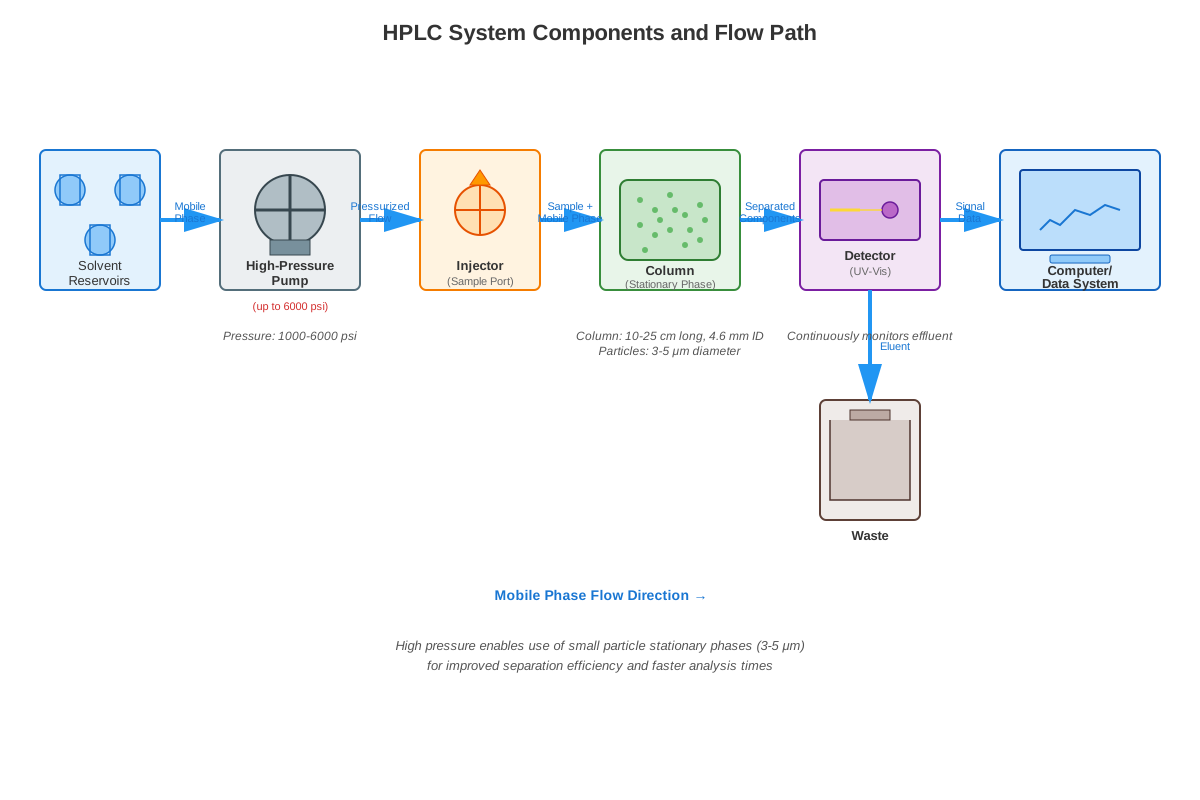
A complete HPLC system consists of several integrated components:
- Solvent reservoir: Contains mobile phase solvents (often multiple for gradient elution)
- Pump: Delivers mobile phase at constant flow rate and high pressure
- Injector: Introduces sample into the mobile phase stream
- Column: Contains stationary phase where separation occurs
- Detector: Monitors eluent and generates signal when compounds pass
- Data system: Records detector signal and produces chromatogram
The column represents the heart of the system, typically a stainless steel tube (10-25 cm long, 4.6 mm internal diameter) packed with silica particles chemically modified with various functional groups. Column temperature is often controlled to improve reproducibility and separation efficiency.
Normal-Phase vs. Reverse-Phase HPLC
HPLC operates in two primary modes that differ fundamentally in their phase polarities:
| Feature | Normal-Phase HPLC | Reverse-Phase HPLC |
|---|---|---|
| Stationary phase | Polar (silica, alumina, cyano) | Nonpolar (C8, C18 hydrocarbon chains) |
| Mobile phase | Nonpolar (hexane, chloroform) | Polar (water, methanol, acetonitrile) |
| Elution order | Nonpolar compounds elute first | Polar compounds elute first |
| Best for | Separating isomers, nonpolar compounds | Most organic compounds, biomolecules |
| Frequency | Less common (10-15% of applications) | Most common (85-90% of applications) |
Normal-phase HPLC uses a polar stationary phase and nonpolar mobile phase. Polar compounds interact strongly with the stationary phase through hydrogen bonding and dipole interactions, causing them to elute slowly. Nonpolar compounds have minimal stationary phase interaction and elute quickly. Increasing mobile phase polarity decreases retention times by competing for stationary phase binding sites.
Reverse-phase HPLC inverts this relationship with a nonpolar stationary phase (typically silica modified with C18 or C8 alkyl chains) and polar mobile phase (aqueous solutions with methanol or acetonitrile). Nonpolar compounds interact favorably with the hydrocarbon stationary phase through London dispersion forces and elute slowly. Polar compounds prefer the aqueous mobile phase and elute quickly. Increasing mobile phase organic content (decreasing polarity) reduces retention times by better solvating nonpolar analytes.
Retention Time and Selectivity
Retention time (tR) is the time from sample injection to peak maximum detection. Each compound has a characteristic retention time under specific conditions, enabling identification. However, retention time alone is insufficient for definitive identification because multiple factors affect it.
The capacity factor (k') provides a more fundamental measure of retention:
k' = (tR - t0) / t0where t0 is the void time (time for unretained compound to pass through the column). The capacity factor represents the ratio of time a compound spends in the stationary phase versus the mobile phase. Optimal separations typically occur when k' values fall between 2 and 10.
Selectivity (α) quantifies how well a system distinguishes between two compounds:
α = k'2 / k'1where k'2 > k'1. Greater selectivity (α > 1) indicates better separation potential. Selectivity depends on the chemical nature of the phases and can be optimized by changing stationary phase chemistry or mobile phase composition.
Chromatogram Interpretation
A chromatogram displays detector response (y-axis) versus time (x-axis). Each separated compound produces a peak characterized by:
- Retention time: Position of peak maximum (identifies compound)
- Peak height: Maximum detector response (relates to concentration)
- Peak area: Integrated signal under the curve (quantifies amount)
- Peak width: Breadth at base (indicates separation efficiency)
Resolution (Rs) quantifies separation quality between adjacent peaks:
Rs = 2(tR2 - tR1) / (w1 + w2)where w represents peak widths. Resolution values above 1.5 indicate baseline separation, while values below 1.0 suggest significant peak overlap. Poor resolution may result from insufficient selectivity, low column efficiency, or overloading.
Mobile Phase Optimization
Mobile phase composition critically affects separation quality. In reverse-phase HPLC, the mobile phase typically consists of water mixed with an organic modifier (methanol, acetonitrile, or tetrahydrofuran). The organic content percentage determines elution strength:
- Low organic content (high water): Stronger retention of nonpolar compounds, longer run times
- High organic content (low water): Weaker retention, faster elution, risk of poor resolution
Isocratic elution maintains constant mobile phase composition throughout the run, suitable for samples with similar polarities. Gradient elution systematically increases organic content during the run, starting with high water content to retain nonpolar compounds, then increasing organic content to elute them. Gradients are essential for complex mixtures containing compounds with widely varying polarities.
Mobile phase pH also influences separation, particularly for ionizable compounds. Adjusting pH changes the ionization state of acidic or basic analytes, dramatically affecting their retention. Buffers maintain stable pH and improve peak shape for ionizable compounds.
Detection Methods
HPLC detectors monitor eluent and generate signals when compounds pass. Common detectors include:
- UV-Vis detector: Measures absorbance at specific wavelengths; requires compounds with chromophores (conjugated systems, aromatic rings)
- Fluorescence detector: Detects fluorescent compounds; extremely sensitive but limited to fluorescent analytes
- Refractive index detector: Universal detector measuring refractive index changes; less sensitive but detects all compounds
- Mass spectrometer (LC-MS): Provides molecular weight and structural information; most powerful but expensive
The UV-Vis detector is most common for MCAT contexts, as many organic compounds absorb UV light. Detection wavelength selection depends on analyte absorption characteristics—aromatic compounds typically absorb at 254 nm, while conjugated systems may require longer wavelengths.
Concept Relationships
HPLC integrates multiple fundamental organic chemistry concepts into a unified analytical technique. The core principle—differential migration based on phase interactions—directly applies intermolecular forces and polarity concepts. Understanding why a compound interacts more strongly with one phase requires analyzing its functional groups and predicting hydrogen bonding capability, dipole moments, and hydrophobic character.
The relationship flows: Molecular structure → determines → Polarity and functional groups → govern → Intermolecular interactions → control → Phase affinity → produces → Retention time differences → enables → Separation.
HPLC connects to other Separations and Spectroscopy techniques through shared principles. Thin-layer chromatography (TLC) uses identical separation mechanisms but different formats—HPLC is essentially TLC performed in a column under pressure. Gas chromatography (GC) applies similar concepts but uses gaseous mobile phases, limiting it to volatile compounds. Understanding HPLC reinforces these related techniques.
The technique also bridges to spectroscopy when HPLC is coupled with detectors like UV-Vis or mass spectrometry. The separation component (HPLC) isolates individual compounds, while the detection component (spectroscopy) identifies and quantifies them. This integration demonstrates how analytical methods combine to solve complex problems.
Within experimental design, HPLC connects to reaction monitoring and product purification. Organic chemists use HPLC to track reaction progress, identify products, assess purity, and isolate desired compounds. These applications make HPLC relevant to synthesis passages on the MCAT, where students must interpret analytical data to evaluate experimental outcomes.
Quick check — test yourself on HPLC so far.
Try Flashcards →High-Yield Facts
⭐ Reverse-phase HPLC (nonpolar stationary phase, polar mobile phase) is used in approximately 85-90% of applications and elutes polar compounds first, nonpolar compounds last
⭐ In reverse-phase HPLC, increasing the organic content of the mobile phase decreases retention times by better solvating nonpolar analytes
⭐ Retention time identifies compounds, while peak area quantifies the amount present in the sample
⭐ Normal-phase HPLC uses polar stationary phase and nonpolar mobile phase, eluting nonpolar compounds first
⭐ Compounds with greater affinity for the stationary phase have longer retention times and elute later
- HPLC operates at pressures of 1000-6000 psi, enabling use of small (3-5 μm) particles for superior resolution
- The most common reverse-phase stationary phases are C18 (octadecyl) and C8 (octyl) bonded to silica
- UV-Vis detection at 254 nm is standard for aromatic compounds and those with conjugated systems
- Gradient elution systematically increases mobile phase organic content during the run to separate compounds with widely varying polarities
- Resolution values above 1.5 indicate baseline separation between peaks, while values below 1.0 suggest significant overlap
- Mobile phase pH affects retention of ionizable compounds by changing their charge state and polarity
- The void time (t0) represents the time for an unretained compound to pass through the column and is used to calculate capacity factors
Common Misconceptions
Misconception: HPLC always uses high pressure, so "high-pressure" is the only correct expansion of the acronym.
Correction: While HPLC originally stood for "high-pressure liquid chromatography," it is now commonly called "high-performance liquid chromatography" to emphasize the technique's superior resolution and efficiency rather than just the pressure used. Both expansions are acceptable, though "high-performance" is more modern.
Misconception: In reverse-phase HPLC, polar compounds elute last because they interact strongly with the polar mobile phase.
Correction: Polar compounds elute first in reverse-phase HPLC because they prefer the polar mobile phase over the nonpolar stationary phase. Strong mobile phase affinity means rapid migration through the column. Nonpolar compounds interact favorably with the nonpolar stationary phase and elute slowly.
Misconception: Increasing retention time always improves separation quality.
Correction: While adequate retention is necessary, excessively long retention times waste time without improving resolution. Optimal separation balances retention (k' = 2-10) with reasonable run times. Resolution depends on selectivity and column efficiency, not just retention time.
Misconception: Peak height directly indicates the amount of compound present.
Correction: Peak area, not height, quantifies compound amount because area integrates the entire detector response. Peak height can vary with injection volume, flow rate, and peak width even when the same amount is present. Quantitative analysis always uses peak area.
Misconception: HPLC can separate any mixture of compounds regardless of their properties.
Correction: HPLC separation requires compounds to have different affinities for the stationary and mobile phases. Compounds with identical polarities and similar structures may co-elute (same retention time) and cannot be separated without changing the phase system. Structural isomers with very similar properties can be particularly challenging.
Misconception: Normal-phase HPLC is called "normal" because it's the standard method used most frequently.
Correction: Normal-phase was historically the first HPLC mode developed, hence "normal," but reverse-phase is now far more common (85-90% of applications). The terminology reflects historical development, not current usage frequency.
Misconception: Adding more organic solvent to the mobile phase in reverse-phase HPLC will increase retention times.
Correction: Increasing organic content in reverse-phase HPLC decreases retention times because the more nonpolar mobile phase better solvates nonpolar analytes, reducing their stationary phase affinity. This is opposite to normal-phase, where increasing mobile phase polarity decreases retention.
Worked Examples
Example 1: Predicting Elution Order in Reverse-Phase HPLC
Question: A mixture contains four compounds: hexane, ethanol, acetic acid, and toluene. Using reverse-phase HPLC with a C18 column and a mobile phase of 50% water/50% methanol, predict the elution order from first to last.
Solution:
Step 1: Identify the HPLC mode and its characteristics.
- Reverse-phase HPLC uses a nonpolar stationary phase (C18 hydrocarbon chains)
- Polar compounds prefer the polar mobile phase and elute quickly
- Nonpolar compounds interact with the nonpolar stationary phase and elute slowly
Step 2: Assess the polarity of each compound.
- Acetic acid (CH₃COOH): Most polar; contains carboxylic acid group capable of hydrogen bonding and ionization
- Ethanol (CH₃CH₂OH): Polar; contains hydroxyl group capable of hydrogen bonding
- Toluene (C₆H₅CH₃): Nonpolar; aromatic hydrocarbon with only weak dipole
- Hexane (C₆H₁₄): Most nonpolar; saturated hydrocarbon with no functional groups
Step 3: Predict elution order based on polarity.
In reverse-phase HPLC, polar compounds elute first (weak stationary phase interaction), nonpolar compounds elute last (strong stationary phase interaction).
Elution order: Acetic acid → Ethanol → Toluene → Hexane
Step 4: Verify reasoning.
- Acetic acid is most polar and has minimal affinity for the C18 chains, so it elutes first
- Ethanol is polar but less so than acetic acid (no ionizable group), eluting second
- Toluene has some nonpolar character from its aromatic ring, interacting moderately with C18
- Hexane is completely nonpolar and interacts most strongly with the C18 stationary phase, eluting last
This example demonstrates the fundamental principle: in reverse-phase HPLC, elution order follows increasing nonpolarity.
Example 2: Troubleshooting Poor Resolution
Question: A researcher attempts to separate a mixture of three closely related steroids using reverse-phase HPLC with a C18 column and isocratic elution (60% water/40% acetonitrile). The chromatogram shows three peaks with retention times of 8.2, 8.5, and 8.7 minutes, but the peaks overlap significantly (resolution < 1.0). Suggest two modifications to improve separation and explain why each would work.
Solution:
Step 1: Identify the problem.
- The compounds have very similar retention times (8.2-8.7 min), indicating similar polarities
- Poor resolution (Rs < 1.0) means peaks overlap, preventing accurate quantification
- The compounds are eluting relatively quickly, suggesting they may not be adequately retained
Step 2: Consider factors affecting resolution.
Resolution depends on three factors:
- Selectivity (α): How differently the system treats the compounds
- Efficiency (N): Column performance (number of theoretical plates)
- Retention (k'): How long compounds stay on the column
Step 3: Propose modification #1 - Decrease mobile phase organic content.
Modification: Reduce acetonitrile to 30% (70% water/30% acetonitrile)
Explanation: Decreasing organic content makes the mobile phase more polar, increasing retention of the nonpolar steroids on the C18 column. This increases retention times and spreads peaks further apart in time. The steroids will interact more strongly with the stationary phase, and small structural differences will have greater impact on retention, improving selectivity. Longer retention times also allow more time for diffusion processes to separate the compounds.
Step 4: Propose modification #2 - Use gradient elution.
Modification: Start with 80% water/20% acetonitrile and gradually increase to 40% water/60% acetonitrile over 20 minutes
Explanation: Gradient elution begins with high water content to strongly retain all steroids, then gradually increases organic content to elute them sequentially. This approach is particularly effective for compounds with similar polarities because it provides strong initial retention (separating the compounds) while preventing excessively long run times. The first steroid elutes when the mobile phase reaches its optimal composition, followed by the others as organic content continues increasing.
Step 5: Additional consideration.
A third option would be changing the stationary phase to one with different selectivity (e.g., C8 instead of C18, or a phenyl column for aromatic interactions). However, changing columns is more expensive and time-consuming than optimizing mobile phase composition.
This example illustrates practical problem-solving with HPLC, demonstrating how understanding retention mechanisms enables rational optimization of separation conditions.
Exam Strategy
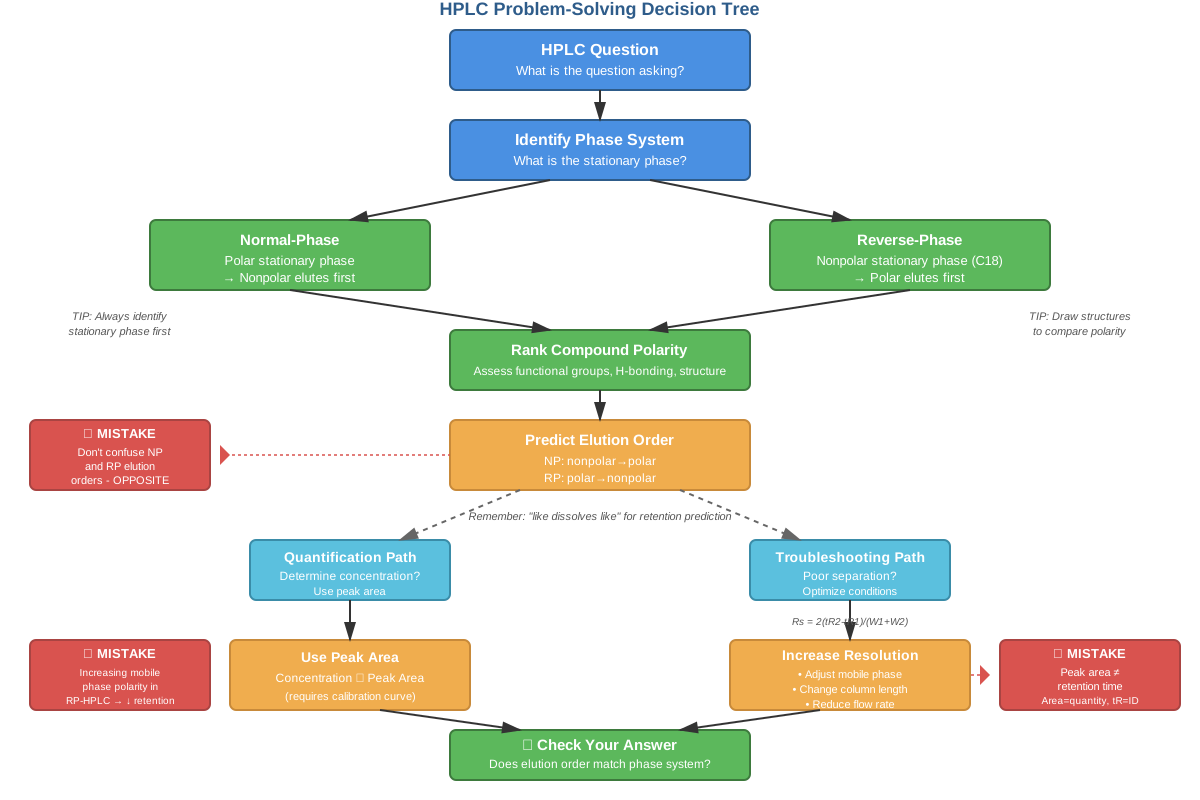
When approaching HPLC MCAT questions, first identify whether the passage describes normal-phase or reverse-phase chromatography—this determines whether polar or nonpolar compounds elute first. Look for explicit statements about stationary phase composition (silica = normal-phase; C18/C8 = reverse-phase) or mobile phase composition (organic solvents = normal-phase; aqueous solutions = reverse-phase).
Trigger words indicating HPLC questions include: "chromatogram," "retention time," "elution order," "mobile phase," "stationary phase," "resolution," and "peak area." Questions asking to "predict which compound elutes first" test understanding of polarity and phase interactions. Questions presenting chromatograms and asking to "identify the compound" or "determine concentration" test data interpretation skills.
For elution order questions, use this systematic approach:
- Identify the HPLC mode (normal vs. reverse-phase)
- Rank compounds by polarity (assess functional groups)
- Apply the rule: normal-phase elutes nonpolar first; reverse-phase elutes polar first
- Eliminate answer choices that violate this principle
When analyzing chromatograms, remember that retention time identifies compounds (x-axis position) while peak area quantifies amount (integrated signal). Questions asking about concentration always refer to peak area, not height. If a question asks which peak represents a specific compound, compare the retention time to reference values or predict based on polarity.
For troubleshooting questions about poor separation, consider:
- Insufficient retention: Increase stationary phase interaction (decrease mobile phase elution strength)
- Poor selectivity: Change mobile phase composition or pH, or use different stationary phase
- Peak overlap: Increase resolution by optimizing retention and selectivity
Time management: HPLC questions typically appear in passages with chromatogram figures. Spend 30-45 seconds examining the chromatogram before reading questions—identify the number of peaks, their relative retention times, and any trends. This preview enables faster question answering. Don't get bogged down calculating exact resolution or capacity factors unless explicitly required; the MCAT emphasizes conceptual understanding over mathematical computation.
Process of elimination: Wrong answers often confuse normal-phase and reverse-phase behavior (stating polar compounds elute last in reverse-phase) or misidentify what peak characteristics indicate (claiming peak height quantifies amount). Eliminate choices that contradict fundamental principles before evaluating remaining options.
Memory Techniques
Mnemonic for Reverse-Phase HPLC: "Reverse = Retains Repulsive" (nonpolar compounds are retained because they're repulsed by the polar mobile phase and prefer the nonpolar stationary phase)
Mnemonic for Normal-Phase HPLC: "Normal = Nonpolar Now" (nonpolar compounds elute now/first because they don't interact with the polar stationary phase)
Visualization for Phase Systems: Picture reverse-phase as an "oil and water" scenario. The stationary phase is like oil (nonpolar C18 chains), and the mobile phase is like water (polar aqueous solution). Nonpolar molecules dissolve in the "oil" stationary phase and move slowly, while polar molecules stay in the "water" mobile phase and move quickly.
Acronym for Chromatogram Analysis: "TRAP"
- Time = retention time (identifies compound)
- Resolution = separation quality
- Area = quantifies amount
- Position = elution order
Memory aid for mobile phase effects in reverse-phase: "More Organic = More Out" (increasing organic content in reverse-phase mobile phase pushes nonpolar compounds out faster, decreasing retention times)
Conceptual anchor: Remember that HPLC is just "like dissolves like" in action. Compounds spend more time in whichever phase they're more similar to. In reverse-phase, nonpolar compounds "like" the nonpolar stationary phase and stick around longer.
Summary
High-Performance Liquid Chromatography (HPLC) separates mixture components by exploiting differential interactions between analytes and two phases under high pressure. The technique exists in two primary modes: normal-phase (polar stationary phase, nonpolar mobile phase, nonpolar compounds elute first) and reverse-phase (nonpolar stationary phase, polar mobile phase, polar compounds elute first). Reverse-phase dominates modern applications, using C18 or C8 columns with aqueous-organic mobile phases. Separation quality depends on selectivity, efficiency, and retention, all of which can be optimized by adjusting mobile phase composition, pH, or stationary phase chemistry. Chromatograms display detector response versus time, with retention time identifying compounds and peak area quantifying amounts. For the MCAT, success requires understanding how molecular structure and polarity determine elution order, interpreting chromatographic data, and predicting how experimental modifications affect separation. HPLC integrates fundamental organic chemistry concepts—intermolecular forces, polarity, and functional group behavior—into a practical analytical technique that appears regularly in experimental passages testing data interpretation and conceptual reasoning.
Key Takeaways
- Reverse-phase HPLC (nonpolar stationary phase, polar mobile phase) is the dominant mode, eluting polar compounds first and nonpolar compounds last
- In reverse-phase systems, increasing mobile phase organic content decreases retention times by better solvating nonpolar analytes
- Retention time identifies compounds based on their characteristic elution position, while peak area quantifies the amount present
- Normal-phase HPLC inverts the polarity relationship, using polar stationary phase and nonpolar mobile phase, causing nonpolar compounds to elute first
- Separation quality (resolution) depends on selectivity, efficiency, and retention—all optimizable through mobile phase composition, gradient elution, or stationary phase selection
- HPLC questions on the MCAT emphasize predicting elution order based on molecular polarity and interpreting chromatogram data rather than memorizing specific retention times
- Understanding intermolecular forces and "like dissolves like" principles enables prediction of phase interactions and retention behavior
Related Topics
Thin-Layer Chromatography (TLC): Uses the same separation principles as HPLC but in a planar format with gravity-driven mobile phase flow; understanding HPLC directly translates to TLC interpretation
Gas Chromatography (GC): Applies similar chromatographic principles but uses gaseous mobile phase, limiting applications to volatile compounds; comparing GC and HPLC reinforces understanding of phase interactions
Spectroscopy (UV-Vis, IR, NMR, Mass Spectrometry): Often coupled with HPLC for compound identification; mastering HPLC enables understanding of hyphenated techniques like LC-MS
Intermolecular Forces: The fundamental basis for all chromatographic separations; deeper understanding of hydrogen bonding, dipole interactions, and dispersion forces enhances HPLC mastery
Acid-Base Chemistry: Controls ionization state of analytes, dramatically affecting retention in HPLC; understanding pKa and pH relationships enables prediction of retention behavior for ionizable compounds
Protein Purification: Applies HPLC principles to biomolecule separation; understanding HPLC fundamentals enables progression to biochemical applications
Practice CTA
Now that you've mastered the core concepts of HPLC, it's time to solidify your understanding through active practice. Challenge yourself with MCAT-style passages featuring chromatogram interpretation, elution order predictions, and experimental troubleshooting scenarios. Work through the practice questions to test your ability to apply these principles under exam conditions, and use flashcards to reinforce high-yield facts and common misconceptions. Remember: understanding HPLC isn't just about memorizing which compounds elute first—it's about developing the analytical reasoning skills to predict separation behavior from first principles. Every practice question you complete strengthens the neural pathways that will serve you on test day. You've got this!
Sign up free to keep reading
Create a free AnvayaPrep account to finish this MCAT guide on HPLC — plus flashcards and practice questions.