Overview
Base strength is a fundamental concept in Organic Chemistry that plays a critical role in understanding reaction mechanisms, particularly in Substitution and Elimination reactions. On the MCAT, the ability to predict and compare base strength determines success in questions involving E1, E2, SN1, and SN2 mechanisms, as well as acid-base equilibria that appear throughout the Chemical and Physical Foundations section. Base strength refers to a species' ability to accept a proton (H⁺) and is quantitatively measured by the equilibrium constant for proton acceptance. Unlike nucleophilicity, which describes the rate at which a species donates electrons to an electrophilic carbon, base strength is a thermodynamic property that reflects equilibrium stability.
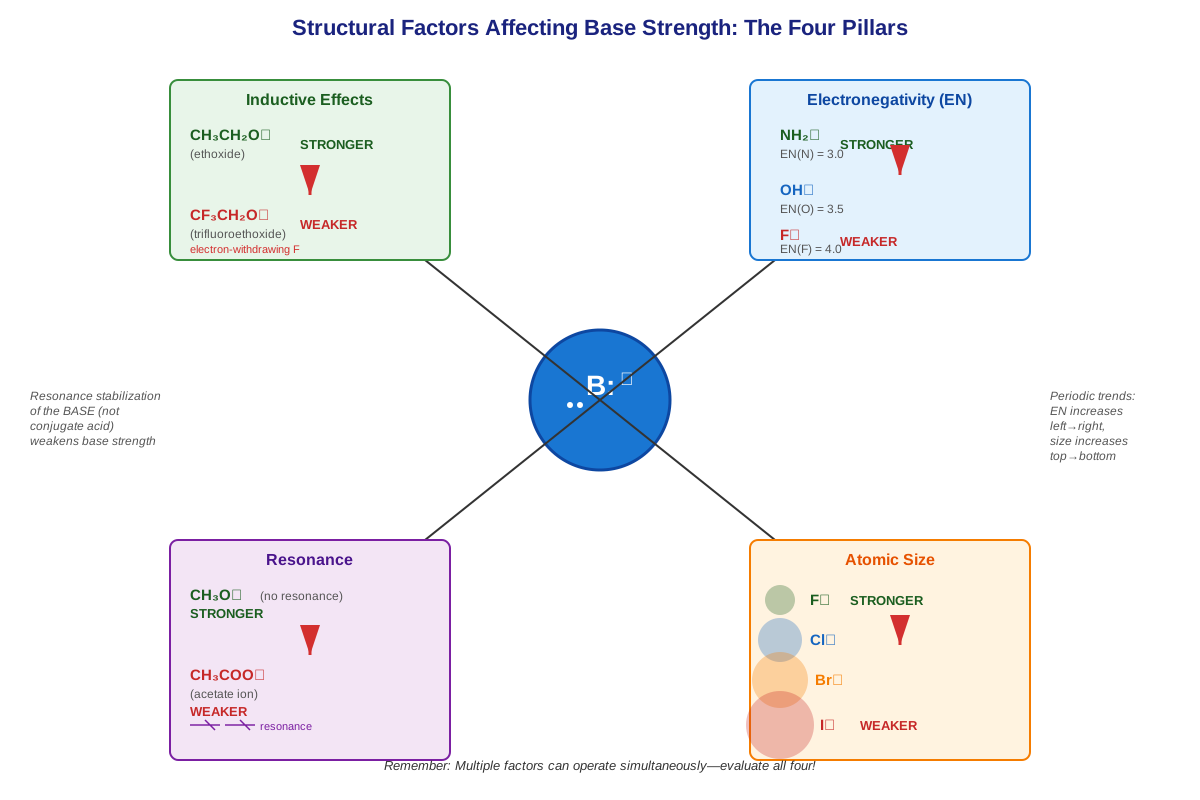
Understanding Base strength Organic Chemistry requires mastery of structural factors that influence a molecule's affinity for protons: electronegativity, atomic size, resonance stabilization, inductive effects, and hybridization. These factors determine whether a base will preferentially abstract a proton (leading to elimination) or attack an electrophilic carbon (leading to substitution). The MCAT frequently tests the distinction between strong bases (which favor E2 mechanisms) and weak bases (which may allow SN2 or SN1 pathways), making this topic essential for predicting reaction outcomes.
The relationship between base strength and other Organic Chemistry concepts extends beyond substitution and elimination reactions. Base strength connects to acid-base equilibria (pKa relationships), resonance theory, molecular orbital theory, and reaction kinetics. Students who master base strength gain a powerful predictive tool for analyzing complex reaction schemes, interpreting experimental data in passages, and solving discrete questions that require rapid comparison of molecular structures. This topic represents high-yield content that appears in approximately 15-20% of Organic Chemistry questions on the MCAT, making it an essential investment of study time.
Learning Objectives
- [ ] Define Base strength using accurate Organic Chemistry terminology
- [ ] Explain why Base strength matters for the MCAT
- [ ] Apply Base strength to exam-style questions
- [ ] Identify common mistakes related to Base strength
- [ ] Connect Base strength to related Organic Chemistry concepts
- [ ] Predict relative base strengths by analyzing structural features including electronegativity, size, resonance, and inductive effects
- [ ] Distinguish between base strength (thermodynamic) and nucleophilicity (kinetic) and explain when each property determines reaction outcomes
- [ ] Use pKa values of conjugate acids to rank bases quantitatively and predict reaction equilibria
Prerequisites
- Acid-base equilibria and pKa/pKb relationships: Base strength is quantitatively related to the pKa of the conjugate acid through the relationship pKa + pKb = 14; understanding equilibrium constants is essential for comparing bases
- Lewis structures and formal charges: Accurate assessment of base strength requires proper identification of lone pairs, formal charges, and electron distribution in molecules
- Electronegativity trends: The ability of atoms to attract electrons directly influences their willingness to share lone pairs with protons
- Resonance and electron delocalization: Resonance stabilization of the conjugate acid affects base strength by altering the equilibrium position
- Molecular orbital theory basics: Understanding hybridization (sp, sp², sp³) explains differences in base strength based on orbital character
- SN1, SN2, E1, and E2 mechanisms: Base strength determines which reaction pathway predominates under given conditions
Why This Topic Matters
Base strength MCAT questions appear with high frequency because they integrate multiple fundamental concepts and require analytical thinking rather than memorization. Clinical applications include understanding drug metabolism (many pharmaceuticals contain basic nitrogen groups), buffer systems in biological fluids, and enzyme mechanisms that involve proton transfer steps. The Henderson-Hasselbalch equation, which governs physiological pH regulation, depends directly on base strength principles.
On the MCAT, base strength appears in several question formats: discrete questions asking for direct comparison of base strength, passage-based questions requiring prediction of reaction mechanisms based on reagent basicity, and data interpretation questions where experimental results depend on acid-base equilibria. Approximately 3-5 questions per exam directly test base strength, with many additional questions requiring this knowledge as foundational understanding. The Chemical and Physical Foundations section frequently presents reaction schemes where students must identify whether a strong base will cause elimination or whether a weak base allows substitution.
Common passage contexts include: synthetic organic chemistry schemes requiring reagent selection, biochemical pathways involving amino acids (which contain both acidic and basic groups), pharmaceutical development passages discussing drug protonation states, and experimental passages measuring reaction rates under varying pH conditions. The ability to rapidly assess base strength from molecular structure provides a significant time advantage, as these questions often appear as "speed bumps" designed to separate well-prepared students from those relying on memorization alone.
Core Concepts
Definition of Base Strength
Base strength is defined as the equilibrium constant for the reaction of a base (B) with a proton (H⁺) to form the conjugate acid (BH⁺):
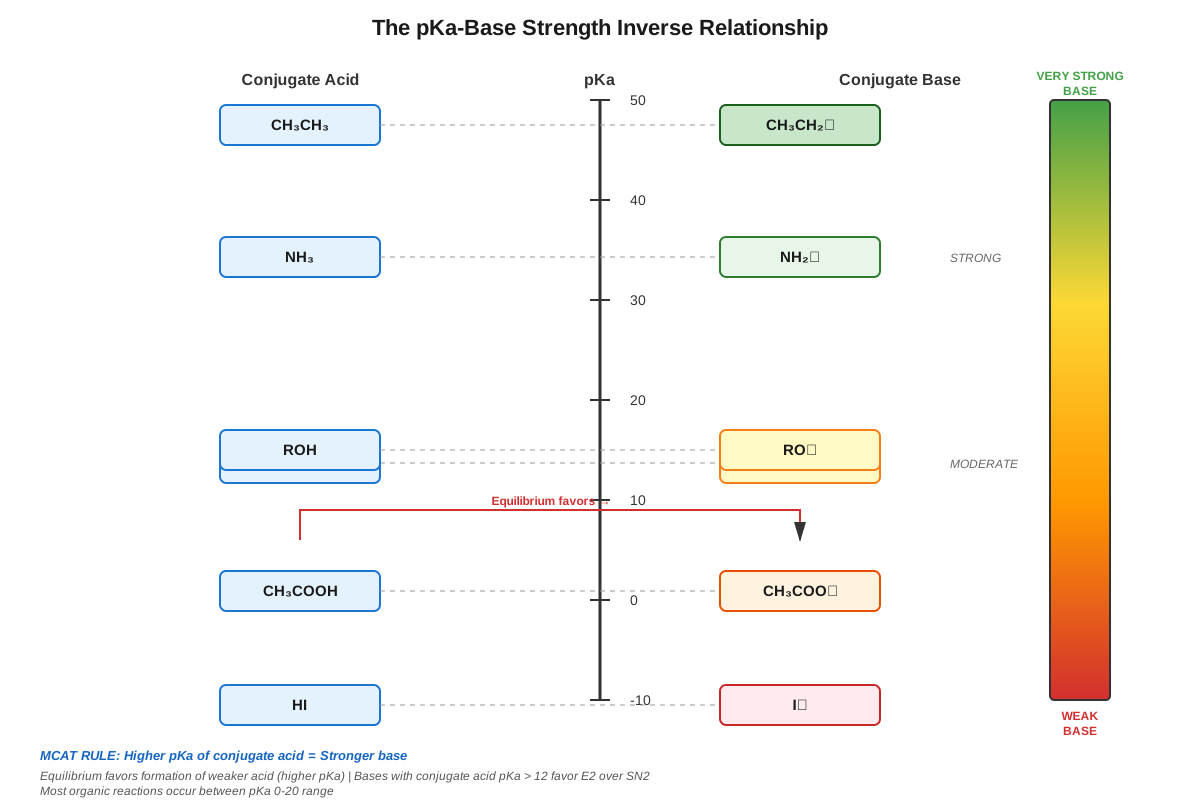
B + H⁺ ⇌ BH⁺The equilibrium constant for this reaction is Kb (base dissociation constant). A stronger base has a larger Kb value, indicating greater affinity for protons and a more favorable equilibrium toward the conjugate acid. In Organic Chemistry, base strength is most commonly assessed using the pKa of the conjugate acid: a stronger base has a conjugate acid with a higher pKa value. This inverse relationship is crucial: the weaker the conjugate acid, the stronger the base.
The quantitative relationship is:
pKa (conjugate acid) + pKb (base) = 14 (at 25°C in water)For MCAT purposes, comparing pKa values of conjugate acids provides the most efficient method for ranking base strength. A base whose conjugate acid has pKa = 35 is much stronger than a base whose conjugate acid has pKa = 10.
Structural Factors Affecting Base Strength
Electronegativity
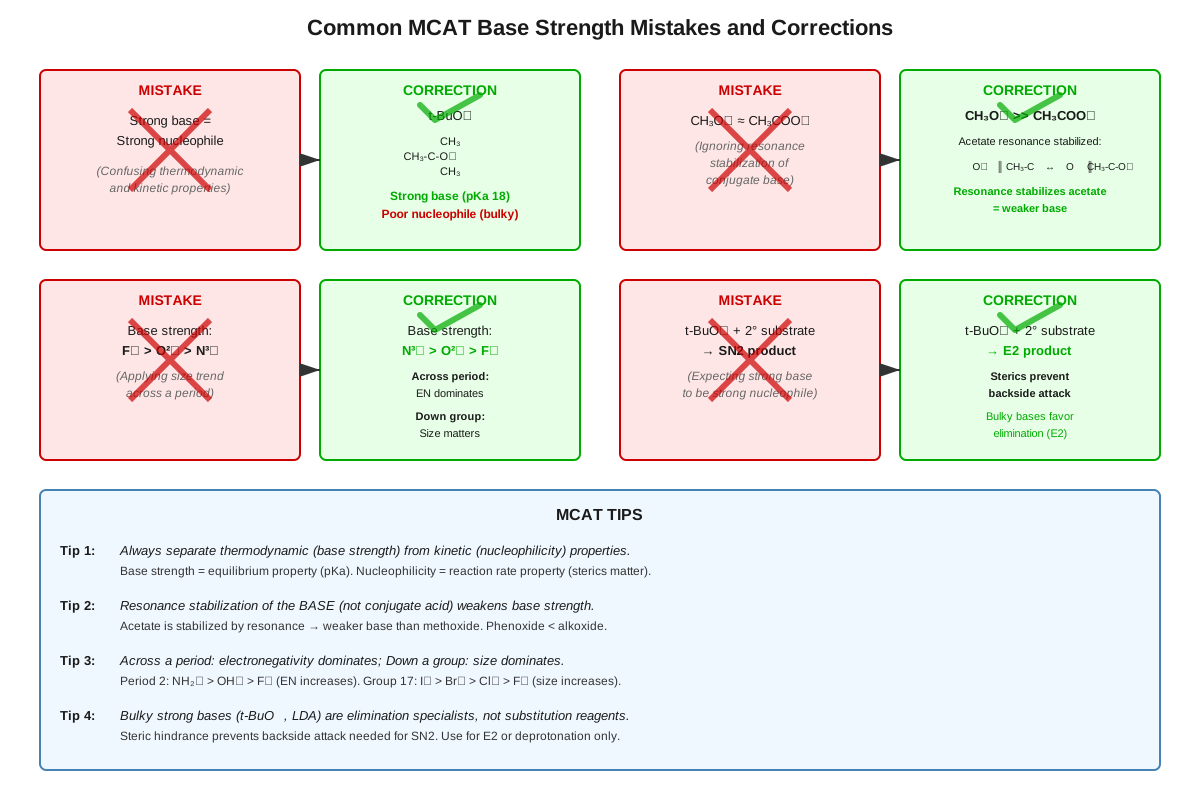
Electronegativity is the most important factor determining base strength across a period of the periodic table. More electronegative atoms hold their lone pair electrons more tightly and are less willing to share them with a proton, making them weaker bases. The trend across period 2 is:
CH₃⁻ > NH₂⁻ > OH⁻ > F⁻
(strongest base)        (weakest base)
Carbon is the least electronegative, making carbanions extremely strong bases (pKa of CH₄ ≈ 50). Nitrogen is less electronegative than oxygen, making amines stronger bases than alcohols. Fluoride is the weakest base among these despite having a full negative charge because fluorine's high electronegativity stabilizes the lone pair.
Atomic Size and Polarizability
Down a group in the periodic table, atomic size becomes the dominant factor. Larger atoms have more diffuse electron clouds, making their lone pairs less available for bonding with protons. Additionally, the conjugate acid's bond to a larger atom is weaker (longer bond length), making the conjugate acid more acidic and the base weaker:
NH₂⁻ > PH₂⁻
OH⁻ > SH⁻
F⁻ > Cl⁻ > Br⁻ > I⁻
(strongest)    (weakest)
This trend explains why thiols (RSH) are more acidic than alcohols (ROH), and consequently why thiolate anions (RS⁻) are weaker bases than alkoxide anions (RO⁻).
Resonance Stabilization
Resonance stabilization of the conjugate acid decreases base strength by stabilizing the protonated form, shifting the equilibrium toward BH⁺. Conversely, resonance stabilization of the base itself (before protonation) decreases base strength by making the base more stable and less reactive.
Consider the comparison between ammonia (NH₃) and aniline (C₆H₅NH₂):
- Ammonia: pKb ≈ 4.75 (pKa of NH₄⁺ ≈ 9.25)
- Aniline: pKb ≈ 9.4 (pKa of C₆H₅NH₃⁺ ≈ 4.6)
Aniline is a much weaker base because the nitrogen lone pair is delocalized into the aromatic ring through resonance. When aniline is protonated, this resonance stabilization is lost (the lone pair is now bonded to H⁺), making protonation less favorable.
Amide ions (RCONH⁻) are weaker bases than alkoxide ions (RO⁻) despite nitrogen being less electronegative than oxygen because the negative charge on nitrogen is delocalized through resonance with the carbonyl group.
Inductive Effects
Inductive effects involve the withdrawal or donation of electron density through sigma bonds. Electron-withdrawing groups (EWGs) decrease base strength by pulling electron density away from the basic site, making the lone pair less available. Electron-donating groups (EDGs) increase base strength by increasing electron density at the basic site.
For example, comparing ethoxide (CH₃CH₂O⁻) with trifluoroethoxide (CF₃CH₂O⁻):
- Ethoxide: stronger base (pKa of ethanol ≈ 16)
- Trifluoroethoxide: weaker base (pKa of trifluoroethanol ≈ 12)
The three fluorine atoms withdraw electron density through the sigma bonds, stabilizing the negative charge on oxygen and making trifluoroethoxide a weaker base.
Alkyl groups are electron-donating through hyperconjugation and inductive effects, making substituted amines stronger bases than ammonia:
(CH₃)₃N > (CH₃)₂NH > CH₃NH₂ > NH₃However, this trend is complicated by solvation effects and steric hindrance in protic solvents.
Hybridization
The hybridization of the atom bearing the lone pair significantly affects base strength. Electrons in orbitals with more s-character are held closer to the nucleus and are less available for bonding:
sp³ > sp² > sp
(strongest base)  (weakest base)
This explains why:
- Alkylamines (sp³ nitrogen) are stronger bases than pyridine (sp² nitrogen)
- Alkoxide ions (sp³ oxygen) are stronger bases than carboxylate ions (sp² oxygen, also resonance-stabilized)
- Alkyl anions (sp³ carbon) are stronger bases than vinyl anions (sp² carbon) or alkynyl anions (sp carbon)
The pKa values of conjugate acids reflect this:
- Ethane (sp³ C-H): pKa ≈ 50
- Ethene (sp² C-H): pKa ≈ 44
- Ethyne (sp C-H): pKa ≈ 25
Base Strength vs. Nucleophilicity
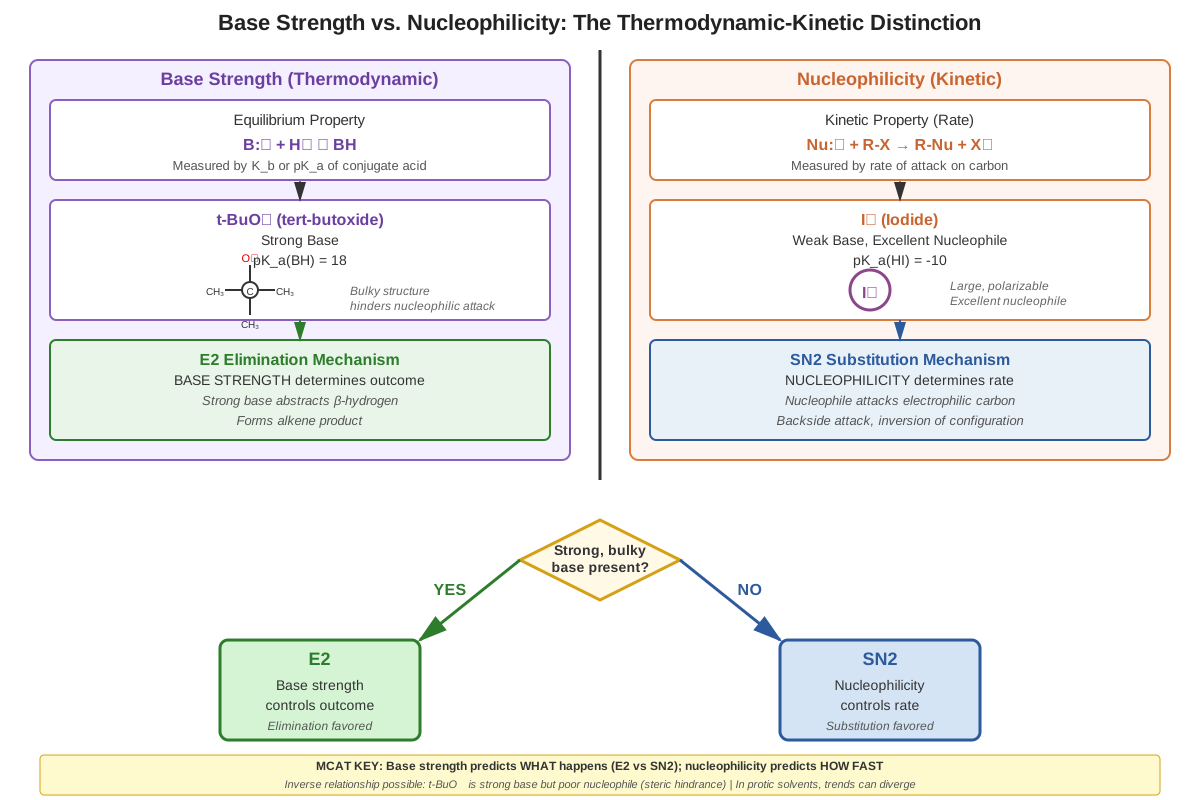
A critical distinction for Substitution and Elimination reactions is that base strength is a thermodynamic property (equilibrium constant) while nucleophilicity is a kinetic property (reaction rate). These properties often correlate but can diverge significantly:
| Property | Measures | Solvent Dependence | Key Factors |
|---|---|---|---|
| Base Strength | Equilibrium position for proton acceptance | Moderate | Stability of conjugate acid |
| Nucleophilicity | Rate of attack on electrophilic carbon | Strong | Polarizability, solvation, steric access |
In protic solvents, small, highly charged bases (like F⁻) are strongly solvated, decreasing their nucleophilicity despite moderate base strength. In aprotic solvents, base strength and nucleophilicity correlate more closely.
For E2 vs. SN2 competition:
- Strong, bulky bases (like tert-butoxide) favor E2 elimination
- Weak, small bases (like I⁻) favor SN2 substitution
- Moderate bases (like Br⁻, Cl⁻) can do either depending on substrate and conditions
Quantitative Comparison Using pKa
The most efficient MCAT strategy for comparing base strength is using pKa values of conjugate acids:
Higher pKa of conjugate acid = Stronger base
Common pKa values to memorize:
| Conjugate Acid | pKa | Base | Relative Strength |
|---|---|---|---|
| H₂O | 15.7 | OH⁻ | Strong base |
| ROH (alcohols) | 15-16 | RO⁻ | Strong base |
| NH₄⁺ | 9.25 | NH₃ | Weak base |
| RNH₃⁺ | 10-11 | RNH₂ | Weak base |
| H₂O | -1.7 | H₃O⁺ | Not a base |
| Carboxylic acids | 4-5 | RCOO⁻ | Very weak base |
When comparing two bases, find the pKa of their conjugate acids. The base whose conjugate acid has the higher pKa is the stronger base.
Quick check — test yourself on Base strength so far.
Try Flashcards →Concept Relationships
Base strength serves as a central organizing principle connecting multiple Organic Chemistry concepts. The relationship map flows as follows:
Molecular Structure (electronegativity, size, hybridization) → Electronic Effects (resonance, inductive effects) → Base Strength (thermodynamic stability) → Reaction Mechanism Selection (E2 vs. SN2 vs. E1 vs. SN1)
Base strength directly determines reaction outcomes in Substitution and Elimination reactions:
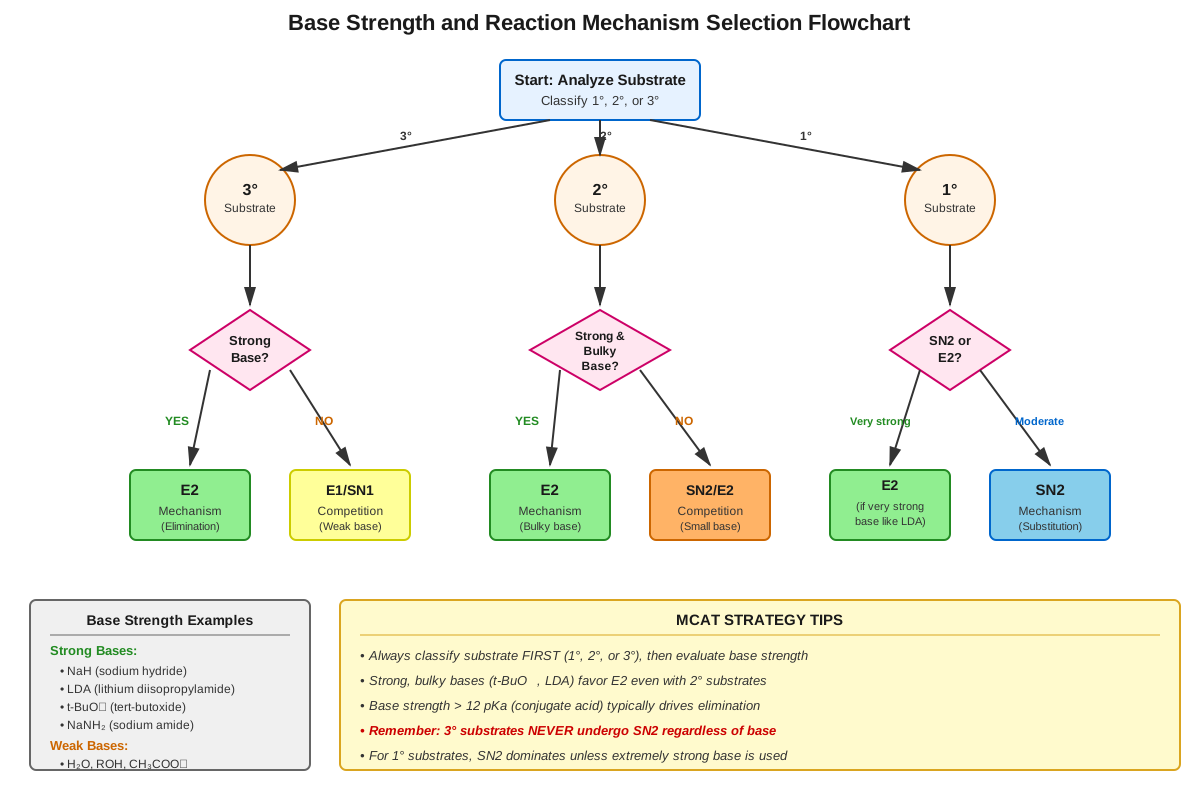
- Strong bases (pKa of conjugate acid > 12) favor E2 elimination, especially with bulky bases and secondary/tertiary substrates
- Weak bases (pKa of conjugate acid < 12) allow SN2 substitution with primary substrates or SN1/E1 with tertiary substrates
The connection to acid-base equilibria is bidirectional: understanding pKa relationships allows prediction of base strength, while base strength knowledge enables prediction of equilibrium positions in proton transfer reactions. This connects to buffer systems and pH calculations in biochemistry contexts.
Base strength also relates to leaving group ability: good leaving groups are weak bases (conjugate bases of strong acids). The inverse relationship means that strong bases are poor leaving groups, explaining why hydroxide (OH⁻) and alkoxide (RO⁻) groups require activation (protonation or conversion to tosylate/mesylate) before substitution can occur.
The connection to resonance theory is particularly important: any structural feature that stabilizes the base through resonance decreases base strength, while features that stabilize the conjugate acid increase base strength. This principle extends to aromatic chemistry, where substituent effects on aromatic rings alter the basicity of attached groups through resonance and inductive effects.
High-Yield Facts
⭐ Base strength is inversely related to the acidity of the conjugate acid: A stronger base has a conjugate acid with a higher pKa value.
⭐ Across a period, electronegativity dominates: Base strength decreases from left to right (C⁻ > N⁻ > O⁻ > F⁻).
⭐ Down a group, atomic size dominates: Base strength decreases down a group (F⁻ > Cl⁻ > Br⁻ > I⁻).
⭐ Strong bases favor E2 elimination: Bases with conjugate acid pKa > 12 (like OH⁻, RO⁻, NH₂⁻) preferentially abstract protons rather than attack carbons.
⭐ Resonance delocalization of the base decreases base strength: Aniline is a weaker base than ammonia because the nitrogen lone pair is delocalized into the aromatic ring.
- Hybridization affects base strength: sp³ > sp² > sp (more s-character = weaker base).
- Electron-withdrawing groups decrease base strength through inductive effects (CF₃CH₂O⁻ is weaker than CH₃CH₂O⁻).
- Alkyl groups increase base strength of amines through electron donation: (CH₃)₃N > NH₃ in gas phase.
- Amide ions (R₂N⁻) are stronger bases than hydroxide (OH⁻) because nitrogen is less electronegative than oxygen.
- Carbanions are extremely strong bases (pKa of conjugate acid typically > 40) and are rarely stable in solution.
- Pyridine is a weaker base than aliphatic amines because the lone pair occupies an sp² orbital rather than sp³.
- Good leaving groups are weak bases: the conjugate bases of strong acids (pKa < 0) make the best leaving groups.
- Steric hindrance around the basic site can decrease base strength by destabilizing the conjugate acid through steric strain.
Common Misconceptions
Misconception: Nucleophilicity and base strength are the same property.
Correction: Base strength is thermodynamic (equilibrium constant for proton acceptance) while nucleophilicity is kinetic (rate of attack on carbon). In protic solvents, these can diverge significantly—iodide is a weak base but excellent nucleophile due to high polarizability and weak solvation.
Misconception: A negative charge always indicates a strong base.
Correction: Charge is only one factor. Carboxylate ions (RCOO⁻) carry a negative charge but are very weak bases (pKa of conjugate acid ≈ 4-5) due to resonance stabilization. Conversely, neutral ammonia (NH₃) is a reasonably strong base (pKa of conjugate acid ≈ 9.25).
Misconception: Larger atoms make stronger bases because they have more electrons.
Correction: Larger atoms make weaker bases because their electron clouds are more diffuse and less available for bonding with protons. This is why OH⁻ is a stronger base than SH⁻, despite sulfur being larger.
Misconception: Electron-donating groups always increase base strength.
Correction: The effect depends on where the electron density goes. Alkyl groups on nitrogen increase base strength by donating to nitrogen. However, alkyl groups on the conjugate acid can cause steric hindrance that destabilizes the protonated form, potentially decreasing base strength in sterically crowded molecules.
Misconception: All amines are stronger bases than all oxygen-containing bases.
Correction: While nitrogen is generally less electronegative than oxygen (favoring stronger bases), structural factors can reverse this trend. Aniline (aromatic amine) is a weaker base than methoxide (CH₃O⁻) because resonance delocalization in aniline significantly reduces base strength.
Misconception: The strongest bases always cause elimination reactions.
Correction: While strong bases favor E2 mechanisms, extremely strong bases can also perform substitution if they are small and unhindered. The key distinction is that bulky strong bases (like tert-butoxide) favor elimination, while small strong bases (like hydroxide) can do either depending on substrate structure and reaction conditions.
Worked Examples
Example 1: Ranking Base Strength
Question: Rank the following species in order of increasing base strength: CH₃OH, CH₃O⁻, CH₃NH₂, CH₃NH⁻
Solution:
Step 1: Identify the conjugate acids and their approximate pKa values.
- CH₃OH is already protonated (conjugate acid is CH₃OH₂⁺, pKa ≈ -2)
- CH₃O⁻ has conjugate acid CH₃OH (pKa ≈ 15.5)
- CH₃NH₂ has conjugate acid CH₃NH₃⁺ (pKa ≈ 10.6)
- CH₃NH⁻ has conjugate acid CH₃NH₂ (pKa ≈ 35)
Step 2: Apply the principle that higher pKa of conjugate acid = stronger base.
Step 3: Rank from lowest to highest pKa of conjugate acid:
CH₃OH (pKa ≈ -2) < CH₃NH₂ (pKa ≈ 10.6) < CH₃O⁻ (pKa ≈ 15.5) < CH₃NH⁻ (pKa ≈ 35)
Answer: CH₃OH < CH₃NH₂ < CH₃O⁻ < CH₃NH⁻ (increasing base strength)
Key Insight: Neutral molecules are weaker bases than their deprotonated anions. The amide anion (CH₃NH⁻) is an extremely strong base because the conjugate acid (CH₃NH₂) is very weak. This connects to Learning Objective 6 (predicting relative base strengths by analyzing structural features).
Example 2: Predicting Reaction Mechanism
Question: When 2-bromopropane is treated with sodium ethoxide (NaOEt) in ethanol at elevated temperature, the major product is propene (elimination product) rather than ethyl isopropyl ether (substitution product). Explain this outcome in terms of base strength.
Solution:
Step 1: Identify the base and assess its strength.
Sodium ethoxide provides ethoxide ion (CH₃CH₂O⁻), which is a strong base. The conjugate acid (ethanol) has pKa ≈ 15.9.
Step 2: Identify the substrate.
2-bromopropane is a secondary alkyl halide, which can undergo both SN2 and E2 reactions.
Step 3: Apply base strength principles to mechanism selection.
Strong bases (pKa of conjugate acid > 12) favor E2 elimination over SN2 substitution, especially with secondary substrates. Ethoxide is both a strong base and moderately bulky, making it an excellent E2 reagent.
Step 4: Consider the E2 mechanism.
In E2, the base abstracts a β-hydrogen while the leaving group (Br⁻) departs simultaneously. The strong base strength of ethoxide makes proton abstraction highly favorable.
Step 5: Explain why substitution is disfavored.
Although ethoxide is also a competent nucleophile, the combination of strong base strength, secondary substrate (which has steric hindrance), and elevated temperature all favor the E2 pathway. The base's affinity for protons (high base strength) outcompetes its affinity for the electrophilic carbon.
Answer: Ethoxide is a strong base (pKa of EtOH ≈ 15.9) that preferentially abstracts β-hydrogens in an E2 mechanism rather than attacking the electrophilic carbon in an SN2 mechanism. The secondary nature of the substrate and elevated temperature further favor elimination.
Key Insight: This example demonstrates the practical application of base strength to Substitution and Elimination reactions, directly addressing Learning Objective 3 (applying base strength to exam-style questions). Strong bases favor elimination, especially with secondary and tertiary substrates.
Exam Strategy
When approaching Base strength MCAT questions, use this systematic strategy:
Step 1: Identify what the question is really asking. Trigger phrases include:
- "Which is the strongest/weakest base?"
- "Which base would favor elimination?"
- "Rank in order of basicity"
- "Which species is most likely to abstract a proton?"
Step 2: Draw or visualize the structures if not provided. Many students make errors by trying to reason abstractly without clear structural representations.
Step 3: Identify the conjugate acids and estimate their pKa values. If exact values aren't known, use periodic trends and structural factors to estimate relative acidity.
Step 4: Apply the inverse relationship: Higher pKa of conjugate acid = stronger base.
Step 5: Check for complicating factors:
- Resonance stabilization (decreases base strength)
- Inductive effects (EWGs decrease, EDGs increase base strength)
- Hybridization (more s-character = weaker base)
- Steric effects (can destabilize conjugate acid)
Process of elimination tips:
- Eliminate any answer choice that violates periodic trends (e.g., claiming F⁻ is a stronger base than OH⁻)
- Eliminate choices that confuse base strength with nucleophilicity
- Be suspicious of choices that ignore resonance stabilization
- Watch for distractors that focus on charge alone without considering stabilization
Time allocation: Base strength comparison questions should take 45-60 seconds. If spending more time, make an educated guess based on periodic trends and move on. These questions reward pattern recognition more than lengthy analysis.
Red flag phrases that indicate the question tests base strength:
- "Abstract a proton"
- "Favor elimination"
- "Equilibrium position"
- "Conjugate acid"
- "pKa comparison"
Memory Techniques
Mnemonic for periodic trends: "CANO" (Carbon, Nitrogen, Oxygen) - base strength decreases left to right
- Carbanions are Awesome bases
- Nitrogen is Nice
- Oxygen is Okay
- (Fluorine is Forgotten - very weak base)
Mnemonic for size trend: "Small Bases Stand Strong" - smaller atoms make stronger bases down a group
- F⁻ > Cl⁻ > Br⁻ > I⁻
Visualization for resonance: Picture electrons "spreading out" like butter on bread - the more spread out (delocalized), the weaker the base. Concentrated electron density = strong base.
Acronym for factors affecting base strength: "SEARCH"
- Size (smaller = stronger)
- Electronegativity (less = stronger)
- Atomic orbital (sp³ > sp² > sp)
- Resonance (less = stronger)
- Charge (negative usually stronger, but not always)
- Hybridization (more s-character = weaker)
Memory aid for E2 vs. SN2: "Strong Bases Eliminate" - if the base has a conjugate acid with pKa > 12, think elimination first, especially with secondary/tertiary substrates.
Rhyme for conjugate acid relationship: "When the acid's pKa is high, the base will reach up to the sky" (strong base). "When the acid's pKa is low, the base has nowhere to go" (weak base).
Summary
Base strength is a thermodynamic property measuring a species' equilibrium affinity for protons, quantified by the pKa of the conjugate acid. Stronger bases have conjugate acids with higher pKa values. The primary structural factors determining base strength follow predictable trends: across a period, electronegativity dominates (making bases weaker from left to right), while down a group, atomic size dominates (making bases weaker down the group). Resonance delocalization, inductive effects, and hybridization provide additional fine-tuning of base strength. For MCAT purposes, distinguishing base strength (thermodynamic) from nucleophilicity (kinetic) is essential for predicting whether substitution or elimination will occur. Strong bases (conjugate acid pKa > 12) favor E2 elimination, particularly with secondary and tertiary substrates, while weaker bases allow SN2 substitution with primary substrates or SN1/E1 pathways with tertiary substrates. Mastery of base strength enables rapid prediction of reaction outcomes, efficient analysis of experimental data, and confident selection of correct answers on exam questions involving acid-base equilibria and organic reaction mechanisms.
Key Takeaways
- Base strength is inversely proportional to conjugate acid acidity: higher pKa of conjugate acid = stronger base
- Electronegativity (across period) and atomic size (down group) are the dominant periodic trends affecting base strength
- Resonance delocalization of the base or conjugate acid significantly alters base strength by stabilizing one form over the other
- Strong bases (pKa of conjugate acid > 12) favor E2 elimination; weak bases allow SN2 substitution or SN1/E1 pathways
- Base strength is thermodynamic (equilibrium) while nucleophilicity is kinetic (rate); these properties correlate but can diverge
- Hybridization affects base strength: sp³ > sp² > sp (more s-character = electrons held closer = weaker base)
- The most efficient MCAT strategy is comparing pKa values of conjugate acids rather than attempting complex structural analysis
Related Topics
Nucleophilicity and Nucleophiles: While base strength measures thermodynamic stability, nucleophilicity measures kinetic reactivity toward electrophilic carbons. Understanding both properties is essential for predicting SN2 vs. E2 competition. Mastering base strength provides the foundation for distinguishing these related but distinct concepts.
Leaving Group Ability: Good leaving groups are weak bases (conjugate bases of strong acids). The inverse relationship between base strength and leaving group ability explains why certain functional group transformations require activation steps.
E1 and E2 Mechanisms: Base strength determines whether elimination occurs through E2 (strong base required) or E1 (weak base sufficient) pathways. This topic builds directly on base strength principles.
Acid-Base Equilibria and pKa: Quantitative understanding of acid-base equilibria provides the mathematical foundation for comparing base strength. This topic extends base strength concepts to buffer calculations and pH predictions.
Resonance and Electron Delocalization: Resonance theory explains many exceptions to simple base strength trends. Mastering resonance enables prediction of how structural modifications alter base strength.
Practice CTA
Now that you've mastered the core concepts of base strength, it's time to solidify your understanding through active practice. Attempt the practice questions to test your ability to rank bases, predict reaction mechanisms, and apply base strength principles to complex scenarios. Use the flashcards to reinforce high-yield facts and memorize key pKa values. Remember: base strength questions reward pattern recognition and systematic analysis. The more you practice identifying structural features and applying periodic trends, the faster and more accurate you'll become. You've built a strong foundation—now transform that knowledge into exam-day confidence through deliberate practice!
Sign up free to keep reading
Create a free AnvayaPrep account to finish this MCAT guide on Base strength — plus flashcards and practice questions.