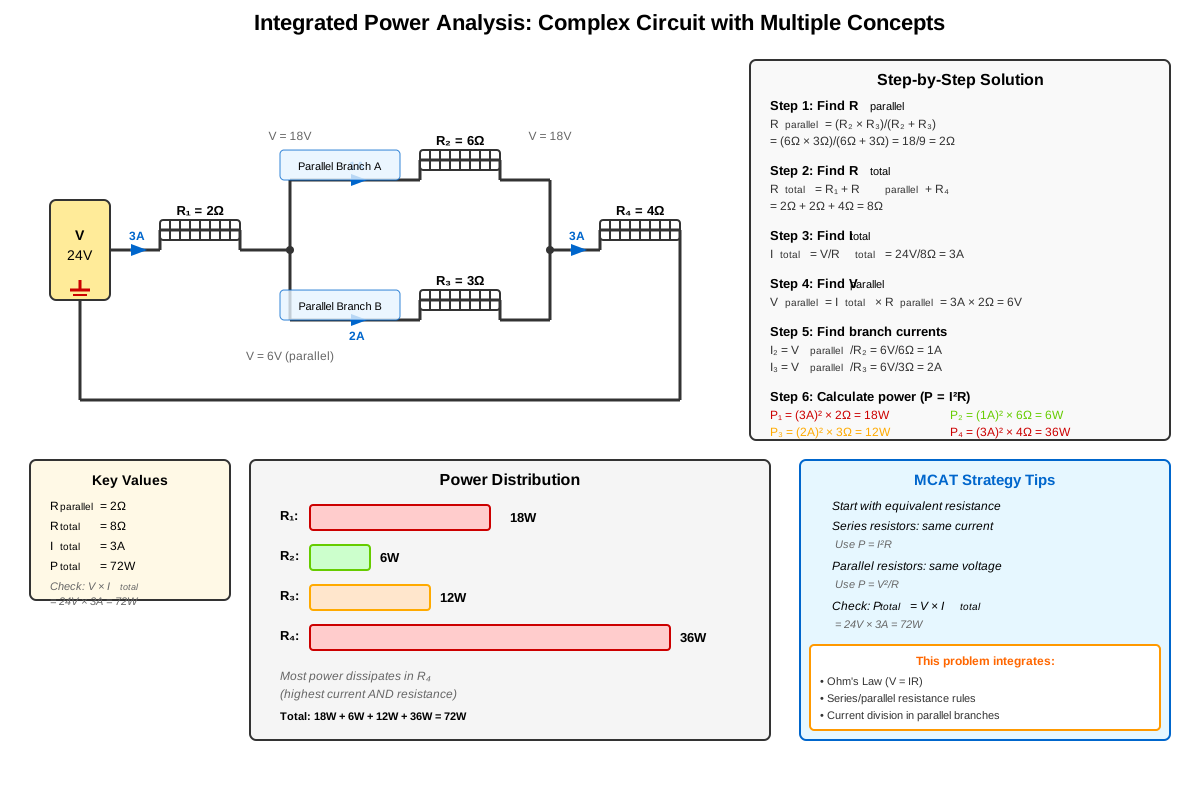
Overview
Power in circuits is a fundamental concept in Electricity and Magnetism that describes the rate at which electrical energy is converted into other forms of energy—such as heat, light, or mechanical work—within an electrical circuit. Understanding power relationships is essential for analyzing circuit behavior, predicting energy dissipation, and solving complex problems involving resistors, batteries, and other circuit elements. On the MCAT, power calculations frequently appear in both discrete questions and passage-based problems, often requiring students to integrate multiple concepts including voltage, current, resistance, and energy conservation.
The concept of Power in circuits Physics extends beyond simple calculations to encompass energy efficiency, heat generation in resistive elements, and the practical limitations of electrical devices. Students must be comfortable manipulating the various forms of the power equation and recognizing when each form is most appropriate for a given problem. This topic serves as a bridge between basic circuit analysis (Ohm's Law, series and parallel circuits) and more advanced applications involving energy transformations and thermodynamic considerations.
For the Power in circuits MCAT, mastery of this topic is non-negotiable. Power calculations appear regularly across multiple question formats, and the ability to quickly identify the appropriate equation and execute calculations efficiently can significantly impact performance. Moreover, power concepts frequently integrate with biological applications—such as nerve conduction, muscle contraction, and medical device function—making this topic particularly high-yield for test preparation. The MCAT expects students to not only perform calculations but also to reason conceptually about energy flow, efficiency, and the physical consequences of power dissipation in various circuit configurations.
Learning Objectives
- [ ] Define Power in circuits using accurate Physics terminology
- [ ] Explain why Power in circuits matters for the MCAT
- [ ] Apply Power in circuits to exam-style questions
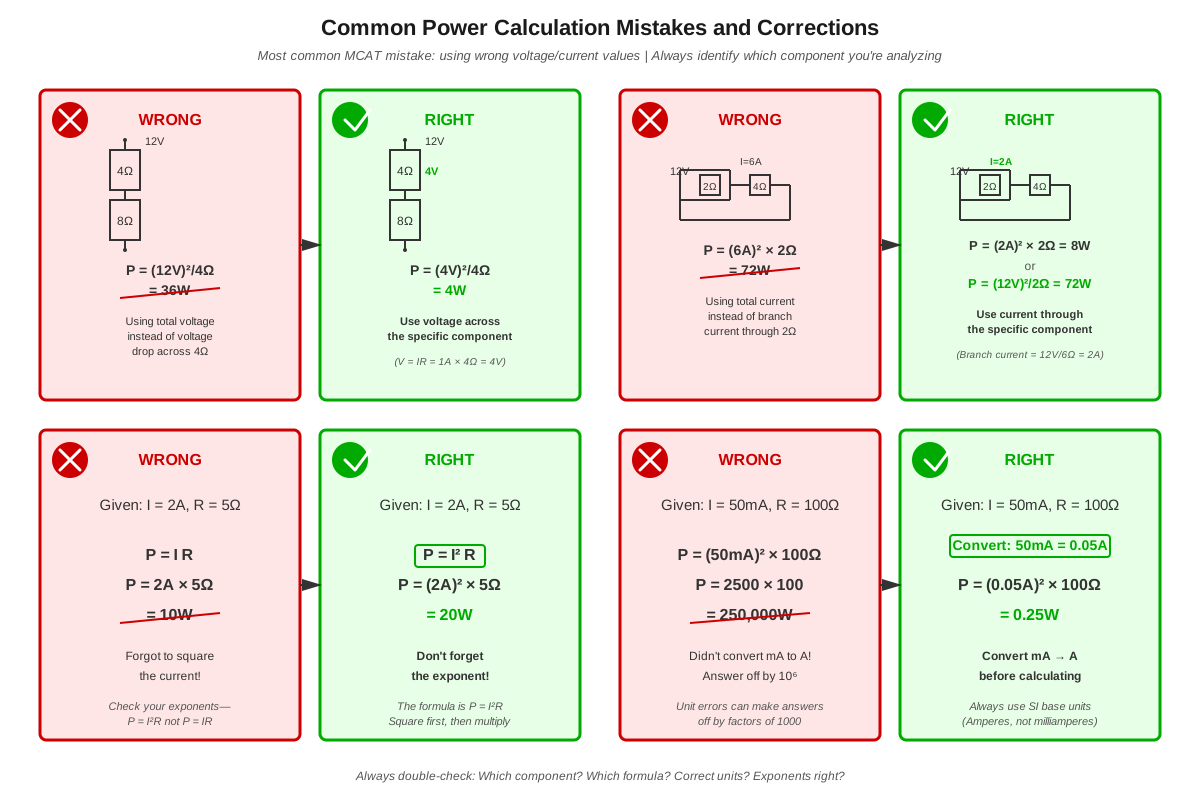
- [ ] Identify common mistakes related to Power in circuits
- [ ] Connect Power in circuits to related Physics concepts
- [ ] Derive and interconvert between the three primary power equations (P = IV, P = I²R, P = V²/R)
- [ ] Analyze power distribution in series and parallel circuit configurations
- [ ] Calculate total power consumption and energy costs in complex circuits
- [ ] Predict the effects of changing circuit parameters on power dissipation
Prerequisites
- Ohm's Law (V = IR): Essential for deriving alternative forms of the power equation and solving for unknown circuit quantities
- Series and parallel circuit analysis: Required to determine voltage drops and current distributions before calculating power in individual components
- Basic algebra and equation manipulation: Necessary for rearranging power equations and solving multi-step problems efficiently
- Energy and work concepts: Provides the foundational understanding that power represents the rate of energy transfer
- Units and dimensional analysis: Critical for verifying calculations and converting between different unit systems (watts, kilowatts, joules per second)
Why This Topic Matters
Clinical and Real-World Significance
Power in circuits has direct applications in medical technology and biological systems. Defibrillators must deliver precise amounts of power to restore normal heart rhythm without causing tissue damage. Electrosurgical units use controlled power dissipation to cut tissue or cauterize blood vessels. Pacemakers must operate within strict power budgets to maximize battery life while delivering effective electrical stimulation. Understanding power relationships helps medical professionals optimize device settings, troubleshoot equipment malfunctions, and ensure patient safety during procedures involving electrical current.
Biological systems themselves operate as electrical circuits. Neurons transmit signals through ion currents that dissipate power as heat. The metabolic cost of maintaining membrane potentials and generating action potentials can be analyzed using circuit power principles. Muscle contraction involves electrical activation that consumes power, and the efficiency of this energy conversion affects athletic performance and metabolic demands.
MCAT Exam Statistics
Power in circuits appears in approximately 8-12% of Physics questions on the MCAT, making it one of the most frequently tested topics within Electricity and Magnetism. Questions typically fall into three categories: (1) direct calculation problems requiring power determination from given circuit parameters, (2) conceptual questions about power distribution in series versus parallel configurations, and (3) passage-based problems integrating power with biological systems or medical devices.
The MCAT commonly presents power questions within passages about nerve conduction, medical imaging equipment, or household electrical systems. Students must be prepared to extract relevant information from complex scenarios, identify which power equation to apply, and execute calculations under time pressure. Questions often include distractors based on common misconceptions, such as confusing power with energy or incorrectly applying power equations to series versus parallel circuits.
Common Exam Presentations
Power questions frequently appear disguised within broader circuit analysis problems. A passage might describe a complex circuit and ask students to determine which resistor dissipates the most power, requiring both circuit analysis skills and power calculations. Other questions present scenarios involving energy costs, asking students to calculate electricity bills based on power consumption over time. The MCAT also tests conceptual understanding by asking how power changes when circuit parameters are modified—for example, what happens to total power when resistors are added in series versus parallel.
Core Concepts
Definition of Electrical Power
Power is defined as the rate at which energy is transferred or converted. In electrical circuits, power represents the rate at which electrical energy is converted into other forms of energy. The fundamental equation for power in circuits is:
P = IVWhere:
- P = power (measured in watts, W)
- I = current (measured in amperes, A)
- V = voltage or potential difference (measured in volts, V)
One watt equals one joule per second (1 W = 1 J/s), establishing the direct relationship between power and energy. This equation states that power equals the product of current flowing through a circuit element and the voltage across that element. When current flows through a potential difference, electrical energy is converted at a rate proportional to both quantities.
The Three Forms of the Power Equation
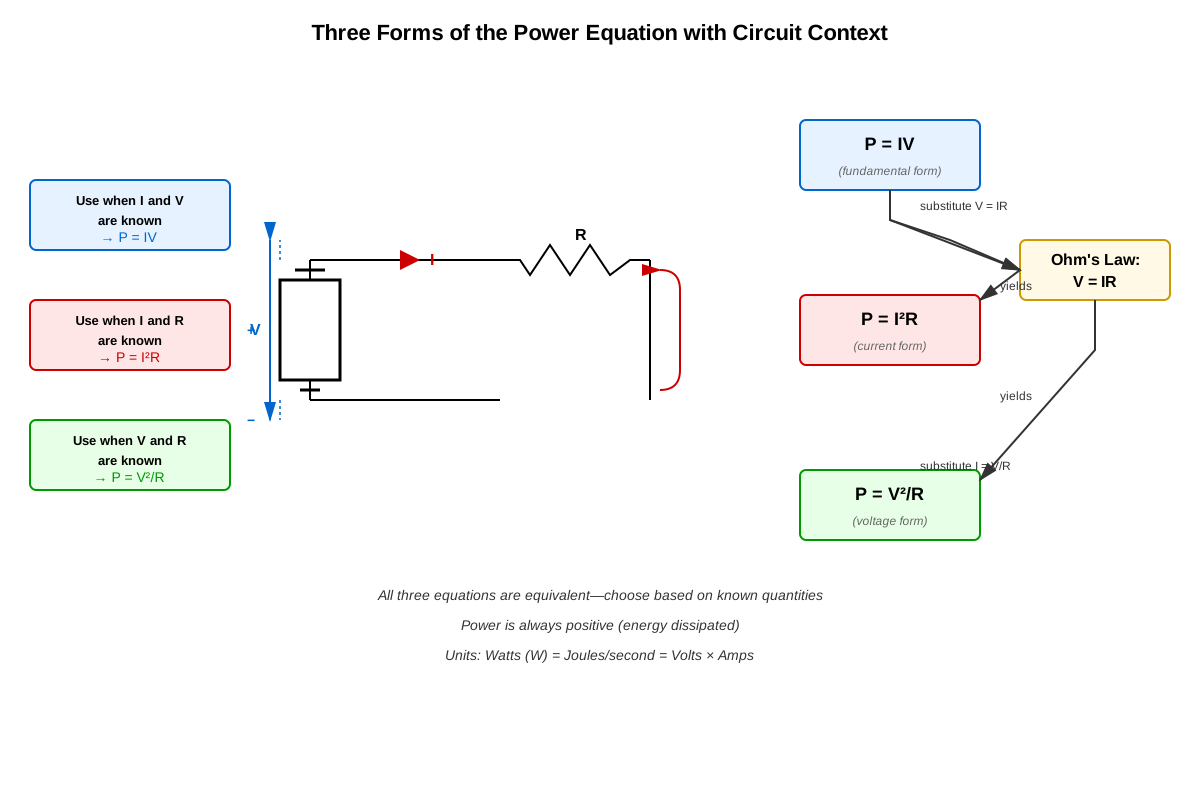
By combining the fundamental power equation (P = IV) with Ohm's Law (V = IR), we can derive two additional forms that are equally valid and often more convenient depending on the given information:
Form 1: P = IV (fundamental definition)
- Use when both current and voltage are known
- Most direct application of the power definition
- Applicable to any circuit element
Form 2: P = I²R (current-based form)
- Derived by substituting V = IR into P = IV
- Use when current and resistance are known
- Particularly useful for analyzing power dissipation in resistors
- Shows that power increases with the square of current
Form 3: P = V²/R (voltage-based form)
- Derived by substituting I = V/R into P = IV
- Use when voltage and resistance are known
- Convenient for parallel circuits where voltage is constant
- Shows that power increases with the square of voltage
These three equations are mathematically equivalent but strategically different. Selecting the appropriate form based on available information saves time and reduces calculation errors on the MCAT.
Power Dissipation in Resistors
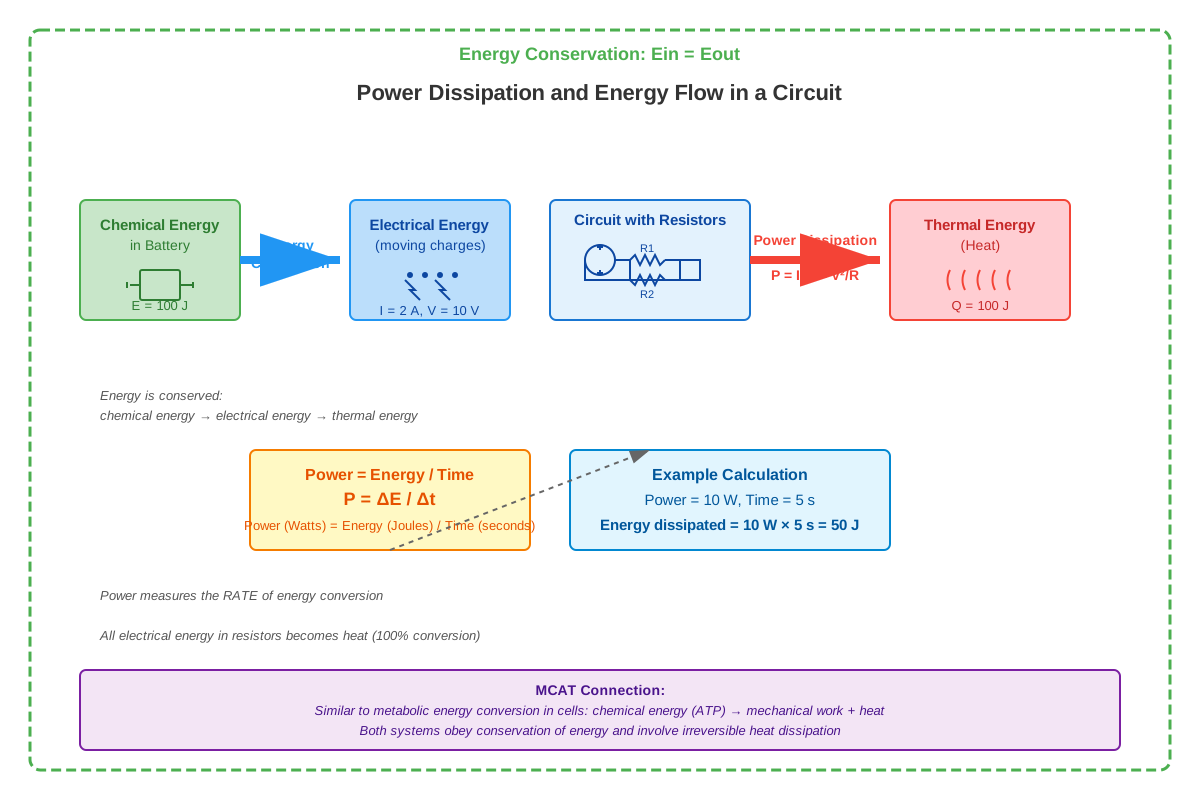
When current flows through a resistor, electrical energy is converted to thermal energy—a process called Joule heating or resistive heating. The power dissipated in a resistor always represents energy lost from the electrical system as heat. This is why electronic devices become warm during operation and why high-power resistors require heat sinks or cooling systems.
The rate of heat generation depends on both the resistance value and the current flowing through it. Doubling the current through a resistor quadruples the power dissipation (since P = I²R), which explains why electrical systems have current limits and why circuit breakers trip when current becomes excessive.
Power in Series Circuits
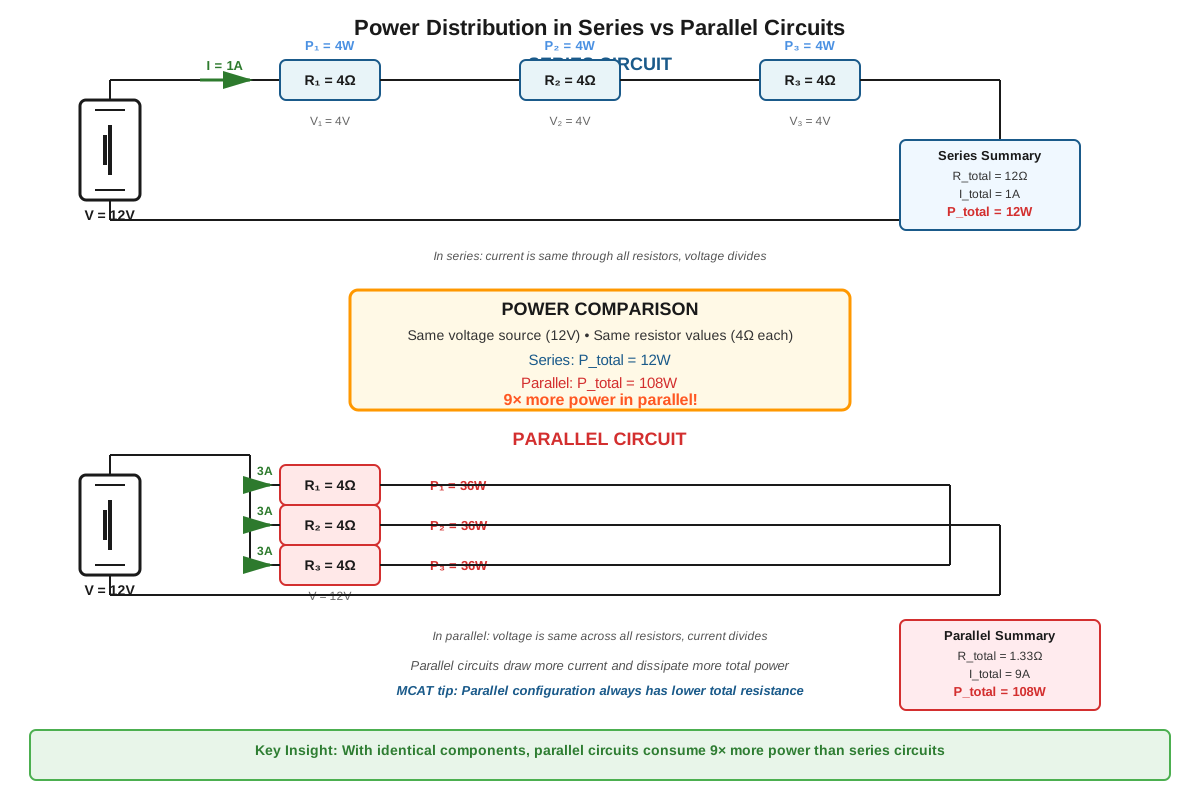
In a series circuit, the same current flows through all components, but voltage divides among them according to their resistances. To analyze power in series circuits:
- The current is identical through all resistors: I₁ = I₂ = I₃ = I_total
- Voltage divides proportionally: V_total = V₁ + V₂ + V₃
- Power dissipated by each resistor: P = I²R (most convenient form)
- Resistors with higher resistance dissipate more power
- Total power: P_total = P₁ + P₂ + P₃
Because current is constant in series circuits, the P = I²R form is typically most efficient. The resistor with the largest resistance will dissipate the most power since P ∝ R when current is constant.
Power in Parallel Circuits
In a parallel circuit, voltage is identical across all branches, but current divides among them according to their resistances. To analyze power in parallel circuits:
- Voltage is identical across all resistors: V₁ = V₂ = V₃ = V_total
- Current divides inversely with resistance: I_total = I₁ + I₂ + I₃
- Power dissipated by each resistor: P = V²/R (most convenient form)
- Resistors with lower resistance dissipate more power
- Total power: P_total = P₁ + P₂ + P₃
Because voltage is constant in parallel circuits, the P = V²/R form is typically most efficient. The resistor with the smallest resistance will dissipate the most power since P ∝ 1/R when voltage is constant.
Power Supplied by Batteries and Sources
Batteries and power sources supply energy to circuits. The power supplied by an ideal battery equals:
P_supplied = εIWhere ε is the electromotive force (emf) of the battery. In real batteries with internal resistance (r), some power is dissipated internally:
P_internal = I²rThe power delivered to the external circuit is:
P_external = P_supplied - P_internal = εI - I²rThis distinction is crucial for understanding battery efficiency and why batteries heat up during use. Maximum power transfer to an external load occurs when the external resistance equals the internal resistance, though this condition results in only 50% efficiency.
Conservation of Energy in Circuits
The principle of energy conservation applies to electrical circuits: the total power supplied by sources must equal the total power dissipated by all circuit elements. This provides a powerful check for circuit calculations:
ΣP_supplied = ΣP_dissipatedFor a simple circuit with one battery and multiple resistors:
εI = I²R₁ + I²R₂ + I²R₃ + ... + I²rThis relationship allows students to verify their work and solve for unknown quantities when some information is missing.
Comparison Table: Power in Series vs. Parallel Circuits
| Property | Series Circuit | Parallel Circuit |
|---|---|---|
| Current distribution | Same through all (I = constant) | Divides among branches |
| Voltage distribution | Divides among components | Same across all (V = constant) |
| Best power equation | P = I²R | P = V²/R |
| Highest power dissipation | Largest resistance | Smallest resistance |
| Effect of adding resistor | Decreases total power | Increases total power |
| Total resistance | R_total = R₁ + R₂ + R₃ | 1/R_total = 1/R₁ + 1/R₂ + 1/R₃ |
Concept Relationships
The concept of power in circuits sits at the intersection of multiple fundamental physics principles. Ohm's Law (V = IR) provides the foundation for deriving alternative forms of the power equation, creating a direct mathematical link between resistance, current, voltage, and power. Understanding this relationship allows students to approach problems flexibly, choosing the most efficient calculation path based on available information.
Energy conservation principles underlie all power calculations. Since power represents the rate of energy transfer (P = E/t), every power problem fundamentally involves energy considerations. This connection becomes explicit when calculating energy consumption over time (E = Pt) or determining electricity costs. The relationship flows: Energy → Power → Circuit Parameters (V, I, R).
Series and parallel circuit analysis determines how voltage and current distribute among circuit elements, which in turn dictates power distribution. The circuit configuration fundamentally changes which components dissipate the most power: in series circuits, high-resistance elements dominate power dissipation, while in parallel circuits, low-resistance elements dominate. This creates the relationship: Circuit Configuration → V and I Distribution → Power Distribution.
Kirchhoff's Laws ensure that power calculations respect conservation principles. Kirchhoff's Current Law guarantees that current entering a junction equals current leaving, while Kirchhoff's Voltage Law ensures that voltage drops sum correctly around loops. These laws provide the framework for analyzing complex circuits before calculating power: Kirchhoff's Laws → Circuit Solution → Power Calculation.
The concept map flows as: Basic Definitions (V, I, R) → Ohm's Law → Power Equations → Circuit Analysis (Series/Parallel) → Power Distribution → Energy Calculations → Real-World Applications. Each level builds on previous concepts, and mastery requires understanding both the mathematical relationships and the physical principles they represent.
High-Yield Facts
⭐ Power is the rate of energy transfer, measured in watts (W), where 1 W = 1 J/s
⭐ The three equivalent power equations are P = IV, P = I²R, and P = V²/R; choose based on known quantities
⭐ In series circuits, the resistor with the largest resistance dissipates the most power (use P = I²R)
⭐ In parallel circuits, the resistor with the smallest resistance dissipates the most power (use P = V²/R)
⭐ Total power supplied by sources must equal total power dissipated by all circuit elements (energy conservation)
- Power dissipated in a resistor always converts electrical energy to thermal energy (Joule heating)
- Doubling the current through a resistor quadruples the power dissipation (P ∝ I²)
- Doubling the voltage across a resistor quadruples the power dissipation (P ∝ V²)
- Adding resistors in series decreases total circuit power; adding resistors in parallel increases total circuit power
- Maximum power transfer to a load occurs when load resistance equals source internal resistance
- Real batteries dissipate power internally due to internal resistance (P_internal = I²r)
- Energy consumed over time equals power multiplied by time (E = Pt), measured in joules or kilowatt-hours
- A 100-watt light bulb converts 100 joules of electrical energy per second into light and heat
- Circuit breakers and fuses protect against excessive power dissipation that could cause fires
- Efficiency equals useful power output divided by total power input, always less than 100% in real systems
Quick check — test yourself on Power in circuits so far.
Try Flashcards →Common Misconceptions
Misconception: Power and energy are the same thing.
Correction: Power is the rate of energy transfer (energy per unit time), not energy itself. Power measures how quickly energy is being converted, while energy measures the total amount converted. A 100 W light bulb uses energy at a rate of 100 J/s, but the total energy consumed depends on how long it operates (E = Pt).
Misconception: The resistor with the highest resistance always dissipates the most power.
Correction: This is only true in series circuits where current is constant. In parallel circuits, the resistor with the lowest resistance dissipates the most power because voltage is constant and P = V²/R. The circuit configuration determines which factor (R or 1/R) dominates the power relationship.
Misconception: All three power equations (P = IV, P = I²R, P = V²/R) can be used interchangeably in any situation.
Correction: While mathematically equivalent, these equations are strategically different. Use P = I²R when current is constant (series circuits), P = V²/R when voltage is constant (parallel circuits), and P = IV when both are known. Using the wrong form requires additional calculations and increases error risk.
Misconception: Adding more resistors to a circuit always increases total power consumption.
Correction: The effect depends on circuit configuration. Adding resistors in series increases total resistance, decreases current, and decreases total power (P = V²/R_total). Adding resistors in parallel decreases total resistance, increases current, and increases total power. This distinction is frequently tested on the MCAT.
Misconception: Power dissipated in a circuit can be negative.
Correction: Power dissipated in resistive elements is always positive—resistors always convert electrical energy to heat, never the reverse. However, power supplied by a battery is considered positive, while power consumed by the circuit is sometimes represented as negative in energy accounting. The magnitude of power dissipation is always positive.
Misconception: Voltage and current are independent variables that can be chosen arbitrarily when calculating power.
Correction: Voltage and current are related through Ohm's Law (V = IR) and cannot be chosen independently for a given resistance. When calculating power, you must use values that are consistent with the circuit constraints. Using inconsistent values leads to incorrect power calculations.
Misconception: A battery supplies constant power regardless of the circuit connected to it.
Correction: A battery supplies approximately constant voltage (emf), not constant power. The power supplied depends on the current drawn, which varies with the external resistance (P = εI). As external resistance changes, current changes, and therefore power supplied changes. Only the voltage remains relatively constant.
Worked Examples
Example 1: Power Distribution in a Series Circuit
Problem: A 12 V battery is connected to three resistors in series: R₁ = 2 Ω, R₂ = 4 Ω, and R₃ = 6 Ω. Calculate (a) the power dissipated by each resistor, (b) the total power dissipated, and (c) verify energy conservation.
Solution:
Step 1: Calculate total resistance
In series: R_total = R₁ + R₂ + R₃ = 2 + 4 + 6 = 12 Ω
Step 2: Calculate circuit current
Using Ohm's Law: I = V/R_total = 12 V / 12 Ω = 1 A
Step 3: Calculate power dissipated by each resistor
Since current is constant in series, use P = I²R:
- P₁ = I²R₁ = (1 A)²(2 Ω) = 2 W
- P₂ = I²R₂ = (1 A)²(4 Ω) = 4 W
- P₃ = I²R₃ = (1 A)²(6 Ω) = 6 W
Step 4: Calculate total power dissipated
P_total = P₁ + P₂ + P₃ = 2 + 4 + 6 = 12 W
Step 5: Verify energy conservation
Power supplied by battery: P_supplied = VI = (12 V)(1 A) = 12 W
This equals P_total, confirming energy conservation. ✓
Key Insights:
- In series circuits, the largest resistor (R₃ = 6 Ω) dissipates the most power
- The P = I²R form was most efficient since current is constant
- Energy conservation provides a valuable check of calculations
Example 2: Power Distribution in a Parallel Circuit
Problem: Three resistors are connected in parallel across a 24 V battery: R₁ = 8 Ω, R₂ = 12 Ω, and R₃ = 24 Ω. Calculate (a) the power dissipated by each resistor, (b) the total power drawn from the battery, and (c) which resistor gets hottest.
Solution:
Step 1: Recognize that voltage is constant across parallel resistors
V₁ = V₂ = V₃ = 24 V
Step 2: Calculate power dissipated by each resistor
Since voltage is constant in parallel, use P = V²/R:
- P₁ = V²/R₁ = (24 V)² / 8 Ω = 576 / 8 = 72 W
- P₂ = V²/R₂ = (24 V)² / 12 Ω = 576 / 12 = 48 W
- P₃ = V²/R₃ = (24 V)² / 24 Ω = 576 / 24 = 24 W
Step 3: Calculate total power
P_total = P₁ + P₂ + P₃ = 72 + 48 + 24 = 144 W
Step 4: Verify using alternative method
Calculate total resistance: 1/R_total = 1/8 + 1/12 + 1/24 = 3/24 + 2/24 + 1/24 = 6/24
R_total = 24/6 = 4 Ω
Total current: I_total = V/R_total = 24 V / 4 Ω = 6 A
Total power: P_total = VI_total = (24 V)(6 A) = 144 W ✓
Step 5: Determine which resistor gets hottest
R₁ dissipates the most power (72 W), so it gets hottest.
Key Insights:
- In parallel circuits, the smallest resistor (R₁ = 8 Ω) dissipates the most power
- The P = V²/R form was most efficient since voltage is constant
- The resistor dissipating the most power experiences the greatest temperature rise
- This explains why low-resistance short circuits are dangerous—they dissipate enormous power
Example 3: Real Battery with Internal Resistance
Problem: A battery with emf ε = 9 V and internal resistance r = 1 Ω is connected to an external resistor R = 8 Ω. Calculate (a) the current, (b) the terminal voltage, (c) power dissipated in the external resistor, (d) power dissipated internally, and (e) the battery's efficiency.
Solution:
Step 1: Calculate current
Total resistance = R + r = 8 + 1 = 9 Ω
I = ε/(R + r) = 9 V / 9 Ω = 1 A
Step 2: Calculate terminal voltage
V_terminal = ε - Ir = 9 V - (1 A)(1 Ω) = 8 V
(Alternatively: V_terminal = IR = (1 A)(8 Ω) = 8 V)
Step 3: Calculate power dissipated in external resistor
P_external = I²R = (1 A)²(8 Ω) = 8 W
(Or: P_external = V_terminal × I = 8 V × 1 A = 8 W)
Step 4: Calculate power dissipated internally
P_internal = I²r = (1 A)²(1 Ω) = 1 W
Step 5: Calculate efficiency
Total power supplied: P_total = εI = (9 V)(1 A) = 9 W
Efficiency = P_external / P_total = 8 W / 9 W = 0.889 = 88.9%
Key Insights:
- Internal resistance reduces terminal voltage below the emf
- Not all power supplied by the battery reaches the external circuit
- Efficiency decreases as internal resistance increases relative to external resistance
- This explains why batteries heat up during use and why battery performance degrades under heavy loads
Exam Strategy
Approaching Power Questions
When encountering a power question on the MCAT, follow this systematic approach:
- Identify the circuit configuration (series, parallel, or mixed) to determine how voltage and current distribute
- List known quantities (V, I, R for each element) and identify what needs to be calculated
- Choose the appropriate power equation based on available information:
- Use P = IV when both voltage and current are known
- Use P = I²R for series circuits or when current is constant
- Use P = V²/R for parallel circuits or when voltage is constant
- Perform necessary preliminary calculations (total resistance, circuit current) before calculating power
- Check your answer using energy conservation: total power supplied must equal total power dissipated
Trigger Words and Phrases
Watch for these key phrases that signal power-related questions:
- "Rate of energy dissipation" → directly asking for power
- "Heat generated" → power dissipated as thermal energy
- "Which resistor gets hottest" → which dissipates the most power
- "Electricity cost" or "energy consumption" → calculate E = Pt, then cost
- "Maximum power transfer" → load resistance equals source resistance
- "Efficiency" → ratio of useful power output to total power input
- "Battery life" → relates to total energy capacity and power drain rate
- "Brightness of bulbs" → power dissipated determines brightness
Process of Elimination Tips
When facing multiple-choice power questions:
- Eliminate answers with incorrect units: Power must be in watts (W) or related units (mW, kW)
- Check magnitude reasonableness: A household circuit shouldn't show megawatts; a cell phone shouldn't show kilowatts
- Verify series vs. parallel logic: In series, highest R → highest P; in parallel, lowest R → highest P
- Test extreme cases: What happens if R → 0 or R → ∞? Eliminate answers that violate these limits
- Use proportionality: If current doubles, power quadruples (P ∝ I²); eliminate answers showing linear relationships
Time Allocation
For a typical MCAT power question:
- Simple calculation (one resistor, direct application): 30-45 seconds
- Series or parallel circuit (multiple resistors, requires circuit analysis): 60-90 seconds
- Complex mixed circuit (requires multiple steps): 90-120 seconds
- Passage-based conceptual question: 45-60 seconds
If a calculation is taking longer than expected, check whether you're using the most efficient power equation form. Switching from P = IV to P = I²R or P = V²/R might eliminate unnecessary intermediate steps.
Memory Techniques
The "PIV" Mnemonic
Remember the three power equations using PIV (like the medical term for peripheral intravenous):
- P = IV (fundamental definition)
- P = I²R (current-squared form)
- P = V²/R (voltage-squared form)
Series vs. Parallel Power Mnemonic
"Series: Same Current, High Resistance Heats"
- In series, current is the same everywhere
- Use P = I²R
- Highest resistance dissipates most power
"Parallel: Same Voltage, Low Resistance Heats"
- In parallel, voltage is the same everywhere
- Use P = V²/R
- Lowest resistance dissipates most power
The "Square Law" Visualization
Visualize power relationships as squares:
- Doubling current → imagine a 2×2 square → power increases 4× (P ∝ I²)
- Doubling voltage → imagine a 2×2 square → power increases 4× (P ∝ V²)
- Doubling resistance (at constant I) → power increases 2× (P ∝ R)
- Doubling resistance (at constant V) → power decreases 2× (P ∝ 1/R)
Energy Conservation Check
Remember "What Goes In Must Come Out" (WGIMCO):
- Power supplied by sources = Power dissipated by circuit
- Always verify: ΣP_supplied = ΣP_dissipated
- If these don't match, you've made an error
Unit Conversion Memory Aid
"Watts Are Joules per Second" (WAJS):
- 1 W = 1 J/s
- Power × time = energy
- P(W) × t(s) = E(J)
- For electricity bills: kWh = kilowatt-hours (energy, not power!)
Summary
Power in circuits represents the rate at which electrical energy is converted to other forms of energy, fundamentally defined as P = IV. This single definition expands into three equivalent forms—P = IV, P = I²R, and P = V²/R—each strategically useful depending on circuit configuration and available information. In series circuits where current remains constant, the P = I²R form reveals that resistors with higher resistance dissipate more power. Conversely, in parallel circuits where voltage remains constant, the P = V²/R form shows that resistors with lower resistance dissipate more power. Energy conservation requires that total power supplied by sources equals total power dissipated by all circuit elements, providing both a conceptual framework and a practical calculation check. Real batteries with internal resistance dissipate some power internally, reducing efficiency and explaining why batteries heat during use. Mastery of power calculations requires not only mathematical facility with the equations but also conceptual understanding of energy flow, circuit configuration effects, and the physical consequences of power dissipation. For MCAT success, students must rapidly identify which power equation to apply, execute calculations efficiently, and recognize the common question patterns involving power distribution, energy consumption, and efficiency.
Key Takeaways
- Power is the rate of energy transfer (P = E/t), measured in watts, where 1 W = 1 J/s
- Three equivalent power equations exist: P = IV (fundamental), P = I²R (current form), and P = V²/R (voltage form)
- In series circuits, use P = I²R; the highest resistance dissipates the most power
- In parallel circuits, use P = V²/R; the lowest resistance dissipates the most power
- Energy conservation requires that total power supplied equals total power dissipated in any circuit
- Power dissipation in resistors converts electrical energy to thermal energy (Joule heating)
- Real batteries with internal resistance dissipate power internally, reducing efficiency and terminal voltage
Related Topics
Ohm's Law and Resistance: Understanding V = IR is essential for deriving alternative power equations and solving circuit problems. Mastery of power concepts depends on facility with Ohm's Law manipulations.
Series and Parallel Circuits: Circuit configuration determines voltage and current distribution, which directly affects power distribution. Advanced power problems require combining circuit analysis with power calculations.
Kirchhoff's Laws: These laws provide the framework for analyzing complex circuits before calculating power. They ensure that power calculations respect conservation of charge and energy.
Capacitors in Circuits: Capacitors store energy rather than dissipating it, but power concepts apply when analyzing charging and discharging. Understanding power in resistive circuits prepares students for RC circuit analysis.
Magnetic Fields and Electromagnetic Induction: Power concepts extend to AC circuits and transformers, where power transfer occurs through changing magnetic fields. The principles learned here form the foundation for understanding AC power.
Thermodynamics and Heat Transfer: Power dissipated in resistors generates heat, connecting electrical concepts to thermal physics. Understanding power provides a bridge between electricity and thermodynamics.
Practice CTA
Now that you've mastered the core concepts of power in circuits, it's time to solidify your understanding through active practice. Work through the practice questions to test your ability to select appropriate power equations, analyze series and parallel configurations, and apply energy conservation principles. Use the flashcards to reinforce high-yield facts and ensure rapid recall under exam conditions. Remember: understanding the concepts is essential, but MCAT success requires the ability to apply them quickly and accurately under time pressure. Each practice problem you solve strengthens your pattern recognition and builds the confidence needed to excel on test day. You've built a strong foundation—now put it to work!
Sign up free to keep reading
Create a free AnvayaPrep account to finish this MCAT guide on Power in circuits — plus flashcards and practice questions.