Overview
The lens equation is one of the most fundamental relationships in Light and Optics, forming the mathematical backbone for understanding how lenses form images. This equation relates three critical quantities: the object distance from the lens, the image distance from the lens, and the focal length of the lens itself. Mastery of the lens equation enables students to predict where images will form, whether they will be real or virtual, magnified or reduced, and upright or inverted—all essential skills for MCAT success.
For the MCAT, the lens equation appears frequently in both discrete questions and passage-based problems, particularly in contexts involving the human eye, corrective lenses, microscopes, telescopes, and other optical instruments. The AAMC consistently tests students' ability to manipulate this equation algebraically, interpret sign conventions correctly, and connect mathematical results to physical reality. Questions often require integration of the lens equation with concepts like magnification, power of lenses, and ray diagrams, making this topic a high-yield area that demands thorough understanding rather than mere memorization.
Within the broader framework of Physics, the lens equation connects directly to geometric optics, wave properties of light, and energy considerations in optical systems. It serves as a bridge between abstract ray diagrams and quantitative problem-solving, and understanding it deeply prepares students for related topics including mirrors, refraction at interfaces, and the physics of vision. The lens equation exemplifies how physics uses mathematical models to predict observable phenomena, a core competency tested throughout the MCAT Physical Sciences section.
Learning Objectives
- [ ] Define the lens equation using accurate Physics terminology and identify all variables and their units
- [ ] Explain why the lens equation matters for the MCAT and how it appears in exam contexts
- [ ] Apply the lens equation to exam-style questions involving converging and diverging lenses
- [ ] Identify common mistakes related to sign conventions, algebraic manipulation, and physical interpretation
- [ ] Connect the lens equation to related Physics concepts including magnification, lens power, and ray diagrams
- [ ] Derive image characteristics (real vs. virtual, upright vs. inverted, magnified vs. reduced) from lens equation calculations
- [ ] Solve multi-step problems involving combinations of lenses or lenses in optical instruments
- [ ] Interpret the physical meaning of positive and negative values for object distance, image distance, and focal length
Prerequisites
- Basic algebra and equation manipulation: Essential for rearranging the lens equation to solve for different variables and handling reciprocals
- Understanding of light as rays: The lens equation derives from geometric optics where light travels in straight lines until refracted
- Concept of focal point and focal length: The lens equation fundamentally depends on knowing what focal length represents physically
- Sign conventions in coordinate systems: Proper application requires consistent use of positive and negative values based on position and orientation
- Basic understanding of refraction: Lenses work by refracting light, and the lens equation summarizes the cumulative effect of refraction at both lens surfaces
Why This Topic Matters
The lens equation has profound clinical and real-world significance, particularly in understanding human vision and its correction. Ophthalmologists and optometrists use principles derived from the lens equation daily when prescribing corrective lenses for myopia (nearsightedness), hyperopia (farsightedness), and presbyopia (age-related loss of accommodation). The equation explains how eyeglasses and contact lenses modify the focal length of the eye's optical system to ensure images form precisely on the retina. Additionally, the lens equation underlies the design of all optical instruments used in medicine, from otoscopes and ophthalmoscopes to surgical microscopes and endoscopes.
From an exam perspective, the lens equation appears in approximately 15-20% of MCAT Light and Optics questions, making it one of the highest-yield topics in this content area. Questions typically fall into several categories: straightforward calculations requiring direct application of the equation, conceptual questions asking students to predict image characteristics without calculation, passage-based problems involving optical instruments like microscopes or the human eye, and multi-step problems requiring integration with magnification or lens power. The AAMC particularly favors questions that test whether students truly understand sign conventions and can interpret negative values correctly rather than just plugging numbers into formulas.
Common exam presentations include passages describing experimental setups with lenses, clinical vignettes about vision correction, and data-based questions requiring students to calculate image positions from given object positions and focal lengths. The lens equation frequently appears alongside ray diagrams, where students must verify that their mathematical results match the geometric construction. Questions may also present scenarios where the lens equation predicts unusual results (like virtual images or negative magnification) and ask students to explain the physical meaning. Understanding this topic thoroughly provides a significant competitive advantage on test day.
Core Concepts
The Fundamental Lens Equation
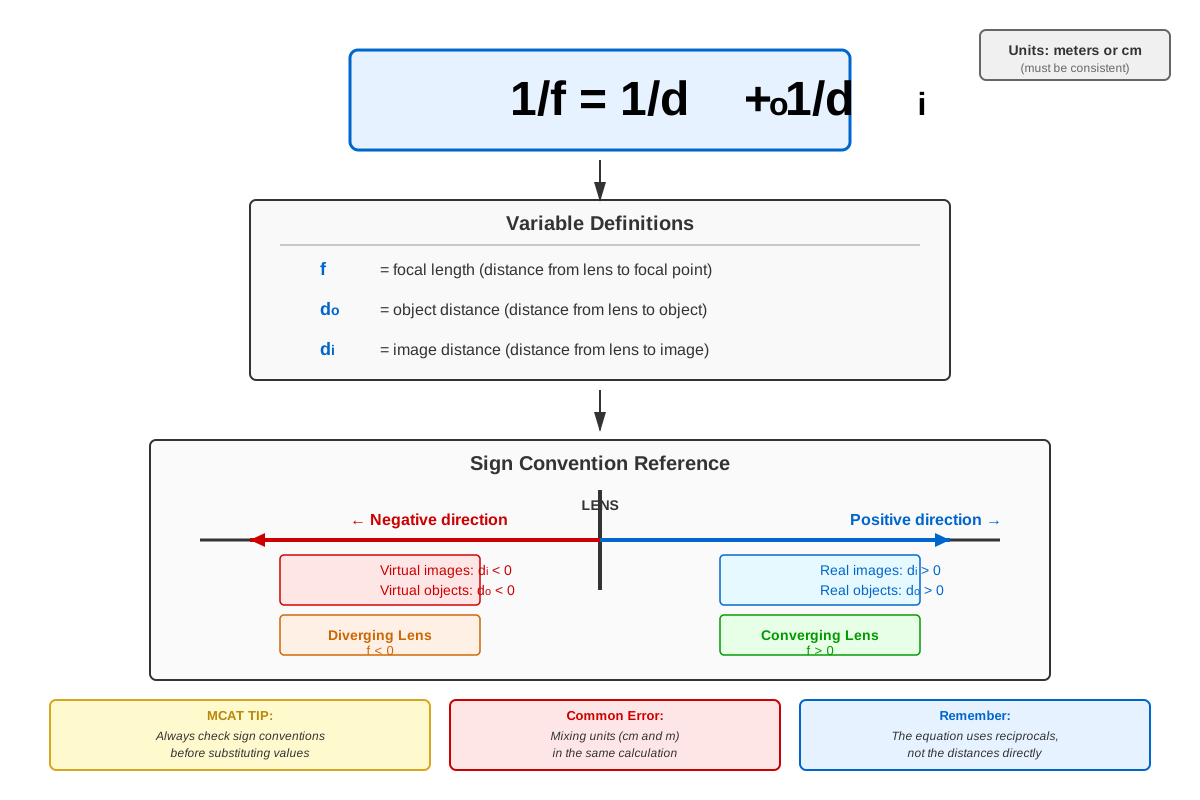
The lens equation (also called the thin lens equation) is expressed mathematically as:
1/f = 1/d_o + 1/d_iWhere:
- f = focal length of the lens (distance from lens center to focal point)
- d_o = object distance (distance from object to lens center)
- d_i = image distance (distance from lens center to image)
This equation applies to all thin lenses—both converging (convex) and diverging (concave)—provided the appropriate sign conventions are used. The equation represents a fundamental relationship: for any lens with a given focal length, the position where an image forms depends entirely on where the object is placed. The reciprocal form of the equation (using 1/distance rather than distance) arises from the geometry of ray refraction through the lens surfaces.
Sign Conventions: The Foundation of Correct Application
Proper use of the lens equation absolutely requires mastering sign conventions. The most commonly used convention (and the one tested on the MCAT) is:
| Quantity | Positive When | Negative When |
|---|---|---|
| Focal length (f) | Converging lens (convex) | Diverging lens (concave) |
| Object distance (d_o) | Object on same side as incoming light (real object) | Object on opposite side (virtual object)* |
| Image distance (d_i) | Image on opposite side from object (real image) | Image on same side as object (virtual image) |
*Virtual objects are rare and typically only appear in multi-lens systems.
The physical interpretation: positive image distance means the image forms on the opposite side of the lens from the object, and light actually converges there (real image that can be projected on a screen). Negative image distance means the image forms on the same side as the object, and light only appears to diverge from that point (virtual image that cannot be projected).
Converging Lenses (Convex Lenses)
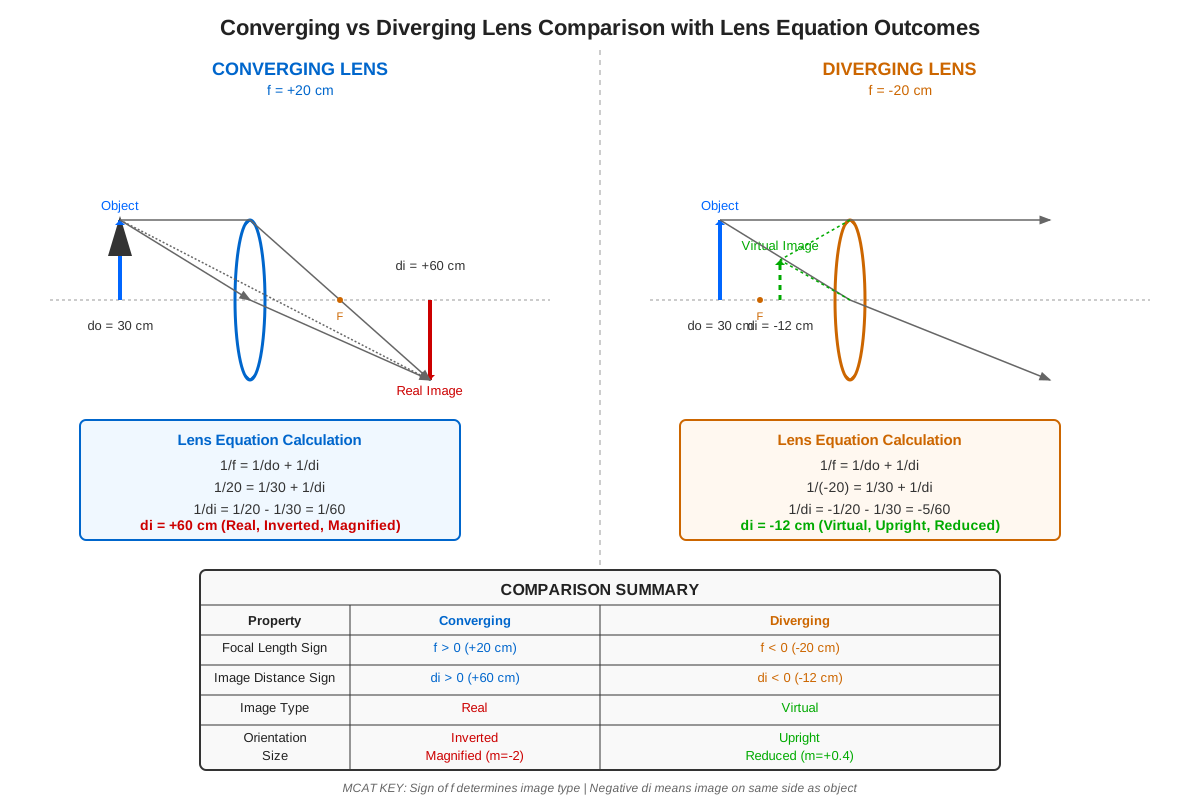
Converging lenses are thicker in the middle than at the edges and have positive focal lengths. These lenses refract parallel light rays so they converge at the focal point. For converging lenses, the relationship between object position and image characteristics follows predictable patterns:
- Object beyond 2f: Image is real, inverted, reduced, located between f and 2f on opposite side
- Object at 2f: Image is real, inverted, same size, located at 2f on opposite side
- Object between f and 2f: Image is real, inverted, magnified, located beyond 2f on opposite side
- Object at f: No image forms (rays emerge parallel; image at infinity)
- Object inside f: Image is virtual, upright, magnified, located on same side as object
These patterns can all be derived using the lens equation and the magnification equation. For example, when an object is placed at distance d_o = 2f from a converging lens with focal length f:
1/f = 1/(2f) + 1/d_i
1/d_i = 1/f - 1/(2f) = 1/(2f)
d_i = 2f
The positive value confirms a real image at 2f on the opposite side.
Diverging Lenses (Concave Lenses)
Diverging lenses are thinner in the middle than at the edges and have negative focal lengths. These lenses refract parallel light rays so they diverge as if emanating from the focal point. For diverging lenses, regardless of object position (as long as it's a real object), the image is always:
- Virtual (negative d_i)
- Upright
- Reduced
- Located between the lens and the focal point on the same side as the object
This can be verified with the lens equation. For any positive object distance d_o and negative focal length f:
1/f = 1/d_o + 1/d_i
1/d_i = 1/f - 1/d_o
Since f is negative and d_o is positive, 1/f is negative and 1/d_o is positive. The magnitude of 1/f is always greater than 1/d_o (for real objects), so 1/d_i is always negative, meaning d_i is always negative (virtual image).
Magnification and Its Connection to the Lens Equation
The magnification equation is intimately connected to the lens equation:
m = -d_i/d_o = h_i/h_oWhere:
- m = magnification (dimensionless)
- h_i = image height
- h_o = object height
The negative sign in the equation is crucial: when m is positive, the image is upright; when m is negative, the image is inverted. The magnitude of m tells us whether the image is magnified (|m| > 1) or reduced (|m| < 1).
By combining the lens equation with the magnification equation, students can solve for any unknown variable. For instance, if given focal length and desired magnification, one can determine required object distance:
m = -d_i/d_o → d_i = -m × d_oSubstituting into lens equation:
1/f = 1/d_o + 1/(-m × d_o) = 1/d_o - 1/(m × d_o) = (m - 1)/(m × d_o)
d_o = f(m - 1)/m
Lens Power and the Diopter
Lens power (P) is defined as the reciprocal of focal length measured in meters:
P = 1/fThe unit of lens power is the diopter (D), where 1 D = 1 m⁻¹. This concept is particularly important in clinical contexts involving corrective lenses. A converging lens has positive power, while a diverging lens has negative power. The lens equation can be rewritten in terms of power:
P = 1/d_o + 1/d_iFor the human eye, typical lens power ranges from about +60 D (combined cornea and lens) when viewing distant objects to about +64 D when maximally accommodated for near vision. Corrective lenses add or subtract power to ensure images focus on the retina.
Multiple Lens Systems
When light passes through multiple lenses in sequence, the image formed by the first lens becomes the object for the second lens. The approach is:
- Use the lens equation to find the image position from the first lens
- Calculate the object distance for the second lens (distance from first image to second lens)
- Apply appropriate sign convention: if the first image would form beyond the second lens, it's a virtual object for the second lens (negative d_o)
- Use the lens equation again for the second lens
- Total magnification is the product of individual magnifications: m_total = m₁ × m₂
This principle underlies compound microscopes and telescopes, where multiple lenses work together to achieve magnifications impossible with a single lens.
Concept Relationships
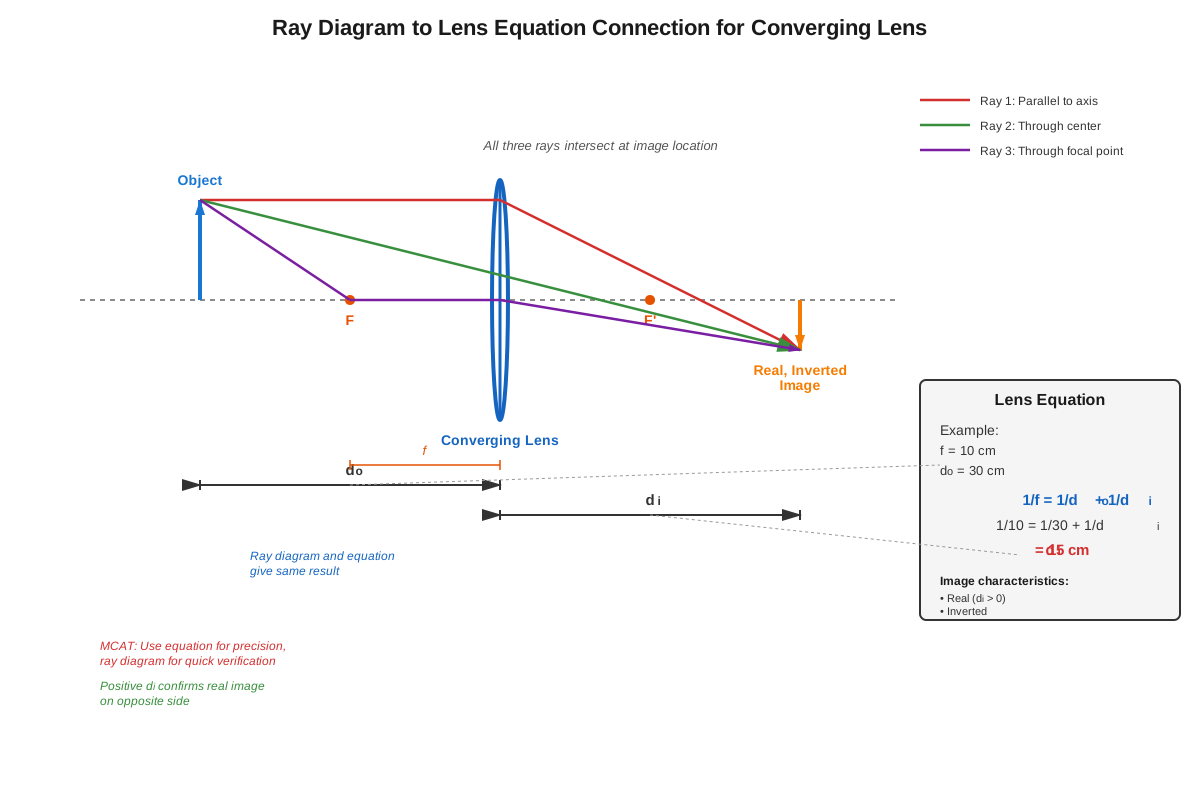
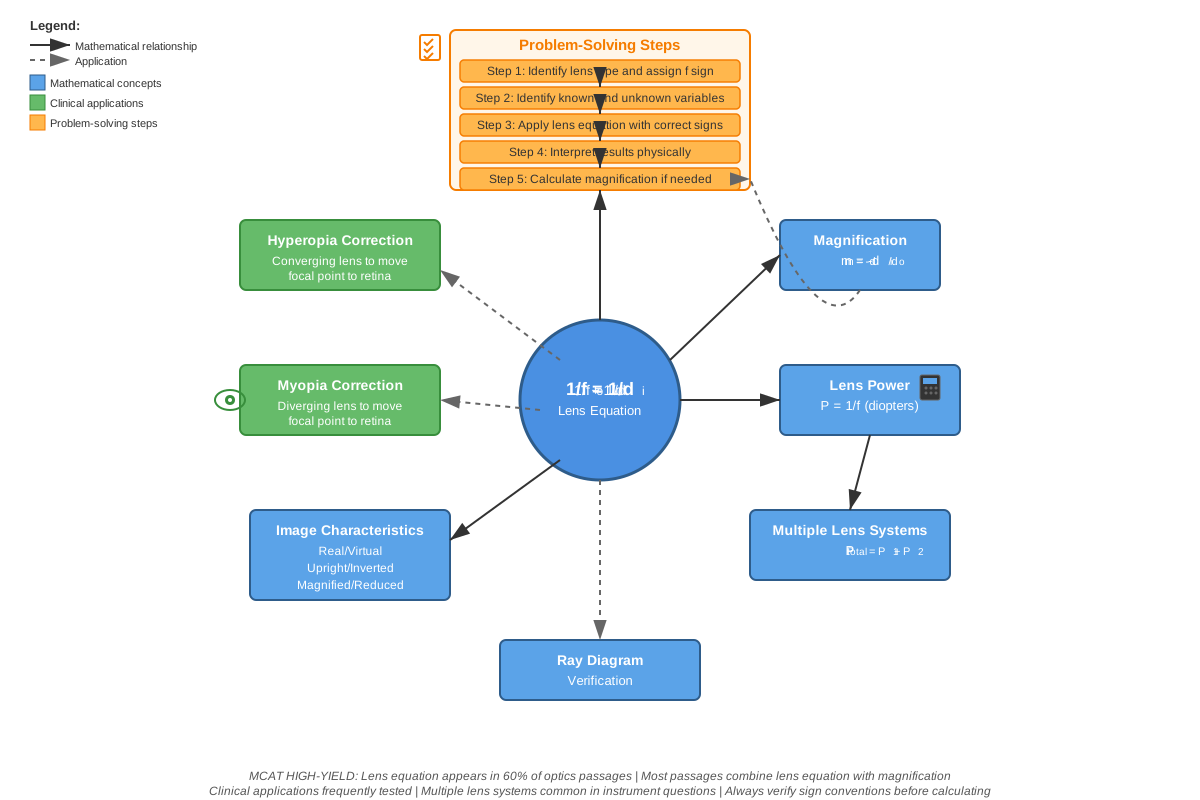
The lens equation serves as the quantitative foundation that connects multiple concepts within Light and Optics. At its core, the equation mathematically describes what ray diagrams show geometrically: the relationship between object position, image position, and focal length. Every ray diagram can be verified using the lens equation, and every lens equation result can be visualized with a ray diagram. This bidirectional relationship makes these tools complementary rather than redundant.
The lens equation directly determines magnification through the ratio -d_i/d_o, creating an inseparable link between image position and image size. This connection means that any change in object distance simultaneously affects both where the image forms and how large it appears. The equation also connects to lens power through the reciprocal relationship P = 1/f, allowing seamless conversion between focal length (useful for calculations) and diopters (useful for clinical applications).
Moving outward to broader physics concepts, the lens equation relates to refraction at interfaces because lenses work by refracting light at two curved surfaces. The focal length in the lens equation actually summarizes the cumulative refractive effect of both surfaces, incorporating the lens material's refractive index and the curvature radii. The equation also connects to the mirror equation (1/f = 1/d_o + 1/d_i), which has identical form but different sign conventions, illustrating how reflection and refraction follow parallel mathematical frameworks.
Conceptual flow: Refraction at curved surfaces → Focal point and focal length → Lens equation → Image position and characteristics → Magnification → Lens power → Multi-lens systems → Optical instruments
Understanding this progression helps students see the lens equation not as an isolated formula but as a central node in a network of interconnected optical principles.
High-Yield Facts
⭐ The lens equation 1/f = 1/d_o + 1/d_i applies to all thin lenses with proper sign conventions
⭐ Converging lenses have positive focal lengths; diverging lenses have negative focal lengths
⭐ Real images have positive d_i and form on the opposite side of the lens from the object; virtual images have negative d_i and form on the same side
⭐ When an object is placed at the focal point (d_o = f), the image forms at infinity (parallel rays emerge)
⭐ Diverging lenses always produce virtual, upright, reduced images for real objects
- Converging lenses produce real images when d_o > f and virtual images when d_o < f
- Magnification m = -d_i/d_o; negative m means inverted image, positive m means upright image
- Lens power P = 1/f (in meters) is measured in diopters (D); positive for converging, negative for diverging
- When d_o = 2f for a converging lens, the image forms at d_i = 2f with magnification m = -1 (same size, inverted)
- In multi-lens systems, the image from the first lens becomes the object for the second lens
- The human eye has a total power of approximately +60 D when relaxed (viewing distant objects)
- Myopia (nearsightedness) is corrected with diverging lenses (negative power); hyperopia (farsightedness) is corrected with converging lenses (positive power)
- For a converging lens, maximum magnification of a real image occurs when the object is just outside the focal point
- Virtual images cannot be projected onto a screen because light doesn't actually converge at the image location
- The focal length of a lens is independent of object position but depends on the lens material's refractive index and surface curvatures
Quick check — test yourself on Lens equation so far.
Try Flashcards →Common Misconceptions
Misconception: The focal length changes depending on where the object is placed.
Correction: Focal length is an intrinsic property of the lens determined by its shape and material. Object position affects where the image forms (d_i) but never changes f. The lens equation shows f as a constant that relates the variable quantities d_o and d_i.
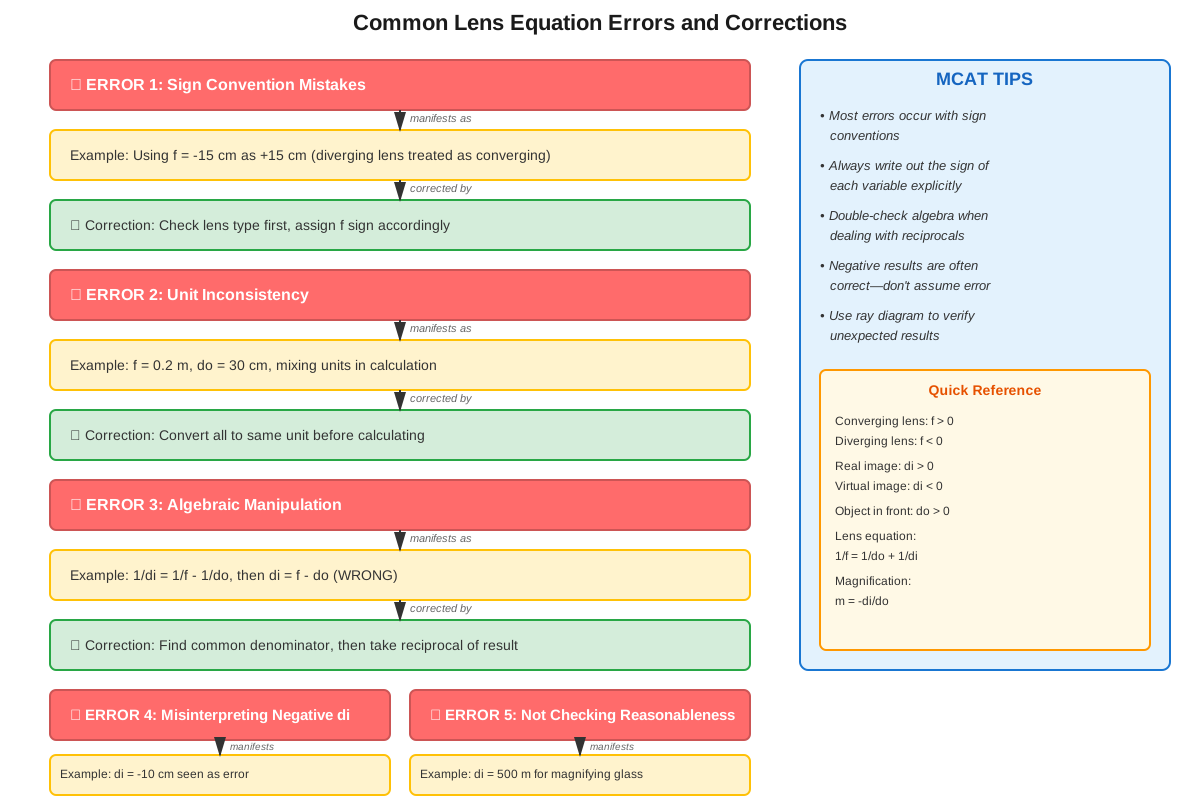
Misconception: Negative values in the lens equation mean you made a calculation error.
Correction: Negative values are physically meaningful and expected in many situations. A negative d_i indicates a virtual image, negative f indicates a diverging lens, and negative magnification indicates an inverted image. The sign conventions are essential for correct physical interpretation.
Misconception: Virtual images aren't "real" and therefore don't matter or can't be seen.
Correction: Virtual images are absolutely visible—you see them every time you look in a flat mirror or through a magnifying glass held close to an object. "Virtual" means light doesn't actually converge at the image location, but the diverging rays still enter your eye and create a visible image. Virtual images simply cannot be projected onto a screen.
Misconception: The lens equation only works for converging lenses.
Correction: The lens equation applies equally to converging and diverging lenses. The key is using correct sign conventions: use negative f for diverging lenses, and the equation will correctly predict a negative d_i (virtual image) for real objects.
Misconception: When solving for d_i, if you get a value larger than d_o, something is wrong.
Correction: Image distance can be larger, smaller, or equal to object distance depending on the situation. For example, when an object is placed between f and 2f of a converging lens, the image forms beyond 2f, making d_i > d_o. This is perfectly correct and indicates a magnified real image.
Misconception: Magnification tells you whether an image is real or virtual.
Correction: Magnification tells you whether an image is upright (positive m) or inverted (negative m) and whether it's magnified (|m| > 1) or reduced (|m| < 1). To determine if an image is real or virtual, you must examine the sign of d_i, not m. A magnified image can be either real or virtual depending on the situation.
Misconception: In the lens equation, all distances are measured from the focal point.
Correction: All distances (d_o, d_i, and f) are measured from the center of the lens, not from the focal point. The focal point is simply the location at distance f from the lens center where parallel rays converge (or appear to diverge from).
Worked Examples
Example 1: Converging Lens with Real Image
Problem: An object is placed 30 cm in front of a converging lens with focal length 10 cm. Determine (a) the image distance, (b) the magnification, (c) whether the image is real or virtual, and (d) whether the image is upright or inverted.
Solution:
(a) Finding image distance using the lens equation:
Given: d_o = +30 cm (positive, real object), f = +10 cm (positive, converging lens)
1/f = 1/d_o + 1/d_i
1/10 = 1/30 + 1/d_i
1/d_i = 1/10 - 1/30 = 3/30 - 1/30 = 2/30 = 1/15
d_i = +15 cm
(b) Finding magnification:
m = -d_i/d_o = -15/30 = -0.5(c) Real or virtual?
Since d_i = +15 cm is positive, the image is real. It forms 15 cm on the opposite side of the lens from the object and can be projected onto a screen.
(d) Upright or inverted?
Since m = -0.5 is negative, the image is inverted. The magnitude |m| = 0.5 < 1 indicates the image is also reduced to half the object's size.
Physical interpretation: This scenario corresponds to an object placed between f and 2f (since 10 cm < 30 cm < 20 cm). As expected from our conceptual understanding, this produces a real, inverted, reduced image on the opposite side of the lens. This configuration is used in cameras and the human eye.
Example 2: Diverging Lens
Problem: A diverging lens has a focal length of -20 cm. An object is placed 40 cm in front of the lens. Find (a) the image distance, (b) the magnification, and (c) describe the image characteristics.
Solution:
(a) Finding image distance:
Given: d_o = +40 cm (positive, real object), f = -20 cm (negative, diverging lens)
1/f = 1/d_o + 1/d_i
1/(-20) = 1/40 + 1/d_i
1/d_i = -1/20 - 1/40 = -2/40 - 1/40 = -3/40
d_i = -40/3 ≈ -13.3 cm
(b) Finding magnification:
m = -d_i/d_o = -(-13.3)/40 = +13.3/40 ≈ +0.33(c) Image characteristics:
- Virtual: d_i is negative (-13.3 cm), so the image forms on the same side as the object, 13.3 cm from the lens
- Upright: m is positive (+0.33)
- Reduced: |m| = 0.33 < 1, so the image is about one-third the object's height
- Location: The image appears between the lens and the focal point (since |-13.3| < |-20|)
Physical interpretation: This result is consistent with the principle that diverging lenses always produce virtual, upright, reduced images for real objects. This configuration is used in corrective lenses for myopia (nearsightedness), where the diverging lens causes light to spread out before entering the eye, effectively moving the focal point back onto the retina.
Example 3: Clinical Application - Corrective Lens Calculation
Problem: A myopic (nearsighted) person has a far point of 50 cm (they can see clearly only up to 50 cm away). What power lens is needed to correct their vision so they can see distant objects clearly?
Solution:
Understanding the problem: For distant objects (d_o = ∞), we want the corrective lens to form a virtual image at the person's far point (50 cm in front of their eye), where they can see clearly.
Given: d_o = ∞ (distant object), d_i = -50 cm (virtual image at far point; negative because it's on the same side as the object)
Finding focal length:
1/f = 1/d_o + 1/d_i
1/f = 1/∞ + 1/(-50) = 0 - 1/50 = -1/50
f = -50 cm = -0.50 m
Finding lens power:
P = 1/f = 1/(-0.50) = -2.0 DAnswer: The person needs a -2.0 diopter diverging lens (concave lens). This lens will take parallel rays from distant objects and make them diverge as if coming from 50 cm away, which the person can see clearly.
Physical interpretation: This demonstrates why myopia is corrected with diverging (negative power) lenses. The myopic eye's optical system is too powerful, focusing distant objects in front of the retina. The diverging corrective lens reduces the total power of the eye-lens system, moving the focal point back onto the retina.
Exam Strategy
When approaching MCAT questions involving the lens equation, begin by identifying what type of lens is involved (converging or diverging) and immediately assign the correct sign to the focal length. This single step prevents the majority of calculation errors. Next, carefully read what the question provides and what it asks for—many students waste time calculating quantities that aren't requested or that can be determined conceptually without calculation.
Trigger words and phrases to watch for include:
- "Real image" or "projected onto a screen" → expect positive d_i
- "Virtual image" or "appears to be located" → expect negative d_i
- "Upright" → expect positive magnification
- "Inverted" → expect negative magnification
- "Converging," "convex," or "positive lens" → use positive f
- "Diverging," "concave," or "negative lens" → use negative f
- "Correcting myopia/nearsightedness" → diverging lens needed
- "Correcting hyperopia/farsightedness" → converging lens needed
For process-of-elimination strategies, remember that diverging lenses with real objects always produce virtual, upright, reduced images—any answer choice suggesting a real or inverted image from a single diverging lens can be immediately eliminated. Similarly, if an object is placed beyond the focal point of a converging lens, the image must be real and inverted, allowing elimination of choices suggesting virtual or upright images.
Time allocation is critical: straightforward lens equation calculations should take 60-90 seconds maximum. If you find yourself spending more time, you're likely making the problem harder than necessary. Many questions can be answered conceptually without calculation by recognizing standard configurations (object at 2f, object inside f, etc.). Save detailed calculations for questions that explicitly require numerical answers.
When a question provides a passage with multiple lenses or an optical instrument, sketch a simple diagram showing light path through the system. For the first lens, apply the lens equation normally. For subsequent lenses, carefully determine whether the "object" for the next lens is real (if the previous image would form before the next lens) or virtual (if the previous image would form beyond the next lens). This systematic approach prevents sign errors in multi-lens problems.
If a calculation yields an unexpected result (like a very large image distance or unusual magnification), don't automatically assume you made an error. Check your signs first, then verify the calculation. Often, unusual results are physically meaningful—for example, when an object approaches the focal point of a converging lens, image distance approaches infinity, which is correct (rays emerge nearly parallel).
Memory Techniques
Mnemonic for sign conventions - "PRON":
- Positive focal length = Positive lens (converging)
- Real images are on the Reverse side (opposite from object, positive d_i)
- Opposite sides means positive d_i
- Negative focal length = Negative lens (diverging)
Visualization for converging lens behavior: Picture the acronym "FIRE" for object positions:
- Far (beyond 2f): Image is reduced, real, inverted, between f and 2f
- Intermediate (between f and 2f): Image is magnified, real, inverted, beyond 2f
- Right at f: Rays emerge parallel (image at infinity)
- Extremely close (inside f): Image is virtual, upright, magnified
Acronym for diverging lens images - "VURD":
All images from diverging lenses (with real objects) are:
- Virtual
- Upright
- Reduced
- Diminished (same as reduced, reinforces the concept)
Reciprocal relationship memory aid: Think "RIP" - Reciprocals In Physics. The lens equation uses reciprocals (1/f, 1/d_o, 1/d_i), and so does lens power (P = 1/f). This reminds you that you're working with reciprocals, not direct proportions.
Clinical correction memory: "My Diverging Hyper Converging" - Myopia needs Diverging lenses; Hyperopia needs Converging lenses.
Magnification sign memory: The negative sign in m = -d_i/d_o means "Negative Inverts" - when magnification is negative, the image is inverted.
Summary
The lens equation (1/f = 1/d_o + 1/d_i) is the fundamental quantitative relationship in Light and Optics, enabling prediction of image location, size, orientation, and nature (real vs. virtual) for any thin lens system. Mastery requires understanding that converging lenses have positive focal lengths and can produce either real or virtual images depending on object position, while diverging lenses have negative focal lengths and always produce virtual images for real objects. The sign conventions are not arbitrary rules but reflect physical reality: positive image distance means light actually converges to form a real image on the opposite side of the lens, while negative image distance means light only appears to diverge from a virtual image on the same side. The lens equation connects seamlessly to magnification (m = -d_i/d_o) and lens power (P = 1/f), forming an integrated framework for solving optical problems. For the MCAT, students must be able to apply the equation rapidly and accurately, interpret signs correctly, and connect mathematical results to physical scenarios including vision correction and optical instruments. Success requires both computational facility and conceptual understanding—knowing not just how to calculate but what the results mean physically.
Key Takeaways
- The lens equation 1/f = 1/d_o + 1/d_i applies universally to thin lenses with proper sign conventions: positive f for converging lenses, negative f for diverging lenses, positive d_i for real images, negative d_i for virtual images
- Converging lenses produce real, inverted images when objects are beyond the focal point (d_o > f) and virtual, upright, magnified images when objects are inside the focal point (d_o < f)
- Diverging lenses always produce virtual, upright, reduced images for real objects, making them essential for correcting myopia (nearsightedness)
- Magnification m = -d_i/d_o connects image size to position; negative m indicates inversion, and |m| > 1 indicates magnification
- Lens power P = 1/f (measured in diopters when f is in meters) provides a clinically relevant way to describe lens strength, with positive power for converging lenses and negative power for diverging lenses
- Sign conventions are physically meaningful, not arbitrary: negative values indicate specific physical situations (virtual images, diverging lenses, inverted images) that must be interpreted correctly
- Multi-lens systems require sequential application of the lens equation, with the image from one lens becoming the object for the next, and total magnification equals the product of individual magnifications
Related Topics
Mirror Equation and Spherical Mirrors: Uses an identical mathematical form (1/f = 1/d_o + 1/d_i) but with different sign conventions; mastering the lens equation provides direct preparation for understanding curved mirrors and their image formation.
Ray Diagrams and Geometric Optics: Provides the visual complement to the lens equation's mathematical approach; combining both methods enables comprehensive problem-solving and error-checking.
Refraction and Snell's Law: The underlying physical principle that explains why lenses work; understanding refraction at curved interfaces deepens comprehension of why the lens equation takes its particular form.
The Human Eye and Vision Correction: Direct clinical application of the lens equation; understanding how the eye's lens and cornea combine to form images on the retina, and how corrective lenses modify this system.
Optical Instruments (Microscopes, Telescopes): Multi-lens systems that apply the lens equation sequentially; mastering single-lens problems is essential preparation for understanding compound optical systems.
Wave Optics and Interference: While the lens equation derives from geometric optics, understanding wave properties of light provides deeper insight into limitations of the thin lens approximation and diffraction effects.
Practice CTA
Now that you've mastered the theoretical foundations of the lens equation, it's time to cement your understanding through active practice. Work through the practice questions and flashcards designed specifically for this topic—they'll challenge you to apply the lens equation in diverse contexts, from straightforward calculations to complex clinical scenarios. Remember, the MCAT rewards not just knowledge but the ability to apply that knowledge under time pressure. Each practice problem you solve builds the pattern recognition and problem-solving speed that will give you confidence on test day. You've put in the work to understand the concepts; now prove to yourself that you can execute flawlessly when it counts!
Sign up free to keep reading
Create a free AnvayaPrep account to finish this MCAT guide on Lens equation — plus flashcards and practice questions.