Overview
Reflection is a fundamental phenomenon in Light and Optics that describes how light waves interact with surfaces and boundaries between different media. When light encounters a surface, a portion of the incident light bounces back into the original medium rather than being transmitted through or absorbed by the material. This seemingly simple process underlies numerous biological systems, medical imaging technologies, and optical instruments that appear regularly on the MCAT. Understanding reflection requires mastery of geometric principles, wave behavior, and the relationship between light propagation and material properties.
For the MCAT, reflection represents a medium-yield topic that frequently appears in both discrete questions and passage-based scenarios. The exam tests not only the mathematical relationships governing reflection but also the conceptual understanding of how light behaves at interfaces. Students must be comfortable applying the law of reflection, distinguishing between specular and diffuse reflection, and connecting these principles to biological vision, fiber optic medical devices, and diagnostic imaging techniques. Questions often integrate reflection with other optics concepts such as refraction, image formation, and wave properties.
Reflection Physics connects intimately with broader themes in the Physics section of the MCAT. The wave nature of light, energy conservation principles, and geometric optics all intersect when analyzing reflective phenomena. Additionally, reflection serves as a gateway concept for understanding more complex optical systems including mirrors, lenses, and the human eye—all high-yield topics for the exam. Mastering reflection provides the foundation for tackling multi-step problems involving light pathways through biological tissues, endoscopic procedures, and the physics underlying various medical imaging modalities.
Learning Objectives
- [ ] Define Reflection using accurate Physics terminology
- [ ] Explain why Reflection matters for the MCAT
- [ ] Apply Reflection to exam-style questions
- [ ] Identify common mistakes related to Reflection
- [ ] Connect Reflection to related Physics concepts
- [ ] Distinguish between specular and diffuse reflection and predict which occurs based on surface properties
- [ ] Calculate angles of incidence and reflection using the law of reflection
- [ ] Analyze ray diagrams involving plane and curved mirrors using reflection principles
- [ ] Evaluate the energy and intensity relationships in reflected versus incident light
Prerequisites
- Basic wave properties: Understanding wavelength, frequency, and wave propagation is essential because light behaves as an electromagnetic wave during reflection
- Geometric principles: Familiarity with angles, normal lines, and coordinate systems enables proper application of the law of reflection
- Energy conservation: Recognizing that energy must be conserved helps explain how incident light divides into reflected, transmitted, and absorbed components
- Vector concepts: Understanding directional quantities aids in analyzing incident and reflected ray paths
- Properties of light: Knowledge that light travels in straight lines (ray approximation) and can be modeled as both waves and particles provides the foundation for reflection analysis
Why This Topic Matters
Reflection has profound clinical and real-world significance that makes it relevant for future physicians. The human visual system depends entirely on reflected light—we see objects because light reflects off their surfaces and enters our eyes. Medical diagnostic tools such as endoscopes, otoscopes, and ophthalmoscopes utilize carefully designed reflective surfaces to illuminate and visualize internal body structures. Fiber optic cables, which employ total internal reflection (a special case of reflection), enable minimally invasive surgical procedures and diagnostic imaging. Understanding reflection also explains why certain tissues appear bright on ultrasound imaging and how laser treatments interact with skin and other tissues.
On the MCAT, reflection appears in approximately 2-4 questions per exam administration, either as discrete items or embedded within passages about optical instruments, vision, or medical imaging. The topic typically appears in the Chemical and Physical Foundations of Biological Systems section, though it can also emerge in passages discussing sensory physiology in the Biological and Biochemical Foundations of Living Systems section. Questions commonly test the law of reflection, the distinction between types of reflection, mirror image formation, and the application of reflection principles to novel scenarios involving medical devices or biological systems.
Exam passages frequently present reflection in contexts such as: analyzing how ophthalmoscopes use mirrors to examine the retina; explaining why certain surgical instruments have polished versus matte finishes; describing fiber optic endoscopy procedures; or discussing how animals use reflective structures (like the tapetum lucidum in nocturnal animals) to enhance vision. The MCAT favors questions that require students to apply reflection principles to unfamiliar situations rather than simply recalling definitions, making conceptual understanding crucial for success.
Core Concepts
The Law of Reflection
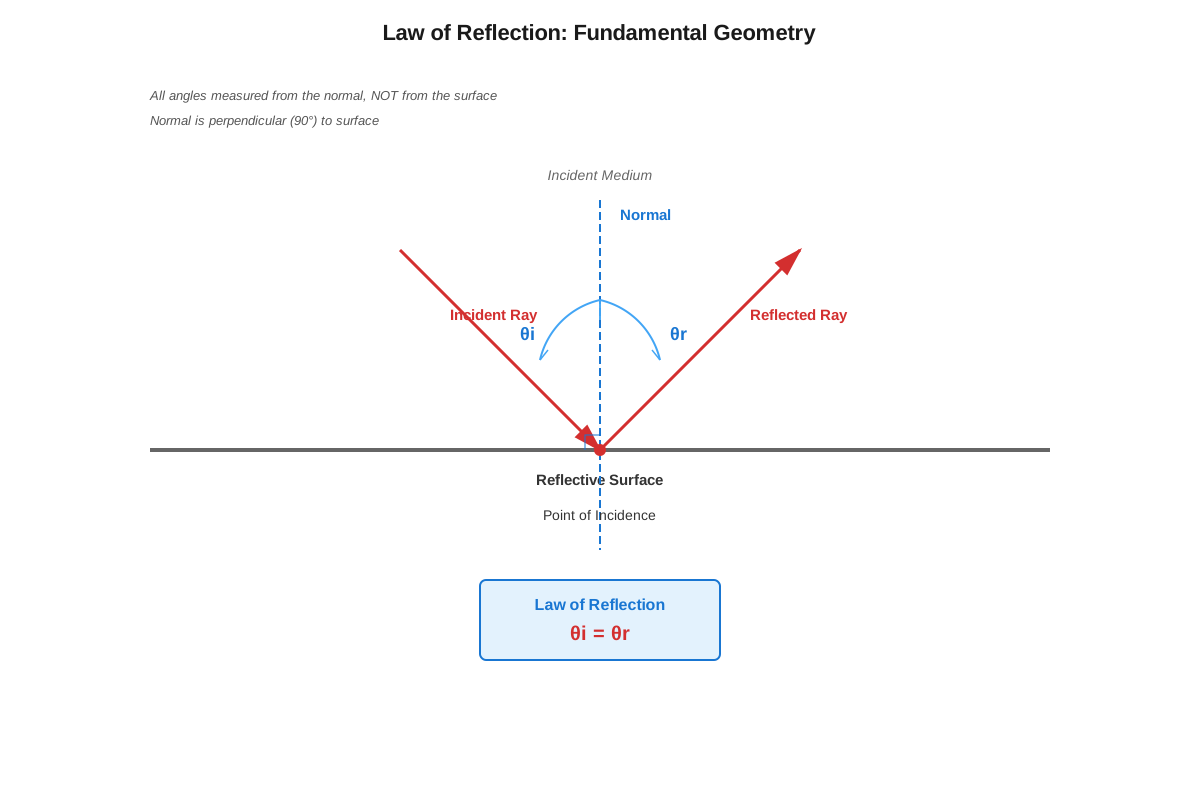
Reflection occurs when a wave, particularly light, encounters a boundary between two media and bounces back into the original medium. The fundamental principle governing this phenomenon is the law of reflection, which states that the angle of incidence equals the angle of reflection. Mathematically, this is expressed as:
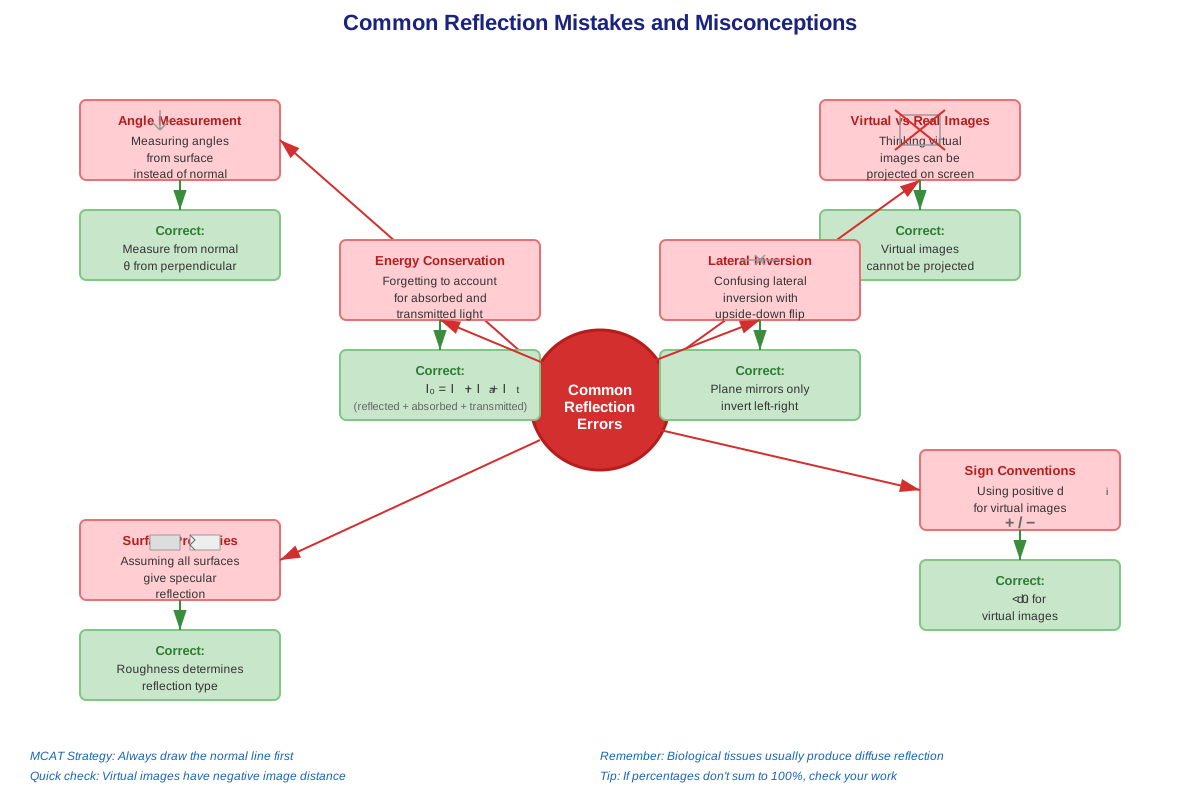
θᵢ = θᵣWhere θᵢ represents the angle of incidence (the angle between the incident ray and the normal to the surface) and θᵣ represents the angle of reflection (the angle between the reflected ray and the normal). Critically, both angles are measured from the normal line—an imaginary line perpendicular to the surface at the point of incidence—not from the surface itself. This is a frequent source of errors on the MCAT.
The law of reflection applies universally to all types of surfaces and all wavelengths of electromagnetic radiation. Whether light strikes a smooth mirror, a rough wall, or a biological membrane, the law holds for each individual ray. The normal line serves as the reference axis, and both the incident ray, reflected ray, and normal line all lie in the same plane (the plane of incidence).
Specular Versus Diffuse Reflection
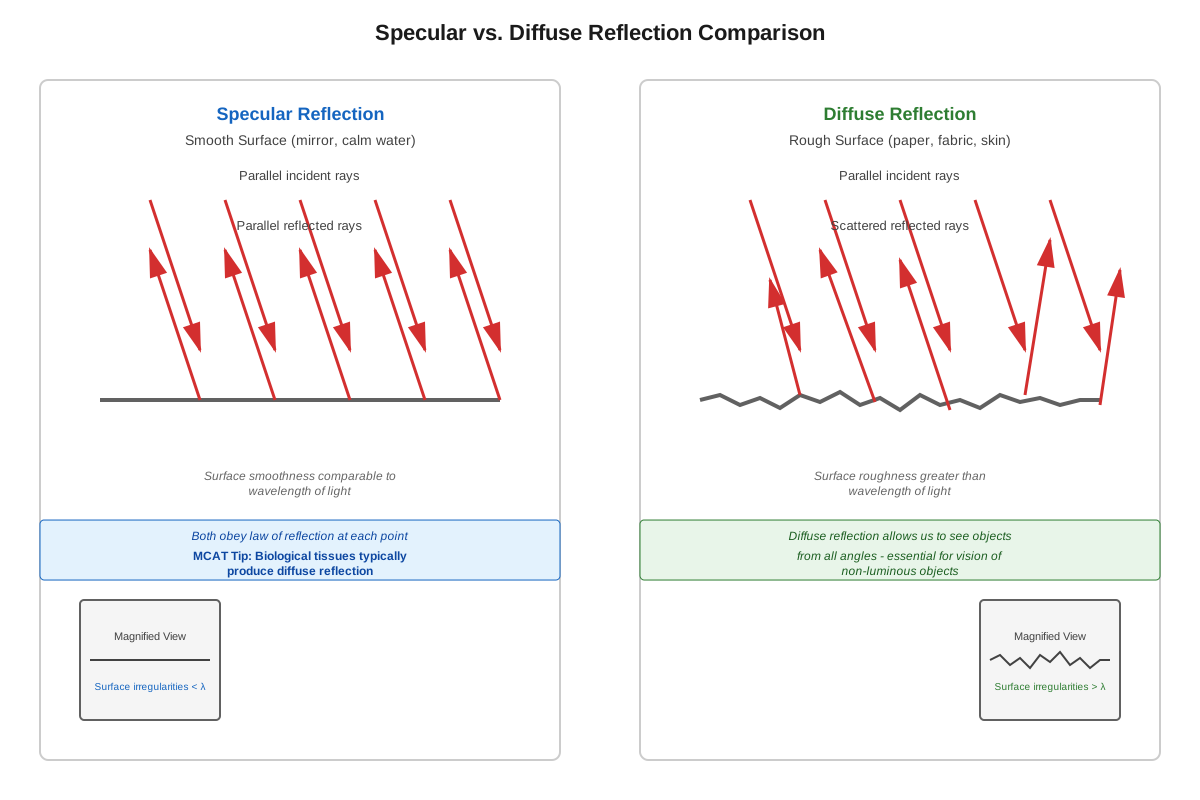
Not all reflection produces the same visual result, leading to the important distinction between specular reflection and diffuse reflection. Specular reflection occurs when light reflects off a smooth, polished surface where surface irregularities are much smaller than the wavelength of light. In this case, parallel incident rays remain parallel after reflection, producing a clear, mirror-like image. Examples include reflection from mirrors, calm water surfaces, and polished metal instruments used in surgery.
Diffuse reflection, by contrast, occurs when light encounters a rough surface where irregularities are comparable to or larger than the wavelength of light. Although the law of reflection still applies to each individual ray, the varying orientations of the surface normals at different points cause incident parallel rays to scatter in many directions. This scattering prevents image formation but allows us to see the surface from multiple viewing angles. Most objects we observe daily—paper, clothing, unpolished wood, and biological tissues—exhibit diffuse reflection.
| Property | Specular Reflection | Diffuse Reflection |
|---|---|---|
| Surface characteristic | Smooth (irregularities << λ) | Rough (irregularities ≥ λ) |
| Parallel ray behavior | Remain parallel | Scatter in multiple directions |
| Image formation | Yes, clear images | No image formation |
| Examples | Mirrors, calm water, polished metal | Paper, fabric, matte paint, most tissues |
| Medical relevance | Surgical mirrors, endoscope optics | Tissue visualization, diffuse illumination |
The distinction between these reflection types has practical medical significance. Surgical instruments often have matte (diffuse) finishes to prevent glare that could interfere with procedures, while diagnostic instruments like laryngoscopes incorporate polished (specular) surfaces to direct light precisely.
Energy Considerations in Reflection
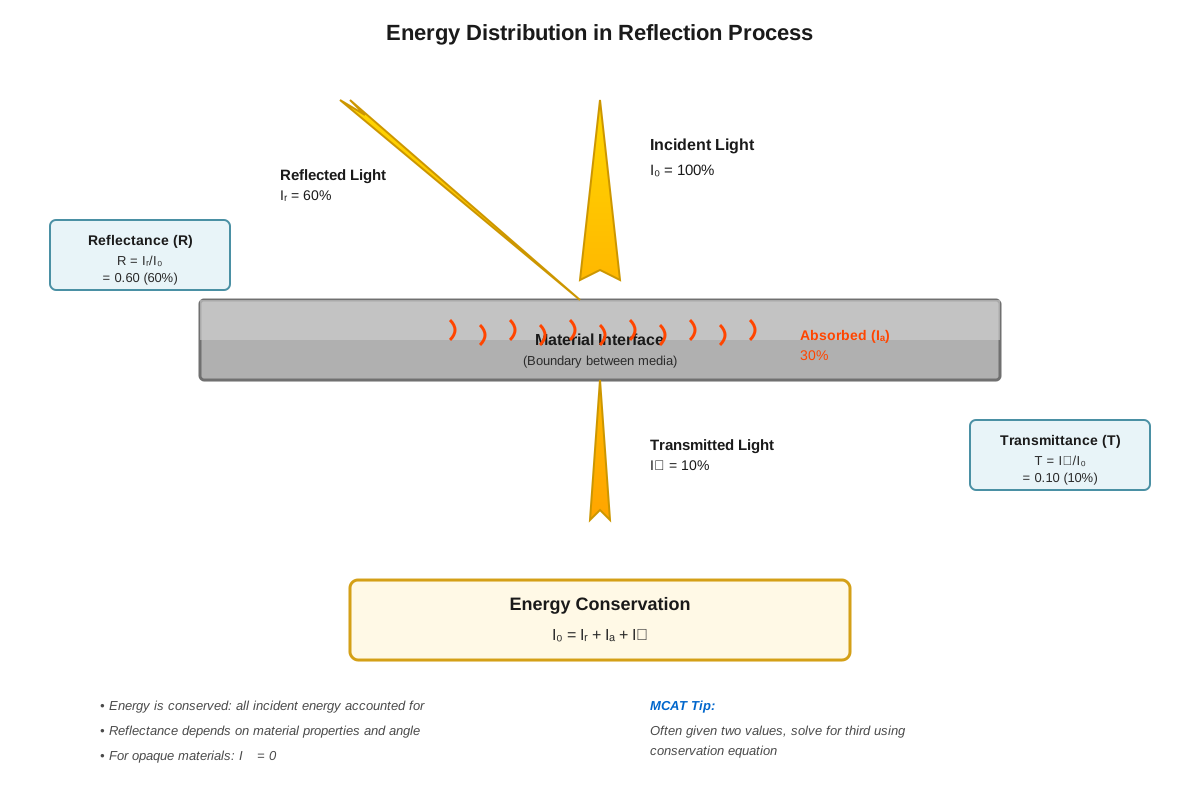
When light strikes a surface, energy conservation dictates that the incident energy must equal the sum of reflected, transmitted, and absorbed energy:
E_incident = E_reflected + E_transmitted + E_absorbedThe fraction of incident light that reflects depends on the reflectance of the material, which varies with wavelength, angle of incidence, and the refractive indices of the two media forming the boundary. For normal incidence (light striking perpendicular to the surface), the reflectance R can be calculated using the Fresnel equations, simplified for normal incidence as:
R = [(n₁ - n₂)/(n₁ + n₂)]²Where n₁ and n₂ are the refractive indices of the two media. This relationship explains why glass (n ≈ 1.5) reflects only about 4% of normally incident light from air (n ≈ 1.0), while water-air interfaces reflect similarly small percentages. However, at grazing angles (near 90° from the normal), reflectance increases dramatically—a phenomenon exploited in fiber optics and explaining why water surfaces appear mirror-like when viewed at shallow angles.
Plane Mirror Image Formation
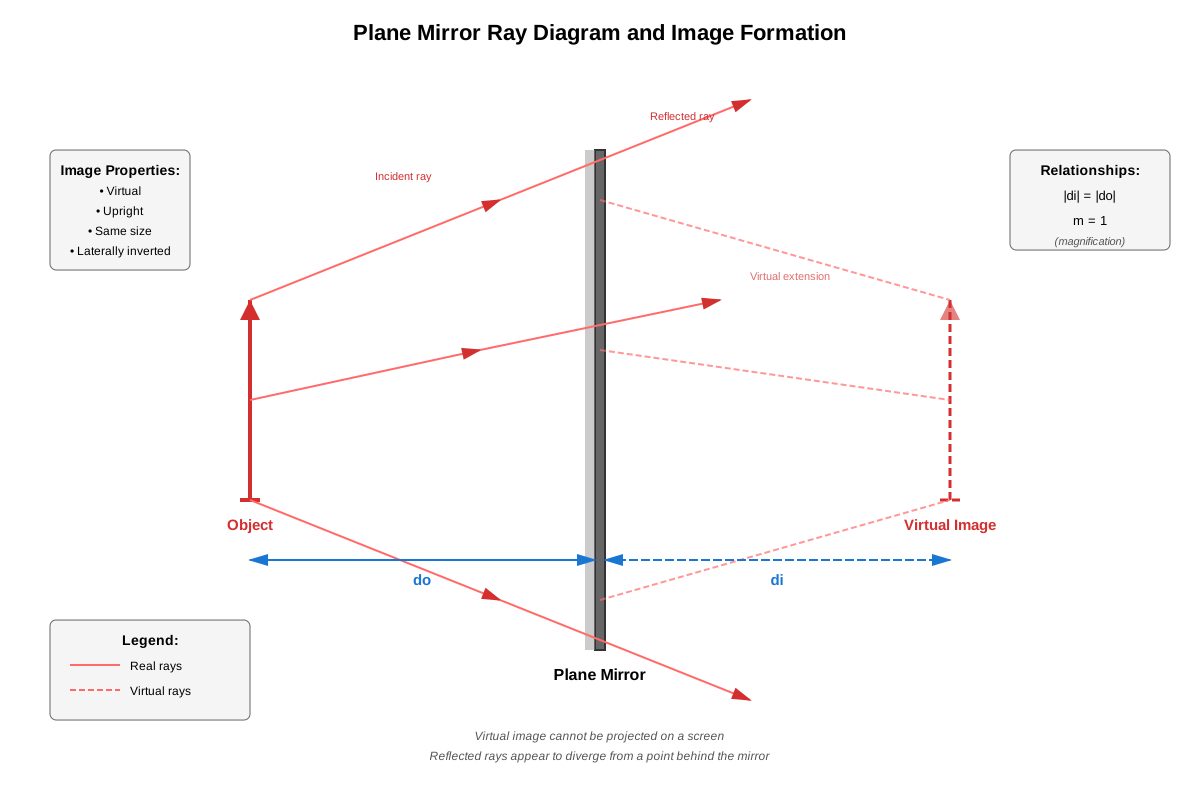
Plane (flat) mirrors create virtual images through reflection. When an object is placed in front of a plane mirror, light rays emanating from each point on the object reflect according to the law of reflection. To an observer, these reflected rays appear to diverge from a point behind the mirror. The characteristics of plane mirror images are:
- The image distance behind the mirror equals the object distance in front of the mirror
- The image is virtual (cannot be projected on a screen)
- The image is upright (same orientation as object)
- The image is the same size as the object (magnification = 1)
- The image exhibits lateral inversion (left and right are reversed)
These properties result directly from applying the law of reflection to multiple rays from the object. Ray tracing—drawing the paths of light rays from object to mirror to observer—provides a geometric method for locating images that frequently appears in MCAT questions.
Curved Mirror Fundamentals
While plane mirrors are important, curved mirrors (both concave and convex) appear regularly on the MCAT because they can focus or diverge light, creating real or virtual images with various magnifications. The law of reflection still applies at each point on a curved surface, but the continuously changing normal direction produces different reflection angles across the mirror.
Concave mirrors (converging mirrors) curve inward like a cave and can produce both real and virtual images depending on object position. Convex mirrors (diverging mirrors) curve outward and always produce virtual, upright, reduced images. The center of curvature (C), focal point (F), and radius of curvature (r) are key reference points, with the focal length f = r/2 for spherical mirrors.
Although detailed mirror equations appear in the refraction and image formation topics, understanding that reflection principles underlie all mirror behavior is essential. Each point on a curved mirror reflects light according to θᵢ = θᵣ, with the normal determined by the local surface orientation.
Concept Relationships
The concepts within reflection form a hierarchical and interconnected framework. The law of reflection serves as the foundational principle from which all other reflection phenomena derive. This law applies universally but manifests differently depending on surface properties → which determines whether specular or diffuse reflection occurs. The surface smoothness relative to wavelength acts as the deciding factor in this branching.
Energy conservation operates in parallel with the law of reflection, constraining how much light can reflect versus transmit or absorb → this connects to reflectance calculations that depend on the refractive indices of the media involved. The refractive index concept bridges reflection to refraction, as both phenomena occur simultaneously at interfaces.
Plane mirror image formation represents an application of the law of reflection to extended objects → this concept extends to curved mirrors, where the continuously varying normal direction creates focusing or diverging effects. Curved mirror behavior → leads to concepts of focal points, image formation, and magnification covered in more advanced optics topics.
Reflection connects to prerequisite knowledge through wave properties (since light behaves as a wave during reflection) and geometric principles (angles and normal lines). It links forward to refraction (which occurs simultaneously at boundaries), total internal reflection (a special case when light cannot refract), lenses (which combine refraction and reflection), and optical instruments (which employ multiple reflective and refractive elements). Understanding reflection also supports comprehension of interference and diffraction phenomena, where reflected waves can interact with incident or transmitted waves.
Quick check — test yourself on Reflection so far.
Try Flashcards →High-Yield Facts
⭐ The angle of incidence always equals the angle of reflection, with both measured from the normal to the surface, not from the surface itself
⭐ Specular reflection occurs on smooth surfaces (irregularities << wavelength) and produces clear images; diffuse reflection occurs on rough surfaces and scatters light without forming images
⭐ Plane mirrors create virtual, upright images at the same distance behind the mirror as the object is in front, with lateral inversion
⭐ The law of reflection applies to all electromagnetic radiation, not just visible light, and holds for every individual ray regardless of surface type
⭐ At normal incidence, reflectance R = [(n₁ - n₂)/(n₁ + n₂)]², explaining why glass-air interfaces reflect only ~4% of incident light
- Incident, reflected, and normal vectors always lie in the same plane (the plane of incidence)
- Reflectance increases with angle of incidence, approaching 100% at grazing angles regardless of material
- Most biological tissues exhibit diffuse reflection, which is why we can see them from multiple angles
- Concave mirrors can produce real or virtual images depending on object position; convex mirrors always produce virtual images
- The tapetum lucidum in nocturnal animals is a reflective layer that increases light capture by reflecting photons back through the retina
- Fiber optic medical devices rely on total internal reflection, a special case where reflection approaches 100% efficiency
- Polarization can affect reflection; Brewster's angle represents the incident angle at which reflected light is completely polarized
Common Misconceptions
Misconception: Angles of incidence and reflection are measured from the surface itself.
Correction: Both angles are measured from the normal line (perpendicular to the surface). A ray striking a surface at 30° from the surface has an angle of incidence of 60° from the normal.
Misconception: Rough surfaces don't obey the law of reflection.
Correction: The law of reflection applies to every individual ray on any surface. Rough surfaces produce diffuse reflection because the varying normal directions at different points cause rays to scatter, but each ray still reflects with θᵢ = θᵣ relative to its local normal.
Misconception: Mirrors reverse images front-to-back.
Correction: Mirrors produce lateral inversion (left-right reversal), not front-back reversal. What appears reversed is actually a rotation effect—if you point your right hand at a mirror, the image's hand closest to your right hand appears to be a left hand because the image is facing you.
Misconception: More light always reflects from smoother surfaces.
Correction: Surface smoothness determines whether reflection is specular or diffuse, not the total amount of light reflected. A rough white surface may reflect more total light than a smooth dark surface; smoothness affects the directionality of reflection, while reflectance (determined by material properties) affects the amount.
Misconception: Virtual images in mirrors aren't "real" and can't be photographed.
Correction: Virtual images can be seen and photographed; "virtual" means the image cannot be projected onto a screen because light rays don't actually converge at the image location. The rays only appear to diverge from that point. Cameras can capture virtual images because the lens redirects the diverging rays.
Misconception: Reflection only occurs at the surface of materials.
Correction: While most reflection occurs at surfaces, light can reflect from internal structures as well. Subsurface scattering in biological tissues involves multiple reflection and refraction events beneath the surface, contributing to tissue appearance.
Worked Examples
Example 1: Analyzing Reflection in an Endoscope
Problem: A fiber optic endoscope uses a bundle of optical fibers to illuminate and visualize the interior of the colon. Each fiber has a core with refractive index n = 1.52 surrounded by cladding with n = 1.48. A light ray traveling through the core strikes the core-cladding boundary at an angle of 85° from the normal. Will this ray reflect back into the core or transmit into the cladding? If it reflects, what is the angle of reflection?
Solution:
Step 1: Identify the relevant principle. Since light is traveling from a higher refractive index medium (core, n = 1.52) to a lower refractive index medium (cladding, n = 1.48), we need to determine if total internal reflection occurs.
Step 2: Calculate the critical angle for total internal reflection:
sin(θc) = n₂/n₁ = 1.48/1.52 = 0.974
θc = arcsin(0.974) = 76.7°
Step 3: Compare the incident angle to the critical angle. The incident angle (85°) exceeds the critical angle (76.7°), so total internal reflection occurs—the ray reflects completely back into the core with no transmission into the cladding.
Step 4: Apply the law of reflection. Since the ray reflects, the angle of reflection equals the angle of incidence:
θᵣ = θᵢ = 85°Answer: The ray undergoes total internal reflection and reflects back into the core at an angle of 85° from the normal. This principle enables fiber optic endoscopes to transmit light efficiently through curved paths by ensuring light remains trapped within the fiber cores through repeated total internal reflections.
Connection to learning objectives: This example applies reflection principles to a medical device, demonstrates the law of reflection, and connects reflection to the related concept of total internal reflection.
Example 2: Mirror Image Distance Calculation
Problem: During a physical examination, a physician uses a head mirror (a concave mirror worn on the forehead) to reflect light into a patient's throat. For simplicity, consider the mirror as a plane mirror positioned 40 cm from the patient's uvula. The physician's light source is 30 cm from the mirror. How far behind the mirror does the image of the light source appear to be? If the physician looks at the mirror, at what total distance from the light source does the image appear?
Solution:
Step 1: Recall the properties of plane mirror images. For plane mirrors, the image distance behind the mirror equals the object distance in front of the mirror.
Step 2: Calculate the image distance. Since the light source is 30 cm in front of the mirror:
Image distance = Object distance = 30 cm behind the mirrorStep 3: Calculate the total distance from light source to image. The light source is 30 cm in front of the mirror, and the image appears 30 cm behind the mirror:
Total distance = 30 cm + 30 cm = 60 cmStep 4: Consider the clinical application. The image of the light source appears to be 60 cm from the actual light source. When the physician directs this mirror toward the patient's throat (40 cm away), the reflected light illuminates the area effectively because the mirror redirects light rays according to the law of reflection.
Answer: The image appears 30 cm behind the mirror, or 60 cm from the actual light source. This demonstrates how plane mirrors create virtual images at distances equal to the object distance, a principle used in various medical examination tools.
Connection to learning objectives: This example applies reflection to a clinical scenario, uses plane mirror image properties derived from the law of reflection, and demonstrates practical medical applications of reflection principles.
Exam Strategy
When approaching MCAT questions on reflection, begin by identifying whether the question involves plane mirrors, curved mirrors, or general reflection principles. Look for trigger words such as "angle of incidence," "smooth surface," "mirror image," "specular," or "diffuse" that indicate which concepts to apply.
For angle calculations, immediately draw a diagram showing the surface, normal line, incident ray, and reflected ray. Many students lose points by measuring angles from the surface rather than the normal—always verify that angles are measured correctly. If a question provides an angle "from the surface," convert it to the angle from the normal by subtracting from 90°.
When distinguishing between specular and diffuse reflection, focus on the relationship between surface roughness and wavelength. The MCAT often presents novel scenarios where you must predict reflection type based on surface descriptions. Remember: if irregularities are much smaller than the wavelength, expect specular reflection; if comparable or larger, expect diffuse reflection.
For mirror image problems, use the systematic approach of identifying image characteristics: real or virtual, upright or inverted, magnified or reduced, and image location. Plane mirrors always produce virtual, upright, same-size images at equal distances. If the question involves curved mirrors, recall that concave mirrors can produce various image types depending on object position, while convex mirrors always produce virtual, upright, reduced images.
Process-of-elimination strategies work well for reflection questions. Eliminate answer choices that violate the law of reflection (θᵢ ≠ θᵣ), violate energy conservation (reflected energy exceeds incident energy), or contradict plane mirror properties (wrong image distance or orientation). Watch for distractors that use angles measured from the surface instead of the normal.
Time management tip: Reflection questions typically require 60-90 seconds. If a question involves complex ray tracing or multiple reflections, quickly sketch the scenario rather than attempting mental visualization. The 10-15 seconds spent drawing often saves time by preventing errors and clarifying the geometry.
Memory Techniques
"Normal is the Norm": Always measure angles from the normal line, not the surface. Visualize the normal as the "norm" or standard reference.
"Smooth Specular, Rough Diffuse": The alliteration helps remember that smooth surfaces produce specular reflection while rough surfaces produce diffuse reflection. Add: "Specular = See yourself" (clear images) and "Diffuse = Distributed light" (scattered).
"Equal Angles, Same Plane": This phrase captures both key aspects of the law of reflection—angles are equal and everything lies in one plane.
VUSM for Plane Mirrors: Virtual, Upright, Same size, Mirror distance equals object distance. This acronym captures all essential plane mirror image properties.
"Wavelength Wins": Surface roughness matters only relative to wavelength. If roughness is smaller than wavelength, wavelength "wins" and reflection is specular.
Visualization strategy: Picture a ball bouncing off a wall at the same angle it approached. This analogy helps remember that reflection angles are equal and provides intuition for ray paths.
"In-Re-Nor" sequence: Incident ray, Reflected ray, Normal line—all three must be identified to solve reflection problems. Check that you've drawn all three before calculating.
Summary
Reflection represents a fundamental optical phenomenon where light bounces off surfaces according to the law of reflection: the angle of incidence equals the angle of reflection, with both measured from the normal to the surface. This principle applies universally to all surfaces and wavelengths, though the visual result depends on surface smoothness relative to wavelength. Smooth surfaces produce specular reflection with clear image formation, while rough surfaces cause diffuse reflection that scatters light without forming images. Energy conservation constrains reflection, with the fraction of reflected light determined by material properties and angle of incidence. Plane mirrors create virtual, upright images at distances equal to object distances, exhibiting lateral inversion. These principles extend to curved mirrors and underlie numerous medical applications including endoscopy, diagnostic instruments, and vision. For MCAT success, students must master angle calculations from normal lines, distinguish reflection types based on surface properties, apply reflection principles to novel scenarios, and connect reflection to broader optics concepts including refraction, image formation, and optical instruments.
Key Takeaways
- The law of reflection (θᵢ = θᵣ) applies universally with angles measured from the normal line, not the surface
- Specular reflection occurs on smooth surfaces (irregularities << λ) producing clear images; diffuse reflection occurs on rough surfaces scattering light
- Plane mirrors create virtual, upright, same-size images at equal distances behind the mirror with lateral inversion
- Reflectance depends on refractive indices of the two media: R = [(n₁ - n₂)/(n₁ + n₂)]² at normal incidence
- Reflection principles underlie medical devices (endoscopes, examination mirrors) and biological vision systems
- Energy conservation requires incident energy equals reflected plus transmitted plus absorbed energy
- Both incident and reflected rays lie in the same plane as the normal (plane of incidence)
Related Topics
Refraction: Light bending when crossing boundaries between media with different refractive indices; occurs simultaneously with reflection at interfaces and follows Snell's law. Mastering reflection provides the foundation for understanding how light divides between reflected and refracted components.
Total Internal Reflection: Special case where light reflects completely at a boundary when traveling from higher to lower refractive index medium beyond the critical angle; essential for fiber optics and medical imaging devices.
Curved Mirrors and Image Formation: Application of reflection principles to concave and convex mirrors, involving focal points, mirror equations, and ray tracing to determine image characteristics; builds directly on reflection fundamentals.
Lenses and Refraction: Optical elements that bend light through refraction to form images; understanding reflection helps distinguish between reflective (mirror) and refractive (lens) image formation mechanisms.
Optical Instruments: Microscopes, telescopes, endoscopes, and other devices that combine mirrors, lenses, and reflection/refraction principles; requires integration of reflection concepts with other optics topics.
Wave Properties of Light: Interference, diffraction, and polarization phenomena that emerge from light's wave nature; reflection can produce interference patterns when reflected waves interact with incident waves.
Practice CTA
Now that you've mastered the core concepts of reflection, reinforce your understanding by working through practice questions and flashcards. Focus on problems involving angle calculations, distinguishing reflection types, and applying reflection principles to medical scenarios. Challenge yourself with passage-based questions that integrate reflection with other optics concepts. The more you practice applying the law of reflection to diverse situations, the more confident and efficient you'll become on test day. Remember: reflection appears in multiple contexts on the MCAT, so versatility with these principles will serve you well across various question types. You've built a strong foundation—now solidify it through active practice!
Sign up free to keep reading
Create a free AnvayaPrep account to finish this MCAT guide on Reflection — plus flashcards and practice questions.