Overview
Acceleration is a fundamental concept in Mechanics that describes how velocity changes over time. In Physics, acceleration represents the rate at which an object's velocity increases, decreases, or changes direction. This vector quantity is essential for understanding motion in all its forms—from a car speeding up on a highway to a ball thrown vertically into the air to the circular motion of a centrifuge in a laboratory setting. Mastering acceleration is critical for success on the MCAT because it forms the foundation for understanding Newton's laws, projectile motion, circular motion, and energy concepts that appear frequently throughout the Physics section.
For the MCAT, acceleration appears in multiple contexts across the Mechanics unit and beyond. Test-makers frequently embed acceleration concepts within passages about biomechanical systems, such as muscle contractions producing limb movements, cardiovascular dynamics involving blood flow acceleration, or even psychological experiments measuring reaction times. Understanding acceleration enables students to analyze force diagrams, predict motion trajectories, and solve complex kinematics problems that integrate multiple physics principles. The concept bridges purely mathematical problem-solving with conceptual reasoning about physical systems.
The relationship between acceleration and other physics concepts cannot be overstated. Acceleration directly connects to Newton's second law (F = ma), making it essential for understanding forces. It relates to velocity and displacement through kinematic equations, connects to energy through work-energy principles, and appears in rotational motion as angular acceleration. This interconnectedness means that a solid grasp of acceleration provides the foundation for approximately 30-40% of physics questions on the MCAT, making it one of the highest-yield topics in the entire physics curriculum.
Learning Objectives
- [ ] Define Acceleration using accurate Physics terminology
- [ ] Explain why Acceleration matters for the MCAT
- [ ] Apply Acceleration to exam-style questions
- [ ] Identify common mistakes related to Acceleration
- [ ] Connect Acceleration to related Physics concepts
- [ ] Distinguish between average acceleration and instantaneous acceleration in various scenarios
- [ ] Calculate acceleration from velocity-time graphs and apply graphical analysis techniques
- [ ] Analyze situations involving negative acceleration (deceleration) and differentiate from negative velocity
Prerequisites
- Vectors and scalars: Acceleration is a vector quantity, requiring understanding of magnitude and direction
- Velocity and displacement: Acceleration describes the rate of change of velocity, making velocity comprehension essential
- Basic algebra and calculus concepts: Solving kinematic equations and understanding derivatives aids acceleration calculations
- Units and dimensional analysis: Proper unit conversion (m/s², cm/s²) prevents calculation errors
- Coordinate systems: Establishing positive and negative directions is crucial for vector analysis
Why This Topic Matters
Clinical and Real-World Significance
Acceleration concepts appear throughout medical practice and biological systems. The human body constantly experiences acceleration—from the acceleration of blood through the aorta during systole to the acceleration of limbs during movement. Traumatic injuries often result from excessive acceleration or deceleration forces, such as whiplash from rapid deceleration in car accidents or concussions from sudden head acceleration. Understanding acceleration helps medical professionals interpret diagnostic data, such as accelerometer readings in gait analysis for neurological disorders or cardiac output measurements that involve blood acceleration.
MCAT Exam Statistics
Acceleration appears in approximately 15-20% of physics passages on the MCAT, making it a medium-to-high yield topic. Questions typically present acceleration in three formats: (1) direct calculation problems requiring kinematic equations, (2) conceptual questions about the relationship between forces and acceleration, and (3) graph interpretation questions showing velocity or position versus time. The MCAT frequently tests acceleration within interdisciplinary contexts, embedding physics concepts within biological or biochemical scenarios. For example, a passage might describe muscle fiber contraction rates and ask students to calculate the acceleration of a limb.
Common Exam Appearances
The MCAT presents acceleration through various question types. Passage-based questions often describe experimental setups involving moving objects, requiring students to extract relevant information and apply kinematic equations. Discrete questions may present scenarios involving free fall, projectile motion, or objects on inclined planes. Graph-based questions are particularly common, asking students to interpret velocity-time graphs to determine acceleration or to sketch acceleration-time graphs from given motion descriptions. The exam also tests conceptual understanding by asking about the direction of acceleration during different phases of motion, particularly in circular motion or when objects change direction.
Core Concepts
Definition of Acceleration
Acceleration is defined as the rate of change of velocity with respect to time. Mathematically, acceleration is expressed as:
a = Δv/Δt = (v_f - v_i)/(t_f - t_i)Where:
- a = acceleration
- v_f = final velocity
- v_i = initial velocity
- Δt = change in time
The SI unit for acceleration is meters per second squared (m/s²), though other units like cm/s² or km/h² may appear in MCAT problems. As a vector quantity, acceleration possesses both magnitude and direction. The direction of acceleration indicates the direction of velocity change, not necessarily the direction of motion—a critical distinction that frequently appears on the MCAT.
Average vs. Instantaneous Acceleration
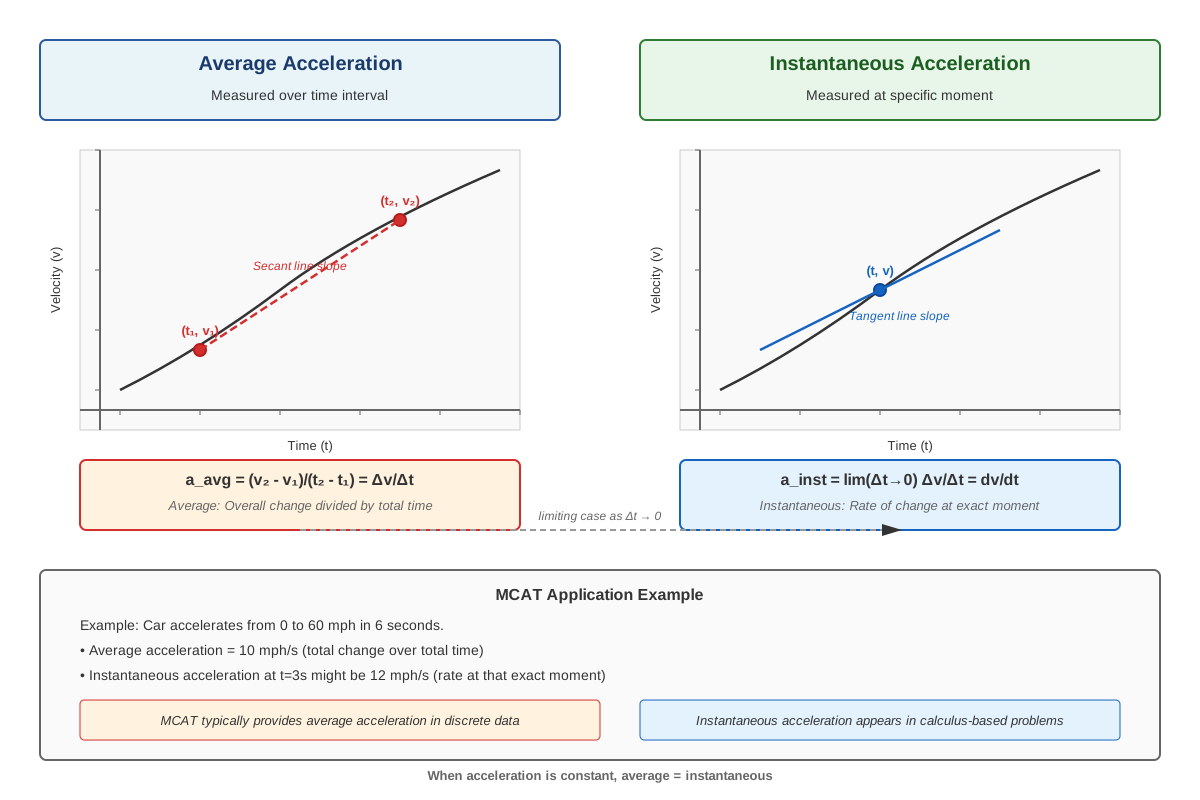
Average acceleration represents the overall rate of velocity change over a finite time interval, calculated using the formula above. Instantaneous acceleration represents the acceleration at a specific moment in time, mathematically defined as the derivative of velocity with respect to time:
a_inst = dv/dtFor the MCAT, understanding the distinction matters when interpreting graphs. On a velocity-time graph, average acceleration equals the slope of the secant line connecting two points, while instantaneous acceleration equals the slope of the tangent line at a single point. Most MCAT problems involve average acceleration, but passages may describe situations where acceleration varies continuously, requiring conceptual understanding of instantaneous values.
Vector Nature of Acceleration
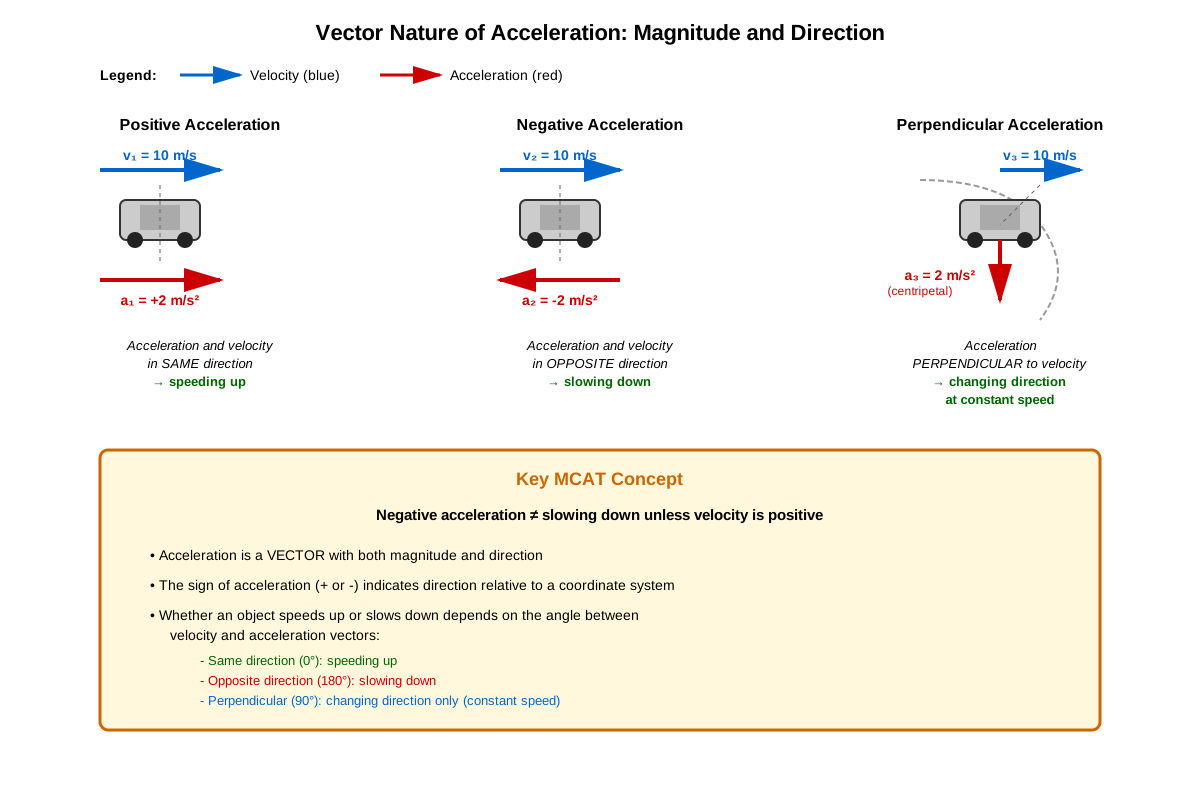
Since acceleration is a vector, it has both magnitude and direction. The direction of acceleration can be:
- In the same direction as velocity: The object speeds up (positive acceleration in the direction of motion)
- Opposite to the direction of velocity: The object slows down (negative acceleration or deceleration)
- Perpendicular to velocity: The object changes direction without changing speed (as in uniform circular motion)
The MCAT frequently tests whether students recognize that acceleration direction depends on velocity change, not position change. An object moving in the negative direction while slowing down experiences positive acceleration because its velocity is becoming less negative (moving toward zero).
Kinematic Equations
Four fundamental kinematic equations relate acceleration to other motion variables. These equations apply only when acceleration is constant:
1. v_f = v_i + at
2. Δx = v_i*t + (1/2)at²
3. v_f² = v_i² + 2aΔx
4. Δx = ((v_i + v_f)/2)t
Where:
- Δx = displacement
- v_i = initial velocity
- v_f = final velocity
- a = acceleration
- t = time
| Equation | Missing Variable | Best Used When |
|---|---|---|
| v_f = v_i + at | Δx (displacement) | Finding final velocity or time |
| Δx = v_i*t + (1/2)at² | v_f (final velocity) | Finding displacement with known time |
| v_f² = v_i² + 2aΔx | t (time) | Time is unknown or not needed |
| Δx = ((v_i + v_f)/2)t | a (acceleration) | Acceleration is unknown |
Selecting the appropriate equation requires identifying which variables are given and which must be found. The MCAT often provides three variables and asks students to find a fourth, making equation selection a critical skill.
Graphical Representation
Understanding motion graphs is essential for MCAT success. Acceleration appears in three types of graphs:
Position-Time Graphs: Acceleration manifests as curvature. A straight line indicates zero acceleration (constant velocity), while a parabolic curve indicates constant acceleration. The concavity direction indicates acceleration direction—concave up means positive acceleration, concave down means negative acceleration.
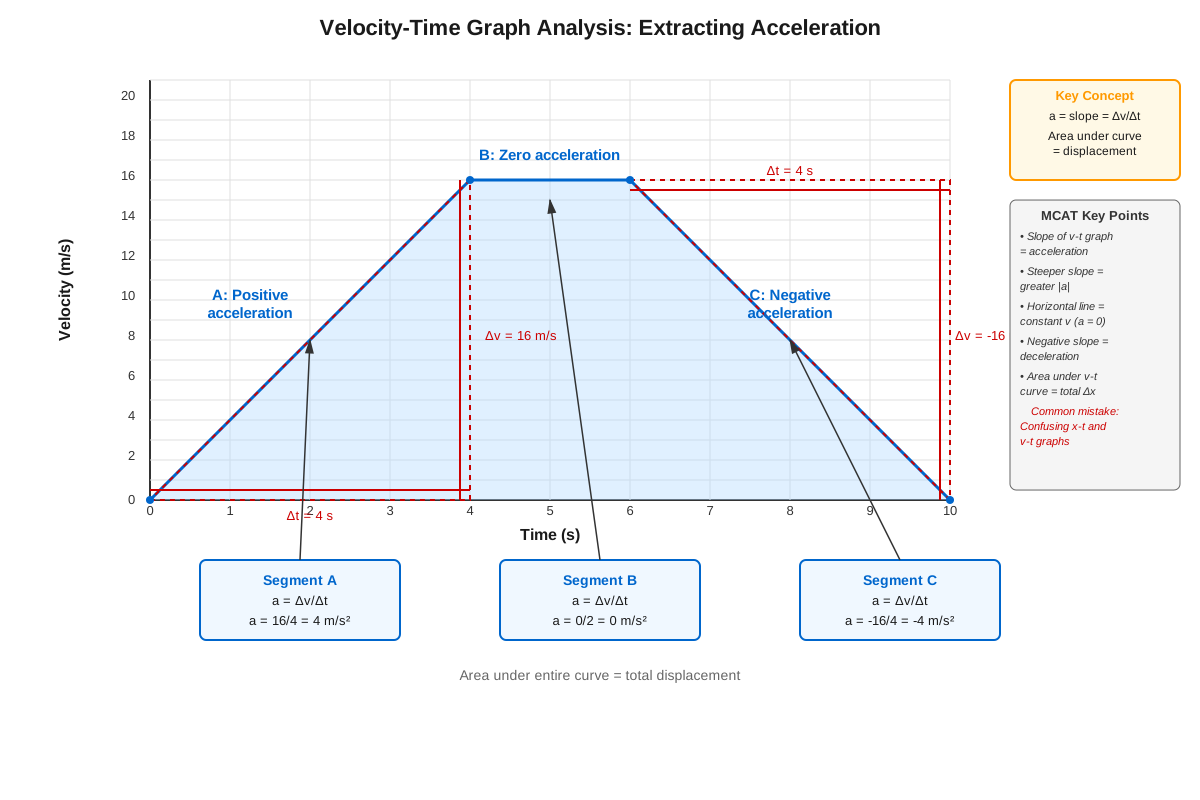
Velocity-Time Graphs: The slope of a velocity-time graph equals acceleration. A horizontal line indicates zero acceleration, a positive slope indicates positive acceleration, and a negative slope indicates negative acceleration. The area under a velocity-time curve equals displacement.
Acceleration-Time Graphs: The graph directly shows acceleration values. The area under an acceleration-time curve equals the change in velocity. For constant acceleration, the graph appears as a horizontal line.
Free Fall and Gravitational Acceleration
Free fall represents motion under the influence of gravity alone, with no air resistance. Near Earth's surface, all objects in free fall experience the same acceleration: g = 9.8 m/s² (often approximated as 10 m/s² on the MCAT) directed downward toward Earth's center. This acceleration is constant regardless of the object's mass—a fact that often appears in MCAT questions.
For objects thrown upward, acceleration remains -9.8 m/s² (taking upward as positive) throughout the entire trajectory, including at the highest point where velocity momentarily equals zero. This counterintuitive fact—that acceleration is non-zero when velocity is zero—frequently appears as a conceptual question on the MCAT.
Centripetal Acceleration
Objects moving in circular paths experience centripetal acceleration directed toward the center of the circular path. Even when speed remains constant, the continuous direction change means velocity changes, producing acceleration:
a_c = v²/rWhere:
- a_c = centripetal acceleration
- v = tangential speed
- r = radius of circular path
Centripetal acceleration always points toward the center of curvature, perpendicular to the velocity vector. This concept appears in MCAT questions about circular motion, centrifuges, and curved paths in biological systems.
Deceleration and Negative Acceleration
Deceleration colloquially means "slowing down," but in physics, the term "negative acceleration" has specific meaning related to coordinate system choice. An object decelerates when acceleration and velocity vectors point in opposite directions, regardless of their signs. The MCAT tests whether students can distinguish between:
- Negative acceleration (acceleration in the negative direction)
- Deceleration (slowing down, which may involve positive or negative acceleration depending on motion direction)
An object moving in the negative direction with negative acceleration is actually speeding up, not slowing down—a common source of MCAT questions.
Concept Relationships
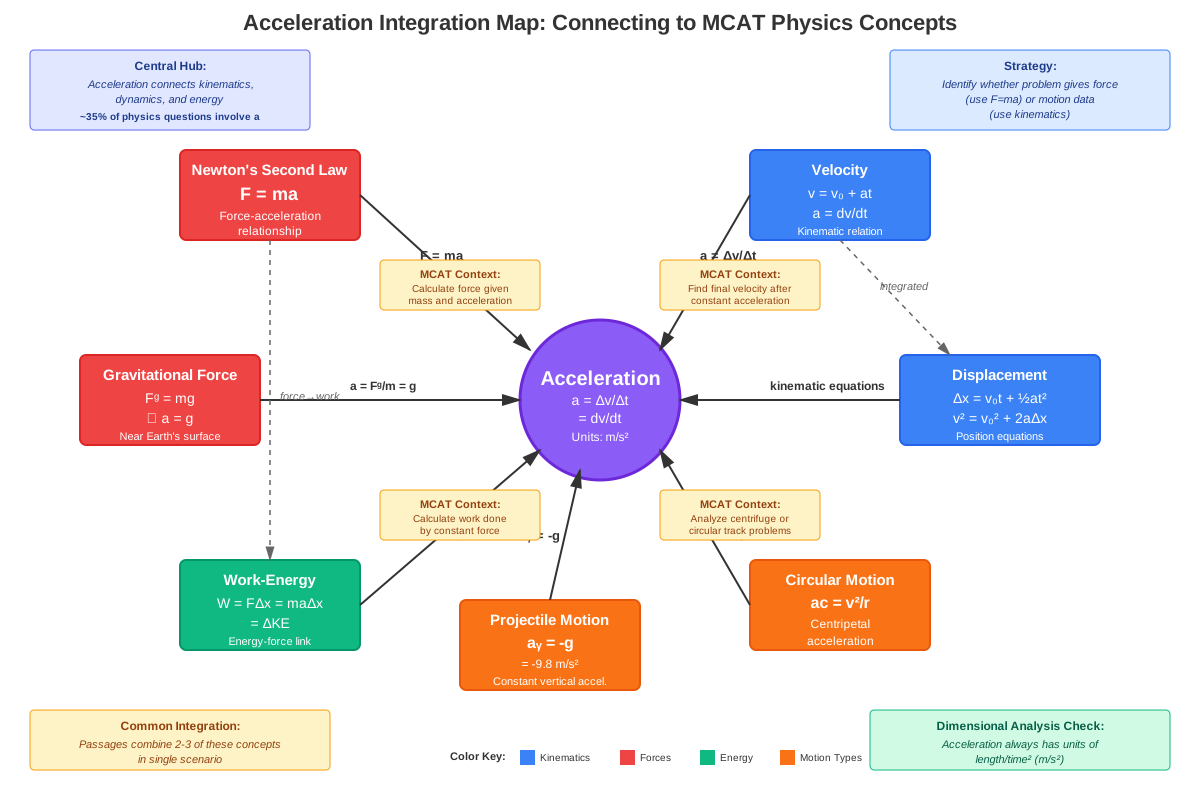
Acceleration serves as a central hub connecting multiple physics concepts. The relationship map flows as follows:
Position → Velocity → Acceleration: Position describes location, velocity describes the rate of position change, and acceleration describes the rate of velocity change. Each concept is the time derivative of the previous one, creating a hierarchical relationship fundamental to kinematics.
Acceleration → Force: Newton's second law (F = ma) directly links acceleration to net force. Understanding acceleration enables force analysis, making it essential for dynamics problems. This connection appears in approximately 40% of mechanics questions on the MCAT.
Acceleration → Energy: The work-energy theorem connects force (and thus acceleration) to kinetic energy changes. When a net force produces acceleration, work is performed, changing the object's kinetic energy. This relationship bridges kinematics and energy concepts.
Acceleration → Momentum: Since momentum equals mass times velocity (p = mv), acceleration produces momentum changes. The impulse-momentum theorem (FΔt = Δp) connects acceleration-producing forces to momentum changes over time.
Linear Acceleration → Angular Acceleration: Rotational motion concepts parallel linear motion. Just as linear acceleration describes velocity change, angular acceleration describes angular velocity change. The relationship a = αr connects linear and angular acceleration for objects in circular motion.
Within the topic itself, average acceleration provides the foundation for understanding instantaneous acceleration. Constant acceleration enables the use of kinematic equations, while variable acceleration requires calculus-based approaches (though the MCAT rarely requires actual calculus calculations). Graphical representations provide alternative ways to visualize and calculate acceleration, connecting mathematical and visual reasoning.
Quick check — test yourself on Acceleration so far.
Try Flashcards →High-Yield Facts
⭐ Acceleration is a vector quantity with both magnitude and direction, measured in m/s²
⭐ The direction of acceleration indicates the direction of velocity change, not necessarily the direction of motion
⭐ On a velocity-time graph, acceleration equals the slope; on a position-time graph, acceleration relates to curvature
⭐ All objects in free fall near Earth's surface experience the same acceleration (g ≈ 10 m/s²) regardless of mass
⭐ At the highest point of projectile motion, velocity is zero but acceleration equals -g (not zero)
- Negative acceleration does not always mean slowing down; it depends on the direction of velocity
- Centripetal acceleration (a = v²/r) always points toward the center of circular motion, even at constant speed
- When acceleration and velocity point in the same direction, the object speeds up; when opposite, it slows down
- The kinematic equation v_f² = v_i² + 2aΔx is most useful when time is unknown or not needed
- Average acceleration over an interval equals the change in velocity divided by the change in time
- An object can have zero velocity but non-zero acceleration (e.g., at the peak of vertical motion)
- Constant acceleration produces parabolic position-time graphs and linear velocity-time graphs
Common Misconceptions
Misconception: Acceleration only occurs when an object speeds up.
Correction: Acceleration occurs whenever velocity changes in magnitude OR direction. An object slowing down experiences acceleration (in the opposite direction to velocity), and an object moving in a circle at constant speed experiences centripetal acceleration due to continuous direction change.
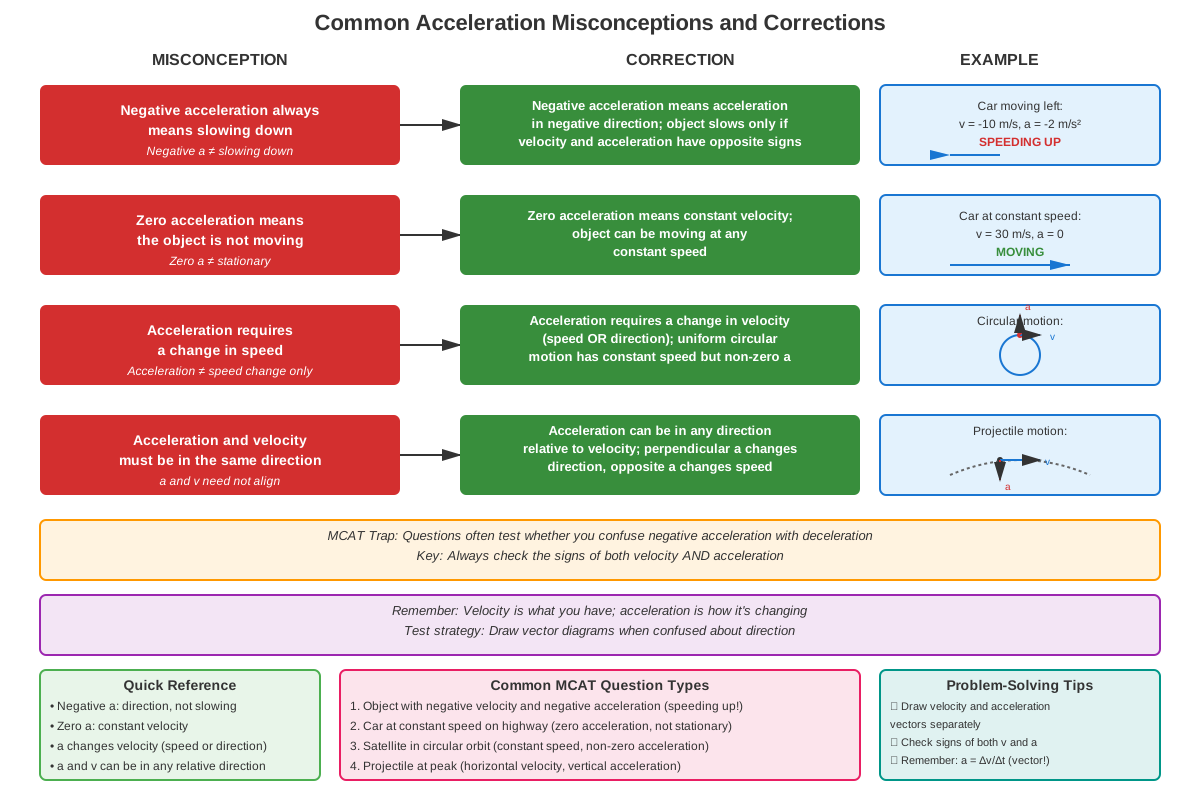
Misconception: Negative acceleration always means slowing down.
Correction: Negative acceleration simply means acceleration in the negative direction of the chosen coordinate system. An object moving in the negative direction with negative acceleration is actually speeding up. Deceleration (slowing down) occurs when acceleration and velocity vectors point in opposite directions, regardless of their signs.
Misconception: At the highest point of projectile motion, both velocity and acceleration are zero.
Correction: At the highest point, vertical velocity momentarily equals zero, but acceleration remains constant at -g (approximately -10 m/s²) throughout the entire trajectory. Gravity continuously acts on the projectile, producing constant downward acceleration.
Misconception: Heavier objects fall faster than lighter objects.
Correction: In the absence of air resistance, all objects experience the same gravitational acceleration (g = 9.8 m/s²) regardless of mass. This follows from Newton's second law: while heavier objects experience greater gravitational force, their greater mass exactly cancels this effect (a = F/m = mg/m = g).
Misconception: Acceleration and velocity must point in the same direction.
Correction: Acceleration and velocity are independent vectors that can point in any relative directions. When they point in the same direction, the object speeds up; when opposite, it slows down; when perpendicular, the object changes direction without changing speed (as in uniform circular motion).
Misconception: If acceleration is constant, velocity must also be constant.
Correction: Constant acceleration means velocity changes at a steady rate. If acceleration is constant and non-zero, velocity continuously changes. Only when acceleration equals zero does velocity remain constant.
Misconception: The area under an acceleration-time graph gives displacement.
Correction: The area under an acceleration-time graph gives the change in velocity (Δv), not displacement. The area under a velocity-time graph gives displacement. Students often confuse these graphical relationships.
Worked Examples
Example 1: Kinematic Calculation with Constant Acceleration
Problem: A car accelerates uniformly from rest to 25 m/s over a distance of 100 meters. Calculate (a) the acceleration and (b) the time required.
Solution:
Given information:
- v_i = 0 m/s (starts from rest)
- v_f = 25 m/s
- Δx = 100 m
- a = ? (part a)
- t = ? (part b)
(a) Finding acceleration:
Since we know initial velocity, final velocity, and displacement but not time, we use the kinematic equation that doesn't include time:
v_f² = v_i² + 2aΔxSubstituting values:
(25)² = (0)² + 2a(100)
625 = 200a
a = 625/200 = 3.125 m/s²
(b) Finding time:
Now that we know acceleration, we can use:
v_f = v_i + at
25 = 0 + 3.125t
t = 25/3.125 = 8 seconds
Alternative approach for part (b): We could also use:
Δx = ((v_i + v_f)/2)t
100 = ((0 + 25)/2)t
100 = 12.5t
t = 8 seconds
Key takeaway: This problem demonstrates equation selection strategy—choosing the equation that contains the known variables and the single unknown. This approach appears frequently on the MCAT.
Example 2: Graphical Analysis and Conceptual Understanding
Problem: A ball is thrown vertically upward with an initial velocity of 20 m/s. Taking upward as positive and using g = 10 m/s², determine: (a) the velocity at t = 1 s, (b) the velocity at t = 3 s, (c) the acceleration at the highest point, and (d) the time to reach maximum height.
Solution:
Given information:
- v_i = +20 m/s (upward)
- a = -10 m/s² (gravity acts downward)
(a) Velocity at t = 1 s:
Using v_f = v_i + at:
v = 20 + (-10)(1) = 20 - 10 = 10 m/sThe ball is still moving upward but has slowed to 10 m/s.
(b) Velocity at t = 3 s:
v = 20 + (-10)(3) = 20 - 30 = -10 m/sThe negative sign indicates the ball is now moving downward at 10 m/s. At t = 2 s, the ball reached its highest point and began falling.
(c) Acceleration at the highest point:
This tests a common misconception. The acceleration remains -10 m/s² throughout the entire motion, including at the highest point where velocity momentarily equals zero. Gravity continuously acts on the ball, producing constant downward acceleration.
(d) Time to reach maximum height:
At maximum height, vertical velocity equals zero:
v_f = v_i + at
0 = 20 + (-10)t
10t = 20
t = 2 seconds
Conceptual insight: The symmetry of projectile motion means the ball takes 2 seconds to rise and 2 seconds to fall back to its starting height, reaching the ground at t = 4 s with velocity -20 m/s (same magnitude as initial velocity but opposite direction).
MCAT relevance: This problem type appears frequently, testing whether students recognize that acceleration remains constant during free fall and that velocity can be zero while acceleration is non-zero.
Exam Strategy
Approaching MCAT Acceleration Questions
When encountering acceleration problems on the MCAT, follow this systematic approach:
- Identify the motion type: Is it linear motion with constant acceleration, free fall, circular motion, or variable acceleration? This determines which equations and concepts apply.
- Establish a coordinate system: Choose positive and negative directions explicitly. For vertical motion, typically take upward as positive. For horizontal motion, choose right or the direction of initial motion as positive.
- List known and unknown variables: Write out v_i, v_f, a, t, and Δx, filling in given values and marking the unknown. This reveals which kinematic equation to use.
- Check for hidden information: "Starts from rest" means v_i = 0; "comes to a stop" means v_f = 0; "highest point" means v = 0; "free fall" means a = ±g.
Trigger Words and Phrases
Watch for these key phrases that signal acceleration concepts:
- "Uniformly accelerates" or "constant acceleration": Use kinematic equations
- "Speeds up" or "slows down": Determine relative directions of velocity and acceleration
- "Free fall" or "dropped": Apply g = 10 m/s² (or 9.8 m/s²)
- "Highest point" or "maximum height": Velocity = 0, but acceleration ≠ 0
- "Circular path" or "centrifuge": Consider centripetal acceleration
- "Velocity-time graph": Slope equals acceleration
- "Instantaneous": Refers to a specific moment; use tangent slope or derivative concept
Process of Elimination Tips
For conceptual questions about acceleration:
- Eliminate choices that confuse velocity and acceleration: If a question asks about acceleration and an answer choice discusses velocity magnitude, it's likely incorrect
- Eliminate choices that claim acceleration is zero when velocity is zero: These are independent quantities
- Eliminate choices that ignore vector nature: Acceleration direction matters; magnitude alone is insufficient
- For graph questions, eliminate choices with wrong units: Position-time graphs don't directly show acceleration; velocity-time graphs do
Time Allocation
Acceleration problems typically require 60-90 seconds:
- 15-20 seconds: Read and identify problem type
- 20-30 seconds: Set up equation and substitute values
- 20-30 seconds: Calculate and check units
- 10 seconds: Verify answer makes physical sense
For passage-based questions, spend 30 seconds identifying where acceleration information appears in the passage before attempting calculations. Don't recalculate values already provided in tables or graphs.
Memory Techniques
Kinematic Equations Mnemonic
Remember the four kinematic equations using "Very Tall Dinosaurs Ate":
- Velocity: v_f = v_i + at (simplest equation, involves velocity directly)
- Time squared: Δx = v_i*t + (1/2)at² (only equation with t²)
- Distance without time: v_f² = v_i² + 2aΔx (no time variable)
- Average: Δx = ((v_i + v_f)/2)t (uses average velocity)
Acceleration Direction Visualization
Use the "Gas and Brake" analogy:
- Gas pedal (acceleration in direction of motion): Speeds up
- Brake pedal (acceleration opposite to motion): Slows down
- Steering wheel (acceleration perpendicular to motion): Changes direction
Free Fall Memory Aid
"All Fall Equally, Gravity's Gift" reminds you:
- All objects fall with the same acceleration
- Fall acceleration equals g
- Equally regardless of mass
- Gravity's acceleration is approximately 10 m/s²
- Gift (g) = 10 m/s² on the MCAT
Graph Interpretation Acronym: SPAV
- Slope of position-time graph = velocity
- Position-time graph curvature indicates acceleration
- Acceleration = slope of velocity-time graph
- Velocity change = area under acceleration-time graph
Summary
Acceleration, defined as the rate of change of velocity with respect to time, is a fundamental vector quantity in mechanics measured in m/s². Understanding acceleration requires recognizing its vector nature—both magnitude and direction matter, with direction indicating the direction of velocity change rather than motion direction. The MCAT tests acceleration through kinematic calculations using four fundamental equations (applicable only for constant acceleration), graphical analysis of motion graphs, and conceptual questions about free fall and circular motion. Critical concepts include distinguishing between average and instantaneous acceleration, recognizing that acceleration can be non-zero when velocity is zero (as at the peak of projectile motion), understanding that all objects in free fall experience the same gravitational acceleration regardless of mass, and identifying that negative acceleration doesn't necessarily mean slowing down. Acceleration connects directly to forces through Newton's second law, to energy through the work-energy theorem, and to momentum through impulse. Mastering acceleration provides the foundation for understanding approximately 30-40% of MCAT physics questions, making it one of the highest-yield topics in the physics curriculum.
Key Takeaways
- Acceleration is a vector quantity (magnitude and direction) representing the rate of velocity change, measured in m/s²
- The direction of acceleration indicates velocity change direction, not necessarily motion direction; acceleration and velocity can point in different directions
- Four kinematic equations apply only when acceleration is constant; equation selection depends on which variables are known and unknown
- On velocity-time graphs, acceleration equals the slope; on position-time graphs, acceleration relates to curvature (concavity)
- All objects in free fall experience the same acceleration (g ≈ 10 m/s²) regardless of mass, and this acceleration remains constant throughout the motion, even when velocity is zero
- Centripetal acceleration (a = v²/r) occurs in circular motion, always pointing toward the center, even at constant speed
- Negative acceleration means acceleration in the negative direction, not necessarily slowing down; deceleration occurs when acceleration and velocity point in opposite directions
Related Topics
Newton's Laws of Motion: Acceleration directly connects to Newton's second law (F = ma), making force analysis dependent on understanding acceleration. Mastering acceleration enables prediction of how forces affect motion.
Projectile Motion: Two-dimensional motion combines horizontal motion (zero acceleration) with vertical motion (constant acceleration due to gravity), requiring application of kinematic equations in both dimensions simultaneously.
Circular Motion and Centripetal Force: Objects in circular paths experience centripetal acceleration toward the center, produced by centripetal forces. This extends acceleration concepts to non-linear motion.
Work, Energy, and Power: Acceleration produced by net forces relates to kinetic energy changes through the work-energy theorem, bridging kinematics and energy concepts.
Momentum and Impulse: Since momentum equals mass times velocity, acceleration produces momentum changes. Understanding acceleration enables analysis of collision and impulse problems.
Rotational Motion: Angular acceleration parallels linear acceleration in rotational systems, with analogous equations and relationships. Linear acceleration concepts transfer directly to rotational contexts.
Practice CTA
Now that you've mastered the core concepts of acceleration, it's time to solidify your understanding through active practice. Attempt the practice questions and work through the flashcards to reinforce these high-yield concepts. Focus particularly on problems involving graphical analysis and free fall scenarios, as these appear most frequently on the MCAT. Remember, understanding acceleration isn't just about memorizing equations—it's about developing physical intuition for how objects move and change velocity. Each practice problem you solve strengthens the neural pathways that will help you quickly and accurately answer MCAT questions under time pressure. You've built a strong foundation; now apply it with confidence!
Sign up free to keep reading
Create a free AnvayaPrep account to finish this MCAT guide on Acceleration — plus flashcards and practice questions.