Overview
Free body diagrams (FBDs) are essential visual tools in Physics that represent all forces acting on a single object or system. These diagrams simplify complex physical situations by isolating an object of interest and depicting every force vector acting upon it, allowing for systematic application of Newton's laws. In free body diagrams Physics, the object is typically represented as a point or simple shape, with arrows indicating the magnitude and direction of each force. Mastering this technique is fundamental to solving Mechanics problems efficiently and accurately.
For the MCAT, free body diagrams serve as the foundation for analyzing virtually all mechanics scenarios, from simple inclined planes to complex pulley systems and biomechanical situations involving the human body. The ability to quickly construct and interpret FBDs distinguishes high-scoring students from those who struggle with physics passages. These diagrams bridge conceptual understanding with mathematical problem-solving, enabling test-takers to translate word problems and experimental scenarios into solvable equations using Newton's second law (F = ma).
Free body diagrams MCAT questions appear across multiple contexts within the Chemical and Physical Foundations section, often embedded within passages about biomechanics, equilibrium, circular motion, and energy conservation. The skill of drawing accurate FBDs connects directly to understanding forces, acceleration, momentum, and energy—making it one of the highest-yield techniques in the entire physics curriculum. Students who can rapidly identify all forces acting on a system and represent them correctly will save valuable time and avoid the most common physics errors on test day.
Learning Objectives
- [ ] Define Free body diagrams using accurate Physics terminology
- [ ] Explain why Free body diagrams matters for the MCAT
- [ ] Apply Free body diagrams to exam-style questions
- [ ] Identify common mistakes related to Free body diagrams
- [ ] Connect Free body diagrams to related Physics concepts
- [ ] Construct accurate free body diagrams for objects in various states of motion (equilibrium, acceleration, rotation)
- [ ] Decompose force vectors into components and apply trigonometric relationships
- [ ] Distinguish between internal and external forces when defining a system
Prerequisites
- Newton's Three Laws of Motion: Free body diagrams are the primary tool for applying Newton's second law (ΣF = ma) to solve for unknown forces or accelerations
- Vector Addition and Decomposition: Forces are vectors that must be added using component methods or graphical techniques
- Trigonometry (sine, cosine, tangent): Essential for resolving forces into perpendicular components, especially on inclined planes
- Basic Force Types: Understanding gravity, normal force, tension, friction, and applied forces is necessary to identify which forces to include in diagrams
- Coordinate Systems: Ability to establish x-y axes appropriately simplifies force component calculations
Why This Topic Matters
Free body diagrams represent one of the most practical and frequently tested skills in MCAT physics. Approximately 15-20% of physics questions on the MCAT involve mechanics scenarios that require either explicit or implicit use of FBDs. These questions appear in standalone format and within passages describing experimental setups, biomechanical systems (joints, muscles, bones), or engineering applications relevant to medical contexts.
Clinically, understanding force analysis through FBDs has direct applications to orthopedics, physical therapy, and biomechanics. Medical professionals must understand how forces act on bones during fractures, how joint replacements distribute loads, and how muscles generate tension to produce movement. The MCAT frequently presents passages about prosthetic devices, rehabilitation equipment, or musculoskeletal injuries that require force analysis.
On the exam, FBDs typically appear in questions about: (1) objects on inclined planes, (2) hanging masses and pulley systems, (3) objects in equilibrium, (4) circular motion scenarios requiring centripetal force analysis, (5) friction problems, and (6) biomechanical situations involving limbs as levers. The ability to quickly sketch an accurate FBD and translate it into equations is often the rate-limiting step in solving these problems within the time constraints of the MCAT.
Core Concepts
Definition and Purpose of Free Body Diagrams
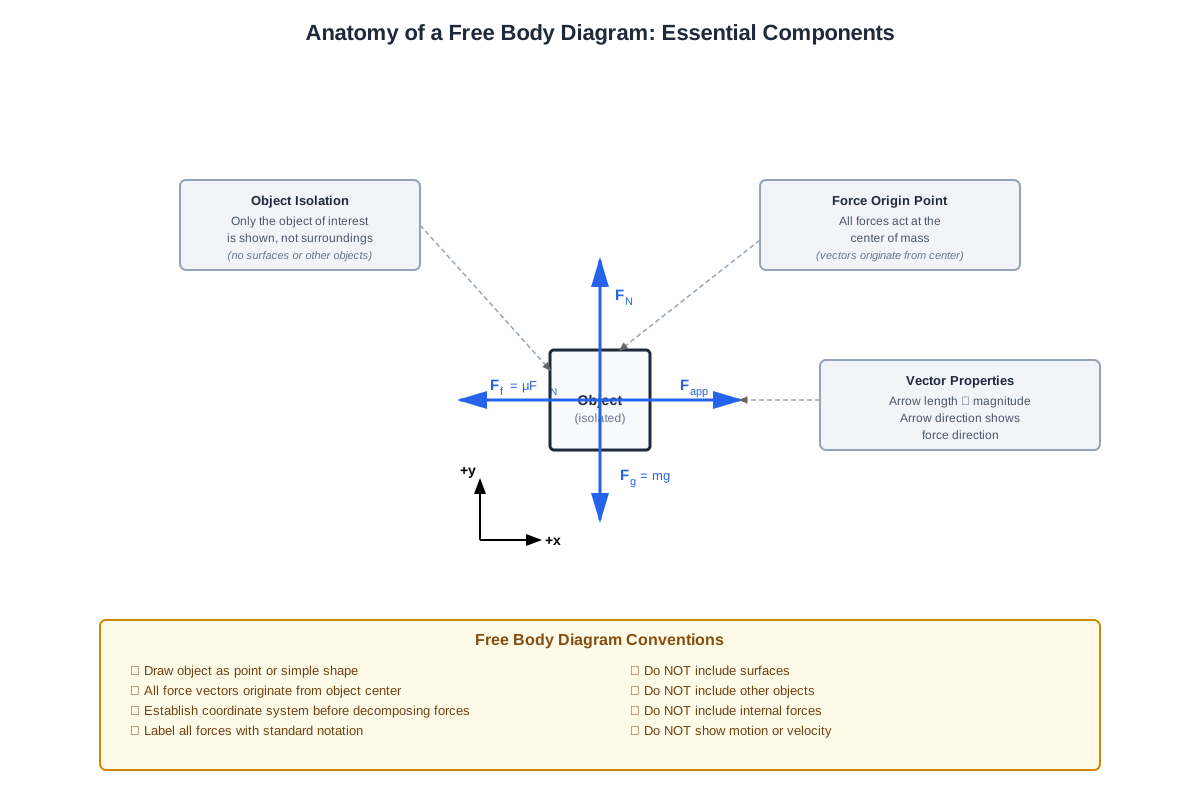
A free body diagram is a simplified representation showing all external forces acting on a single object or system, with the object typically drawn as a point or simple shape at the center. The term "free body" indicates that the object has been isolated from its surroundings, and only the forces exerted on the object by external sources are shown. Each force is represented as an arrow (vector) with its tail at the object's center, pointing in the direction the force acts, with length proportional to magnitude.
The primary purpose of constructing FBDs is to organize information systematically before applying Newton's second law. By identifying all forces and their directions, students can write component equations (ΣFx = max and ΣFy = may) that lead directly to solutions. FBDs prevent the common error of including forces that don't actually act on the object or omitting forces that do.
Essential Components of a Free Body Diagram
Every complete FBD must include:
- The object of interest: Represented as a dot, box, or simple shape
- Coordinate axes: Clearly labeled x and y axes (choice of orientation is strategic)
- All external forces: Drawn as arrows with labels indicating force type
- Force labels: Each arrow labeled with standard notation (Fg, FN, Ft, Ff, Fa, etc.)
- Directional accuracy: Arrows pointing in the correct direction relative to the object
Types of Forces Commonly Appearing in FBDs
| Force Type | Symbol | Direction | Notes |
|---|---|---|---|
| Gravitational/Weight | Fg or W | Always downward (toward Earth's center) | Magnitude = mg |
| Normal Force | FN or N | Perpendicular to contact surface | Reaction force from surface |
| Tension | Ft or T | Along rope/string, away from object | Always pulls, never pushes |
| Friction | Ff or f | Parallel to surface, opposes motion/potential motion | Static (fs) or kinetic (fk) |
| Applied Force | Fa or F | Specified in problem | External push or pull |
| Air Resistance/Drag | Fd or D | Opposite to velocity direction | Often negligible unless stated |
| Spring Force | Fs | Opposite to displacement from equilibrium | Magnitude = kx (Hooke's law) |
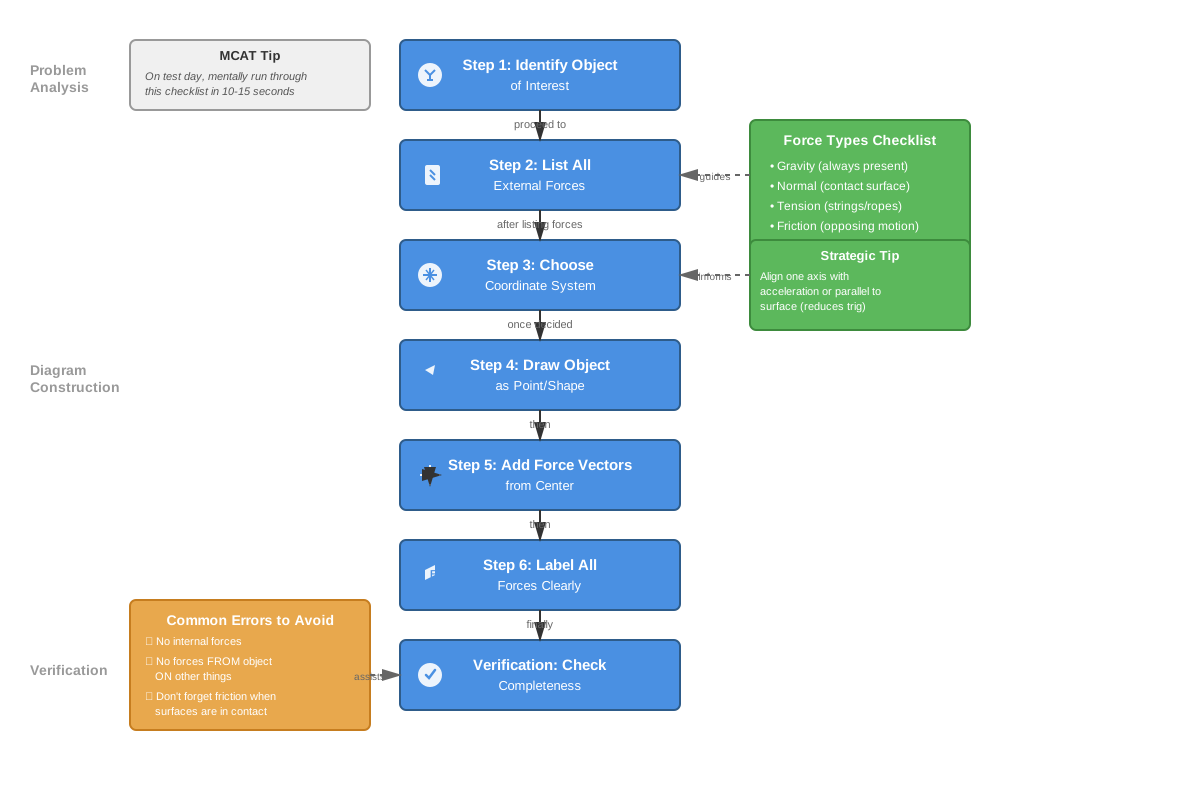
Step-by-Step Process for Constructing FBDs
- Identify the object: Determine which single object or system to analyze
- Isolate the object: Mentally separate it from all surroundings
- Establish coordinate axes: Choose orientation that simplifies calculations (often align one axis with acceleration direction)
- Identify all contact forces: Any object touching the system exerts a force (normal, friction, tension, applied)
- Identify all field forces: Gravity always acts; electromagnetic forces if charges/magnets present
- Draw force vectors: Each force as an arrow from the object's center
- Label clearly: Use standard notation and indicate magnitudes if known
- Check completeness: Verify no forces are missing or incorrectly included
Strategic Axis Selection
The choice of coordinate system orientation significantly affects calculation complexity. Standard approaches include:
- Horizontal-vertical axes: Default choice for objects on horizontal surfaces or in free fall
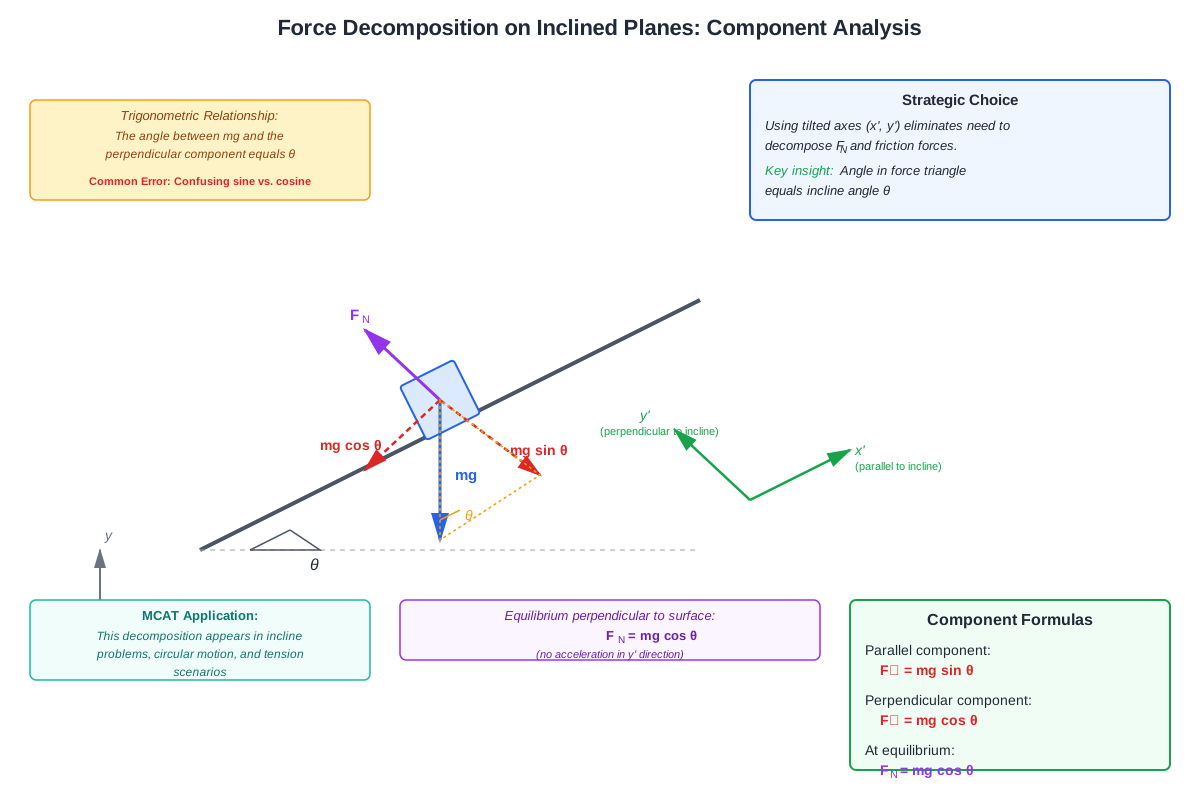
- Tilted axes (parallel and perpendicular to incline): Optimal for inclined plane problems; reduces the number of forces requiring decomposition
- Radial-tangential axes: Used for circular motion; radial direction points toward center of circular path
Exam Tip: On inclined plane problems, always rotate your axes so one axis is parallel to the incline surface. This means only the gravitational force needs to be decomposed into components, while normal force and friction align with axes.
Force Decomposition and Components
When a force doesn't align with chosen axes, it must be resolved into perpendicular components using trigonometry:
Fx = F cos(θ)
Fy = F sin(θ)
Where θ is the angle between the force vector and the x-axis. For inclined planes with angle θ above horizontal:
Fg,parallel = mg sin(θ)  (down the incline)
Fg,perpendicular = mg cos(θ)  (into the incline)
Equilibrium vs. Non-Equilibrium Situations
Static Equilibrium: Object at rest with zero acceleration
- ΣFx = 0 and ΣFy = 0
- All forces balance in every direction
- Common in problems about hanging objects, objects on surfaces, or structures
Dynamic Equilibrium: Object moving at constant velocity (zero acceleration)
- ΣFx = 0 and ΣFy = 0
- Net force is zero despite motion
- Example: parachutist at terminal velocity
Non-Equilibrium: Object experiencing acceleration
- ΣF = ma (net force equals mass times acceleration)
- Forces don't balance; there's a net force in direction of acceleration
- Most dynamics problems fall into this category
Common Force Pairs and Newton's Third Law
While FBDs show only forces acting on the object, understanding Newton's third law helps identify forces correctly. Every force has an equal and opposite reaction force, but the reaction acts on a different object and therefore doesn't appear on the same FBD.
Example: A book resting on a table
- On the book's FBD: Weight (Fg, downward) and normal force from table (FN, upward)
- Not on the book's FBD: The force the book exerts on the table (this is the reaction to FN and acts on the table, not the book)
Systems with Multiple Objects
For connected objects (like masses connected by ropes or objects in contact), two approaches exist:
- Separate FBDs: Draw individual FBDs for each object, including internal forces (tensions, contact forces between objects)
- System FBD: Treat all objects as one system; internal forces cancel and don't appear; only external forces shown
The system approach simplifies problems when internal forces (like tension in a connecting rope) aren't needed in the answer.
Concept Relationships
Free body diagrams serve as the central hub connecting multiple mechanics concepts. The process begins with force identification, which requires understanding each force type (gravity, normal, friction, tension). These forces are represented as vectors, necessitating knowledge of vector addition and decomposition. The completed FBD enables application of Newton's second law (ΣF = ma), which connects force to acceleration.
The relationship flow: Force types → Free body diagram construction → Vector decomposition → Newton's second law application → Kinematic equations (if acceleration is found and motion parameters are needed).
FBDs connect backward to prerequisites like trigonometry (for component calculations) and forward to advanced topics like work and energy (forces through distances), momentum (forces over time), circular motion (identifying centripetal force), and rotational dynamics (torque analysis requires identifying forces and their lever arms).
In biomechanical contexts, FBDs of body segments connect to lever systems in the musculoskeletal system, where bones act as rigid bodies, joints as fulcrums, and muscles provide applied forces. Understanding these connections allows MCAT passages about human movement to be analyzed systematically.
High-Yield Facts
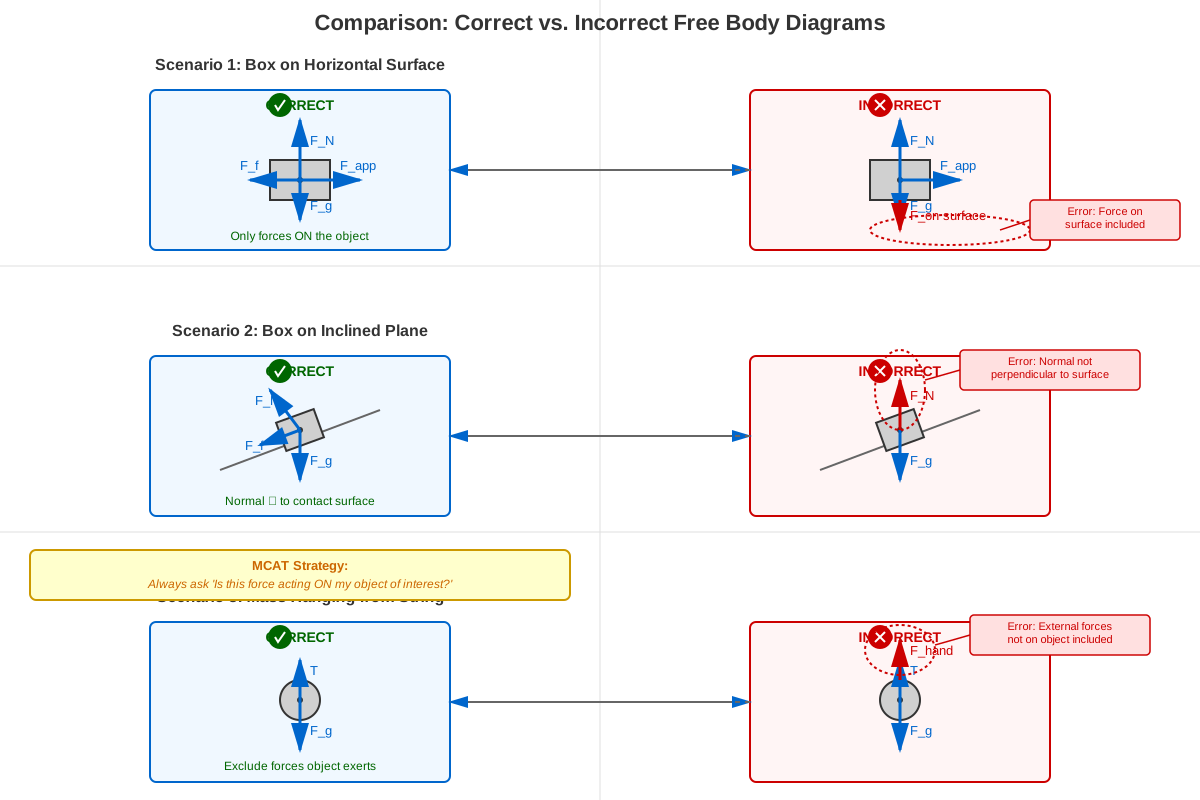
⭐ Free body diagrams must include only external forces acting ON the object, never forces the object exerts on other things
⭐ Weight (Fg = mg) always points straight downward toward Earth's center, regardless of surface orientation
⭐ Normal force is always perpendicular to the contact surface, not necessarily vertical
⭐ On an incline of angle θ, gravitational force components are: parallel = mg sin(θ), perpendicular = mg cos(θ)
⭐ Tension forces always pull away from the object along the direction of the rope or string
- Static friction can vary from zero up to μsN and points opposite to the direction of potential motion
- Kinetic friction has constant magnitude fk = μkN and points opposite to the velocity direction
- In equilibrium problems (ΣF = 0), the number of unknown forces must not exceed the number of independent equations (typically two: ΣFx = 0 and ΣFy = 0)
- For objects in circular motion, net force toward the center equals mv²/r (centripetal force requirement)
- When multiple objects are connected, drawing separate FBDs for each object reveals internal forces like tension
- Air resistance is typically negligible in MCAT problems unless explicitly mentioned
- The normal force does NOT always equal weight; it equals weight only for objects on horizontal surfaces with no vertical applied forces
Quick check — test yourself on Free body diagrams so far.
Try Flashcards →Common Misconceptions
Misconception: Normal force always equals the object's weight (FN = mg)
Correction: Normal force equals weight only for objects on horizontal surfaces with no other vertical forces. On inclines, FN = mg cos(θ). If additional vertical forces exist (like someone pushing down), normal force adjusts accordingly. Normal force is whatever value is needed to prevent the object from accelerating through the surface.
Misconception: Friction always opposes motion
Correction: Friction opposes relative motion or potential relative motion between surfaces. Static friction can point in the direction of motion (example: friction on your shoes provides the forward force when you walk). The key is that friction opposes the sliding that would occur without it.
Misconception: Tension has different values at different points along a massless rope
Correction: For massless, frictionless ropes and strings, tension is uniform throughout. If the rope has mass or passes over a pulley with friction, tension can vary, but MCAT problems typically assume ideal massless ropes with constant tension.
Misconception: An object moving at constant velocity has forces acting on it in the direction of motion
Correction: Constant velocity means zero acceleration, which requires zero net force (ΣF = 0). Forces are balanced. The object continues moving due to inertia, not because of an unbalanced force. This is Newton's first law.
Misconception: You should include "ma" as a force on the free body diagram
Correction: "ma" is not a force; it's the result of net force (ΣF = ma). Only actual forces (gravity, normal, tension, friction, applied) appear on FBDs. The term "ma" appears on the right side of Newton's second law equation after analyzing the FBD.
Misconception: The force of motion or "force of velocity" should be included
Correction: Motion and velocity are not forces. Objects in motion continue moving due to inertia (Newton's first law), not because of a force. Only interactions with other objects or fields produce forces.
Misconception: On an incline, the normal force component of gravity points perpendicular to the surface
Correction: The normal force itself points perpendicular to the surface. It's the gravitational force (weight) that gets decomposed into components parallel and perpendicular to the incline. The normal force is a separate force that reacts to the perpendicular component of weight.
Worked Examples
Example 1: Block on an Inclined Plane
Problem: A 5.0 kg block rests on a frictionless incline angled at 30° above horizontal. Draw the free body diagram and calculate the acceleration of the block down the incline.
Solution:
Step 1 - Identify the object: The 5.0 kg block
Step 2 - Choose coordinate system: Rotate axes so x-axis is parallel to incline (pointing down the slope) and y-axis is perpendicular to incline (pointing away from surface)
Step 3 - Identify all forces:
- Gravitational force (weight): Fg = mg = (5.0 kg)(10 m/s²) = 50 N, pointing straight downward
- Normal force: FN, pointing perpendicular to incline surface (along +y axis)
- No friction (stated as frictionless)
- No applied forces
Step 4 - Draw FBD:
- Block represented as a dot or square
- Arrow pointing straight down labeled "Fg = 50 N"
- Arrow perpendicular to surface pointing away from incline labeled "FN"
- Axes shown with x parallel to incline, y perpendicular
Step 5 - Decompose forces:
Since axes are rotated, only gravity needs decomposition:
- Fg,x = mg sin(30°) = 50 × 0.5 = 25 N (down the incline, +x direction)
- Fg,y = mg cos(30°) = 50 × 0.866 = 43.3 N (into the incline, -y direction)
- FN remains along y-axis
Step 6 - Apply Newton's second law:
In y-direction (perpendicular to incline): No acceleration perpendicular to surface
ΣFy = 0
FN - mg cos(30°) = 0
FN = 43.3 N
In x-direction (parallel to incline): Block accelerates down slope
ΣFx = max
mg sin(30°) = max
25 N = (5.0 kg) × ax
ax = 5.0 m/s²Answer: The block accelerates down the incline at 5.0 m/s². The FBD shows weight (50 N downward) and normal force (43.3 N perpendicular to surface), with the weight decomposed into 25 N parallel and 43.3 N perpendicular to the incline.
Example 2: Hanging Masses with Pulley
Problem: Two masses are connected by a massless rope over a frictionless pulley. Mass m₁ = 3.0 kg hangs vertically on the left side, and mass m₂ = 5.0 kg hangs vertically on the right side. Draw free body diagrams for each mass and determine the acceleration of the system and the tension in the rope.
Solution:
Step 1 - Draw separate FBDs:
For m₁ (3.0 kg):
- Weight: Fg1 = m₁g = 30 N downward
- Tension: T upward
For m₂ (5.0 kg):
- Weight: Fg2 = m₂g = 50 N downward
- Tension: T upward
Step 2 - Establish sign convention:
Let positive direction be the direction of motion. Since m₂ is heavier, it will accelerate downward and m₁ will accelerate upward. For m₂, take downward as positive; for m₁, take upward as positive. Both masses have the same magnitude of acceleration (a) because they're connected.
Step 3 - Apply Newton's second law to m₁:
ΣF = m₁a
T - m₁g = m₁a
T - 30 = 3a  ... (equation 1)
Step 4 - Apply Newton's second law to m₂:
ΣF = m₂a
m₂g - T = m₂a
50 - T = 5a  ... (equation 2)
Step 5 - Solve system of equations:
Add equations 1 and 2:
(T - 30) + (50 - T) = 3a + 5a
20 = 8a
a = 2.5 m/s²
Substitute back into equation 1:
T - 30 = 3(2.5)
T = 37.5 NAnswer: The system accelerates at 2.5 m/s² (m₂ downward, m₁ upward), and the tension in the rope is 37.5 N. The FBDs show each mass with its weight downward and tension upward, with the net force on each mass producing acceleration in the expected direction.
Exam Strategy
When approaching MCAT questions involving free body diagrams, follow this systematic strategy:
1. Read carefully for the object of interest: Passages often describe complex systems with multiple objects. Identify which specific object the question asks about. If unclear, consider whether analyzing the entire system as one object or separating into individual objects will be more efficient.
2. Watch for trigger words:
- "At rest" or "equilibrium" → ΣF = 0
- "Constant velocity" → ΣF = 0 (dynamic equilibrium)
- "Accelerating" → ΣF = ma (non-zero net force)
- "Frictionless" → Exclude friction from FBD
- "Massless rope" → Tension is uniform throughout
- "Smooth surface" → Another way of saying frictionless
3. Sketch quickly but accurately: Even if the question doesn't explicitly ask for an FBD, drawing one on scratch paper prevents errors. A 10-second sketch can save 30 seconds of confused calculation. Focus on correct directions rather than artistic quality.
4. Count unknowns vs. equations: Before diving into algebra, verify that the problem is solvable. For 2D problems, you get two equations (ΣFx = 0 or max, and ΣFy = 0 or may). If there are more than two unknowns, you may need additional information or need to analyze multiple objects.
5. Strategic axis rotation: For inclined plane problems, immediately rotate axes parallel and perpendicular to the surface. This is the highest-yield time-saving technique for these problems. Students who keep horizontal-vertical axes waste time decomposing multiple forces.
6. Process of elimination for conceptual questions:
- Eliminate choices that include non-existent forces (force of motion, centrifugal force, etc.)
- Eliminate choices with forces pointing in impossible directions (normal force not perpendicular to surface, weight not pointing down)
- Eliminate choices that violate Newton's third law (showing both action and reaction on the same object)
7. Time allocation: Don't spend more than 30-45 seconds drawing an FBD for a discrete question, or 60-90 seconds for a complex passage-based question. If you're stuck, move on and return later. The MCAT rewards efficient time management.
Memory Techniques
WIN-TAG Mnemonic for Force Identification:
- Weight (gravity) - always present, always downward
- Interaction forces (normal, friction) - present when surfaces touch
- Normal - perpendicular to contact surface
- Tension - along ropes/strings, pulls away from object
- Applied - external pushes or pulls mentioned in problem
- Gravity - (redundant with W, but reinforces that it's never forgotten)
"SNAP" for Incline Problems:
- Set axes parallel and perpendicular to surface
- Normal force along perpendicular axis
- Angle appears in sine for parallel component: mg sin(θ)
- Perpendicular component uses cosine: mg cos(θ)
Visualization Strategy:
Imagine yourself as the object. What would you feel pushing or pulling on you? This kinesthetic approach helps identify contact forces. You'd feel the ground pushing up (normal), friction resisting sliding, ropes pulling, but you wouldn't feel your own weight as a separate force—you'd feel the ground's reaction to it.
"Only ON, Never BY" Rule:
Free body diagrams show only forces acting ON the object, never forces BY the object on other things. If you're tempted to include a force, ask: "Is this acting ON my object?" If the answer is no, exclude it.
Summary
Free body diagrams are the essential first step in solving virtually all mechanics problems on the MCAT. By systematically isolating an object and representing all external forces as vectors, FBDs transform complex physical situations into manageable mathematical problems. The key principles include: identifying only forces acting ON the object (never forces the object exerts), recognizing that weight always points downward while normal force points perpendicular to contact surfaces, and strategically choosing coordinate axes to minimize the number of forces requiring decomposition. For inclined planes, rotating axes parallel and perpendicular to the surface is the highest-yield technique. Understanding the distinction between equilibrium (ΣF = 0) and non-equilibrium (ΣF = ma) situations allows rapid problem categorization. Common forces include weight, normal force, tension, friction, and applied forces, each with characteristic directions and properties. Mastery of FBD construction enables efficient application of Newton's laws and connects to broader topics including kinematics, energy, momentum, and circular motion—making this skill one of the most valuable in the entire MCAT physics curriculum.
Key Takeaways
- Free body diagrams isolate a single object and show all external forces acting ON it as vectors, enabling systematic application of Newton's second law
- Weight (mg) always points straight downward; normal force always points perpendicular to the contact surface (not necessarily upward)
- On inclines with angle θ, decompose weight into mg sin(θ) parallel to surface and mg cos(θ) perpendicular to surface after rotating coordinate axes
- Equilibrium (static or dynamic) means ΣF = 0 in all directions; non-equilibrium means ΣF = ma with net force in the direction of acceleration
- Common errors include treating "ma" as a force, assuming normal force always equals weight, and including forces the object exerts rather than forces acting on it
- Strategic axis selection (especially rotating axes for incline problems) dramatically simplifies calculations and reduces errors
- Tension in massless ropes is uniform throughout; friction opposes relative motion between surfaces; and forces always come in action-reaction pairs (though only one appears on any single FBD)
Related Topics
Newton's Laws of Motion: Free body diagrams are the primary tool for applying Newton's second law; mastering FBDs enables deeper understanding of force-acceleration relationships and inertia
Inclined Plane Problems: Specialized application of FBDs requiring trigonometric decomposition of gravitational force and strategic axis rotation
Friction (Static and Kinetic): Understanding friction forces on FBDs, including direction determination and magnitude calculations using normal force
Circular Motion and Centripetal Force: FBDs for objects in circular paths require identifying which forces or force components provide the centripetal acceleration toward the center
Work and Energy: Forces identified on FBDs, when multiplied by displacement, determine work done; connects force analysis to energy conservation
Torque and Rotational Dynamics: Extended FBDs showing forces at specific locations on extended objects enable torque calculations for rotational motion analysis
Biomechanics and Lever Systems: Application of FBDs to human body segments, analyzing forces from muscles, bones, and joints in physiologically relevant contexts
Practice CTA
Now that you've mastered the fundamentals of free body diagrams, it's time to solidify your understanding through active practice. Work through the practice questions and flashcards to test your ability to construct accurate FBDs, identify forces correctly, and apply Newton's laws efficiently. Remember, the difference between understanding FBDs conceptually and being able to execute them rapidly under test conditions comes from deliberate practice. Each problem you solve strengthens your pattern recognition and builds the automaticity you'll need on test day. You've built the foundation—now make it unshakeable through application!
Sign up free to keep reading
Create a free AnvayaPrep account to finish this MCAT guide on Free body diagrams — plus flashcards and practice questions.