Overview
Thermal expansion is a fundamental phenomenon in Physics where materials change their dimensions—length, area, or volume—in response to temperature changes. This concept sits at the intersection of thermodynamics, material properties, and molecular kinetics, making it an essential topic within Thermodynamics and Gases for the MCAT. When substances absorb thermal energy, their constituent particles gain kinetic energy and vibrate more vigorously, causing the material to expand. Conversely, cooling causes contraction as particles lose kinetic energy and move closer together. Understanding thermal expansion requires integrating knowledge of temperature, heat transfer, and the molecular basis of matter.
For the MCAT, thermal expansion appears in multiple contexts: passage-based questions involving experimental apparatus, standalone problems requiring quantitative calculations, and conceptual questions linking thermal behavior to real-world applications. The topic frequently connects to other Physics concepts such as heat capacity, phase transitions, and the ideal gas law, while also appearing in interdisciplinary passages that bridge physics with chemistry or biological systems. Mastery of thermal expansion enables students to predict material behavior under temperature stress, understand the design of engineering systems, and analyze experimental setups where temperature variations affect measurements.
The significance of thermal expansion Physics extends beyond pure calculation—it represents a critical application of thermodynamic principles to practical scenarios. MCAT questions often test whether students can identify which materials expand more (based on coefficients of expansion), predict the consequences of constrained expansion, and recognize situations where thermal expansion creates mechanical stress. This topic exemplifies how microscopic molecular behavior manifests as macroscopic observable changes, a recurring theme throughout MCAT physics content that requires both conceptual understanding and quantitative problem-solving skills.
Learning Objectives
- [ ] Define thermal expansion using accurate Physics terminology
- [ ] Explain why thermal expansion matters for the MCAT
- [ ] Apply thermal expansion to exam-style questions
- [ ] Identify common mistakes related to thermal expansion
- [ ] Connect thermal expansion to related Physics concepts
- [ ] Calculate dimensional changes using linear, area, and volumetric expansion coefficients
- [ ] Predict the relative expansion of different materials based on their thermal expansion coefficients
- [ ] Analyze scenarios involving constrained thermal expansion and resulting mechanical stress
Prerequisites
- Temperature and heat: Understanding the distinction between temperature (average kinetic energy) and heat (energy transfer) is essential for comprehending why materials expand when heated
- Kinetic molecular theory: Knowledge of how particle motion relates to temperature provides the microscopic explanation for macroscopic expansion
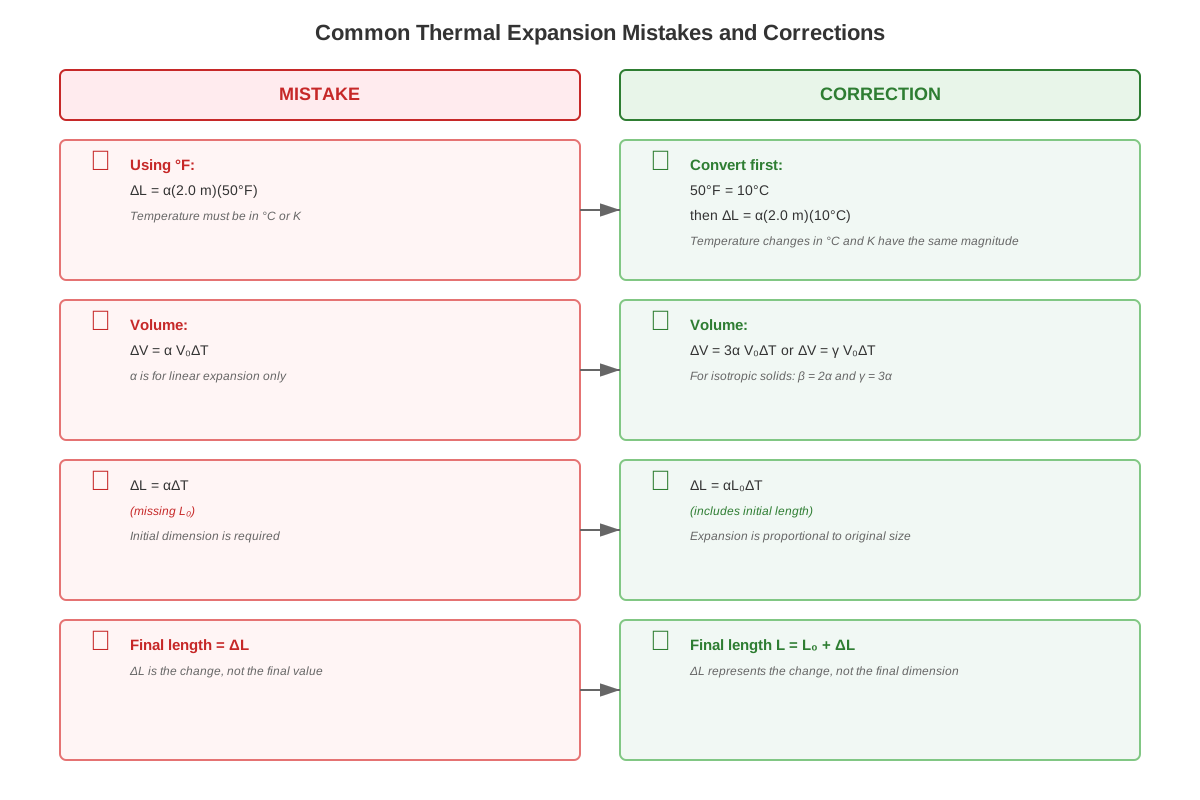
- Basic algebra and unit conversion: Thermal expansion calculations require manipulating equations and converting between temperature scales (Celsius, Kelvin, Fahrenheit)
- States of matter: Recognizing differences in molecular arrangement between solids, liquids, and gases explains why expansion coefficients vary across phases
Why This Topic Matters
Thermal expansion has profound real-world and clinical significance. Medical devices, from thermometers to surgical instruments, must account for dimensional changes with temperature. Dental fillings must have thermal expansion coefficients matching tooth enamel to prevent cracking during temperature fluctuations from hot and cold foods. Prosthetic implants and bone screws require careful material selection to ensure expansion compatibility with biological tissues across body temperature variations. In diagnostic imaging, thermal expansion affects the precision of measurement instruments and the stability of calibration standards.
On the MCAT, thermal expansion appears in approximately 2-4% of Physics questions, typically as part of thermodynamics passages or standalone problems. Questions commonly present experimental scenarios where temperature changes affect apparatus dimensions, requiring students to calculate length changes or predict measurement errors. Passage-based questions might describe a calorimetry experiment where container expansion affects volume measurements, or a materials science study comparing expansion coefficients of different alloys. The topic also appears in interdisciplinary contexts, such as analyzing how temperature affects the volume of biological fluids or the dimensions of laboratory glassware.
Common MCAT question formats include: calculating the change in length of a metal rod heated through a specific temperature range; determining which material in a composite structure will expand more; predicting whether gaps will open or close in structures with temperature changes; and analyzing how thermal expansion affects the accuracy of measuring devices. The exam frequently tests whether students can distinguish between linear, area, and volumetric expansion, and whether they understand that expansion coefficients are material-specific properties.
Core Concepts
Definition and Molecular Basis
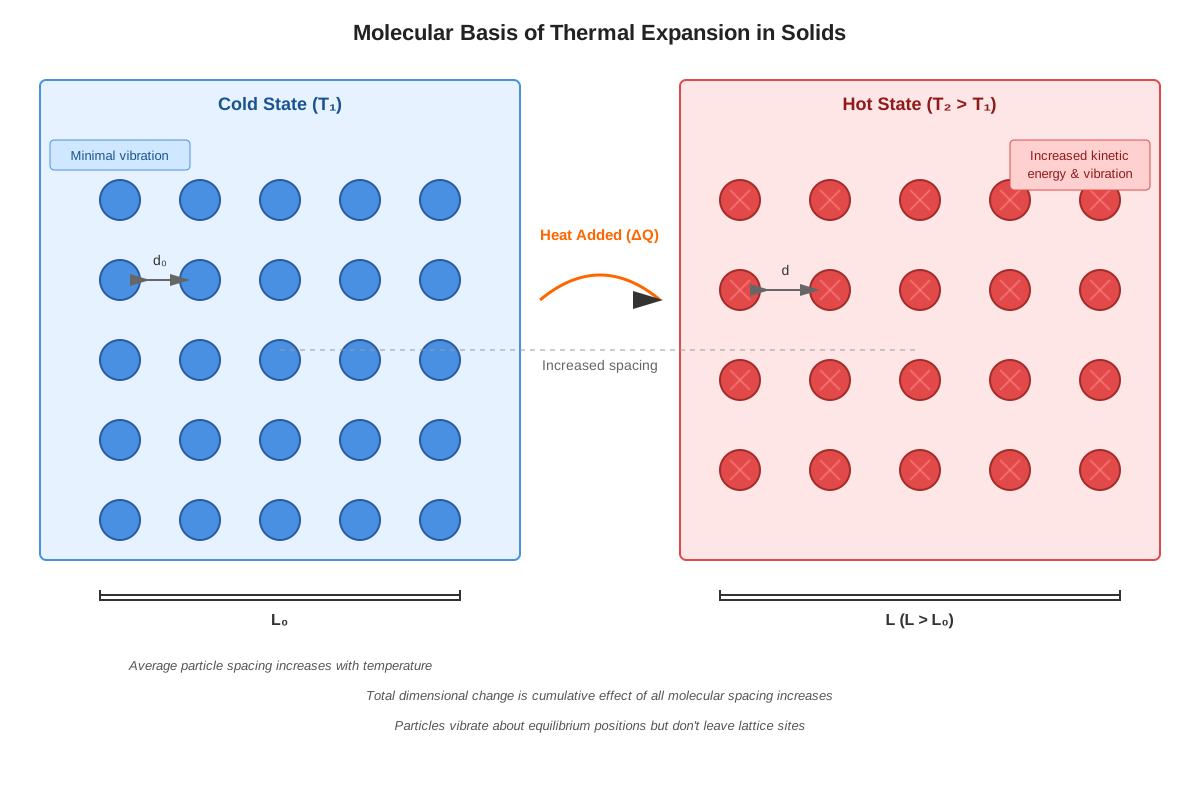
Thermal expansion refers to the tendency of matter to increase in volume, area, or length when temperature increases. At the molecular level, heating a substance increases the average kinetic energy of its constituent particles (atoms, molecules, or ions). This increased vibrational energy causes particles to oscillate with greater amplitude around their equilibrium positions. In solids, where particles are bound in relatively fixed positions, this enhanced vibration increases the average separation between particles, resulting in macroscopic expansion. The asymmetry of the interatomic potential energy curve—where repulsive forces increase more steeply than attractive forces—explains why average particle separation increases rather than remaining constant with increased vibration.
Different states of matter exhibit varying degrees of thermal expansion. Gases expand most dramatically because their particles are already widely separated and weakly interacting. Liquids show intermediate expansion, while solids typically expand least due to strong intermolecular forces constraining particle movement. However, the specific expansion behavior depends on the material's atomic structure, bonding type, and crystal lattice arrangement.
Linear Thermal Expansion
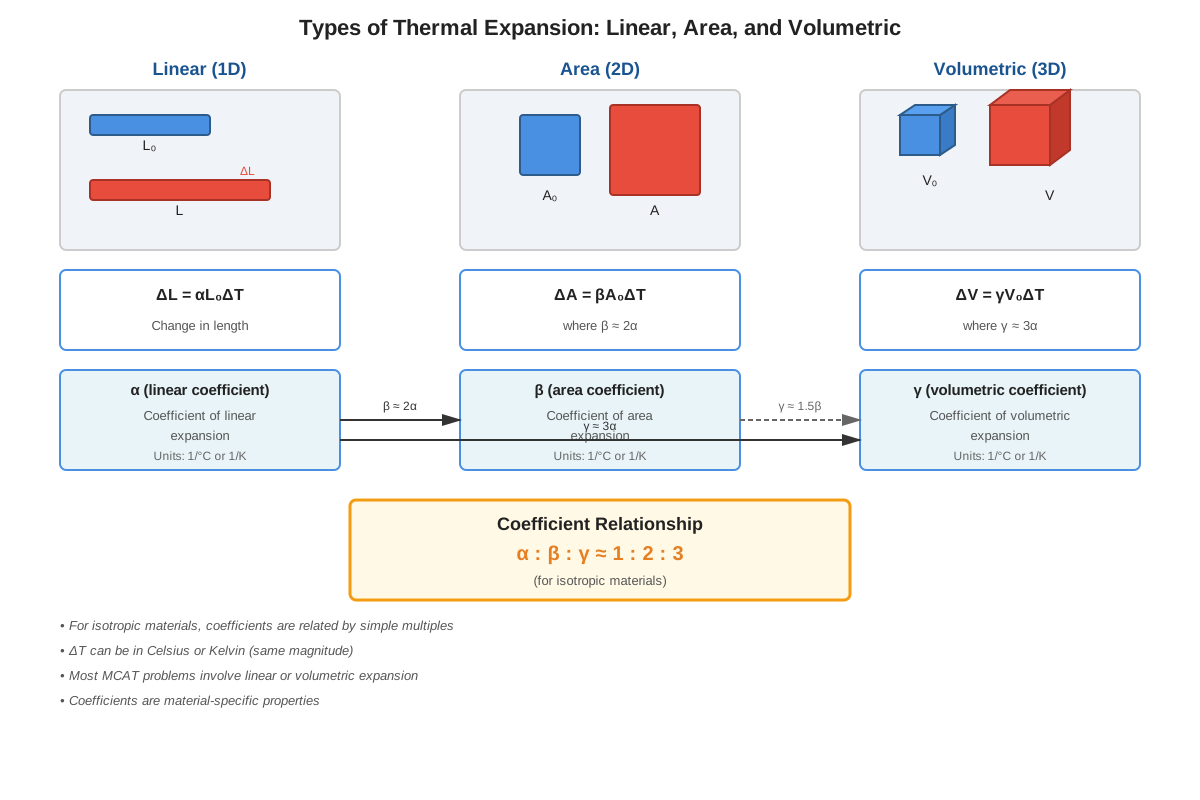
Linear thermal expansion describes the change in one dimension (length) of a material with temperature change. This is the most commonly tested form on the MCAT for solid objects like rods, beams, or wires. The relationship is expressed mathematically as:
ΔL = α L₀ ΔTWhere:
- ΔL = change in length
- α = coefficient of linear expansion (units: 1/°C or 1/K)
- L₀ = original length
- ΔT = change in temperature
The final length after expansion is:
L = L₀(1 + α ΔT)The coefficient of linear expansion (α) is a material-specific property that quantifies how much a material expands per degree of temperature change per unit length. Typical values range from 10⁻⁶ to 10⁻⁵ per °C for common solids. Materials with higher α values expand more for the same temperature change.
| Material | Linear Expansion Coefficient (α) × 10⁻⁶ /°C |
|---|---|
| Steel | 11-13 |
| Aluminum | 23-24 |
| Copper | 16-17 |
| Glass (Pyrex) | 3.3 |
| Concrete | 12 |
| Brass | 19 |
Area Thermal Expansion
Area thermal expansion describes how the two-dimensional surface area of a material changes with temperature. For a thin sheet or plate, the area expansion coefficient (β) relates to the linear expansion coefficient:
β = 2αThe change in area is:
ΔA = β A₀ ΔT = 2α A₀ ΔTWhere:
- ΔA = change in area
- β = coefficient of area expansion
- A₀ = original area
- ΔT = change in temperature
This relationship (β = 2α) derives from considering a square expanding in two perpendicular directions. When each side increases by a factor of (1 + α ΔT), the area increases by (1 + α ΔT)², which approximates to (1 + 2α ΔT) when α ΔT is small (which is typically true for solids).
Volumetric Thermal Expansion
Volumetric thermal expansion describes three-dimensional volume changes with temperature and is particularly important for liquids and gases. The volumetric expansion coefficient (γ) relates to linear expansion:
γ = 3αThe change in volume is:
ΔV = γ V₀ ΔT = 3α V₀ ΔTWhere:
- ΔV = change in volume
- γ = coefficient of volumetric expansion
- V₀ = original volume
- ΔT = change in temperature
For liquids, volumetric expansion is the primary concern since liquids don't maintain fixed shapes. Water exhibits anomalous behavior: it contracts when heated from 0°C to 4°C, reaching maximum density at 4°C, then expands normally above this temperature. This unusual property has profound ecological significance (ice floats, lakes freeze from top down) and occasionally appears in MCAT passages.
Thermal Stress and Constrained Expansion
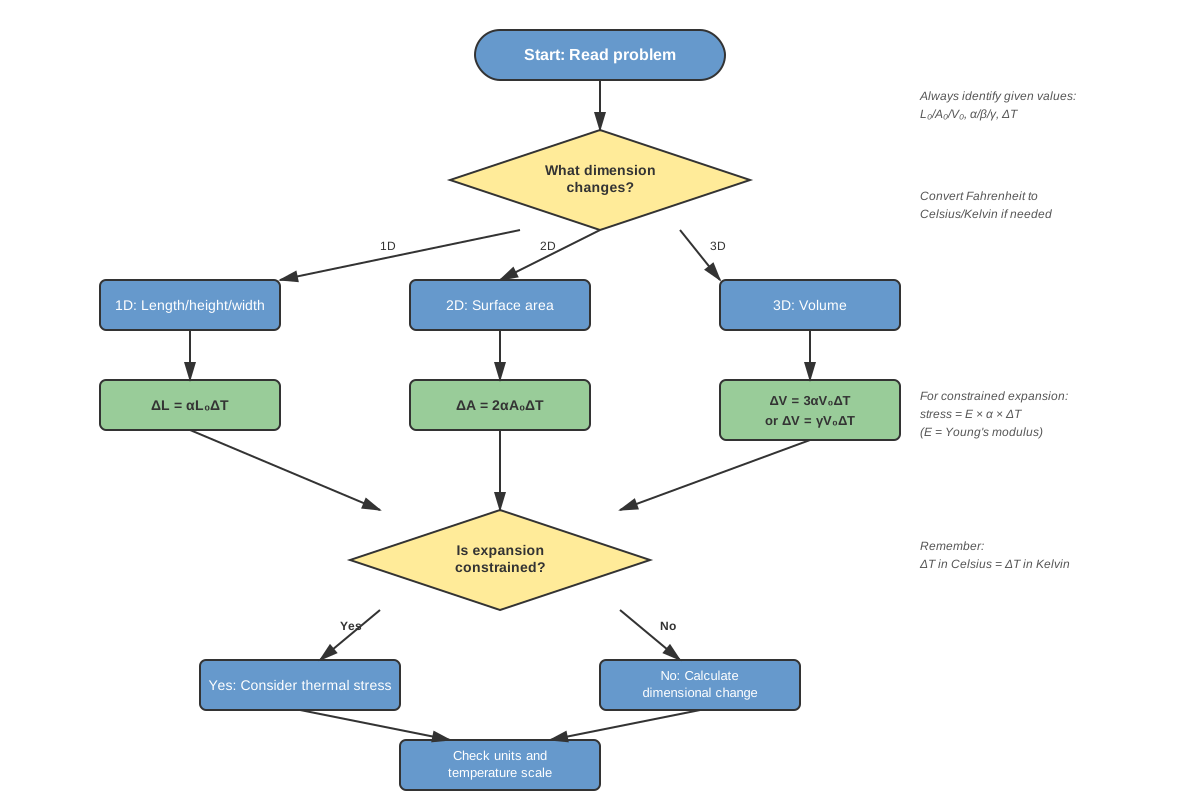
When thermal expansion is prevented or constrained, thermal stress develops within the material. This occurs when a material is heated but cannot expand freely due to physical constraints. The stress generated can be substantial enough to cause structural failure, buckling, or fracture. The thermal stress (σ) in a constrained material is:
σ = E α ΔTWhere:
- σ = thermal stress
- E = Young's modulus (elastic modulus) of the material
- α = coefficient of linear expansion
- ΔT = change in temperature
This relationship shows that stiffer materials (higher E) and materials with larger expansion coefficients (higher α) develop greater thermal stress when constrained. Engineers must account for this by including expansion joints in structures like bridges, railroad tracks, and pipelines. MCAT questions may present scenarios where students must predict whether a constrained material will buckle, crack, or exert force on surrounding structures.
Bimetallic Strips
A bimetallic strip consists of two different metals bonded together, each with different thermal expansion coefficients. When heated, the metal with the larger coefficient expands more, causing the strip to bend toward the side with the smaller coefficient. When cooled, the strip bends in the opposite direction. This principle is used in thermostats, circuit breakers, and temperature-sensing devices. MCAT questions may ask students to predict the direction of bending or explain the operating principle of such devices.
Practical Applications and Considerations
Thermal expansion has numerous engineering applications and constraints:
- Expansion joints: Gaps intentionally left in bridges, sidewalks, and railroad tracks to accommodate expansion
- Thermometers: Liquid-in-glass thermometers rely on the differential expansion between liquid (typically mercury or alcohol) and glass
- Precision instruments: Optical equipment and measuring devices use materials with low expansion coefficients (like Invar alloys) to maintain accuracy across temperature ranges
- Composite materials: Different expansion rates in composite structures can cause delamination or cracking
- Piping systems: Long pipelines require expansion loops or flexible joints to prevent stress buildup
Concept Relationships
The concepts within thermal expansion form a hierarchical structure. Linear thermal expansion serves as the foundation, with the coefficient α being the fundamental material property. From linear expansion, area expansion (β = 2α) and volumetric expansion (γ = 3α) are derived mathematically, representing extensions to two and three dimensions respectively. These relationships assume isotropic materials (properties same in all directions), which is valid for most MCAT contexts.
Thermal stress emerges when expansion is constrained, connecting thermal expansion to mechanics and material properties (Young's modulus). This represents the intersection of thermodynamics and solid mechanics. Bimetallic strips demonstrate differential expansion, combining the concepts of material-specific expansion coefficients with mechanical bending, illustrating how thermal expansion can be harnessed for practical devices.
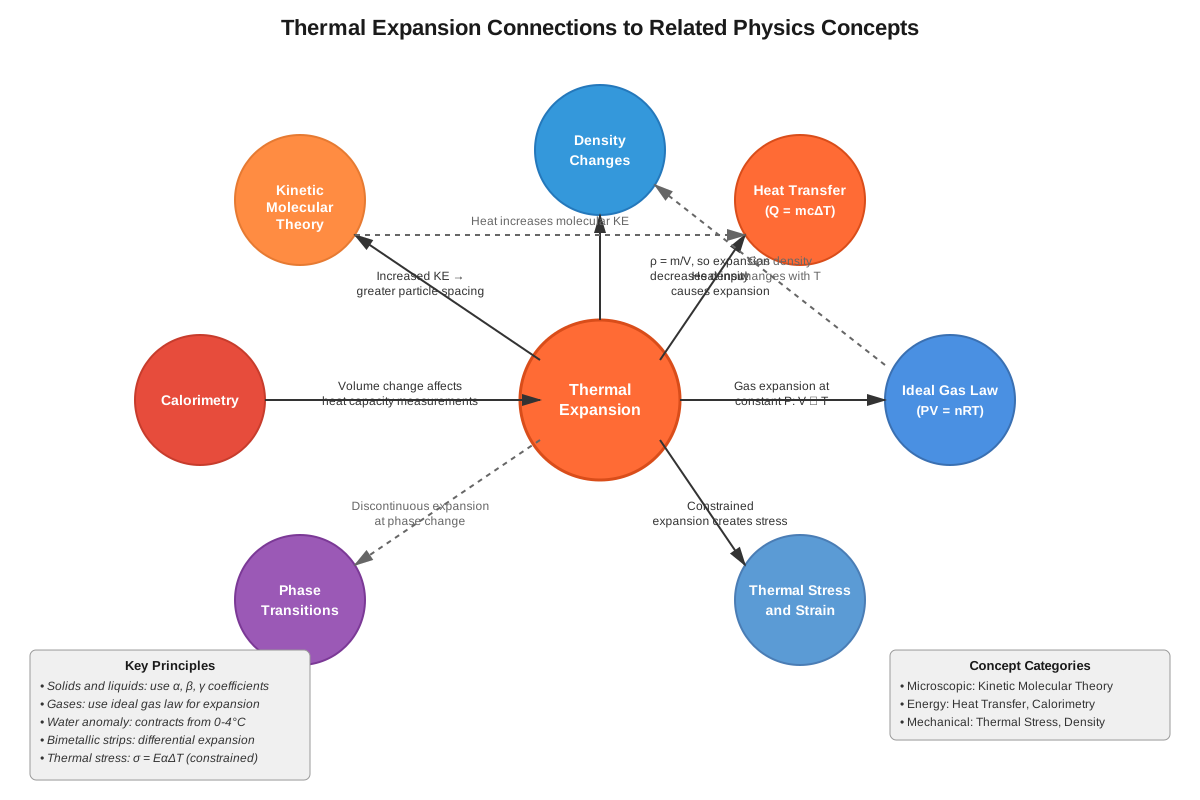
Thermal expansion connects to prerequisite topics through multiple pathways: Temperature and heat → provides the energy input that drives expansion; Kinetic molecular theory → explains the microscopic mechanism (increased particle vibration); States of matter → determines the magnitude of expansion (gases > liquids > solids). Related topics include: Ideal gas law (PV = nRT shows how gas volume changes with temperature at constant pressure); Heat capacity (determines how much temperature changes for given heat input); Phase transitions (expansion coefficients change discontinuously at phase boundaries); Calorimetry (thermal expansion of containers affects volume measurements).
The conceptual flow: Molecular kinetic energy increase → Enhanced particle vibration → Increased average particle separation → Macroscopic dimensional change → Potential thermal stress if constrained → Engineering solutions (expansion joints, material selection).
Quick check — test yourself on Thermal expansion so far.
Try Flashcards →High-Yield Facts
⭐ The coefficient of linear expansion (α) is material-specific and typically ranges from 10⁻⁶ to 10⁻⁵ per °C for common solids
⭐ Area expansion coefficient β = 2α, and volumetric expansion coefficient γ = 3α for isotropic materials
⭐ Aluminum expands approximately twice as much as steel for the same temperature change (αₐₗ ≈ 24 × 10⁻⁶ /°C vs. αₛₜₑₑₗ ≈ 12 × 10⁻⁶ /°C)
⭐ Water exhibits anomalous expansion: it contracts from 0°C to 4°C, reaching maximum density at 4°C, then expands normally above 4°C
⭐ In a bimetallic strip, heating causes the strip to bend toward the metal with the smaller expansion coefficient
- Thermal expansion is generally reversible—cooling returns the material to its original dimensions (assuming no phase change or plastic deformation)
- Gases have volumetric expansion coefficients approximately 1000 times larger than solids
- Pyrex glass has a very low expansion coefficient (3.3 × 10⁻⁶ /°C), making it ideal for laboratory glassware and cookware
- Thermal stress in constrained materials is proportional to both the expansion coefficient and Young's modulus: σ = E α ΔT
- Railroad tracks traditionally had gaps every 12 meters to allow for expansion; modern continuous welded rail uses different engineering solutions
- The change in length formula ΔL = α L₀ ΔT shows that longer objects experience greater absolute expansion for the same temperature change
- Invar (iron-nickel alloy) has an extremely low expansion coefficient and is used in precision instruments and pendulum clocks
Common Misconceptions
Misconception: All materials expand by the same amount when heated through the same temperature range.
Correction: Different materials have different coefficients of thermal expansion. The expansion depends on both the temperature change AND the material-specific coefficient α. Aluminum expands about twice as much as steel for the same ΔT.
Misconception: Thermal expansion only applies to solids.
Correction: All states of matter exhibit thermal expansion. Gases actually expand much more than liquids or solids. Liquids expand more than solids. The phenomenon is universal but the magnitude varies by state and material.
Misconception: When a metal plate with a hole is heated, the hole gets smaller because the metal expands inward.
Correction: The hole actually gets larger. Every dimension of the material expands proportionally, including the diameter of any holes or voids. Think of the hole as if it were made of the same material—it expands just like the rest of the plate.
Misconception: The formula ΔL = α L₀ ΔT only works for temperature increases.
Correction: The formula works for both heating (positive ΔT, positive ΔL) and cooling (negative ΔT, negative ΔL). Thermal expansion is reversible—materials contract when cooled.
Misconception: In a bimetallic strip, the metal that expands more is on the outside of the curve when heated.
Correction: The metal with the larger expansion coefficient is on the outside (convex side) of the curve. The strip bends toward the metal with the smaller coefficient because that side expands less and becomes the concave side.
Misconception: Thermal expansion is negligible and can be ignored in most practical situations.
Correction: While expansion coefficients are small (10⁻⁶ to 10⁻⁵ /°C), the effects become significant over large dimensions or large temperature changes. A 100-meter steel bridge can expand by several centimeters with seasonal temperature variations, requiring expansion joints.
Misconception: Water always expands when heated like other liquids.
Correction: Water exhibits anomalous behavior between 0°C and 4°C, contracting when heated in this range. Above 4°C, water expands normally. This is why ice floats and lakes freeze from the top down.
Worked Examples
Example 1: Linear Expansion of a Steel Bridge
Problem: A steel bridge is 200 meters long at 20°C. On a hot summer day, the temperature reaches 40°C. If the coefficient of linear expansion for steel is 12 × 10⁻⁶ /°C, calculate: (a) the change in length of the bridge, and (b) the final length of the bridge.
Solution:
Given information:
- L₀ = 200 m (original length)
- T₁ = 20°C (initial temperature)
- T₂ = 40°C (final temperature)
- α = 12 × 10⁻⁶ /°C (coefficient of linear expansion for steel)
Step 1: Calculate the temperature change
ΔT = T₂ - T₁ = 40°C - 20°C = 20°CStep 2: Calculate the change in length using ΔL = α L₀ ΔT
ΔL = (12 × 10⁻⁶ /°C)(200 m)(20°C)
ΔL = 12 × 10⁻⁶ × 200 × 20 m
ΔL = 48,000 × 10⁻⁶ m
ΔL = 0.048 m = 4.8 cm
Step 3: Calculate the final length
L = L₀ + ΔL = 200 m + 0.048 m = 200.048 mAnswer: (a) The bridge expands by 4.8 cm, (b) The final length is 200.048 m
Key insights: This example demonstrates that even with a small expansion coefficient, significant dimensional changes occur over large structures and moderate temperature changes. This is why bridges require expansion joints. The calculation is straightforward application of the linear expansion formula, which is the most common type of thermal expansion problem on the MCAT.
Example 2: Bimetallic Strip Analysis
Problem: A bimetallic strip consists of brass (α = 19 × 10⁻⁶ /°C) bonded to steel (α = 12 × 10⁻⁶ /°C). The strip is initially straight at 25°C. When heated to 100°C, which direction does the strip bend, and why? If the strip is 10 cm long, calculate the difference in expansion between the two metals.
Solution:
Given information:
- αᵦᵣₐₛₛ = 19 × 10⁻⁶ /°C
- αₛₜₑₑₗ = 12 × 10⁻⁶ /°C
- L₀ = 10 cm = 0.10 m
- ΔT = 100°C - 25°C = 75°C
Step 1: Determine which metal expands more
Brass has a larger expansion coefficient (19 × 10⁻⁶ /°C) than steel (12 × 10⁻⁶ /°C), so brass expands more.
Step 2: Predict bending direction
The metal that expands more (brass) becomes longer and forms the outer (convex) surface of the curve. The strip bends toward the steel side (the side that expands less becomes concave).
Step 3: Calculate expansion of each metal
For brass:
ΔLᵦᵣₐₛₛ = αᵦᵣₐₛₛ L₀ ΔT = (19 × 10⁻⁶ /°C)(0.10 m)(75°C)
ΔLᵦᵣₐₛₛ = 142.5 × 10⁻⁶ m = 0.1425 mm
For steel:
ΔLₛₜₑₑₗ = αₛₜₑₑₗ L₀ ΔT = (12 × 10⁻⁶ /°C)(0.10 m)(75°C)
ΔLₛₜₑₑₗ = 90 × 10⁻⁶ m = 0.090 mm
Step 4: Calculate the difference
Difference = ΔLᵦᵣₐₛₛ - ΔLₛₜₑₑₗ = 0.1425 mm - 0.090 mm = 0.0525 mmAnswer: The strip bends toward the steel side (brass on the outside of the curve). The difference in expansion between the two metals is approximately 0.053 mm.
Key insights: This example illustrates differential expansion and requires understanding that the metal with the larger coefficient forms the outer curve. MCAT questions often test whether students can predict bending direction without calculation. The quantitative difference is small but sufficient to cause visible bending, which is the operating principle of thermostats and temperature-sensing switches.
Exam Strategy
When approaching thermal expansion MCAT questions, first identify what type of expansion is involved: linear (one dimension), area (two dimensions), or volumetric (three dimensions). The question stem usually makes this clear by mentioning "length," "area," or "volume." For linear expansion problems, immediately write down the formula ΔL = α L₀ ΔT and identify each variable from the question.
Trigger words and phrases to watch for:
- "Coefficient of expansion" → signals a calculation problem requiring the expansion formula
- "Bimetallic strip" or "two different metals" → predict bending direction based on expansion coefficients
- "Constrained" or "cannot expand freely" → consider thermal stress
- "Expansion joint" or "gap" → application of thermal expansion principles
- "Precision instrument" or "accurate measurement" → likely involves materials with low expansion coefficients
- "Temperature increases/decreases by" → calculate ΔT carefully, watching for sign
Process-of-elimination strategies:
- Eliminate answers with incorrect units (length changes should have length units, not temperature or dimensionless)
- Check magnitude reasonableness: expansion coefficients are small (10⁻⁶ to 10⁻⁵), so changes should be small fractions of original dimensions unless ΔT is very large
- For bimetallic strips, eliminate options suggesting the strip bends toward the metal with larger α
- If the question asks about cooling, eliminate answers showing expansion (ΔL should be negative)
- For holes in materials, eliminate answers suggesting holes shrink when heated
Time allocation: Straightforward calculation problems should take 60-90 seconds. Passage-based questions requiring interpretation of experimental setups may take 90-120 seconds. If a problem requires multiple steps (e.g., calculating both linear and volumetric expansion), budget 2 minutes. Don't get bogged down in excessive precision—MCAT answers typically differ by factors of 2-10, so rough calculations often suffice.
Exam Tip: When you see a thermal expansion problem, quickly assess whether you need an exact calculation or just a qualitative comparison. Many MCAT questions ask "which material expands more" or "in which direction does the strip bend"—these require understanding concepts, not precise arithmetic.
Memory Techniques
Mnemonic for expansion coefficient relationships: "L-A-V" (Linear-Area-Volume)
- Linear uses α (1 dimension)
- Area uses 2α (2 dimensions)
- Volume uses 3α (3 dimensions)
The number of dimensions equals the multiplier of α.
Visualization for bimetallic strips: Picture the metal with the bigger α value getting bigger (expanding more) and forming the bigger curve (outside/convex). The strip bends away from the metal that expands more, toward the metal that expands less.
Acronym for common expansion coefficients (low to high): "G-S-C-B-A"
- Glass (Pyrex): ~3 × 10⁻⁶ /°C (lowest)
- Steel: ~12 × 10⁻⁶ /°C
- Copper: ~17 × 10⁻⁶ /°C
- Brass: ~19 × 10⁻⁶ /°C
- Aluminum: ~24 × 10⁻⁶ /°C (highest of common metals)
Memory aid for water's anomalous behavior: "Water's weird from zero to four" (0°C to 4°C is the anomalous contraction range). Above 4°C, water behaves normally.
Formula memory: Think of the expansion formula as "Alpha Length Delta-T" (α L₀ ΔT) which sounds like a fraternity name, making it memorable.
Summary
Thermal expansion describes the dimensional changes materials undergo when temperature changes, arising from increased molecular kinetic energy and vibration. The phenomenon is quantified by material-specific expansion coefficients: α for linear expansion, β = 2α for area expansion, and γ = 3α for volumetric expansion. The fundamental relationship ΔL = α L₀ ΔT allows calculation of length changes, with analogous formulas for area and volume. Different materials expand at different rates, with aluminum expanding roughly twice as much as steel for the same temperature change. When expansion is constrained, thermal stress develops according to σ = E α ΔT, potentially causing structural failure. Bimetallic strips exploit differential expansion, bending toward the metal with smaller α when heated. Water exhibits anomalous contraction between 0°C and 4°C before expanding normally above 4°C. For the MCAT, students must master both quantitative calculations using expansion formulas and qualitative predictions about material behavior, bending direction, and practical applications like expansion joints and thermostats.
Key Takeaways
- Thermal expansion is quantified by material-specific coefficients: α (linear), β = 2α (area), and γ = 3α (volume)
- The change in length formula ΔL = α L₀ ΔT is the most commonly tested relationship on the MCAT
- Different materials expand at different rates; aluminum expands approximately twice as much as steel
- In bimetallic strips, heating causes bending toward the metal with the smaller expansion coefficient
- Constrained thermal expansion generates thermal stress (σ = E α ΔT) that can cause structural damage
- Water's anomalous behavior (contraction from 0-4°C, maximum density at 4°C) is a high-yield exception
- Holes in materials expand (get larger) when heated, not smaller—every dimension scales proportionally
Related Topics
Ideal Gas Law and Gas Expansion: Thermal expansion of gases follows PV = nRT, showing how volume changes with temperature at constant pressure. This connects thermal expansion to gas behavior and provides the theoretical maximum expansion (gases expand ~1000× more than solids).
Heat Capacity and Calorimetry: Understanding how much heat is required to produce a given temperature change (Q = mcΔT) connects to thermal expansion by determining the ΔT that drives dimensional changes. Calorimetry experiments must account for thermal expansion of containers.
Thermal Stress and Material Properties: Young's modulus and material strength determine how materials respond to thermal stress. This extends thermal expansion into solid mechanics and materials science, relevant for engineering applications.
Phase Transitions: Expansion coefficients change discontinuously at phase boundaries. Understanding how thermal expansion relates to melting, freezing, and boiling provides deeper insight into material behavior across temperature ranges.
Practice CTA
Now that you've mastered the core concepts of thermal expansion, it's time to solidify your understanding through active practice. Attempt the practice questions to test your ability to apply expansion formulas, predict material behavior, and analyze bimetallic strips under various conditions. Use the flashcards to reinforce high-yield facts like expansion coefficients and the relationships between α, β, and γ. Remember, thermal expansion questions on the MCAT reward both conceptual understanding and computational accuracy—practice both types of problems to build confidence and speed. You've built a strong foundation; now demonstrate your mastery through deliberate practice!
Sign up free to keep reading
Create a free AnvayaPrep account to finish this MCAT guide on Thermal expansion — plus flashcards and practice questions.