Overview
Work done by gas is a fundamental concept in thermodynamics that describes the energy transfer occurring when a gas expands or contracts against an external pressure. This topic sits at the intersection of mechanics and thermodynamics, bridging the familiar concept of mechanical work (force × distance) with the behavior of gases under changing conditions. Understanding work done by gas is essential for mastering the First Law of Thermodynamics, analyzing heat engines, and solving problems involving pressure-volume relationships in biological and physical systems.
For the MCAT, work done by gas appears frequently in both standalone questions and passage-based problems within the Chemical and Physical Foundations of Biological Systems section. The concept is particularly high-yield because it connects multiple testable areas: thermodynamic processes (isothermal, adiabatic, isobaric, isochoric), the ideal gas law, energy conservation, and real-world applications like respiratory physiology and engine cycles. Students must be comfortable calculating work from pressure-volume graphs, determining sign conventions, and applying the relationship between work, heat, and internal energy.
The broader significance of this topic extends to understanding how biological systems perform work (such as muscle contraction and cellular respiration), how heat engines operate, and how energy transformations govern both living organisms and mechanical devices. Mastery of work done by gas Physics provides the foundation for analyzing any system where volume changes occur under pressure, making it indispensable for MCAT success.
Learning Objectives
- [ ] Define Work done by gas using accurate Physics terminology
- [ ] Explain why Work done by gas matters for the MCAT
- [ ] Apply Work done by gas to exam-style questions
- [ ] Identify common mistakes related to Work done by gas
- [ ] Connect Work done by gas to related Physics concepts
- [ ] Calculate work from pressure-volume (P-V) diagrams for various thermodynamic processes
- [ ] Determine the correct sign (positive or negative) for work in expansion and compression scenarios
- [ ] Analyze the relationship between work, heat, and internal energy using the First Law of Thermodynamics
Prerequisites
- Basic mechanics and work definition: Understanding that work equals force times displacement (W = F·d) provides the foundation for extending this concept to gases where pressure and volume replace force and distance.
- Ideal Gas Law (PV = nRT): Familiarity with the relationship between pressure, volume, temperature, and number of moles is essential for analyzing how gases behave during expansion and compression.
- Pressure concepts: Knowing that pressure is force per unit area (P = F/A) allows students to connect mechanical work to the pressure-volume work equation.
- Energy conservation principles: Understanding that energy cannot be created or destroyed but only transformed is necessary for applying the First Law of Thermodynamics.
- Graph interpretation skills: The ability to read and analyze graphs, particularly calculating areas under curves, is crucial for determining work from P-V diagrams.
Why This Topic Matters
Work done by gas is clinically and practically significant in numerous biological contexts. The human respiratory system constantly performs work as the diaphragm and intercostal muscles change thoracic volume, creating pressure gradients that move air in and out of the lungs. Understanding this work is essential for comprehending respiratory mechanics, ventilation disorders, and the energy cost of breathing. Additionally, cellular processes like ATP synthesis in mitochondria involve pressure-volume work at the molecular level, and muscle contraction represents a biological system converting chemical energy into mechanical work.
From an exam perspective, work done by gas MCAT questions appear in approximately 15-20% of thermodynamics problems on the Chemical and Physical Foundations section. These questions typically present as:
- Calculation problems requiring work determination from given pressure and volume values
- P-V diagram interpretation where students must calculate the area under a curve
- Passage-based questions connecting respiratory physiology to thermodynamic principles
- Multi-step problems integrating the First Law of Thermodynamics with heat transfer and internal energy changes
The MCAT frequently tests this concept through scenarios involving heat engines, refrigerators, biological systems, and experimental setups where gases undergo various thermodynamic processes. Questions often require students to distinguish between work done BY the gas (expansion) versus work done ON the gas (compression), making sign convention mastery critical for exam success.
Core Concepts
Definition and Fundamental Equation
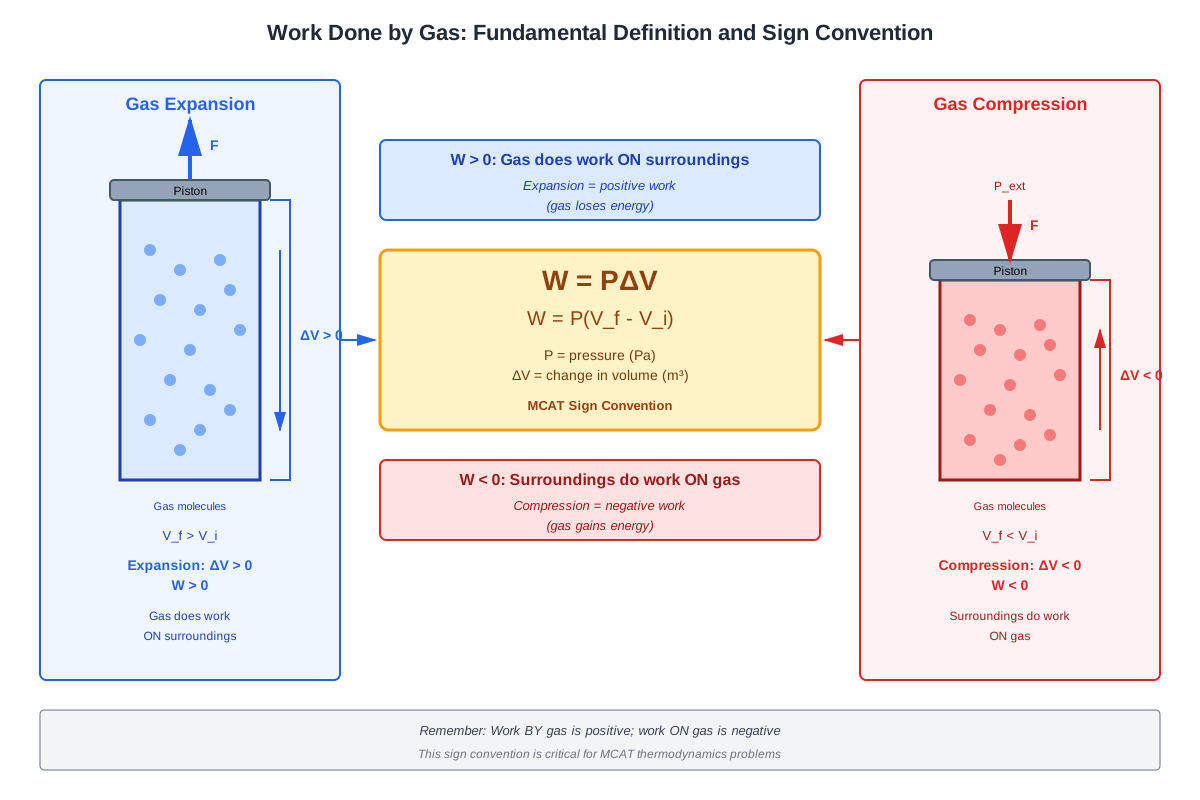
Work done by gas represents the energy transferred when a gas changes volume against an external pressure. The fundamental equation for this work is:
W = ∫ P dVFor constant pressure processes (isobaric), this simplifies to:
W = P ΔV = P(V_f - V_i)Where:
- W = work done by the gas (in Joules)
- P = external pressure (in Pascals or atm)
- ΔV = change in volume (in m³ or L)
- V_f = final volume
- V_i = initial volume
The sign convention is critical: when a gas expands (ΔV > 0), work is positive because the gas does work on its surroundings. When a gas is compressed (ΔV < 0), work is negative because work is done on the gas by the surroundings. This convention aligns with the thermodynamic perspective where we consider the gas as our system of interest.
Pressure-Volume (P-V) Diagrams
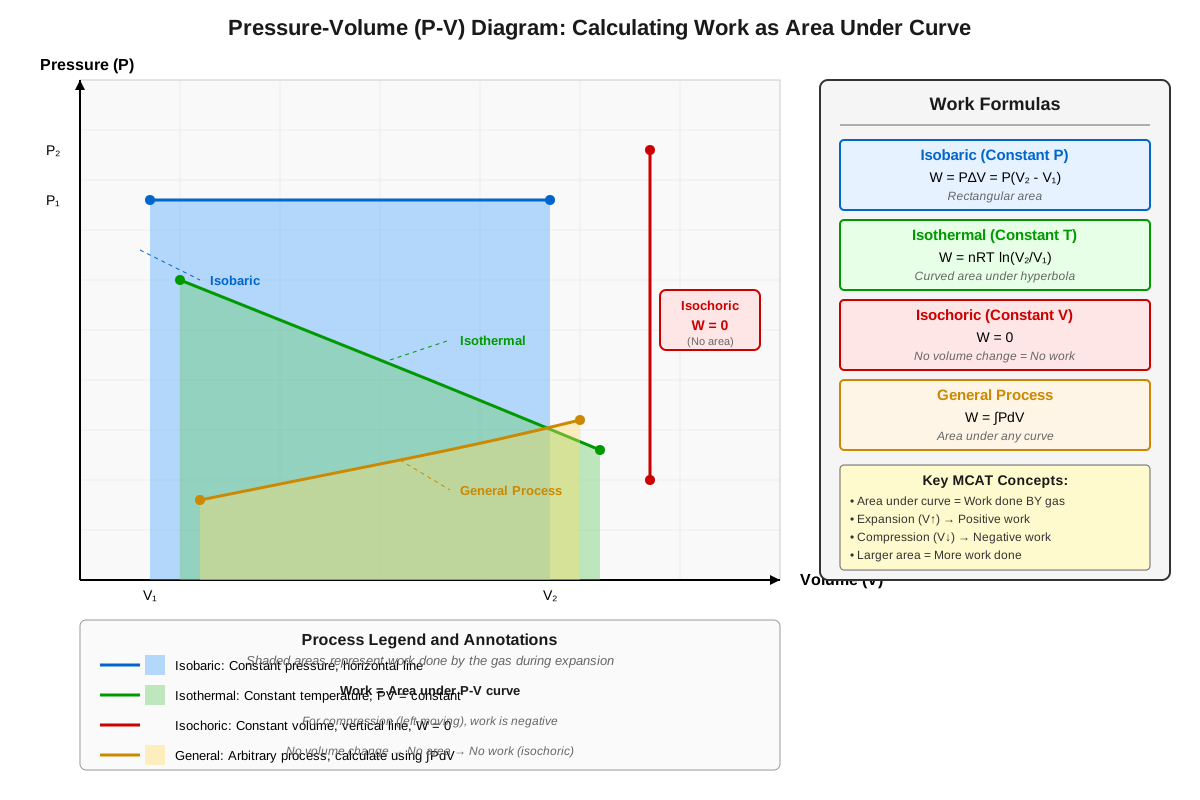
P-V diagrams provide a powerful visual tool for analyzing thermodynamic processes. On these graphs, pressure is plotted on the y-axis and volume on the x-axis. The area under the curve represents the magnitude of work done during the process. Different paths between the same initial and final states result in different amounts of work, demonstrating that work is a path-dependent quantity (not a state function).
Key features of P-V diagrams:
- Rightward processes (increasing volume) represent expansion with positive work
- Leftward processes (decreasing volume) represent compression with negative work
- Horizontal lines indicate constant pressure (isobaric processes)
- Vertical lines indicate constant volume (isochoric processes) with zero work
- Curved lines represent processes where both pressure and volume change simultaneously
Work in Different Thermodynamic Processes
Thermodynamics and Gases behavior varies significantly depending on which variables are held constant:
| Process Type | Constant Variable | Work Equation | Characteristics |
|---|---|---|---|
| Isobaric | Pressure (P) | W = P ΔV | Horizontal line on P-V diagram; work easily calculated |
| Isochoric | Volume (V) | W = 0 | Vertical line on P-V diagram; no volume change means no work |
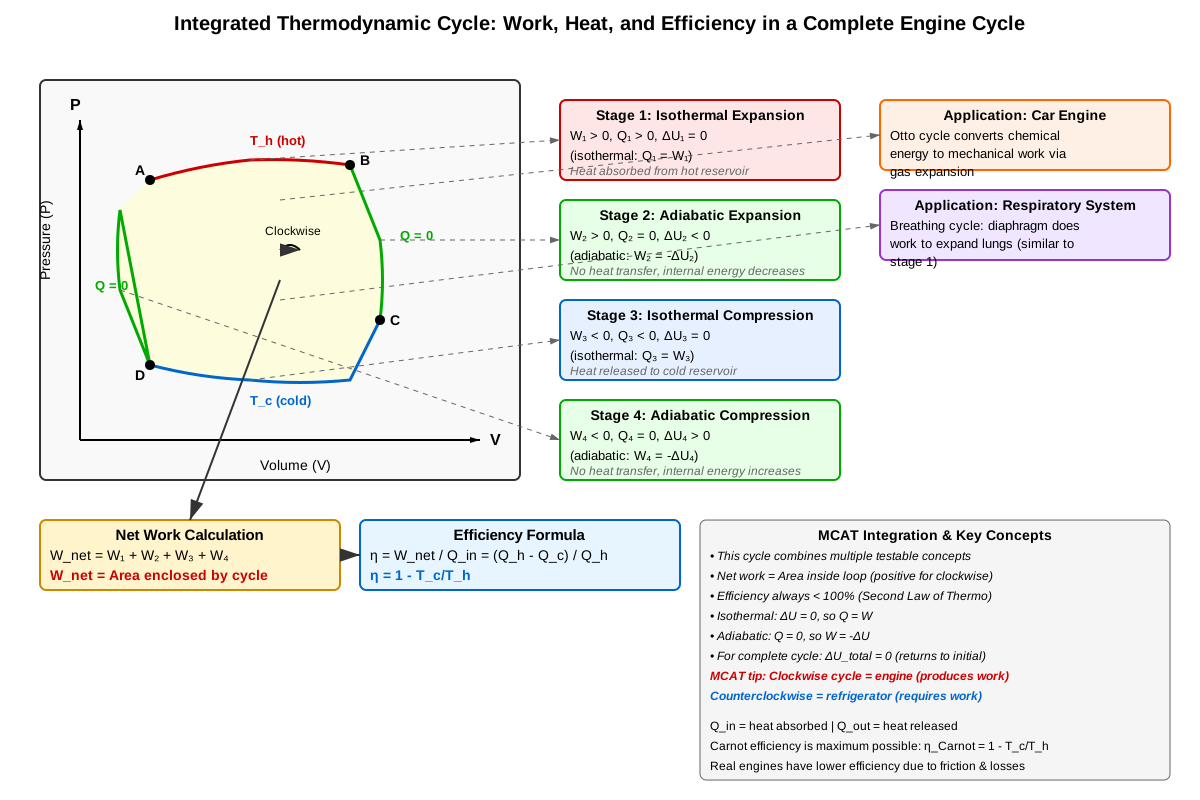
| Isothermal | Temperature (T) | W = nRT ln(V_f/V_i) | Hyperbolic curve; ΔU = 0, so Q = W |
| Adiabatic | Heat (Q = 0) | W = -ΔU | Steeper curve than isothermal; no heat exchange with surroundings |
Isobaric processes occur when pressure remains constant, such as when a gas is heated in a cylinder with a movable piston exposed to constant atmospheric pressure. The work calculation is straightforward: multiply the constant pressure by the volume change.
Isochoric processes involve no volume change, meaning no work is performed regardless of pressure changes. This occurs in rigid, sealed containers where the gas cannot expand or contract. All energy transfer occurs as heat, not work.
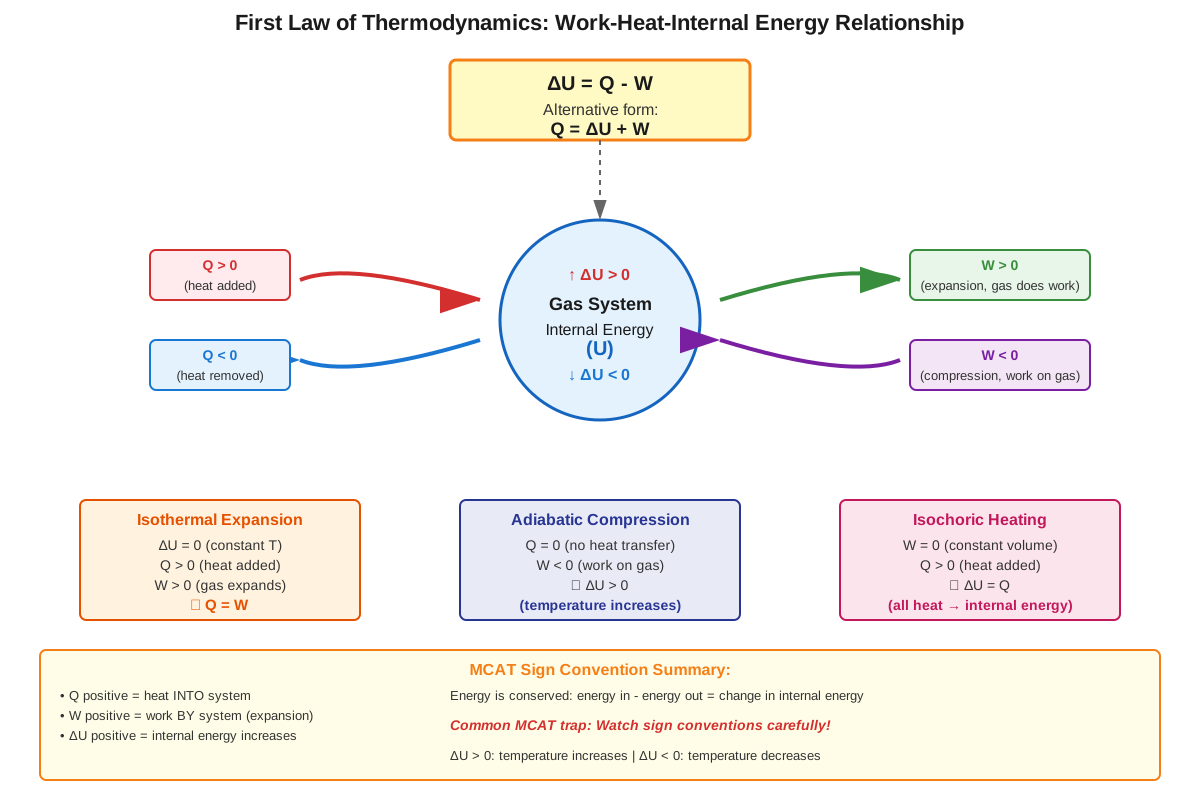
Isothermal processes maintain constant temperature, requiring that any work done by the gas must be exactly balanced by heat absorbed from the surroundings (or vice versa). For an ideal gas undergoing isothermal expansion or compression, the work involves the natural logarithm of the volume ratio. Since internal energy depends only on temperature for an ideal gas, ΔU = 0 for isothermal processes, making Q = W according to the First Law.
Adiabatic processes occur without heat transfer between the system and surroundings, typically happening very quickly or in well-insulated systems. When a gas expands adiabatically, it does work on the surroundings but receives no compensating heat, so its internal energy and temperature decrease. The work done equals the negative of the internal energy change: W = -ΔU.
Connection to the First Law of Thermodynamics
The First Law of Thermodynamics provides the essential framework for understanding work done by gas:
ΔU = Q - WWhere:
- ΔU = change in internal energy
- Q = heat added to the system
- W = work done by the system
This equation represents energy conservation for thermodynamic systems. The internal energy of a system changes when heat flows in or out (Q) or when work is performed by or on the system (W). The sign convention is crucial: Q is positive when heat enters the system, and W is positive when the system does work on its surroundings.
For an ideal gas, internal energy depends only on temperature: ΔU = (3/2)nRΔT for a monatomic gas. This relationship allows students to connect temperature changes with work and heat transfer, creating a complete picture of energy transformations.
Calculating Work from P-V Diagrams
To calculate work from a P-V diagram, determine the area under the curve between the initial and final states. For simple geometric shapes:
- Rectangle (isobaric process): Area = base × height = ΔV × P
- Triangle: Area = (1/2) × base × height
- Trapezoid: Area = (1/2) × (P₁ + P₂) × ΔV
For curved paths (isothermal, adiabatic), integration is required, though the MCAT typically provides equations or allows estimation. When a process involves multiple steps, calculate the work for each segment separately and sum them, being careful with signs.
Sign Conventions and Physical Interpretation
Understanding when work is positive or negative is essential for work done by gas MCAT success:
Positive work (W > 0): The gas expands, pushing against external pressure and transferring energy to the surroundings. The gas loses energy through work, which must be compensated by heat input or internal energy decrease.
Negative work (W < 0): The gas is compressed, with external forces doing work on the gas and adding energy to it. The gas gains energy through work, which may increase internal energy or be released as heat.
Zero work (W = 0): Either no volume change occurs (isochoric), or the process follows a closed cycle returning to the initial state (though work may be non-zero for individual segments).
Concept Relationships
The concepts within work done by gas form an interconnected web of thermodynamic principles. The fundamental work equation (W = ∫P dV) serves as the foundation, connecting directly to P-V diagrams where this integral becomes a geometric area calculation. This graphical representation then branches into four major process types (isobaric, isochoric, isothermal, adiabatic), each with distinct characteristics and work calculations.
The First Law of Thermodynamics (ΔU = Q - W) acts as the central organizing principle, linking work to heat transfer and internal energy changes. This relationship demonstrates that work done by gas cannot be understood in isolation—it always occurs in the context of energy conservation and must be balanced by changes in heat or internal energy.
Relationship map:
- Mechanical work (F·d) → extends to → Pressure-volume work (P·ΔV)
- P-V diagrams → visualize → Work as area under curve
- Process type (isobaric, isothermal, etc.) → determines → Work calculation method
- Work done by gas → combines with heat transfer → determines internal energy change via First Law
- Sign convention → governs → Energy flow direction (system vs. surroundings)
- Ideal Gas Law → constrains → Possible P-V-T combinations during processes
These concepts connect to prerequisite knowledge of basic mechanics (work definition), pressure (force per area), and the ideal gas law. They also lead forward to more advanced topics like heat engines, Carnot cycles, entropy, and the Second Law of Thermodynamics. Understanding work done by gas is essential for analyzing any cyclic process, refrigeration system, or biological application involving gas behavior.
High-Yield Facts
⭐ Work done by a gas is positive during expansion (ΔV > 0) and negative during compression (ΔV < 0).
⭐ For an isobaric process, work equals W = PΔV, calculated as a rectangular area on a P-V diagram.
⭐ For an isochoric process, work is always zero because ΔV = 0, regardless of pressure changes.
⭐ The area under the curve on a P-V diagram represents the magnitude of work done during any process.
⭐ For an isothermal process with an ideal gas, W = nRT ln(V_f/V_i) and ΔU = 0, so Q = W.
- For an adiabatic process, Q = 0, so W = -ΔU; expansion causes cooling while compression causes heating.
- Work is path-dependent (not a state function); different paths between the same initial and final states involve different amounts of work.
- In a cyclic process, the net work equals the area enclosed by the loop on a P-V diagram.
- Clockwise cycles on P-V diagrams represent heat engines (net positive work output), while counterclockwise cycles represent refrigerators (net negative work, requiring work input).
- The First Law of Thermodynamics (ΔU = Q - W) connects work to heat transfer and internal energy changes, with sign conventions critical for correct application.
- For an ideal gas, internal energy depends only on temperature: ΔU = (3/2)nRΔT for monatomic gases and (5/2)nRΔT for diatomic gases.
- Atmospheric pressure work: when a gas expands against constant atmospheric pressure, W = P_atm × ΔV.
Quick check — test yourself on Work done by gas so far.
Try Flashcards →Common Misconceptions
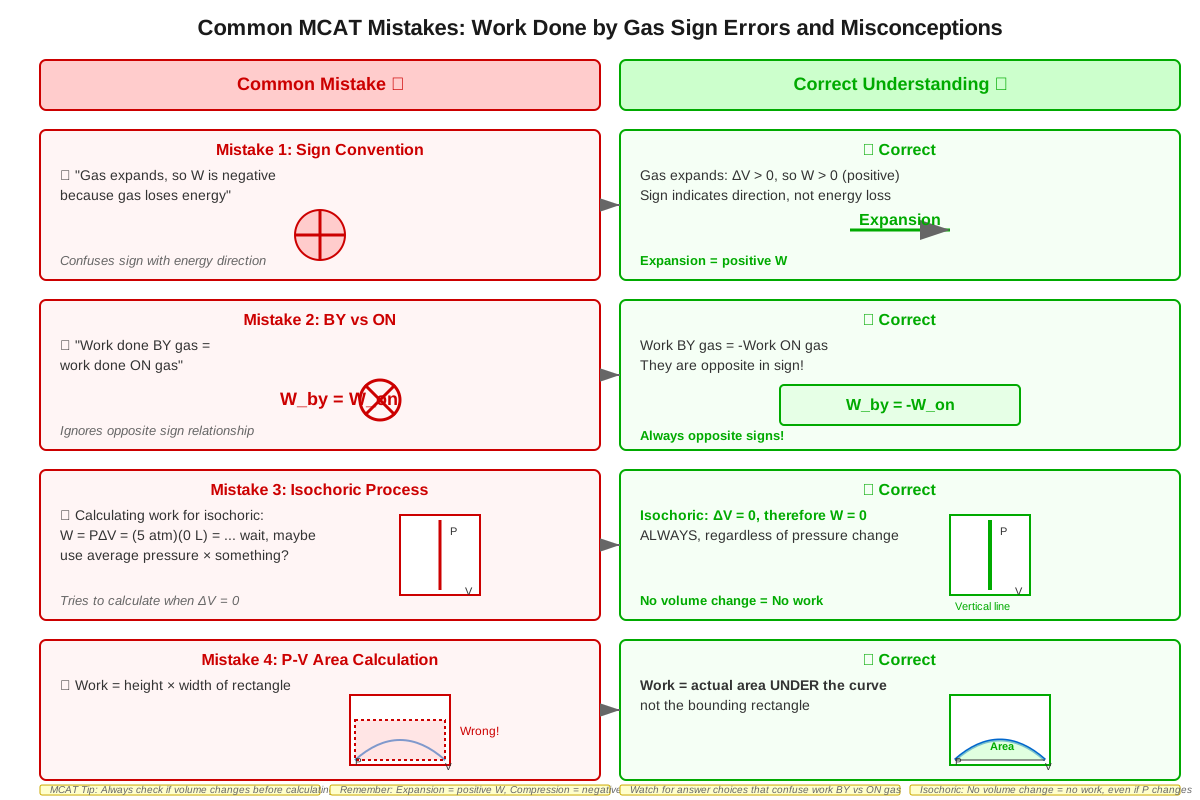
Misconception: Work is always positive when energy is involved in a process.
Correction: Work can be positive, negative, or zero depending on whether the gas expands (positive), is compressed (negative), or maintains constant volume (zero). The sign indicates the direction of energy transfer relative to the system.
Misconception: The area under the curve on a P-V diagram always equals the work done by the gas.
Correction: The area represents the magnitude of work, but the sign depends on the direction. Rightward processes (expansion) give positive work, while leftward processes (compression) give negative work. For closed cycles, the enclosed area represents net work, with clockwise loops positive and counterclockwise loops negative.
Misconception: Work and heat are the same thing because both involve energy transfer.
Correction: Work and heat are distinct forms of energy transfer. Work involves organized, directional energy transfer through volume changes against pressure, while heat involves random, thermal energy transfer due to temperature differences. They have different mechanisms and are treated separately in the First Law of Thermodynamics.
Misconception: In an isothermal process, no energy transfer occurs because temperature is constant.
Correction: Isothermal processes involve significant energy transfer as both heat and work. For an ideal gas, ΔU = 0 in an isothermal process, but this means Q = W, not that both are zero. The gas exchanges heat with surroundings to maintain constant temperature while doing work.
Misconception: The work done depends only on the initial and final states of the gas.
Correction: Work is path-dependent, not a state function. Different processes connecting the same initial and final states involve different amounts of work. Only state functions like internal energy, pressure, volume, and temperature depend solely on the state, not the path taken.
Misconception: Adiabatic processes involve no energy changes.
Correction: Adiabatic processes involve no heat transfer (Q = 0), but work and internal energy changes still occur. During adiabatic expansion, the gas does work and its internal energy decreases (temperature drops). During adiabatic compression, work is done on the gas and its internal energy increases (temperature rises).
Misconception: Using W = PΔV always gives the correct work for any process.
Correction: W = PΔV applies only to isobaric (constant pressure) processes. For processes where pressure varies, the general integral form W = ∫P dV must be used, leading to different equations for isothermal (W = nRT ln(V_f/V_i)) and adiabatic processes.
Worked Examples
Example 1: Isobaric Expansion with First Law Application
Problem: A gas in a cylinder with a movable piston undergoes an isobaric expansion at a constant pressure of 2.0 × 10⁵ Pa. The volume increases from 0.010 m³ to 0.030 m³. During this process, 6000 J of heat is added to the gas. Calculate: (a) the work done by the gas, and (b) the change in internal energy of the gas.
Solution:
(a) For an isobaric process, work is calculated using W = PΔV:
- Initial volume: V_i = 0.010 m³
- Final volume: V_f = 0.030 m³
- Change in volume: ΔV = V_f - V_i = 0.030 - 0.010 = 0.020 m³
- Pressure: P = 2.0 × 10⁵ Pa
W = PΔV = (2.0 × 10⁵ Pa)(0.020 m³) = 4000 J
The work is positive because the gas expands (ΔV > 0), meaning the gas does work on its surroundings.
(b) Apply the First Law of Thermodynamics: ΔU = Q - W
- Heat added to system: Q = +6000 J (positive because heat enters the system)
- Work done by system: W = +4000 J (positive because gas expands)
ΔU = 6000 J - 4000 J = 2000 J
The internal energy increases by 2000 J. This makes physical sense: of the 6000 J of heat added, 4000 J went into doing work on the surroundings, while 2000 J remained in the gas as increased internal energy (higher temperature).
Key learning points: This problem demonstrates the straightforward calculation for isobaric work, proper sign convention application, and integration of work with the First Law. Students should recognize that when heat is added during expansion, some energy does work while the remainder increases internal energy.
Example 2: P-V Diagram Analysis with Multiple Processes
Problem: A gas undergoes a three-step cycle shown on a P-V diagram:
- Step 1: Isobaric expansion from (V₁ = 2.0 L, P₁ = 3.0 atm) to (V₂ = 6.0 L, P₂ = 3.0 atm)
- Step 2: Isochoric cooling from (V₂ = 6.0 L, P₂ = 3.0 atm) to (V₃ = 6.0 L, P₃ = 1.0 atm)
- Step 3: Isobaric compression from (V₃ = 6.0 L, P₃ = 1.0 atm) back to (V₁ = 2.0 L, P₁ = 1.0 atm), followed by isochoric heating back to the initial state
Calculate the net work done by the gas during one complete cycle. (Use 1 atm = 101,325 Pa for unit conversion if needed, or work in L·atm)
Solution:
Working in L·atm for simplicity (can convert to Joules at the end):
Step 1 (Isobaric expansion):
- W₁ = P₁ΔV = P₁(V₂ - V₁) = (3.0 atm)(6.0 L - 2.0 L) = (3.0 atm)(4.0 L) = 12 L·atm
- Positive work (expansion)
Step 2 (Isochoric cooling):
- W₂ = 0 (no volume change)
Step 3 (Isobaric compression):
- W₃ = P₃ΔV = P₃(V₁ - V₃) = (1.0 atm)(2.0 L - 6.0 L) = (1.0 atm)(-4.0 L) = -4.0 L·atm
- Negative work (compression)
Step 4 (Isochoric heating):
- W₄ = 0 (no volume change)
Net work for complete cycle:
W_net = W₁ + W₂ + W₃ + W₄ = 12 + 0 + (-4.0) + 0 = 8.0 L·atm
Converting to Joules: W_net = 8.0 L·atm × 101.325 J/L·atm = 810.6 J ≈ 811 J
Alternative approach: The net work for a cycle equals the area enclosed by the loop on the P-V diagram. This forms a rectangle with:
- Height: ΔP = 3.0 atm - 1.0 atm = 2.0 atm
- Width: ΔV = 6.0 L - 2.0 L = 4.0 L
- Area = 2.0 atm × 4.0 L = 8.0 L·atm (same result)
The cycle is clockwise, indicating a heat engine that produces net positive work output.
Key learning points: This problem reinforces that isochoric processes contribute no work, demonstrates how to sum work for multi-step processes with careful attention to signs, and shows the geometric interpretation of cyclic work as enclosed area. The clockwise direction indicates this is a heat engine cycle.
Exam Strategy
When approaching work done by gas MCAT questions, follow this systematic strategy:
Step 1: Identify the process type by determining which variable(s) remain constant. Look for trigger words:
- "Constant pressure" or "atmospheric pressure" → isobaric (use W = PΔV)
- "Rigid container" or "constant volume" → isochoric (W = 0)
- "Constant temperature" or "isothermal" → isothermal (use W = nRT ln(V_f/V_i))
- "Insulated" or "no heat exchange" → adiabatic (use W = -ΔU)
Step 2: Determine the sign before calculating:
- Expansion (volume increases) → positive work
- Compression (volume decreases) → negative work
- No volume change → zero work
Step 3: For P-V diagram questions, immediately identify:
- The area under the curve represents work magnitude
- Rightward = expansion = positive work
- Leftward = compression = negative work
- Enclosed loops = net work (clockwise positive, counterclockwise negative)
Step 4: Apply the First Law when the question involves heat or internal energy:
- Write ΔU = Q - W with proper signs
- Remember: Q positive = heat in; W positive = work out
- For ideal gases: ΔU relates to temperature change
Process of elimination tips:
- Eliminate answers with incorrect signs first (most common error)
- For isochoric processes, eliminate any non-zero work answers immediately
- For isothermal ideal gas processes, eliminate answers where Q ≠ W
- For adiabatic processes, eliminate answers where Q ≠ 0
Time allocation: Straightforward work calculations should take 30-45 seconds. P-V diagram problems may require 60-90 seconds for area calculations. Multi-step problems involving the First Law may need 2-3 minutes. If a problem requires complex integration, look for shortcuts or estimation methods—the MCAT rarely requires detailed calculus.
Common question formats:
- Direct calculation: "Calculate the work done when..."
- P-V diagram interpretation: "What is the work represented by the shaded area?"
- First Law application: "If heat Q is added and work W is done, what is ΔU?"
- Comparison: "Which process involves the most work?"
- Respiratory physiology passages: Connecting lung volume changes to work
Exam Tip: When you see a P-V diagram, immediately sketch the process direction and label expansion/compression regions. This visual approach prevents sign errors and helps you quickly estimate work magnitude.
Memory Techniques
Sign Convention Mnemonic: "EX-pansion is EX-cellent" (positive work)
- Expansion = Excellent = Positive work (gas does work on surroundings)
- Compression = Concerning = Negative work (surroundings do work on gas)
Process Type Acronym: "I-I-I-A" for the four main processes:
- Isobaric (constant Pressure)
- Isochoric (constant Volume)
- Isothermal (constant Temperature)
- Adiabatic (no heat transfer)
First Law Memory Device: "U = Q - W" sounds like "You = Cute - Double-you"
- Internal energy (U) changes when heat (Q) comes in minus work (W) going out
- Alternative: "Understand: Quickly Work" to remember the order
Work Equation Visualization: Picture a piston in a cylinder:
- Pressure (P) = force pushing on the piston face
- Volume change (ΔV) = distance the piston moves × area
- Work = force × distance = (pressure × area) × distance = pressure × volume change
P-V Diagram Area Rule: "Area Under = Work Wonder"
- The area under any curve on a P-V diagram gives work magnitude
- Direction (right/left) determines sign
Zero Work Reminder: "Vertical = Zero"
- Vertical lines on P-V diagrams (isochoric) mean zero work
- No volume change = no work, regardless of pressure changes
Isothermal Process: "Iso-T means Q = W"
- Constant temperature means ΔU = 0 for ideal gas
- Therefore, all heat input equals work output (or vice versa)
Summary
Work done by gas represents energy transfer through volume changes against pressure, calculated as W = ∫P dV or W = PΔV for constant pressure processes. The sign convention is critical: expansion produces positive work (gas does work on surroundings), while compression produces negative work (surroundings do work on gas). P-V diagrams provide powerful visual tools where the area under the curve represents work magnitude, with rightward processes indicating expansion and leftward processes indicating compression. Different thermodynamic processes—isobaric (constant P), isochoric (constant V), isothermal (constant T), and adiabatic (Q = 0)—each have distinct work characteristics and calculation methods. The First Law of Thermodynamics (ΔU = Q - W) connects work to heat transfer and internal energy changes, providing the framework for analyzing all thermodynamic processes. For MCAT success, students must master sign conventions, recognize process types from trigger words, calculate work from P-V diagrams, and apply the First Law correctly. This topic appears frequently in both calculation problems and passage-based questions, particularly those involving respiratory physiology, heat engines, and gas behavior under various conditions.
Key Takeaways
- Work done by gas equals W = PΔV for constant pressure processes, with positive work during expansion and negative work during compression
- The area under the curve on a P-V diagram represents the magnitude of work, with direction determining sign
- Isochoric processes (constant volume) always involve zero work regardless of pressure changes
- The First Law of Thermodynamics (ΔU = Q - W) connects work, heat, and internal energy with critical sign conventions
- Different process types (isobaric, isochoric, isothermal, adiabatic) require different work calculation approaches
- Work is path-dependent, not a state function—different paths between the same states involve different work amounts
- For isothermal ideal gas processes, ΔU = 0 so Q = W; for adiabatic processes, Q = 0 so W = -ΔU
Related Topics
First Law of Thermodynamics: Builds directly on work done by gas by incorporating heat transfer and internal energy changes into a comprehensive energy conservation framework. Mastering work concepts is essential before tackling complete First Law problems.
Heat Engines and Carnot Cycles: Apply work done by gas to cyclic processes that convert heat into useful work. Understanding how to calculate work for individual process steps enables analysis of engine efficiency and performance.
Respiratory Physiology: Connects thermodynamic work concepts to biological systems, particularly the work required for breathing and the pressure-volume relationships in the lungs. This represents a high-yield MCAT application area.
Adiabatic Processes and PV^γ Relationships: Extends work calculations to processes without heat transfer, requiring understanding of how pressure and volume relate through the adiabatic index γ.
Entropy and the Second Law of Thermodynamics: Builds on work and heat concepts to introduce the directionality of natural processes and the concept of entropy, representing the next level of thermodynamic sophistication.
Practice CTA
Now that you've mastered the core concepts of work done by gas, it's time to solidify your understanding through active practice. Attempt the practice questions to test your ability to calculate work in various scenarios, interpret P-V diagrams, and apply the First Law of Thermodynamics. Use the flashcards to reinforce key equations, sign conventions, and process characteristics until they become automatic. Remember: thermodynamics questions are highly predictable on the MCAT—consistent practice with these concepts will translate directly into points on test day. Focus especially on sign conventions and P-V diagram interpretation, as these are the most commonly tested aspects. You've got this!
Sign up free to keep reading
Create a free AnvayaPrep account to finish this MCAT guide on Work done by gas — plus flashcards and practice questions.