Overview
Beats represent a fascinating acoustic phenomenon that occurs when two sound waves of slightly different frequencies interfere with one another, producing a periodic variation in amplitude that listeners perceive as a pulsating or "throbbing" sound. This interference pattern creates alternating regions of constructive and destructive interference, resulting in the characteristic waxing and waning of sound intensity that defines the beats phenomenon. Understanding beats requires synthesizing knowledge of wave superposition, interference patterns, and the mathematical relationship between frequency differences and the resulting beat frequency.
For MCAT preparation, beats serve as an excellent test of conceptual understanding in Waves and Sound, bridging fundamental wave mechanics with practical applications. The College Board frequently uses beats to assess whether students can apply wave interference principles to real-world scenarios, making this a medium-yield topic that appears in both discrete questions and passage-based contexts. Beats Physics questions often require students to manipulate frequency relationships, interpret graphical representations of wave interference, and connect acoustic phenomena to underlying physical principles.
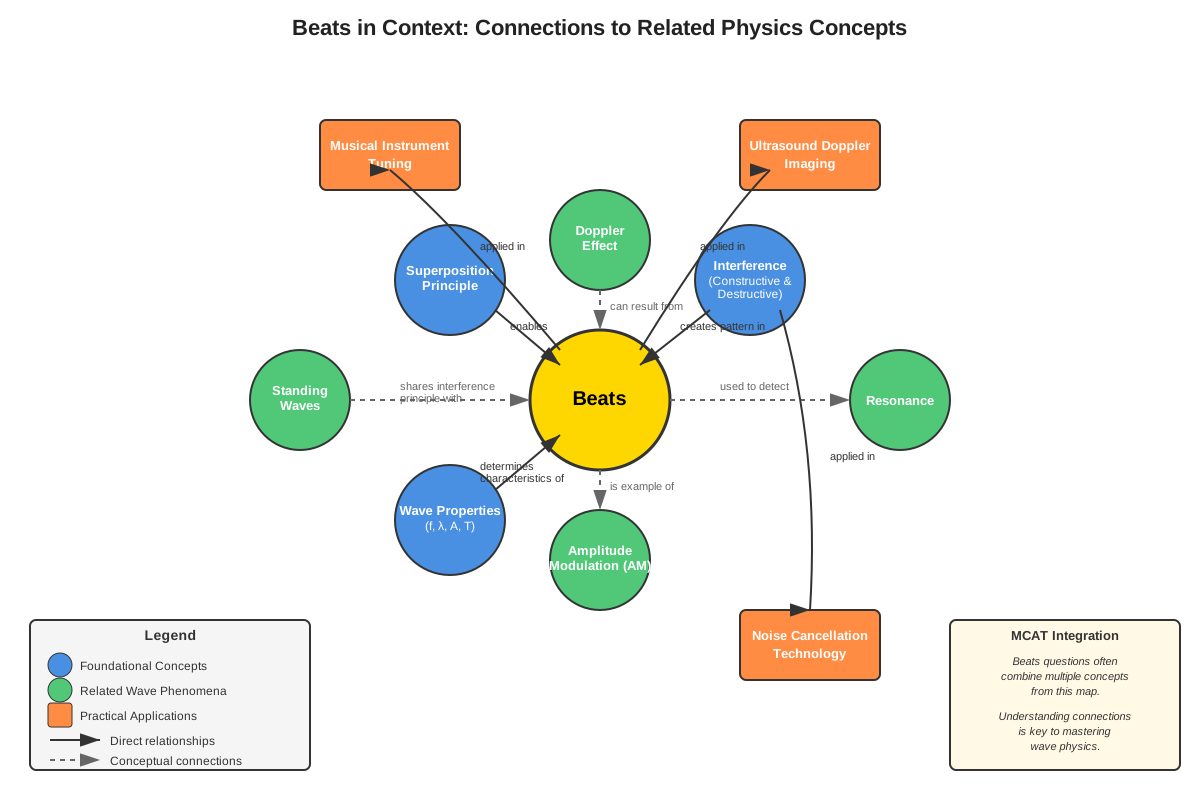
The study of Beats MCAT content connects directly to broader Physics concepts including wave superposition, constructive and destructive interference, frequency, period, and amplitude modulation. Mastery of beats demonstrates understanding of how waves combine in space and time, a principle that extends beyond sound to electromagnetic waves, quantum mechanics, and even medical imaging technologies like ultrasound. This topic exemplifies how seemingly abstract wave mechanics manifest in observable, measurable phenomena that have practical applications in music, acoustics, and medical diagnostics.
Learning Objectives
- [ ] Define Beats using accurate Physics terminology
- [ ] Explain why Beats matters for the MCAT
- [ ] Apply Beats to exam-style questions
- [ ] Identify common mistakes related to Beats
- [ ] Connect Beats to related Physics concepts
- [ ] Calculate beat frequency given two source frequencies
- [ ] Predict the amplitude envelope pattern resulting from wave superposition
- [ ] Interpret graphical representations of beating waveforms
- [ ] Distinguish between beat frequency and the frequencies of component waves
Prerequisites
- Wave properties (frequency, wavelength, amplitude, period): Essential for understanding how two waves combine and what parameters determine the beat pattern
- Superposition principle: The foundation for understanding how multiple waves interact without permanently affecting each other
- Constructive and destructive interference: Beats are the direct result of alternating between these two interference types
- Trigonometric identities: Helpful for understanding the mathematical derivation of beat frequency, though not strictly required for MCAT-level problems
- Sound wave characteristics: Beats are most commonly discussed in the context of audible sound waves
Why This Topic Matters
Clinical and Real-World Significance
Beats have numerous practical applications that extend into medical and clinical contexts. Musicians use beats to tune instruments by listening for the disappearance of beats when two strings reach identical frequencies. In medical diagnostics, ultrasound technology employs beat frequencies (through the Doppler effect) to measure blood flow velocity and detect cardiovascular abnormalities. Audiologists use beat phenomena to test hearing sensitivity and diagnose certain auditory processing disorders. The ability to detect and interpret beats also plays a role in noise-canceling technology, which uses destructive interference principles to reduce unwanted ambient sound.
Exam Statistics and Question Types
Beats appear on the MCAT with moderate frequency, typically 1-2 questions per several administrations. Questions usually fall into three categories: (1) calculation-based problems requiring determination of beat frequency from two given source frequencies, (2) conceptual questions about what happens to beat frequency when one source frequency changes, and (3) passage-based questions connecting beats to experimental setups or clinical applications. The topic most commonly appears in the Chemical and Physical Foundations of Biological Systems section, often integrated with questions about sound intensity, frequency perception, or wave interference.
Common Exam Contexts
MCAT passages featuring beats often present experimental scenarios such as tuning fork experiments, musical instrument acoustics, or Doppler ultrasound applications. Questions may ask students to interpret graphs showing amplitude modulation over time, predict how changing one frequency affects the beat pattern, or explain why beats become imperceptible when frequency differences exceed certain thresholds. The MCAT particularly favors questions that require students to distinguish between the beat frequency (which is heard) and the average frequency of the two sources (which determines pitch).
Core Concepts
Definition and Physical Basis of Beats
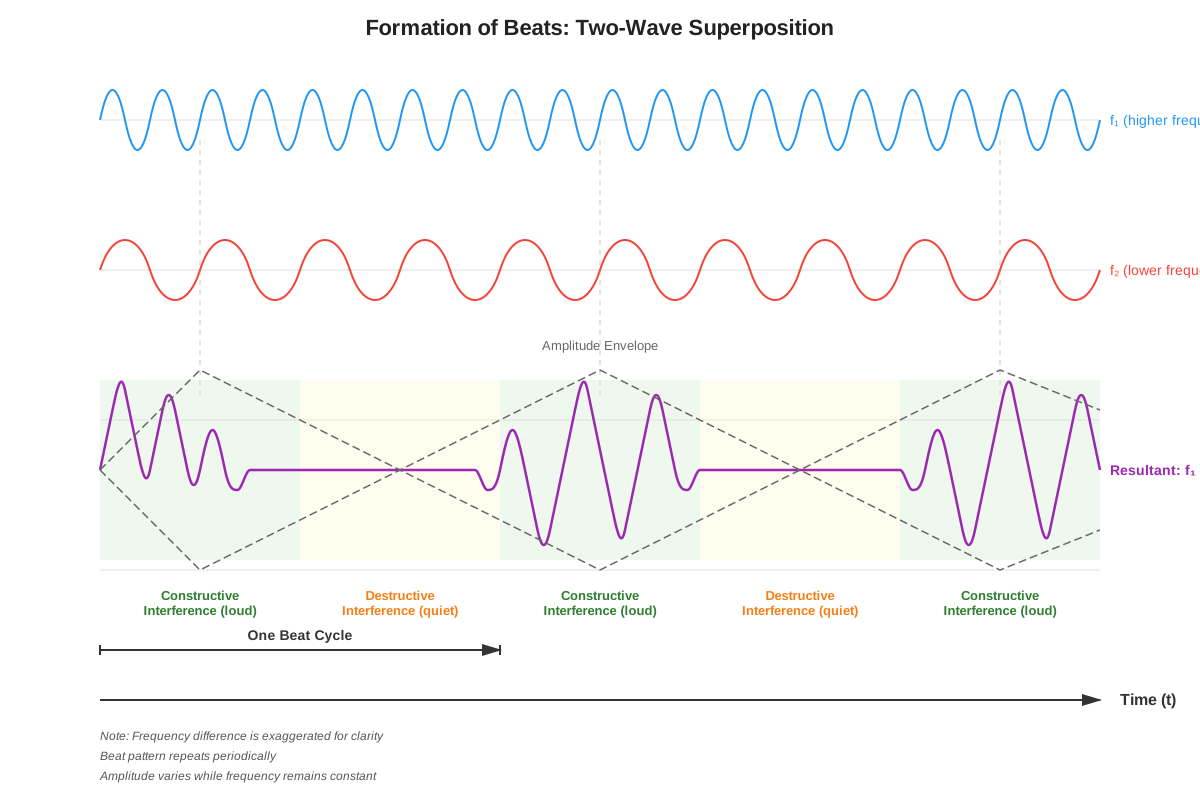
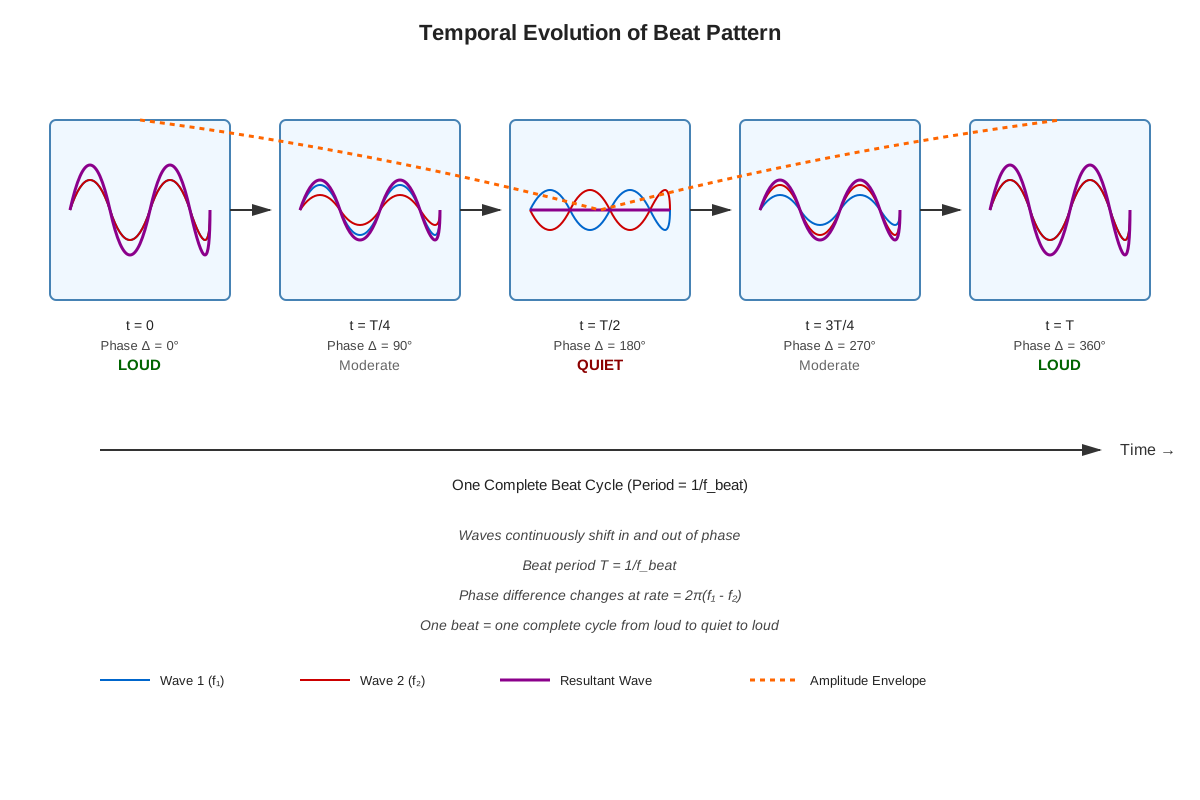
Beats are the periodic variations in amplitude that result when two waves of slightly different frequencies interfere with one another. When two sound sources produce tones at frequencies f₁ and f₂, the resulting sound wave exhibits an amplitude that oscillates at a frequency equal to the absolute difference between the two source frequencies. This phenomenon occurs because the two waves alternately align in phase (constructive interference, producing maximum amplitude) and out of phase (destructive interference, producing minimum amplitude).
The physical mechanism underlying beats involves the continuous shifting of the phase relationship between the two waves. At any given moment, the two waves have a specific phase difference that determines whether they interfere constructively or destructively. Because the waves have different frequencies, they complete cycles at different rates, causing the phase relationship to continuously evolve. When the waves are in phase, their amplitudes add to produce a loud sound; when they are out of phase, their amplitudes subtract to produce a quiet sound or silence.
Mathematical Relationship: Beat Frequency Formula
The beat frequency (f_beat) is given by the fundamental equation:
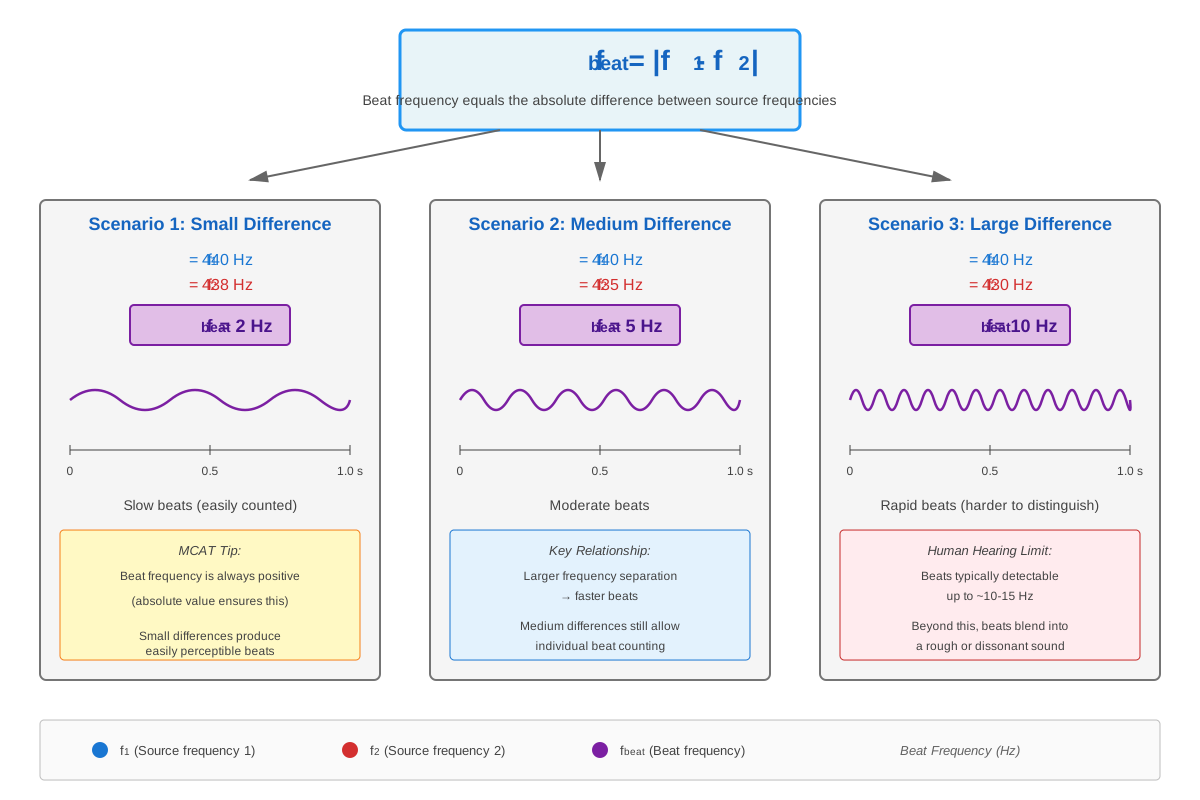
f_beat = |f₁ - f₂|Where f₁ and f₂ are the frequencies of the two interfering waves. The absolute value ensures that beat frequency is always positive, regardless of which source has the higher frequency. This simple relationship is one of the most testable aspects of beats on the MCAT.
For example, if one tuning fork vibrates at 440 Hz (concert A) and another vibrates at 445 Hz, the beat frequency would be |440 - 445| = 5 Hz, meaning a listener would hear the sound intensity rise and fall five times per second.
It's crucial to understand that the beat frequency represents how often the amplitude envelope completes one full cycle (from maximum to minimum and back to maximum), not the frequency of the sound wave itself. The actual sound heard has a frequency approximately equal to the average of the two source frequencies: (f₁ + f₂)/2.
Wave Superposition and Amplitude Modulation
The superposition principle states that when two or more waves occupy the same space, the resulting displacement at any point is the algebraic sum of the individual wave displacements. For beats, this means the instantaneous pressure (or displacement) at any location is the sum of the pressures from both sound sources.
When two sinusoidal waves of slightly different frequencies combine, the mathematical result is a wave whose amplitude varies periodically—a phenomenon called amplitude modulation. The resulting waveform can be visualized as a high-frequency carrier wave (at approximately the average frequency) whose amplitude is modulated by a low-frequency envelope (at the beat frequency).
The amplitude envelope oscillates between a maximum value (when waves are in phase) and a minimum value (when waves are out of phase). For two waves of equal amplitude A, the maximum combined amplitude is 2A (complete constructive interference) and the minimum is 0 (complete destructive interference). If the waves have different amplitudes, the minimum will be non-zero, equal to the difference between the two amplitudes.
Perceptual Aspects of Beats
Human perception of beats depends on the frequency difference between the two sources. When the beat frequency is very low (less than about 1 Hz), listeners perceive distinct, separate pulses of sound. As beat frequency increases to the range of 1-10 Hz, the sensation becomes a clear, rhythmic throbbing or "wah-wah" effect. When beat frequency exceeds approximately 15-20 Hz, the individual beats become too rapid to distinguish, and the sensation transitions to a rough, dissonant quality called "roughness." At even higher frequency differences (above 50-100 Hz, depending on the base frequency), the two tones become perceptually separate, and beats are no longer detected.
This perceptual limitation has practical implications: beats are only useful for tuning when the two frequencies are quite close. The MCAT may test understanding of this concept by asking why beats disappear when frequency differences become too large.
Graphical Representation
| Time Domain Feature | Description | MCAT Relevance | ||
|---|---|---|---|---|
| Carrier wave | High-frequency oscillation at ~(f₁+f₂)/2 | Represents the perceived pitch | ||
| Envelope | Low-frequency modulation at \ | f₁-f₂\ | Represents the beat pattern | |
| Period of beats | T_beat = 1/f_beat | Time between successive maxima | ||
| Amplitude maxima | Points of constructive interference | Occur at beat frequency intervals | ||
| Amplitude minima | Points of destructive interference | Occur halfway between maxima |
When examining a graph of beats, students should identify: (1) the rapid oscillations representing the actual sound wave, (2) the slower envelope pattern showing amplitude variation, and (3) the time interval between successive amplitude peaks, which equals the beat period.
Conditions for Observable Beats
For beats to be clearly observable, several conditions must be met:
- Similar frequencies: The two sources must have frequencies that differ by a small amount relative to their average frequency
- Similar amplitudes: If one wave is much stronger than the other, the amplitude variation becomes less pronounced
- Sustained tones: Both sources must produce continuous waves long enough for multiple beat cycles to occur
- Same propagation medium: The waves must travel through the same medium to the same location
- Coherent sources: While not strictly required, more stable beat patterns occur when both sources maintain constant frequencies
Concept Relationships
The phenomenon of beats emerges directly from the superposition principle, which states that waves combine linearly without affecting each other's individual properties. This principle leads to interference patterns, which can be either constructive (amplitude addition) or destructive (amplitude subtraction). Beats represent a special case where the interference pattern changes over time due to the frequency difference between sources.
The relationship can be mapped as:
Wave Superposition → enables → Interference → produces → Alternating Constructive/Destructive Patterns → manifests as → Beats → characterized by → Beat Frequency
Beats connect to prerequisite knowledge of wave properties because understanding frequency, period, and amplitude is essential for predicting beat behavior. The concept also relates to sound intensity, as the perceived loudness varies with the beat cycle. Furthermore, beats demonstrate temporal interference, distinguishing them from spatial interference patterns like standing waves.
Looking forward, beats connect to more advanced topics including Doppler effect (which can create beats when a moving source changes frequency), resonance (where beats can indicate proximity to resonant frequency), and wave packets in quantum mechanics (where beat-like patterns appear in probability distributions). In medical contexts, beats relate to ultrasound imaging and cardiac auscultation, where beat frequencies help diagnose conditions.
The mathematical relationship f_beat = |f₁ - f₂| also connects to difference frequency concepts in nonlinear acoustics and heterodyne detection in radio technology, though these applications extend beyond MCAT scope.
Quick check — test yourself on Beats so far.
Try Flashcards →High-Yield Facts
⭐ Beat frequency equals the absolute difference between the two source frequencies: f_beat = |f₁ - f₂|
⭐ The perceived pitch corresponds to the average of the two frequencies, not the beat frequency: f_perceived ≈ (f₁ + f₂)/2
⭐ Beats become imperceptible when the frequency difference exceeds approximately 15-20 Hz due to limitations in human auditory temporal resolution
⭐ One complete beat cycle includes one maximum and one minimum in amplitude, occurring over a time period T_beat = 1/f_beat
⭐ When tuning an instrument using beats, the goal is to eliminate beats entirely by making the two frequencies identical (f_beat = 0)
- The amplitude envelope of beats oscillates at the beat frequency, while the carrier wave oscillates at approximately the average frequency
- Two waves of equal amplitude produce complete destructive interference (zero amplitude) at beat minima when perfectly out of phase
- Increasing the frequency of one source while keeping the other constant increases the beat frequency
- Beats require two separate sources or two separate frequencies; a single source cannot produce beats with itself
- The number of beats heard per second equals the beat frequency in Hz
- Beats demonstrate that wave interference is a temporal as well as spatial phenomenon
- The mathematical description of beats involves trigonometric product-to-sum identities, though MCAT questions rarely require explicit derivation
Common Misconceptions
Misconception: Beat frequency is the frequency of the sound you hear.
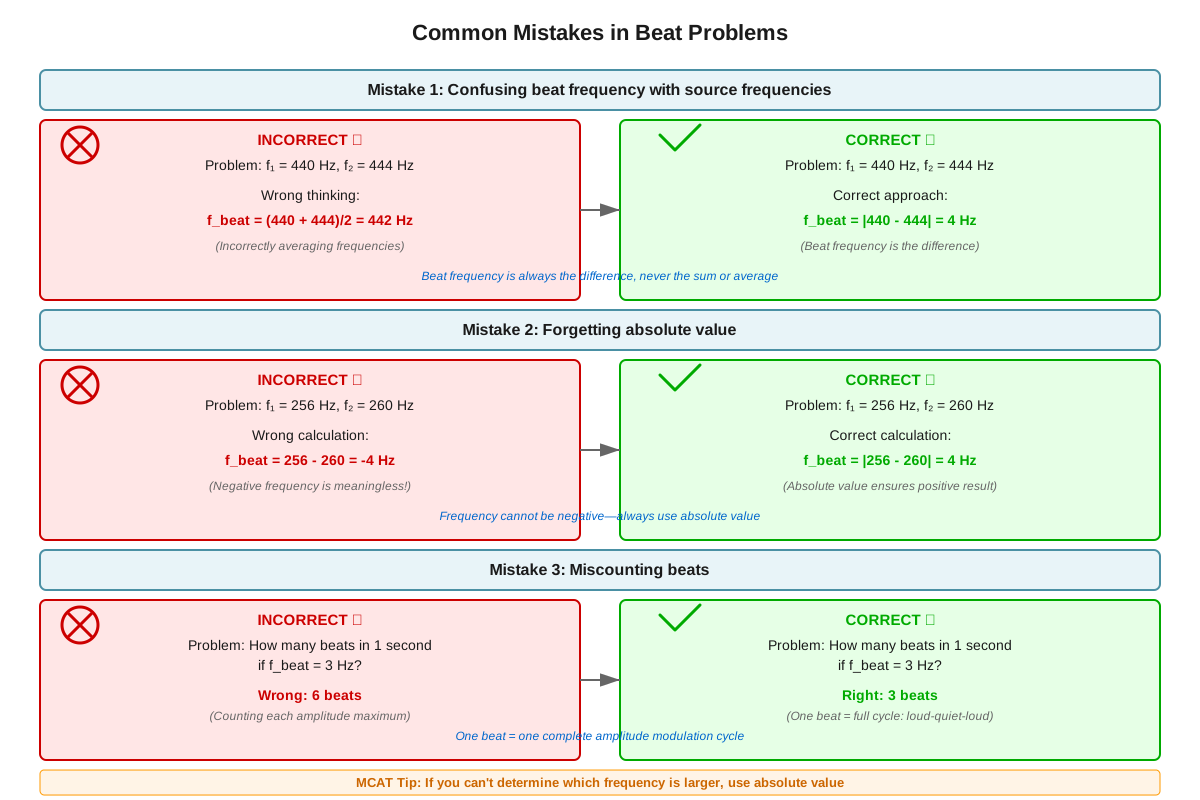
Correction: The beat frequency is the rate at which the amplitude (loudness) varies. The actual pitch you hear corresponds to the average of the two source frequencies: (f₁ + f₂)/2. Beat frequency describes the "wah-wah" pulsation rate, not the tone itself.
Misconception: Beats only occur with sound waves.
Correction: While beats are most commonly discussed in the context of sound, the phenomenon occurs with any type of wave, including electromagnetic waves, water waves, and even quantum mechanical wave functions. The MCAT focuses on acoustic beats, but understanding the general principle is important.
Misconception: If you hear 5 beats per second, one source must be at 5 Hz.
Correction: The beat frequency of 5 Hz means the difference between the two sources is 5 Hz. For example, the sources could be at 440 Hz and 445 Hz, or 1000 Hz and 1005 Hz. The beat frequency tells you nothing about the absolute frequencies, only their difference.
Misconception: Beats and standing waves are the same phenomenon.
Correction: While both involve wave interference, standing waves result from spatial interference patterns (typically from reflection) and remain stationary in space, whereas beats result from temporal interference between waves of different frequencies and create a time-varying amplitude pattern. Standing waves have nodes and antinodes fixed in space; beats have amplitude variations that occur everywhere simultaneously.
Misconception: Louder beats mean higher beat frequency.
Correction: The loudness (amplitude) of beats depends on the amplitudes of the source waves and how well they're matched, not on the beat frequency. Beat frequency depends only on the frequency difference between sources. You can have loud, slow beats or quiet, fast beats depending on the source characteristics.
Misconception: When two frequencies are very different, you hear faster beats.
Correction: When frequency differences become too large (typically above 15-20 Hz), beats become imperceptible and you instead hear two separate tones or a rough, dissonant sound. The beat frequency does increase with larger frequency differences, but only within the range where beats remain perceptible.
Worked Examples
Example 1: Tuning Fork Calculation
Problem: A physics student uses two tuning forks to demonstrate beats. One fork is labeled 512 Hz. When both forks are struck simultaneously, the student hears 4 beats per second. What are the possible frequencies of the second tuning fork?
Solution:
Step 1: Identify the given information
- f₁ = 512 Hz (known frequency)
- f_beat = 4 Hz (observed beat frequency)
- f₂ = ? (unknown frequency)
Step 2: Apply the beat frequency formula
f_beat = |f₁ - f₂|
4 = |512 - f₂|
Step 3: Solve for both possible values
The absolute value equation has two solutions:
- Case 1: 512 - f₂ = 4, so f₂ = 508 Hz
- Case 2: 512 - f₂ = -4, so f₂ = 516 Hz
Step 4: Interpret the result
The second tuning fork could be either 508 Hz or 516 Hz. Without additional information, we cannot determine which is correct. Both frequencies differ from 512 Hz by 4 Hz, producing the same beat frequency.
MCAT Connection: This problem demonstrates that beat frequency alone cannot determine absolute frequencies, only their difference. MCAT questions often include a follow-up asking how to distinguish between the two possibilities (answer: change one frequency and observe whether beats speed up or slow down).
Example 2: Doppler Effect and Beats
Problem: An ambulance siren emits sound at 1000 Hz. A stationary observer with perfect pitch can produce a 1000 Hz tone by humming. As the ambulance approaches at 30 m/s, the observer hums while listening to the siren. Approximately how many beats per second does the observer hear? (Speed of sound = 340 m/s)
Solution:
Step 1: Calculate the Doppler-shifted frequency heard by the observer
For a source approaching a stationary observer:
f_observed = f_source × (v_sound)/(v_sound - v_source)
f_observed = 1000 × (340)/(340 - 30)
f_observed = 1000 × (340/310)
f_observed ≈ 1097 Hz
Step 2: Identify the two interfering frequencies
- f₁ = 1097 Hz (Doppler-shifted siren)
- f₂ = 1000 Hz (observer's humming)
Step 3: Calculate beat frequency
f_beat = |f₁ - f₂| = |1097 - 1000| = 97 Hz
Step 4: Interpret the result
The observer would hear approximately 97 beats per second. However, this is well above the threshold for perceiving individual beats (~15-20 Hz), so the observer would actually perceive a rough, dissonant sound rather than distinct beats.
MCAT Connection: This problem integrates beats with the Doppler effect, a common MCAT strategy for testing multiple concepts simultaneously. It also requires recognizing that very high beat frequencies exceed perceptual limits—a conceptual understanding that distinguishes strong students from those who merely calculate.
Exam Strategy
Approaching MCAT Questions on Beats
When encountering a beats question on the MCAT, follow this systematic approach:
- Identify the question type: Is it asking for beat frequency calculation, conceptual understanding of the phenomenon, or interpretation of a graph?
- Extract relevant information: Note all given frequencies, and determine whether you're asked about beat frequency, perceived pitch, or time between beats.
- Apply the fundamental formula: For calculation questions, f_beat = |f₁ - f₂| is almost always the starting point.
- Consider the absolute value: Remember that beat frequency is always positive, regardless of which source has higher frequency.
- Distinguish between beat frequency and perceived frequency: Many wrong answer choices exploit confusion between these concepts.
Trigger Words and Phrases
Watch for these key phrases that signal beats questions:
- "Pulsating sound" or "throbbing sound" → indicates beats phenomenon
- "How many times per second does the loudness vary" → asking for beat frequency
- "Tuning an instrument" → typically involves eliminating beats
- "Two sources of slightly different frequencies" → setup for beats problem
- "Amplitude modulation" → technical term for the beat envelope
- "Waxing and waning" → describes the amplitude variation in beats
Process of Elimination Tips
Eliminate answers that:
- Give beat frequency equal to one of the source frequencies (beat frequency is always the difference)
- Suggest beat frequency equals the sum of source frequencies (common distractor)
- Claim beats occur with identical frequencies (f_beat = 0 means no beats)
- State that louder sources produce higher beat frequencies (amplitude doesn't affect beat frequency)
- Confuse beat frequency with the perceived pitch
Favor answers that:
- Recognize beat frequency as the absolute difference between sources
- Distinguish between the rate of amplitude variation and the pitch heard
- Acknowledge perceptual limits on beat detection
- Connect beats to wave interference principles
Time Allocation
Beats questions typically require 60-90 seconds:
- Simple calculation problems: 45-60 seconds
- Conceptual questions: 60-75 seconds
- Passage-based questions: 75-90 seconds
If a problem requires both Doppler shift calculation AND beat frequency, allocate 90-120 seconds. Don't spend excessive time on complex derivations—the MCAT tests application, not mathematical proof.
Memory Techniques
Mnemonics
"Beat = Difference": The simplest and most important mnemonic. Whenever you see beats, think "difference in frequency."
"BEAT" acronym:
- Between two frequencies
- Envelope varies slowly
- Amplitude modulation
- Temporal interference
Visualization Strategy
Imagine two runners on a circular track running at slightly different speeds. Initially, they start together (constructive interference = loud). As they run, the faster runner gradually pulls ahead. When the faster runner is exactly halfway around the track ahead, they're at opposite positions (destructive interference = quiet). When the faster runner completes one full lap more than the slower runner, they're together again (loud). The time for this cycle is analogous to the beat period.
Conceptual Anchors
Tuning Fork Image: Visualize two tuning forks vibrating side by side. When their prongs move outward together, they compress air together (loud). When one moves out while the other moves in, they partially cancel (quiet). The rate at which this relationship cycles is the beat frequency.
Formula Memory: Remember that beat frequency is always smaller than either source frequency (it's a difference, not a sum). This helps eliminate unreasonable answer choices.
Summary
Beats represent a fundamental wave interference phenomenon where two sources of slightly different frequencies produce a periodic variation in amplitude, perceived as a pulsating or throbbing sound. The beat frequency, given by f_beat = |f₁ - f₂|, describes how rapidly the amplitude oscillates between maximum and minimum values, while the perceived pitch corresponds to the average of the two source frequencies. This phenomenon results from the continuous evolution of the phase relationship between the two waves, alternating between constructive interference (maximum amplitude) and destructive interference (minimum amplitude). Understanding beats requires synthesizing knowledge of wave superposition, interference, and the distinction between temporal and spatial wave phenomena. For MCAT success, students must master the beat frequency calculation, recognize that beats become imperceptible when frequency differences exceed perceptual thresholds (~15-20 Hz), and distinguish between beat frequency (rate of amplitude variation) and perceived frequency (pitch). Beats connect to broader physics concepts including the Doppler effect, resonance, and wave superposition, while having practical applications in musical tuning, medical ultrasound, and acoustic engineering.
Key Takeaways
- Beat frequency equals the absolute difference between two source frequencies: f_beat = |f₁ - f₂|, the single most important equation for this topic
- Beats result from temporal interference, not spatial interference, distinguishing them from standing waves and other interference patterns
- The perceived pitch is the average frequency (f₁ + f₂)/2, while the beat frequency describes the amplitude variation rate
- Beats are only perceptible when frequency differences are small (typically less than 15-20 Hz); larger differences produce roughness or separate tones
- One beat cycle includes one maximum and one minimum, with period T_beat = 1/f_beat
- Eliminating beats (achieving f_beat = 0) indicates perfect frequency matching, the principle behind tuning musical instruments
- MCAT questions often test the distinction between beat frequency and source frequencies, making this conceptual understanding more important than complex calculations
Related Topics
Standing Waves: While beats involve temporal interference between waves of different frequencies, standing waves result from spatial interference between waves of the same frequency traveling in opposite directions. Mastering beats provides foundation for understanding how interference patterns manifest differently in time versus space.
Doppler Effect: The Doppler effect can create the frequency differences necessary for beats, particularly in scenarios involving moving sources or observers. Combined Doppler-beats problems are moderately high-yield for the MCAT.
Sound Intensity and Decibels: The amplitude variations in beats directly affect perceived sound intensity, connecting to logarithmic intensity scales and the decibel system.
Resonance and Natural Frequency: Beats can indicate proximity to resonant frequencies in mechanical systems, as beat frequency decreases when a driving frequency approaches natural frequency.
Wave Packets and Fourier Analysis: Advanced treatment of beats leads to understanding wave packets and frequency spectra, concepts that appear in quantum mechanics and signal processing.
Practice CTA
Now that you've mastered the conceptual foundation of beats, it's time to solidify your understanding through active practice. Challenge yourself with MCAT-style practice questions that test your ability to calculate beat frequencies, interpret graphical representations, and apply beats concepts to experimental scenarios. Use flashcards to drill the key formulas and conceptual distinctions, particularly the difference between beat frequency and perceived frequency. Remember: understanding beats demonstrates your mastery of wave interference—a fundamental principle that appears throughout physics and connects to numerous MCAT topics. Your investment in truly understanding this phenomenon will pay dividends not only on direct beats questions but also on integrated problems involving sound, waves, and interference. You've got this!
Sign up free to keep reading
Create a free AnvayaPrep account to finish this MCAT guide on Beats — plus flashcards and practice questions.