Overview
Sound intensity is a fundamental concept in the study of Waves and Sound that quantifies the power carried by sound waves per unit area. This topic bridges mechanical wave properties with logarithmic scales and energy transfer, making it essential for understanding how sound propagates through different media and how humans perceive loudness. On the MCAT, sound intensity appears frequently in both passage-based and discrete questions within the Physics section, often integrated with topics such as wave properties, energy conservation, and sensory physiology.
Understanding sound intensity requires mastery of both the linear intensity scale (measured in watts per square meter) and the logarithmic decibel scale, which better represents human auditory perception. The MCAT tests not only computational skills involving intensity calculations but also conceptual understanding of inverse-square relationships, the distinction between intensity and loudness, and the practical applications of sound in medical contexts such as ultrasound imaging and hearing assessment. Questions frequently require students to manipulate equations, convert between scales, and apply proportional reasoning to novel scenarios.
This topic connects directly to broader Physics principles including energy conservation, wave propagation, the inverse-square law for point sources, and logarithmic relationships. Mastery of Sound intensity Physics provides the foundation for understanding more complex acoustic phenomena and prepares students for interdisciplinary MCAT questions that combine physics principles with biological systems, particularly the auditory system and diagnostic imaging technologies.
Learning Objectives
- [ ] Define Sound intensity using accurate Physics terminology
- [ ] Explain why Sound intensity matters for the MCAT
- [ ] Apply Sound intensity to exam-style questions
- [ ] Identify common mistakes related to Sound intensity
- [ ] Connect Sound intensity to related Physics concepts
- [ ] Calculate sound intensity using power and area relationships
- [ ] Convert between intensity values and decibel levels with precision
- [ ] Predict how intensity changes with distance from a point source
- [ ] Analyze the relationship between intensity, amplitude, and frequency
Prerequisites
- Wave properties (wavelength, frequency, amplitude): Sound intensity depends on wave amplitude, and understanding basic wave parameters is essential for manipulating intensity equations
- Energy and power concepts: Intensity represents power per unit area, requiring solid understanding of energy transfer rates
- Inverse relationships and proportional reasoning: The inverse-square law governs how intensity decreases with distance from a source
- Logarithms and exponential functions: The decibel scale uses base-10 logarithms to compress the wide range of audible intensities
- Basic algebra and equation manipulation: Solving intensity problems requires rearranging formulas and working with scientific notation
Why This Topic Matters
Sound intensity MCAT questions appear with moderate frequency on the exam, typically 1-3 questions per test administration. These questions assess both computational proficiency and conceptual understanding, making this a high-yield topic for score improvement. The MCAT favors questions that require students to apply the inverse-square law, convert between intensity and decibel scales, or analyze how changes in one variable affect intensity.
Clinically, sound intensity has direct relevance to audiology, hearing protection, diagnostic ultrasound, and therapeutic applications of focused sound waves. Medical professionals must understand intensity thresholds for hearing damage, the principles behind ultrasound imaging intensity settings, and how sound energy interacts with biological tissues. This real-world applicability makes sound intensity an attractive topic for MCAT passage writers who seek to create clinically relevant scenarios.
In exam passages, sound intensity commonly appears in contexts involving: ultrasound imaging and the piezoelectric effect; hearing threshold testing and audiometry; noise-induced hearing loss and occupational safety; acoustic impedance and tissue interfaces; or Doppler ultrasound and blood flow measurement. Discrete questions often test straightforward calculations or conceptual understanding of the decibel scale and inverse-square relationships.
Core Concepts
Definition and Fundamental Equation
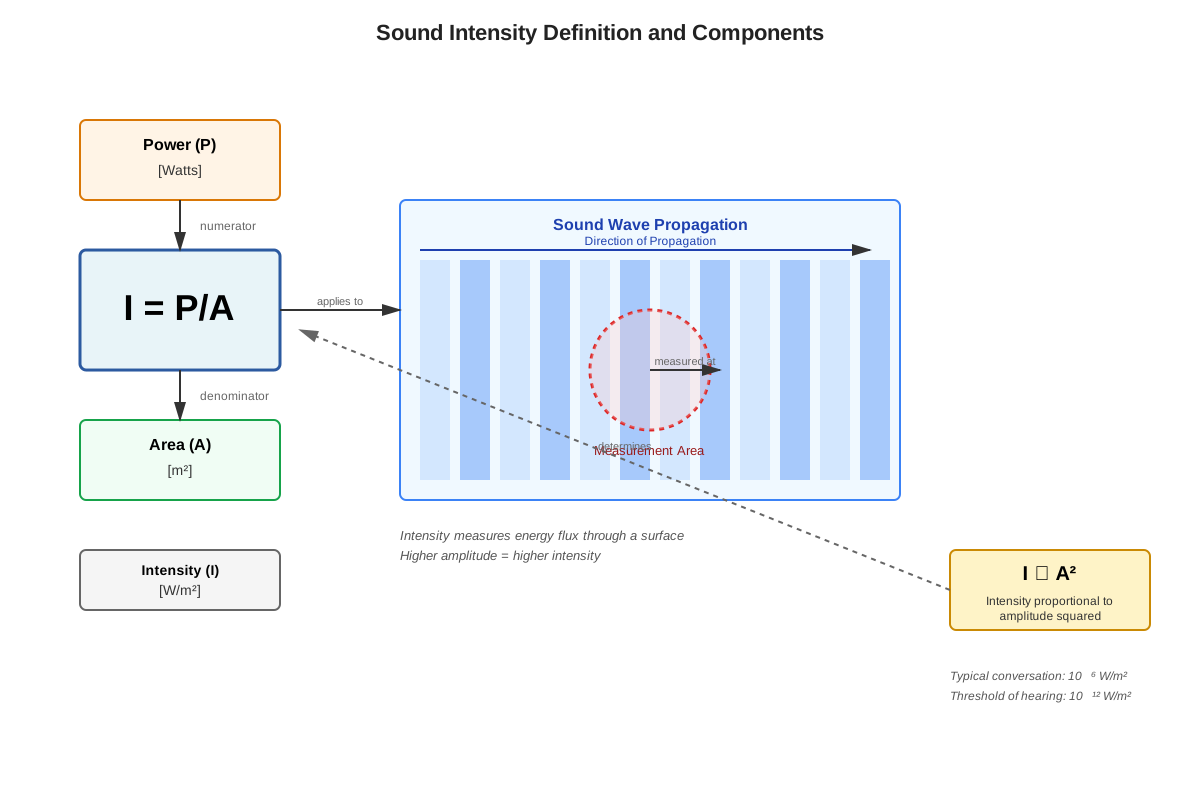
Sound intensity (I) is defined as the average power (P) transmitted by a sound wave per unit area (A) perpendicular to the direction of propagation. The fundamental equation is:
I = P/AWhere:
- I = intensity (W/m²)
- P = power (W)
- A = area (m²)
This definition establishes intensity as a measure of energy flux—how much acoustic energy passes through a given area per unit time. For the MCAT, understanding that intensity quantifies the concentration of sound power is crucial for conceptual questions.
Intensity and Wave Amplitude
Sound intensity is proportional to the square of the wave's amplitude. For a sinusoidal sound wave:
I ∝ A²Where A represents the amplitude of oscillation (displacement amplitude for mechanical waves). This quadratic relationship means that doubling the amplitude increases intensity by a factor of four. This relationship derives from the fact that wave energy is proportional to amplitude squared, and intensity represents energy transfer rate per unit area.
Additionally, intensity depends on the square of frequency (f) and the properties of the medium:
I ∝ f²A²ρvWhere ρ is the medium density and v is the wave speed. For MCAT purposes, the key takeaway is that intensity increases with both amplitude squared and frequency squared, though amplitude effects are more commonly tested.
The Inverse-Square Law
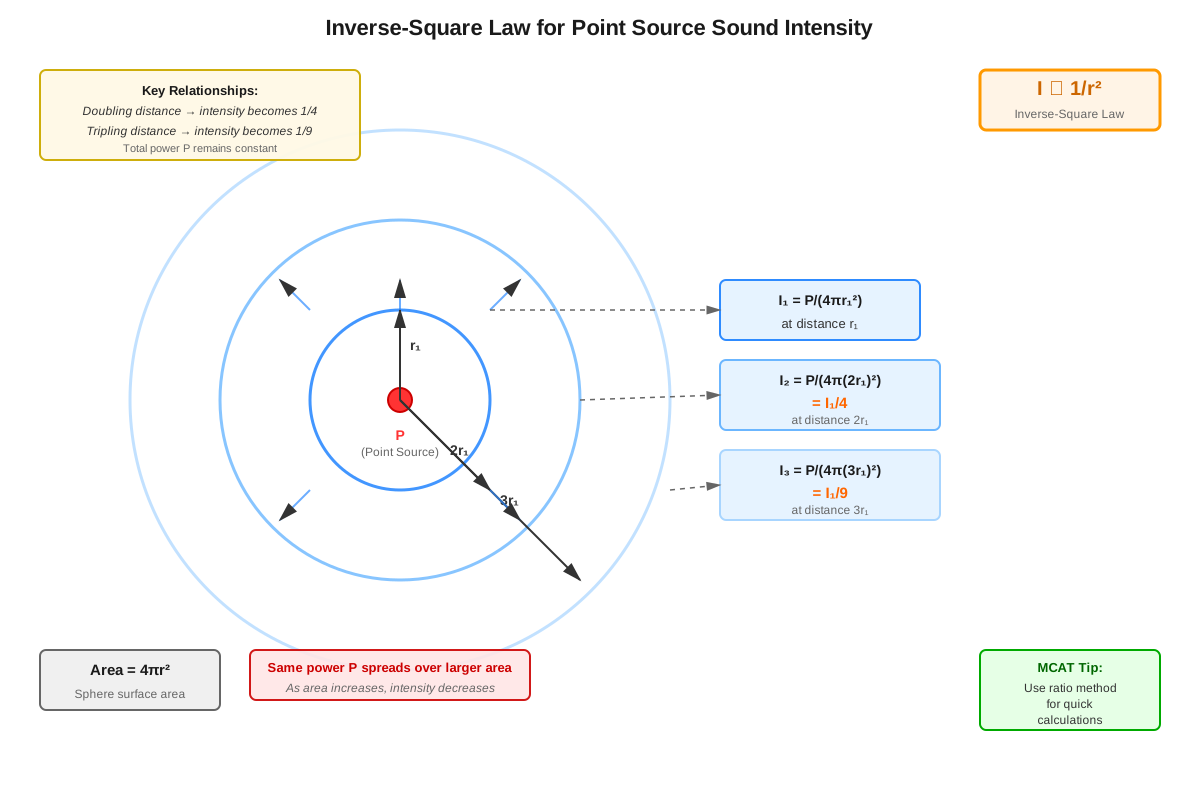
For a point source radiating sound uniformly in all directions (spherical wavefronts), intensity decreases with the square of the distance from the source:
I = P/(4πr²)Where r is the distance from the source. This inverse-square law reflects the geometric spreading of wave energy over increasingly larger spherical surfaces. As distance doubles, the same power spreads over four times the area, reducing intensity to one-quarter its original value.
The relationship between intensities at two different distances can be expressed as:
I₁/I₂ = (r₂/r₁)²This proportional form is particularly useful for MCAT calculations, as it eliminates the need to know the absolute power of the source.
The Decibel Scale
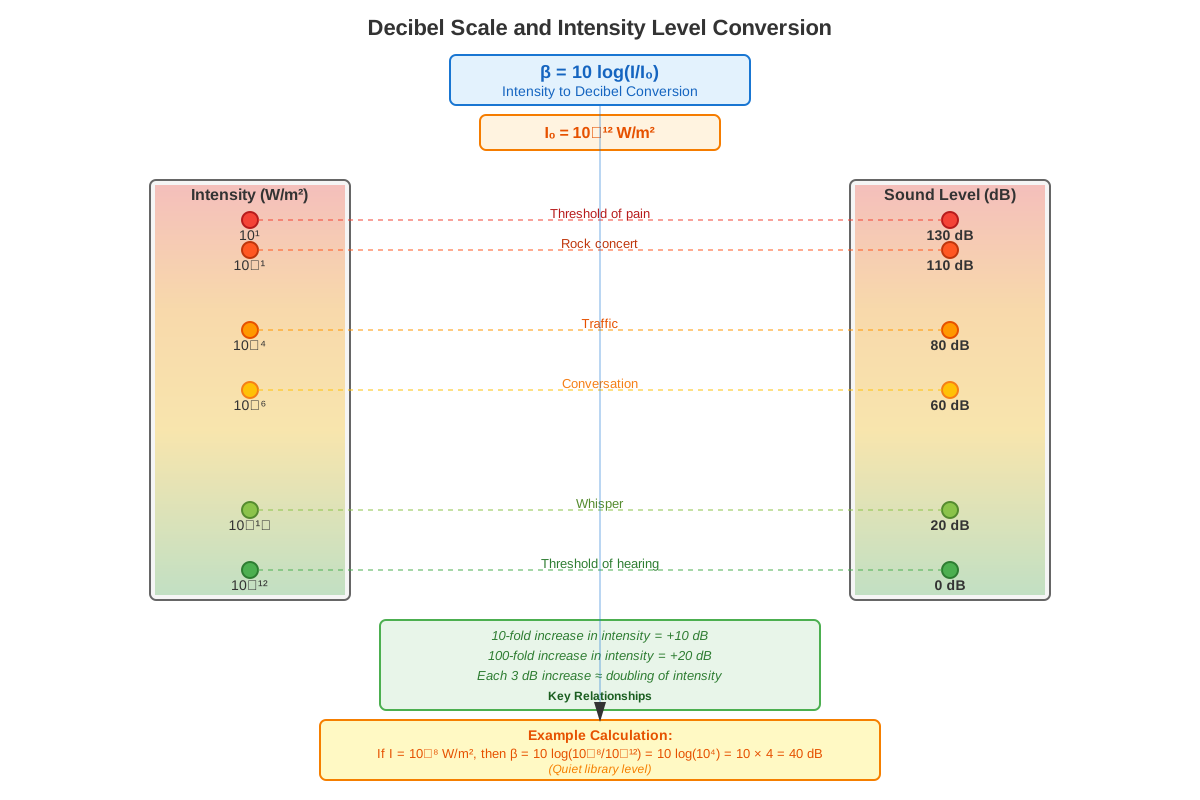
The decibel (dB) scale provides a logarithmic measure of sound intensity that better corresponds to human perception of loudness. The sound level β in decibels is defined as:
β = 10 log₁₀(I/I₀)Where:
- β = sound level (dB)
- I = intensity (W/m²)
- I₀ = reference intensity = 10⁻¹² W/m² (threshold of hearing at 1000 Hz)
The reference intensity I₀ represents the faintest sound detectable by the average human ear under ideal conditions. This logarithmic scale compresses the enormous range of audible intensities (spanning 12 orders of magnitude) into a manageable 0-120 dB scale.
Key properties of the decibel scale:
- Each 10 dB increase represents a 10-fold increase in intensity
- Each 3 dB increase represents approximately a doubling of intensity
- 0 dB corresponds to the threshold of hearing (I = I₀)
- 120 dB corresponds to the threshold of pain (I = 1 W/m²)
Converting Between Intensity and Decibels
To convert from decibels to intensity, rearrange the decibel equation:
I = I₀ × 10^(β/10)For comparing two sound levels:
β₂ - β₁ = 10 log₁₀(I₂/I₁)This relationship is crucial for MCAT problems asking how many decibels louder one sound is compared to another.
Intensity and Distance Relationships in Decibels
Combining the inverse-square law with the decibel scale yields:
β₂ - β₁ = 10 log₁₀(r₁²/r₂²) = 20 log₁₀(r₁/r₂)This shows that when distance doubles (r₂ = 2r₁), the sound level decreases by:
Δβ = 20 log₁₀(1/2) ≈ -6 dBTherefore, doubling the distance from a point source reduces the sound level by approximately 6 dB.
Intensity vs. Loudness
While intensity is an objective physical quantity, loudness is a subjective perception that depends on both intensity and frequency. The human ear has varying sensitivity across frequencies, being most sensitive around 3000-4000 Hz. Equal-loudness contours (Fletcher-Munson curves) show that sounds of equal loudness can have different intensities at different frequencies. For the MCAT, recognize that intensity and loudness are related but distinct concepts—intensity is measurable and objective, while loudness is perceptual and subjective.
Intensity in Different Media
Sound intensity depends on the medium's properties. When sound travels from one medium to another, intensity changes due to reflection and transmission at the interface. The acoustic impedance (Z = ρv, where ρ is density and v is sound speed) determines how much sound energy is reflected versus transmitted. Greater impedance mismatch leads to more reflection and less transmitted intensity—a principle fundamental to ultrasound imaging.
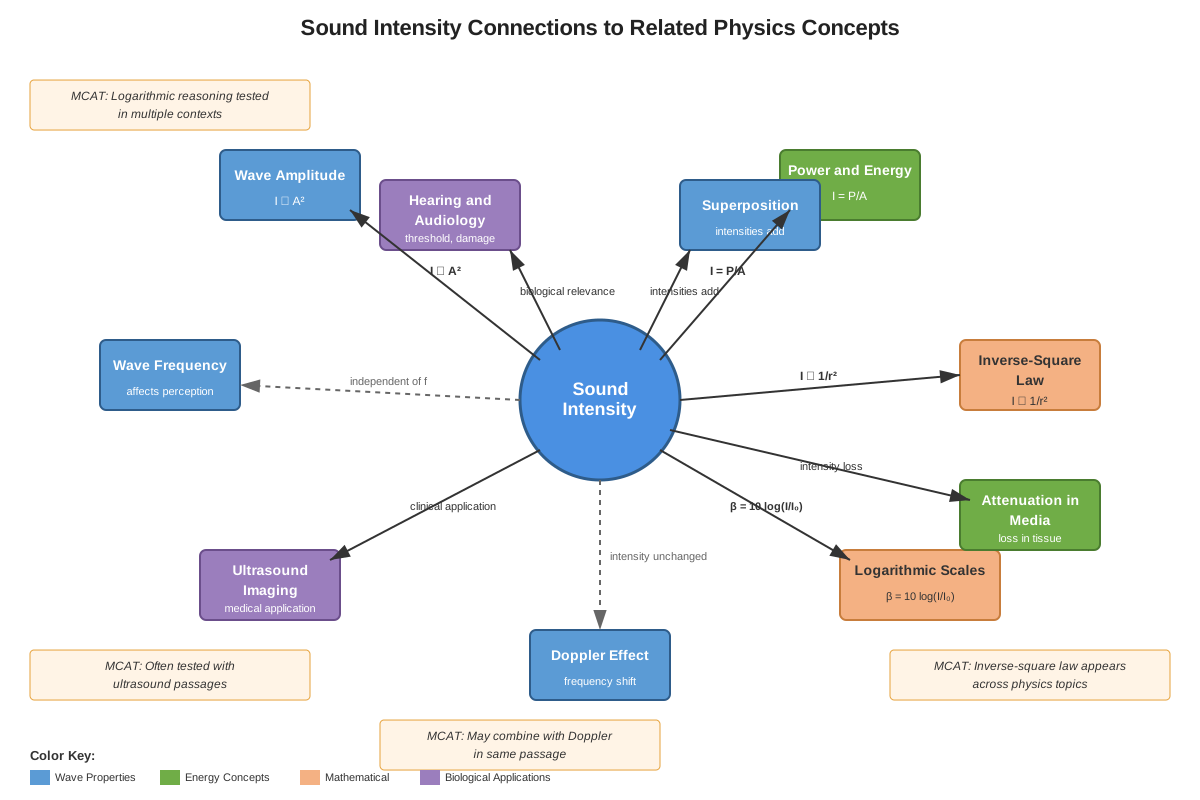
Concept Relationships
The concepts within sound intensity form an interconnected framework. The fundamental definition (I = P/A) establishes intensity as power per unit area → this connects to the inverse-square law, which describes how intensity decreases with distance for point sources → the inverse-square relationship explains why intensity falls off as 1/r² → this geometric spreading necessitates the decibel scale, which compresses the wide range of intensities into a manageable logarithmic scale → the decibel scale connects back to intensity through the logarithmic relationship β = 10 log₁₀(I/I₀) → intensity's dependence on amplitude squared (I ∝ A²) links to wave energy concepts → this amplitude relationship connects to the broader understanding that wave energy is proportional to amplitude squared.
Sound intensity connects to prerequisite topics through multiple pathways. Wave properties (frequency, wavelength, amplitude) determine intensity values through the relationship I ∝ f²A². Energy and power concepts underlie the definition of intensity as power per unit area. The inverse-square law applies the same geometric principles used in electrostatics and gravitation. Logarithmic functions from mathematics enable the decibel scale's compression of the intensity range.
Related topics build upon sound intensity foundations. Doppler effect problems often involve intensity changes as sources move. Standing waves and resonance create intensity patterns with nodes and antinodes. Wave interference produces regions of varying intensity through constructive and destructive interference. Ultrasound imaging relies on intensity calculations for safety limits and image quality. Hearing physiology connects intensity to neural responses and perception.
High-Yield Facts
⭐ Sound intensity is defined as power per unit area: I = P/A, measured in W/m²
⭐ For a point source, intensity follows the inverse-square law: I ∝ 1/r², so doubling distance reduces intensity to 1/4
⭐ The decibel scale is logarithmic: β = 10 log₁₀(I/I₀), where I₀ = 10⁻¹² W/m²
⭐ Each 10 dB increase represents a 10-fold increase in intensity; each 3 dB increase represents approximately a doubling
⭐ Doubling the distance from a point source decreases sound level by approximately 6 dB
- Intensity is proportional to the square of amplitude: I ∝ A², so doubling amplitude quadruples intensity
- The threshold of hearing is 0 dB (I = 10⁻¹² W/m²); the threshold of pain is 120 dB (I = 1 W/m²)
- Intensity and loudness are different—intensity is objective and measurable, loudness is subjective and perceptual
- When comparing two intensities: β₂ - β₁ = 10 log₁₀(I₂/I₁)
- Sound intensity depends on both frequency squared and amplitude squared: I ∝ f²A²
- Acoustic impedance mismatch at interfaces causes intensity reduction through reflection
- The human ear's sensitivity varies with frequency, being most sensitive around 3000-4000 Hz
Quick check — test yourself on Sound intensity so far.
Try Flashcards →Common Misconceptions
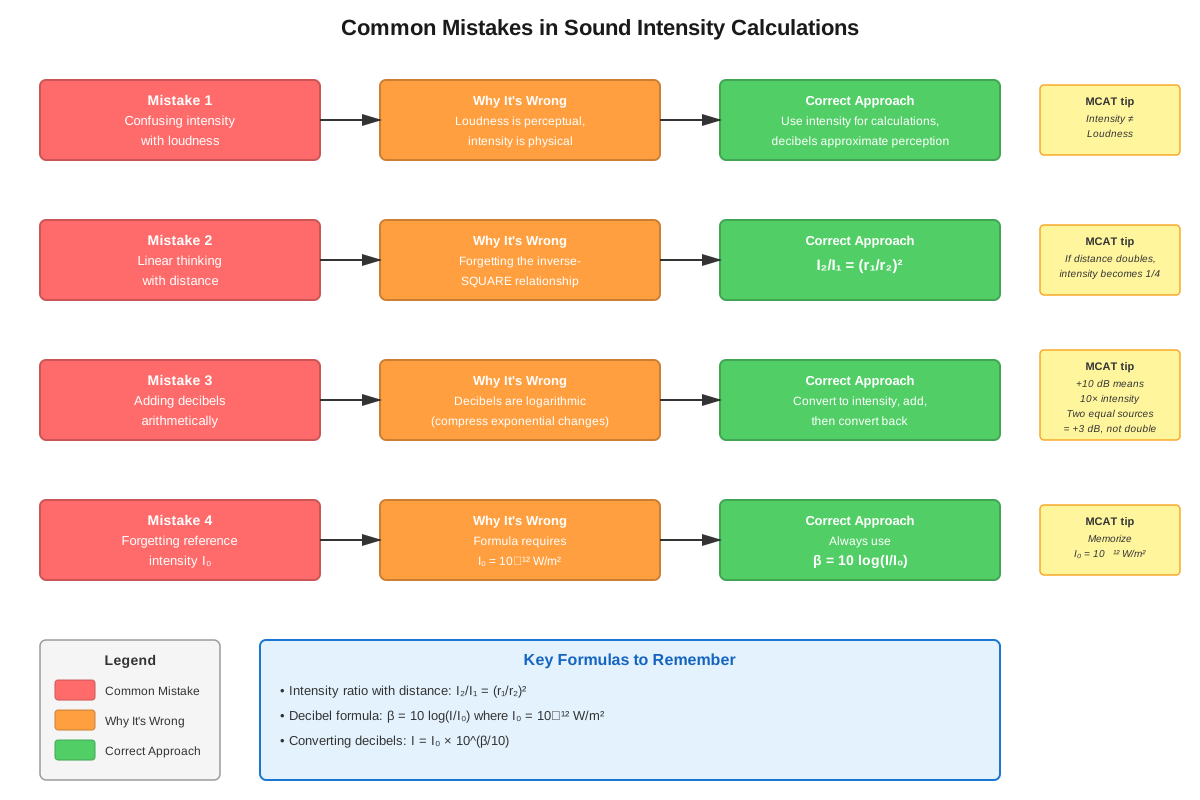
Misconception: Doubling the distance from a sound source reduces intensity by half.
Correction: Due to the inverse-square law, doubling distance reduces intensity to one-quarter (1/4) of the original value, not one-half. The intensity decreases as 1/r², not 1/r.
Misconception: A sound that is 20 dB is twice as loud as a sound that is 10 dB.
Correction: The decibel scale is logarithmic, not linear. A 20 dB sound has 10 times the intensity of a 10 dB sound (since 20 - 10 = 10 dB difference, representing one order of magnitude). Perceived loudness roughly doubles with each 10 dB increase, but intensity increases 10-fold.
Misconception: Intensity and loudness are the same thing.
Correction: Intensity is an objective, measurable physical quantity (power per unit area), while loudness is a subjective perception that depends on both intensity and frequency. Two sounds with equal intensity at different frequencies may have different perceived loudness due to the ear's frequency-dependent sensitivity.
Misconception: Doubling the amplitude of a sound wave doubles its intensity.
Correction: Intensity is proportional to amplitude squared (I ∝ A²), so doubling amplitude increases intensity by a factor of four, not two. This quadratic relationship is crucial for calculations involving amplitude changes.
Misconception: The reference intensity I₀ = 10⁻¹² W/m² is arbitrary.
Correction: While the value is standardized by convention, it represents the approximate threshold of human hearing at 1000 Hz—the faintest sound the average human ear can detect under ideal conditions. This physiologically meaningful reference point anchors the decibel scale to human perception.
Misconception: Sound intensity remains constant as a wave propagates through a uniform medium.
Correction: Even in a uniform medium, intensity decreases with distance from the source due to geometric spreading (inverse-square law for point sources). Additionally, absorption and scattering in real media cause further intensity reduction. Only in the idealized case of a plane wave in a perfectly non-absorbing medium would intensity remain constant.
Misconception: A 3 dB increase means the sound is three times more intense.
Correction: A 3 dB increase corresponds to approximately doubling the intensity (since 10^(3/10) ≈ 2), not tripling it. The logarithmic nature of the decibel scale means that equal dB differences represent equal ratios of intensity, not equal absolute differences.
Worked Examples
Example 1: Inverse-Square Law Application
Problem: A person stands 4 meters from a loudspeaker and measures a sound intensity of 2.0 × 10⁻⁴ W/m². If the person moves to a distance of 12 meters from the speaker, what will be the new intensity?
Solution:
Step 1: Identify the relevant relationship. For a point source, intensity follows the inverse-square law:
I₁/I₂ = (r₂/r₁)²Step 2: Identify known values:
- I₁ = 2.0 × 10⁻⁴ W/m² (intensity at r₁)
- r₁ = 4 m (initial distance)
- r₂ = 12 m (final distance)
- I₂ = ? (intensity at r₂)
Step 3: Rearrange to solve for I₂:
I₂ = I₁ × (r₁/r₂)²Step 4: Substitute values:
I₂ = 2.0 × 10⁻⁴ × (4/12)²
I₂ = 2.0 × 10⁻⁴ × (1/3)²
I₂ = 2.0 × 10⁻⁴ × 1/9
I₂ = 2.2 × 10⁻⁵ W/m²
Step 5: Verify the answer makes sense. The distance tripled (from 4 m to 12 m), so intensity should decrease by a factor of 3² = 9. Indeed, 2.0 × 10⁻⁴ ÷ 9 ≈ 2.2 × 10⁻⁵.
Answer: The intensity at 12 meters is 2.2 × 10⁻⁵ W/m².
Connection to learning objectives: This problem applies the inverse-square law, demonstrating how intensity changes with distance—a core concept for MCAT questions on sound intensity Physics.
Example 2: Decibel Scale Conversion
Problem: A rock concert produces a sound level of 110 dB. A normal conversation produces a sound level of 60 dB. How many times more intense is the sound at the rock concert compared to the conversation?
Solution:
Step 1: Identify the relevant equation for comparing two sound levels:
β₂ - β₁ = 10 log₁₀(I₂/I₁)Step 2: Identify known values:
- β₂ = 110 dB (rock concert)
- β₁ = 60 dB (conversation)
- Need to find: I₂/I₁ (intensity ratio)
Step 3: Calculate the difference in sound levels:
Δβ = 110 - 60 = 50 dBStep 4: Substitute into the equation:
50 = 10 log₁₀(I₂/I₁)Step 5: Solve for the intensity ratio:
5 = log₁₀(I₂/I₁)
I₂/I₁ = 10⁵ = 100,000
Step 6: Interpret the result. The rock concert is 100,000 times more intense than the conversation. This makes sense because each 10 dB represents a 10-fold increase in intensity, and we have a 50 dB difference (5 orders of magnitude).
Answer: The rock concert is 100,000 times more intense than the conversation.
Connection to learning objectives: This problem demonstrates conversion between decibel levels and intensity ratios, a high-yield skill for Sound intensity MCAT questions. It also reinforces understanding of the logarithmic nature of the decibel scale.
Example 3: Combined Inverse-Square Law and Decibel Calculation
Problem: At a distance of 2 meters from a point source, the sound level is 80 dB. What is the sound level at a distance of 8 meters?
Solution:
Step 1: Recognize this combines inverse-square law with decibel calculations. Use the relationship:
β₂ - β₁ = 20 log₁₀(r₁/r₂)Step 2: Identify known values:
- β₁ = 80 dB (at r₁ = 2 m)
- r₁ = 2 m
- r₂ = 8 m
- β₂ = ?
Step 3: Calculate the change in sound level:
Δβ = 20 log₁₀(2/8) = 20 log₁₀(1/4) = 20 log₁₀(0.25)Step 4: Evaluate the logarithm:
log₁₀(0.25) = log₁₀(1/4) = -log₁₀(4) ≈ -0.602Step 5: Complete the calculation:
Δβ = 20 × (-0.602) ≈ -12 dBStep 6: Find the final sound level:
β₂ = β₁ + Δβ = 80 + (-12) = 68 dBStep 7: Verify using the "doubling distance = -6 dB" rule. Distance increased by a factor of 4 (doubled twice), so sound level should decrease by 2 × 6 = 12 dB. Indeed, 80 - 12 = 68 dB.
Answer: The sound level at 8 meters is 68 dB.
Connection to learning objectives: This problem integrates multiple concepts—inverse-square law, decibel scale, and logarithmic relationships—demonstrating the type of multi-step reasoning required on the MCAT.
Exam Strategy
When approaching Sound intensity MCAT questions, first identify whether the problem involves the linear intensity scale (W/m²) or the logarithmic decibel scale (dB). This distinction determines which equations to use. Look for trigger words: "intensity" typically refers to W/m², while "sound level" or "loudness level" indicates decibels.
For inverse-square law problems, watch for phrases like "point source," "distance from the source," or "spherical wavefronts." These signal that intensity varies as 1/r². Set up the ratio I₁/I₂ = (r₂/r₁)² rather than trying to calculate absolute intensities—this eliminates the need to know the source power.
When dealing with decibel questions, recognize common patterns:
- "How many times more intense" → calculate 10^(Δβ/10)
- "How many dB louder" → calculate 10 log₁₀(I₂/I₁)
- "Distance doubles" → sound level decreases by 6 dB
- "Intensity doubles" → sound level increases by 3 dB
Exam Tip: If a question asks about doubling or halving, use the shortcuts: doubling distance = -6 dB; doubling intensity = +3 dB. These eliminate the need for logarithm calculations.
For process of elimination, remember that intensity must decrease with distance (never increase for a passive source), and decibel changes are additive (not multiplicative). If answer choices include intensity increasing with distance or decibels being multiplied, eliminate those immediately.
Time management: Straightforward inverse-square law or decibel conversion problems should take 60-90 seconds. Multi-step problems combining concepts may require 2-3 minutes. If a problem requires complex logarithm calculations without a calculator, look for a conceptual shortcut or estimation strategy—the MCAT rarely requires precise logarithm evaluation.
Watch for questions that test conceptual understanding rather than calculation. These might ask about the relationship between intensity and amplitude, the difference between intensity and loudness, or how intensity changes when waves pass between media. These questions reward deep understanding over formula memorization.
Memory Techniques
Decibel Shortcuts Mnemonic: "Double Distance Drops Six" (DDDS)
- Doubling Distance Drops Six dB
- Also remember: "Twice Intensity, Three up" (TIT) - doubling intensity adds 3 dB
Inverse-Square Law Visualization: Picture a balloon expanding from a point source. As the radius doubles, the surface area quadruples (4πr²), so the same energy spreads over four times the area, reducing intensity to 1/4.
Decibel Scale Landmarks (memorize these reference points):
- 0 dB: Threshold of hearing (whisper in a quiet library)
- 60 dB: Normal conversation
- 90 dB: Lawnmower, prolonged exposure causes damage
- 120 dB: Threshold of pain (rock concert, jet engine)
Formula Organization Acronym: "I Prefer Apples" for I = P/A
- Intensity equals Power over Area
Logarithm Relationship: Remember "TEN for TEN" - each 10 dB represents a 10-fold change in intensity. This anchors the logarithmic relationship.
Amplitude-Intensity Connection: "Square the Amplitude" (SA) - intensity is proportional to amplitude squared, so changes in amplitude have squared effects on intensity.
Summary
Sound intensity quantifies the power transmitted by sound waves per unit area, measured in W/m² and defined by I = P/A. For point sources, intensity follows the inverse-square law (I ∝ 1/r²), meaning intensity decreases to one-quarter when distance doubles. The decibel scale provides a logarithmic measure (β = 10 log₁₀(I/I₀)) that compresses the enormous range of audible intensities into a manageable 0-120 dB scale, where each 10 dB represents a 10-fold intensity change and each 3 dB represents approximately a doubling. Intensity is proportional to amplitude squared (I ∝ A²), creating a quadratic relationship between wave amplitude and energy flux. Understanding both the linear intensity scale and logarithmic decibel scale, along with their interconversion and the geometric spreading described by the inverse-square law, enables students to tackle the full range of MCAT questions on this topic. Distinguishing between objective intensity and subjective loudness, recognizing trigger words for different scales, and applying shortcuts for common scenarios (doubling distance = -6 dB, doubling intensity = +3 dB) are essential strategies for exam success.
Key Takeaways
- Sound intensity (I = P/A) measures power per unit area in W/m² and follows the inverse-square law for point sources (I ∝ 1/r²)
- The decibel scale is logarithmic (β = 10 log₁₀(I/I₀)) with reference intensity I₀ = 10⁻¹² W/m², compressing 12 orders of magnitude into 0-120 dB
- Each 10 dB increase represents a 10-fold intensity increase; each 3 dB increase represents approximately a doubling of intensity
- Doubling distance from a point source reduces intensity by a factor of 4 and decreases sound level by 6 dB
- Intensity is proportional to amplitude squared (I ∝ A²), so doubling amplitude quadruples intensity
- Intensity is objective and measurable; loudness is subjective and depends on both intensity and frequency
- Master both the ratio form of equations (I₁/I₂ = (r₂/r₁)²) and the decibel difference form (β₂ - β₁ = 10 log₁₀(I₂/I₁)) for efficient problem-solving
Related Topics
Doppler Effect: Building on sound intensity, the Doppler effect describes frequency shifts when sources or observers move, often combined with intensity changes in MCAT passages about medical ultrasound or blood flow measurement.
Wave Interference and Superposition: Understanding how waves combine helps explain intensity patterns in standing waves, beats, and diffraction—all topics that extend the foundational intensity concepts.
Ultrasound Imaging: This clinical application directly uses sound intensity principles, including intensity calculations for safety limits, acoustic impedance for tissue interfaces, and the inverse-square law for beam spreading.
Hearing Physiology: The biological response to sound intensity connects physics to biology, covering topics like the auditory threshold, frequency response curves, and noise-induced hearing loss mechanisms.
Acoustic Impedance and Reflection: This topic extends intensity concepts to explain how sound energy is reflected or transmitted at interfaces between different media, crucial for understanding ultrasound imaging.
Practice CTA
Now that you've mastered the core concepts of sound intensity, it's time to solidify your understanding through active practice. Attempt the practice questions and flashcards associated with this topic to reinforce the inverse-square law, decibel conversions, and problem-solving strategies. Focus on both computational problems and conceptual questions to build the comprehensive understanding needed for MCAT success. Remember: mastery comes from application, not just reading. Challenge yourself with timed practice to simulate exam conditions, and review any mistakes to identify gaps in understanding. You've built a strong foundation—now strengthen it through deliberate practice!
Sign up free to keep reading
Create a free AnvayaPrep account to finish this MCAT guide on Sound intensity — plus flashcards and practice questions.