Overview
Harmonics represent one of the most elegant and testable concepts in Physics, particularly within the domain of Waves and Sound. At its core, harmonics describe the specific frequencies at which standing waves naturally form in bounded systems such as strings, pipes, and air columns. These resonant frequencies emerge when waves reflect back and forth within a confined space, interfering constructively to create stable patterns of nodes (points of zero displacement) and antinodes (points of maximum displacement). Understanding harmonics requires synthesizing knowledge of wave behavior, boundary conditions, and the mathematical relationships that govern resonance phenomena.
For the MCAT, harmonics serves as a bridge between abstract wave mechanics and practical applications in musical instruments, medical imaging technologies, and biological systems. The exam frequently tests harmonics through calculation-based questions involving string instruments and open or closed pipes, as well as conceptual questions about how changing physical parameters (length, tension, density) affects resonant frequencies. Students must be comfortable manipulating the fundamental equations for harmonics while also understanding the qualitative differences between various boundary conditions.
Harmonics connects intimately with broader Physics concepts including wave interference, standing waves, resonance, and the relationship between frequency, wavelength, and wave speed. Mastery of this topic enables deeper understanding of sound production in the human vocal tract, ultrasound imaging principles, and the physics underlying musical perception—all areas that may appear in MCAT passages integrating physics with biological or clinical contexts.
Learning Objectives
- [ ] Define Harmonics using accurate Physics terminology
- [ ] Explain why Harmonics matters for the MCAT
- [ ] Apply Harmonics to exam-style questions
- [ ] Identify common mistakes related to Harmonics
- [ ] Connect Harmonics to related Physics concepts
- [ ] Calculate harmonic frequencies for strings and pipes with different boundary conditions
- [ ] Distinguish between open-pipe and closed-pipe harmonic series
- [ ] Predict how changes in physical parameters affect harmonic frequencies
- [ ] Interpret standing wave diagrams to identify harmonic number
Prerequisites
- Wave fundamentals: Understanding wavelength, frequency, amplitude, and wave speed is essential because harmonics are specific frequencies determined by these wave properties
- Standing waves: Knowledge of how waves interfere to create stationary patterns with nodes and antinodes provides the foundation for understanding why only certain frequencies produce harmonics
- Wave equation (v = fλ): This relationship is used repeatedly in deriving and calculating harmonic frequencies
- Basic algebra: Manipulating equations and solving for variables is necessary for quantitative harmonic problems
Why This Topic Matters
Harmonics appears regularly on the MCAT, typically in 1-2 discrete questions per exam and occasionally within passages about musical instruments, sound production, or medical imaging technologies. The topic is considered medium-yield but high-efficiency—questions are usually straightforward if the fundamental concepts and equations are mastered, making it an excellent opportunity to secure points.
Clinically, harmonics principles underlie several medical technologies and biological phenomena. Ultrasound imaging relies on resonance frequencies to generate and detect sound waves that create diagnostic images. The human vocal tract functions as a resonant cavity where harmonics determine voice quality and timbre. Understanding harmonics also illuminates how musical therapy might affect physiological responses and why certain frequencies can cause resonance in body structures.
On the MCAT, harmonics most commonly appears in three contexts: (1) calculation questions asking for specific harmonic frequencies given physical parameters, (2) conceptual questions about how changing string tension or pipe length affects pitch, and (3) passage-based questions integrating harmonics with musical instruments or sound perception. The exam particularly favors questions comparing open and closed pipes, as this tests both conceptual understanding and attention to detail regarding boundary conditions.
Core Concepts
Definition of Harmonics
Harmonics (also called overtones or resonant frequencies) are the specific frequencies at which standing waves naturally form in a bounded medium. When a wave-supporting system has fixed boundaries—such as a string attached at both ends or an air column in a pipe—only certain wavelengths can "fit" within the system such that the reflected waves interfere constructively with incoming waves. These special frequencies produce stable standing wave patterns rather than chaotic interference.
The fundamental frequency (first harmonic) represents the lowest possible frequency at which a standing wave can form in a given system. Higher harmonics are integer multiples of this fundamental frequency. The complete set of harmonics constitutes the harmonic series for that system, and the specific harmonics present determine the timbre or tonal quality of sounds produced.
Standing Waves and Boundary Conditions
Standing waves form when two waves of identical frequency and amplitude travel in opposite directions through the same medium, creating interference patterns. At certain locations called nodes, destructive interference causes zero displacement at all times. At antinodes, constructive interference produces maximum displacement. The distance between adjacent nodes (or adjacent antinodes) equals half a wavelength (λ/2).
Boundary conditions determine which standing wave patterns are possible. Fixed boundaries (like the clamped ends of a guitar string) must be nodes because the medium cannot move at these points. Free or open boundaries (like the open end of a pipe) must be antinodes because pressure variations are minimized and displacement is maximized at these locations. These constraints limit which wavelengths can form standing waves.
Harmonics on Strings
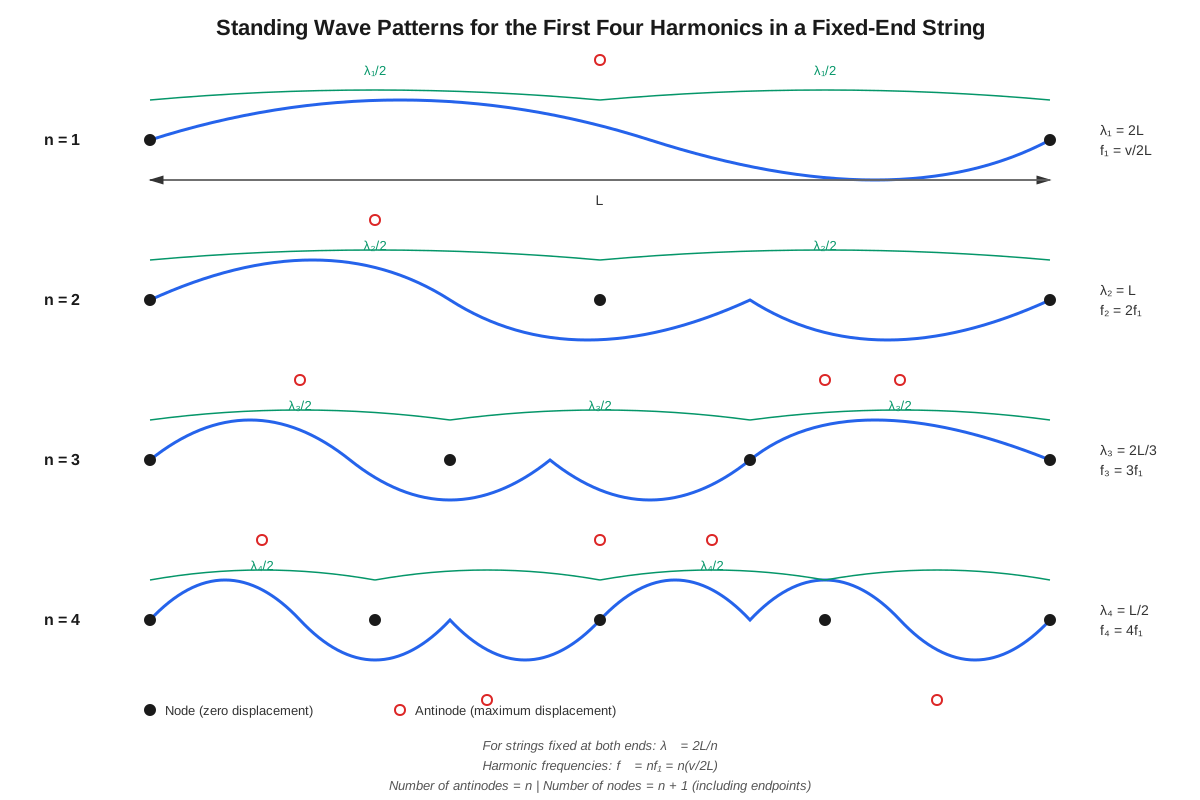
For a string of length L fixed at both ends (both boundaries are nodes), the allowed wavelengths must satisfy the condition that the string length equals an integer number of half-wavelengths:
L = n(λ/2)where n = 1, 2, 3, 4... represents the harmonic number.
Rearranging gives the wavelength for the nth harmonic:
λₙ = 2L/nUsing the wave equation v = fλ, where v is the wave speed on the string, the frequency of the nth harmonic becomes:
fₙ = nv/(2L) = n·f₁The fundamental frequency (n=1) is:
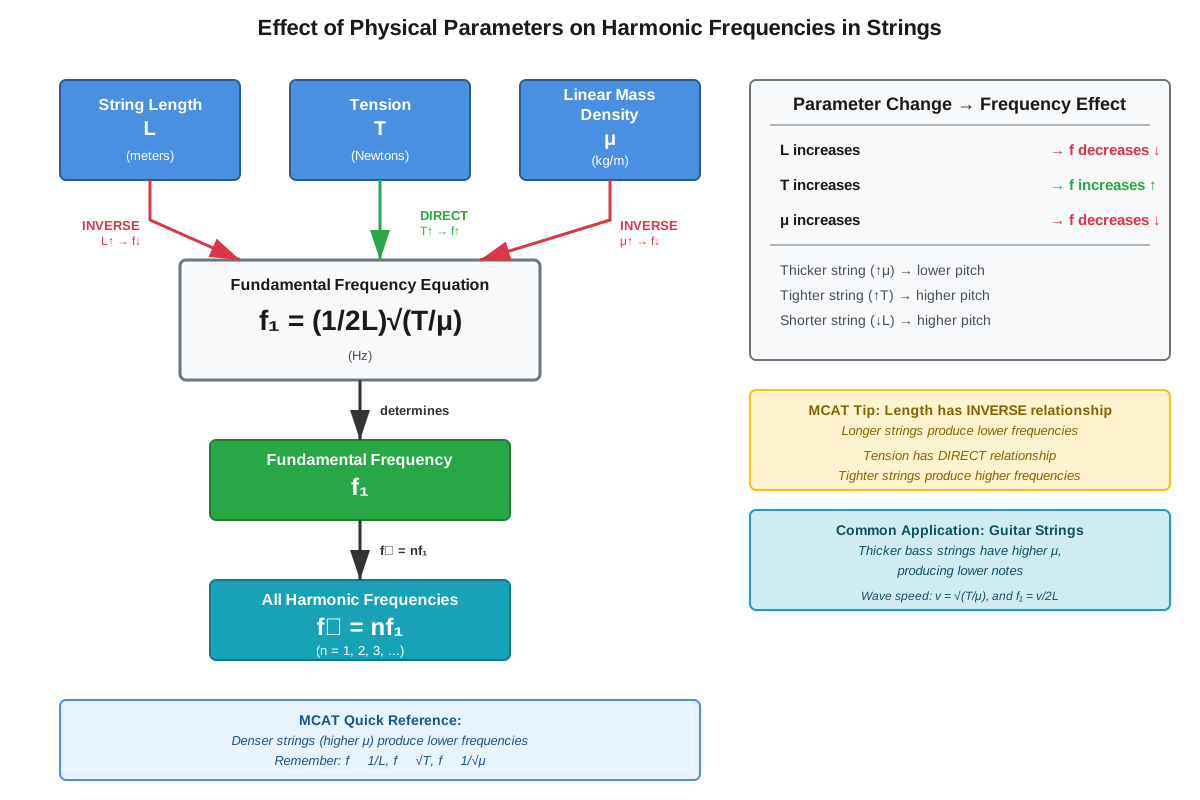
f₁ = v/(2L)The wave speed on a string depends on the tension (T) and linear mass density (μ = mass/length):
v = √(T/μ)Therefore, increasing tension raises all harmonic frequencies, while increasing mass density lowers them. Doubling the string length halves all frequencies (lowering pitch by one octave).
| Harmonic Number (n) | Wavelength | Frequency | Number of Antinodes |
|---|---|---|---|
| 1 (fundamental) | 2L | f₁ | 1 |
| 2 (first overtone) | L | 2f₁ | 2 |
| 3 (second overtone) | 2L/3 | 3f₁ | 3 |
| 4 (third overtone) | L/2 | 4f₁ | 4 |
Harmonics in Open Pipes
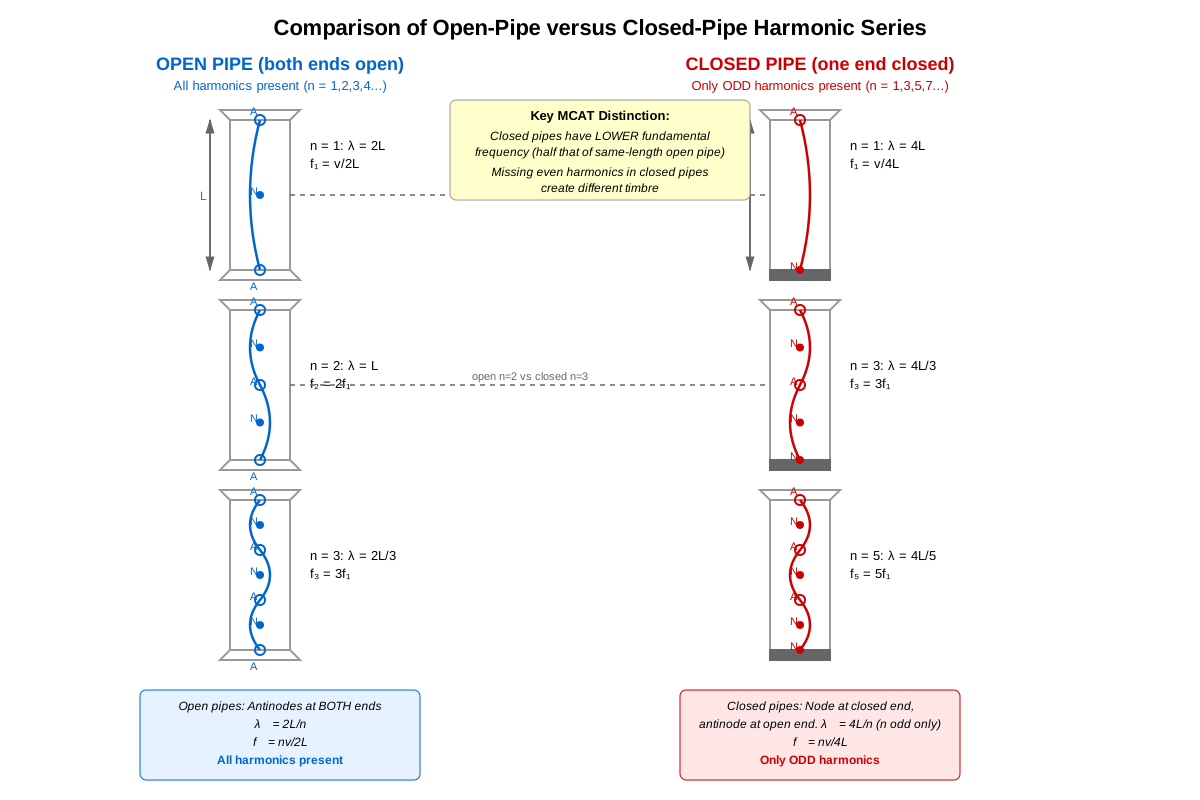
An open pipe (open at both ends) has antinodes at both boundaries. The allowed wavelengths satisfy:
L = n(λ/2)This is identical to the string condition, so the harmonic frequencies are:
fₙ = nv/(2L) = n·f₁where v is now the speed of sound in the medium (typically air at ~343 m/s at room temperature).
Open pipes support all integer harmonics (n = 1, 2, 3, 4...), producing a complete harmonic series. Examples include flutes, organ pipes open at both ends, and the human vocal tract when producing certain vowel sounds.
Harmonics in Closed Pipes
A closed pipe (closed at one end, open at the other) has a node at the closed end and an antinode at the open end. This asymmetric boundary condition means the pipe length must equal an odd number of quarter-wavelengths:
L = n(λ/4)where n = 1, 3, 5, 7... (odd integers only).
The wavelength for the nth harmonic is:
λₙ = 4L/nThe frequency becomes:
fₙ = nv/(4L) = n·f₁where n must be odd.
The fundamental frequency is:
f₁ = v/(4L)Critically, closed pipes support only odd harmonics (n = 1, 3, 5, 7...), lacking all even harmonics. This produces a distinctly different timbre compared to open pipes. Examples include clarinets, some organ pipes, and partially covered bottles.
| System Type | Boundary Conditions | Allowed Harmonics | Fundamental Frequency |
|---|---|---|---|
| String (both ends fixed) | Node-Node | All integers (1,2,3,4...) | v/(2L) |
| Open pipe | Antinode-Antinode | All integers (1,2,3,4...) | v/(2L) |
| Closed pipe | Node-Antinode | Odd integers only (1,3,5,7...) | v/(4L) |
Resonance and Forced Vibrations
When an external force drives a system at one of its natural harmonic frequencies, resonance occurs—the system absorbs energy efficiently and oscillates with large amplitude. This principle explains why pushing a swing at its natural frequency produces large motion, while random pushing is ineffective. In musical instruments, resonance amplifies specific frequencies, creating louder, richer sounds.
Forced vibrations occur when a system is driven at a frequency different from its natural harmonics. The system still vibrates but with smaller amplitude and less energy transfer. Understanding resonance is crucial for MCAT questions about sound amplification, instrument design, and potentially harmful resonance effects (like shattering glass with sound).
Concept Relationships
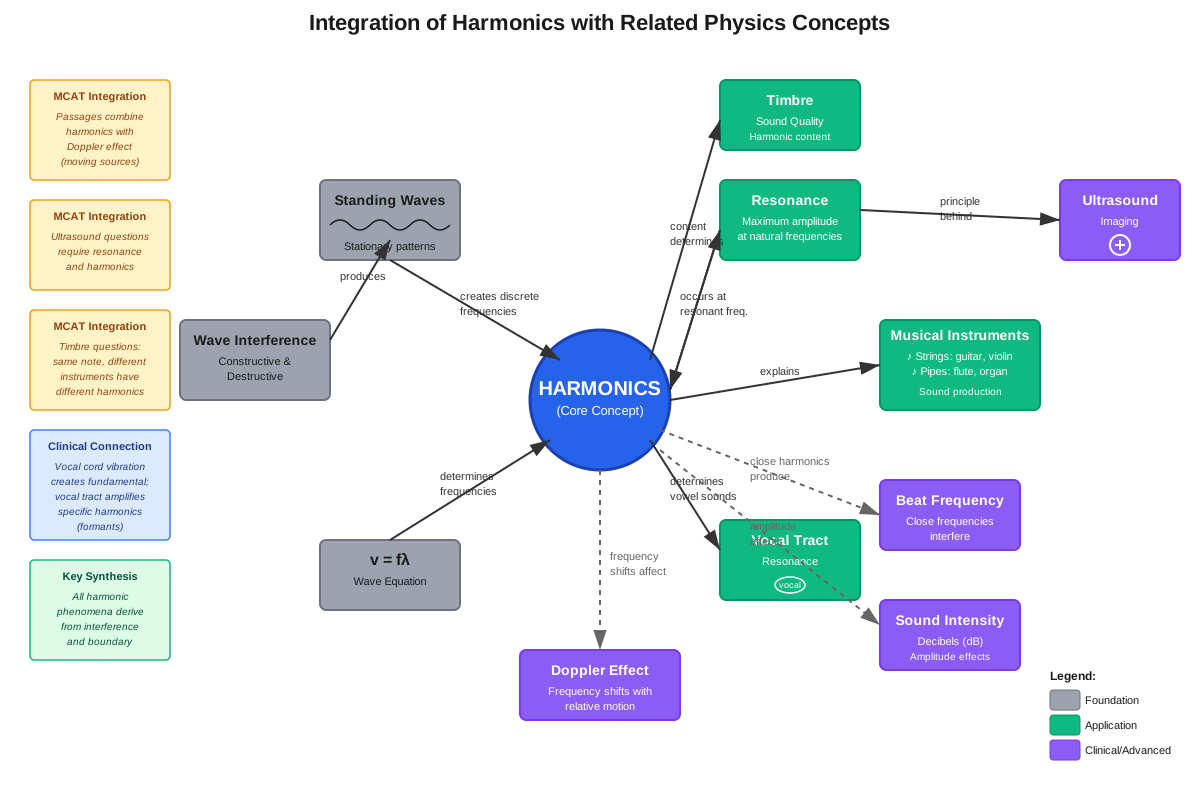
The study of harmonics builds directly on fundamental wave properties. The wave equation (v = fλ) serves as the mathematical foundation, connecting wave speed, frequency, and wavelength. Standing waves emerge from wave interference, and harmonics represent the specific standing wave patterns allowed by boundary conditions. The relationship flows: wave properties → interference → standing waves → boundary conditions → harmonics.
Harmonics connects forward to sound perception and musical acoustics. The presence or absence of specific harmonics determines timbre—why a clarinet sounds different from a flute even when playing the same note. The Doppler effect can shift perceived frequencies, potentially moving harmonics into or out of the audible range. Beat frequencies occur when two slightly different harmonics interfere.
Within the broader Physics curriculum, harmonics exemplifies resonance phenomena that appear in mechanical systems (springs, pendulums), electrical circuits (LC oscillators), and quantum mechanics (atomic energy levels). The mathematical structure of harmonics—discrete allowed frequencies determined by boundary conditions—foreshadows quantum mechanical concepts where boundary conditions produce quantized energy states.
The conceptual flow: Wave fundamentals → Standing waves → Boundary conditions → Harmonic series → Resonance → Applications (musical instruments, medical imaging, structural engineering).
Quick check — test yourself on Harmonics so far.
Try Flashcards →High-Yield Facts
⭐ The fundamental frequency of a string fixed at both ends is f₁ = v/(2L), where v = √(T/μ)
⭐ Open pipes (both ends open) support all integer harmonics: f₁, 2f₁, 3f₁, 4f₁...
⭐ Closed pipes (one end closed) support only odd harmonics: f₁, 3f₁, 5f₁, 7f₁...
⭐ The fundamental frequency of a closed pipe is half that of an open pipe of the same length: f₁(closed) = v/(4L) vs. f₁(open) = v/(2L)
⭐ Increasing string tension increases all harmonic frequencies; increasing mass density decreases them
- The distance between adjacent nodes (or adjacent antinodes) in a standing wave equals λ/2
- The nth harmonic has n antinodes and (n+1) nodes for strings and open pipes
- Doubling the length of a string or pipe halves all harmonic frequencies (drops pitch by one octave)
- Resonance occurs when a system is driven at one of its natural harmonic frequencies
- The harmonic number equals the number of antinodes in the standing wave pattern
- All harmonics are integer multiples of the fundamental frequency
- The speed of sound in air increases with temperature, raising all pipe harmonic frequencies
- Closed pipes have a fundamental frequency one octave lower than open pipes of equal length
Common Misconceptions
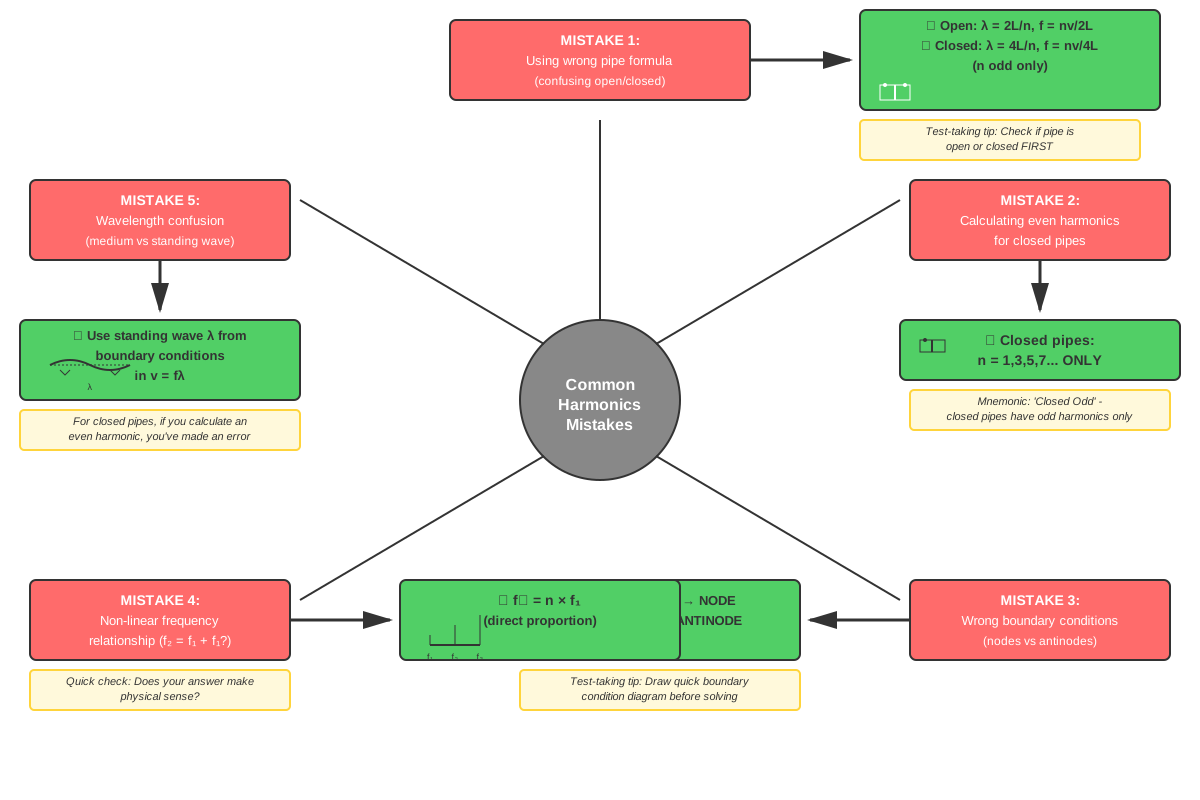
Misconception: All pipes and strings support the same harmonic series.
Correction: Boundary conditions determine which harmonics are allowed. Strings and open pipes support all integer harmonics, while closed pipes support only odd harmonics due to their asymmetric boundary conditions (node at one end, antinode at the other).
Misconception: The fundamental frequency is always the loudest or most prominent frequency.
Correction: While the fundamental is the lowest frequency, higher harmonics can have greater amplitude depending on how the system is excited. The relative amplitudes of different harmonics determine timbre, not just which harmonics are present.
Misconception: Doubling the tension in a string doubles all harmonic frequencies.
Correction: Since wave speed v = √(T/μ), doubling tension increases v by a factor of √2 ≈ 1.41, not 2. Frequencies increase by the same factor since f ∝ v. To double frequency, tension must be quadrupled.
Misconception: A closed pipe is half the length of an open pipe producing the same fundamental frequency.
Correction: It's the opposite—a closed pipe must be half the length of an open pipe to produce the same fundamental frequency. Since f₁(closed) = v/(4L) and f₁(open) = v/(2L), for equal frequencies, L(closed) = L(open)/2.
Misconception: Nodes and antinodes are the same thing in different contexts.
Correction: Nodes and antinodes are opposite. Nodes are points of zero displacement (destructive interference), while antinodes are points of maximum displacement (constructive interference). Confusing these leads to incorrect standing wave diagrams and harmonic calculations.
Misconception: The harmonic number tells you the number of nodes in the standing wave.
Correction: For strings and open pipes, the nth harmonic has (n+1) nodes, not n nodes. The harmonic number equals the number of antinodes. For example, the second harmonic (n=2) has 3 nodes and 2 antinodes.
Worked Examples
Example 1: String Harmonics Calculation
Problem: A guitar string is 0.65 m long with a linear mass density of 3.2 × 10⁻³ kg/m. When tuned, the string has a tension of 72 N. (a) What is the fundamental frequency? (b) What is the frequency of the third harmonic? (c) If the guitarist presses the string at the midpoint, effectively halving its length, what is the new fundamental frequency?
Solution:
(a) First, calculate the wave speed on the string:
v = √(T/μ) = √(72 N / 3.2 × 10⁻³ kg/m)
v = √(22,500 m²/s²) = 150 m/s
The fundamental frequency for a string fixed at both ends:
f₁ = v/(2L) = 150 m/s / (2 × 0.65 m)
f₁ = 150 / 1.3 = 115.4 Hz ≈ 115 Hz
(b) The third harmonic is three times the fundamental:
f₃ = 3f₁ = 3 × 115 Hz = 345 HzAlternatively, using the general formula:
f₃ = 3v/(2L) = 3 × 150 / 1.3 = 346 Hz(slight difference due to rounding)
(c) When the effective length is halved to L' = 0.325 m:
f₁' = v/(2L') = 150 / (2 × 0.325) = 150 / 0.65 = 230.8 Hz ≈ 231 HzNotice this is exactly double the original fundamental frequency—halving length doubles frequency, raising pitch by one octave. This demonstrates the inverse relationship between string length and frequency.
Key Concepts Applied: Wave speed on strings, fundamental frequency formula, harmonic series as integer multiples, inverse relationship between length and frequency.
Example 2: Comparing Open and Closed Pipes
Problem: An organ has two pipes of equal length (L = 0.85 m). Pipe A is open at both ends, while Pipe B is closed at one end. The speed of sound is 340 m/s. (a) What is the fundamental frequency of each pipe? (b) What is the frequency of the second harmonic for each pipe? (c) Which pipe produces a lower pitch, and by what musical interval?
Solution:
(a) For Pipe A (open pipe):
f₁(A) = v/(2L) = 340 m/s / (2 × 0.85 m)
f₁(A) = 340 / 1.7 = 200 Hz
For Pipe B (closed pipe):
f₁(B) = v/(4L) = 340 m/s / (4 × 0.85 m)
f₁(B) = 340 / 3.4 = 100 Hz
(b) For Pipe A, the second harmonic (n=2) is:
f₂(A) = 2f₁(A) = 2 × 200 Hz = 400 HzFor Pipe B, only odd harmonics exist. The "second harmonic" in the series is actually n=3:
f₃(B) = 3f₁(B) = 3 × 100 Hz = 300 HzNote: Some sources call this the "first overtone" rather than "second harmonic" to avoid confusion.
(c) Pipe B produces the lower pitch (100 Hz vs. 200 Hz). The frequency ratio is 2:1, which corresponds to one octave. The closed pipe produces a pitch one octave lower than the open pipe of the same length.
Key Concepts Applied: Different boundary conditions produce different fundamental frequencies, closed pipes support only odd harmonics, frequency ratios determine musical intervals, closed pipes have fundamentals one octave below open pipes of equal length.
Exam Strategy
When approaching Harmonics MCAT questions, immediately identify the system type: string, open pipe, or closed pipe. This determines which formula to use and which harmonics are allowed. Look for keywords like "fixed at both ends" (string), "open at both ends" (open pipe), or "closed at one end" (closed pipe).
Trigger phrases to watch for:
- "Fundamental frequency" or "first harmonic" → use n=1 formulas
- "Pitch increases/decreases" → consider how L, T, or μ changed
- "Same note" or "same frequency" → set two frequency expressions equal
- "Octave higher" → frequency doubles
- "Timbre" or "tone quality" → refers to which harmonics are present
For calculation questions, write down the relevant formula first, then identify what's given and what's asked. Many harmonics problems require two steps: (1) calculate wave speed from given parameters, (2) calculate frequency using that speed. Don't skip the intermediate step.
Process of elimination tips:
- If a question asks about closed pipes and an answer choice includes even harmonics (2f₁, 4f₁), eliminate it immediately
- If comparing pipes of equal length, the closed pipe always has the lower fundamental frequency
- If tension increases, all frequencies increase; if an answer shows frequencies decreasing, eliminate it
- For string problems, if mass density increases, frequencies decrease
Time allocation: Most harmonics questions can be solved in 60-90 seconds if formulas are memorized. If a question requires multiple calculation steps, budget 2 minutes. Don't get bogged down deriving formulas from first principles—memorize the key equations and apply them efficiently.
Memory Techniques
Mnemonic for boundary conditions: "Nailed = Node, Free = Flapping" (antinodes). Fixed ends must be nodes; open ends are antinodes.
Mnemonic for pipe formulas: "Open pipes have All harmonics; Closed pipes have Odd harmonics only" (OACO).
Visualization for closed vs. open pipes: Picture a closed pipe as having "half the breathing room" at the fundamental—it needs 4L to fit one quarter-wavelength, while an open pipe needs only 2L to fit one half-wavelength. This explains why f₁(closed) = v/(4L) vs. f₁(open) = v/(2L).
Acronym for string frequency dependencies: "TUL" - Tension increases frequency, Up (mass density) decreases frequency, Length decreases frequency. Remember: f ∝ √T, f ∝ 1/√μ, f ∝ 1/L.
Number pattern memory: For strings and open pipes, harmonics go 1f₁, 2f₁, 3f₁, 4f₁... (all integers). For closed pipes, harmonics go 1f₁, 3f₁, 5f₁, 7f₁... (odd integers only). Visualize a number line with every other number crossed out for closed pipes.
Relationship memory: "Double trouble" - Doubling length halves frequency, doubling tension increases frequency by √2, doubling mass density decreases frequency by √2. Only doubling frequency itself requires quadrupling tension.
Summary
Harmonics represent the discrete resonant frequencies at which standing waves form in bounded systems, determined by boundary conditions and system dimensions. Strings fixed at both ends and open pipes (antinodes at both ends) support all integer harmonics with fundamental frequency f₁ = v/(2L), while closed pipes (node at one end, antinode at the other) support only odd harmonics with fundamental frequency f₁ = v/(4L). The wave speed on strings depends on tension and linear mass density (v = √(T/μ)), while in pipes it's the speed of sound in the medium. All higher harmonics are integer multiples of the fundamental frequency, with the specific harmonics present determining timbre. For MCAT success, memorize the fundamental frequency formulas for each system type, understand how physical parameters affect frequencies, and recognize that closed pipes produce fundamentals one octave lower than open pipes of equal length while lacking all even harmonics. The mathematical relationships are straightforward, but attention to boundary conditions and which harmonics are allowed is critical for avoiding common errors.
Key Takeaways
- Harmonics are resonant frequencies where standing waves form, determined by boundary conditions and system length
- Strings and open pipes support all integer harmonics (1, 2, 3, 4...) with f₁ = v/(2L)
- Closed pipes support only odd harmonics (1, 3, 5, 7...) with f₁ = v/(4L), producing fundamentals one octave lower than open pipes
- String wave speed v = √(T/μ) increases with tension and decreases with mass density
- Frequency is inversely proportional to length: halving length doubles all harmonic frequencies
- The harmonic number equals the number of antinodes in the standing wave pattern
- Resonance occurs when systems are driven at natural harmonic frequencies, producing large-amplitude oscillations
Related Topics
Standing Waves and Interference: Deeper exploration of how waves combine to create stationary patterns, including mathematical treatment of superposition and phase relationships. Mastering harmonics provides the foundation for understanding complex interference phenomena.
Doppler Effect: How relative motion between source and observer shifts perceived frequencies, potentially affecting which harmonics are audible. Understanding harmonics helps predict how Doppler shifts affect musical pitch and timbre.
Sound Intensity and Decibels: Quantifying sound energy and loudness, often involving harmonic frequencies. Harmonics knowledge enables analysis of how different frequencies contribute to overall sound intensity.
Resonance in Mechanical Systems: Extending harmonic principles to springs, pendulums, and other oscillators. The mathematical structure of harmonics applies broadly to any resonant system.
Musical Acoustics and Psychoacoustics: How the human ear perceives different harmonic combinations, including consonance, dissonance, and timbre. Harmonics provides the physical basis for understanding musical perception.
Practice CTA
Now that you've mastered the core concepts of harmonics, it's time to solidify your understanding through active practice. Work through the practice questions to test your ability to apply harmonic formulas, distinguish between system types, and avoid common pitfalls. Use the flashcards to drill the key equations and relationships until they become automatic—this will save valuable time on test day. Remember, harmonics questions are highly predictable on the MCAT; consistent practice with these concepts virtually guarantees points in this content area. You've built the foundation—now reinforce it through deliberate practice!
Sign up free to keep reading
Create a free AnvayaPrep account to finish this MCAT guide on Harmonics — plus flashcards and practice questions.